
Prevention Intervention Programs for Children Youth Who are



- Slides: 46
Prevention & Intervention Programs for Children & Youth Who are Neglected, Delinquent, or At Risk Title I, Part D, Subpart 2 What’s It All About?
Accelerating Student Achievement u u u 2 Using the School Improvement Process Working in Partnerships Maximizing allowable use of supplementary resources Mike Radke Director, Office Field Services
Materials on MDE Website u Go to: www. michigan. gov/ofs Look under Programs for Title I, Part D, Subpart 2 – Formal Agreement – Application for Funding – Legislation – Non-Regulatory Guidance 3
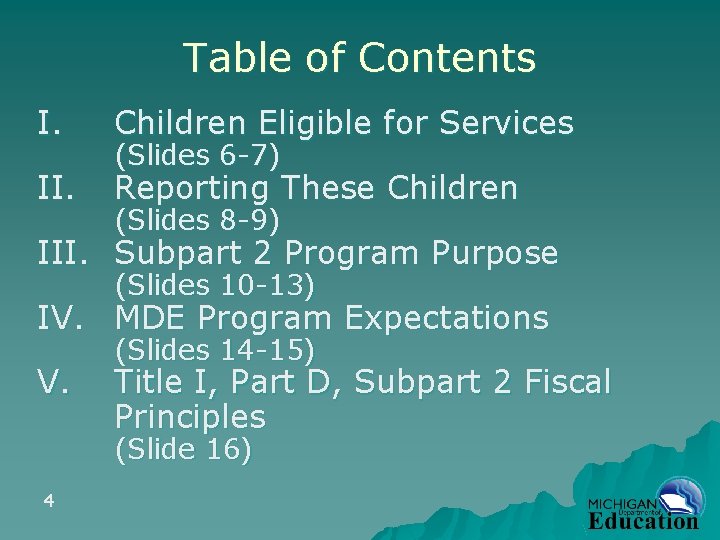
Table of Contents I. Children Eligible for Services II. Reporting These Children (Slides 6 -7) (Slides 8 -9) III. Subpart 2 Program Purpose (Slides 10 -13) IV. MDE Program Expectations V. (Slides 14 -15) Title I, Part D, Subpart 2 Fiscal Principles (Slide 16) 4
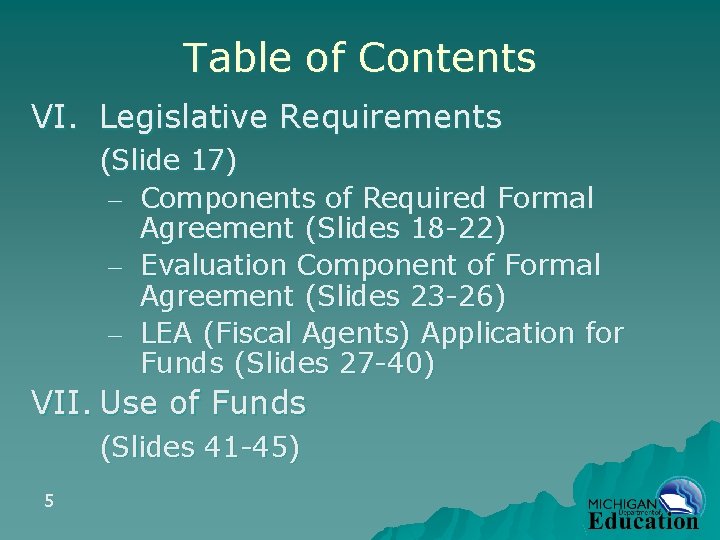
Table of Contents VI. Legislative Requirements (Slide 17) – Components of Required Formal Agreement (Slides 18 -22) – Evaluation Component of Formal Agreement (Slides 23 -26) – LEA (Fiscal Agents) Application for Funds (Slides 27 -40) VII. Use of Funds (Slides 41 -45) 5
I. Children Eligible for Services Delinquent: Children who reside in a public or private residential facility that is operated primarily for the care of children (up to the age of 21) who have been adjudicated as delinquent or in need of supervision. This may include locally-operated correctional facilities 6
I. Children Eligible for Services Neglected: Children who reside in a public or private residential facility, other than a foster home, that is operated primarily for the care of children who have been committed to the institution or voluntarily placed in the institution under applicable State law due to abandonment, neglect or death of their parents or guardians (funded under Title I, Part A) 7
II. Reporting These Children u u 8 Children are reported using the Annual Survey Form (from October 1 through October 30) The count tabulates the number of children age 5 -17 who lived in a qualifying institution for at least one day during the 30 consecutive day counting window of which one day must be in October
II. Reporting These Children Counts collected by MDE are submitted by January 15 th to the United States Department of Education (USED) u These counts are used to generate Michigan’s Title I, Part D allocation u 9
III. Subpart 2 Program Purpose Section 1421 of the Elementary and Secondary Education Act/No Child Left Behind Act of 2001 (ESEA/NCLB) titled: Prevention & Intervention Programs for Children & Youth 10
III. Subpart 2 Program Purpose “(1) to carry out high quality education programs to prepare children and youth for secondary school completion, training, employment, or further education; 11
III. Subpart 2 Program Purpose “(2) to provide activities to facilitate the transition of such children and youth from the correctional program to further education or employment; and 12
III. Subpart 2 Program Purpose “(3) to operate programs in local schools for children and youth returning from correctional facilities, and programs which may serve at-risk children and youth 13
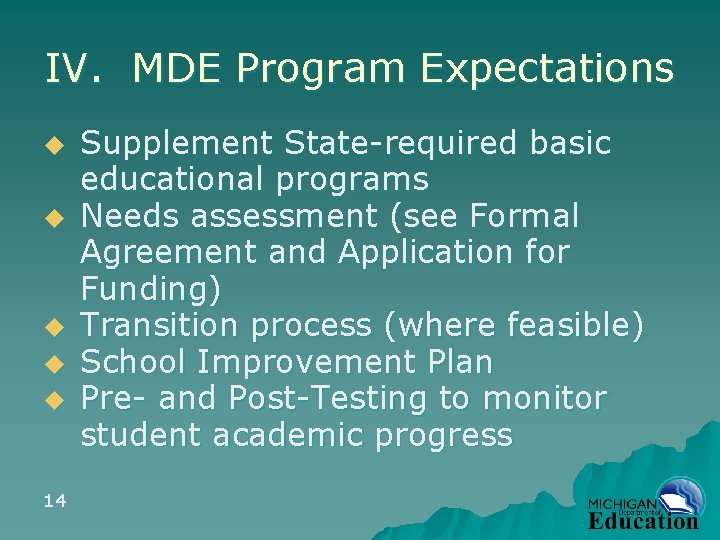
IV. MDE Program Expectations u u u 14 Supplement State-required basic educational programs Needs assessment (see Formal Agreement and Application for Funding) Transition process (where feasible) School Improvement Plan Pre- and Post-Testing to monitor student academic progress
IV. MDE Program Expectations Maintain a Formal Agreement u Maintain administrative oversight u Implement dropout prevention services by program provider u Staff members paid with Subpart 2 funds must be qualified u Evaluate the program u 15
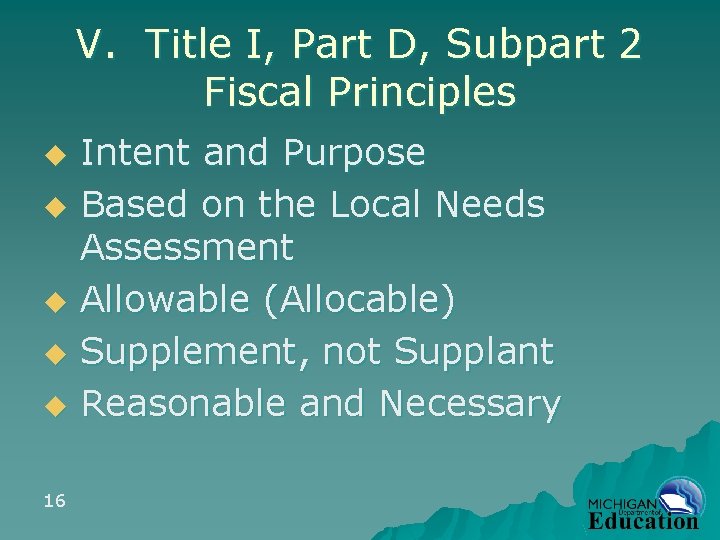
V. Title I, Part D, Subpart 2 Fiscal Principles Intent and Purpose u Based on the Local Needs Assessment u Allowable (Allocable) u Supplement, not Supplant u Reasonable and Necessary u 16
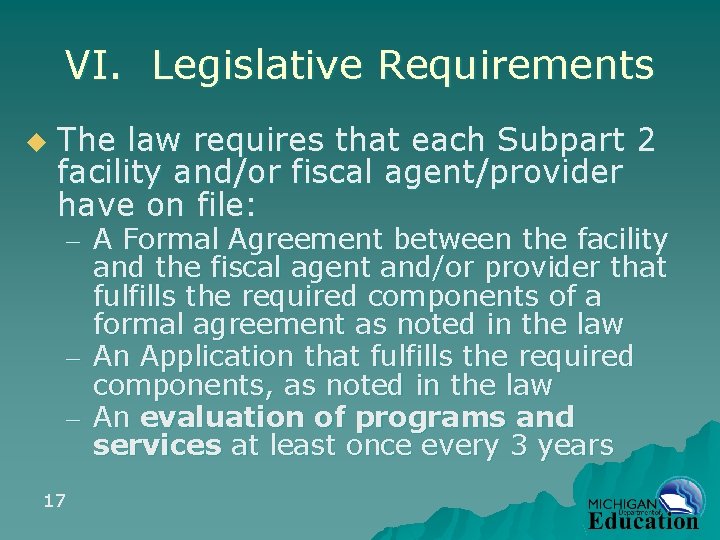
VI. Legislative Requirements u The law requires that each Subpart 2 facility and/or fiscal agent/provider have on file: – A Formal Agreement between the facility and the fiscal agent and/or provider that fulfills the required components of a formal agreement as noted in the law – An Application that fulfills the required components, as noted in the law – An evaluation of programs and services at least once every 3 years 17
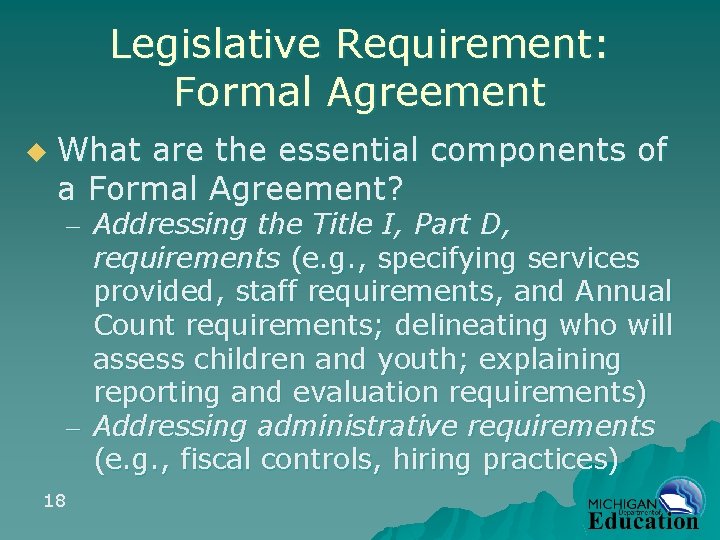
Legislative Requirement: Formal Agreement u What are the essential components of a Formal Agreement? – Addressing the Title I, Part D, requirements (e. g. , specifying services provided, staff requirements, and Annual Count requirements; delineating who will assess children and youth; explaining reporting and evaluation requirements) – Addressing administrative requirements (e. g. , fiscal controls, hiring practices) 18
Legislative Requirement: Formal Agreement u u 19 Addressing materials and equipment requirements (e. g. , how materials would be transferred if no longer used by the program) Formal Agreements will be renewed annually to ensure that facilities are up to date with licensing and the agreement reflects the appropriate scope of work
Legislative Requirement: Formal Agreement In accordance with the law, the Formal Agreement required by MDE must include the following components: 20
Formal Agreement u u u Applicant LEA (Fiscal Agent) and Service Provider Facility information and Titles of Staff Services to be Provided Activities to be funded How the services will supplement (and not supplant) regularly-funded educational activities Program description should coincide with the applicant LEA’s (Fiscal Agent) Title I, Part D school improvement plan and budget detail in their Title I, N & D Application 21
Formal Agreement u u u Characteristics of Students to be Served Grant Award, Indirect Cost Rate, Carryover Documentation of Program Evaluation Documentation of Student Evaluation Addressing Materials, Equipment and Funding Requirements Authorized Signatures 22
Evaluation Component Include multiple and appropriate measures of student progress u u u 23 The Program evaluation process and reports shall – Assess academic and non-academic services – Be conducted at least once every three years The Student evaluation process shall – Include pre- and post-test results – Be continuous and ongoing Include procedures, schedule, instruments, measures and evaluation tools
Formal Agreement Evaluation Component u The program evaluation requirements should verify Title I, Part D’s impact on the ability of eligible program participants to: – Maintain and improve educational achievement – Accrue school credits that meet State requirements for grade promotion and secondary school graduation 24
Formal Agreement Evaluation Component, cont. – Make the transition to a regular program or other education program operated by an LEA – Complete secondary school (or secondary equivalency requirements) – Obtain employment after leaving the facility and, as appropriate, participate in postsecondary education or job training 25
Formal Agreement Evaluation Component u 26 There should be evidence that the LEA uses the results of evaluations to plan and improve subsequent supplemental instructional programs and services
The Application In accordance with the law (Section 1423) each educational agency desiring assistance under this subpart must submit an application to the State Educational Agency that shall include the following thirteen (13) components: 27
The Application 1. A description of the program to be funded and monitored - Include how the program aligns with the school improvement plan 28
The Application 2. A description of the formal agreements, regarding the program to be assisted between: – The local educational agency; and – Correctional facilities and alternative school programs serving children and youth involved with the juvenile justice system 29
The Application 3. 30 As appropriate, a description of how participating schools will coordinate with facilities working with delinquent children and youth to ensure that such children and youth are participating in an education program comparable to the one operating in the local school such youth would attend
The Application 4. 31 A description of the program operated by participating schools for children and youth returning from correctional facilities and, as appropriate, the types of services that such schools will provide such children and youth and other atrisk children and youth
The Application 5. 32 A description of the characteristics (including learning difficulties, substance abuse problems, and other special needs) of the children and youth who will be returning from correctional facilities and, as appropriate, other at-risk children and youth expected to be served by the program, and a description of how the school will coordinate existing educational programs to meet the unique educational needs of such children and youth
The Application 6. 33 A description of how schools will coordinate with existing social, health, and other services to meet the needs of students returning from correctional facilities, at-risk children or youth, and other participating children and youth, including prenatal health care and nutrition services related to the health of the parent and the child or youth, parenting and child development classes, child care, targeted re-entry and outreach programs, referrals to community resources, and scheduling flexibility
The Application 7. A description of any partnerships with local businesses to develop training, curriculum-based youth entrepreneurship education, and mentoring services for participating students 34
The Application 8. A description of how the program will involve parents in efforts to improve the educational achievement of their children, assist in dropout prevention activities, and prevent the involvement of their children in delinquent activities 35
The Application 9. 36 A description of how the program under this subpart will be coordinated with other Federal, State, and local programs, such as programs under Title I of Public Law 105 -220 [Workforce Investment Act of 1998] and vocational and technical education programs serving at-risk children and youth
The Application 10. A description of how the program will be coordinated with programs operated under the Juvenile Justice and Delinquency Prevention Act of 1974 and other comparable programs, if applicable 37
The Application 11. As appropriate, a description of how schools will work with probation officers to assist in meeting the needs of children and youth returning from correctional facilities 38
The Application 12. A description of the efforts participating schools will make to ensure correctional facilities working with children and youth are aware of a child’s or youth’s existing Individualized Education Program (IEP) 39
The Application 13. A description of the steps participating schools will take to find alternative placements for children and youth interested in continuing their education but unable to participate in a regular public school program 40
VII. Use of Funds provided to the LEA (Fiscal Agent) under this subpart may be used, as appropriate, for – (1) Programs that serve children and youth returning to local schools from correctional facilities, to assist in the transition of such children and youth to the school environment and help them remain in school in order to complete their education 41
VII. Use of Funds (2) Dropout prevention programs which serve at-risk children and youth, including pregnant and parenting teens, children and youth who have come in contact with the juvenile justice system, children and youth at least 1 year behind their expected grade level, migrant youth, immigrant youth, students with limited English proficiency, and gang members 42
VII. Use of Funds (3) The coordination of health and social services for such individuals if there is a likelihood that the provision of such services, including day care, drug and alcohol counseling, and mental health services, will improve the likelihood such individuals will complete their education 43
VII. Use of Funds (4) Special programs to meet the unique academic needs of participating children and youth, including vocational and technical education, special education, career counseling, curriculum-based youth entrepreneurship education, and assistance in securing student loans or grants for postsecondary education (5) Programs providing mentoring and peer mediation 44
VII. Use of Funds u To summarize – The uses of funds must align with: – The 5 allowable uses of funds in Section 1424 of the law, – The LEA (Fiscal Agent) or facility needs assessment, – The LEA Planning Cycle Application (LEA/Fiscal Agent is required to submit) – The intent and purpose of Title I, Part D, Subpart 2 under Section 1421 45
For Further Information Contact Michelle Patton Education Consultant Office of Field Services Michigan Department of Education 517 -373 -6066 Patton. M@michigan. gov 46