
Prevention Doing something now can avert more serious
- Slides: 38
Prevention Doing something now can avert more serious problems in the future • Promises proactive efforts that reduce the overall suffering of the population • Potentially cost-effective, more people become contributing members of society • Interest in prevention continues to grow • Public health movement of the 19 th century
Historical View – to 1960 s • Looked at applying the medical prevention model to mental disorders • In 1961 the Joint Commission on Mental Health recommended a preventive approach to reducing mental disorders • Head Start (1965) • In 60 s social inequality and injustice were seen as contributors to the development of mental disorders • We would never have enough trained professionals to address all the mental health needs so prevention became the path to overall wellness
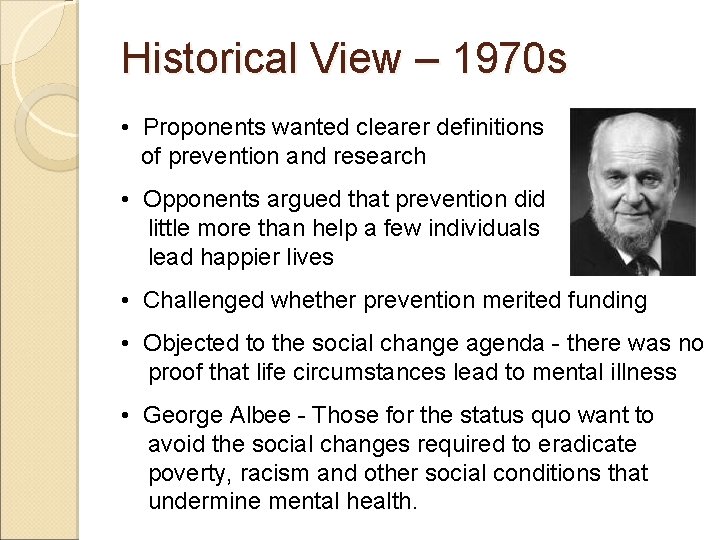
Historical View – 1970 s • Proponents wanted clearer definitions of prevention and research • Opponents argued that prevention did little more than help a few individuals lead happier lives • Challenged whether prevention merited funding • Objected to the social change agenda - there was no proof that life circumstances lead to mental illness • George Albee - Those for the status quo want to avoid the social changes required to eradicate poverty, racism and other social conditions that undermine mental health.
Historical View – 1980 to 90 s Publications supported implementation of the prevention model: • Journal of Primary prevention • Prevention in Human Services • 14 Ounces of Prevention: A Casebook for Practitioners Definitions of prevention were tightened Prevention research became more rigorous In the 1990 s, the prevention model came of age
Meta-analysis Support A research technique that collapses data across many studies in order to obtain an overview of the magnitude of effects. Durlak & Wells assessed over 300 interventions: • Participants who did not show signs of disorder significantly surpassed the performance of 59 -82% of the control group • Participants showing initial signs of maladjustment out performed 70% of control participants Institute of Medicine review of federally-sponsored research showed that prevention programs were effective and merited federal funding
Prevention Topologies Incidence – the number of new cases that arise in a population during a specified period Prevalence – total number of cases in a population at a specified time; reflects the incidence and duration of the disorder
Primary, Secondary, Tertiary Prevention Gerald Caplan (1964) • Tertiary prevention – after the disorder has developed • Secondary prevention – early intervention • Primary prevention – targets people who do not show signs of the disorder Problems with this model: • Tertiary prevention for one is primary for another • When are at-risk populations healthy or showing early indicators of a problem
Indicated, Selective, Universal Prevention Institute of Medicine (IOM) report • Defines an intervention continuum • Tertiary intervention no longer qualifies as prevention • Secondary prevention is divided into Indicated and Selective prevention Cowen (1983) – although the goals of reducing the adverse consequences of disorder are neither unworthy or unneeded, they are simply not prevention”
Indicated Prevention Targets people who have detectable signs of maladjustment that foreshadow more significant mental disorders or who have biological markers that are linked to the disorder Examples • Fetal Alcohol Syndrome prevention • Primary Mental Health Project • Substance Abuse prevention
Selective Prevention Targets people who are at high-risk for developing a disorder but do not yet show any indications of the disorder. Risk is assessed by evaluation of biological, psychological and/or social risk factors. Examples • STEP • Binge Drinking • DARE • Bullying
Universal Prevention Corresponds to primary prevention, targets all of the people in a given population • Reach large numbers of people • Cost little per individual and are effective • Acceptable to the general population • Little risk of negative outcomes “Best Practice” interventions - strategies and programs that are deemed promising based on the results of high-quality research Examples • Just Say No • Eating Disorders • Identity theft
Primary Intervention and Promotion • Attempt to reduce the likelihood of disorders • Reduce risk levels by helping people and communities develop skills and competencies • HIV/AIDS education • Bullying • Teen suicide • Acceptance • Safe Sex • Obesity Competence building is the single most persuasive preventative strategy for dealing with individual and social issues
Dohrenwend Revisited Serves as a third topology for organizing prevention research and practice. Tertiary Prevention • Mutual help groups • Corrective therapy Secondary/Selective Prevention • Disaster relief
Dohrenwend (cont’d) The remaining four interventions do not need stress to occur before implemented. They affect the context of stress at the individual or environmental level. They can either prevent the occurrence of stress or facilitate the capacity to adjust after the stress occurs. • Skill training • Education and socialization • Community organization and development • Political action
Assessing Risk • In public health, specific disorders develop from single causes • Mental health prevention cannot be traced to a single pathogen, they result from complex interactions of multiple individual and environmental factors • Selective and indicated programs need to know what leads to disorder or strengthens health, under what circumstances
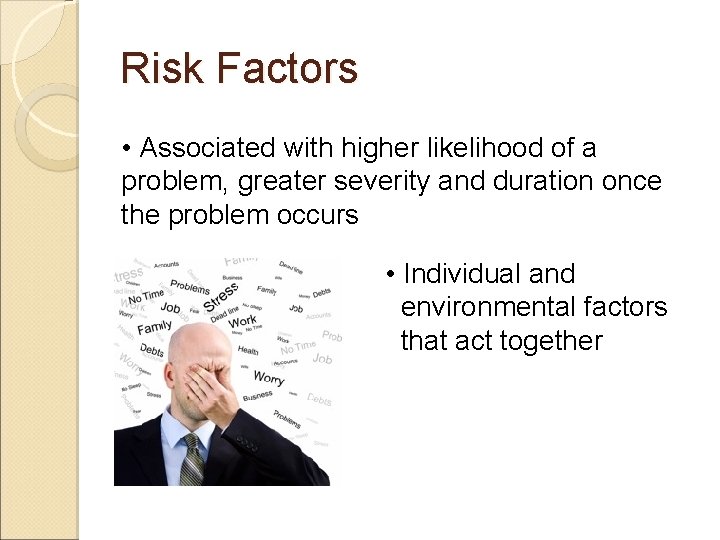
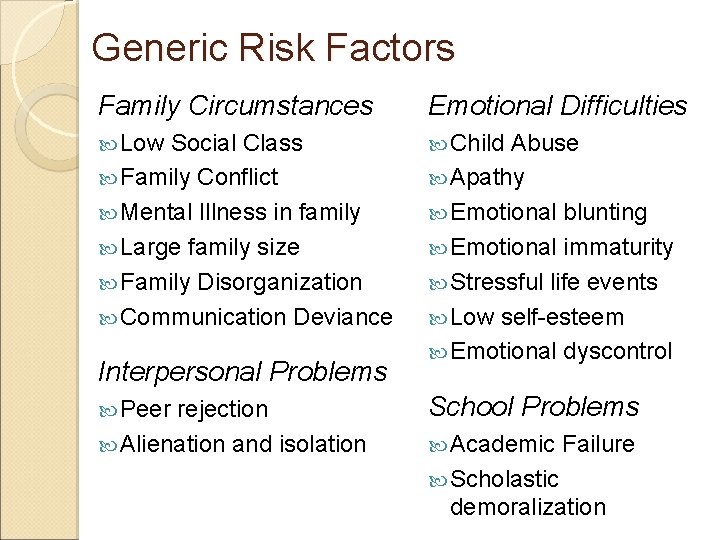
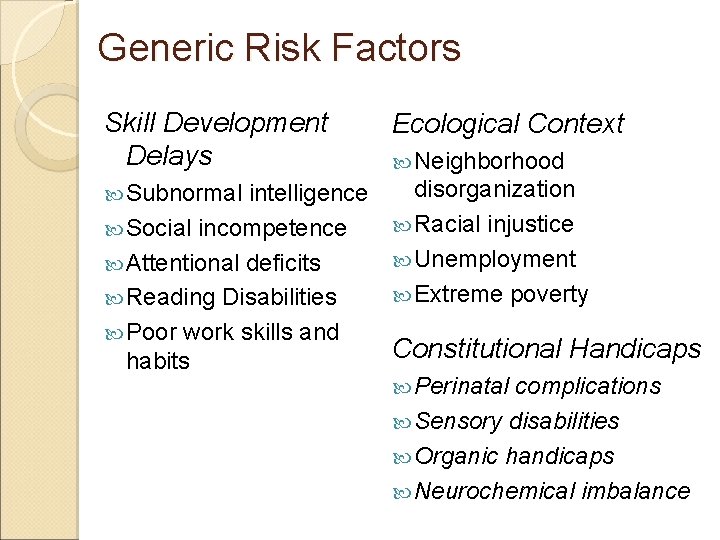
Risk Factors • Associated with higher likelihood of a problem, greater severity and duration once the problem occurs • Individual and environmental factors that act together
Generic Risk Factors Family Circumstances Emotional Difficulties Low Social Class Child Abuse Family Conflict Apathy Mental Illness in family Emotional blunting Large family size Emotional immaturity Family Disorganization Stressful life events Communication Deviance Low self-esteem Interpersonal Problems Emotional dyscontrol Peer rejection School Problems Alienation and isolation Academic Failure Scholastic demoralization
Generic Risk Factors Skill Development Delays Ecological Context Subnormal intelligence disorganization Racial injustice Unemployment Extreme poverty Social incompetence Attentional deficits Reading Disabilities Poor work skills and habits Neighborhood Constitutional Handicaps Perinatal complications Sensory disabilities Organic handicaps Neurochemical imbalance
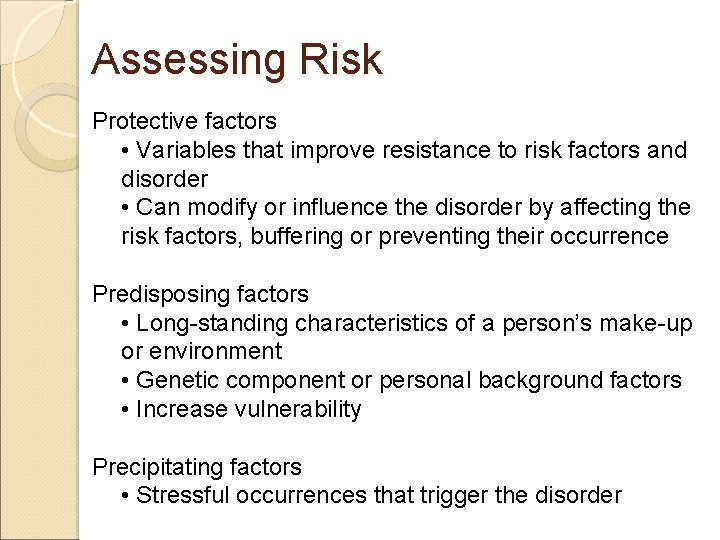
Assessing Risk Protective factors • Variables that improve resistance to risk factors and disorder • Can modify or influence the disorder by affecting the risk factors, buffering or preventing their occurrence Predisposing factors • Long-standing characteristics of a person’s make-up or environment • Genetic component or personal background factors • Increase vulnerability Precipitating factors • Stressful occurrences that trigger the disorder
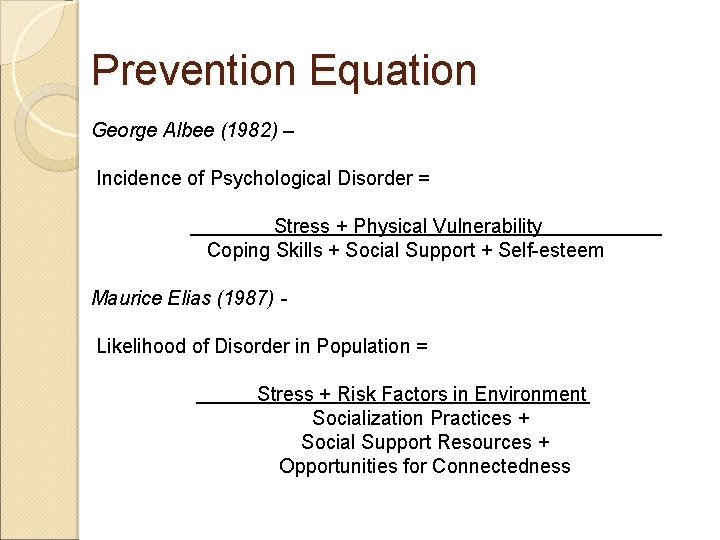
Prevention Equation George Albee (1982) – Incidence of Psychological Disorder = Stress + Physical Vulnerability Coping Skills + Social Support + Self-esteem Maurice Elias (1987) Likelihood of Disorder in Population = Stress + Risk Factors in Environment Socialization Practices + Social Support Resources + Opportunities for Connectedness
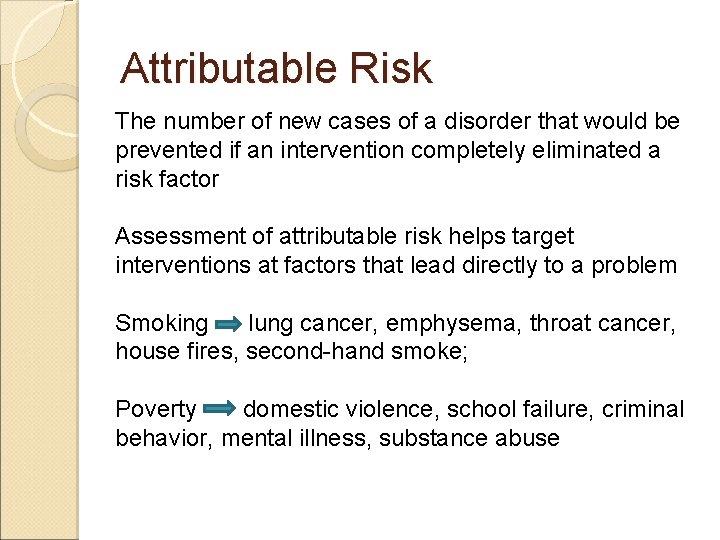
Attributable Risk The number of new cases of a disorder that would be prevented if an intervention completely eliminated a risk factor Assessment of attributable risk helps target interventions at factors that lead directly to a problem Smoking lung cancer, emphysema, throat cancer, house fires, second-hand smoke; Poverty domestic violence, school failure, criminal behavior, mental illness, substance abuse
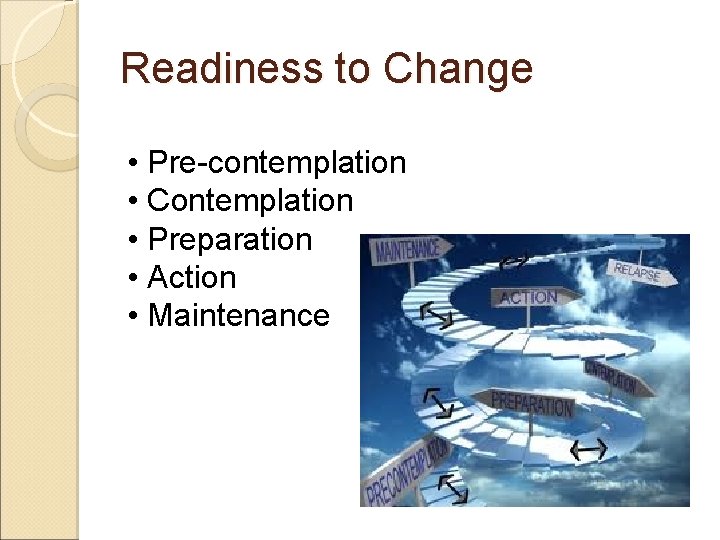
Readiness to Change • Pre-contemplation • Contemplation • Preparation • Action • Maintenance
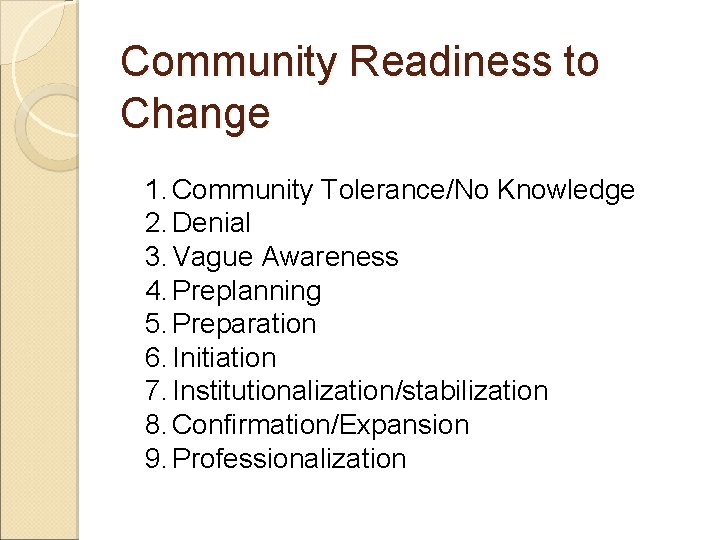
Community Readiness to Change 1. Community Tolerance/No Knowledge 2. Denial 3. Vague Awareness 4. Preplanning 5. Preparation 6. Initiation 7. Institutionalization/stabilization 8. Confirmation/Expansion 9. Professionalization
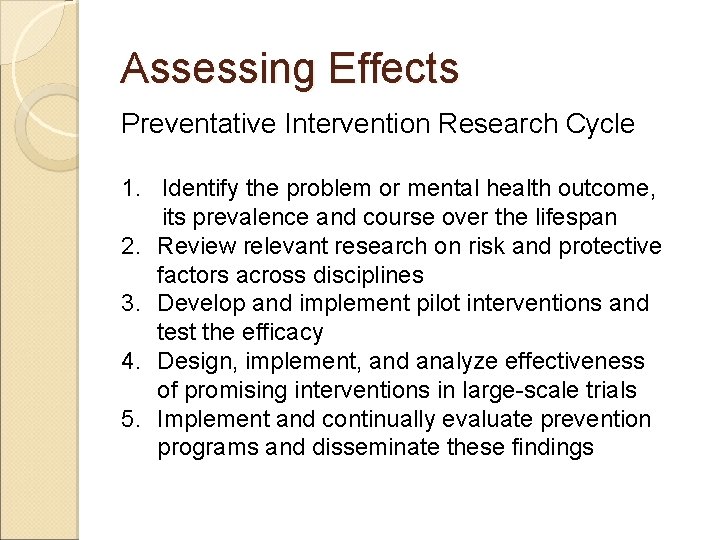
Assessing Effects Preventative Intervention Research Cycle 1. Identify the problem or mental health outcome, its prevalence and course over the lifespan 2. Review relevant research on risk and protective factors across disciplines 3. Develop and implement pilot interventions and test the efficacy 4. Design, implement, and analyze effectiveness of promising interventions in large-scale trials 5. Implement and continually evaluate prevention programs and disseminate these findings
Challenges to the Research Agenda Emory Cowen (1983) – delineated some of the “research-weakening vicissitudes” of community-based prevention efforts • Difficulties finding appropriate control groups • Antagonism between researcher and community needs • Attrition of participants • Changes during course of the intervention that are attributable to the program
The Challenge of Follow-up When can researchers say with confidence that a problem has actually been prevented and not just postponed? • Proximal outcomes • Distal outcomes • Lifespan development • Problem development
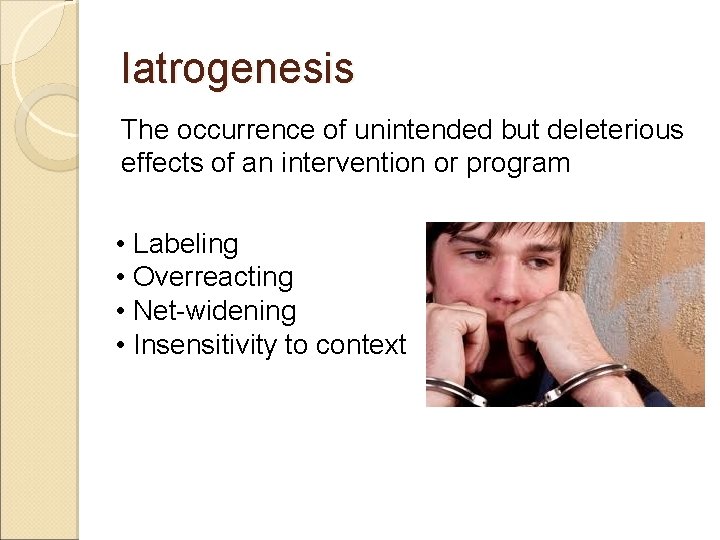
Iatrogenesis The occurrence of unintended but deleterious effects of an intervention or program • Labeling • Overreacting • Net-widening • Insensitivity to context
Ensuring Program Integrity Ethical guidelines: 1. 2. 3. 4. 5. 6. 7. 8. Do no harm Program should not be designed for preventionist gain Piloted in small-scale studies to ensure effectiveness Participants should be treated with respect and active in planning, implementation and evaluation of the program Program planners, participants and others are entitled to professional courtesies, particularly confidentiality Informed consent should be obtained before implementation of the program The program should promote equality and justice The preventionist is accountable for the impact of the program and must resolve any problems that result
Program Popularity & Efficacy Public and political support does not depend on evidence of efficacy. • Juvenile boot camps, Zero Tolerance school policies and school-based sexual abuse programs are widely popular without evidence of effectiveness • DARE (1983) • By 1990 in 3000 communities in 50 states • 1990’s reports of ineffectiveness, small short term effect on drug use • Program evaluators, researchers worked with DARE to reformulate its program based on sound research and program evaluation
Program Evaluation Program evaluation is carefully collecting information about a program or some aspect of a program in order to make necessary decisions about the program. Program evaluations can address: needs assessments, accreditation, cost/benefit analysis, effectiveness, efficiency, processes, outcomes, etc. The type of evaluation you undertake depends on what you want to learn about your program. Don't worry about what type of evaluation you need or are doing -- worry about what you need to know to make the program decisions you need to make, and worry about how you can accurately collect and understand that information.
What Program Evaluation Does 1. Verification that the programs are indeed helping constituents. 2. Improve delivery mechanisms to be more efficient and less costly. 3. Identify program strengths and weaknesses to improve the program. 4. Verify that you're doing what you think you're doing. 5. Facilitate thinking about what the program is all about including its goals, and how it will know if it has met its goals or not. 6. Produce data that can be used for public relations and promoting services in the community. 7. Produce valid comparisons between programs to decide which should be retained in the face of pending budget cuts. 8. Examine and describe effective programs for duplication elsewhere.
Evaluation Methods Process-based - geared to fully understanding how a program works - how does it produce that results that it does. Goal-based - evaluate the extent to which programs are meeting predetermined goals or objectives Outcomes-based - Increasingly important for nonprofits and asked for by funders. Facilitates asking if your organization is really doing the right activities to bring about the outcomes you believe to be needed by your clients
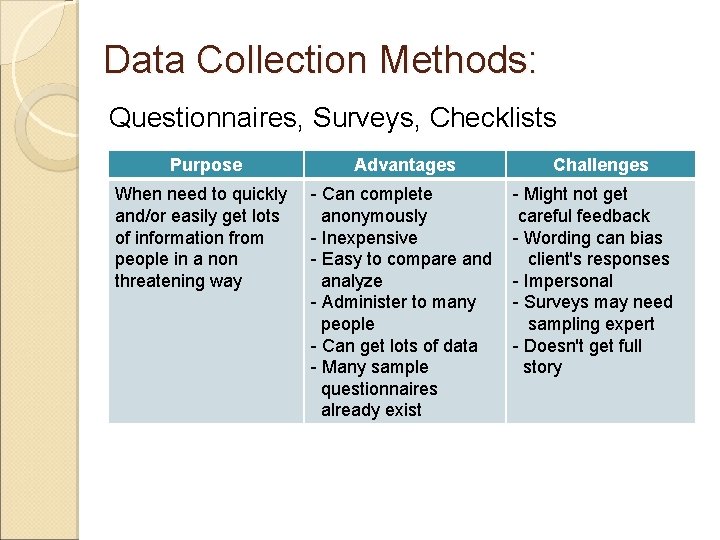
Data Collection Methods: Questionnaires, Surveys, Checklists Purpose Advantages When need to quickly and/or easily get lots of information from people in a non threatening way - Can complete anonymously - Inexpensive - Easy to compare and analyze - Administer to many people - Can get lots of data - Many sample questionnaires already exist Challenges - Might not get careful feedback - Wording can bias client's responses - Impersonal - Surveys may need sampling expert - Doesn't get full story
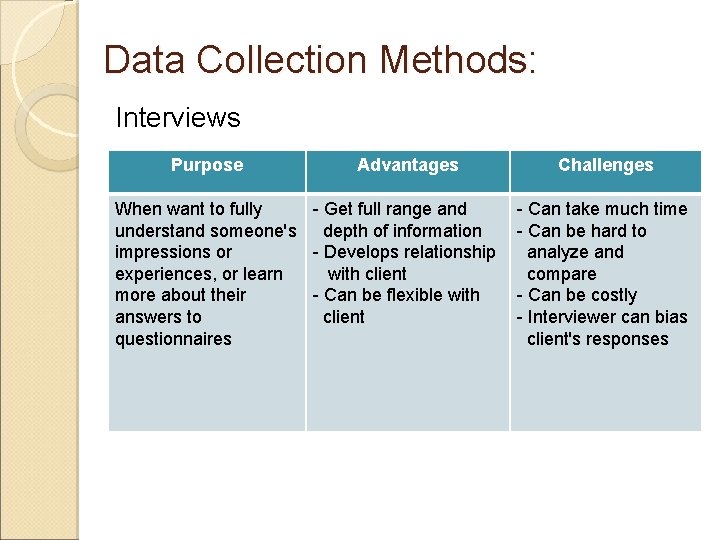
Data Collection Methods: Interviews Purpose When want to fully understand someone's impressions or experiences, or learn more about their answers to questionnaires Advantages Challenges - Get full range and - Can take much time depth of information - Can be hard to - Develops relationship analyze and with client compare - Can be flexible with - Can be costly client - Interviewer can bias client's responses
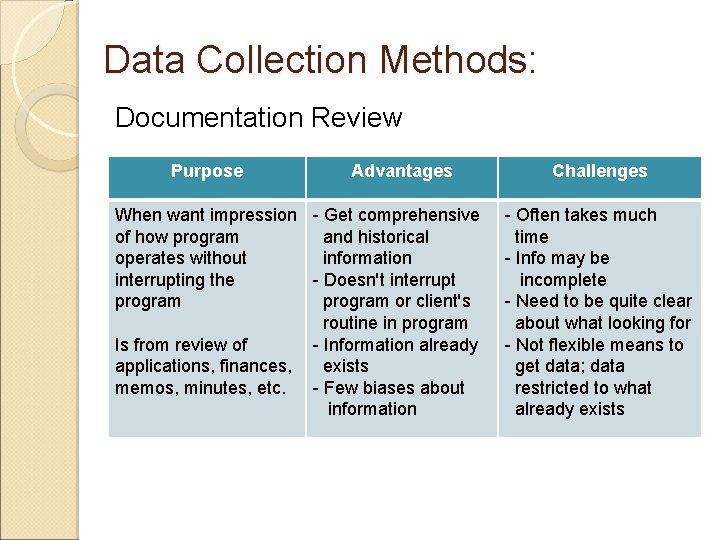
Data Collection Methods: Documentation Review Purpose Advantages - Get comprehensive and historical information - Doesn't interrupt program or client's routine in program Is from review of - Information already applications, finances, exists memos, minutes, etc. - Few biases about information When want impression of how program operates without interrupting the program Challenges - Often takes much time - Info may be incomplete - Need to be quite clear about what looking for - Not flexible means to get data; data restricted to what already exists
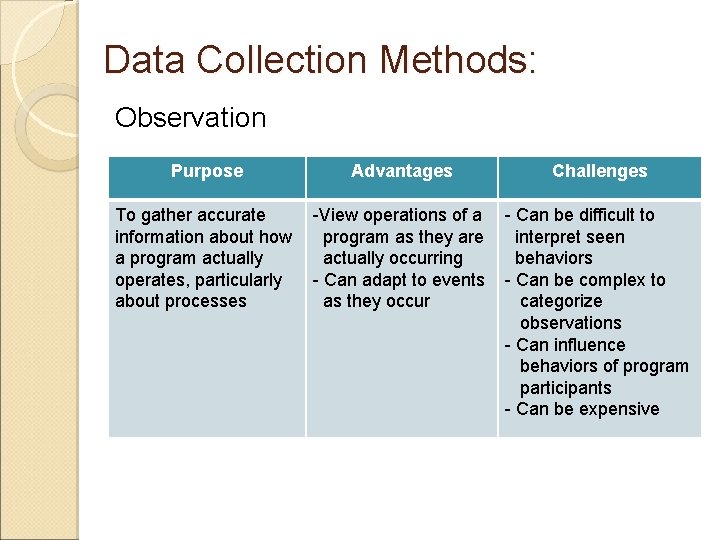
Data Collection Methods: Observation Purpose Advantages Challenges To gather accurate information about how a program actually operates, particularly about processes -View operations of a program as they are actually occurring - Can adapt to events as they occur - Can be difficult to interpret seen behaviors - Can be complex to categorize observations - Can influence behaviors of program participants - Can be expensive
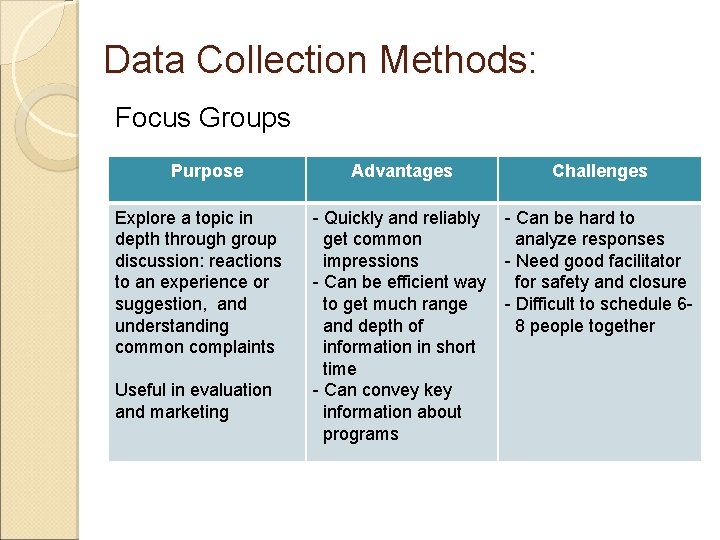
Data Collection Methods: Focus Groups Purpose Explore a topic in depth through group discussion: reactions to an experience or suggestion, and understanding common complaints Useful in evaluation and marketing Advantages Challenges - Quickly and reliably get common impressions - Can be efficient way to get much range and depth of information in short time - Can convey key information about programs - Can be hard to analyze responses - Need good facilitator for safety and closure - Difficult to schedule 6 8 people together
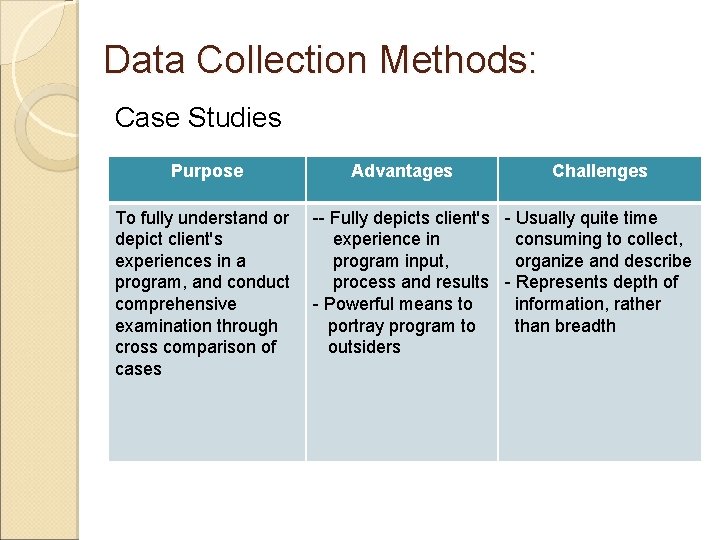
Data Collection Methods: Case Studies Purpose Advantages Challenges To fully understand or depict client's experiences in a program, and conduct comprehensive examination through cross comparison of cases -- Fully depicts client's experience in program input, process and results - Powerful means to portray program to outsiders - Usually quite time consuming to collect, organize and describe - Represents depth of information, rather than breadth