
PREVENTION AND TREATMENT OF NEUROPSYCHIATRIC SYMPTOMS OF DEMENTIA
- Slides: 56
PREVENTION AND TREATMENT OF NEUROPSYCHIATRIC SYMPTOMS OF DEMENTIA IN LTC: BEST PRACTICES AND DEVELOPMENT OF A LTC RESEARCH NETWORK Dr. Dallas Seitz MD Ph. D FRCPC Assistant Professor and Division Chair, Division of Geriatric Psychiatry Department of Psychiatry, Queen’s University British Columbia Psychogeriatric Association Kamloops, BC April 24, 2015 1
FACULTY/PRESENTER DISCLOSURE Faculty: Dr. Dallas Seitz Relationships with commercial interests: Grants/Research Support: CIHR, Alzheimer’s Association, Queen’s University Advisory Board: Eli-Lilly 2
DISCLOSURE OF COMMERCIAL SUPPORT This program has received no in-kind support from outside organizations 3
KEY OBJECTIVES By the end of the presentation, the participant is expected to be able to: 1. ) Understand approaches to the assessment of neuropsychiatric symptoms (NPS) in dementia; 2. ) Review recent evidence in nonpharmacological and pharmacological treatments for NPS; 3. ) Introduce a research network focussed on NPS in LTC. 4
NEUROPSYCHIATRIC SYMPTOMS Non-cognitive symptoms associated with dementia Also known as Behavioral and Psychological Symptoms of Dementia (BPSD) International Psychogeriatrics Association 1996 “Signs and symptoms of disturbed perception, thought content, mood, or behavior that frequently occur in patients with dementia” 1 1. Finkel, Int Psychogeriatr, 1996; 8(suppl 3): 497 -500 5
ALZHEIMER’S ASSOCIATION CLASSIFICATION Agitation “inappropriate verbal, vocal, or motor activity that is not an obvious expression of need or confusion” 1 Psychosis Delusions, hallucinations Depression Apathy “absence of responsiveness to stimuli as demonstrated by a lack of self-initiated action” Sleep 1. Cohen-Mansfield, J Gerontol, 1989 6
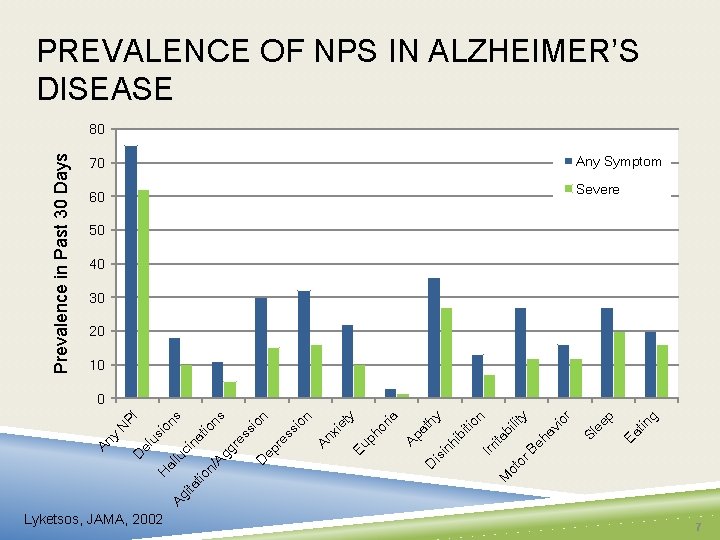
Lyketsos, JAMA, 2002 g Ea tin 60 p 70 Sl ee r y vi o Be ha bi lit Irr ita n hy at ib iti o is in h or ot M D Ap y ia ph or Eu xi et on re ss i An ns si on gr es ep D si on s PI N in at io lu c Ag n/ ita tio Ag al H el u D y An Prevalence in Past 30 Days PREVALENCE OF NPS IN ALZHEIMER’S DISEASE 80 Any Symptom Severe 50 40 30 20 10 0 7
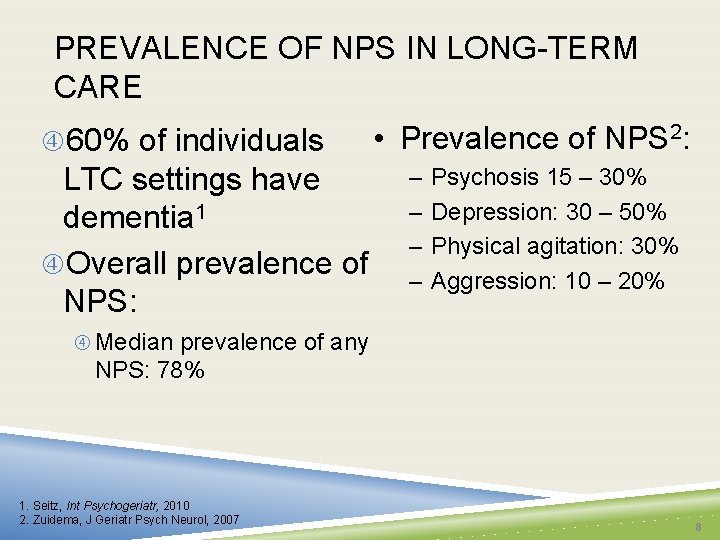
PREVALENCE OF NPS IN LONG-TERM CARE 60% of individuals LTC settings have dementia 1 Overall prevalence of NPS: • Prevalence of NPS 2: – – Psychosis 15 – 30% Depression: 30 – 50% Physical agitation: 30% Aggression: 10 – 20% Median prevalence of any NPS: 78% 1. Seitz, Int Psychogeriatr, 2010 2. Zuidema, J Geriatr Psych Neurol, 2007 8
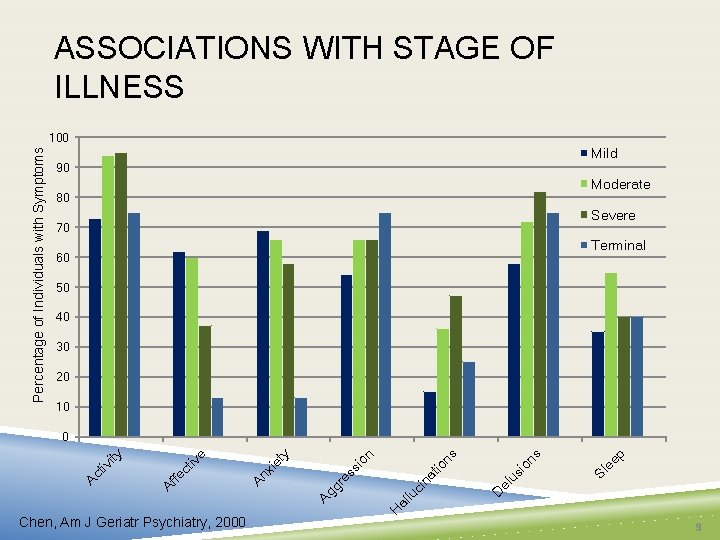
ASSOCIATIONS WITH STAGE OF ILLNESS Percentage of Individuals with Symptoms 100 Mild 90 Moderate 80 Severe 70 Terminal 60 50 40 30 20 10 p Sl ee si on s el u D in at io lu c gr e Ag al H Chen, Am J Geriatr Psychiatry, 2000 ns ss io n y An xi et iv e fe ct Af Ac tiv ity 0 9
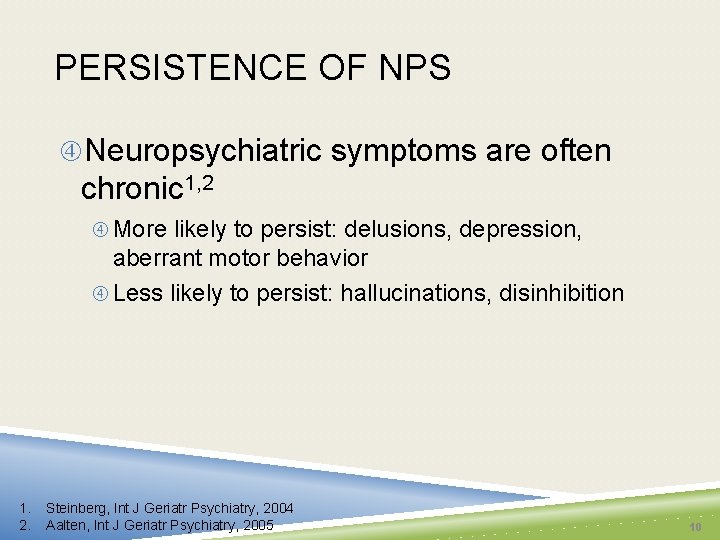
PERSISTENCE OF NPS Neuropsychiatric symptoms are often chronic 1, 2 More likely to persist: delusions, depression, aberrant motor behavior Less likely to persist: hallucinations, disinhibition 1. 2. Steinberg, Int J Geriatr Psychiatry, 2004 Aalten, Int J Geriatr Psychiatry, 2005 10
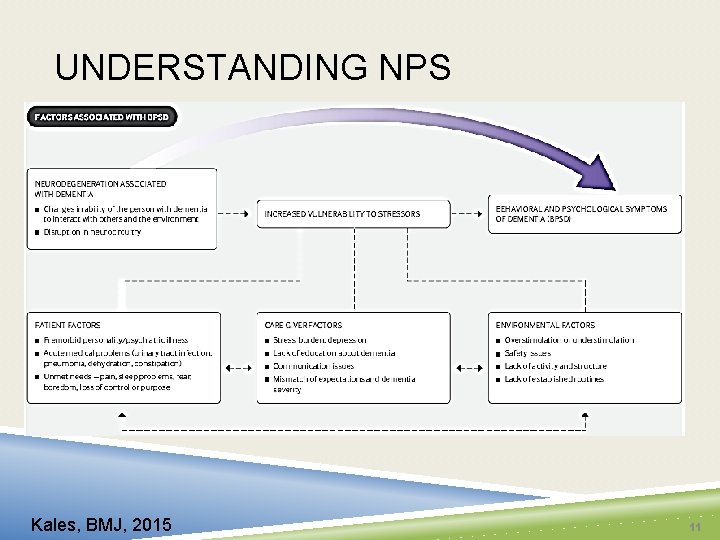
UNDERSTANDING NPS Kales, BMJ, 2015 11
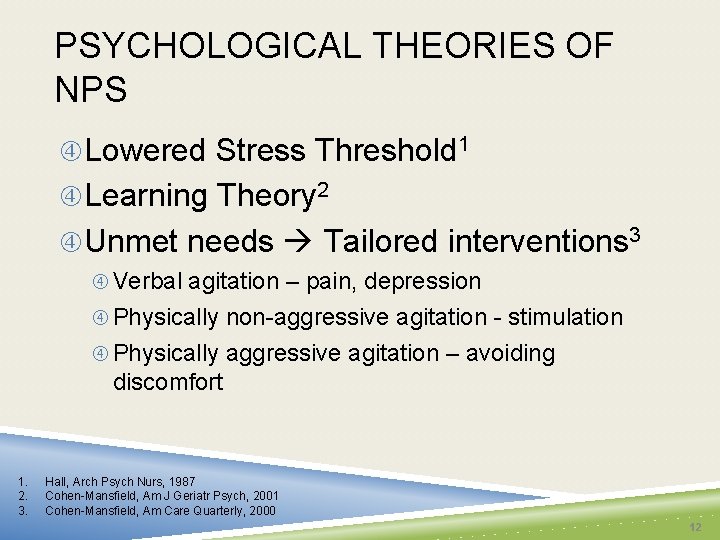
PSYCHOLOGICAL THEORIES OF NPS Lowered Stress Threshold 1 Learning Theory 2 Unmet needs Tailored interventions 3 Verbal agitation – pain, depression Physically non-aggressive agitation - stimulation Physically aggressive agitation – avoiding discomfort 1. 2. 3. Hall, Arch Psych Nurs, 1987 Cohen-Mansfield, Am J Geriatr Psych, 2001 Cohen-Mansfield, Am Care Quarterly, 2000 12
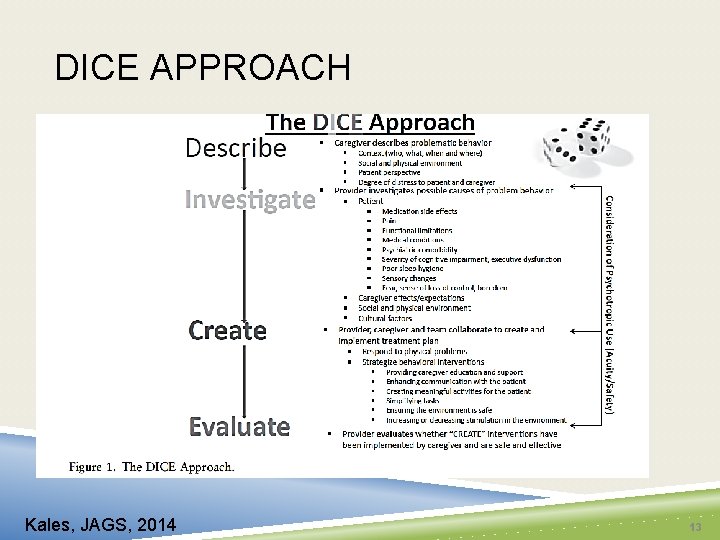
DICE APPROACH Kales, JAGS, 2014 13
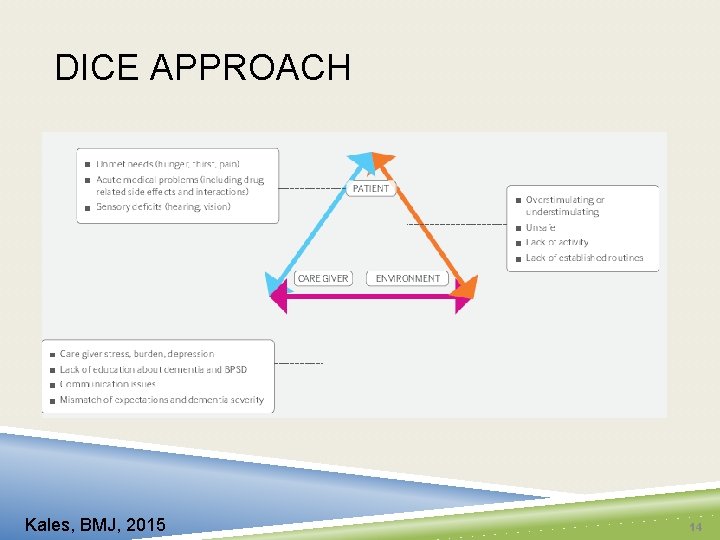
DICE APPROACH Kales, BMJ, 2015 14
GENERAL PRINCIPLES TO MANAGING NPS Non-pharmacological treatments should be used first whenever available Even when NPS are caused by specific etiologies (pain, depression, psychosis) nonpharmacological interventions should be utilized with medications All non-pharmacological interventions work best when tailored to individual needs and background Family and caregivers are key collaborators and need to involved in treatment planning IPA BPSD Guide, Module 5, 2010 15
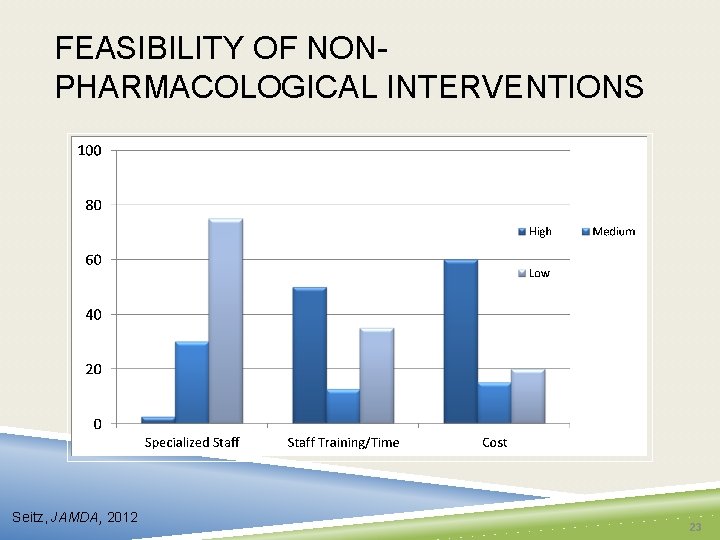
NONPHARMACOLOGICAL INTERVENTIONS Training caregivers or Mental health consultations Participation in pleasant events Exercise Music Sensory stimulation (e. g. touch, Snoezelen, aromatherapy) Cohen-Mansfield, Am J Geriatr Psychiatry, 2001 Livingston, Am J Psychiatry, 2005 Seitz, JAMDA, 2012 16
TRAINING CAREGIVERS AND STAFF Some staff and caregiver training approaches are effective in reducing NPS 1 -3 Also referred to as patient-centred care Most training programs involve psychoeducation about dementia symptoms Communication strategies to avoid confrontation Strategies for redirection and distraction Often incorporate personalized pleasant events into interactions 1. 2. 3. Mc. Callion, Gerontologist, 1999 Chenoweth, Lancet Neurology, 2009 Testad, J Clin Psychiatry, 2010 17
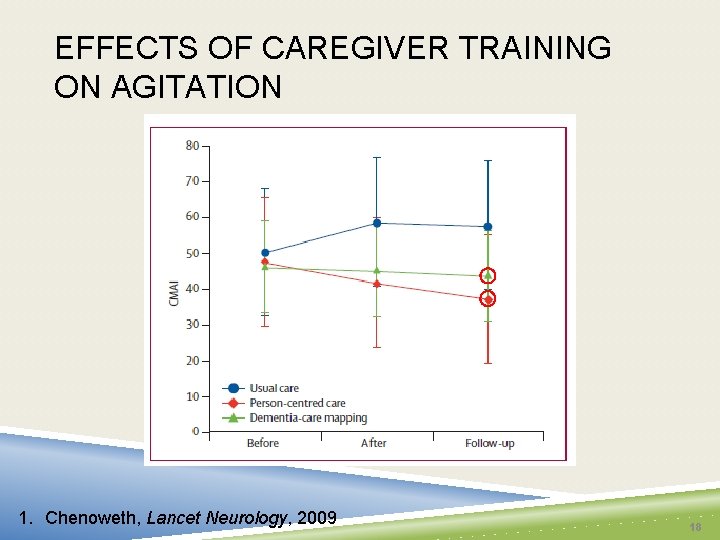
EFFECTS OF CAREGIVER TRAINING ON AGITATION 1. Chenoweth, Lancet Neurology, 2009 18
PARTICIPATION IN PLEASANT EVENTS 1 -to-1 interaction with personalized pleasant events has been demonstrated to reduce NPS 1 Given 3 X/week – 20 – 30 minutes/session Participation in group “validation therapy” may also be beneficial 2 1. Lichtenberg, Gerontologist, 2005 2. Toseland, J Appl Gerontol, 1997 19
EXERCISE Exercise programs have been demonstrated to reduce NPS in LTC residents 1 -3 Training caregivers in behavioral management and exercise program improved physical functioning of person with dementia and depressive symptoms 4 30 minutes/day was recommended Exercise program included strength, flexibility, aerobic activity, balance 1. 2. 3. 4. Alessi, J Am Geriatr Soc, 1999 Landi, Arch Gerontol Geriatr, 2004 Williams, Am J Alzheimer Dis Other Dementi, 2007 Teri, JAMA, 2003 20
MUSIC Group music with movement or individualized music therapy are effective in reducing NPS 1, 2 30 minutes 2 – 3 times/ week May use prior to times of increased agitation Personalized music more effective than generic music 1. Sung, Complement Ther Med, 2006 2. Raglio, Alzheimer Dis Assoc Disord, 2008 21
SENSORY STIMULATION Therapeutic touch or gentle massage may relieve symptoms of agitation 1, 2 Snoezelen (multisensory stimulation) providing tactile, light, olfactory, or auditory stimulation 3 Aromatherapy with massage 1 positive 4 and 1 negative 5 RCT 1. 2. 3. 4. 5. Hawranik, West J Nurs Pract, 2008 Woods, Alter Ther Health Med, 2005 Van Weert, J Am Geriatr Soc, 2005 Ballard, J Clin Psychiatry, 2002 Burns, Dementia Geriatr Cogn Disord, 2011 22
FEASIBILITY OF NONPHARMACOLOGICAL INTERVENTIONS Seitz, JAMDA, 2012 23
PHARMACOLOGICAL MANAGEMENT OF NPS Medications should be used for severe NPS or patient safety, in conjunction with nonpharmacological approaches Prescribing requires assessment of capacity and informed consent Dosages are lower than that used in younger populations and need to be adjusted cautiously Elderly with dementia are more susceptible to some side-effects such as sedation, cognitive decline, EPS International Psychogeriatrics Association, BPSD Guide, Module 6 24
ATYPICAL ANTIPSYCHOTICS Risperidone, aripiprazole, and olanzapine have the strongest evidence to treat psychosis and agitation in dementia 1, 2 Number needed to treat for significant improvement: 5 – 14 Odds ratio for significant improvement compared to placebo: 1. 5 – 2. 5 1. 2. 3. 4. 5. Schneider, Am J Geriatr Psychiatry, 2006 Ballard, Coch Database Syst Rev, 2008 Fontaine, J Clin Psych, 2003 Tariot, Am J Geriatr Psychiatry, 2006 Verhey, Dementia Geriatr Cogn Disord, 2006 25
ANTIPSYCHOTICS FOR DEMENTIA: CATIE-AD Large RCT (N=421) of outpatients with Alzheimer’s comparing risperidone, olanzapine, quetiapine and placebo for psychosis, agitation or aggression over 36 weeks Outcomes: Time to discontinuation due to any cause Global impression Adverse events 1. Schneider, New Eng J Med, 2006
CATIE-AD No difference in groups on time to discontinuation due to any cause Olanzapine and risperidone > placebo and quetiapine on discontinuations due to lack of efficacy Overall discontinuation rate of 63% by 12 weeks Discontinuations due to adverse events favored placebo No difference in rates of global clinical improvement 1. Schneider, New Eng J Med, 2006
NPS THAT RESPOND TO ANTIPSYCHOTICS Olanzapine and risperidone associated with overall improvement in NPS 1 Hostility, psychosis, agitation most likely to improve 1. Sultzer, Am J Psychiatry, 2008 28
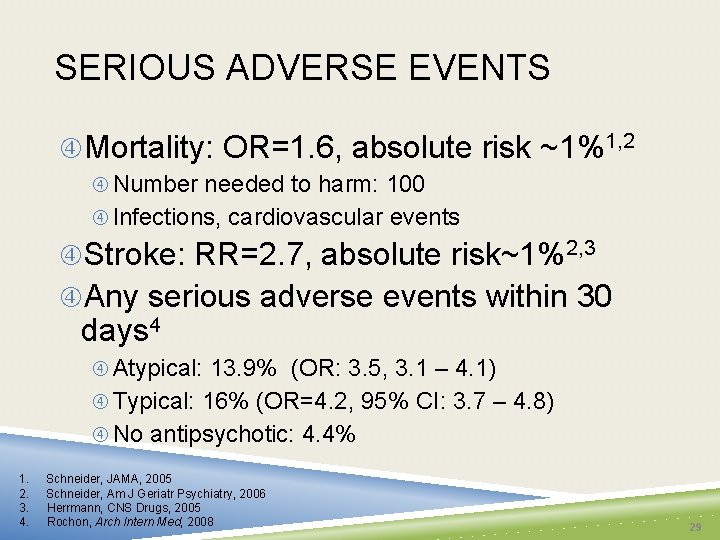
SERIOUS ADVERSE EVENTS Mortality: OR=1. 6, absolute risk ~1%1, 2 Number needed to harm: 100 Infections, cardiovascular events Stroke: RR=2. 7, absolute risk~1%2, 3 Any serious adverse events within 30 days 4 Atypical: 13. 9% (OR: 3. 5, 3. 1 – 4. 1) Typical: 16% (OR=4. 2, 95% CI: 3. 7 – 4. 8) No antipsychotic: 4. 4% 1. 2. 3. 4. Schneider, JAMA, 2005 Schneider, Am J Geriatr Psychiatry, 2006 Herrmann, CNS Drugs, 2005 Rochon, Arch Intern Med, 2008 29
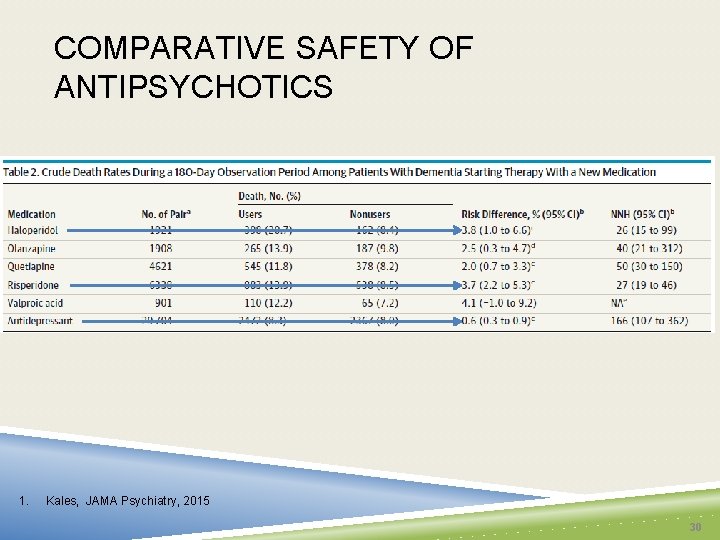
COMPARATIVE SAFETY OF ANTIPSYCHOTICS 1. Kales, JAMA Psychiatry, 2015 30
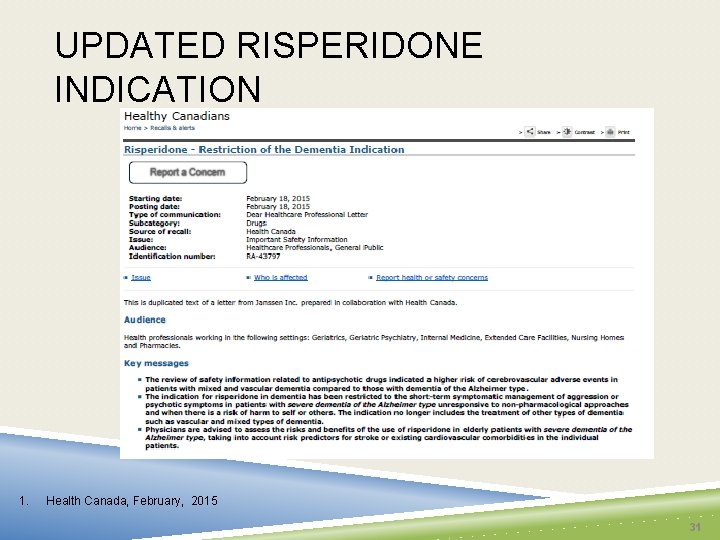
UPDATED RISPERIDONE INDICATION 1. Health Canada, February, 2015 31
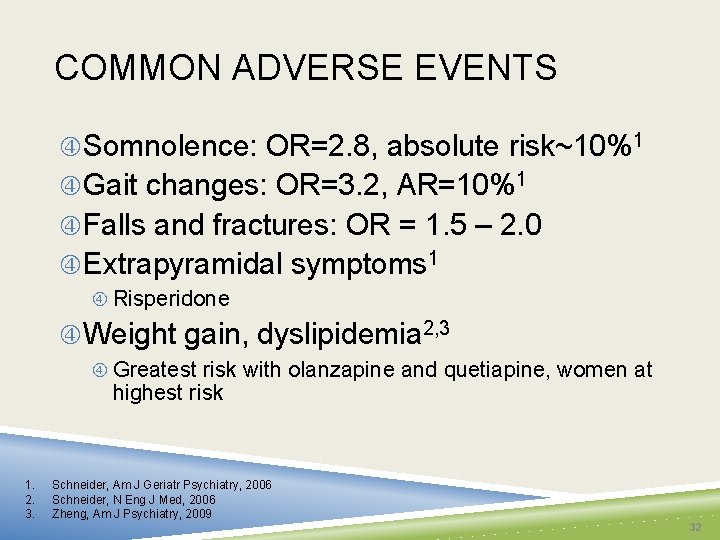
COMMON ADVERSE EVENTS Somnolence: OR=2. 8, absolute risk~10%1 Gait changes: OR=3. 2, AR=10%1 Falls and fractures: OR = 1. 5 – 2. 0 Extrapyramidal symptoms 1 Risperidone Weight gain, dyslipidemia 2, 3 Greatest risk with olanzapine and quetiapine, women at highest risk 1. 2. 3. Schneider, Am J Geriatr Psychiatry, 2006 Schneider, N Eng J Med, 2006 Zheng, Am J Psychiatry, 2009 32
COGNITIVE EFFECTS OF ANTIPSYCHOTICS Atypical antipsychotics associated with a MMSE score -2. 4 over 36 weeks compared to placebo 1 Equivalent to approximately 1 year additional decline MMSE -1 point over 8 – 12 week trials 2 Often LTC population with low MMSE at baseline 1. Vigen, Am J Psychiatry, 2011 2. Schneider, Am J Geriatr Psychiatry, 2006 33
TYPICAL ANTIPSYCHOTICS Effective in reducing symptoms of aggression, agitation and psychosis 1 -3 Adverse event rates higher with typicals when compared to atypicals Risk of stroke 4, 5 and death 6, 7 similar to atypical antipsychotics 1. 2. 3. 4. 5. 6. 7. Schneider, J Am Geriatr Soc, 1990 Lanctot, J Clin Psychiatry, 1988 Lonergan, Cochrane Data Syst Rev, 2002 Gill, BMJ, 2005 Herrmann, Am J Psychiatry, 2004 Wang, N Eng J Med, 2005 Gill, Ann Intern Med, 2007 34
SELECTIVE SEROTONIN REUPTAKE INHIBITORS SSRIs have some benefits in treating agitation, psychosis and other NPS 1 (N=7) Citalopram more effective than placebo in reducing NPS 2 Doses of 20 – 30 mg daily (Note: FDA warning about citalopram doses above 20 mg daily) Sertraline had modest effect on agitation compared to placebo 3 Doses 25 – 100 mg daily 1. 2. 3. Seitz, Cochrane Data Syst Rev, 2011 Pollock, Am J Psychiatry, 2002 Finkel, Int J Geriatr Psychiatry, 2004 35
CITALOPRAM FOR AGITATION: CITAD RCT of citalopram (10 – 30 mg daily) or placebo for AD patient with significant agitation Majority received 30 mg of citalopram* Significant improvements on NBRS-A, CMAI with citalopram compared to placebo 40% of citalopram vs 26% of individuals with placebo had moderate or marked improvement Worsening of cognition noted with citalopram Porsteinsson, JAMA, 2014 36
TRAZODONE 2 small RCTs of trazodone for NPS found no significant difference between trazodone and either placebo 1 or haloperidol 1 -3 Trazodone treated individuals had numerically worse outcomes when compared to placebo and haloperidol Trazodone was not associated with increased risk of major adverse events 1. 2. 3. Teri, Neurology, 2000 Sultzer, Am J Geriatr Psychiatry, 1997 Seitz, Cochrane Data Syst Rev, 2011
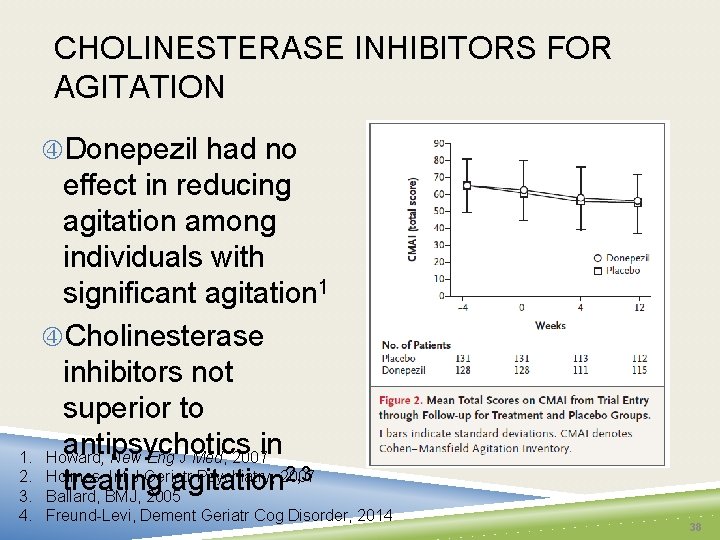
CHOLINESTERASE INHIBITORS FOR AGITATION Donepezil had no effect in reducing agitation among individuals with significant agitation 1 Cholinesterase inhibitors not superior to antipsychotics in 1. Howard, New Eng J Med, 2007 2, 3 2. Holmes, Int J Geriatr Psychiatry, 2007 treating agitation 3. Ballard, BMJ, 2005 4. Freund-Levi, Dement Geriatr Cog Disorder, 2014 38
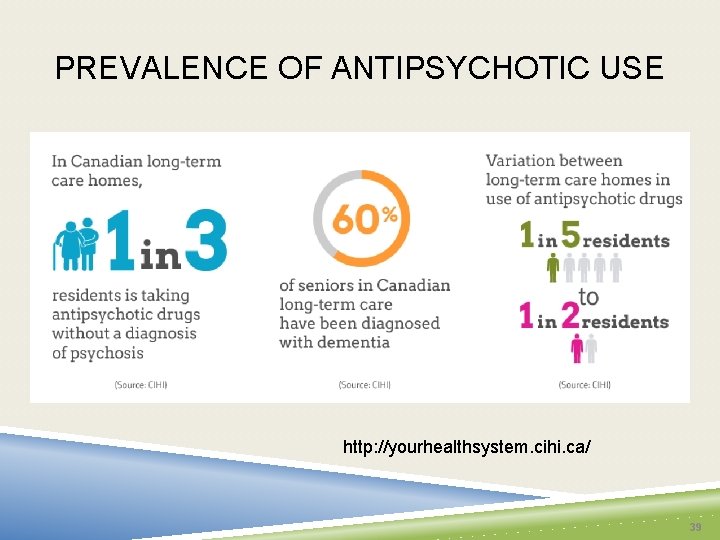
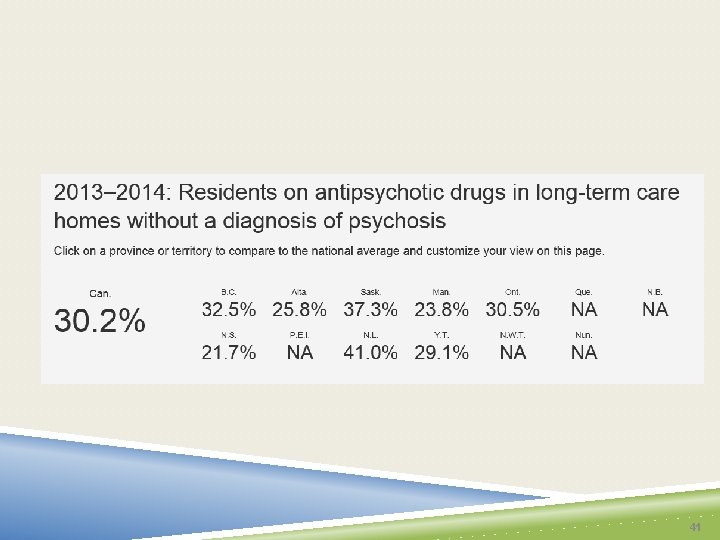
PREVALENCE OF ANTIPSYCHOTIC USE http: //yourhealthsystem. cihi. ca/ 39
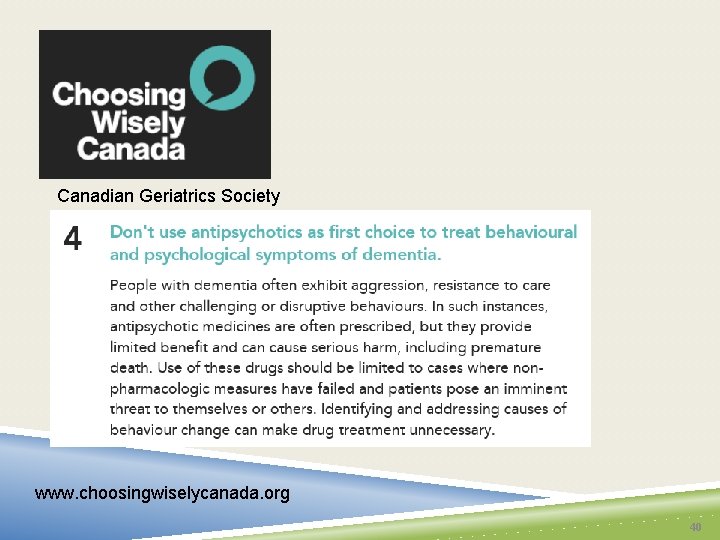
Canadian Geriatrics Society www. choosingwiselycanada. org 40
41
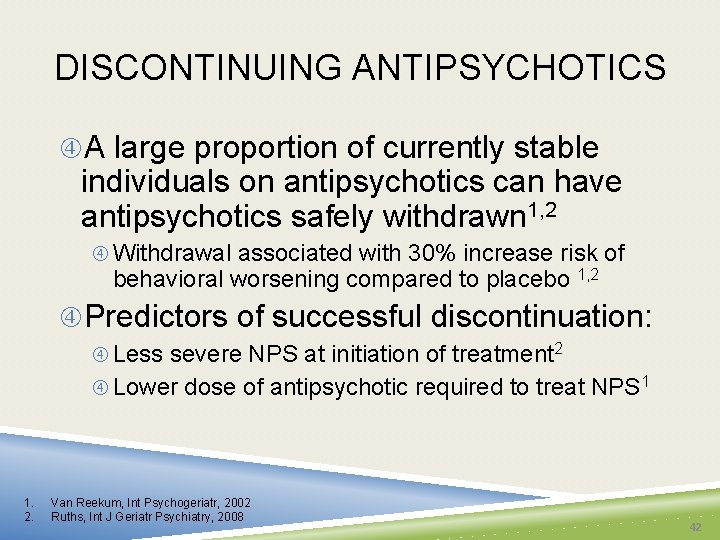
DISCONTINUING ANTIPSYCHOTICS A large proportion of currently stable individuals on antipsychotics can have antipsychotics safely withdrawn 1, 2 Withdrawal associated with 30% increase risk of behavioral worsening compared to placebo 1, 2 Predictors of successful discontinuation: Less severe NPS at initiation of treatment 2 Lower dose of antipsychotic required to treat NPS 1 1. 2. Van Reekum, Int Psychogeriatr, 2002 Ruths, Int J Geriatr Psychiatry, 2008 42
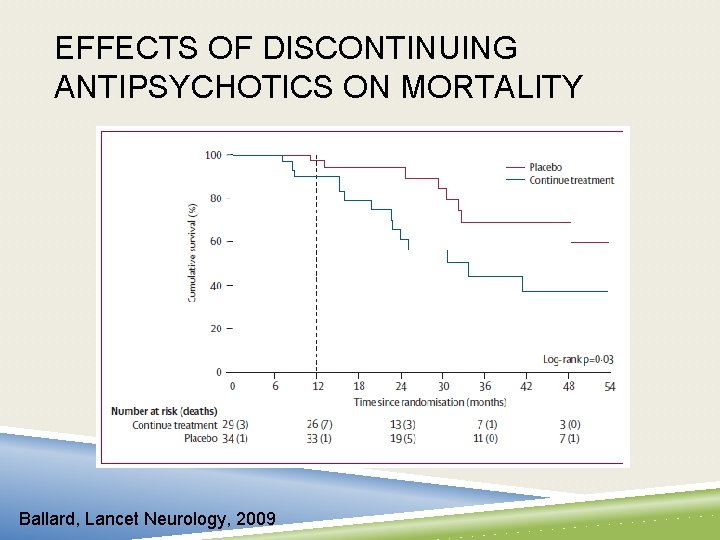
EFFECTS OF DISCONTINUING ANTIPSYCHOTICS ON MORTALITY Ballard, Lancet Neurology, 2009
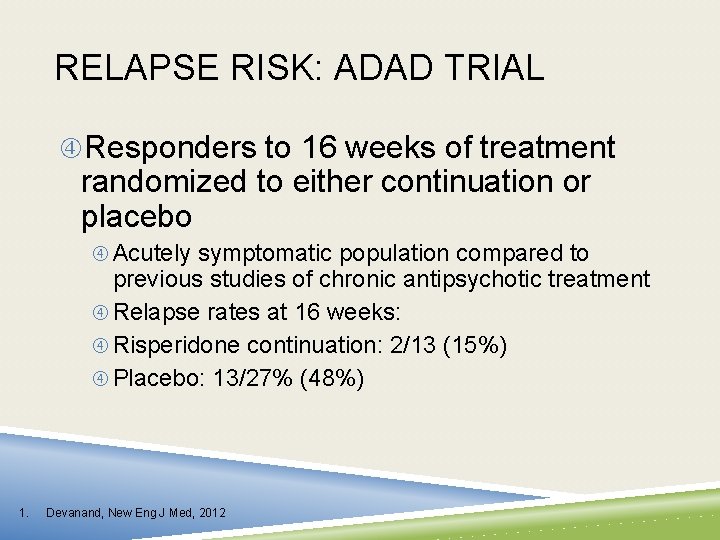
RELAPSE RISK: ADAD TRIAL Responders to 16 weeks of treatment randomized to either continuation or placebo Acutely symptomatic population compared to previous studies of chronic antipsychotic treatment Relapse rates at 16 weeks: Risperidone continuation: 2/13 (15%) Placebo: 13/27% (48%) 1. Devanand, New Eng J Med, 2012
CANADIAN CONSORTIUM ON NEURODEGENERATION IN AGING CCNA is a research hub for all aspects of research involving neurodegenerative diseases (including Alzheimer’s disease) $31. 5 M dollars in funding from CIHR and $24 M from partner organizations in ON and QC 20 research teams including 340 Canadian researchers 45
CCNA GOALS AND OBJECTIVES Strengthen and synergize Canadian innovative and collaborative research Become Canadian hub for leading and participating in international collaborations Reinforce the international positioning, competitiveness and impact of Canadian research Impact the quality of life and services for those living with neurodegenerative diseases and their caregivers 46
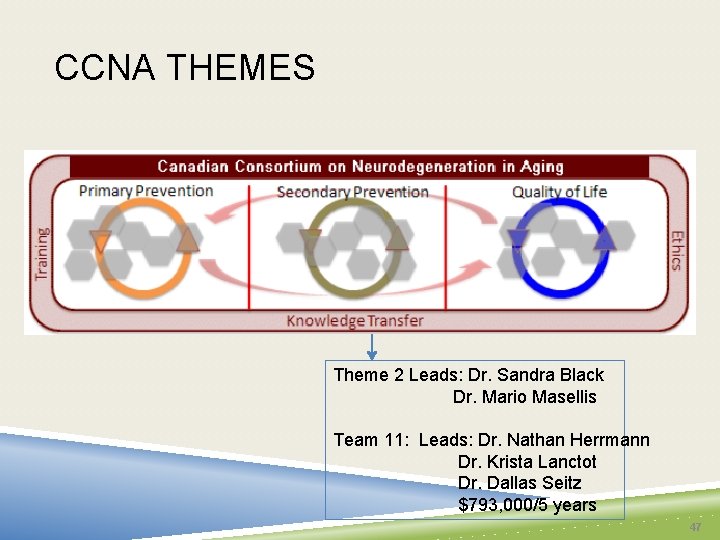
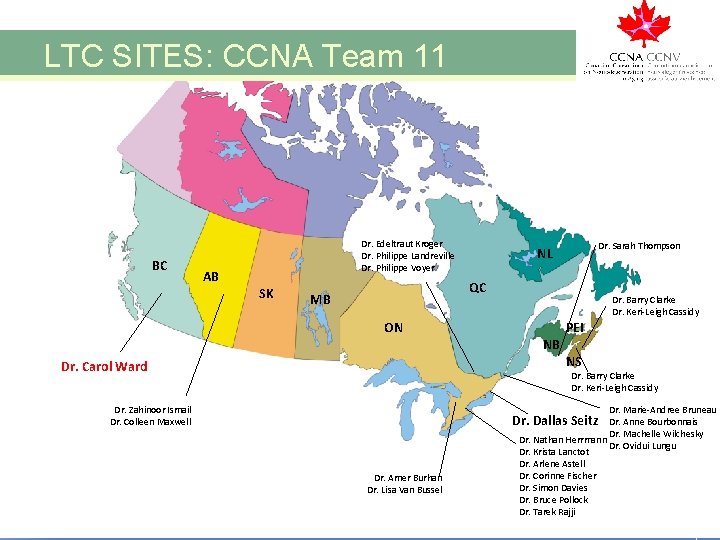
CCNA THEMES Theme 2 Leads: Dr. Sandra Black Dr. Mario Masellis Team 11: Leads: Dr. Nathan Herrmann Dr. Krista Lanctot Dr. Dallas Seitz $793, 000/5 years 47
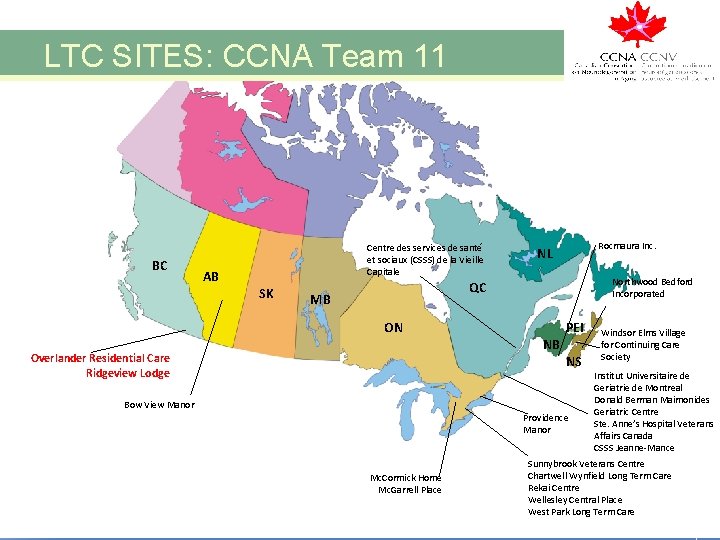
TEAM 11: PREVENTION AND TREATMENT OF NEUROPSYCHIATRIC SYMPTOMS OF DEMENTIA IN LTC Goals: Establish a network of researchers and clinicians focussed on NPS is LTC Develop a research network of LTC across Canada 30 facilities in total representing all of Canada Conduct research studies evaluating strategies to treat and prevent NPS in LTC 48
CARESS SITES LTC SITES: CCNA Team 11 BC AB Centre des services de santé et sociaux (CSSS) de la Vieille Capitale SK Rocmaura Inc. NL Northwood Bedford Incorporated QC MB ON Overlander Residential Care Ridgeview Lodge NB PEI NS Bow View Manor Providence Manor Mc. Cormick Home Mc. Garrell Place Windsor Elms Village for Continuing Care Society Institut Universitaire de Geriatrie de Montreal Donald Berman Maimonides Geriatric Centre Ste. Anne’s Hospital Veterans Affairs Canada CSSS Jeanne-Mance Sunnybrook Veterans Centre Chartwell Wynfield Long Term Care Rekai Centre Wellesley Central Place West Park Long Term Care
CARESS SITES LTC SITES: CCNA Team 11 BC AB Dr. Edeltraut Kroger Dr. Philippe Landreville Dr. Philippe Voyer SK Dr. Sarah Thompson NL QC MB ON Dr. Carol Ward Dr. Barry Clarke Dr. Keri-Leigh Cassidy NB PEI NS Dr. Barry Clarke Dr. Keri-Leigh Cassidy Dr. Zahinoor Ismail Dr. Colleen Maxwell Dr. Marie-Andree Bruneau Dr. Anne Bourbonnais Dr. Machelle Wilchesky Dr. Nathan Herrmann Dr. Ovidui Lungu Dr. Krista Lanctot Dr. Arlene Astell Dr. Corinne Fischer Dr. Simon Davies Dr. Bruce Pollock Dr. Tarek Rajji Dr. Dallas Seitz Dr. Amer Burhan Dr. Lisa Van Bussel
CCNA PROJECTS Survey of LTC facilities, resources and current practices Validation of routinely collected LTC data Clinical Studies: Optimizing Prescribing of Antipsychotics in LTC (OPAL) Mobile Technology Based Intervention for NPS in LTC Randomized controlled trial of cholinesterase inhibitor discontinuation 51
CONCLUSIONS Non-pharmacological interventions have increasing evidence to support their use The risks and benefits of starting and continuation of medications for NPS need to be carefully considered for on an individual basis The CCNA will provide Canada with a unique opportunity to strengthen research capacity into NPS in LTC across Canada 52
QUESTIONS Dr. Dallas Seitz Email: seitzd@providencecare. ca 53
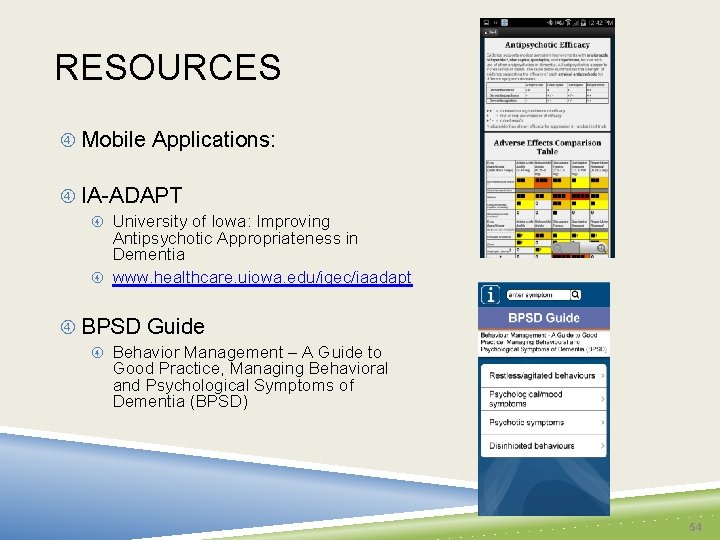
RESOURCES Mobile Applications: IA-ADAPT University of Iowa: Improving Antipsychotic Appropriateness in Dementia www. healthcare. uiowa. edu/igec/iaadapt BPSD Guide Behavior Management – A Guide to Good Practice, Managing Behavioral and Psychological Symptoms of Dementia (BPSD) 54
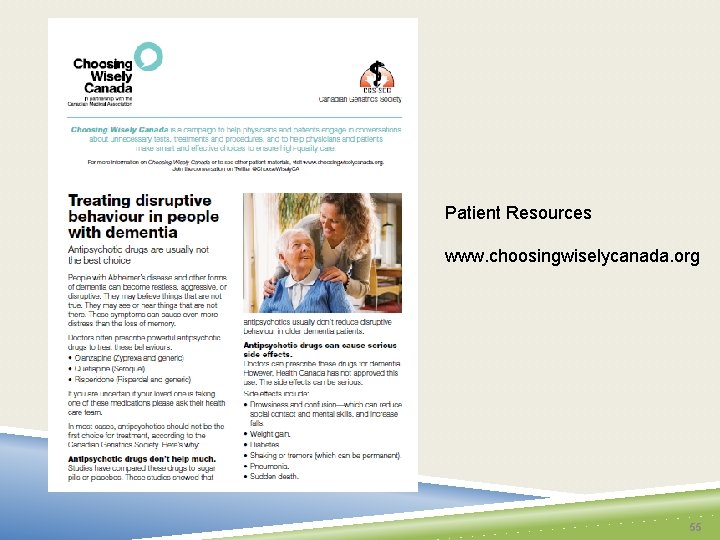
Patient Resources www. choosingwiselycanada. org 55
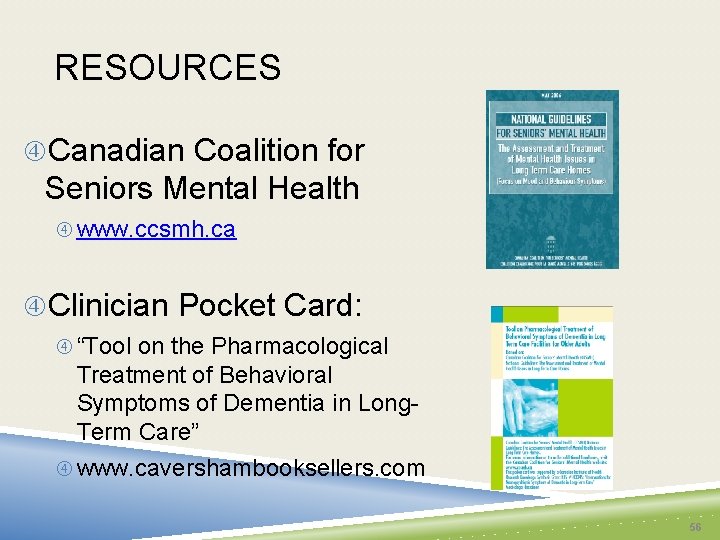
RESOURCES Canadian Coalition for Seniors Mental Health www. ccsmh. ca Clinician Pocket Card: “Tool on the Pharmacological Treatment of Behavioral Symptoms of Dementia in Long. Term Care” www. cavershambooksellers. com 56