
Prevention and Management of Skin Tears True or




- Slides: 40
Prevention and Management of Skin Tears
True or False 1. Skin tears occur mostly on the lower extremities 2. Immobility increases the chance of a skin tear 3. Skin tears are staged like pressure ulcers (Stage I-IV) 4. Nutrition and hydration play a role in the prevention of skin tears 5. Protecting the peri-wound skin is an important step in the treatment of skin tears 6. The maximum wear time of Tegaderm™ Absorbent Clear Acrylic dressing is 7 days 3 M Confidential
Skin Tears Definition : “ A wound caused by shear, friction, and/or blunt force resulting in separation of skin layers. ” A skin tear can be partial-thickness (separation of the epidermis from the dermis) or full-thickness (separation of both the epidermis and dermis from underlying structures) Skin tears: State of the Science: Consensus Statements for Prevention, Prediction, Assessment, and Treatment of Skin Tears; 2011; Leblanc et al 3 M Confidential
Skin Tear Prevalence Studies show that skin tears may have a higher prevalence rate than pressure ulcers, as high as 41%. Skin tears: State of the Science: Consensus Statements for Prevention, Prediction, Assessment, and Treatment of Skin Tears; 2011; Leblanc et al 3 M Confidential
Incidence • Common in elderly population • 1. 5 million skin tears occurring per year in adults in health care facilities • Most common in the upper extremities • 50% without any apparent cause • 25% resulted from wheelchair injuries • 25% resulted from bumping into objects 3 M Confidential
Risk Factors Associated with Skin Tears • • • • Very young( neonate) Age >75 years old Sex Race ( Caucasian) Immobility Poor nutrition Long term corticosteroid use History of skin tears Altered sensory status Cognitive impairment Limb stiffness and spasticity Neuropathy Having blood drawn Polypharmacy Presence of ecchymosis 3 M Confidential • • • • Dependence for activities of daily living Using assistive devices Applying and removing stockings Removing tape or dressings Vascular problems Cardiac problems Pulmonary problems Visual impairment Transfers and falls Prosthetic devices Continence /incontinence Skin cleansers Improper use of skin sealants = (transparent films) Skin tears: State of the Science: Consensus Statements for Prevention, Prediction, Assessment, and Treatment of Skin Tears; 2011;
Aging Skin 3 M Confidential
Factors Contributing to Skin Tear Formation Aging: • • Epidermis thins Skin has less elasticity, dry Subcutaneous tissue loss Decreased barrier function, sensitivity, thermoregulation, and pain perception • Blood vessels become thinner and more fragile (senile purpura) • 20% loss in dermal thickness 3 M Confidential
Layers of the Skin Epidermis Rete Pegs Dermal Epidermal Junction Dermis Subcutaneous Tissue 3 M Confidential Papillary Dermis
ISTAP Skin Tear Classification System (International Skin Tear Advisory Panel) Type 1: No skin loss • Linear or flap tear that can be repositioned to cover the wound bed Le. Blanc, K. , Baranoski et al, J Advances in Skin and Wound Care June 2013 3 M Confidential
ISTAP Skin Tear Classification System (International Skin Tear Advisory Panel) Type 2: Partial flap loss • Partial flap loss that cannot be repositioned to cover the wound bed Le. Blanc, K. , Baranoski et al, J Advances in Skin and Wound Care June 2013 3 M Confidential
ISTAP Skin Tear Classification System (International Skin Tear Advisory Panel) Type 3: Total flap loss • Total flap loss exposing the entire wound bed Le. Blanc, K. , Baranoski et al, J Advances in Skin and Wound Care June 2013 3 M Confidential
RAI-MDS Classification 3 M Confidential
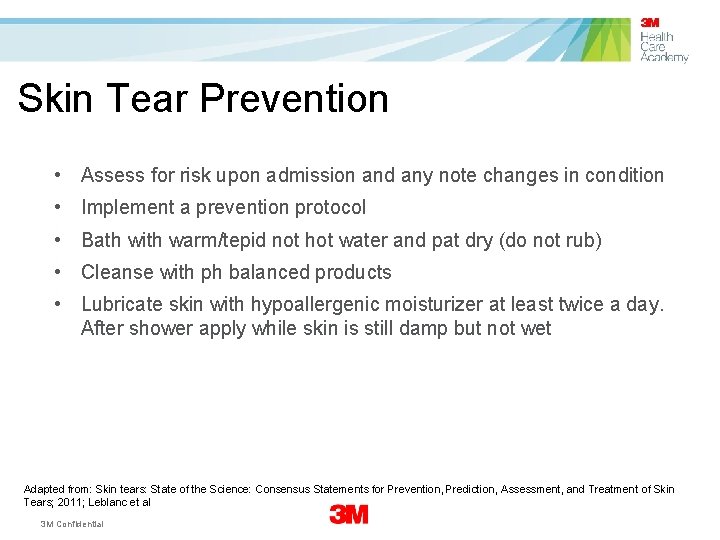
Skin Tear Prevention • Assess for risk upon admission and any note changes in condition • Implement a prevention protocol • Bath with warm/tepid not hot water and pat dry (do not rub) • Cleanse with ph balanced products • Lubricate skin with hypoallergenic moisturizer at least twice a day. After shower apply while skin is still damp but not wet Adapted from: Skin tears: State of the Science: Consensus Statements for Prevention, Prediction, Assessment, and Treatment of Skin Tears; 2011; Leblanc et al 3 M Confidential
Preventing Skin Tears • At risk, wear long sleeves and pants or knee high socks • Wear shin guards when necessary • Ensure safe patient handling techniques and equipment/environment • Transfer patient/ resident carefully to avoid trauma • Avoid friction and shear • Pad bed rails and arm chairs, wheel chairs, mobility devices when necessary Adapted from: Skin tears: State of the Science: Consensus Statements for Prevention, Prediction, Assessment, and Treatment of Skin Tears; 2011; Leblanc et al 3 M Confidential
Preventing Skin Tears • Keep pathways clear • Avoid use of non-skin friendly adhesive tapes and dressings • Care givers should keep finger nails short, remove jewellery etc. that may contribute to skin tear formation • Preventative education for patients and family members • Ensure adequate nutrition and hydration, consult a dietician when necessary Adapted from: Skin tears: State of the Science: Consensus Statements for Prevention, Prediction, Assessment, and Treatment of Skin Tears; 2011; Leblanc et al 3 M Confidential
Wound Care Canada, Vol 6. No 1, 2008 3 M Confidential
ISTAP Skin Tear Decision Algorithm www. skintears. org/Skin-Tear-Algorithm/ 3 M Confidential
RNAO Recommendations Choose a dressing that will: • Maintain constant moisture • Suit the local wound environment • Protect the peri-wound skin • Control or manage exudate • Control or manage infection • Optimize caregiver time RNAO Best Practice Guidelines, L. Ovington 3 M Confidential
CAWC Best Practice Recommendations for the Prevention and Treatment of Skin Tears Leblanc et at, WCC Vol 6, No. 1 , 2008 3 M Confidential
Prevention & Management 3 M Confidential
Skin Tear Treatment Algorithm 3 M Confidential
The 3 M Skin Tear Management System • A simplified, cost effective approach • Protection of the peri-wound & wound management Two simple steps: 1. 3 M™ Cavilon™ No Sting Barrier Film 2. 3 M™ Tegaderm. TM Absorbent Clear Acrylic Dressing 3 M Confidential
3 M™ Tegaderm™ Absorbent Clear Acrylic Dressing 3 M Confidential
3 M™ Tegaderm™ Absorbent Clear Acrylic Dressing A Clear Advantage • • • Ability to visualize the wound Extended wear time May eliminate unnecessary dressing changes Versatile Very conformable and comfortable Washable Patients may shower Moist skin adhesion that’s secure, yet gentle Low maceration potential Low friction surface Barrier to outside contaminants such as fluid, bacteria and viruses 3 M Confidential
3 M™ Tegaderm™ Absorbent Clear Acrylic Dressing A Clear Advantage How frequently do you change the dressing? Extended wear time: Frequency of changing the dressing will depend on factors such as type of wound, volume of drainage, facility protocols and/or recommended guidelines. • Change if dressing is rolling, leaking or if there is exudate under the transparent film border • When wound requires different treatment • When wound is healed 3 M Confidential
Extended Wear Time 14 -24 day wear time K leblanc et at, CAWC, 2005 3 M Confidential
Skin Tears 3 M Confidential
Skin Tears 30 © 3 M 2009. All Rights Reserved. 3 M Confidential © 3 M 2014 All Rights Reserved.
Before and after treatment with 3 M™ Tegaderm™ Absorbent Clear Acrylic Dressing 31 3 M Confidential © 3 M 2014 All Rights Reserved.
Before and after treatment with 3 M™ Tegaderm™ Absorbent Clear Acrylic Dressing 3 M Confidential
3 M™ Tegaderm™ Absorbent Clear Acrylic Dressing - A Clear Advantage Other Clinical Indications for Use: • Partial and Full-thickness ulcers • Stage I-IV, unstageable • • Abrasions and Superficial wounds Donor sites Superficial partial thickness burns Clean, closed approximated surgical incisions or laparoscopic incisions 3 M Confidential
True or False 1. Skin tears occur mostly on the lower extremities 2. Immobility increases the chance of a skin tear 3. Skin tears are staged like pressure ulcers (Stage I-IV) 4. Nutrition and hydration play a role in the prevention of skin tears 5. Protecting the peri-wound skin is an important step in the treatment of skin tears 6. The maximum wear time of 3 M™ Tegaderm™ Absorbent Clear Acrylic dressing is 7 days 3 M Confidential
3 M™Cavilon™ No-Rinse Skin Cleanser • Simple, gentle, effective cleansing for incontinence & other skin care • Cleanse, moisturize & soothe intact or irritated skin • Helps control odour • Contains ingredients to condition skin • No-rinse formula • p. H balanced • Available in fragrance-free & fragrance formulations • Compatible with other 3 M™ Cavilon™ brand products 3 M Confidential
3 M™Cavilon™ Durable Barrier Cream • Used regularly on intact skin can help prevent breakdown caused by regular exposure to urine & stool • Provides breathable barrier – promotes skin health in patients at risk for skin damage from incontinence • Concentrated, unique formula requires less frequent application & less product with each application • Vanishes into skin – will not clog briefs or diapers 3 M Confidential
3 M™Cavilon™No Sting Barrier Film • Alcohol-free liquid barrier film • • • Protects skin from body fluids, adhesive trauma and friction Allows for pain-free, non-stinging application Unique formulation contains: • • • 3 M Confidential Proprietary 3 M terpolymer (protective film former) Solvent system (facilitates non-sticky finish) Plasticizer (allows film to flex and bend without cracking)
3 M™Cavilon™No Sting Barrier Film • Dries quickly on the skin to form a protective, waterproof coating • Transparent so skin can be observed! • Helps support pressure ulcer prevention strategies • Does not need to be removed • Simplifies cleansing • Non-cytotoxic ( it will not damage healing tissue) • Can be used on intact or damaged skin • Hypoallergenic • Long-lasting- Lasts up to 72 hours • Cost-effective • CHG compatible 3 M Confidential
3 M™ Cavilon™ No Sting Barrier Film Its Many Other Uses • Protection from oxygen tubing • Under ostomy appliances • Under ET tubes & securement devices • Under IV site dressings • Around G-tubes, T-tubes & Dtubes • For areas of chaffing and skin folds • Around tracheostomy sites • To protect skin under prosthesis • On Closed Approximated Surgical incisions • Under any adhesive • On minor burns • At dialysis sites • Security for condom catheters • On heels & elbows • Reduction of friction & moisture associated with Radiation Therapy • Peri-Wound Protection 3 M Confidential
All statements, technical information and recommendations contained herein are based on data we believe to be reliable, but the accuracy or completeness thereof is not guaranteed. There is no representation, warranty, conditions, guarantee or other obligation of 3 M or its employees, either directly or indirectly, arising out of this presentation. Please refer to specific product packaging user instructions and related documents of complete details 3 M is a trademark of 3 M. Used under license in Canada © 2014, 3 M. All rights reserved. 3 M Confidential
Questions 3 M Confidential