
PREVENTION AND EARLY INTERVENTION IN POSTPARTUM DEPRESSION RISK
- Slides: 1
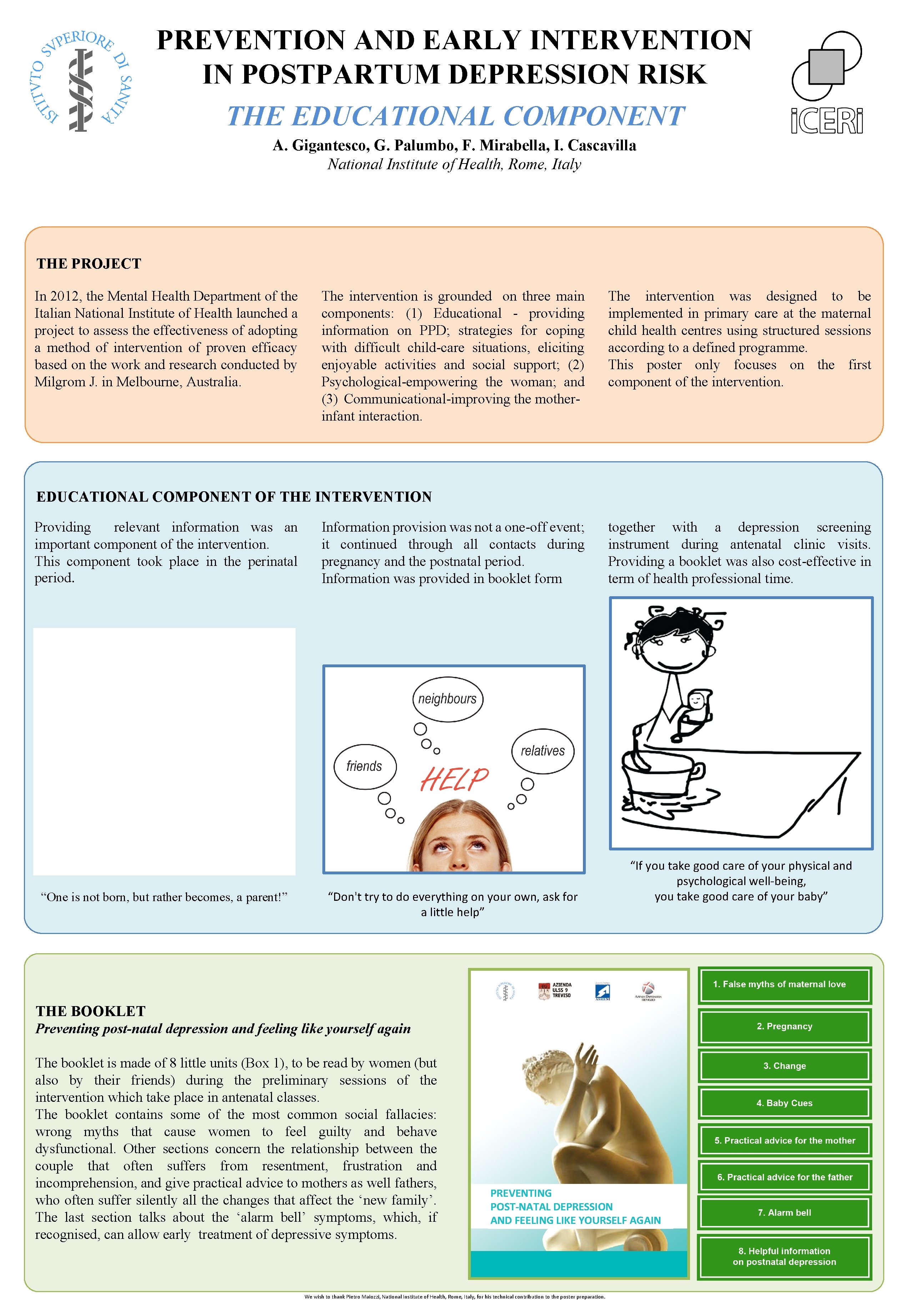
PREVENTION AND EARLY INTERVENTION IN POSTPARTUM DEPRESSION RISK THE EDUCATIONAL COMPONENT A. Gigantesco, G. Palumbo, F. Mirabella, I. Cascavilla National Institute of Health, Rome, Italy THE PROJECT In 2012, the Mental Health Department of the Italian National Institute of Health launched a project to assess the effectiveness of adopting a method of intervention of proven efficacy based on the work and research conducted by Milgrom J. in Melbourne, Australia. The intervention is grounded on three main components: (1) Educational - providing information on PPD; strategies for coping with difficult child-care situations, eliciting enjoyable activities and social support; (2) Psychological-empowering the woman; and (3) Communicational-improving the motherinfant interaction. The intervention was designed to be implemented in primary care at the maternal child health centres using structured sessions according to a defined programme. This poster only focuses on the first component of the intervention. EDUCATIONAL COMPONENT OF THE INTERVENTION Providing relevant information was an important component of the intervention. This component took place in the perinatal period. “One is not born, but rather becomes, a parent!” Information provision was not a one-off event; it continued through all contacts during pregnancy and the postnatal period. Information was provided in booklet form “Don't try to do everything on your own, ask for a little help” together with a depression screening instrument during antenatal clinic visits. Providing a booklet was also cost-effective in term of health professional time. “If you take good care of your physical and psychological well-being, you take good care of your baby” THE BOOKLET Preventing post-natal depression and feeling like yourself again The booklet is made of 8 little units (Box 1), to be read by women (but also by their friends) during the preliminary sessions of the intervention which take place in antenatal classes. The booklet contains some of the most common social fallacies: wrong myths that cause women to feel guilty and behave dysfunctional. Other sections concern the relationship between the couple that often suffers from resentment, frustration and incomprehension, and give practical advice to mothers as well fathers, who often suffer silently all the changes that affect the ‘new family’. The last section talks about the ‘alarm bell’ symptoms, which, if recognised, can allow early treatment of depressive symptoms. PREVENTING POST-NATAL DEPRESSION AND FEELING LIKE YOURSELF AGAIN We wish to thank Pietro Maiozzi, National Institute of Health, Rome, Italy, for his technical contribution to the poster preparation.