
Prevention and Control of Emerging Infectious Diseases in

- Slides: 28
Prevention and Control of Emerging Infectious Diseases in Africa Karen M. Becker DVM, MPH, DACVPM August 7, 2008
Livestock as an Entry Point to Poverty Alleviation Ø The poor of the world in many developing countries depend heavily on animal-based agriculture for their wellbeing.
Burden of Disease on Animal and Human Livelihoods Ø Animal Diseases create barriers to livestock productivity and agricultural development l l l Ø Public health threats Decrease access to markets and trade Institutionalize poverty Threaten food security Threaten livelihoods Sub-Saharan Africa: annual economic losses from animal diseases estimated to be >US$4 B l Direct and indirect losses from mortality, slow growth, low fertility, decreased work output, etc.
Livestock 2020 – The Next Food Revolution Ø Global increase and demand for protein and food of animal origin Ø Shift from poverty: 1 -2 billion people to middle class Ø “Westernization” of Asia and Latin America Ø Increases in emerging zoonoses through the concentration of people and animals
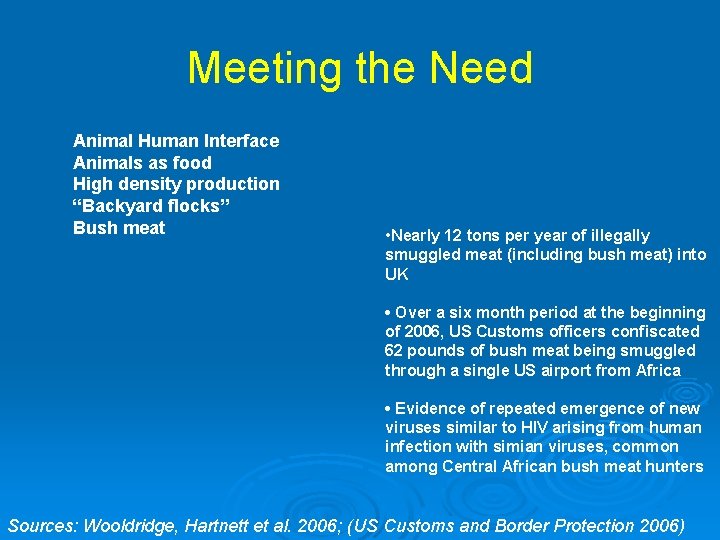
Meeting the Need Animal Human Interface Animals as food High density production “Backyard flocks” Bush meat • Nearly 12 tons per year of illegally smuggled meat (including bush meat) into UK • Over a six month period at the beginning of 2006, US Customs officers confiscated 62 pounds of bush meat being smuggled through a single US airport from Africa • Evidence of repeated emergence of new viruses similar to HIV arising from human infection with simian viruses, common among Central African bush meat hunters Sources: Wooldridge, Hartnett et al. 2006; (US Customs and Border Protection 2006)
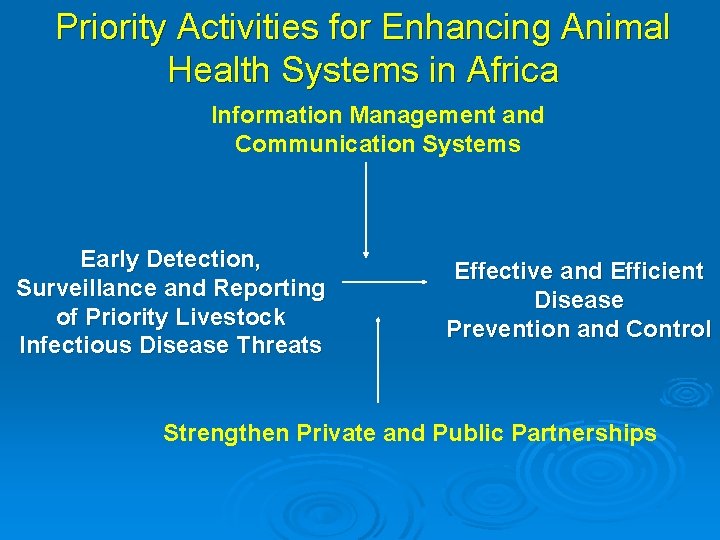
Priority Activities for Enhancing Animal Health Systems in Africa Information Management and Communication Systems Early Detection, Surveillance and Reporting of Priority Livestock Infectious Disease Threats Effective and Efficient Disease Prevention and Control Strengthen Private and Public Partnerships
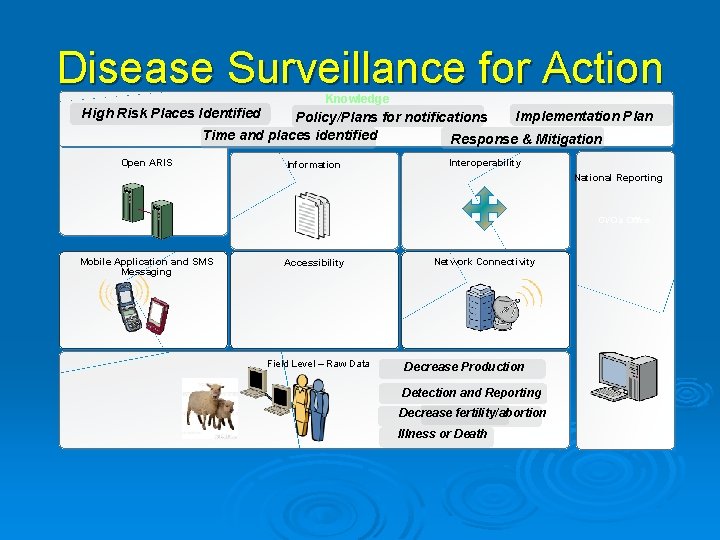
Disease Surveillance for Action High Risk Places Identified Knowledge Implementation Plan Policy/Plans for notifications Time and places identified Response & Mitigation Open ARIS Information Interoperability National Reporting CVO’s Office Mobile Application and SMS Messaging Accessibility Field Level – Raw Data Network Connectivity Decrease Production Detection and Reporting Decrease fertility/abortion Illness or Death
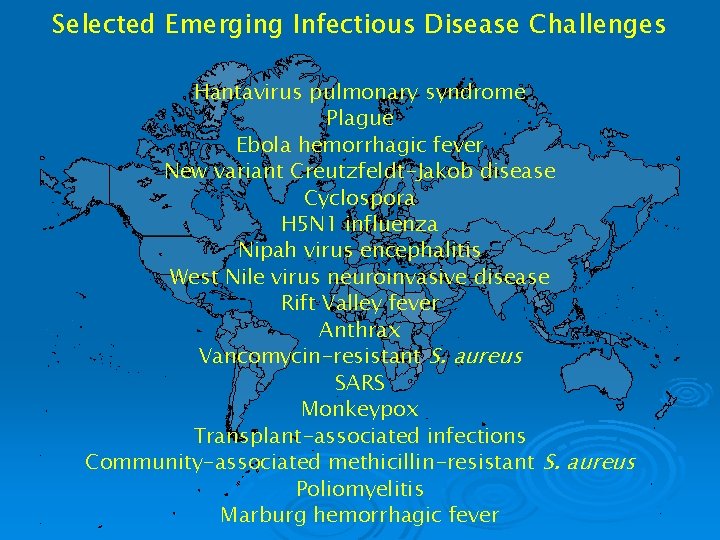
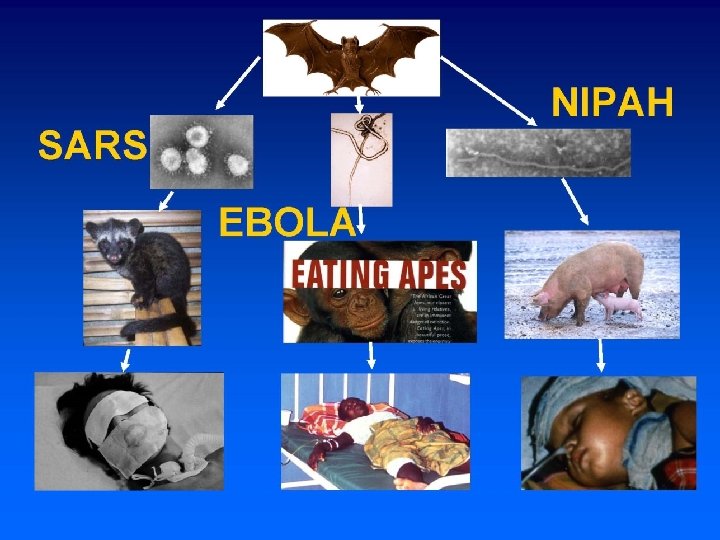
Selected Emerging Infectious Disease Challenges Hantavirus pulmonary syndrome Plague Ebola hemorrhagic fever New variant Creutzfeldt-Jakob disease Cyclospora H 5 N 1 influenza Nipah virus encephalitis West Nile virus neuroinvasive disease Rift Valley fever Anthrax Vancomycin-resistant S. aureus SARS Monkeypox Transplant-associated infections Community-associated methicillin-resistant S. aureus Poliomyelitis Marburg hemorrhagic fever
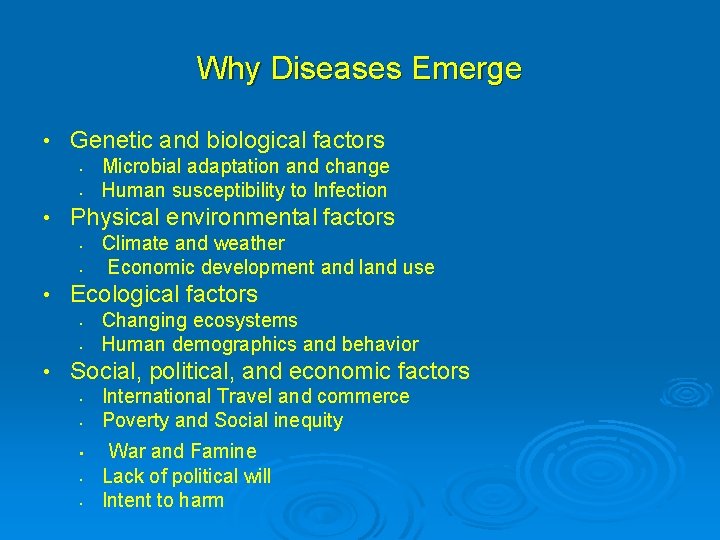
Why Diseases Emerge • Genetic and biological factors • • • Physical environmental factors • • • Climate and weather Economic development and land use Ecological factors • • • Microbial adaptation and change Human susceptibility to Infection Changing ecosystems Human demographics and behavior Social, political, and economic factors • International Travel and commerce Poverty and Social inequity • War and Famine • • • Lack of political will Intent to harm
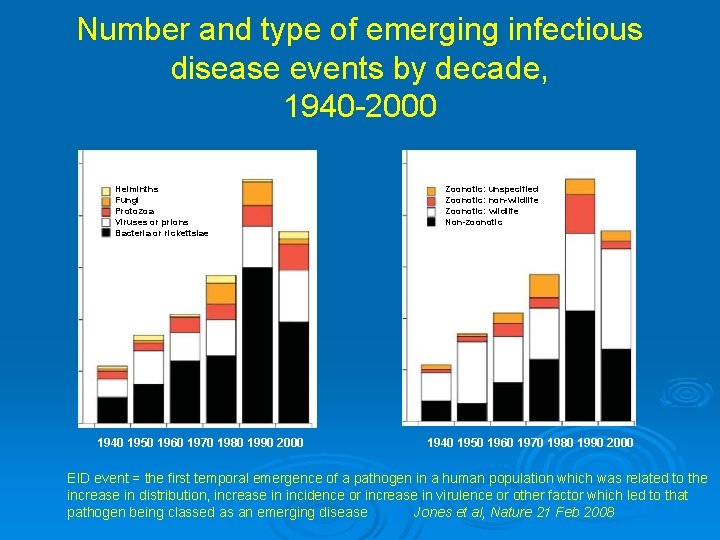
Number and type of emerging infectious disease events by decade, 1940 -2000 Helminths Fungi Protozoa Viruses or prions Bacteria or rickettsiae 1940 1950 1960 1970 1980 1990 2000 Zoonotic: unspecified Zoonotic: non-wildlife Zoonotic: wildlife Non-zoonotic 1940 1950 1960 1970 1980 1990 2000 EID event = the first temporal emergence of a pathogen in a human population which was related to the increase in distribution, increase in incidence or increase in virulence or other factor which led to that pathogen being classed as an emerging disease Jones et al, Nature 21 Feb 2008
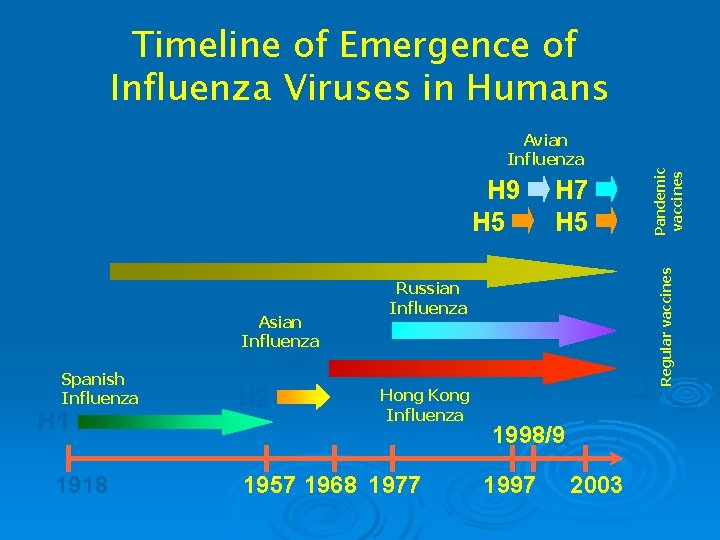
Avian Influenza B Asian Influenza Spanish Influenza H 1 1918 H 1 H 7 H 5 Regular vaccines H 9 H 5 Russian Influenza H 3 H 2 Hong Kong Influenza 1957 1968 1977 Pandemic vaccines Timeline of Emergence of Influenza Viruses in Humans 1998/9 1997 2003
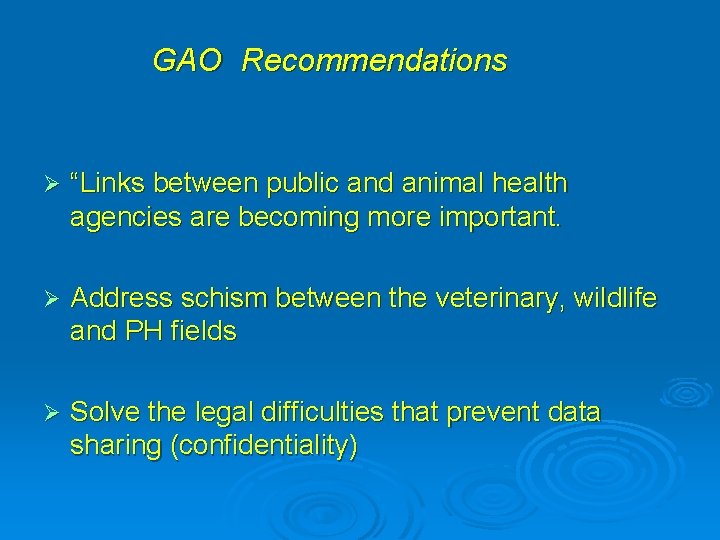
GAO Recommendations Ø “Links between public and animal health agencies are becoming more important. Ø Address schism between the veterinary, wildlife and PH fields Ø Solve the legal difficulties that prevent data sharing (confidentiality)
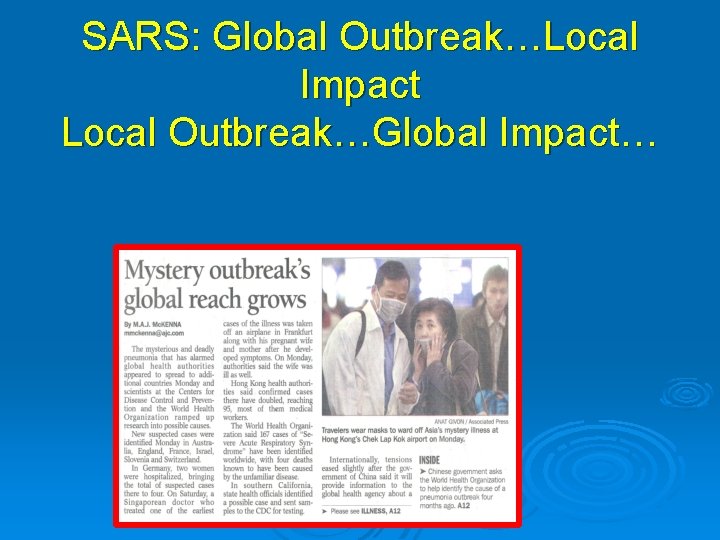
SARS: Global Outbreak…Local Impact Local Outbreak…Global Impact…
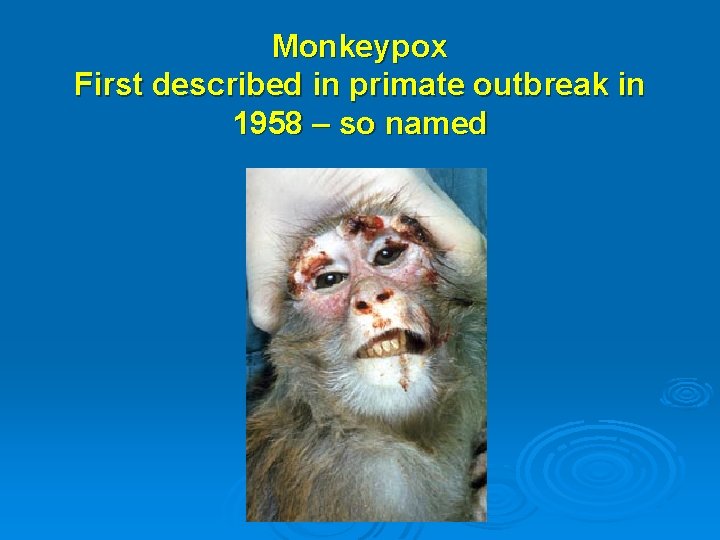
Monkeypox First described in primate outbreak in 1958 – so named
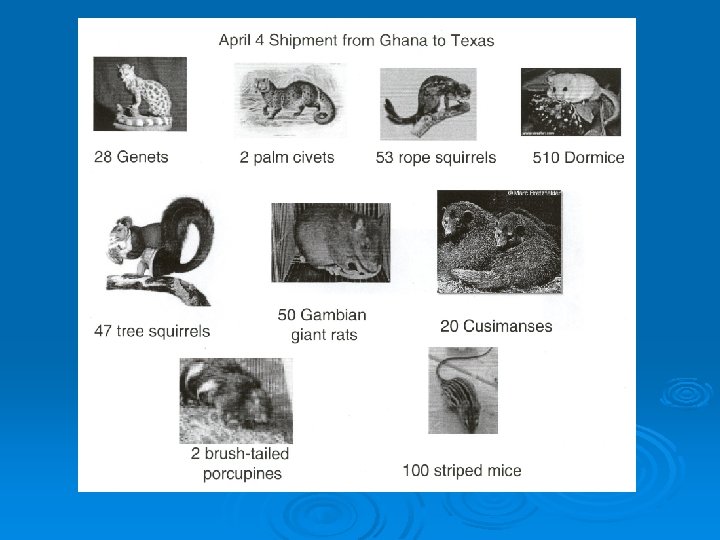
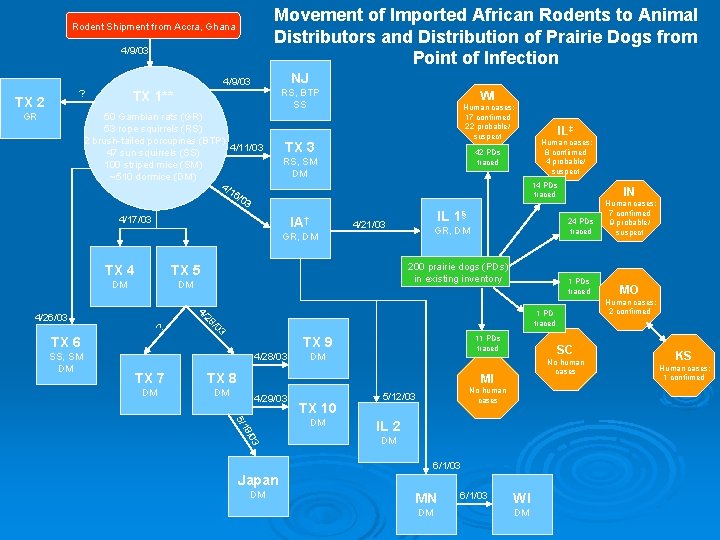
Movement of Imported African Rodents to Animal Distributors and Distribution of Prairie Dogs from Point of Infection Rodent Shipment from Accra, Ghana 4/9/03 NJ 4/9/03 ? TX 2 RS, BTP SS TX 1** 50 Gambian rats (GR) 53 rope squirrels (RS) 2 brush-tailed porcupines (BTP) 4/11/03 47 sun squirrels (SS) 100 striped mice (SM) ~510 dormice (DM) 4/1 6/0 3 GR WI Human cases: 17 confirmed 22 probable/ suspect TX 3 42 PDs traced RS, SM DM IA† IL 1§ 4/21/03 GR, DM TX 5 DM DM ? IN Human cases: 7 confirmed 24 PDs 9 probable/ traced suspect 1 PDs traced 3 11 PDs traced TX 9 4/28/03 TX 7 TX 8 DM DM DM SC No human cases MI 4/29/03 TX 10 3 8/0 5/1 DM No human cases 5/12/03 IL 2 DM 6/1/03 Japan DM MN DM 6/1/03 WI DM MO Human cases: 2 confirmed 1 PD traced /0 TX 6 SS, SM DM 200 prairie dogs (PDs) in existing inventory 28 4/ 4/26/03 Human cases: 8 confirmed 4 probable/ suspect 14 PDs traced 4/17/03 TX 4 IL‡ KS Human cases: 1 confirmed
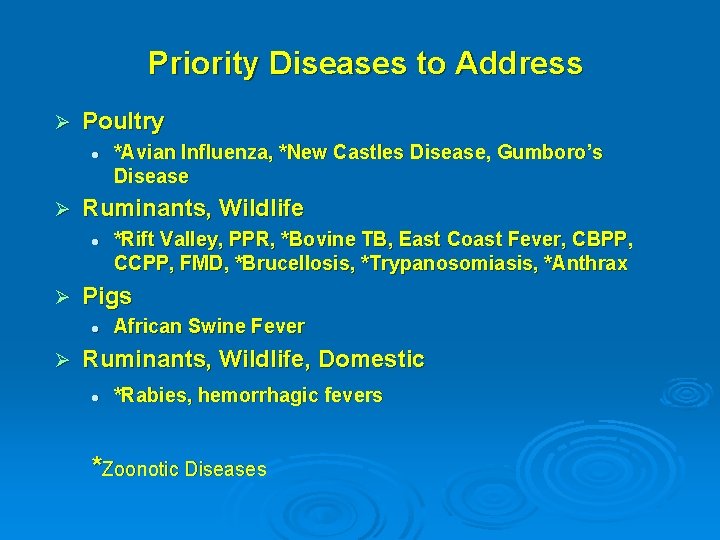
Priority Diseases to Address Ø Poultry l Ø Ruminants, Wildlife l Ø *Rift Valley, PPR, *Bovine TB, East Coast Fever, CBPP, CCPP, FMD, *Brucellosis, *Trypanosomiasis, *Anthrax Pigs l Ø *Avian Influenza, *New Castles Disease, Gumboro’s Disease African Swine Fever Ruminants, Wildlife, Domestic l *Rabies, hemorrhagic fevers *Zoonotic Diseases
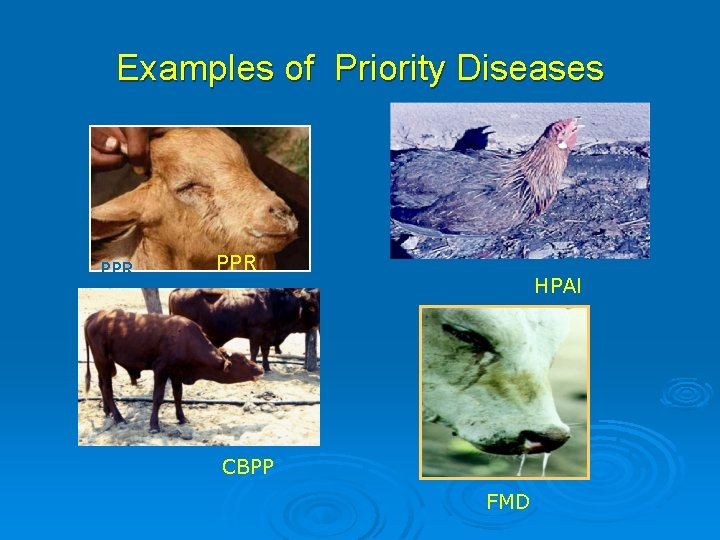
Examples of Priority Diseases PPR NCD HPAI CBPP FMD
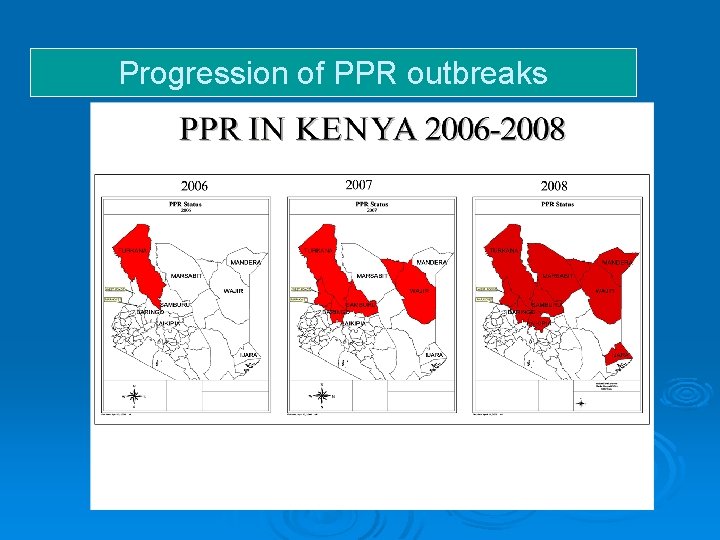
Progression of PPR outbreaks
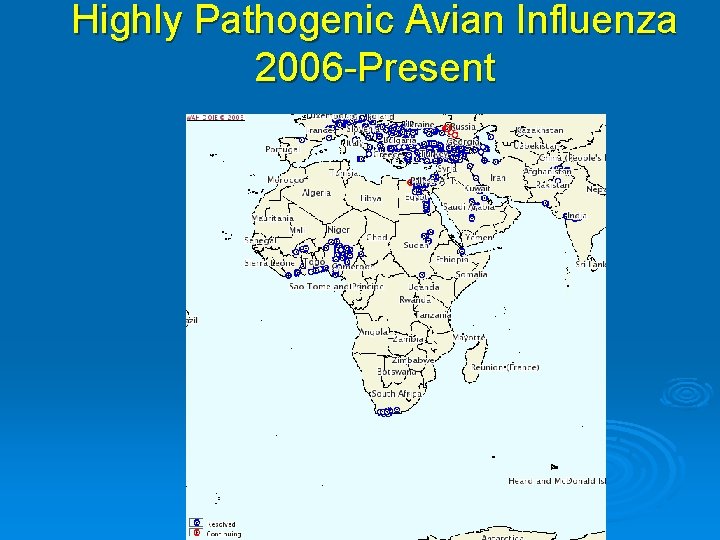
Highly Pathogenic Avian Influenza 2006 -Present
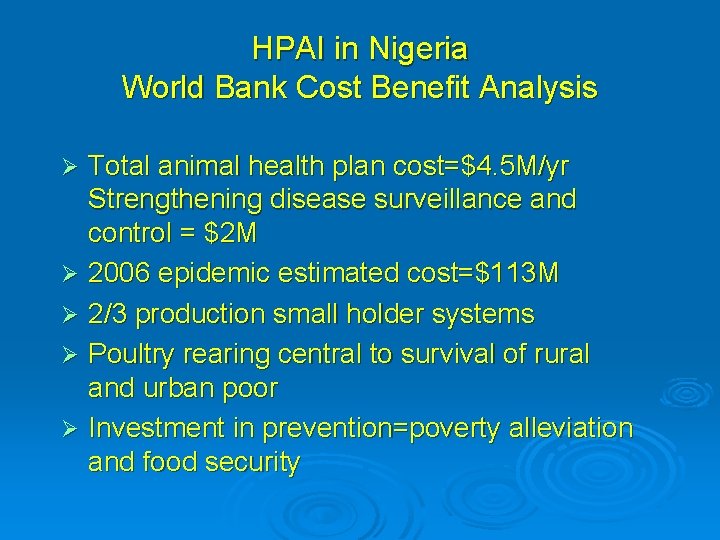
HPAI in Nigeria World Bank Cost Benefit Analysis Total animal health plan cost=$4. 5 M/yr Strengthening disease surveillance and control = $2 M Ø 2006 epidemic estimated cost=$113 M Ø 2/3 production small holder systems Ø Poultry rearing central to survival of rural and urban poor Ø Investment in prevention=poverty alleviation and food security Ø
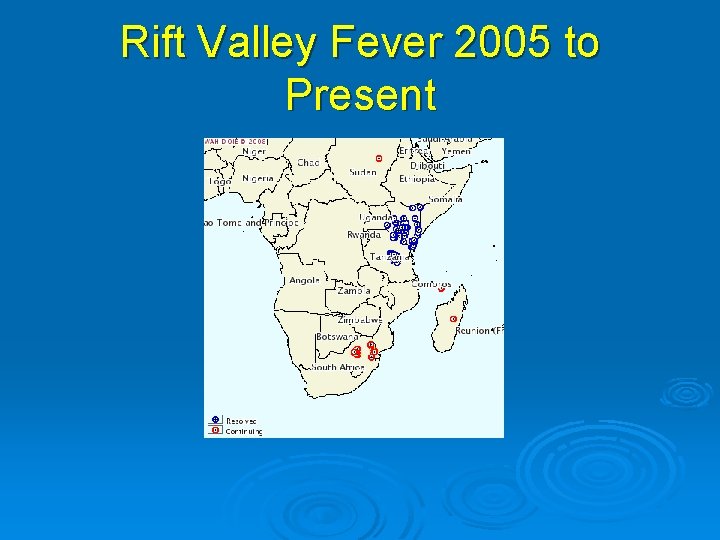
Rift Valley Fever 2005 to Present
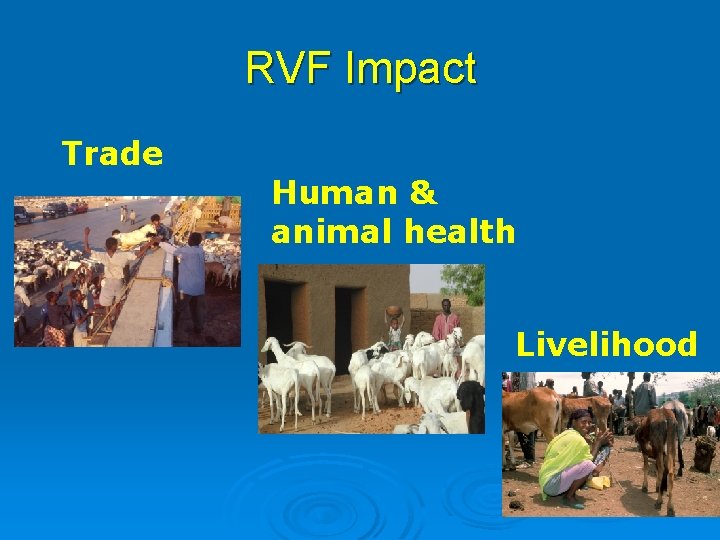
RVF Impact Trade Human & animal health Livelihood
Bottlenecks to Control of Diseases Ø Low priority accorded to animal disease control efforts by governments and other institutions; Ø Lack of financial resources to mount sustained control programmes against animal diseases; Ø The loss of critical mass of capable and experienced workforce with institutional memory in animal disease control methodologies have been detrimental to sustenance of animal disease control efforts. Ø Experienced field staff often the frontline for epizootic disease control, suffer the ravages of HIV/AIDS.
Challenges for Animal Health Development in Africa Become Opportunities Gap between progress in animal science and conversion into effective actions and policies Ø Divide between knowledge and application due to lack of training, infrastructure thus leaving poor surveillance and diagnostic capacity Ø New technologies, tools, and knowledge are important but also need, robust, resilient and transforming processes to build institutional capacity Ø Fragmentation of scientific disciplines l Need more better integration and communication of knowledge, more public engagement for social relevance Ø
THANK YOU!