
Preventing violence and harassment at work w w
- Slides: 22
[ Preventing violence and harassment at work ] w w w. m t a s. e s / i t s s / i n d e x. h t m l Manuel Velázquez Chief of the Labour and Social Security Inspectorate in Bilbao © ITSS 2008 Brussels: 7 - October - 2009
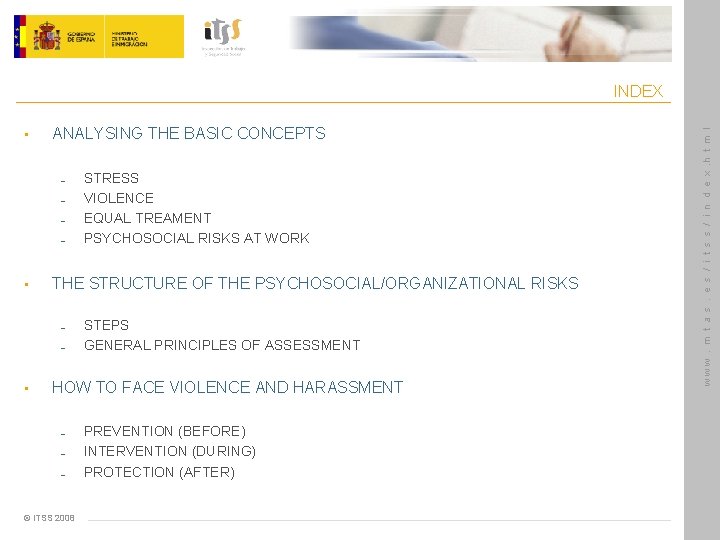
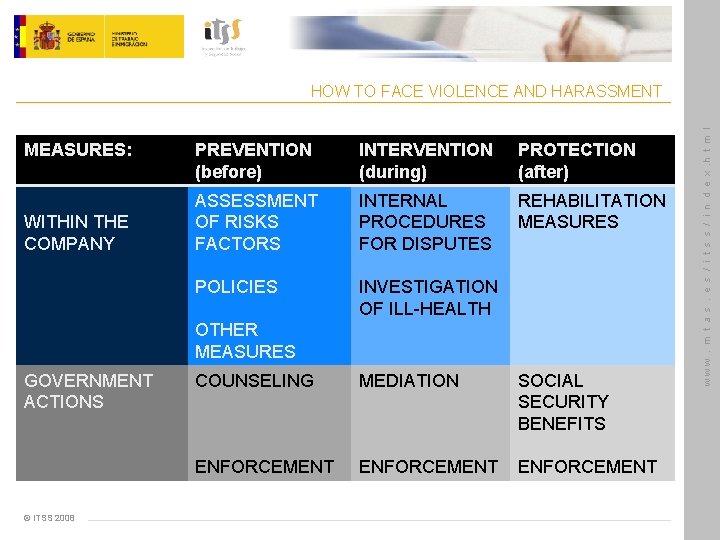
• ANALYSING THE BASIC CONCEPTS – – • THE STRUCTURE OF THE PSYCHOSOCIAL/ORGANIZATIONAL RISKS – – • STRESS VIOLENCE EQUAL TREAMENT PSYCHOSOCIAL RISKS AT WORK STEPS GENERAL PRINCIPLES OF ASSESSMENT HOW TO FACE VIOLENCE AND HARASSMENT – – – © ITSS 2008 PREVENTION (BEFORE) INTERVENTION (DURING) PROTECTION (AFTER) w w w. m t a s. e s / i t s s / i n d e x. h t m l INDEX
BASIC CONCEPTS © ITSS 2008 w w w. m t a s. e s / i t s s / i n d e x. h t m l FIRST
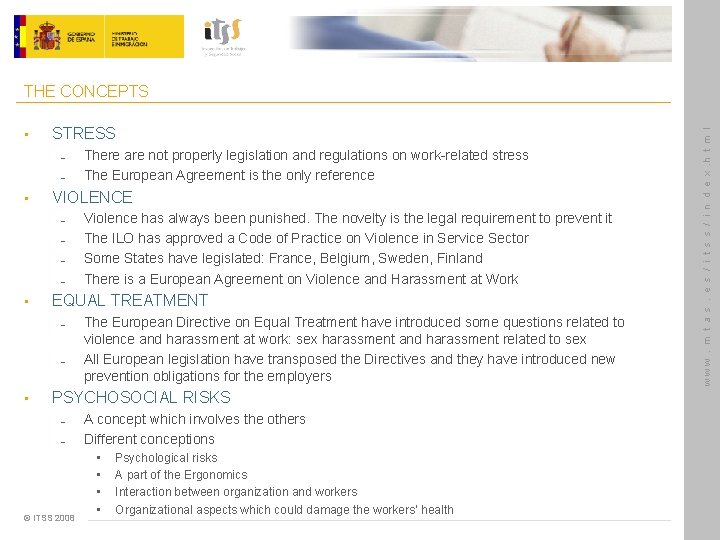
• STRESS – – • VIOLENCE – – • Violence has always been punished. The novelty is the legal requirement to prevent it The ILO has approved a Code of Practice on Violence in Service Sector Some States have legislated: France, Belgium, Sweden, Finland There is a European Agreement on Violence and Harassment at Work EQUAL TREATMENT – – • There are not properly legislation and regulations on work-related stress The European Agreement is the only reference The European Directive on Equal Treatment have introduced some questions related to violence and harassment at work: sex harassment and harassment related to sex All European legislation have transposed the Directives and they have introduced new prevention obligations for the employers PSYCHOSOCIAL RISKS – – © ITSS 2008 A concept which involves the others Different conceptions • • Psychological risks A part of the Ergonomics Interaction between organization and workers Organizational aspects which could damage the workers’ health w w w. m t a s. e s / i t s s / i n d e x. h t m l THE CONCEPTS
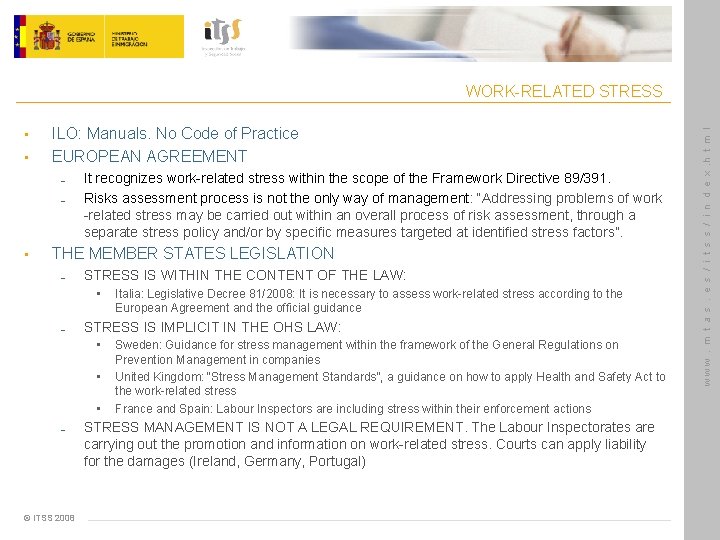
• • ILO: Manuals. No Code of Practice EUROPEAN AGREEMENT – – • It recognizes work-related stress within the scope of the Framework Directive 89/391. Risks assessment process is not the only way of management: “Addressing problems of work -related stress may be carried out within an overall process of risk assessment, through a separate stress policy and/or by specific measures targeted at identified stress factors”. THE MEMBER STATES LEGISLATION – STRESS IS WITHIN THE CONTENT OF THE LAW: • – STRESS IS IMPLICIT IN THE OHS LAW: • • • – © ITSS 2008 Italia: Legislative Decree 81/2008: It is necessary to assess work-related stress according to the European Agreement and the official guidance Sweden: Guidance for stress management within the framework of the General Regulations on Prevention Management in companies United Kingdom: “Stress Management Standards”, a guidance on how to apply Health and Safety Act to the work-related stress France and Spain: Labour Inspectors are including stress within their enforcement actions STRESS MANAGEMENT IS NOT A LEGAL REQUIREMENT. The Labour Inspectorates are carrying out the promotion and information on work-related stress. Courts can apply liability for the damages (Ireland, Germany, Portugal) w w w. m t a s. e s / i t s s / i n d e x. h t m l WORK-RELATED STRESS
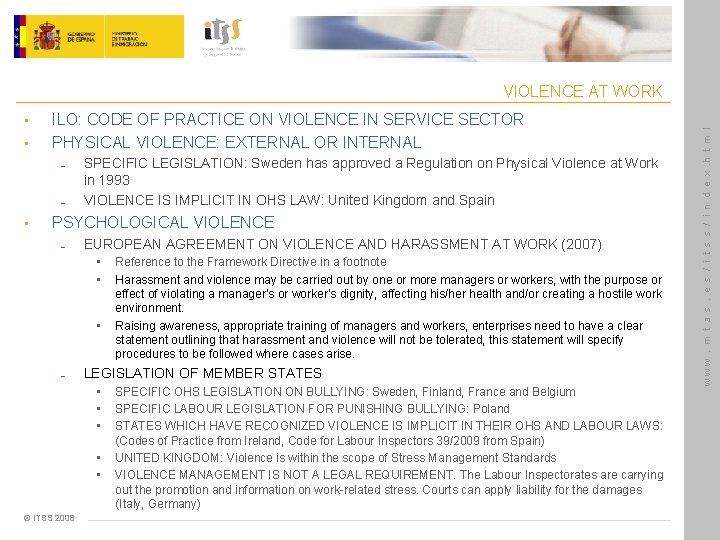
• • ILO: CODE OF PRACTICE ON VIOLENCE IN SERVICE SECTOR PHYSICAL VIOLENCE: EXTERNAL OR INTERNAL – – • SPECIFIC LEGISLATION: Sweden has approved a Regulation on Physical Violence at Work in 1993 VIOLENCE IS IMPLICIT IN OHS LAW: United Kingdom and Spain PSYCHOLOGICAL VIOLENCE – EUROPEAN AGREEMENT ON VIOLENCE AND HARASSMENT AT WORK (2007) • • • – LEGISLATION OF MEMBER STATES • • • © ITSS 2008 Reference to the Framework Directive in a footnote Harassment and violence may be carried out by one or more managers or workers, with the purpose or effect of violating a manager’s or worker’s dignity, affecting his/her health and/or creating a hostile work environment. Raising awareness, appropriate training of managers and workers, enterprises need to have a clear statement outlining that harassment and violence will not be tolerated, this statement will specify procedures to be followed where cases arise. SPECIFIC OHS LEGISLATION ON BULLYING: Sweden, Finland, France and Belgium SPECIFIC LABOUR LEGISLATION FOR PUNISHING BULLYING: Poland STATES WHICH HAVE RECOGNIZED VIOLENCE IS IMPLICIT IN THEIR OHS AND LABOUR LAWS: (Codes of Practice from Ireland, Code for Labour Inspectors 39/2009 from Spain) UNITED KINGDOM: Violence is within the scope of Stress Management Standards VIOLENCE MANAGEMENT IS NOT A LEGAL REQUIREMENT. The Labour Inspectorates are carrying out the promotion and information on work-related stress. Courts can apply liability for the damages (Italy, Germany) w w w. m t a s. e s / i t s s / i n d e x. h t m l VIOLENCE AT WORK
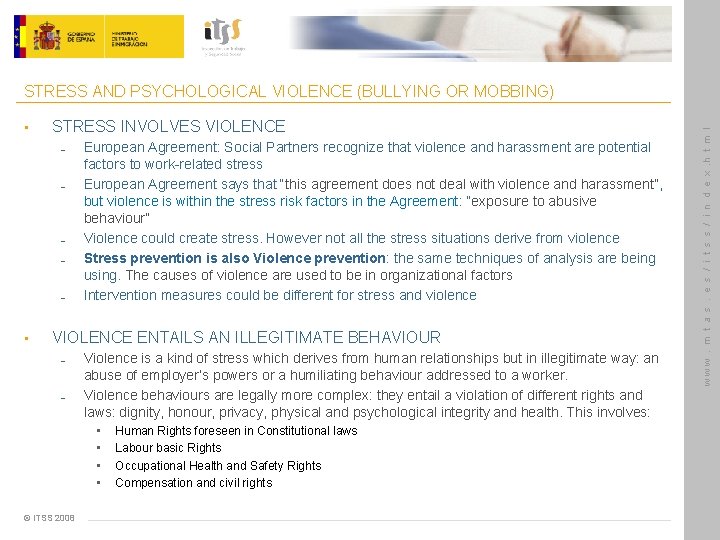
• STRESS INVOLVES VIOLENCE – – – • European Agreement: Social Partners recognize that violence and harassment are potential factors to work-related stress European Agreement says that “this agreement does not deal with violence and harassment”, but violence is within the stress risk factors in the Agreement: “exposure to abusive behaviour” Violence could create stress. However not all the stress situations derive from violence Stress prevention is also Violence prevention: the same techniques of analysis are being using. The causes of violence are used to be in organizational factors Intervention measures could be different for stress and violence VIOLENCE ENTAILS AN ILLEGITIMATE BEHAVIOUR – – Violence is a kind of stress which derives from human relationships but in illegitimate way: an abuse of employer’s powers or a humiliating behaviour addressed to a worker. Violence behaviours are legally more complex: they entail a violation of different rights and laws: dignity, honour, privacy, physical and psychological integrity and health. This involves: • • © ITSS 2008 Human Rights foreseen in Constitutional laws Labour basic Rights Occupational Health and Safety Rights Compensation and civil rights w w w. m t a s. e s / i t s s / i n d e x. h t m l STRESS AND PSYCHOLOGICAL VIOLENCE (BULLYING OR MOBBING)
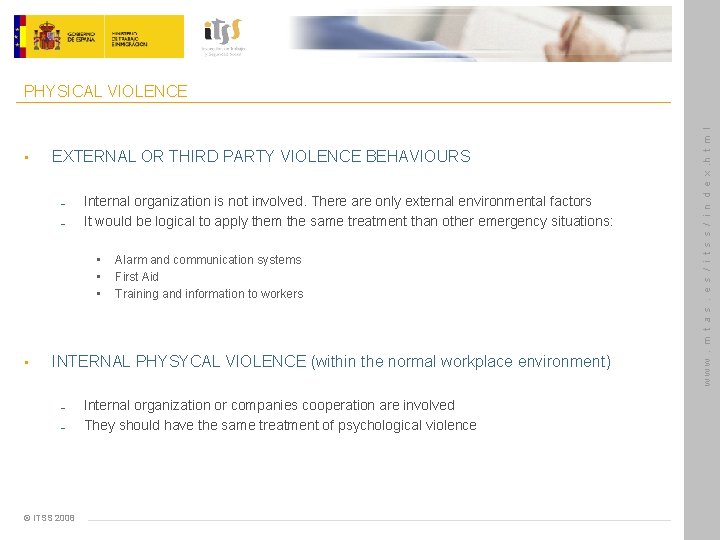
• EXTERNAL OR THIRD PARTY VIOLENCE BEHAVIOURS – – Internal organization is not involved. There are only external environmental factors It would be logical to apply them the same treatment than other emergency situations: • • Alarm and communication systems First Aid Training and information to workers INTERNAL PHYSYCAL VIOLENCE (within the normal workplace environment) – – © ITSS 2008 Internal organization or companies cooperation are involved They should have the same treatment of psychological violence w w w. m t a s. e s / i t s s / i n d e x. h t m l PHYSICAL VIOLENCE
• THE DIRECTIVE 2002/73 HAS INTRODUCE NEW EMPLOYER’S OBLIGATION REGARDING THE FORMS OF VIOLENCE RELATED TO SEX: – Sexual harassment – Harassment related to sex: it is a kind of bullying behaviour – The Directive requires the Member States to prevent these behaviours (Art. 1. 5. ): • Member States have transposed the Directives • Legal prevention requirements are now within the framework of Labour Law in some States and within the framework of Occupational Health and Safety Law in others • Some employers prefer the Labour Law framework: more flexible, subjected to bargaining • Some workers prefer the OHS framework: workers participation is guaranteed © ITSS 2008 w w w. m t a s. e s / i t s s / i n d e x. h t m l EQUAL TREATMENT
• • ILO has no instruments and EU has Manuals (European Agency) STATE LEGISLATIONS – – • Legal requirement to prevent psychosocial risks: Belgium, The Netherlands and Norway Psychosocial risks are within the expert training: Italy, Spain DIFFERENT CONCEPTIONS: – Depending on the result: • Psychosocial risks would be those related with psychological illnesses – Depending on the origin • Psychosocial risks as a part of Ergonomics • As a result of the interaction between organization and workers (ILO) • Organizational and environmental factors which could damage workers’ health (European Agency) © ITSS 2008 w w w. m t a s. e s / i t s s / i n d e x. h t m l PSYCHOSOCIAL RISKS
• Ergonomics (or human factors) is the scientific discipline concerned with the understanding of interactions among humans and other elements of a system, and the profession that applies theory, principles, data and methods to design in order to optimize human well-being and overall system performance. “Organizational ergonomics is concerned with the optimization of socio-technical systems, including their organizational structures, policies, and processes”. (International Ergonomic Association). • Ergonomics is the term more used in North America. • It is also a conception extended in France, Italy and Spain • METHODOLOGY: instruments to carry out the ergonomic assessment: • – © ITSS 2008 The analysis usually affects the individual. The job content is analysed but not always the job context: the macro-organizational subjects w w w. m t a s. e s / i t s s / i n d e x. h t m l PSYCHOSOCIAL RISKS AS A PART OF ERGONOMICS
• PSYCHO-SOCIAL MEANS THE RELATIONSHIPS BETWEEN THE INDIVIDUAL (PSYQUE) AND THE SOCIETY – In our field, this would literally mean that all the relationships between the workers and all their social environment: job, family, town, etc are involved. • European Agreement on work-related stress foresees individual risks factors: subjective factors (emotional and social pressures, feeling unable to cope, perceived lack of support, etc. ). • METHODOLOGY: Differentiated analysis of the organisational risks factors and individual risks factors – – – © ITSS 2008 The questionnaire is nominative and personal Organisational risk analysis is public, with workers reps participation Individual risk analysis should be confidential and carried out by a doctor w w w. m t a s. e s / i t s s / i n d e x. h t m l PSYCHOSOCIAL AS THE INTERACTION BETWEEN WORKERS AND ORGANIZATION
• • • European Agency: organisational and environmental aspects which could damage the workers’ health This is the conception more used and extended in Europe METHODOLOGY: analysis of the organisational aspects, not the individual – – The questionnaire is anonymous: individual situations can not be analysed, only collective situations The treatment of individual problems should be carried out through the medical surveillance • The analysed risks are not properly psychosocial but organisational • The term “organisational risks” would be more precise and better understood by employers and workers: – – © ITSS 2008 Organisation is the power field of the employers. This word could serve them to define the scope of their liability on labour risks. Workers could be relate “psychosocial” to mental health surveillance. The word “organisational” describes better the aim of the risks assessment. w w w. m t a s. e s / i t s s / i n d e x. h t m l PSYCHOSOCIAL RISKS AS ORGANISATIONAL RISKS
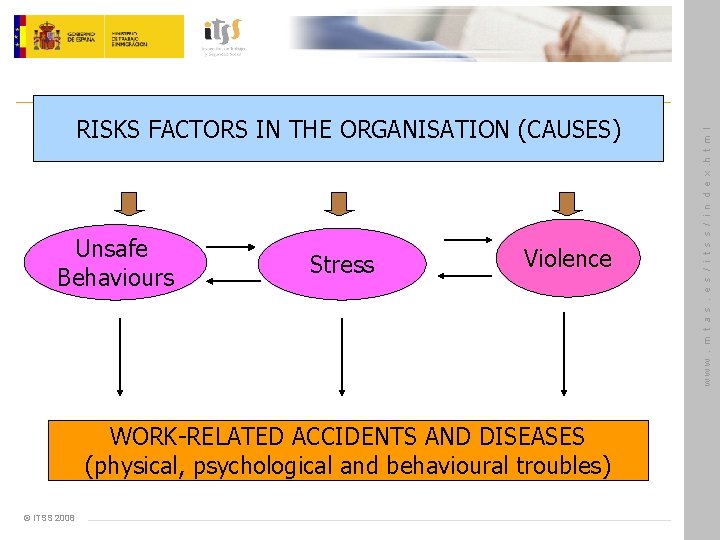
• • • Reports point out that a bad work organisation is the cause of the most of work-related accidents in a 80 to 90 per 100. UNSAFE BEHAVIORS ARE THE HUMAN ERRORS AND NORMS VIOLATION WHAT ARE THE CAUSES OF ERRORS: STRESS AND ORGANISATIONAL FACTORS – – • WHAT ARE THE CAUSES OF INTERNAL NORMS VIOLATION – • • The undue work charge and work rythim The lack or undue training The lack of good communications A bad tasks distribution, etc. Lack of surveillance and/or incentives to act correctly Usually, this problems are only analysed in a reactive manner (work-related accident investigation) but not in a pro-active and preventive manner in the risks assessment Organisational risks assessment would be the indispensible instrument to complete risks assessment process. © ITSS 2008 w w w. m t a s. e s / i t s s / i n d e x. h t m l UNSAFE BEHAVIOURS WHICH DERIVE FROM THE ORGANISATION
• Selection of companies with high rate work-related accidents or high rate of serious work-related accidents • The company should make the following actions – – – Psychosocial risks assessment using any method Assessment of the work-related risks perception by the workers using a method of the Spanish National Institute for Safety and Hygiene at Work (NTP 580 INSHT) An audit on how the prevention tasks are integrated in the usual company management • Results are analysed jointly by workers and employer to identify the problems and the more suitable measures to avoid and reduce them. • Execution of the measure: – – – © ITSS 2008 Plan to implement organisational changes Measures of periodic surveillance Technical measure to avoid human errors w w w. m t a s. e s / i t s s / i n d e x. h t m l PILOT EXPERIENCE IN THE LABOUR INSPECTORATE OF BISCAY
RISKS ASSESSMENT © ITSS 2008 w w w. m t a s. e s / i t s s / i n d e x. h t m l SECOND
Unsafe Behaviours Stress Violence WORK-RELATED ACCIDENTS AND DISEASES (physical, psychological and behavioural troubles) © ITSS 2008 w w w. m t a s. e s / i t s s / i n d e x. h t m l RISKS FACTORS IN THE ORGANISATION (CAUSES)
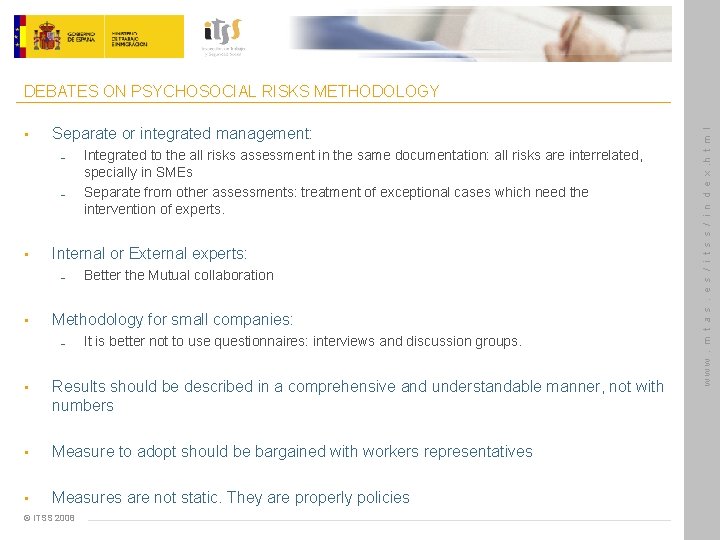
• Separate or integrated management: – – • Internal or External experts: – • Integrated to the all risks assessment in the same documentation: all risks are interrelated, specially in SMEs Separate from other assessments: treatment of exceptional cases which need the intervention of experts. Better the Mutual collaboration Methodology for small companies: – It is better not to use questionnaires: interviews and discussion groups. • Results should be described in a comprehensive and understandable manner, not with numbers • Measure to adopt should be bargained with workers representatives • Measures are not static. They are properly policies © ITSS 2008 w w w. m t a s. e s / i t s s / i n d e x. h t m l DEBATES ON PSYCHOSOCIAL RISKS METHODOLOGY
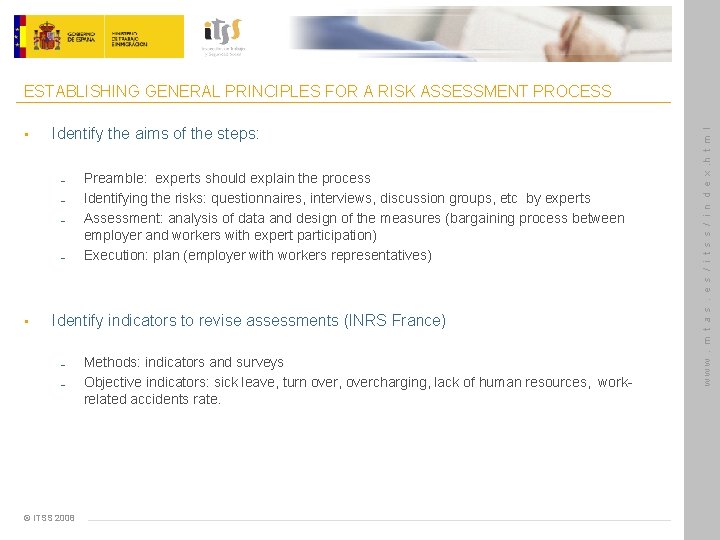
• Identify the aims of the steps: – – • Preamble: experts should explain the process Identifying the risks: questionnaires, interviews, discussion groups, etc by experts Assessment: analysis of data and design of the measures (bargaining process between employer and workers with expert participation) Execution: plan (employer with workers representatives) Identify indicators to revise assessments (INRS France) – – © ITSS 2008 Methods: indicators and surveys Objective indicators: sick leave, turn over, overcharging, lack of human resources, workrelated accidents rate. w w w. m t a s. e s / i t s s / i n d e x. h t m l ESTABLISHING GENERAL PRINCIPLES FOR A RISK ASSESSMENT PROCESS
INTERVENTION FORMS © ITSS 2008 w w w. m t a s. e s / i t s s / i n d e x. h t m l THIRD
MEASURES: WITHIN THE COMPANY PREVENTION (before) INTERVENTION (during) PROTECTION (after) ASSESSMENT OF RISKS FACTORS INTERNAL PROCEDURES FOR DISPUTES REHABILITATION MEASURES POLICIES INVESTIGATION OF ILL-HEALTH OTHER MEASURES GOVERNMENT ACTIONS © ITSS 2008 COUNSELING MEDIATION SOCIAL SECURITY BENEFITS ENFORCEMENT w w w. m t a s. e s / i t s s / i n d e x. h t m l HOW TO FACE VIOLENCE AND HARASSMENT
Muchas gracias por vuestra atención Thanks for your attention © ITSS 2008 w w w. m t a s. e s / i t s s / i n d e x. h t m l l