
PREVENTING RUNWAY COLLISIONS Sudden High Energy Runway Conflicts
- Slides: 42
PREVENTING RUNWAY COLLISIONS Sudden High Energy Runway Conflicts (SHERC) Mike Edwards Homefield ATM Safety June 2017
WHAT IS A SHERC EVENT ? Sudden High Energy Runway Conflict (SHERC) is a sub-set of Runway Incursion. So, why make a separate study of this small area ? Mike Edwards Homefield ATM Safety June 2017
WHY STUDY SHERC EVENTS ? • With the active cooperation of the ANSPs, EUROCONTROL studied 57 of the 110 Severity A&B Runway Incursions reported across Europe in 2014. • 13 of the 57 events were classified as Severity A • 3 of the 13 Severity A events were SHERC events • 2 of the 3 events were resolved by last minute pilot collision avoidance In the other event collision was avoided by providence (luck). Mike Edwards Homefield ATM Safety June 2017
WHY STUDY SHERC EVENTS ? • Sudden High Energy Runway Collision is Our Worst Case Scenario ! Our Nightmare ! • Runway Collision was narrowly avoided 3 times in one year. That’s Why ! Mike Edwards Homefield ATM Safety June 2017
WE NEED TO KNOW • What barriers currently exist to help both ATC, pilots and ground operators to avoid SHERC events? • Are these current defences as strong as reasonably practical ? • If not, Is there a quick fix? • What can be done now and in the medium term? Mike Edwards Homefield ATM Safety June 2017
CAN WE DEFINE A SHERC EVENT ? Not Precisely • A SHERC event typically involves a runway conflict in which, once initiated, the time available to ATC to prevent a collision is likely to be less than the time so needed. Mike Edwards Homefield ATM Safety June 2017
SHERC Guidelines üRunway Occupancy occurred immediately before the Runway Incursion üSudden to those involved üHigh Energy üAvailable Time close to or less than Needed Time üCollision Avoidance üSeparation criteria at CPA Mike Edwards Homefield ATM Safety June 2017
Runway OCCUPANCY occurred immediately before Runway INCURSION The vehicle or second aircraft should not have been on the runway for more than 30 seconds before the “incursion” i. e. the clearance to land or take-off. This removes events where a vehicle or aircraft has been present on the runway for some time. Mike Edwards Homefield ATM Safety June 2017
SUDDEN In order for the event to be categorised as sudden: üA landing aircraft should be not more than 600 ft/2 nm final at the time of the incursion. These accords with the FAROS acquisition protocol of 500 ft. üAn aircraft cleared for take-off must be already lined up at the time of the runway incursion. Mike Edwards Homefield ATM Safety June 2017
HIGH ENERGY In the case of an aircraft taking off; it must have reached at least 80 kts at the time of pilot becoming aware of the conflict. In the case of a landing aircraft; it must have an IAS of at least 100 kts at the time of pilot becoming aware of the conflict. Mike Edwards Homefield ATM Safety June 2017
NEEDED TIME - LANDING ATC or Pilot may become immediately aware though visual detection. If not, research shows that the average time for ATC to react to an alert is 6. 9 secs (within one standard deviation), The same research concluded that the average time for a pilot to subsequently react is 2. 3 seconds. The average time from a systems alert to the commencement of deceleration is 9 - 10 seconds. During this time a landing aircraft (at 130 kts) will travel around 600 m. (4000 m / min) Deceleration to stop with maximum braking – add another 17 seconds and 600 m NEEDED TIME from A-SMGCS alert (or similar) to landing aircraft stopping is around 26 seconds or 1200 m distance. Mike Edwards Homefield ATM Safety June 2017
NEEDED TIME – ON TAKE-OFF. From Alert to commencement of deceleration an aircraft on take-off roll will travel approx. 280 m. Deceleration to stop with maximum braking – add another 570 m NEEDED TIME from A-SMGCS alert (or similar) is the about 21 seconds or 850 m distance. In other words, if A-SMGCS triggers less than 21 secs before CPA – the aircraft will not stop in time. Mike Edwards Homefield ATM Safety June 2017
COLLISION AVOIDANCE There must be evidence of deliberate action taking to avoid the collision or increase the minimum distance at CPA. A sighting report with no apparent deviation from the norm is not a SHERC. Mike Edwards Homefield ATM Safety June 2017
SEPARATION remaining at CPA The minimum separation remaining at CPA: not more than 500 m or 400 ft vertically. Mike Edwards Homefield ATM Safety June 2017
SO, HOW DOES A SHERC EVENT START 4 SCENARIO SOURCES • An incorrect ATC clearance to either an aircraft landing/taking-off, or an aircraft/vehicle on the ground resulting in an incorrect presence on the runway. • A non-conformance with an ATC clearance by an aircraft landing/taking-off, or by an aircraft/vehicle on the ground, due to spatial/positional confusion, resulting in an incorrect presence on the runway. Mike Edwards Homefield ATM Safety June 2017
SO, HOW DOES A DOES SHERC EVENT START SCENARIO SOURCES • A non-conformance with ATC clearance by an aircraft landing/taking-off, or by an aircraft/vehicle on the ground, due to misinterpretation or mishear of the clearance, resulting in an incorrect presence on the runway • A non-conformance with ATC clearance by an aircraft landing/taking-off, or by an aircraft/vehicle on the ground, due poor CRM and/or incorrect execution of the plan, resulting in an incorrect presence on the runway. Mike Edwards Homefield ATM Safety June 2017
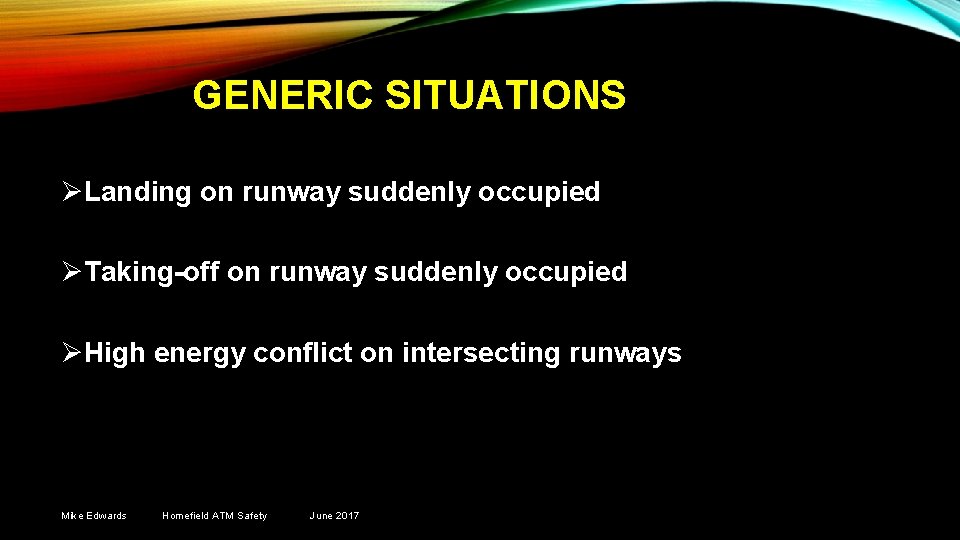
GENERIC SITUATIONS ØLanding on runway suddenly occupied ØTaking-off on runway suddenly occupied ØHigh energy conflict on intersecting runways Mike Edwards Homefield ATM Safety June 2017
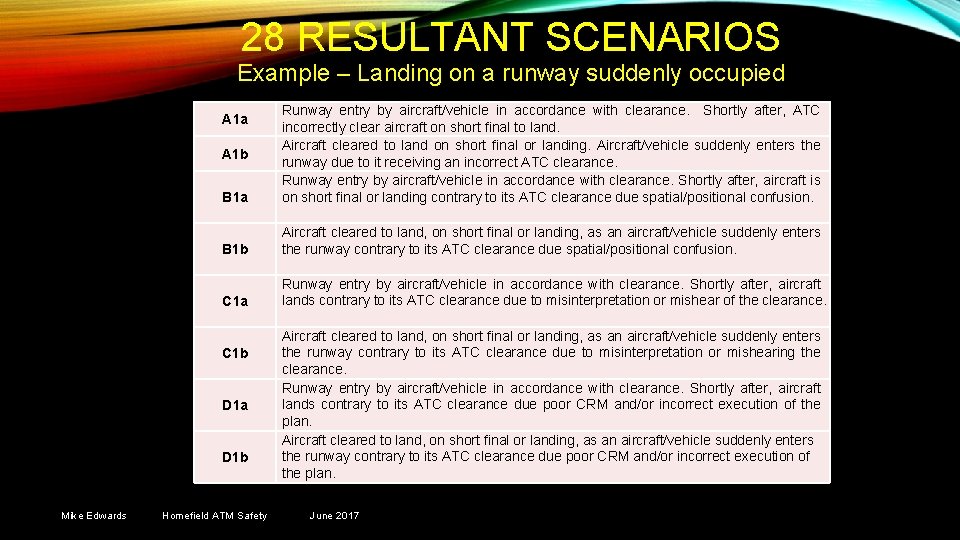
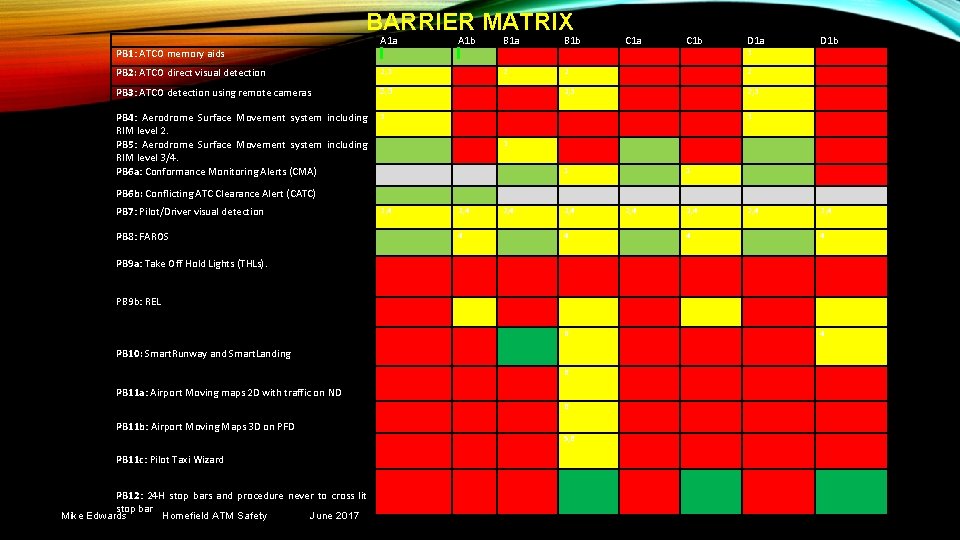
28 RESULTANT SCENARIOS Example – Landing on a runway suddenly occupied B 1 a Runway entry by aircraft/vehicle in accordance with clearance. Shortly after, ATC incorrectly clear aircraft on short final to land. Aircraft cleared to land on short final or landing. Aircraft/vehicle suddenly enters the runway due to it receiving an incorrect ATC clearance. Runway entry by aircraft/vehicle in accordance with clearance. Shortly after, aircraft is on short final or landing contrary to its ATC clearance due spatial/positional confusion. B 1 b Aircraft cleared to land, on short final or landing, as an aircraft/vehicle suddenly enters the runway contrary to its ATC clearance due spatial/positional confusion. C 1 a Runway entry by aircraft/vehicle in accordance with clearance. Shortly after, aircraft lands contrary to its ATC clearance due to misinterpretation or mishear of the clearance. A 1 a A 1 b C 1 b D 1 a D 1 b Mike Edwards Homefield ATM Safety Aircraft cleared to land, on short final or landing, as an aircraft/vehicle suddenly enters the runway contrary to its ATC clearance due to misinterpretation or mishearing the clearance. Runway entry by aircraft/vehicle in accordance with clearance. Shortly after, aircraft lands contrary to its ATC clearance due poor CRM and/or incorrect execution of the plan. Aircraft cleared to land, on short final or landing, as an aircraft/vehicle suddenly enters the runway contrary to its ATC clearance due poor CRM and/or incorrect execution of the plan. June 2017
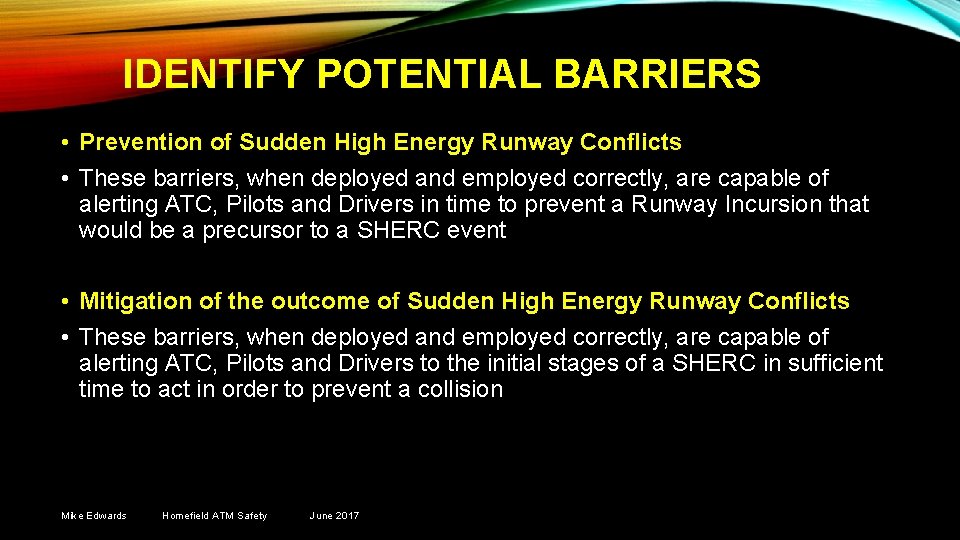
IDENTIFY POTENTIAL BARRIERS • Prevention of Sudden High Energy Runway Conflicts • These barriers, when deployed and employed correctly, are capable of alerting ATC, Pilots and Drivers in time to prevent a Runway Incursion that would be a precursor to a SHERC event • Mitigation of the outcome of Sudden High Energy Runway Conflicts • These barriers, when deployed and employed correctly, are capable of alerting ATC, Pilots and Drivers to the initial stages of a SHERC in sufficient time to act in order to prevent a collision Mike Edwards Homefield ATM Safety June 2017
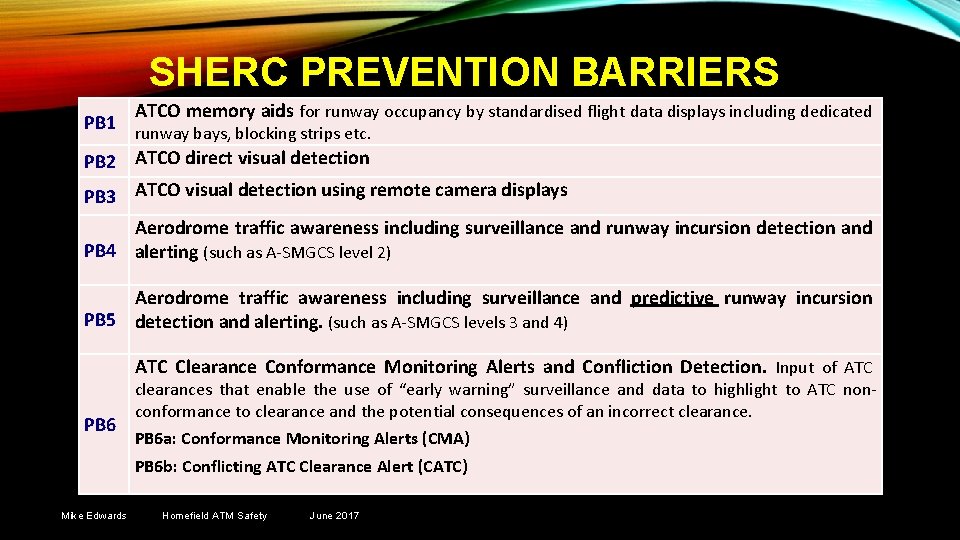
SHERC PREVENTION BARRIERS PB 1 ATCO memory aids for runway occupancy by standardised flight data displays including dedicated runway bays, blocking strips etc. PB 2 ATCO direct visual detection PB 3 ATCO visual detection using remote camera displays Aerodrome traffic awareness including surveillance and runway incursion detection and PB 4 alerting (such as A-SMGCS level 2) Aerodrome traffic awareness including surveillance and predictive runway incursion PB 5 detection and alerting. (such as A-SMGCS levels 3 and 4) ATC Clearance Conformance Monitoring Alerts and Confliction Detection. Input of ATC PB 6 clearances that enable the use of “early warning” surveillance and data to highlight to ATC nonconformance to clearance and the potential consequences of an incorrect clearance. PB 6 a: Conformance Monitoring Alerts (CMA) PB 6 b: Conflicting ATC Clearance Alert (CATC) Mike Edwards Homefield ATM Safety June 2017
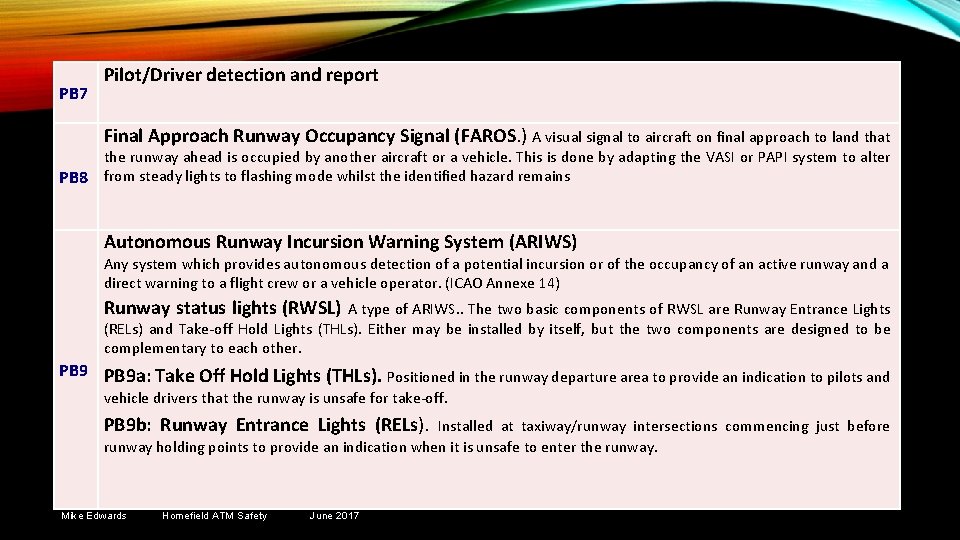
PB 7 Pilot/Driver detection and report Final Approach Runway Occupancy Signal (FAROS. ) A visual signal to aircraft on final approach to land that the runway ahead is occupied by another aircraft or a vehicle. This is done by adapting the VASI or PAPI system to alter PB 8 from steady lights to flashing mode whilst the identified hazard remains Autonomous Runway Incursion Warning System (ARIWS) Any system which provides autonomous detection of a potential incursion or of the occupancy of an active runway and a direct warning to a flight crew or a vehicle operator. (ICAO Annexe 14) Runway status lights (RWSL) A type of ARIWS. . The two basic components of RWSL are Runway Entrance Lights (RELs) and Take-off Hold Lights (THLs). Either may be installed by itself, but the two components are designed to be complementary to each other. PB 9 a: Take Off Hold Lights (THLs). Positioned in the runway departure area to provide an indication to pilots and vehicle drivers that the runway is unsafe for take-off. PB 9 b: Runway Entrance Lights (RELs). Installed at taxiway/runway intersections commencing just before runway holding points to provide an indication when it is unsafe to enter the runway. Mike Edwards Homefield ATM Safety June 2017
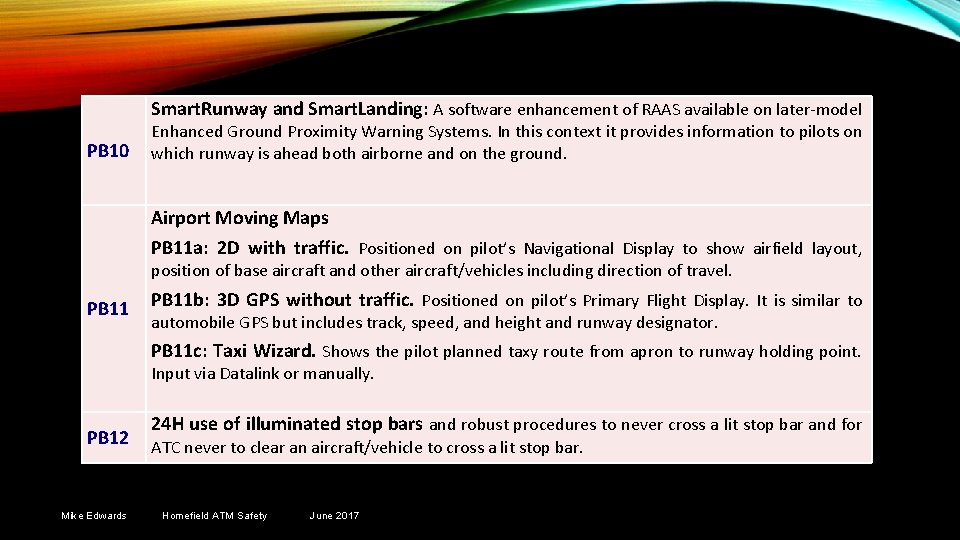
Smart. Runway and Smart. Landing: A software enhancement of RAAS available on later-model PB 10 Enhanced Ground Proximity Warning Systems. In this context it provides information to pilots on which runway is ahead both airborne and on the ground. Airport Moving Maps PB 11 a: 2 D with traffic. Positioned on pilot’s Navigational Display to show airfield layout, position of base aircraft and other aircraft/vehicles including direction of travel. PB 11 b: 3 D GPS without traffic. Positioned on pilot’s Primary Flight Display. It is similar to automobile GPS but includes track, speed, and height and runway designator. PB 11 c: Taxi Wizard. Shows the pilot planned taxy route from apron to runway holding point. Input via Datalink or manually. PB 12 Mike Edwards 24 H use of illuminated stop bars and robust procedures to never cross a lit stop bar and for ATC never to clear an aircraft/vehicle to cross a lit stop bar. Homefield ATM Safety June 2017
3 D AIRPORT MOVING MAP (COURTESY HONEYWELL INC) Mike Edwards Homefield ATM Safety June 2017
2 D AIRPORT MOVING MAP (COURTESY HONEYWELL INC) Mike Edwards Homefield ATM Safety June 2017
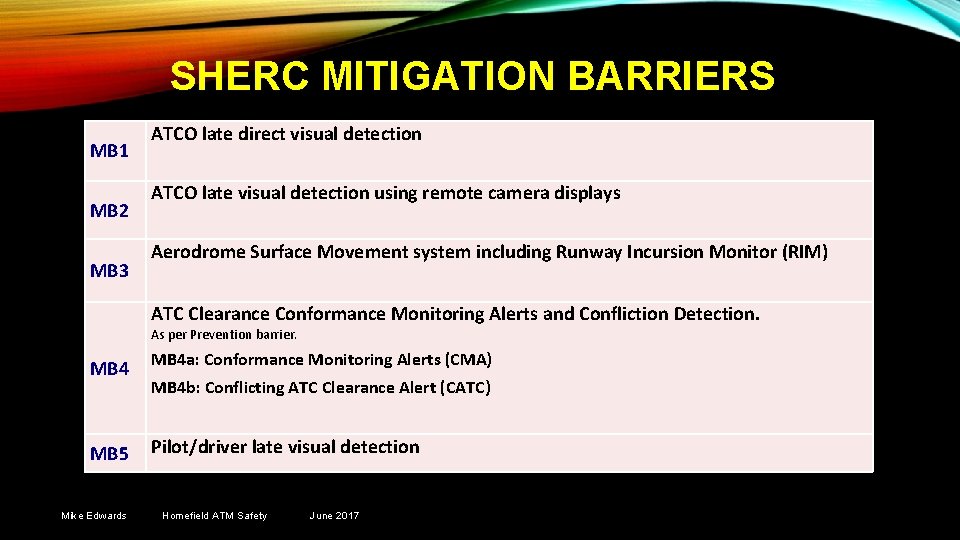
SHERC MITIGATION BARRIERS MB 1 MB 2 MB 3 ATCO late direct visual detection ATCO late visual detection using remote camera displays Aerodrome Surface Movement system including Runway Incursion Monitor (RIM) ATC Clearance Conformance Monitoring Alerts and Confliction Detection. As per Prevention barrier. MB 4 a: Conformance Monitoring Alerts (CMA) MB 5 Pilot/driver late visual detection Mike Edwards MB 4 b: Conflicting ATC Clearance Alert (CATC) Homefield ATM Safety June 2017
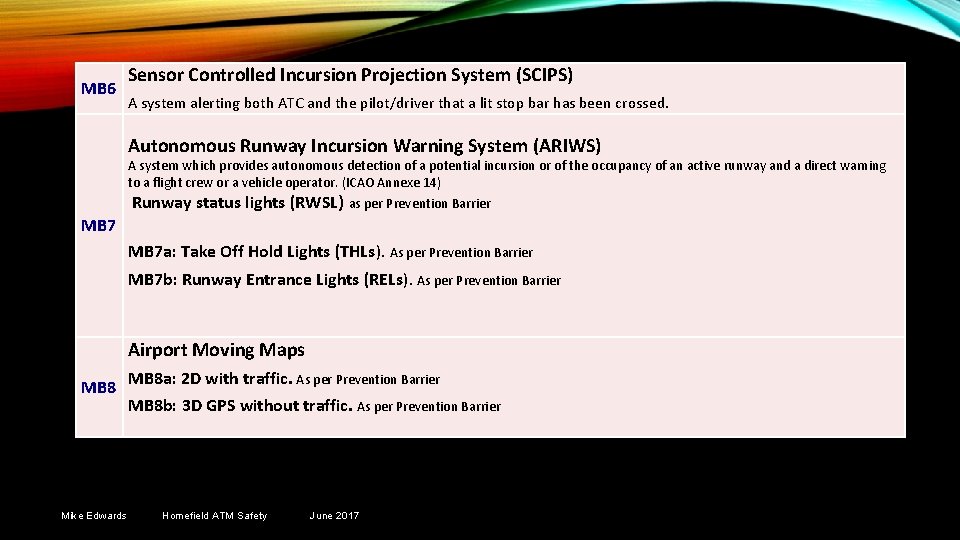
MB 6 Sensor Controlled Incursion Projection System (SCIPS) A system alerting both ATC and the pilot/driver that a lit stop bar has been crossed. Autonomous Runway Incursion Warning System (ARIWS) A system which provides autonomous detection of a potential incursion or of the occupancy of an active runway and a direct warning to a flight crew or a vehicle operator. (ICAO Annexe 14) Runway status lights (RWSL) as per Prevention Barrier MB 7 a: Take Off Hold Lights (THLs). As per Prevention Barrier MB 7 b: Runway Entrance Lights (RELs). As per Prevention Barrier Airport Moving Maps MB 8 Mike Edwards MB 8 a: 2 D with traffic. As per Prevention Barrier MB 8 b: 3 D GPS without traffic. As per Prevention Barrier Homefield ATM Safety June 2017
BARRIER MATRIX PB 1: ATCO memory aids A 1 a PB 2: ATCO direct visual detection 2, 3 PB 3: ATCO detection using remote cameras 2, 3 PB 4: Aerodrome Surface Movement system including RIM level 2. PB 5: Aerodrome Surface Movement system including RIM level 3/4. PB 6 a: Conformance Monitoring Alerts (CMA) 3 A 1 b B 1 a B 1 b C 1 a C 1 b D 1 a 2 2, 3 3 D 1 b 3 3 1 1 PB 6 b: Conflicting ATC Clearance Alert (CATC) PB 7: Pilot/Driver visual detection PB 8: FAROS 2, 4 2, 4 4 PB 9 a: Take Off Hold Lights (THLs). PB 9 b: REL 6 PB 10: Smart. Runway and Smart. Landing 6 PB 11 a: Airport Moving maps 2 D with traffic on ND 6 PB 11 b: Airport Moving Maps 3 D on PFD PB 11 c: Pilot Taxi Wizard PB 12: 24 H stop bars and procedure never to cross lit stop bar Mike Edwards Homefield ATM Safety June 2017 5, 6 4
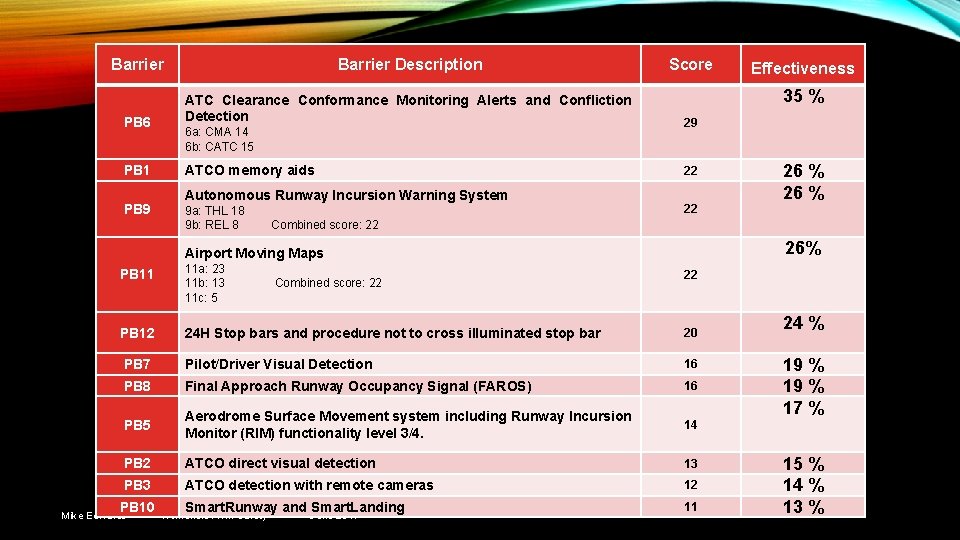
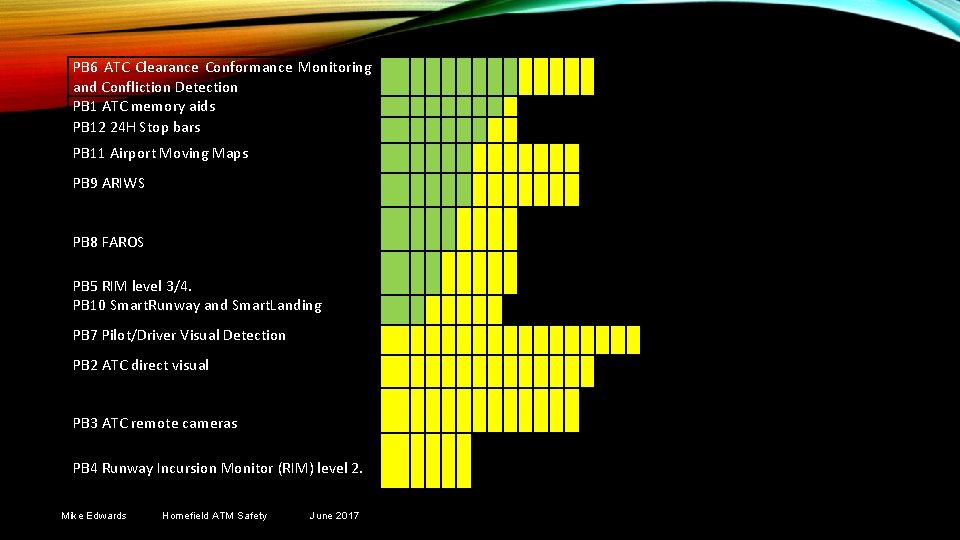
Barrier Description PB 6 ATC Clearance Conformance Monitoring Alerts and Confliction Detection PB 1 ATCO memory aids PB 9 6 a: CMA 14 6 b: CATC 15 Autonomous Runway Incursion Warning System 9 a: THL 18 9 b: REL 8 Score 35 % 29 22 Combined score: 22 26% PB 11 11 a: 23 11 b: 13 11 c: 5 PB 12 24 H Stop bars and procedure not to cross illuminated stop bar 20 PB 7 Pilot/Driver Visual Detection 16 PB 8 Final Approach Runway Occupancy Signal (FAROS) 16 PB 5 Aerodrome Surface Movement system including Runway Incursion Monitor (RIM) functionality level 3/4. 14 PB 2 ATCO direct visual detection 13 PB 3 ATCO detection with remote cameras 12 Smart. Runway and Smart. Landing 11 PB 10 Homefield ATM Safety 26 % 22 Airport Moving Maps Mike Edwards Effectiveness Combined score: 22 June 2017 22 24 % 19 % 17 % 15 % 14 % 13 %
PB 6 ATC Clearance Conformance Monitoring and Confliction Detection PB 1 ATC memory aids PB 12 24 H Stop bars PB 11 Airport Moving Maps PB 9 ARIWS PB 8 FAROS PB 5 RIM level 3/4. PB 10 Smart. Runway and Smart. Landing PB 7 Pilot/Driver Visual Detection PB 2 ATC direct visual PB 3 ATC remote cameras PB 4 Runway Incursion Monitor (RIM) level 2. Mike Edwards Homefield ATM Safety June 2017
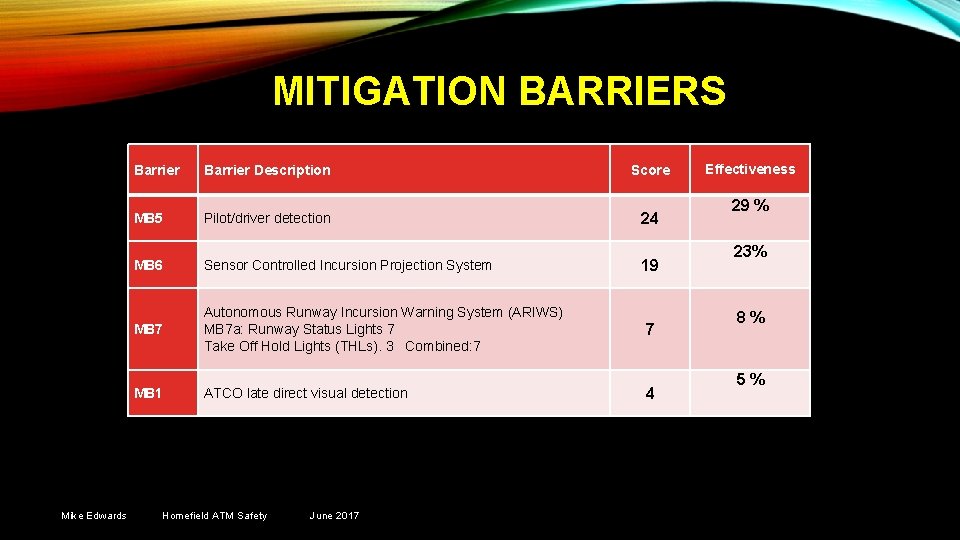
MITIGATION BARRIERS Mike Edwards Barrier Description MB 5 Pilot/driver detection 24 MB 6 Sensor Controlled Incursion Projection System 19 MB 7 Autonomous Runway Incursion Warning System (ARIWS) MB 7 a: Runway Status Lights 7 Take Off Hold Lights (THLs). 3 Combined: 7 7 MB 1 ATCO late direct visual detection 4 Homefield ATM Safety June 2017 Score Effectiveness 29 % 23% 8% 5%
REVIEW OF ACTUAL EVENTS • What were the principal Contributing factors? • What was the ACTUAL recovery barrier? • What ATC barriers were breached? • What barriers, if deployed, could have prevented the event or reduced the risk of collision? • Do the barriers acting in the real world accord with the barriers expected in the Generic Study? Mike Edwards Homefield ATM Safety June 2017
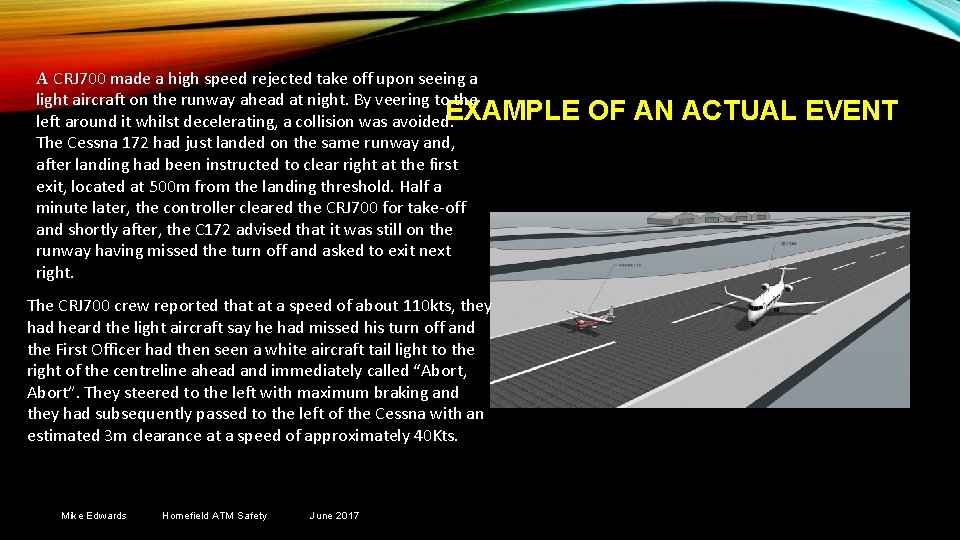
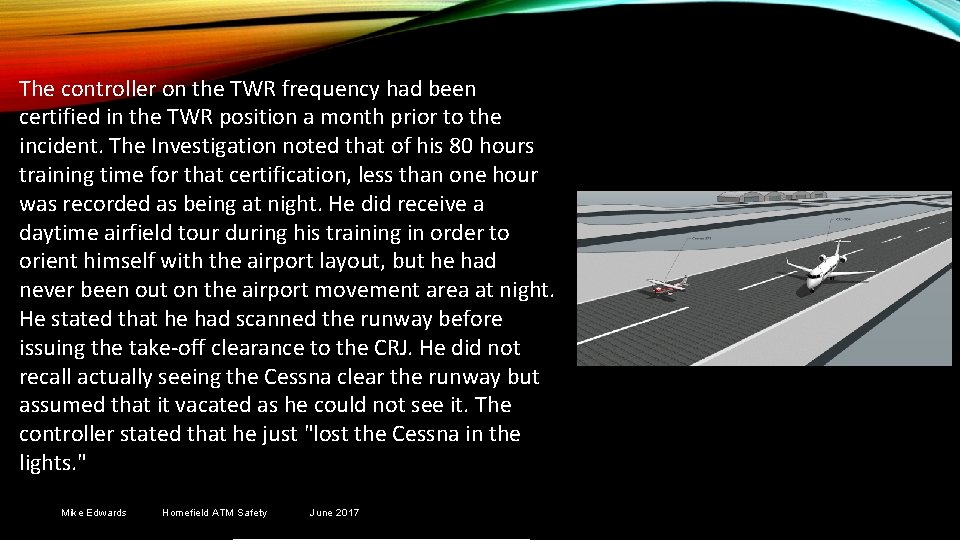
A CRJ 700 made a high speed rejected take off upon seeing a light aircraft on the runway ahead at night. By veering to the EXAMPLE left around it whilst decelerating, a collision was avoided. The Cessna 172 had just landed on the same runway and, after landing had been instructed to clear right at the first exit, located at 500 m from the landing threshold. Half a minute later, the controller cleared the CRJ 700 for take-off and shortly after, the C 172 advised that it was still on the runway having missed the turn off and asked to exit next right. The CRJ 700 crew reported that at a speed of about 110 kts, they had heard the light aircraft say he had missed his turn off and the First Officer had then seen a white aircraft tail light to the right of the centreline ahead and immediately called “Abort, Abort”. They steered to the left with maximum braking and they had subsequently passed to the left of the Cessna with an estimated 3 m clearance at a speed of approximately 40 Kts. Mike Edwards Homefield ATM Safety June 2017 OF AN ACTUAL EVENT
The controller on the TWR frequency had been certified in the TWR position a month prior to the incident. The Investigation noted that of his 80 hours training time for that certification, less than one hour was recorded as being at night. He did receive a daytime airfield tour during his training in order to orient himself with the airport layout, but he had never been out on the airport movement area at night. He stated that he had scanned the runway before issuing the take-off clearance to the CRJ. He did not recall actually seeing the Cessna clear the runway but assumed that it vacated as he could not see it. The controller stated that he just "lost the Cessna in the lights. " Mike Edwards Homefield ATM Safety June 2017
ATC Contributing factors: Perception – Misperceive visual information Decision – Incorrect plan to give take-off clearance without positive evidence of rwy clearance Training – Lack of completeness Training – Task familiarity Actual Recovery Barrier: MB 5 Pilot visual detection Mike Edwards Homefield ATM Safety June 2017
Barriers breached: PB 2 ATC direct visual detection PBP Correct use of ATC procedures re- runway vacation MB 1 ATC late direct visual detection Remaining barriers available that could have reduced risk of collision: X Nil Barriers that, if deployed, could have prevented the runway incursion and/or reduced risk of collision: PB 9 a Take Off Hold Lights Mike Edwards Homefield ATM Safety June 2017
CONTRIBUTING FACTORS IN 19 ACTUAL EVENTS • • • ATC Perception x 24 Pilot Perception x 18 ATC Action x 14 ATC Memory x 11 Pilot CRM Issues x 6 Mike Edwards Homefield ATM Safety June 2017 • • • Not see conflict out of the window Not see other aircraft Convey incomplete information Forgot to scan Distraction
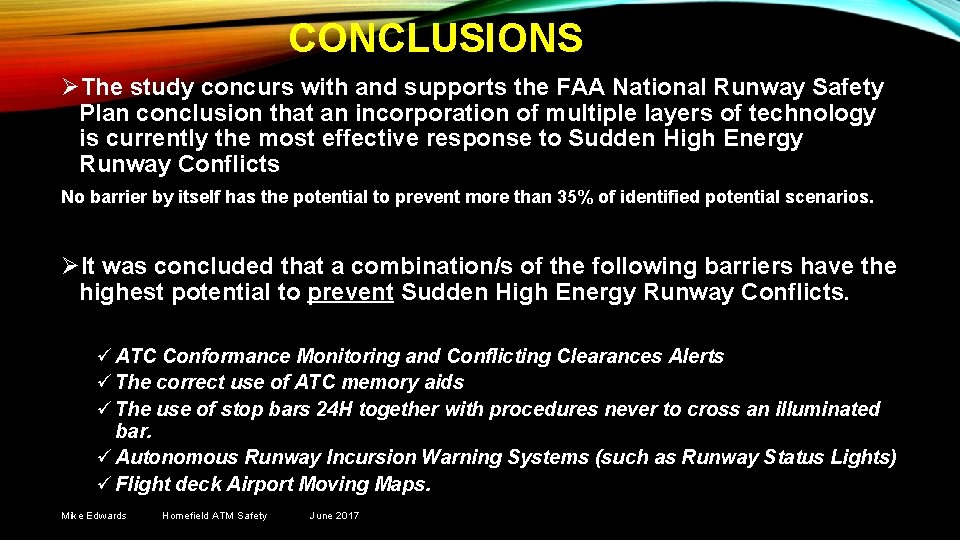
CONCLUSIONS ØThe study concurs with and supports the FAA National Runway Safety Plan conclusion that an incorporation of multiple layers of technology is currently the most effective response to Sudden High Energy Runway Conflicts No barrier by itself has the potential to prevent more than 35% of identified potential scenarios. ØIt was concluded that a combination/s of the following barriers have the highest potential to prevent Sudden High Energy Runway Conflicts. ü ATC Conformance Monitoring and Conflicting Clearances Alerts ü The correct use of ATC memory aids ü The use of stop bars 24 H together with procedures never to cross an illuminated bar. ü Autonomous Runway Incursion Warning Systems (such as Runway Status Lights) ü Flight deck Airport Moving Maps. Mike Edwards Homefield ATM Safety June 2017
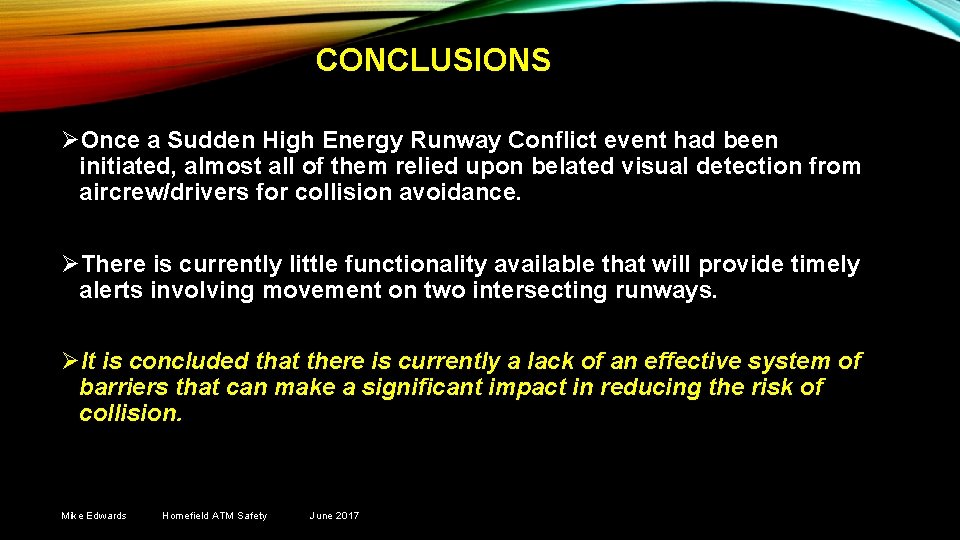
CONCLUSIONS ØOnce a Sudden High Energy Runway Conflict event had been initiated, almost all of them relied upon belated visual detection from aircrew/drivers for collision avoidance. ØThere is currently little functionality available that will provide timely alerts involving movement on two intersecting runways. ØIt is concluded that there is currently a lack of an effective system of barriers that can make a significant impact in reducing the risk of collision. Mike Edwards Homefield ATM Safety June 2017
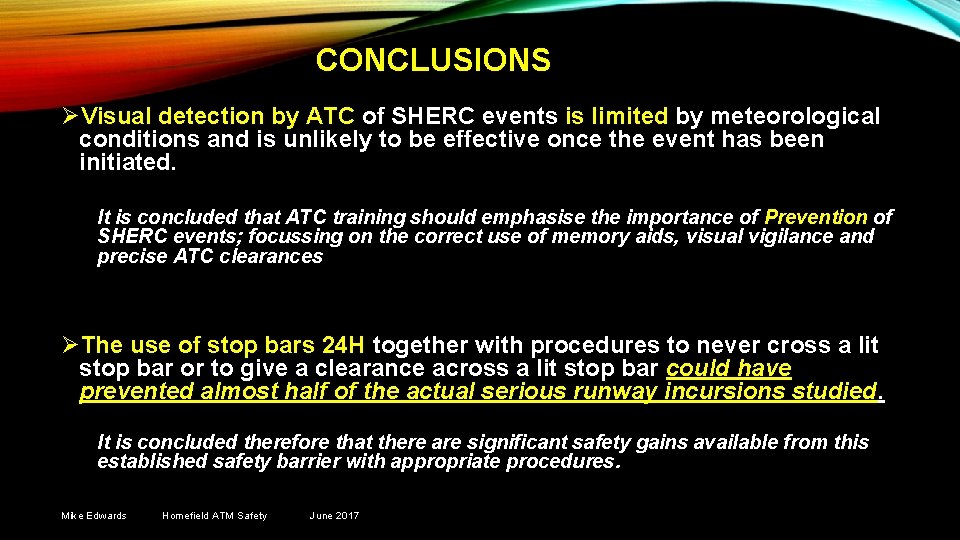
CONCLUSIONS ØVisual detection by ATC of SHERC events is limited by meteorological conditions and is unlikely to be effective once the event has been initiated. It is concluded that ATC training should emphasise the importance of Prevention of SHERC events; focussing on the correct use of memory aids, visual vigilance and precise ATC clearances ØThe use of stop bars 24 H together with procedures to never cross a lit stop bar or to give a clearance across a lit stop bar could have prevented almost half of the actual serious runway incursions studied. It is concluded therefore that there are significant safety gains available from this established safety barrier with appropriate procedures. Mike Edwards Homefield ATM Safety June 2017
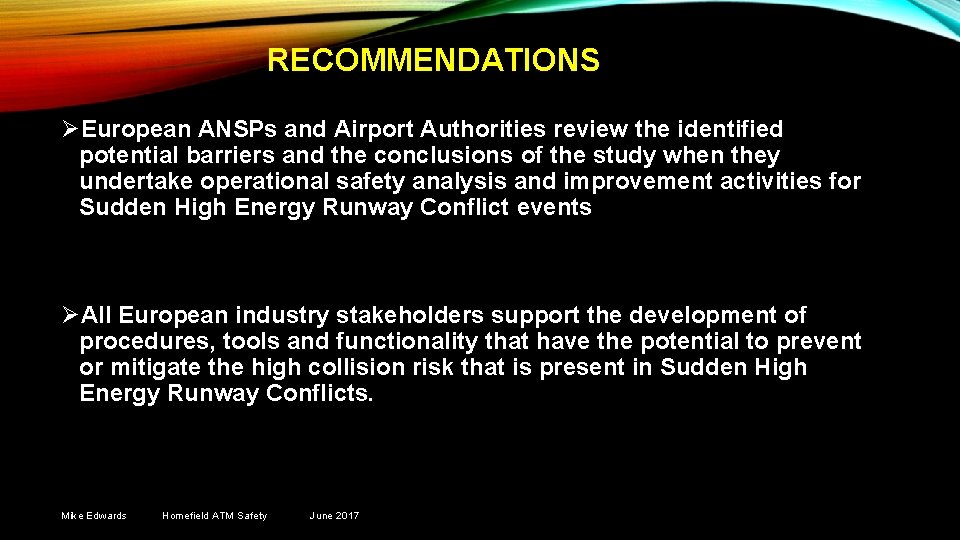
RECOMMENDATIONS ØEuropean ANSPs and Airport Authorities review the identified potential barriers and the conclusions of the study when they undertake operational safety analysis and improvement activities for Sudden High Energy Runway Conflict events ØAll European industry stakeholders support the development of procedures, tools and functionality that have the potential to prevent or mitigate the high collision risk that is present in Sudden High Energy Runway Conflicts. Mike Edwards Homefield ATM Safety June 2017
RECOMMENDATIONS ØAll European industry stakeholders promote and support the deployment and use of runway stop bars with procedures to never cross an illuminated stop bar or to give a clearance across an illuminated stop bar, subject to contingency procedures. ØAll European industry stakeholders to note that the consistent use of memory aids, correct and precise phraseology and visual vigilance by both ATC and Pilots/Drivers can combine to create a strong preventative barrier. Training and competence programmes should reinforce these essential activities. Mike Edwards Homefield ATM Safety June 2017
Thank you for your attention Questions and Comments please Mike Edwards Homefield ATM Safety June 2017