
Preventing Harassment Presented By 2014 PSA All rights
Preventing Harassment Presented By: © 2014 PSA. All rights reserved. .
Training Summary Preventing harassment is YOUR responsibility. This seminar provides a comprehensive review of harassment issues including legal definitions, concepts, landmark rulings and prevention strategies. This seminar will teach participants to better recognize and prevent harassment from occurring in the workplace.
Objectives Participants will learn to: • • Understand the legal definition of Harassment Understand the different Harassment categories Apply sexual harassment law to the workplace Determine appropriate and inappropriate behavior patterns Implement sexual harassment prevention strategies Respond to sexual harassment if victimized Foster a harassment-free workplace
What is Harassment? Harassment is: • A form of discrimination that violates the Title VII of the Civil Rights Act of 1964; the ADA, the ADEA, or GINA • Unwelcome verbal or physical conduct based on a person’s race, color, religion, sex or gender (including pregnancy), national origin, age (40 and over), disability (mental or physical), or genetic information. • Severe, pervasive and persistent conduct that unreasonably interferes with an employee’s work performance or creates an intimidating, hostile or offensive work environment. • An occurrence where an employee’s status or benefits are directly affected by the harassing conduct of a manager or person of authority. • Adverse employment actions (retaliation) against employees complained of harassment or discrimination or who participate in a complaint procedure.
Harassment Categories (other than Sexual Harassment) Race/Color Discrimination • Involves treating someone unfavorably because of his/her: – Racial group or perceived racial group – Race-linked characteristics (e. g. , hair texture, color, facial features) – Marriage to or association with someone of a particular race or color. • Color discrimination involves treating someone unfavorably because of skin color complexion.
Harassment Categories (other than Sexual Harassment) Religious Discrimination • • Involves treating a person unfavorably because of his/her religious beliefs. Religious discrimination can also involve treating someone differently because that person is married to (or associated with) an individual of a particular religion or because of his or her connection with a religious organization or group.
Harassment Categories (other than Sexual Harassment) Sex-Based Discrimination including Pregnancy • • Involves treating someone unfavorably because of that person's sex. Can involve treating someone less favorably because of his or her connection with an organization or group that is generally associated with people of a certain sex. Discrimination against an individual because that person is transgender is discrimination because of sex in violation of Title VII. This is also known as gender identity discrimination. Pregnancy discrimination involves treating a woman (an applicant or employee) unfavorably because of pregnancy, childbirth, or a medical condition related to pregnancy or childbirth.
Harassment Categories (other than Sexual Harassment) National Origin Discrimination • • Involves treating people unfavorably because they are from a particular country or part of the world, because of ethnicity or accent, or because they appear to be of a certain ethnic background (even if they are not). Can involve treating people unfavorably because they are married to (or associated with) a person of a certain national origin or because of their connection with an ethnic organization or group. Age Discrimination • • Involves treating someone less favorably because of his age. ADEA protects individuals who are 40 years of age or older from discimination
Harassment Categories (other than Sexual Harassment) Disability Discrimination • • Occurs when an employer treats a qualified individual with a disability who is an employee or applicant unfavorably because she has a disability. Also occurs when a covered employer or other entity treats an applicant or employee less favorably because: – There is a history of a disability (such as cancer that is controlled or in remission) – Because the person is believed to have a physical or mental impairment that is not transitory (lasting or expected to last six months or less) and minor (even if she does not have such an impairment) • The law also protects people from discrimination based on their relationship with a person with a disability (even if they do not themselves have a disability).
Harassment Categories (other than Sexual Harassment) Genetic Information Discrimination (GINA) • • Involves Discriminating against employees or applicants because of genetic information. Genetic information includes information about an individual’s genetic tests and the genetic tests of an individual’s family members, as well as information about the manifestation of a disease or disorder in an individual’s family members (i. e. family medical history).
Determining Illegal Harassment versus Inappropriate Conduct or Behavior • Employees often say they are being harassed, however, when they are subjected to inappropriate conduct or behavior which is not illegal but unacceptable in the workplace. • This type of behavior and conduct is often referred as workplace bullying. • Workplace bullying is repeated mistreatment of one or more employees using humiliation, intimidation and denigration of performance. • Bullying behavior can exist at any level of an organization. • Bullies can be superiors, subordinates, co-workers and colleagues.
What are some examples of workplace bullying? ILLEGAL HARASSMENT VERSUS INAPPROPRIATE CONDUCT OR BEHAVIOR
SEXUAL HARASSMENT “How Much Do I Know About Sexual Harassment? ” SELF-INVENTORY #1
The Facts on Sexual Harassment • In 2011, EEOC received 11, 364 sexual harassment charges. (EEOC) • 16. 3% of those charges were filed by males. • Only 5 - 15% of harassed women formally report problems of harassment to employers or fair employment agencies. • Studies suggest anywhere between 40 -70% of women and 10 -20% of men have experienced sexual harassment in the workplace. • US businesses lose $1 B annually in absenteeism, low morale, replacement costs and new employee training due to sexual harassment. (US Department of Labor)
Legal Guidelines The Federal Equal Opportunities Commission (EEOC) has issued guidelines on sexual harassment under Title VII of the 1964 Civil Rights Act. According to The Federal EEOC: “Sexual harassment on the job is any unwelcome sexually-oriented behavior, demand, comment or physical contact initiated by an individual at the workplace, that is a term or condition of employment, a basis for employment decisions, or that interferes with the employee’s work or creates a hostile or offensive working environment. ”
Federal Criteria Federal Regulation 29 C. F. R. Part 1604. 11 Sexual Harassment: Harassment on the basis of sex is a violation of section 703 of Title VII. Unwelcome sexual advances, requests for sexual favors, and other verbal or physical conduct of a sexual nature constitute sexual harassment when: 1) 2) 3) submission to such conduct is made either explicitly or implicitly a term or condition of an individual's employment, submission to or rejection of such conduct by an individual is used as the basis for employment decisions affecting such individual, or such conduct has the purpose or effect of unreasonably interfering with an individual's work performance or creating an intimidating, hostile, or offensive working environment.
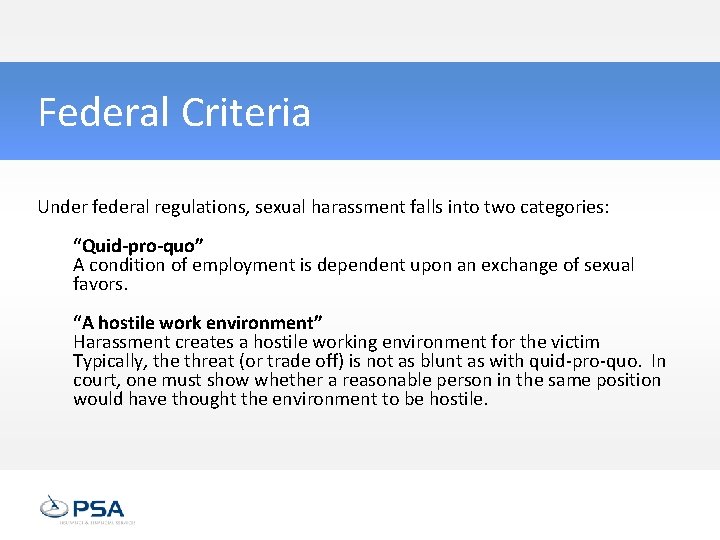
Federal Criteria Under federal regulations, sexual harassment falls into two categories: “Quid-pro-quo” A condition of employment is dependent upon an exchange of sexual favors. “A hostile work environment” Harassment creates a hostile working environment for the victim Typically, the threat (or trade off) is not as blunt as with quid-pro-quo. In court, one must show whether a reasonable person in the same position would have thought the environment to be hostile.
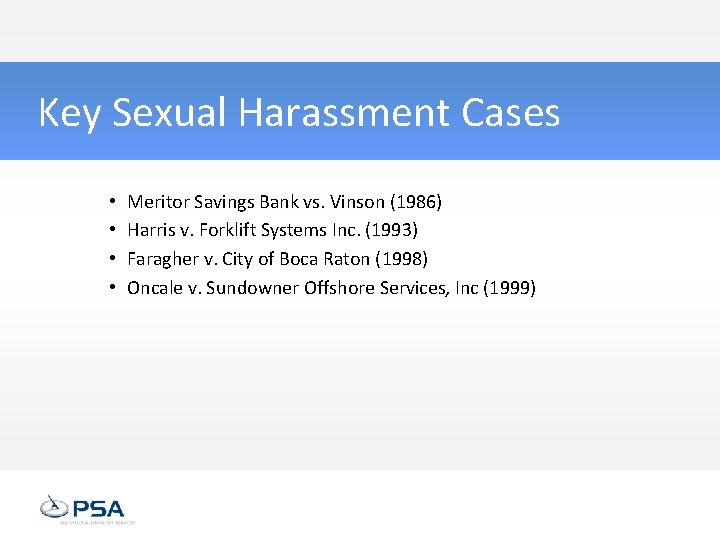
Key Sexual Harassment Cases • • Meritor Savings Bank vs. Vinson (1986) Harris v. Forklift Systems Inc. (1993) Faragher v. City of Boca Raton (1998) Oncale v. Sundowner Offshore Services, Inc (1999)
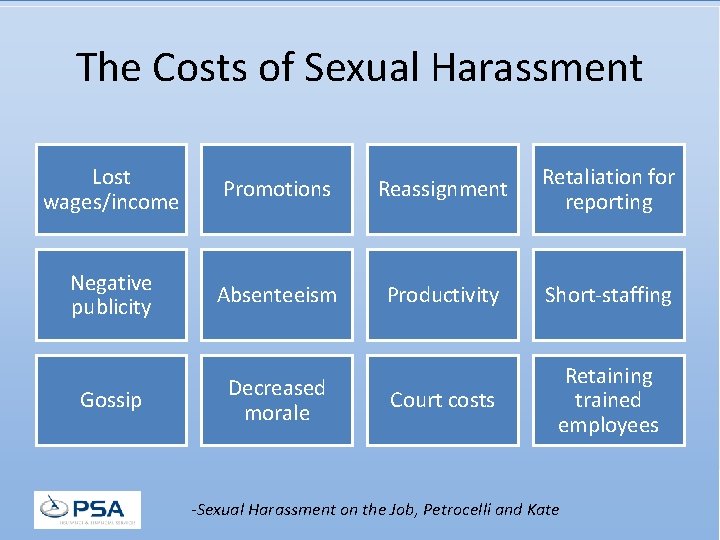
The Costs of Sexual Harassment Lost wages/income Promotions Reassignment Retaliation for reporting Negative publicity Absenteeism Productivity Short-staffing Gossip Decreased morale Court costs Retaining trained employees -Sexual Harassment on the Job, Petrocelli and Kate
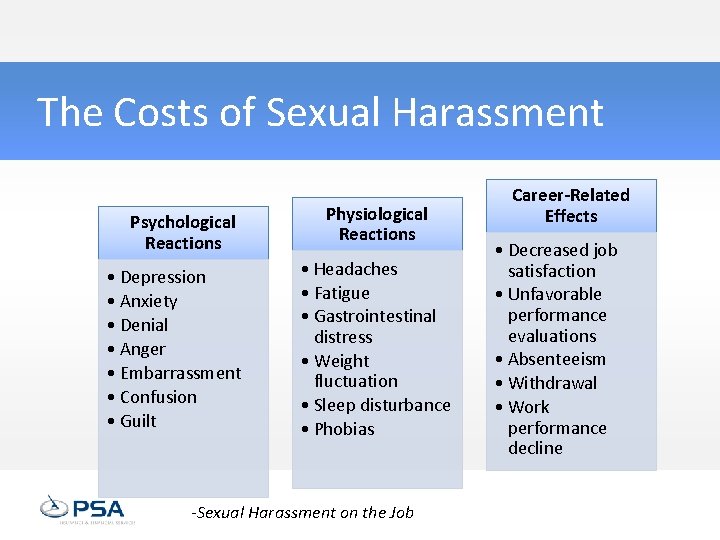
The Costs of Sexual Harassment Psychological Reactions • Depression • Anxiety • Denial • Anger • Embarrassment • Confusion • Guilt Physiological Reactions • Headaches • Fatigue • Gastrointestinal distress • Weight fluctuation • Sleep disturbance • Phobias -Sexual Harassment on the Job Career-Related Effects • Decreased job satisfaction • Unfavorable performance evaluations • Absenteeism • Withdrawal • Work performance decline
Unwanted Physical Behaviors • • Invading personal space Hugging, kissing, patting, or stroking Touching or rubbing oneself sexually around another person Touching a person’s clothing, hair or body Bumping into a co-worker inappropriately Following a person around Massaging a person’s neck or shoulders
Unwanted Non-verbal Advances • Making sexual gestures with hands or through body movements • Blocking a co-worker’s path • Suggestive or obscene letters, notes, invitations or email received at work or at home • Looking a person up and down (elevator eyes) • Displaying sexually suggestive material (calendars, mugs, drawings, limerick’s, etc. ) • Giving personal gifts • Facial expressions such as winking, throwing kisses or licking lips • Staring at someone
Unwanted Verbal Comments • • • Persistently asking someone to go out on a date Referring to a co-worker as a girl, boy, hunk, babe, honey, etc. Spreading rumors about a person’s personal sexual life Whistling at someone; cat calls Asking personal questions about social or sexual life Turning work discussions into sexual topics Making sexual comments about a person’s clothing, anatomy or looks Telling sexual jokes Boasting about sexual prowess
Preventing Sexual Harassment 1. Are my actions clear? 2. Are my behaviors part of my conduct at work? 3. Do I engage in any physical, non-verbal or verbal unwanted or unwelcome behavior? 4. Is my behavior welcome?
What Would You Do? CASE STUDY
Case Study Carl and Juanita are co-workers who both take public transportation to work each day. One day during the commute, Carl passed a note to Juanita. The note to Juanita read, "You have a really fresh body. How about you and I get together? Come over tonight!" After Juanita read the note and looked up at Carl, he made some sexual gestures with his eyebrows and lips.
Strategies for the Harassed 1. 2. 3. 4. 5. 6. Size up the situation. Educate yourself on your options and your rights. Communicate to the harasser that the attention is unwanted. Keep a written record of what happened. Report the harassment to your supervisor. Ask that it be stopped and determine what your supervisor can do to help you in this effort. If your supervisor is harassing you, report it to your supervisor’s boss or someone else of authority whom you trust. File a formal complaint via company procedure.
Barriers to Taking Action • • • If I ignore it, it will stop by itself. I engage in similar behavior, so how can I tell another person to stop? It is embarrassing to talk about. I don’t like conflict. Dealing with the problem could make it worse. It could limit my career opportunities. It is not serious. I want to be liked. The harasser has worked here for a long time. The recipient asks me not to do anything.
How Much Did I Learn About Harassment? FINAL QUIZ!
Guidelines for Behavior 1. Be aware of the difference between the intent of your behavior and the impact of your behavior. 2. Ensure that there is equal initiation and participation when you interact with others. 3. Treat people as they want to be treated, not as you think they want to be treated.
- Slides: 30