
Preventing Harassment Discrimination and Retaliation Guide for Supervisors

- Slides: 54
Preventing Harassment, Discrimination and Retaliation
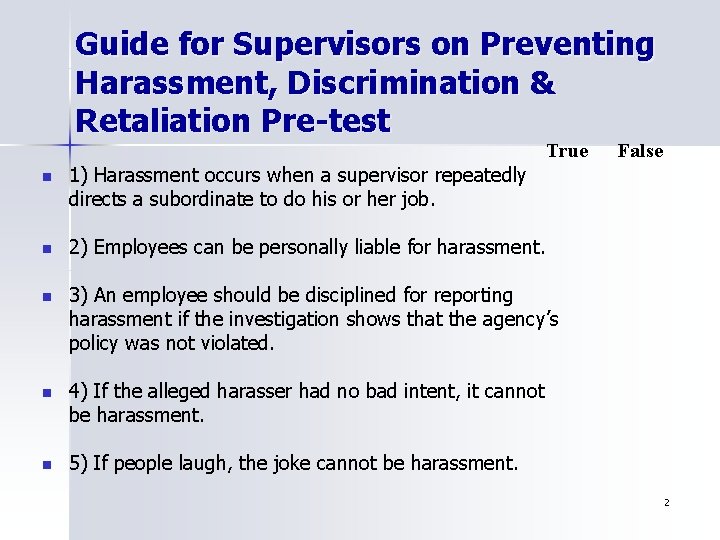
Guide for Supervisors on Preventing Harassment, Discrimination & Retaliation Pre-test True n 1) Harassment occurs when a supervisor repeatedly directs a subordinate to do his or her job. n 2) Employees can be personally liable for harassment. n 3) An employee should be disciplined for reporting harassment if the investigation shows that the agency’s policy was not violated. n 4) If the alleged harasser had no bad intent, it cannot be harassment. n 5) If people laugh, the joke cannot be harassment. False 2
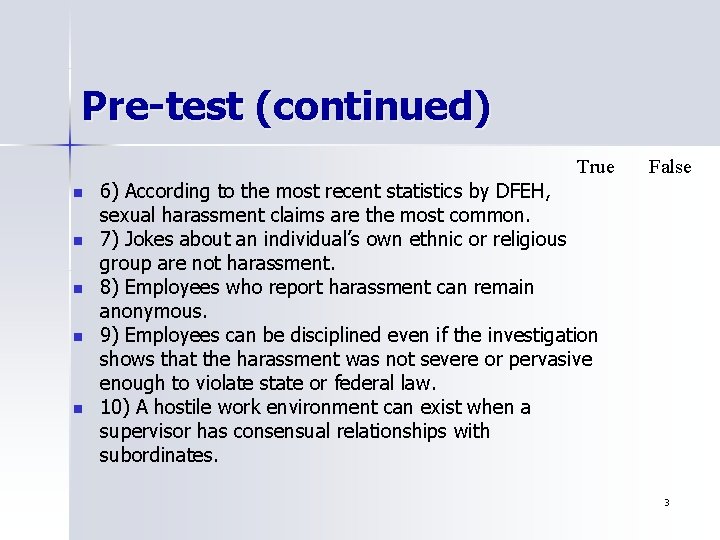
Pre-test (continued) True n n n False 6) According to the most recent statistics by DFEH, sexual harassment claims are the most common. 7) Jokes about an individual’s own ethnic or religious group are not harassment. 8) Employees who report harassment can remain anonymous. 9) Employees can be disciplined even if the investigation shows that the harassment was not severe or pervasive enough to violate state or federal law. 10) A hostile work environment can exist when a supervisor has consensual relationships with subordinates. 3
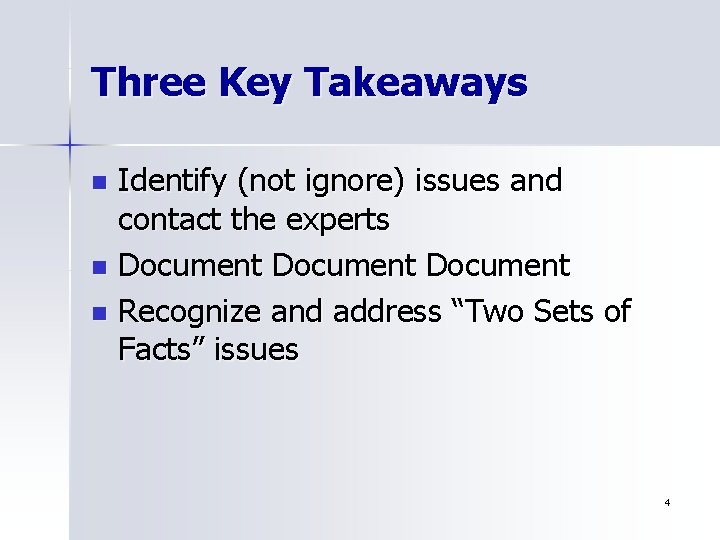
Three Key Takeaways Identify (not ignore) issues and contact the experts n Document n Recognize and address “Two Sets of Facts” issues n 4
Purpose of the Training n Not to make you a legal expert in what is harassment – Encourage you (while at work) not to engage in harassing behavior – If such behavior does occur, to help you: (1) identify it, (2) suggest appropriate steps to take, and (3) know who to contact. 5
Two Laws, a Policy, and a Rule n Federal (Title VII, CRA) n State (FEHA) n County of Sonoma Policy n CSR 10 6
Who Is Protected? n n Applicants and employees Protected from: – Employees – Independent contractors – Clients 7
Discrimination n n Conduct taken because of a protected classification Conduct taken because of the perception that an individual is in a protected class 8
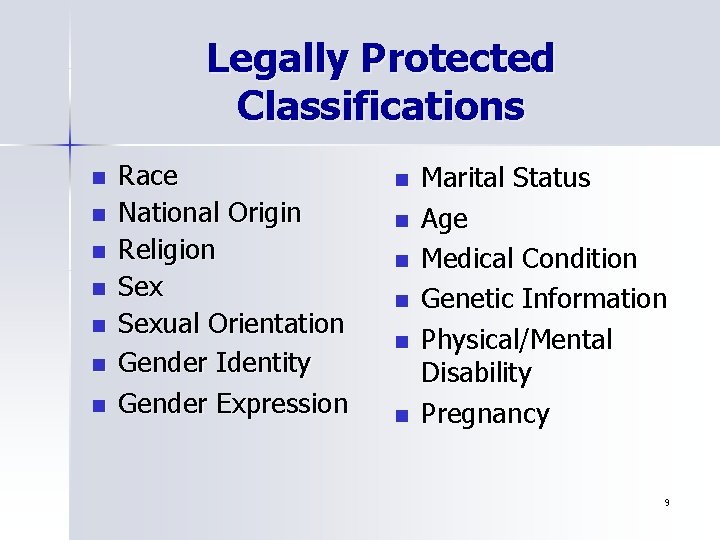
Legally Protected Classifications n n n n Race National Origin Religion Sexual Orientation Gender Identity Gender Expression n n n Marital Status Age Medical Condition Genetic Information Physical/Mental Disability Pregnancy 9
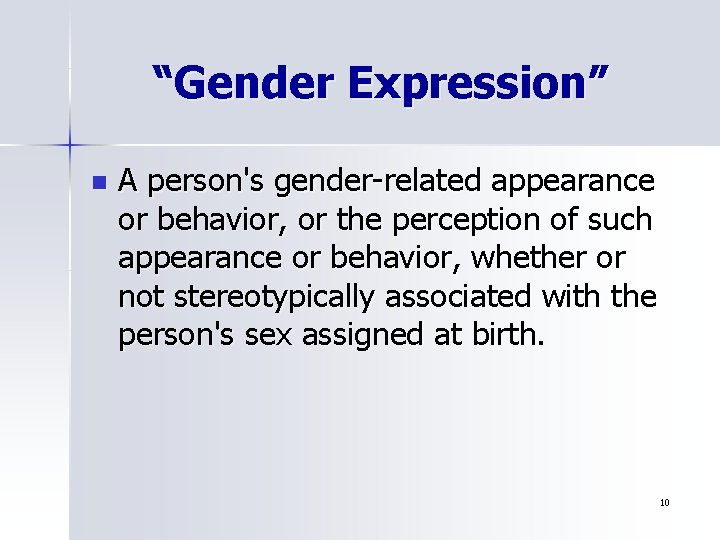
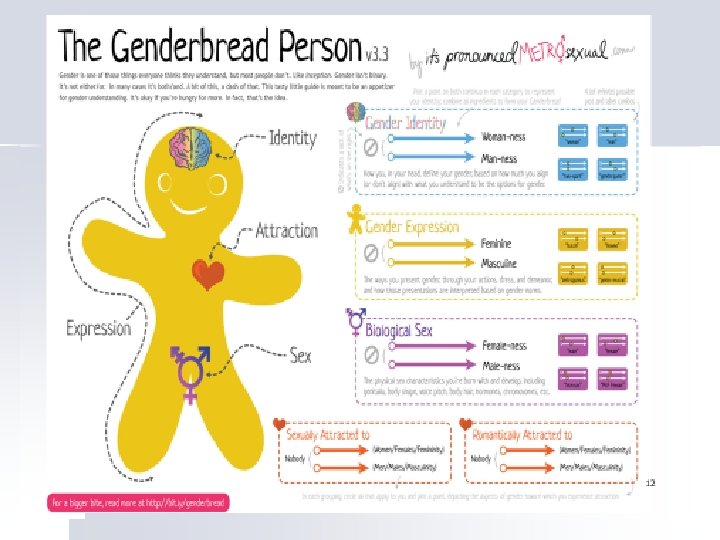
“Gender Expression” n A person's gender-related appearance or behavior, or the perception of such appearance or behavior, whether or not stereotypically associated with the person's sex assigned at birth. 10
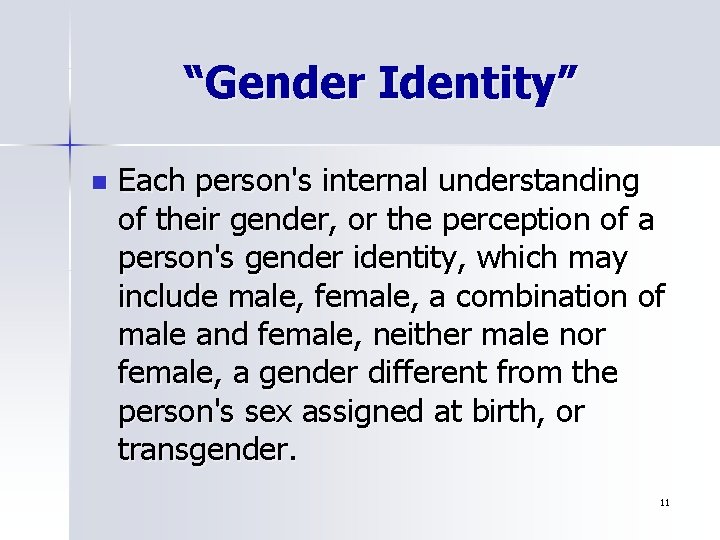
“Gender Identity” n Each person's internal understanding of their gender, or the perception of a person's gender identity, which may include male, female, a combination of male and female, neither male nor female, a gender different from the person's sex assigned at birth, or transgender. 11
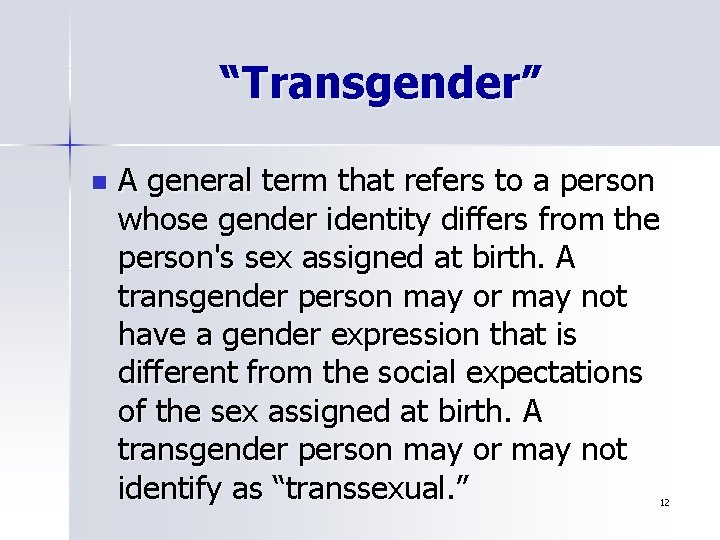
“Transgender” n A general term that refers to a person whose gender identity differs from the person's sex assigned at birth. A transgender person may or may not have a gender expression that is different from the social expectations of the sex assigned at birth. A transgender person may or may not identify as “transsexual. ” 12
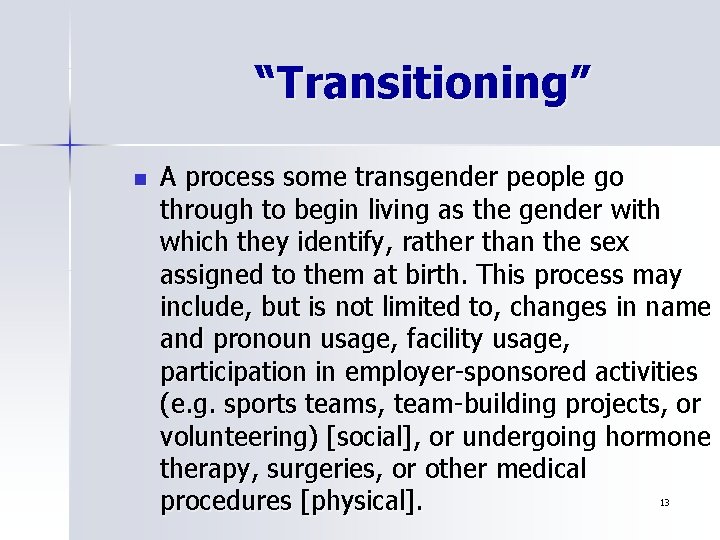
“Transitioning” n A process some transgender people go through to begin living as the gender with which they identify, rather than the sex assigned to them at birth. This process may include, but is not limited to, changes in name and pronoun usage, facility usage, participation in employer-sponsored activities (e. g. sports teams, team-building projects, or volunteering) [social], or undergoing hormone therapy, surgeries, or other medical procedures [physical]. 13
14
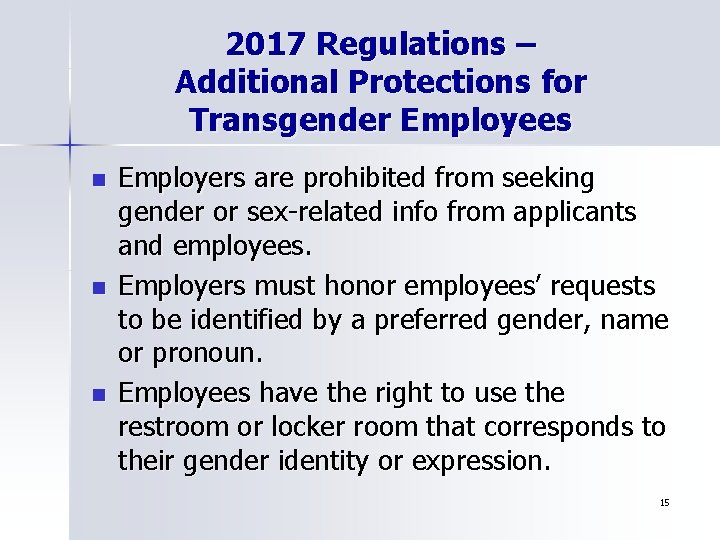
2017 Regulations – Additional Protections for Transgender Employees n n n Employers are prohibited from seeking gender or sex-related info from applicants and employees. Employers must honor employees’ requests to be identified by a preferred gender, name or pronoun. Employees have the right to use the restroom or locker room that corresponds to their gender identity or expression. 15
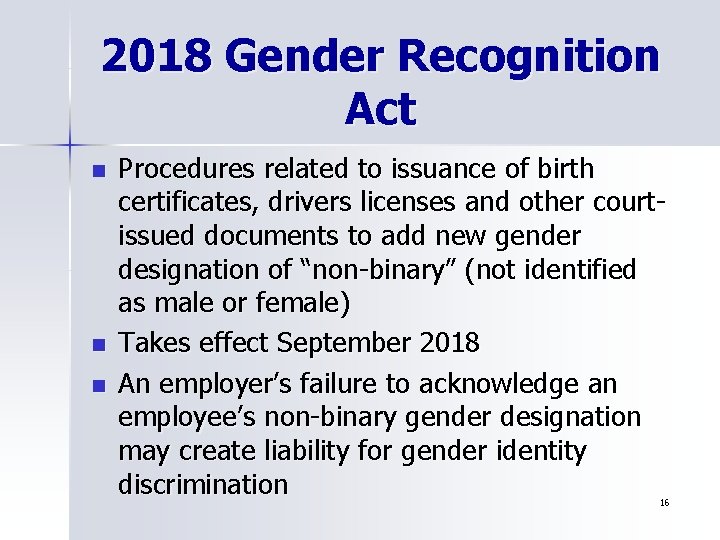
2018 Gender Recognition Act n n n Procedures related to issuance of birth certificates, drivers licenses and other courtissued documents to add new gender designation of “non-binary” (not identified as male or female) Takes effect September 2018 An employer’s failure to acknowledge an employee’s non-binary gender designation may create liability for gender identity discrimination 16
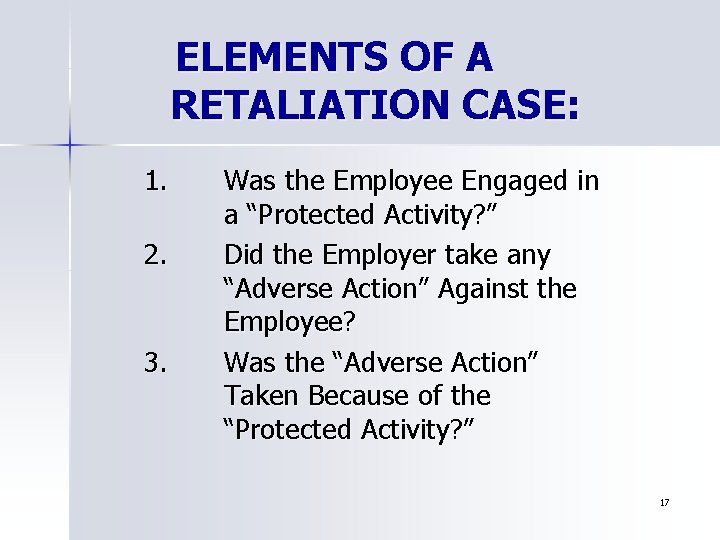
ELEMENTS OF A RETALIATION CASE: 1. 2. 3. Was the Employee Engaged in a “Protected Activity? ” Did the Employer take any “Adverse Action” Against the Employee? Was the “Adverse Action” Taken Because of the “Protected Activity? ” 17
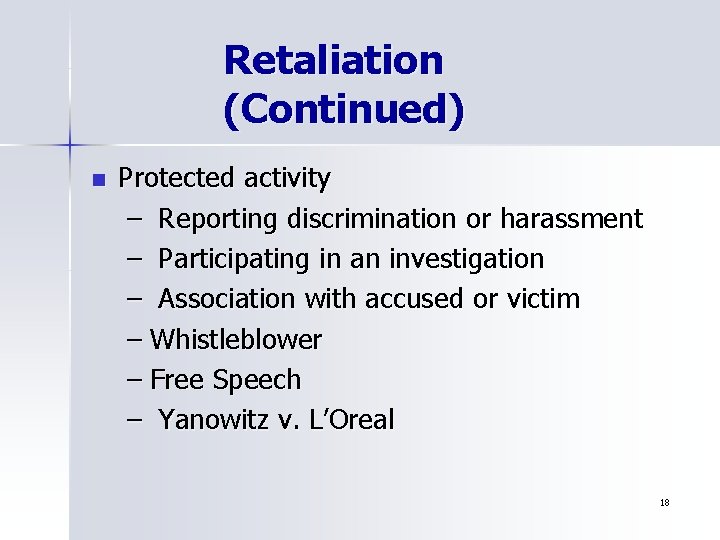
Retaliation (Continued) n Protected activity – Reporting discrimination or harassment – Participating in an investigation – Association with accused or victim – Whistleblower – Free Speech – Yanowitz v. L’Oreal 18
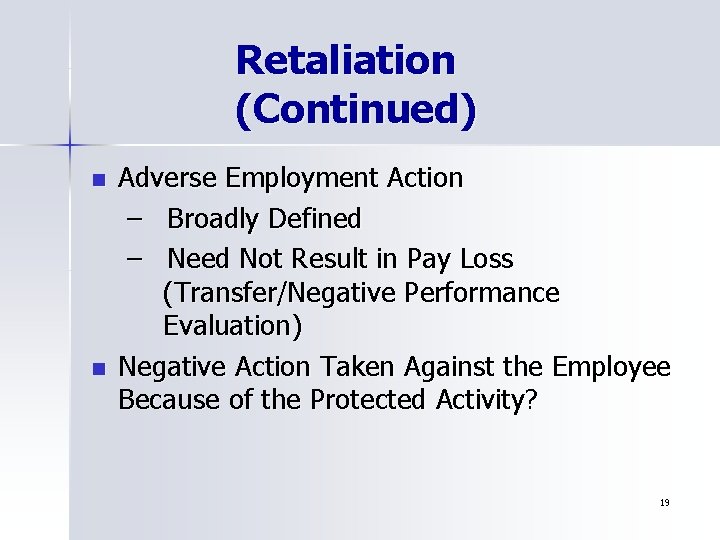
Retaliation (Continued) n n Adverse Employment Action – Broadly Defined – Need Not Result in Pay Loss (Transfer/Negative Performance Evaluation) Negative Action Taken Against the Employee Because of the Protected Activity? 19
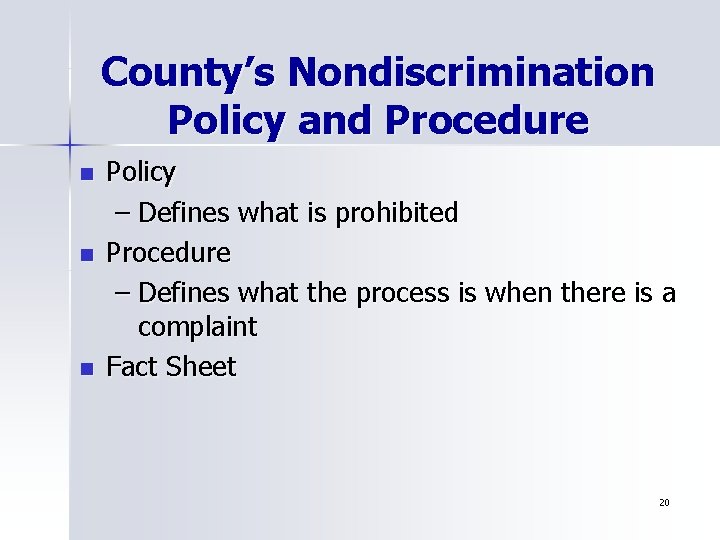
County’s Nondiscrimination Policy and Procedure n n n Policy – Defines what is prohibited Procedure – Defines what the process is when there is a complaint Fact Sheet 20
Two Sets of Facts n n Initial facts leading to the complaint What action the department takes in response – Contact EEO – Ensure no more contact pending the investigation – Determine what happens to the parties pending the investigation – Provide options to complainant 21
Types of Harassment n Quid Pro Quo n Hostile Work Environment 22
Quid Pro Quo Sexual Harassment n Job benefits promised in exchange for sexual favors or denied if sexual favors are not given. 23
Hostile Work Environment n n “Legal test” Physical, verbal or visual behavior of a sexual nature Objectively and Subjectively Offensive (Unwelcome) Severe or Pervasive 24
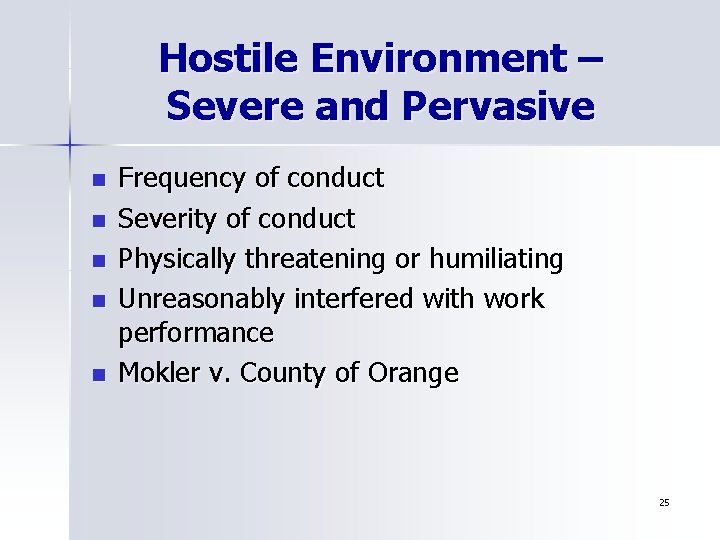
Hostile Environment – Severe and Pervasive n n n Frequency of conduct Severity of conduct Physically threatening or humiliating Unreasonably interfered with work performance Mokler v. County of Orange 25
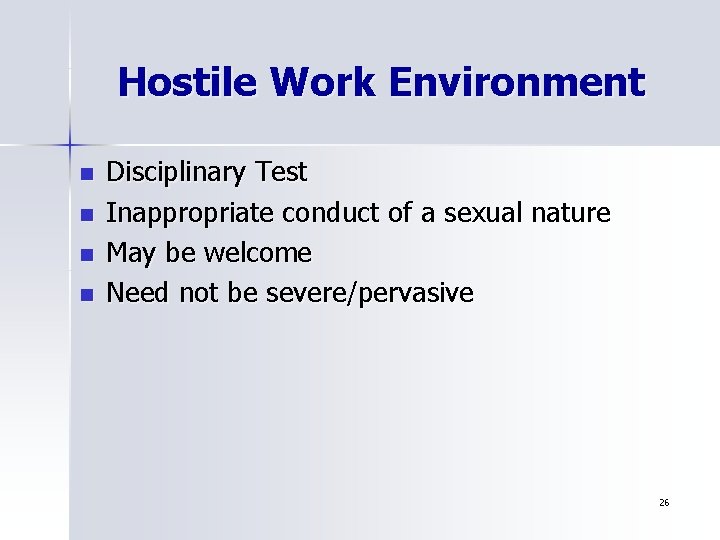
Hostile Work Environment n n Disciplinary Test Inappropriate conduct of a sexual nature May be welcome Need not be severe/pervasive 26
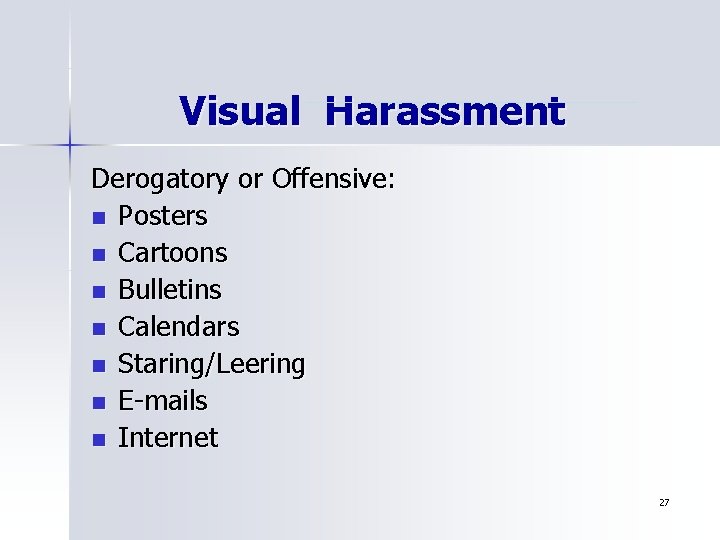
Visual Harassment Derogatory or Offensive: n Posters n Cartoons n Bulletins n Calendars n Staring/Leering n E-mails n Internet 27
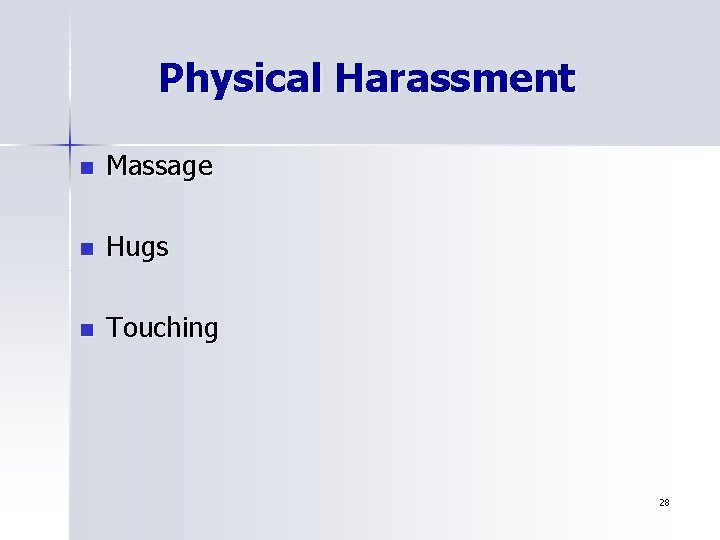
Physical Harassment n Massage n Hugs n Touching 28
Verbal Harassment n n n Sexual comments Ethnic jokes Mocking accent Teasing Posters, Calendars 29
“Gray” (Borderline) Areas n n “Consensual” relationships between supervisors and subordinates? Solicitation of dates, or invitations to lunch, drinks or dinner References to appearance or dress “Casual” touching of non-intimate parts of the body 30
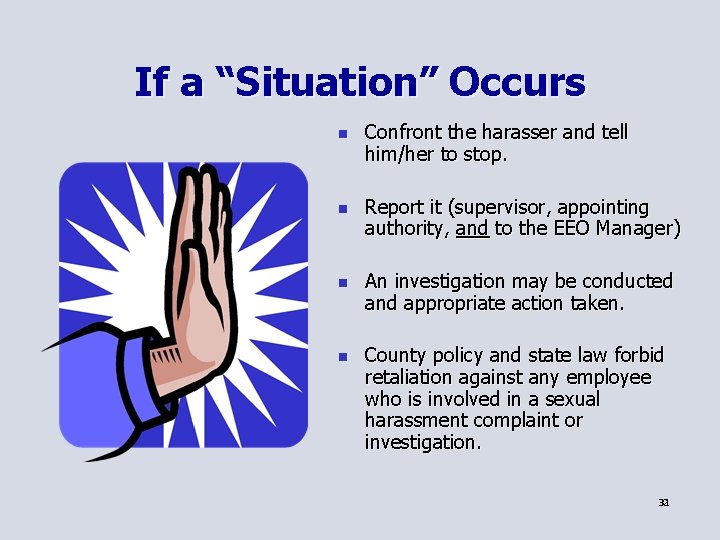
If a “Situation” Occurs n Confront the harasser and tell him/her to stop. n Report it (supervisor, appointing authority, and to the EEO Manager) n An investigation may be conducted and appropriate action taken. n County policy and state law forbid retaliation against any employee who is involved in a sexual harassment complaint or investigation. 31 32
Two Types of Situations (Legal Tests) for Harassment 1. Supervisor-Subordinate 2. Co-workers 32
Supervisor-Subordinate n n n “Supervisor” is broader than just the person who prepares someone’s evaluation Includes the person who directs the employee's work Strict liability test 33
Strictly Liable Unless n n Can show affirmative defense. Reduced damages if employer can show 3 things: 34
Strictly Liable Unless (1) No “adverse employment action” (Loss of pay/undesirable transfer/ negative evaluation) (2) Employer took reasonable care to prevent and correct bad behavior. (a) Prevent: Have a discrimination policy in place and provide training. 35
Strictly Liable Unless (b) Correct: Referral to EEO to conduct a thorough and impartial investigation. If allegations sustained, department takes timely, appropriate remedial action. (3) Employee unreasonably failed to timely inform department. If department knew, department would have taken appropriate action. 36
Co-Workers n Knew or should have known test n How do you “know”? Be proactive 37
Reports of Harassment to Supervisors n n By someone other than victim Verbal report Request that “nothing be done” Rumors 38
Responsibility of Supervisor n n Advise management Cooperate in investigation Prevent further harassment Assure no retaliation 39
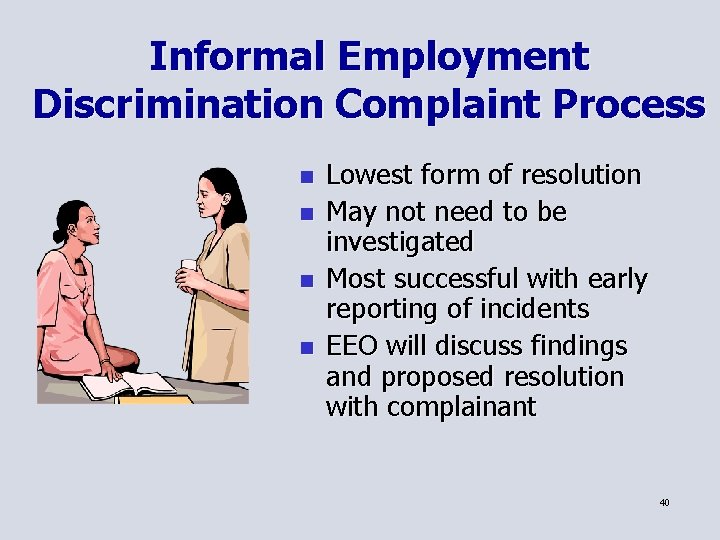
Informal Employment Discrimination Complaint Process n n Lowest form of resolution May not need to be investigated Most successful with early reporting of incidents EEO will discuss findings and proposed resolution with complainant 40
Formal Employment Discrimination Complaint Process n EEO conducts Investigation (Role of investigator) n Formal written report with Findings, Conclusion and Recommendation 41
Documentation Supervisors Can Gather n n n Who was present? Witnesses? What happened? Use quotes if possible. Describe exactly what the conduct was. Include any contextual information. When did it happen? Where did it happen? Gather any evidence. 42
Personal Liability n n Both supervisory and non-supervisory employees who harass or retaliate can be liable to pay damages If the Board of Supervisors finds your conduct to be outside the course and scope of employment, the Board may decide to not defend or indemnify you 43
Prevention n n Report all complaints ASAP Take all complaints seriously Follow County’s procedure Be a good role model 44
What if the actions are not tied to a protected basis? You may need Mediation or EAP (Non-EEO Issues) 45
Bullying n “Abusive Conduct” – Conduct by an employee at work, with malice, that a reasonable person would find hostile, offensive and unrelated to an employer’s legitimate business interests. – Examples: n n Derogatory remarks Insults Verbal or physical conduct That are threatening, intimidating, or humiliating n A single act could be enough if especially severe and egregious 46
REMEMBER, THREE KEY TAKEAWAYS Identify (not ignore) issues and contact the experts n Document n Recognize and address “Two Sets of Facts” issues n 47
Equal Employment Opportunity Post-Test 1. 2. 3. What is the EEO Investigator’s role? ____________ What do you do if you get a complaint of discrimination? ____________ If the alleged conduct would not violate the law, you need not be concerned about it. True ___ False _____ 48
Equal Employment Opportunity Post-Test 4. 5. EEO Rights/ responsibilities are fully explained in the County’s _______. An individual who sexually harasses a co-worker can be held personally liable. True____ False_____ 49
Equal Employment Opportunity Post-Test 6. If the conduct occurs away from the workplace, it cannot be harassment/ discrimination. True _____ False _____ 7. If a manager should have known that one of her staff was sexually harassing a coworker, the county could be liable. True _____ False _____ 50
Equal Employment Opportunity Post-Test 8. During a break at a Board Meeting, the Administrator, staff and a few Board members are chatting. One person makes an “off-color” joke. What if anything, should the Administrator do? 51
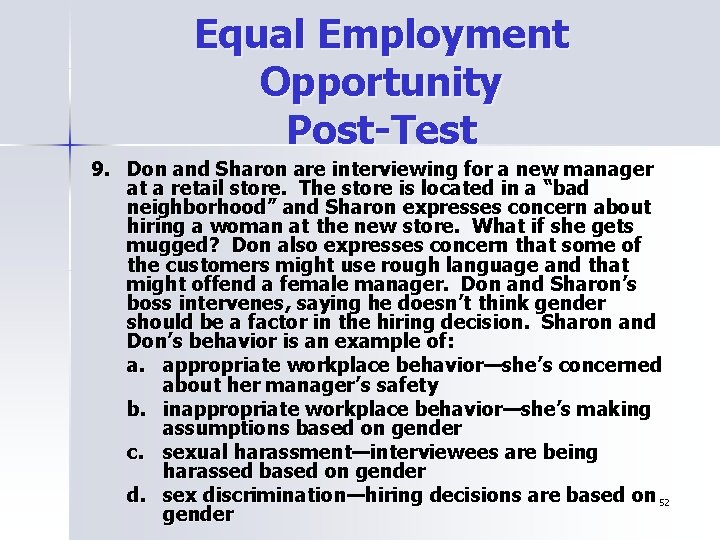
Equal Employment Opportunity Post-Test 9. Don and Sharon are interviewing for a new manager at a retail store. The store is located in a “bad neighborhood” and Sharon expresses concern about hiring a woman at the new store. What if she gets mugged? Don also expresses concern that some of the customers might use rough language and that might offend a female manager. Don and Sharon’s boss intervenes, saying he doesn’t think gender should be a factor in the hiring decision. Sharon and Don’s behavior is an example of: a. appropriate workplace behavior—she’s concerned about her manager’s safety b. inappropriate workplace behavior—she’s making assumptions based on gender c. sexual harassment—interviewees are being harassed based on gender d. sex discrimination—hiring decisions are based on 52 gender
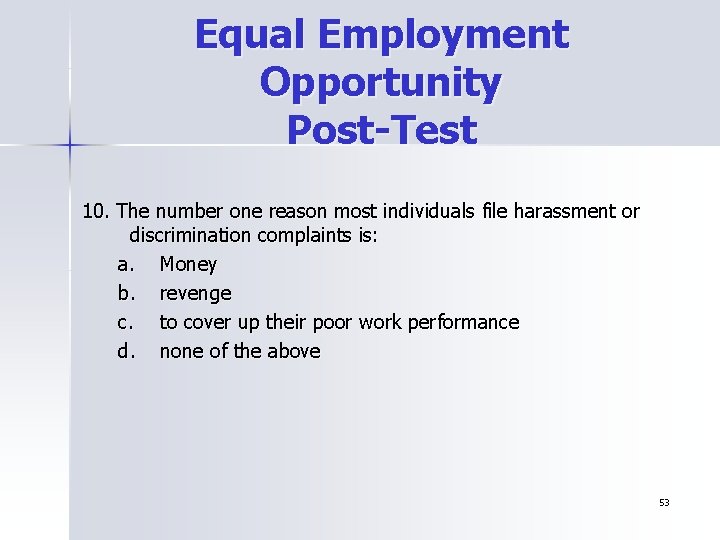
Equal Employment Opportunity Post-Test 10. The number one reason most individuals file harassment or discrimination complaints is: a. Money b. revenge c. to cover up their poor work performance d. none of the above 53
The End