
Preventing and Managing Aggressive Behavior Victoria Selby MS
Preventing and Managing Aggressive Behavior Victoria Selby, MS, PMHNP-BC University of Maryland School of Nursing
Objectives �Compare and contrast passive, assertive, and aggressive behavioral responses �Identify factors useful in the prediction of aggressive behavior among psychiatric patients �Utilize the nursing process in the prevention and management of aggressive behavior �Describe the implementation of crisis management techniques �Discuss aggression in the context of lateral violence and bullying
Definitions �Behaviors �Assertive – self-assurances & respect for others �Passive – rights of others ahead of own �Aggressive – ignore rights of others �Enhance self-esteem by overpowering others �Overall impression of power and dominance is an emotional response to internal (sense of failure, loss of relationship) or external stressors (physical attack, criticism) �Anger �Violence is the result of extreme anger or fear.
Theories on Aggression �Neurobiologic �Psychological – impulse control, learned behavior, developmental factors �Sociocultural – anger seen differently (i. e. , rude, disrespectful) or as syndromes �Society determined what is acceptable and unacceptable

Brain Structures Implicated in Aggression Mosby items and derived items © 2013, 2009 by Mosby, an imprint of Elsevier Inc.
Risk Factors for Aggression �Psychosis �Dementia, delirium, head injuries �Drug/alcohol intoxication �Psychopathic and antisocial personality traits are proving to be more predictive of violent behavior than mental illness
Situational and Environmental Factors �Affect patient behavior escalating from dangerous to violent, including: �Aspects of physical facilities, presence of staff and other patients; studies found greater number of violent incidents when patients gather in groups, are overcrowded, lack privacy, or are inactive �Staff attitudes and actions �When environment is interpreted as hostile, response is likely to be hostile Mosby items and derived items © 2013, 2009 by Mosby, an imprint of Elsevier Inc.
Predicting Aggressive Behavior �Researchers have tried to determine which patients more likely to become violent �Demographic variables, e. g. , age, gender, race, marital status, education, and socioeconomic level, not useful in predicting violent behavior �Past history of aggression best predictor Mosby items and derived items © 2013, 2009 by Mosby, an imprint of Elsevier Inc.
Preventing Aggressive Behavior �Nurse self-awareness �Assertiveness training �Patient education �Anger management �Identifying feelings �Permission to feel angry �Role playing situations �Alternate ways to express anger �Coping skills
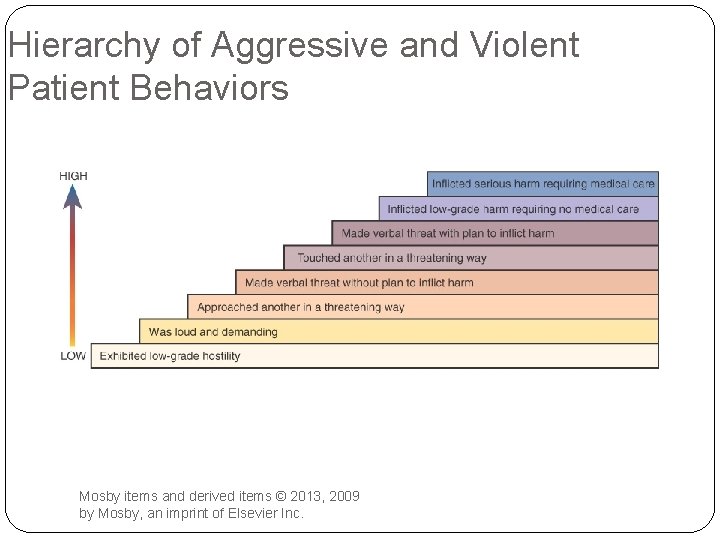
Hierarchy of Aggressive and Violent Patient Behaviors Mosby items and derived items © 2013, 2009 by Mosby, an imprint of Elsevier Inc.
Nursing Assessment �Prediction of violence is impossible �h/o violence biggest predictor �Symptoms �Motor agitation �Verbalizations �Affect �Level of consciousness
Nursing Diagnosis �Risk for other-directed violence �Ineffective coping
Outcomes �No harm to self or others �Refrain from intimidating/ frightening others �Describe feelings without aggression �Comply with treatment
Interventions �Most effective, least restrictive �Environment management �Structure and informal discussion � 1: 1 �Problem solving �Safety
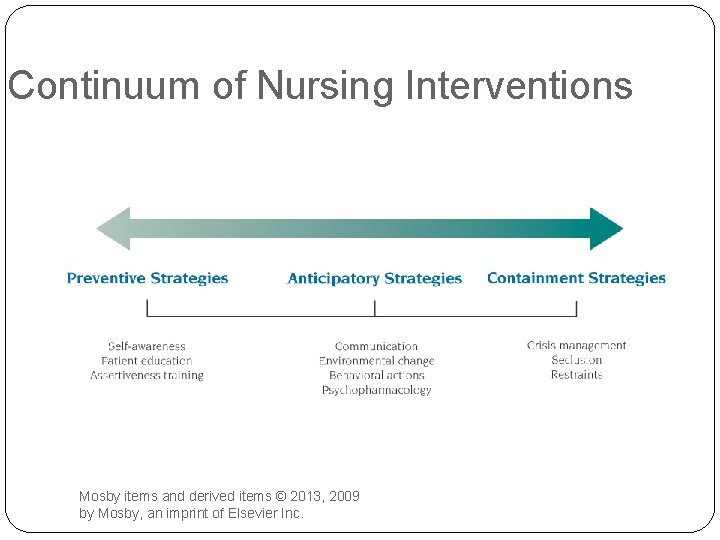
Continuum of Nursing Interventions Mosby items and derived items © 2013, 2009 by Mosby, an imprint of Elsevier Inc.
Interventions for Escalating Behavior • Non-threatening, calm manner • Convey empathy • Encourage verbal expression • Suggest quiet area • PRN meds • Suggest physical activity (e. g. , walking)
Aggression Management • Take control and provide direction with calm, firm • • voice Direct to quiet area Offer medication Set boundary (i. e. , let person know that the behavior is not acceptable) Gather staff/show force
Interventions for Crisis • Inform patient – staff taking control to provide safety • Use of restraint or seclusion if necessary
Seclusion and Restraint �Seclusion is the involuntary confinement of a person alone in a room from which the person is physically prevented from leaving �Physical restraint is manually/physically/mechanically restricting a person’s freedom of movement �Chemical restraint is the use of medication to restrict person’s freedom �Ethical and legal implications
After the Crisis • Debriefing patient and staff • Help with relaxation • Explore alternatives • Document any injuries • Removal of restraint or seclusion • Problem resolution, expression of feelings • Return to activities
Lateral violence �Nurse-on-nurse �Includes verbal abuse, intimidation, bullying, excessive criticism, denial of career opportunities, and withholding information �Risk factors �Being a student or new grad �Receiving a degree, promotion, or other kudos �Pursuing higher education �Having difficulty working with others �Receiving special attention from others at work
Lateral violence �How to prevent �Education �Accountability �“zero tolerance” �Leadership training to uphold standards �Surveillance and reporting (protect reporter) �Documentation �Code of conduct
Bullying among youth �“unwanted, aggressive behavior among school aged children that involves real or perceived power imbalance” �Use of power (physical, access to embarrassing info, popularity) to control others �Repetition of the behavior
Types of bullying �Verbal �Teasing, name calling, inappropriate sexual comments, taunting, threatening �Social �Leaving someone out purposely, telling others not to befriend, rumors, embarrassing someone in public �Physical �Hitting, spitting, tripping/pushing, destroying someone’s belongings, hand gestures
How Pervasive is Bullying? � 28% of students in grades 6 -12 (National Center for Education Statistics) � 20% of students in grades 9 -12 (Youth Risk Behavior Surveillance System)
Victim of Bullying Risk Factors �Perceived to be different �Perceived to be weak or unable to defend themselves �Depressed, anxious, low self-esteem �Those who do not get along with others
Perpetrators �Aggressive, low frustration tolerance �Less parental involvement, issues at home �Think badly of others �Difficulty following rules �Positive view of violence �Have friends who bully
Specific Groups �May be protected by federal civil rights laws �LGBT Youth - increased risk �Youth with disabilities or special health needs – increased risk �Race, ethnicity, and national origin �Religion and faith
Signs of a Child Being Bullied �Unexplainable injuries �Lost or destroyed stuff �Faking sick �Changes in eating habits �Changes in sleep/nightmares �Academic decline �Social avoidance/ loss of friends �Feeling helpless, decreased self-esteem �Self-destructive behaviors
Why Children Don’t Speak Up �Feeling helpless, want to handle it �Fear of judgment �Fear of retaliation �Social isolation �Fear of rejection from other kids
Signs of a Bully �Getting into physical or verbal altercations �Friends who bully �Aggressiveness �Getting into trouble �Unexplained extra money or other stuff �Blame others �Are competitive, worry about reputation
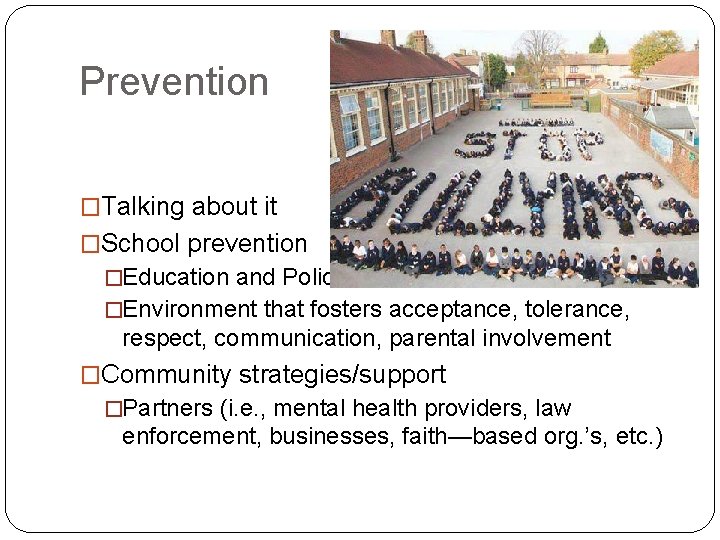
Prevention �Talking about it �School prevention �Education and Policies �Environment that fosters acceptance, tolerance, respect, communication, parental involvement �Community strategies/support �Partners (i. e. , mental health providers, law enforcement, businesses, faith—based org. ’s, etc. )
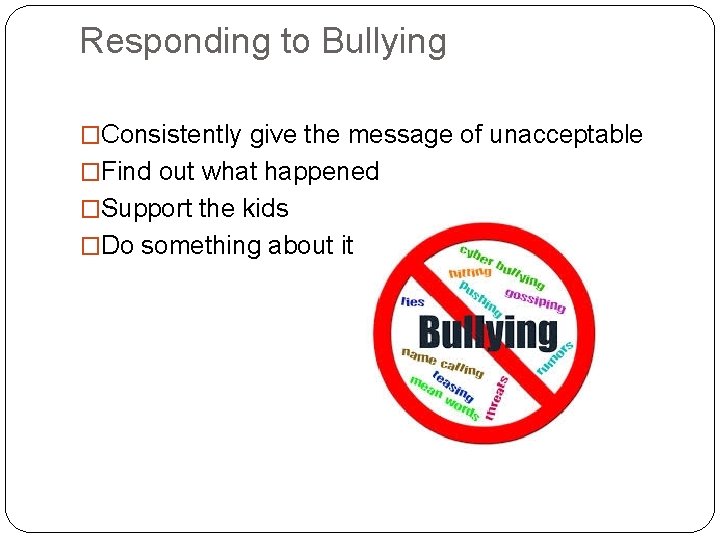
Responding to Bullying �Consistently give the message of unacceptable �Find out what happened �Support the kids �Do something about it
References U. S. Department of Health and Human Services (n. d. ). Stopbullying. gov accessed on February 15, 2015 at http: //www. stopbullying. gov/index. html Stuart, G. W. & Laraia, M. T. (2013). Principles and practice of psychiatric nursing. (10 th ed. ) St. Louis, MO: Mosby Elsevier.
- Slides: 34