
Prevent Update for Schools September 2020 Objectives Develop
Prevent Update for Schools September 2020
Objectives: § Develop an understanding of the Prevent Strategy § Develop existing expertise and professional judgement in relation to extremism and radicalisation or recruitment to extremist groups § Increase awareness of the national / international picture of extremism and terrorism § Raise awareness of the links between online risks and radicalisation § Improve confidence to raise concerns § Raise awareness of the Channel interventions, safeguarding the individual § Increase the whole organisation's capacity to prevent extremism and safeguard vulnerable people PAGE 2
Safeguarding Keeping children safe in education 2020 This guidance applies to all schools and is for: • headteachers, teachers and staff • governing bodies, proprietors and management committees It sets out the legal duties you must follow to safeguard and promote the welfare of children and young people under the age of 18 in schools and colleges. All school and college staff should read part 1 of this guidance. Part 1 of the guidance is also available as a standalone document. https: //assets. publishing. service. gov. uk/government/uploads/system/uploads/attachme nt_data/file/892394/Keeping_children_safe_in_education_2020. pdf
Safeguarding is everyone’s responsibility. Everyone who comes into contact with children and their families has a role to play. All staff have a responsibility to provide a safe environment in which children can learn. Everyone who works with children has a responsibility for keeping them safe. Effective safeguarding is achieved by putting children at the centre of the system. PAGE 4
‘Nothing is more important than children’s welfare. Children who need help and protection deserve high quality and effective support as soon as a need is identified. ’ Education is referenced on Page 59
Prevent Duty toolkit which supplements the Prevent Duty guidance The Prevent duty toolkit is designed to support local authorities and their partners in their work to protect vulnerable people from radicalisation. It supplements the Prevent duty guidance: for England Wales, published in March 2015, and will assist in the consideration of existing statutory guidance. The toolkit supports the practical delivery of Prevent by local authorities and partner agencies by providing practical information on duty implementation, case study examples on good practice local delivery and a self-assessment framework. This includes content on: • local risk assessment process • multi-agency partnership board • Prevent partnership action plan • referral process • channel panel • Prevent problem solving proves • training programme • venue hire and IT policies • community and civil society engagement • communications
Online safety All schools and colleges should continue to consider the safety of their children when they are asked to work online. The starting point for online teaching should be that the same principles as set out in the school’s or college’s staff behaviour policy (sometimes known as a code of conduct) should be followed. This policy should amongst other things include acceptable use of technologies, staff pupil/student relationships and communication including the use of social media. The policy should apply equally to any existing or new online and distance learning arrangements which are introduced. PAGE 7
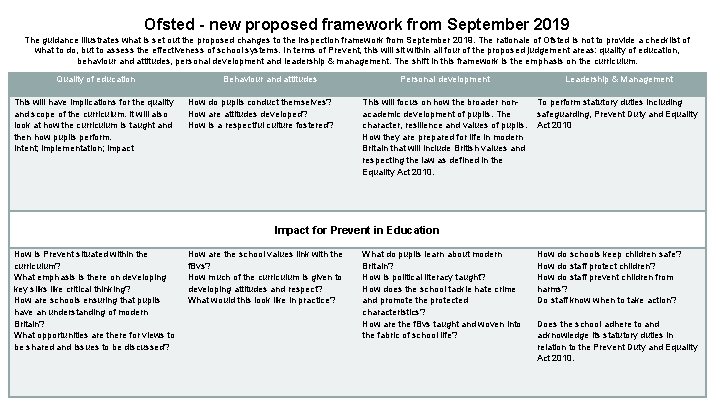
Ofsted - new proposed framework from September 2019 The guidance illustrates what is set out the proposed changes to the inspection framework from September 2019. The rationale of Ofsted is not to provide a checklist of what to do, but to assess the effectiveness of school systems. In terms of Prevent, this will sit within all four of the proposed judgement areas: quality of education, behaviour and attitudes, personal development and leadership & management. The shift in this framework is the emphasis on the curriculum. Quality of education This will have implications for the quality and scope of the curriculum. It will also look at how the curriculum is taught and then how pupils perform. Intent; implementation; impact Behaviour and attitudes How do pupils conduct themselves? How are attitudes developed? How is a respectful culture fostered? Personal development Leadership & Management This will focus on how the broader nonacademic development of pupils. The character, resilience and values of pupils. How they are prepared for life in modern Britain that will include British values and respecting the law as defined in the Equality Act 2010. To perform statutory duties including safeguarding, Prevent Duty and Equality Act 2010 Impact for Prevent in Education How is Prevent situated within the curriculum? What emphasis is there on developing key silks like critical thinking? How are schools ensuring that pupils have an understanding of modern Britain? What opportunities are there for views to be shared and issues to be discussed? How are the school values link with the f. Bvs? How much of the curriculum is given to developing attitudes and respect? What would this look like in practice? What do pupils learn about modern Britain? How is political literacy taught? How does the school tackle hate crime and promote the protected characteristics? How are the f. Bvs taught and woven into the fabric of school life? How do schools keep children safe? How do staff protect children? How do staff prevent children from harms? Do staff know when to take action? Does the school adhere to and acknowledge its statutory duties in relation to the Prevent Duty and Equality Act 2010.
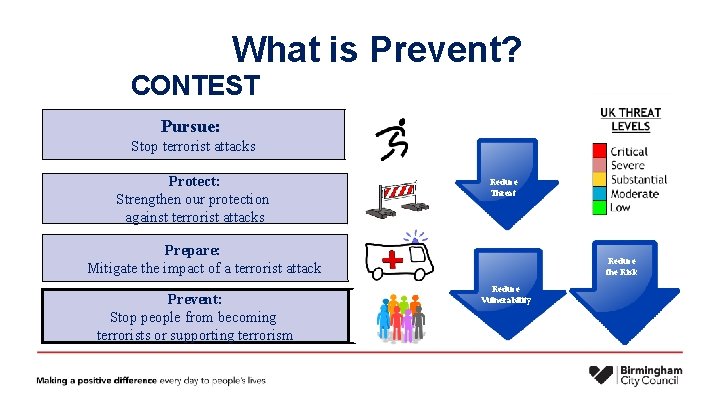
Today we What iswill: Prevent? CONTEST Pursue: Stop terrorist attacks Protect: Strengthen our protection against terrorist attacks Reduce Threat Prepare: Mitigate the impact of a terrorist attack Prevent: Stop people from becoming terrorists or supporting terrorism Reduce the Risk Reduce Vulnerability
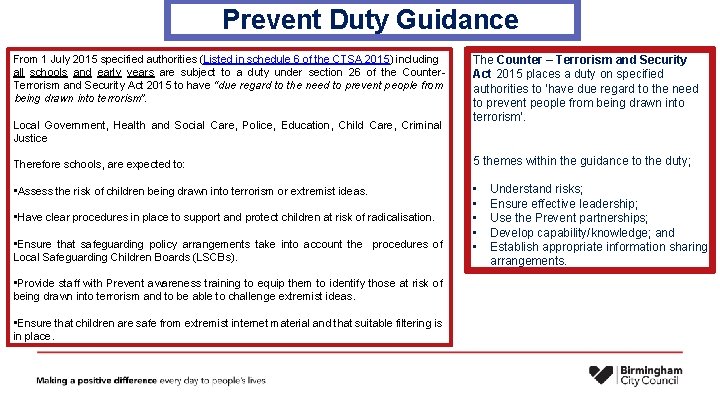
Prevent Duty Guidance From 1 July 2015 specified authorities (Listed in schedule 6 of the CTSA 2015) including all schools and early years are subject to a duty under section 26 of the Counter. Terrorism and Security Act 2015 to have “due regard to the need to prevent people from being drawn into terrorism”. Local Government, Health and Social Care, Police, Education, Child Care, Criminal Justice The Counter – Terrorism and Security Act 2015 places a duty on specified authorities to ‘have due regard to the need to prevent people from being drawn into terrorism’. Therefore schools, are expected to: 5 themes within the guidance to the duty; • Assess the risk of children being drawn into terrorism or extremist ideas. • • • Have clear procedures in place to support and protect children at risk of radicalisation. • Ensure that safeguarding policy arrangements take into account the procedures of Local Safeguarding Children Boards (LSCBs). • Provide staff with Prevent awareness training to equip them to identify those at risk of being drawn into terrorism and to be able to challenge extremist ideas. • Ensure that children are safe from extremist internet material and that suitable filtering is in place. Understand risks; Ensure effective leadership; Use the Prevent partnerships; Develop capability/knowledge; and Establish appropriate information sharing arrangements.
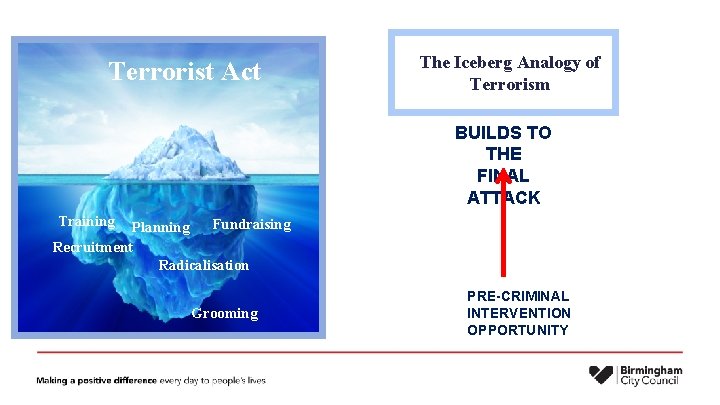
Terrorist Act The Iceberg Analogy of Terrorism BUILDS TO THE FINAL ATTACK Training Fundraising Planning Recruitment Radicalisation Grooming PRE-CRIMINAL INTERVENTION OPPORTUNITY
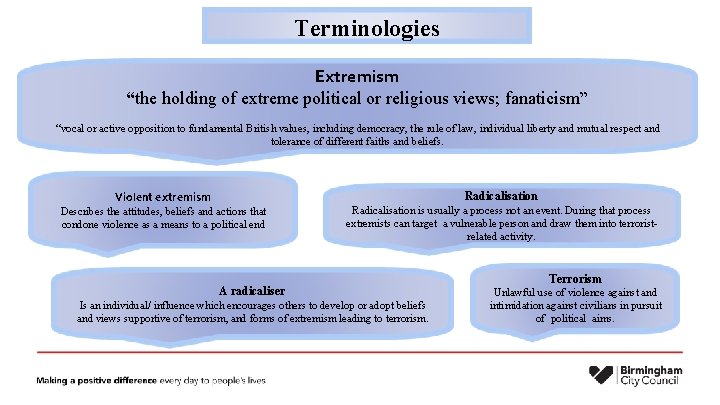
Terminologies Extremism “the holding of extreme political or religious views; fanaticism” “vocal or active opposition to fundamental British values, including democracy, the rule of law, individual liberty and mutual respect and tolerance of different faiths and beliefs. Violent extremism Radicalisation Describes the attitudes, beliefs and actions that condone violence as a means to a political end Radicalisation is usually a process not an event. During that process extremists can target a vulnerable person and draw them into terroristrelated activity. A radicaliser Is an individual/ influence which encourages others to develop or adopt beliefs and views supportive of terrorism, and forms of extremism leading to terrorism. Terrorism Unlawful use of violence against and intimidation against civilians in pursuit of political aims.
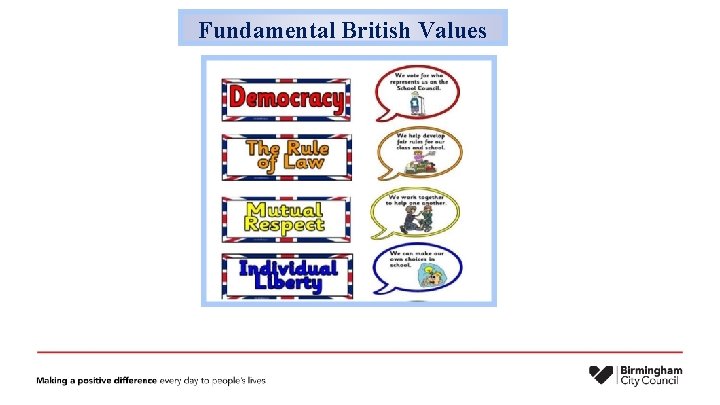
Fundamental British Values Today we will:
Equality Act 2010 v The Sex Discrimination Act - 1975 v The Race Relations Act – 1976 (race, colour, ethnic origin, nationality, national origin) v The Disability Discrimination Act - 1995 v Gender reassignment - 2004 v The Religion and Belief Regulations 2003 v The Equality (Age) Regulations 2006 v The Sexual Orientation Regulations - 2007 v Marriage/Civil Partnership (2010) v Pregnancy & Maternity (2010)
Workshop to Raise Awareness of Prevent You. Tube: Understanding Prevent https: //www. youtube. com/watch? v=5 w. S 9 Ne 0 a 5 MM
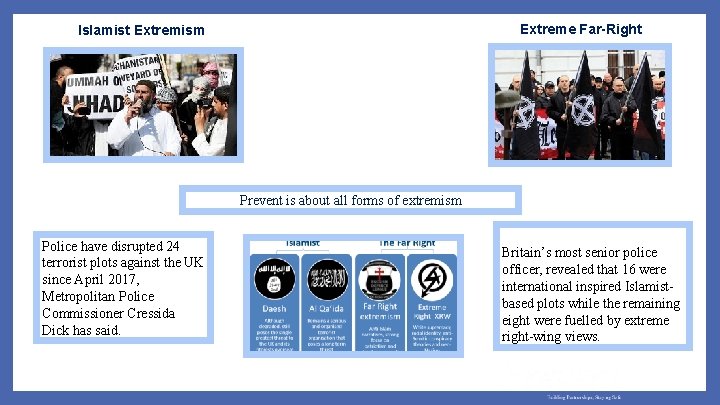
Extreme Far-Right Islamist Extremism Prevent is about all forms of extremism Police have disrupted 24 terrorist plots against the UK since April 2017, Metropolitan Police Commissioner Cressida Dick has said. Britain’s most senior police officer, revealed that 16 were international inspired Islamistbased plots while the remaining eight were fuelled by extreme right-wing views.
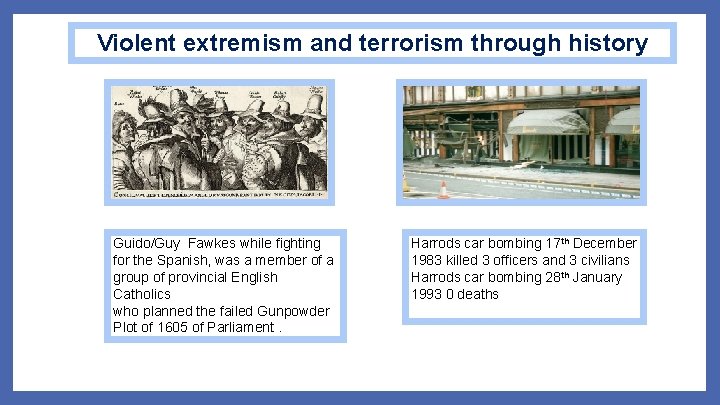
Violent extremism and terrorism through history Guido/Guy Fawkes while fighting for the Spanish, was a member of a group of provincial English Catholics who planned the failed Gunpowder Plot of 1605 of Parliament. Harrods car bombing 17 th December 1983 killed 3 officers and 3 civilians Harrods car bombing 28 th January 1993 0 deaths
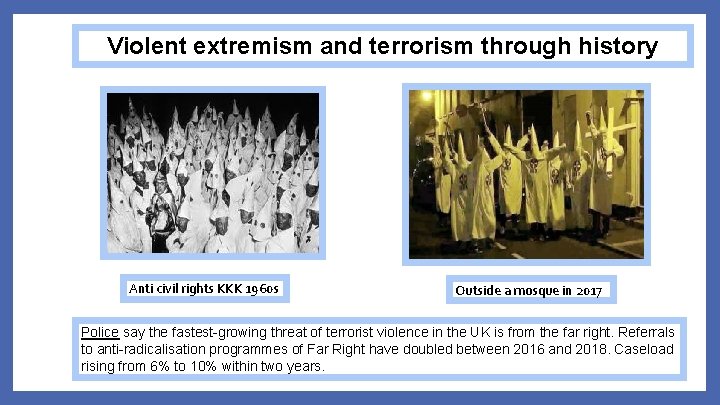
Violent extremism and terrorism through history Anti civil rights KKK 1960 s Outside a mosque in 2017 Police say the fastest-growing threat of terrorist violence in the UK is from the far right. Referrals to anti-radicalisation programmes of Far Right have doubled between 2016 and 2018. Caseload rising from 6% to 10% within two years.
The Far Right Origins of the Great Replacement and white genocide theory The concept of the white replacement theory originated in France. The Identarian group Generation Identity, an organisation that wants to preserve ‘ethnocultural identity’ globally. § These theories focus on the premise that white people are at risk of being wiped out through migration, demographic, diversity, miscegenation or violence. § This amplifies ethnic and cultural differences between whites and non-whites to justify conflict in supremacist circles. § The ideology of extreme-right groups, ties together a cohesive, networked and transnational extreme-right.
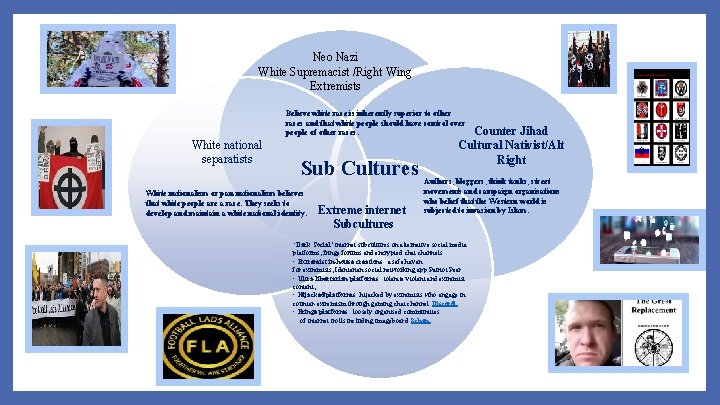
Neo Nazi White Supremacist /Right Wing Extremists Believe white race is inherently superior to other races and that white people should have control over people of other races. White national separatists Sub Cultures White nationalism or pan-nationalism believes that white people are a race. They seeks to develop and maintain a white national identity. Extreme internet Subcultures Counter Jihad Cultural Nativist/Alt Right Authors, bloggers, think tanks, street movements and campaign organisations who belief that the Western world is subjected to invasion by Islam. ‘Dark Social’ internet subcultures on alternative social media platforms, fringe forums and encrypted chat channels. • Extremist in-house creations: a safe haven for extremists, Identarian social networking app Patriot Peer. • Ultra-libertarian platforms: tolerate violent and extremist content, • Hijacked platforms: hijacked by extremists who engage in counter-extremism through gaming chat channel Discord. • Fringe platforms: loosely organised communities of internet trolls including imageboard 8 chan.
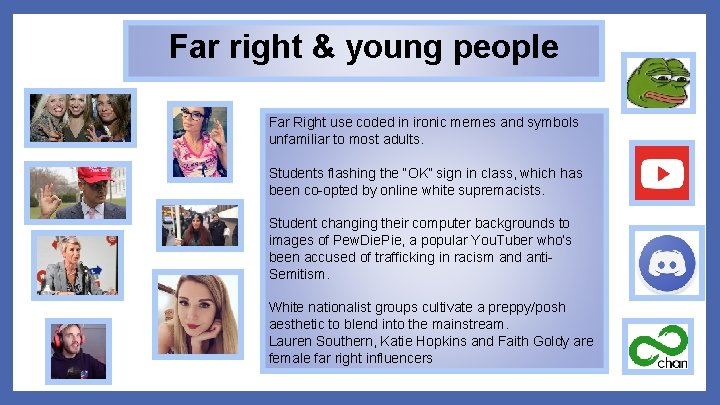
Far right & young people Far Right use coded in ironic memes and symbols unfamiliar to most adults. Students flashing the “OK” sign in class, which has been co-opted by online white supremacists. Student changing their computer backgrounds to images of Pew. Die. Pie, a popular You. Tuber who’s been accused of trafficking in racism and anti. Semitism. White nationalist groups cultivate a preppy/posh aesthetic to blend into the mainstream. Lauren Southern, Katie Hopkins and Faith Goldy are female far right influencers
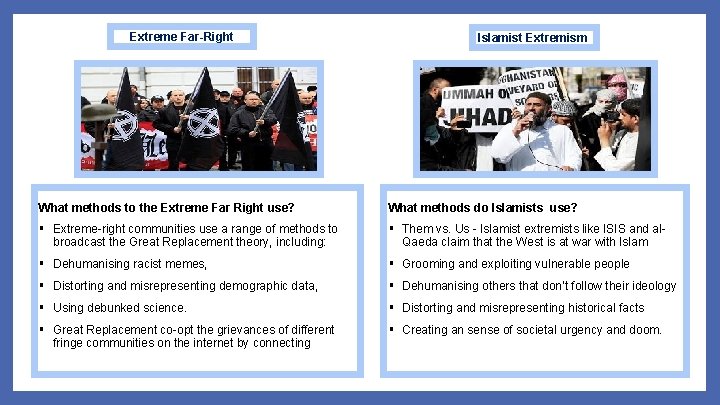
Extreme Far-Right Islamist Extremism What methods to the Extreme Far Right use? What methods do Islamists use? § Extreme-right communities use a range of methods to broadcast the Great Replacement theory, including: § Them vs. Us - Islamist extremists like ISIS and al. Qaeda claim that the West is at war with Islam § Dehumanising racist memes, § Grooming and exploiting vulnerable people § Distorting and misrepresenting demographic data, § Dehumanising others that don’t follow their ideology § Using debunked science. § Distorting and misrepresenting historical facts § Great Replacement co-opt the grievances of different fringe communities on the internet by connecting § Creating an sense of societal urgency and doom.
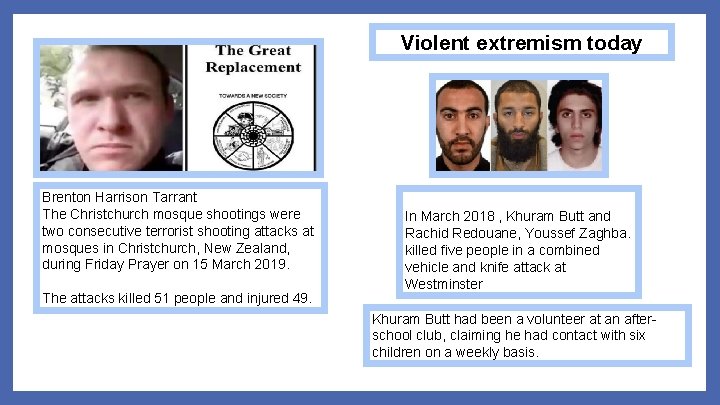
Violent extremism today Brenton Harrison Tarrant The Christchurch mosque shootings were two consecutive terrorist shooting attacks at mosques in Christchurch, New Zealand, during Friday Prayer on 15 March 2019. The attacks killed 51 people and injured 49. In March 2018 , Khuram Butt and Rachid Redouane, Youssef Zaghba. killed five people in a combined vehicle and knife attack at Westminster Khuram Butt had been a volunteer at an afterschool club, claiming he had contact with six children on a weekly basis.
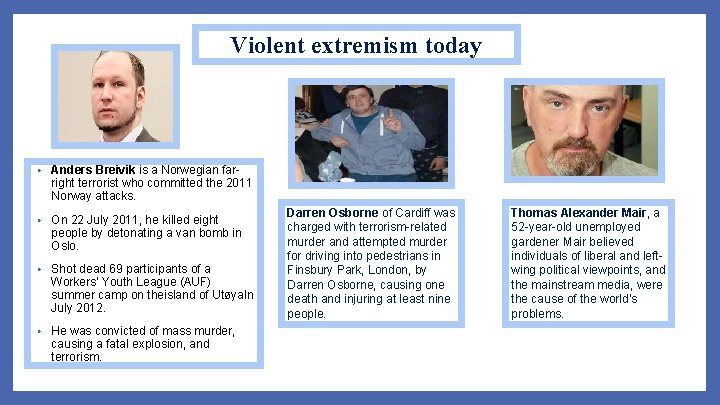
Violent extremism today • Anders Breivik is a Norwegian far- right terrorist who committed the 2011 Norway attacks. • On 22 July 2011, he killed eight people by detonating a van bomb in Oslo. • Shot dead 69 participants of a Workers' Youth League (AUF) summer camp on theisland of Utøya. In July 2012. • He was convicted of mass murder, causing a fatal explosion, and terrorism. Darren Osborne of Cardiff was charged with terrorism-related murder and attempted murder for driving into pedestrians in Finsbury Park, London, by Darren Osborne, causing one death and injuring at least nine people. Thomas Alexander Mair, a 52 -year-old unemployed gardener Mair believed individuals of liberal and leftwing political viewpoints, and the mainstream media, were the cause of the world's problems.
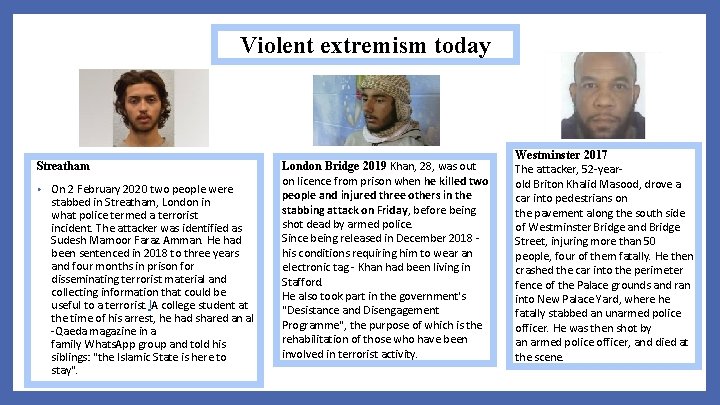
Violent extremism today Streatham • On 2 February 2020 two people were stabbed in Streatham, London in what police termed a terrorist incident. The attacker was identified as Sudesh Mamoor Faraz Amman. He had been sentenced in 2018 to three years and four months in prison for disseminating terrorist material and collecting information that could be useful to a terrorist. [A college student at the time of his arrest, he had shared an al -Qaeda magazine in a family Whats. App group and told his siblings: "the Islamic State is here to stay". London Bridge 2019 Khan, 28, was out on licence from prison when he killed two people and injured three others in the stabbing attack on Friday, before being shot dead by armed police. Since being released in December 2018 his conditions requiring him to wear an electronic tag - Khan had been living in Stafford. He also took part in the government's "Desistance and Disengagement Programme", the purpose of which is the rehabilitation of those who have been involved in terrorist activity. Westminster 2017 The attacker, 52 -yearold Briton Khalid Masood, drove a car into pedestrians on the pavement along the south side of Westminster Bridge and Bridge Street, injuring more than 50 people, four of them fatally. He then crashed the car into the perimeter fence of the Palace grounds and ran into New Palace Yard, where he fatally stabbed an unarmed police officer. He was then shot by an armed police officer, and died at the scene.
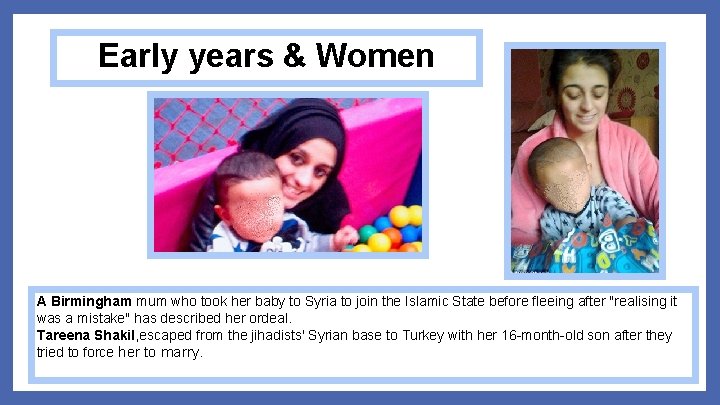
Early years & Women A Birmingham mum who took her baby to Syria to join the Islamic State before fleeing after "realising it was a mistake" has described her ordeal. Tareena Shakil, escaped from the jihadists' Syrian base to Turkey with her 16 -month-old son after they tried to force her to marry.
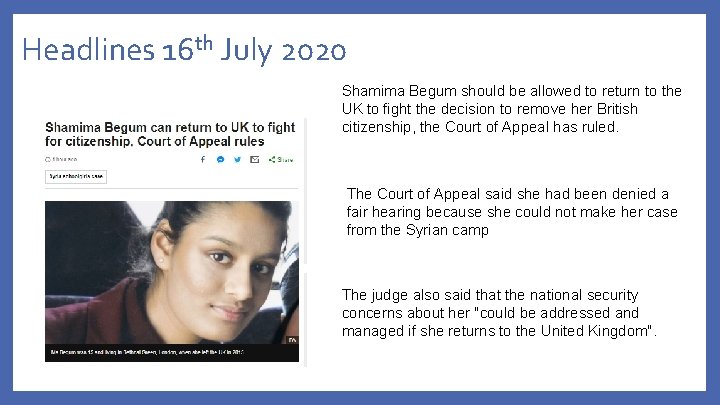
Headlines 16 th July 2020 Shamima Begum should be allowed to return to the UK to fight the decision to remove her British citizenship, the Court of Appeal has ruled. The Court of Appeal said she had been denied a fair hearing because she could not make her case from the Syrian camp The judge also said that the national security concerns about her "could be addressed and managed if she returns to the United Kingdom".
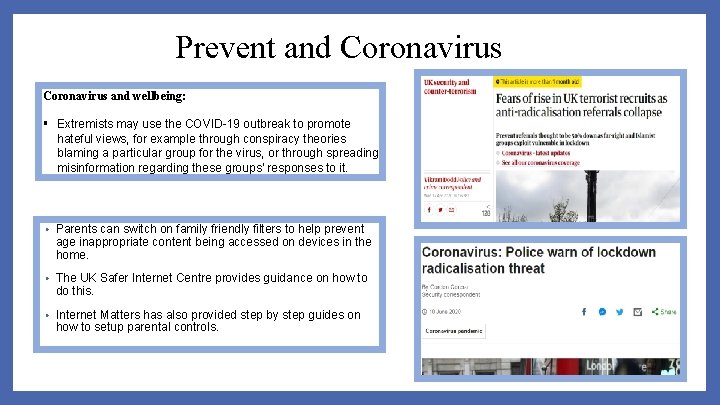
Prevent and Coronavirus and wellbeing: § Extremists may use the COVID-19 outbreak to promote hateful views, for example through conspiracy theories blaming a particular group for the virus, or through spreading misinformation regarding these groups’ responses to it. • Parents can switch on family friendly filters to help prevent age inappropriate content being accessed on devices in the home. • The UK Safer Internet Centre provides guidance on how to do this. • Internet Matters has also provided step by step guides on how to setup parental controls.
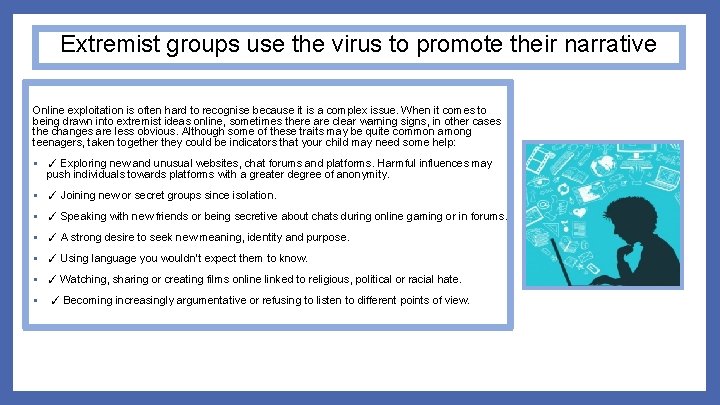
Extremist groups use the virus to promote their narrative Online exploitation is often hard to recognise because it is a complex issue. When it comes to being drawn into extremist ideas online, sometimes there are clear warning signs, in other cases the changes are less obvious. Although some of these traits may be quite common among teenagers, taken together they could be indicators that your child may need some help: § ✓ Exploring new and unusual websites, chat forums and platforms. Harmful influences may push individuals towards platforms with a greater degree of anonymity. § ✓ Joining new or secret groups since isolation. § ✓ Speaking with new friends or being secretive about chats during online gaming or in forums. § ✓ A strong desire to seek new meaning, identity and purpose. § ✓ Using language you wouldn’t expect them to know. § ✓ Watching, sharing or creating films online linked to religious, political or racial hate. § ✓ Becoming increasingly argumentative or refusing to listen to different points of view.
Vulnerability What does vulnerability look like? Examples of some vulnerabilities : Identity Crisis - Distance from cultural/religious heritage and uncomfortable with their place in the society around them Personal Crisis – Family tensions; sense of isolation; adolescence; low self esteem; disassociating from existing friendship group and becoming involved with a new and different group of friends; searching for answers to questions about identity, faith and belonging Personal Circumstances – Migration; local community tensions; events affecting country or region of origin; alienation from UK values; having a sense of grievance that is triggered by personal experience of racism or discrimination or aspects of Government policy Unmet Aspirations – Perceptions of injustice; feeling of failure; rejection of civic life Criminality – Experiences of imprisonment; poor resettlement/reintegration, previous involvement with criminal groups
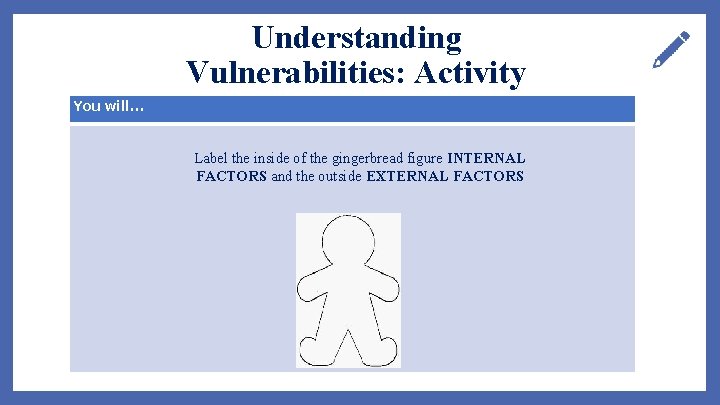
Understanding Vulnerabilities: Activity You will… Label the inside of the gingerbread figure INTERNAL FACTORS and the outside EXTERNAL FACTORS
Push & Pull Factors Push factors consist of conditions of the individual or situations in their life which push them away from mainstream society and cause them to be more susceptible to radicalisation. Ø Searching for identity Ø Discrimination Ø Persecution Ø Alienation Ø Inequalities Ø Perceived global injustice Ø Unemployment Ø Lack of social amenities Ø Other environmental, historical and socio-economic grievances Pull factors nurture the appeal of violent extremism or a ‘cause’ Ø Enticing/bias media stories and disinformation Ø Messages evoking sympathy and affiliation providing a sense of purpose Ø On or offline recruiters promising outlets for grievances, desire for adventure, freedom or belonging Ø Radicalised religious or community leaders Ø Peer groups Ø Self-radicalisation online Ø Criminals in prison
Using case studies to identify vulnerabilities There are lots of case studies in the Facilitator’s Workbook. Choose the one(s) that you feel are appropriate. You must present a balanced approach and provide the opportunity for discussion around XFR, Daesh inspired or any other form of extremism in context.
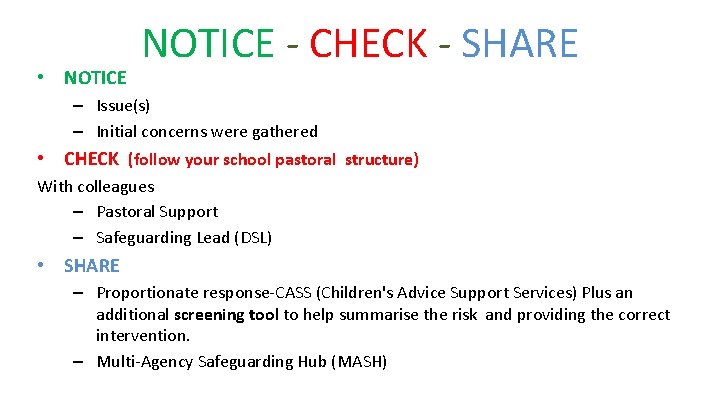
• NOTICE - CHECK - SHARE – Issue(s) – Initial concerns were gathered • CHECK (follow your school pastoral structure) With colleagues – Pastoral Support – Safeguarding Lead (DSL) • SHARE – Proportionate response-CASS (Children's Advice Support Services) Plus an additional screening tool to help summarise the risk and providing the correct intervention. – Multi-Agency Safeguarding Hub (MASH)
SAMMI – ISLAMIST EXTREMISM CASE STUDY • You. Tube: 01 WRAP Prevent Case study 2 https: //www. youtube. com/watch? v=c. SUUb. Je 2 q. Cs
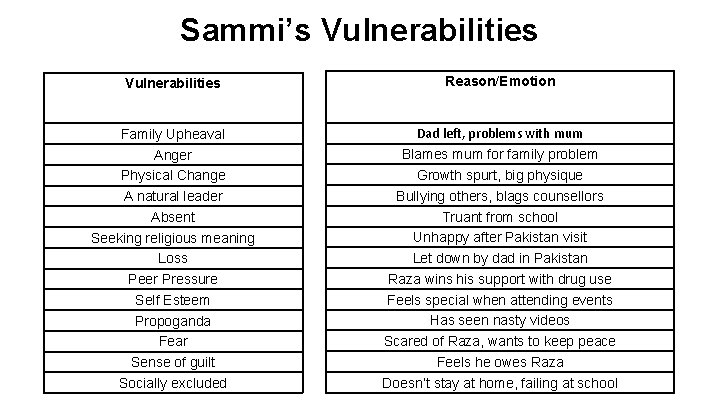
Sammi’s Vulnerabilities Reason/Emotion Family Upheaval Anger Physical Change A natural leader Absent Seeking religious meaning Loss Peer Pressure Self Esteem Propoganda Fear Sense of guilt Socially excluded Dad left, problems with mum Blames mum for family problem Growth spurt, big physique Bullying others, blags counsellors Truant from school Unhappy after Pakistan visit Let down by dad in Pakistan Raza wins his support with drug use Feels special when attending events Has seen nasty videos Scared of Raza, wants to keep peace Feels he owes Raza Doesn’t stay at home, failing at school
Daniel- Far-Right Extremism case study You. Tube: 01 WRAP Prevent Case study 1 https: //www. youtube. com/watch? v=Wp. Pyi. Ih 5 MZQ
Guidance for practitioners Right Help, Right Time • Vulnerable – still needs support • Do something! • Proportionate response • Safeguarding Issue • Terrorism – small likelihood; but still a possibility
Referrals If you’re a working for an agency that’s involved with a child who you suspect or believe is suffering, or is likely to suffer significant harm, you should report your concerns to the Children's Advice and Support Service (CASS) immediately. To help decide whether to contact us to make a referral, you should look at Birmingham’s multi-agency threshold document, Right Help, Right Time, and speak to your agency’s safeguarding representative CASS Telephone: 0121 303 1888
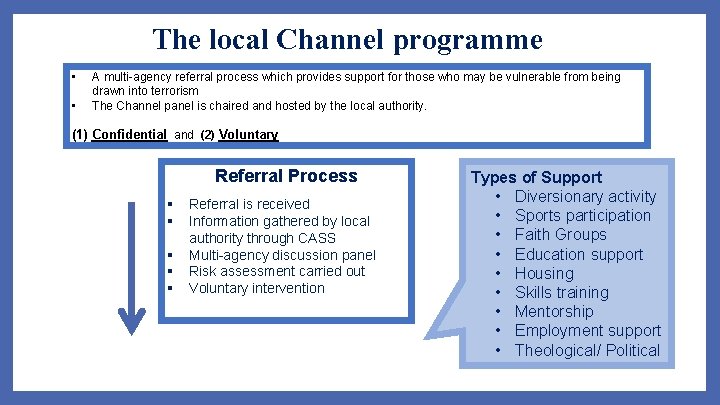
The local Channel programme • • A multi-agency referral process which provides support for those who may be vulnerable from being drawn into terrorism The Channel panel is chaired and hosted by the local authority. (1) Confidential and (2) Voluntary Referral Process § § § Referral is received Information gathered by local authority through CASS Multi-agency discussion panel Risk assessment carried out Voluntary intervention Types of Support • Diversionary activity • Sports participation • Faith Groups • Education support • Housing • Skills training • Mentorship • Employment support • Theological/ Political
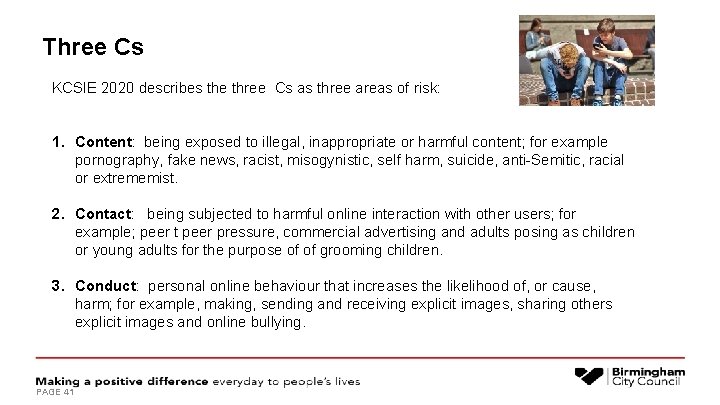
Three Cs KCSIE 2020 describes the three Cs as three areas of risk: 1. Content: being exposed to illegal, inappropriate or harmful content; for example pornography, fake news, racist, misogynistic, self harm, suicide, anti-Semitic, racial or extrememist. 2. Contact: being subjected to harmful online interaction with other users; for example; peer t peer pressure, commercial advertising and adults posing as children or young adults for the purpose of of grooming children. 3. Conduct: personal online behaviour that increases the likelihood of, or cause, harm; for example, making, sending and receiving explicit images, sharing others explicit images and online bullying. PAGE 41
Schools and school staff need an understanding of the risks that exist online so they can tailor their teaching and support to the specific needs of their pupils §Be Internet Legends developed by Parent Zone and Google is a free internet safety curriculum with PSHE accredited lesson plans and teaching resources for Key Stage 2 pupils §Disrespectnobody is Home Office advice and includes resources on healthy relationships, including sexting and pornography §Education for a connected world framework from the UK Council for Internet Safety supports the development of the curriculum and is of particular relevance to RSHE education and Computing. PAGE 42
§PSHE association provides guidance to schools on developing their PSHE curriculum §Teaching online safety in school is departmental guidance outlining how schools can ensure their pupils understand how to stay safe and behave online as part of existing curriculum requirements §Thinkuknow is the National Crime Agency/CEOPs education programme with age specific resources § UK Safer Internet Centre developed guidance and resources that can help with the teaching of the online safety component of the Computing Curriculum. PAGE 43
Prevent online resources • Educate Against Hate(January 2016) - toolkit for schools and parents http: //www. educateagainsthate. com/ • Home office (March 2015; revised September 2015) Prevent Duty Guidance https: //www. gov. uk/government/publications/prevent-duty-guidance • Local Safeguarding Children’s Board http: //www. lscbbirmingham. org. uk/ • Channel Panel awareness online resources; http: //course. ncalt. com/Channel_General_Awareness • INTRODUCTION TO PREVENT E-LEARNING PACKAGE https: //www. elearning. prevent. homeoffice. gov. uk/screen 2 PAGE 44
Whole-school approach and curriculum support
#BLM Race Equality Education Since 2016, we have commissioned training for schools through BRAP, an equalities and human rights Birmingham based charity which whom we have delivered workshops on Mastering Equality and Unconscious Bias. The death of George Floyd in the US and the international response from Black Lives Matter, including peaceful protests in Birmingham, have reminded us that we still have much work to do, to consider what race equality looks link in our city and schools have a critical role to play. We have an Equalities Oversight Group that supported the development of the RSHE Toolkit, which includes the University of Birmingham, Ofsted, Df. E, SACRE, BEP, brap, BCC officers and schools. We are now setting out to deliver on race equality within a wider curriculum context, provide training and support for schools to understand the social constructs of race, understanding the differences between individual bias, structural and systemic racism and privilege and to develop an integrated curriculum offer. If your school would like to be involved in shaping the response, please get in touch with Razia Butt (razia. butt@birmingham. gov. uk). PAGE 46
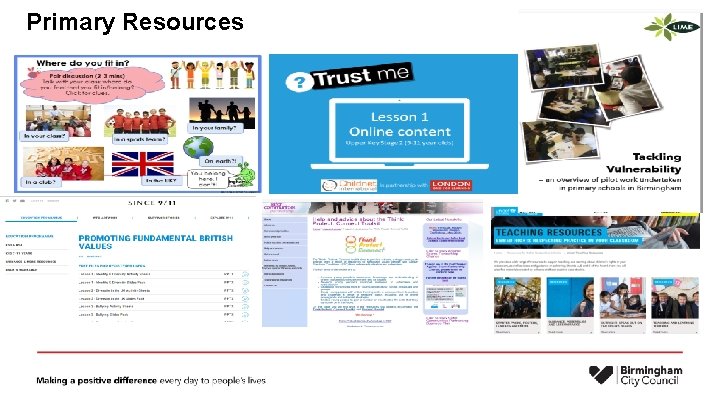
Primary Resources
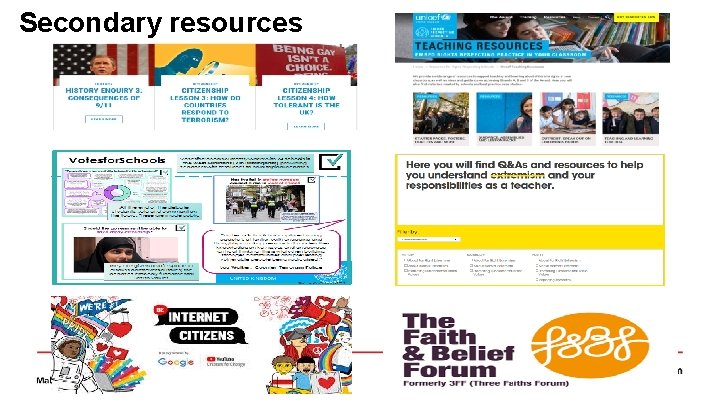
Secondary resources
PREVENT UPDATES 1. Please check the BESS system for upcoming training sessions and workshops 2. You will also receive the Resilience Calendar via the SSI team through the WRAP network
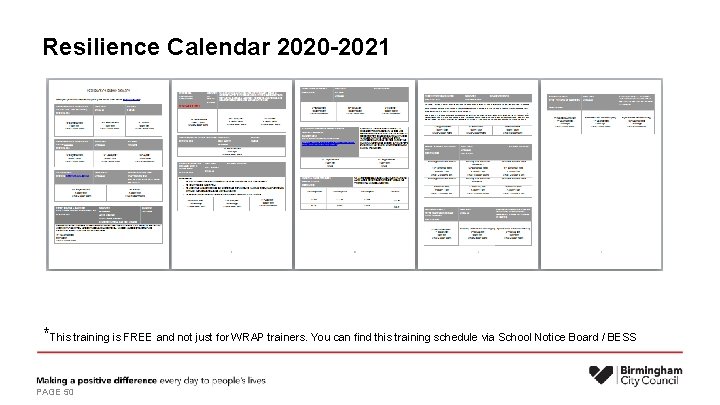
Resilience Calendar 2020 -2021 *This training is FREE and not just for WRAP trainers. You can find this training schedule via School Notice Board / BESS PAGE 50
Birmingham Support Advice & Support CASS Telephone: 0121 303 1888 Education Adviser- Razia Butt Education Adviser- Ayisha Ali Prevent Lead ; Early Help and Family Support – Colvin White
- Slides: 51