
Prevalence of Staphylococcus succinus and Staphylococcus equorum in
- Slides: 1
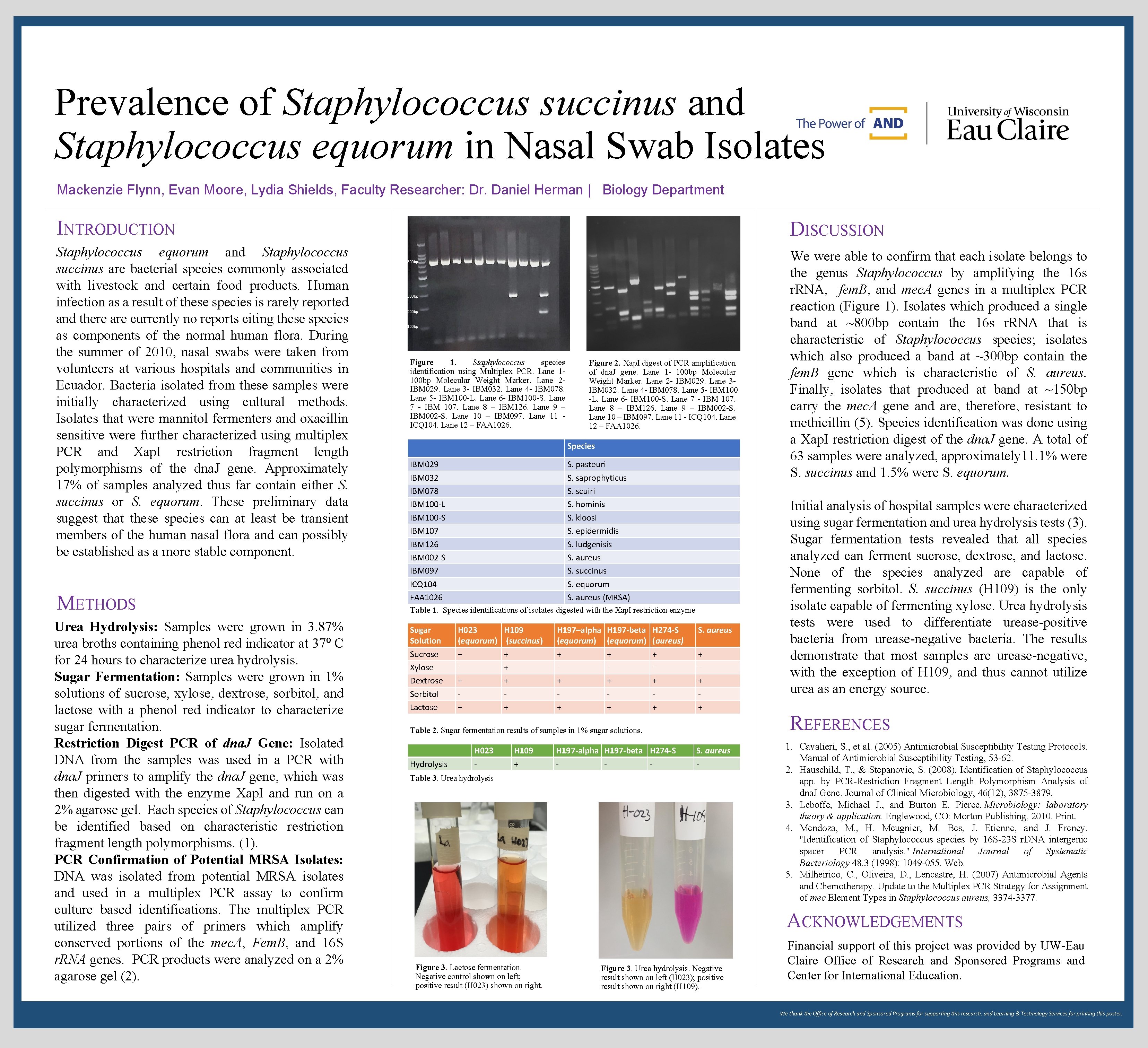
Prevalence of Staphylococcus succinus and Staphylococcus equorum in Nasal Swab Isolates Mackenzie Flynn, Evan Moore, Lydia Shields, Faculty Researcher: Dr. Daniel Herman | Biology Department INTRODUCTION Staphylococcus equorum and Staphylococcus succinus are bacterial species commonly associated with livestock and certain food products. Human infection as a result of these species is rarely reported and there are currently no reports citing these species as components of the normal human flora. During the summer of 2010, nasal swabs were taken from volunteers at various hospitals and communities in Ecuador. Bacteria isolated from these samples were initially characterized using cultural methods. Isolates that were mannitol fermenters and oxacillin sensitive were further characterized using multiplex PCR and Xap. I restriction fragment length polymorphisms of the dna. J gene. Approximately 17% of samples analyzed thus far contain either S. succinus or S. equorum. These preliminary data suggest that these species can at least be transient members of the human nasal flora and can possibly be established as a more stable component. METHODS Urea Hydrolysis: Samples were grown in 3. 87% urea broths containing phenol red indicator at 37⁰ C for 24 hours to characterize urea hydrolysis. Sugar Fermentation: Samples were grown in 1% solutions of sucrose, xylose, dextrose, sorbitol, and lactose with a phenol red indicator to characterize sugar fermentation. Restriction Digest PCR of dna. J Gene: Isolated DNA from the samples was used in a PCR with dna. J primers to amplify the dna. J gene, which was then digested with the enzyme Xap. I and run on a 2% agarose gel. Each species of Staphylococcus can be identified based on characteristic restriction fragment length polymorphisms. (1). PCR Confirmation of Potential MRSA Isolates: DNA was isolated from potential MRSA isolates and used in a multiplex PCR assay to confirm culture based identifications. The multiplex PCR utilized three pairs of primers which amplify conserved portions of the mec. A, Fem. B, and 16 S r. RNA genes. PCR products were analyzed on a 2% agarose gel (2). DISCUSSION 800 bp 300 bp 200 bp 100 bp Figure 1. Staphylococcus species identification using Multiplex PCR. Lane 1 - 100 bp Molecular Weight Marker. Lane 2 - IBM 029. Lane 3 - IBM 032. Lane 4 - IBM 078. Lane 5 - IBM 100 -L. Lane 6 - IBM 100 -S. Lane 7 - IBM 107. Lane 8 – IBM 126. Lane 9 – IBM 002 -S. Lane 10 – IBM 097. Lane 11 - ICQ 104. Lane 12 – FAA 1026. Figure 2. Xap. I digest of PCR amplification of dna. J gene. Lane 1 - 100 bp Molecular Weight Marker. Lane 2 - IBM 029. Lane 3 - IBM 032. Lane 4 - IBM 078. Lane 5 - IBM 100 -L. Lane 6 - IBM 100 -S. Lane 7 - IBM 107. Lane 8 – IBM 126. Lane 9 – IBM 002 -S. Lane 10 – IBM 097. Lane 11 - ICQ 104. Lane 12 – FAA 1026. Species IBM 029 IBM 032 IBM 078 IBM 100 -L IBM 100 -S IBM 107 IBM 126 IBM 002 -S IBM 097 ICQ 104 FAA 1026 S. pasteuri S. saprophyticus S. scuiri S. hominis S. kloosi S. epidermidis S. ludgenisis S. aureus S. succinus S. equorum S. aureus (MRSA) Table 1. Species identifications of isolates digested with the Xap. I restriction enzyme Sugar Solution Sucrose Xylose Dextrose Sorbitol Lactose H 023 (equorum) + + + H 109 (succinus) + + H 197–alpha (equorum) + + + H 197 -beta (equorum) + + + H 274 -S (aureus) + + + S. aureus + + + Table 2. Sugar fermentation results of samples in 1% sugar solutions. Hydrolysis H 023 - H 109 + H 197 -alpha H 197 -beta H 274 -S - S. aureus - Table 3. Urea hydrolysis We were able to confirm that each isolate belongs to the genus Staphylococcus by amplifying the 16 s r. RNA, fem. B, and mec. A genes in a multiplex PCR reaction (Figure 1). Isolates which produced a single band at ~800 bp contain the 16 s r. RNA that is characteristic of Staphylococcus species; isolates which also produced a band at ~300 bp contain the fem. B gene which is characteristic of S. aureus. Finally, isolates that produced at band at ~150 bp carry the mec. A gene and are, therefore, resistant to methicillin (5). Species identification was done using a Xap. I restriction digest of the dna. J gene. A total of 63 samples were analyzed, approximately 11. 1% were S. succinus and 1. 5% were S. equorum. Initial analysis of hospital samples were characterized using sugar fermentation and urea hydrolysis tests (3). Sugar fermentation tests revealed that all species analyzed can ferment sucrose, dextrose, and lactose. None of the species analyzed are capable of fermenting sorbitol. S. succinus (H 109) is the only isolate capable of fermenting xylose. Urea hydrolysis tests were used to differentiate urease-positive bacteria from urease-negative bacteria. The results demonstrate that most samples are urease-negative, with the exception of H 109, and thus cannot utilize urea as an energy source. REFERENCES 1. Cavalieri, S. , et al. (2005) Antimicrobial Susceptibility Testing Protocols. Manual of Antimicrobial Susceptibility Testing, 53 -62. 2. Hauschild, T. , & Stepanovic, S. (2008). Identification of Staphylococcus app. by PCR-Restriction Fragment Length Polymorphism Analysis of dna. J Gene. Journal of Clinical Microbiology, 46(12), 3875 -3879. 3. Leboffe, Michael J. , and Burton E. Pierce. Microbiology: laboratory theory & application. Englewood, CO: Morton Publishing, 2010. Print. 4. Mendoza, M. , H. Meugnier, M. Bes, J. Etienne, and J. Freney. "Identification of Staphylococcus species by 16 S-23 S r. DNA intergenic spacer PCR analysis. " International Journal of Systematic Bacteriology 48. 3 (1998): 1049 -055. Web. 5. Milheirico, C. , Oliveira, D. , Lencastre, H. (2007) Antimicrobial Agents and Chemotherapy. Update to the Multiplex PCR Strategy for Assignment of mec Element Types in Staphylococcus aureus, 3374 -3377. ACKNOWLEDGEMENTS Figure 3. Lactose fermentation. Negative control shown on left; positive result (H 023) shown on right. Figure 3. Urea hydrolysis. Negative result shown on left (H 023); positive result shown on right (H 109). Financial support of this project was provided by UW-Eau Claire Office of Research and Sponsored Programs and Center for International Education. We thank the Office of Research and Sponsored Programs for supporting this research, and Learning & Technology Services for printing this poster.