
PREVALENCE AND INCIDENCE OF DIABETIC RETINOPATHY IN THE
PREVALENCE AND INCIDENCE OF DIABETIC RETINOPATHY IN THE UK Rohini Mathur LSHTM RNIB Research Day 2015 Improving health worldwide www. lshtm. ac. uk
Background • Diabetic Retinopathy (DR) is caused by the presence of diabetes which results in damage to the retina. • Within 20 years of diabetes diagnosis nearly all people with type 1 and almost two thirds of people with type 2 diabetes have some degree of retinopathy. • In the UK, the risk of developing type two diabetes has been shown to be 2 -6 times higher in South Asian communities compared to the White British population. • If untreated, diabetic retinopathy leads to blindness, and is one of the most common causes of sight loss in people of working age.
Aims Though diabetic retinopathy is thought to be one of the leading causes of visual impairment and blindness in the UK, population-wide measures of incidence and prevalence have not been determined The aims of this study were to: 1. Generate nationally representative estimates of the incidence and prevalence of diabetic retinopathy in the United Kingdom 2. Examine trends according to age, sex, ethnicity, socio-economic deprivation, calendar period, and region.
Methods • A prospective cohort study was conducted to examine the prevalence and incidence of diabetic retinopathy in all patients aged 12 and over between January 2004 and December 2014. • The study used data from the Clinical Practice Research Datalink: – A database containing the anonymised medical records of 5. 5 million patients – From 601 general practices across the UK – The CPRD is representative of the UK population with respect to age, gender and ethnic group. • Retinopathy Screening was introduced as a payment indicator in 2004 as part of the Quality and Outcomes Framework, thus coding is likely to be complete and accurate over the study period
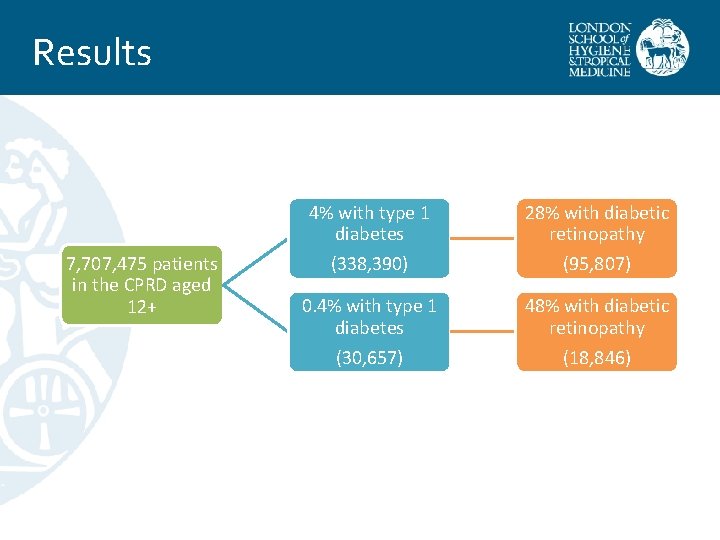
Results 7, 707, 475 patients in the CPRD aged 12+ 4% with type 1 diabetes (338, 390) 28% with diabetic retinopathy (95, 807) 0. 4% with type 1 diabetes (30, 657) 48% with diabetic retinopathy (18, 846)
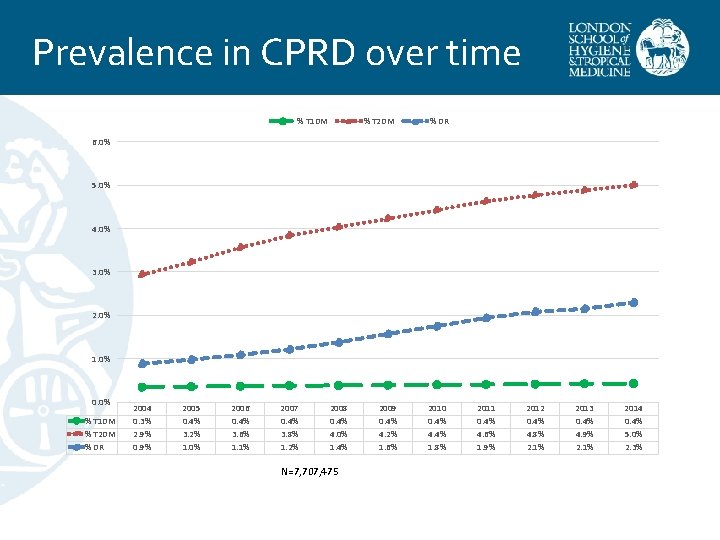
Prevalence in CPRD over time % T 1 DM % T 2 DM % DR 6. 0% 5. 0% 4. 0% 3. 0% 2. 0% 1. 0% 0. 0% % T 1 DM % T 2 DM % DR 2004 0. 3% 2. 9% 0. 9% 2005 0. 4% 3. 2% 1. 0% 2006 0. 4% 3. 6% 1. 1% 2007 0. 4% 3. 8% 1. 2% 2008 0. 4% 4. 0% 1. 4% N=7, 707, 475 2009 0. 4% 4. 2% 1. 6% 2010 0. 4% 4. 4% 1. 8% 2011 0. 4% 4. 6% 1. 9% 2012 0. 4% 4. 8% 2. 1% 2013 0. 4% 4. 9% 2. 1% 2014 0. 4% 5. 0% 2. 3%
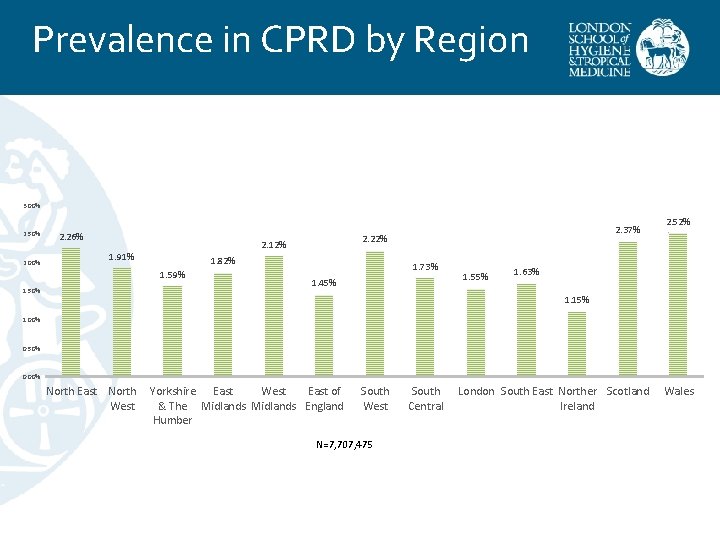
Prevalence in CPRD by Region 3. 00% 2. 50% 2. 00% 2. 26% 1. 82% 1. 59% 1. 50% 2. 22% 2. 12% 1. 91% 2. 37% 1. 73% 1. 45% 1. 55% 2. 52% 1. 63% 1. 15% 1. 00% 0. 50% 0. 00% North East North West Yorkshire East West East of & The Midlands England Humber South West N=7, 707, 475 South Central London South East Norther Scotland Ireland Wales
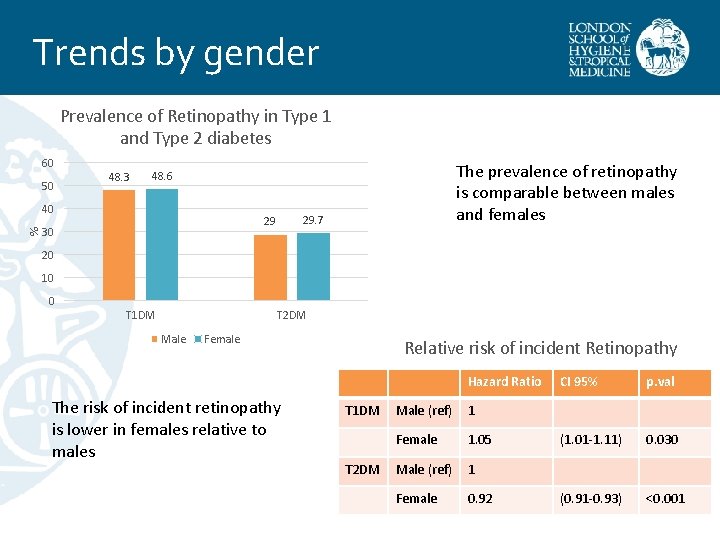
Trends by gender Prevalence of Retinopathy in Type 1 and Type 2 diabetes 60 50 48. 3 40 % The prevalence of retinopathy is comparable between males and females 48. 6 29. 7 29 30 20 10 0 T 1 DM T 2 DM Male Female Relative risk of incident Retinopathy Hazard Ratio The risk of incident retinopathy is lower in females relative to males T 1 DM T 2 DM Male (ref) 1 Female 1. 05 Male (ref) 1 Female 0. 92 CI 95% p. val (1. 01 -1. 11) 0. 030 (0. 91 -0. 93) <0. 001
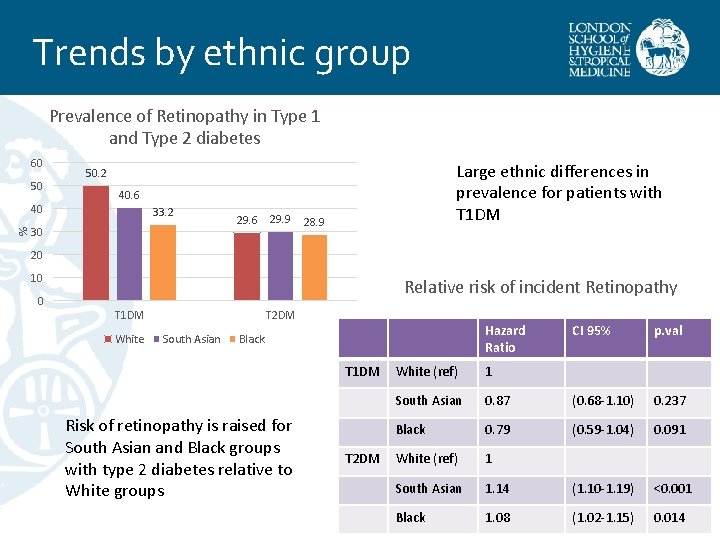
Trends by ethnic group Prevalence of Retinopathy in Type 1 and Type 2 diabetes 60 50 % 40 Large ethnic differences in prevalence for patients with T 1 DM 50. 2 40. 6 33. 2 30 29. 6 29. 9 28. 9 20 10 Relative risk of incident Retinopathy 0 T 1 DM White T 2 DM South Asian Hazard Ratio Black T 1 DM Risk of retinopathy is raised for South Asian and Black groups with type 2 diabetes relative to White groups T 2 DM CI 95% p. val White (ref) 1 South Asian 0. 87 (0. 68 -1. 10) 0. 237 Black 0. 79 (0. 59 -1. 04) 0. 091 White (ref) 1 South Asian 1. 14 (1. 10 -1. 19) <0. 001 Black 1. 08 (1. 02 -1. 15) 0. 014
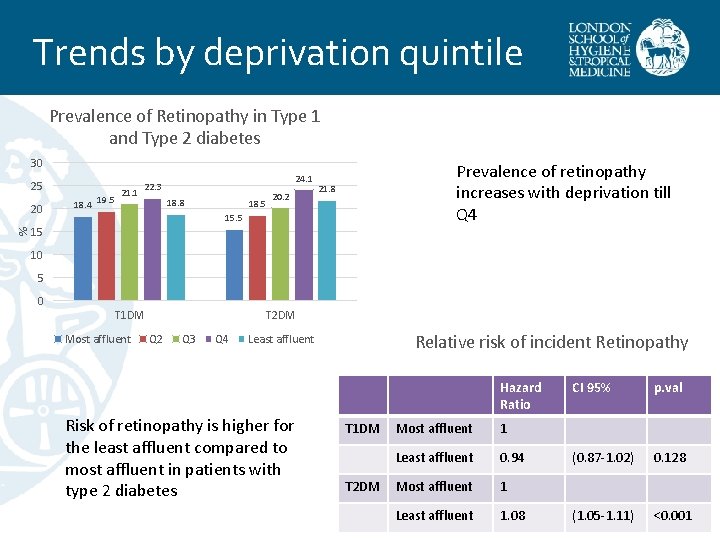
Trends by deprivation quintile Prevalence of Retinopathy in Type 1 and Type 2 diabetes 30 25 % 20 18. 4 19. 5 21. 1 24. 1 22. 3 18. 8 18. 5 20. 2 Prevalence of retinopathy increases with deprivation till Q 4 21. 8 15. 5 15 10 5 0 T 1 DM Most affluent T 2 DM Q 2 Q 3 Q 4 Relative risk of incident Retinopathy Least affluent Hazard Ratio Risk of retinopathy is higher for the least affluent compared to most affluent in patients with type 2 diabetes T 1 DM T 2 DM Most affluent 1 Least affluent 0. 94 Most affluent 1 Least affluent 1. 08 CI 95% p. val (0. 87 -1. 02) 0. 128 (1. 05 -1. 11) <0. 001
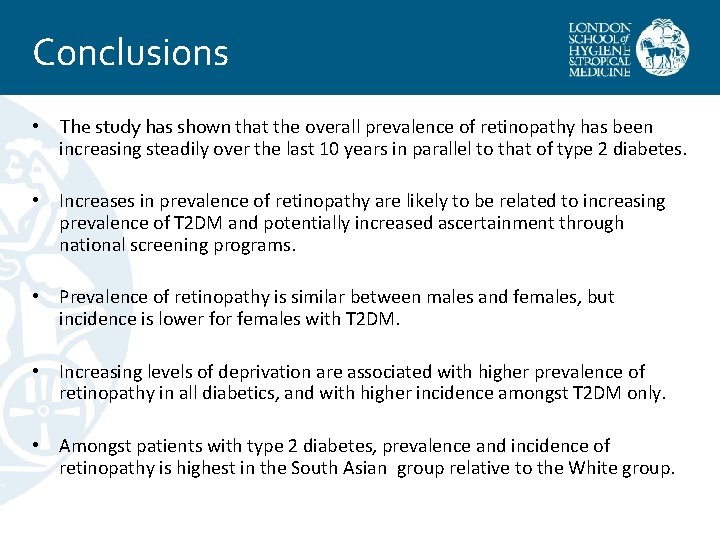
Conclusions • The study has shown that the overall prevalence of retinopathy has been increasing steadily over the last 10 years in parallel to that of type 2 diabetes. • Increases in prevalence of retinopathy are likely to be related to increasing prevalence of T 2 DM and potentially increased ascertainment through national screening programs. • Prevalence of retinopathy is similar between males and females, but incidence is lower for females with T 2 DM. • Increasing levels of deprivation are associated with higher prevalence of retinopathy in all diabetics, and with higher incidence amongst T 2 DM only. • Amongst patients with type 2 diabetes, prevalence and incidence of retinopathy is highest in the South Asian group relative to the White group.
Strengths • This study constitutes the largest ever sample size to examine trends in the burden of diabetes and diabetic retinopathy in the UK. • Currently, this is the only national study to examine ethnicity and deprivation in relation to the prevalence and incidence of diabetic retinopathy. • The advantage of routine electronic health databases is that they are regularly updated and can be used to provide timely information on the demographic makeup of the general population and on areas of growing healthcare need.
Policy implications • Given that the CPRD is representative of the UK population structure, we estimate that the absolute number of people with any form of diabetic retinopathy in the UK is approximately 1. 5 million. • In 2014, attendance at diabetic retinopathy screening was removed from the Quality and Outcomes Framework. Not only will this impact on future research into retinopathy, it is likely to have serious negative implications on service planning for diabetic patients unless the indicator is reinstated. • The national diabetic retinopathy screening programme needs to improve access to screening and support around self-management of diabetes for deprived and ethnic minority populations to avoid increasing inequalities.
Thank you! I’d like to thank the team at LSHTM: Ian Douglas, Krishnan Bhaskaran, Nish Chaturvedi, Liam Smeeth And at the RNIB Emma Edwards, Helen Lee, John Slade Any Questions? (Full Results will be published on the RNIB website in 2016)
PREVALENCE AND INCIDENCE OF DIABETIC RETINOPATHY IN THE UK Rohini Mathur LSHTM RNIB Research Day 2015 Improving health worldwide www. lshtm. ac. uk
- Slides: 15