
Preterm Labor Prevention and Treatment Kerry Watrin MD

Preterm Labor Prevention and Treatment Kerry Watrin MD August 2 nd 2007
Objectives: ¨ ¨ ¨ Define preterm labor and its impact Describe Risk Factors for preterm birth Name several ways to prevent preterm birth Identify and diagnose preterm labor Outline an appropriate evaluation and management algorithm for patients who present with preterm labor and PPROM Understand risks and limitations of management strategies for treating patients with preterm labor and PROM
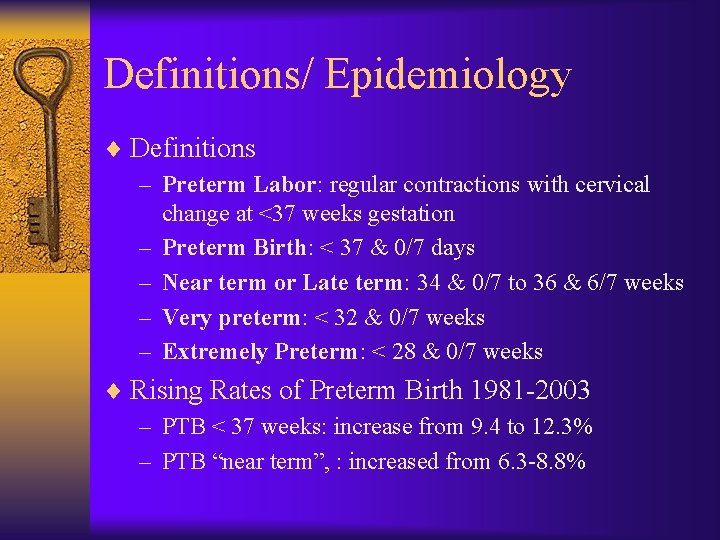
Definitions/ Epidemiology ¨ Definitions – Preterm Labor: regular contractions with cervical – – change at <37 weeks gestation Preterm Birth: < 37 & 0/7 days Near term or Late term: 34 & 0/7 to 36 & 6/7 weeks Very preterm: < 32 & 0/7 weeks Extremely Preterm: < 28 & 0/7 weeks ¨ Rising Rates of Preterm Birth 1981 -2003 – PTB < 37 weeks: increase from 9. 4 to 12. 3% – PTB “near term”, : increased from 6. 3 -8. 8%
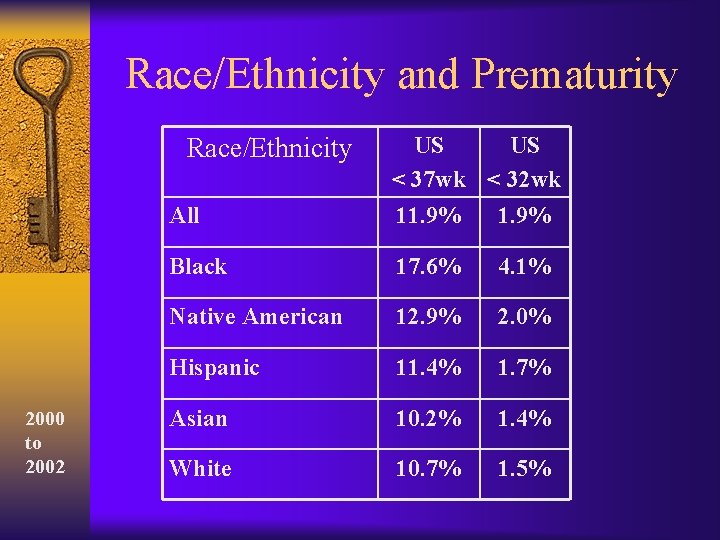
Race/Ethnicity and Prematurity All US US < 37 wk < 32 wk 11. 9% Black 17. 6% 4. 1% Native American 12. 9% 2. 0% Hispanic 11. 4% 1. 7% Asian 10. 2% 1. 4% White 10. 7% 1. 5% Race/Ethnicity 2000 to 2002
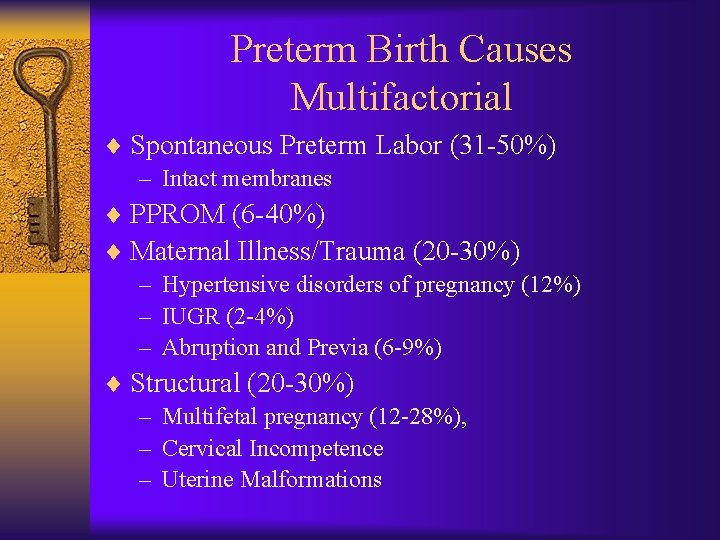
Preterm Birth Causes Multifactorial ¨ Spontaneous Preterm Labor (31 -50%) – Intact membranes ¨ PPROM (6 -40%) ¨ Maternal Illness/Trauma (20 -30%) – Hypertensive disorders of pregnancy (12%) – IUGR (2 -4%) – Abruption and Previa (6 -9%) ¨ Structural (20 -30%) – Multifetal pregnancy (12 -28%), – Cervical Incompetence – Uterine Malformations
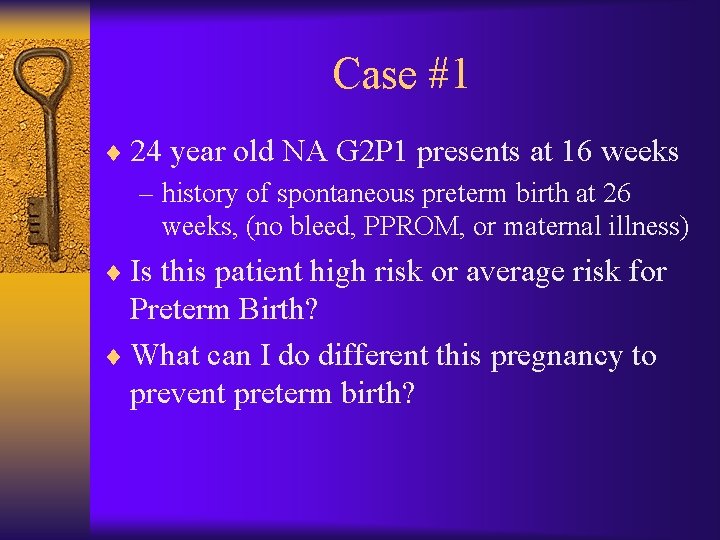
Case #1 ¨ 24 year old NA G 2 P 1 presents at 16 weeks – history of spontaneous preterm birth at 26 weeks, (no bleed, PPROM, or maternal illness) ¨ Is this patient high risk or average risk for Preterm Birth? ¨ What can I do different this pregnancy to prevent preterm birth?
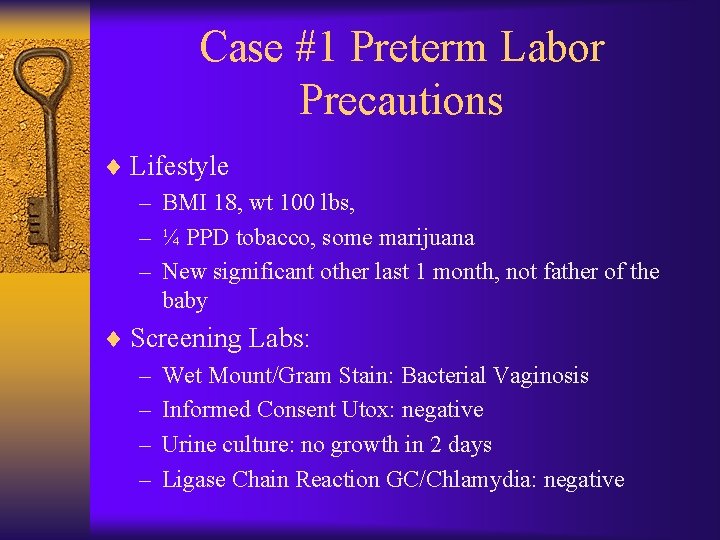
Case #1 Preterm Labor Precautions ¨ Lifestyle – BMI 18, wt 100 lbs, – ¼ PPD tobacco, some marijuana – New significant other last 1 month, not father of the baby ¨ Screening Labs: – Wet Mount/Gram Stain: Bacterial Vaginosis – Informed Consent Utox: negative – Urine culture: no growth in 2 days – Ligase Chain Reaction GC/Chlamydia: negative
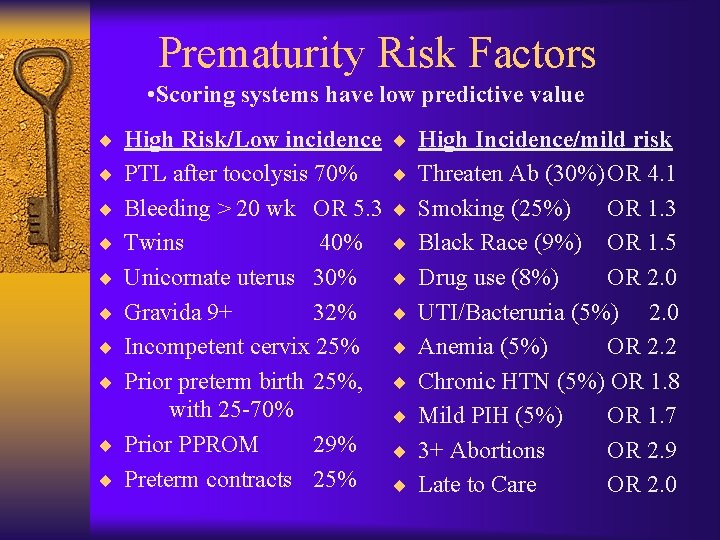
Prematurity Risk Factors • Scoring systems have low predictive value ¨ High Risk/Low incidence ¨ High Incidence/mild risk ¨ PTL after tocolysis 70% ¨ Threaten Ab (30%) OR 4. 1 ¨ Bleeding > 20 wk OR 5. 3 ¨ Smoking (25%) ¨ Twins ¨ ¨ ¨ ¨ 40% Unicornate uterus 30% Gravida 9+ 32% Incompetent cervix 25% Prior preterm birth 25%, with 25 -70% Prior PPROM 29% Preterm contracts 25% ¨ ¨ ¨ OR 1. 3 Black Race (9%) OR 1. 5 Drug use (8%) OR 2. 0 UTI/Bacteruria (5%) 2. 0 Anemia (5%) OR 2. 2 Chronic HTN (5%) OR 1. 8 Mild PIH (5%) OR 1. 7 3+ Abortions OR 2. 9 Late to Care OR 2. 0
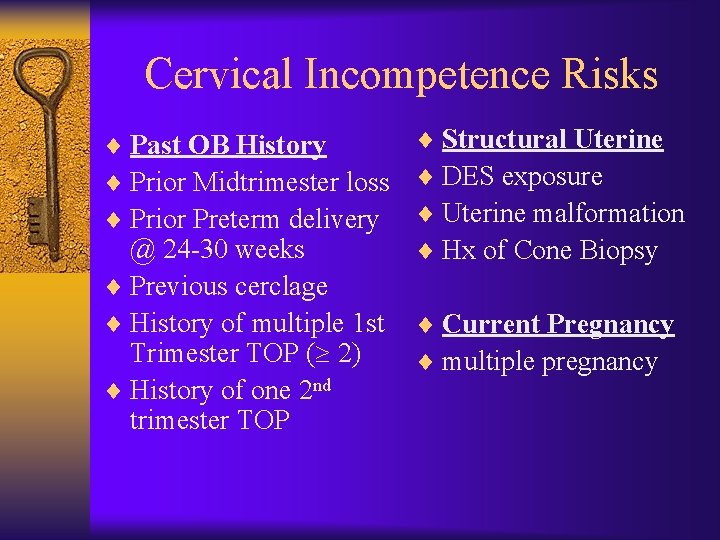
Cervical Incompetence Risks ¨ Structural Uterine ¨ Past OB History ¨ Prior Midtrimester loss ¨ DES exposure ¨ Prior Preterm delivery ¨ Uterine malformation @ 24 -30 weeks ¨ Hx of Cone Biopsy ¨ Previous cerclage ¨ History of multiple 1 st ¨ Current Pregnancy Trimester TOP ( 2) ¨ multiple pregnancy ¨ History of one 2 nd trimester TOP
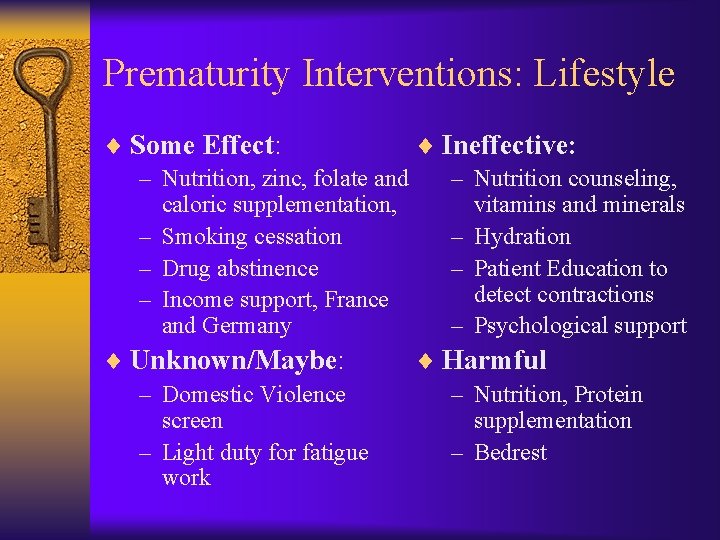
Prematurity Interventions: Lifestyle ¨ Some Effect: ¨ Ineffective: – Nutrition, zinc, folate and – Nutrition counseling, caloric supplementation, – Smoking cessation – Drug abstinence – Income support, France and Germany ¨ Unknown/Maybe: – Domestic Violence screen – Light duty for fatigue work vitamins and minerals – Hydration – Patient Education to detect contractions – Psychological support ¨ Harmful – Nutrition, Protein supplementation – Bedrest
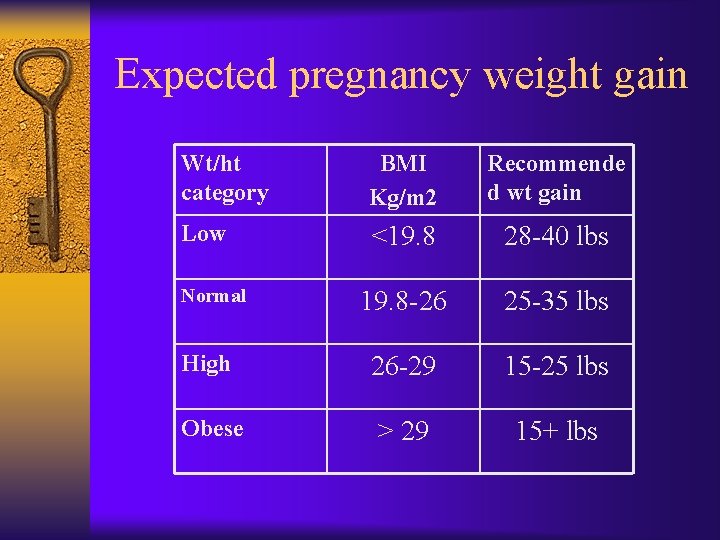
Expected pregnancy weight gain Wt/ht category BMI Kg/m 2 Recommende d wt gain Low <19. 8 28 -40 lbs 19. 8 -26 25 -35 lbs High 26 -29 15 -25 lbs Obese > 29 15+ lbs Normal
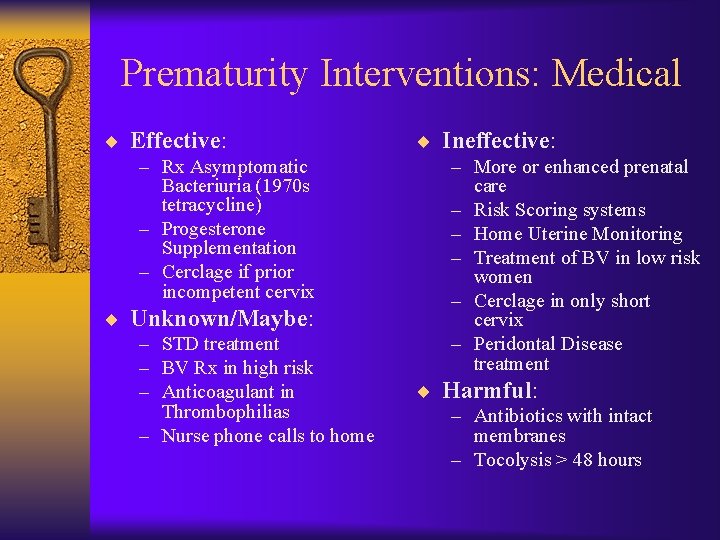
Prematurity Interventions: Medical ¨ Effective: – Rx Asymptomatic Bacteriuria (1970 s tetracycline) – Progesterone Supplementation – Cerclage if prior incompetent cervix ¨ Unknown/Maybe: – STD treatment – BV Rx in high risk – Anticoagulant in Thrombophilias – Nurse phone calls to home ¨ Ineffective: – More or enhanced prenatal care – Risk Scoring systems – Home Uterine Monitoring – Treatment of BV in low risk women – Cerclage in only short cervix – Peridontal Disease treatment ¨ Harmful: – Antibiotics with intact membranes – Tocolysis > 48 hours
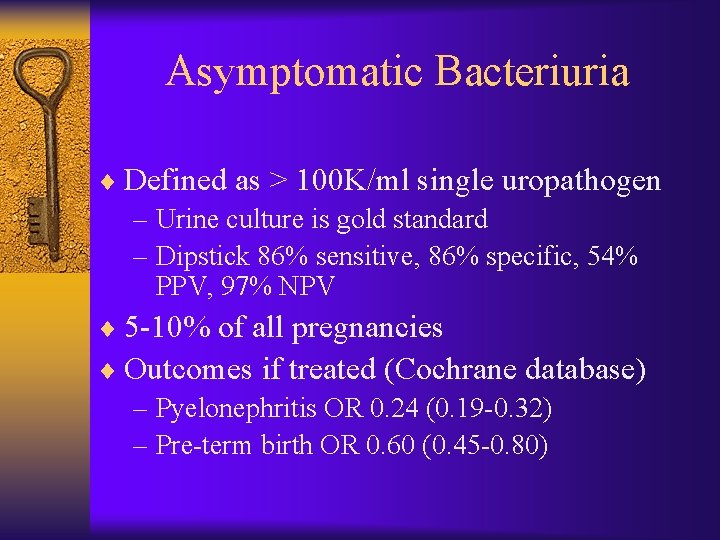
Asymptomatic Bacteriuria ¨ Defined as > 100 K/ml single uropathogen – Urine culture is gold standard – Dipstick 86% sensitive, 86% specific, 54% PPV, 97% NPV ¨ 5 -10% of all pregnancies ¨ Outcomes if treated (Cochrane database) – Pyelonephritis OR 0. 24 (0. 19 -0. 32) – Pre-term birth OR 0. 60 (0. 45 -0. 80)

Bacterial Vaginosis: Clue cell
Bacterial Vaginosis ¨ Common occurs in 20%, asymptomatic in 50% ¨ Diagnosis by – wet mount (3 of 4 criteria: clue cells, p. H > 4. 5, positive whiff test with KOH for amine odor, thin homogenous discharge) – gram stain, criteria on type and amount of bacteria ¨ Increased risk of OB complications, RR or 2. 3 for preterm delivery, 2. 4 for PROM, 3. 2 for chorioamnionitis
Bacterial Vaginosis ¨ 1995 small (n=426) high risk (prior PTB) – RTC showed a 30% decrease in preterm birth with Rx using Erythromycin (14 d) and Metronidazole (7 d) ¨ 2000 Large trial (n= 1953) low risk for PTB – diagnosis by gram stain and treatment with metronidazole 2 gm stat alone, with no effect ¨ AHRQ 2001 Review – I rating for “high risk women” – D rating for “low risk asymptomatic women”
Bacterial Vaginitis Metronidazole potential harm ¨ Metronidazole – 2006 PREMET study, • 900 screened 24 and 27 weeks for fetal fibronectin, 116 positive, 100 randomized, 400 mg TID Metonidazole, 11/53 treated delivered < 37 weeks vs. 18/46 control, RR 1. 6 (CI 1. 05 -2. 4) – 2001 Trichomonas study, • 16 -23 weeks, asymptomatic, treated with 2 grams for 2 doses, PTB 60/320 treated, 31/297 placebo, RR 1. 8 (CI 1. 2 -2. 7) – 2004 Meta-analysis of 4 studies, • 182/1, 375 treated vs. 180/1, 373 control, RR 0. 92 (CI 0. 521. 62) for preterm birth, no difference
Bacterial Vaginitis Clindamycin ¨ Clindamycin – 2003 RTC, Clindamycin low Risk, n= 494, Showed less Preterm Birth 11/244 vs. 28/241, NNT is 17, and less late miscarriage 13 -24 weeks, 2 vs. 10, NNT of 10
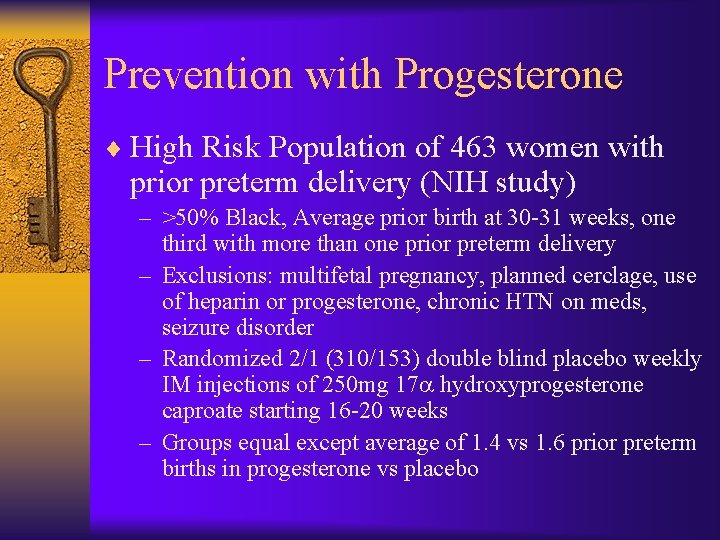
Prevention with Progesterone ¨ High Risk Population of 463 women with prior preterm delivery (NIH study) – >50% Black, Average prior birth at 30 -31 weeks, one third with more than one prior preterm delivery – Exclusions: multifetal pregnancy, planned cerclage, use of heparin or progesterone, chronic HTN on meds, seizure disorder – Randomized 2/1 (310/153) double blind placebo weekly IM injections of 250 mg 17 hydroxyprogesterone caproate starting 16 -20 weeks – Groups equal except average of 1. 4 vs 1. 6 prior preterm births in progesterone vs placebo
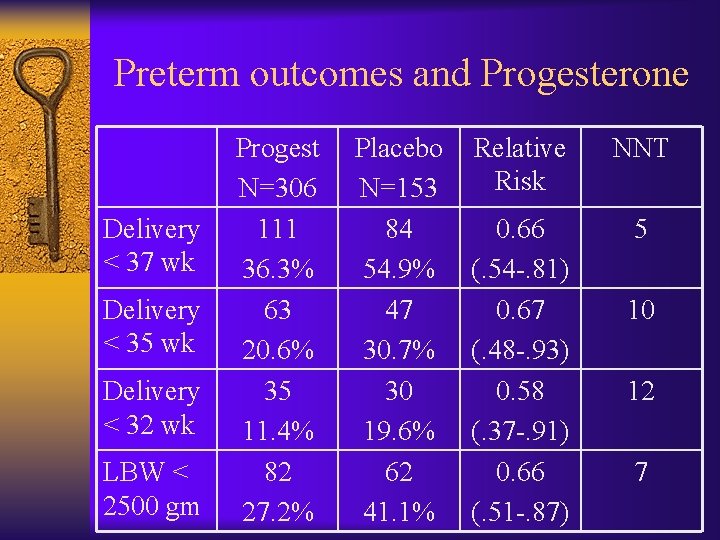
Preterm outcomes and Progesterone Delivery < 37 wk Delivery < 35 wk Delivery < 32 wk LBW < 2500 gm Progest N=306 111 36. 3% 63 20. 6% 35 11. 4% 82 27. 2% Placebo N=153 84 54. 9% 47 30. 7% 30 19. 6% 62 41. 1% Relative Risk NNT 0. 66 (. 54 -. 81) 0. 67 (. 48 -. 93) 0. 58 (. 37 -. 91) 0. 66 (. 51 -. 87) 5 10 12 7
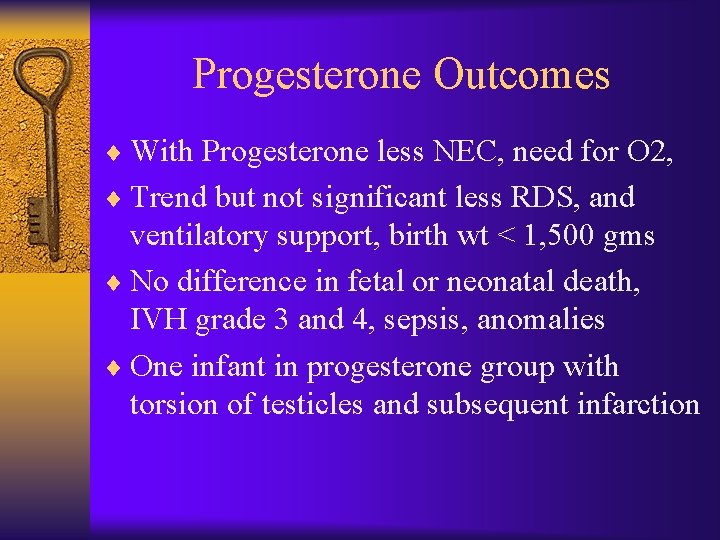
Progesterone Outcomes ¨ With Progesterone less NEC, need for O 2, ¨ Trend but not significant less RDS, and ventilatory support, birth wt < 1, 500 gms ¨ No difference in fetal or neonatal death, IVH grade 3 and 4, sepsis, anomalies ¨ One infant in progesterone group with torsion of testicles and subsequent infarction
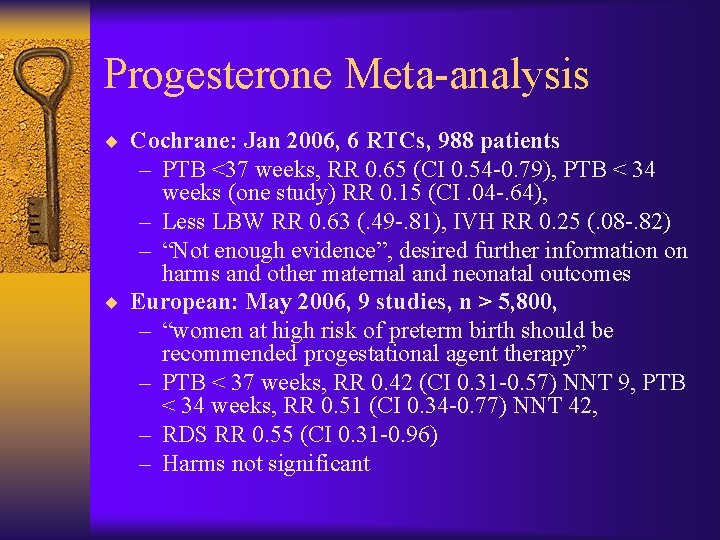
Progesterone Meta-analysis ¨ Cochrane: Jan 2006, 6 RTCs, 988 patients – PTB <37 weeks, RR 0. 65 (CI 0. 54 -0. 79), PTB < 34 weeks (one study) RR 0. 15 (CI. 04 -. 64), – Less LBW RR 0. 63 (. 49 -. 81), IVH RR 0. 25 (. 08 -. 82) – “Not enough evidence”, desired further information on harms and other maternal and neonatal outcomes ¨ European: May 2006, 9 studies, n > 5, 800, – “women at high risk of preterm birth should be recommended progestational agent therapy” – PTB < 37 weeks, RR 0. 42 (CI 0. 31 -0. 57) NNT 9, PTB < 34 weeks, RR 0. 51 (CI 0. 34 -0. 77) NNT 42, – RDS RR 0. 55 (CI 0. 31 -0. 96) – Harms not significant
ACOG and Progesterone ¨ “The hormone progesterone may be used as treatment to help prevent preterm birth but should be restricted to pregnant women with a documented history of preterm birth before 37 weeks gestation”
Preterm Birth Risk Stratification ¨ Contractions: – 50% of those with threatened preterm labor deliver term pregnancies, can we further define risk ¨ Biochemical Markers – Fetal Fibronectin ¨ Biophysical Markers – Cervical Length
Markers for Prematurity ¨ Preterm Prediction Study: Case control ¨ 28 biologic markers studied in 2, 929 women at 23 weeks ¨ 50 (1. 7%) delivered < 32 weeks ¨ 127 (4. 3%) delivered < 35 weeks
Most Potent Predictive Markers For Preterm Birth < 32 weeks ¨ 2 positive below OR 56. 5 – 59% of cases and 2. 4% of controls ¨ Fetal Fibronectin OR 32. 7 ¨ > 90 th % AFP OR 8. 3 ¨ > 90 th % Alk Phos OR 6. 8 ¨ < 10% Cvx (25 mm) OR 5. 8 ¨ > 75% GCSF OR 5. 5 ¨ Any three tests positive – 20% of cases and none of controls
Fetal Fibronectin ¨ Occurs in the choriodecidual junction ¨ Decreases 16 -20 wks, absent 24 -34 wks ¨ Taken from the vaginal fornix for 10 seconds, not in cervix ¨ No prior coitus or vaginal exam for 24 hrs ¨ ROM or bleeding make inaccurate
Fetal Fibronectin ¨ Asymptomatic ¨ Positive (n=1, 530) – 18. 4% delivery <34 weeks – LR 4. 01 (2. 93 to 5. 49) ¨ Negative (n=23, 150) – 96. 8% deliver >34 weeks – LR 0. 78 (0. 72 -0. 84) ¨ Symptomatic ¨ Birth in 7 -10 days – Positive (n=1, 270) • 21% deliver in 7 -10 d • LR 5. 42 (4. 36 -6. 74) – Negative (n= 5865) • 1% deliver in 7 -10 d • LR 0. 25 (0. 2 -0. 31) ¨ Delivery < 34 weeks – Positive (n=189) • 46. 6%, LR 3. 64 – Negative (n= 498) • 93. 4%, LR 0. 32
Fetal Fibronectin ¨ If positive – One in 5 symptomatic deliver in 7 -10 days – One in 5 asymptomatic will deliver by 34 wks – Nearly half symptomatic deliver by 34 weeks ¨ If negative – One in 100 symptomatic deliver in 7 -10 days – Three in 100 asymptomatic deliver < 34 weeks – 6 -7 in 100 symptomatic deliver < 34 weeks
Case #2 Low Risk no prior PTB at 25 weeks ¨ Size < Dates, 21 cm fundal height at 25 weeks ¨ Transabdominal Ultrasound shows – normal growth – cervix is with 1. 2 cm length and 1. 2 cm wide fluid filled beaking in upper canal ¨ Transvaginal Ultrasound repeat shows – 2. 3 cm long cervix, with again beaking down 1. 3 -1. 5 cm of the length, 1. 0 cm from beak tip to external os ¨ One hour of tocodynometer shows no contractions ¨ Vaginal exam is 2 -3 cm long, closed, firm ¨ Outpatient vaginal Fetal Fibronectin is negative ¨ What precautions for this incidental US finding?
Transvaginal Cervical Length ¨ 1996 NEJM study of 2, 915 women with US at 24 weeks, repeat on 2, 531 at 28 weeks ¨ 126 with preterm birth < 35 weeks, 4. 3% ¨ Was a general population, 42% were nulliparous ¨ 16% had history of prior preterm birth ¨ There was only 2 mm difference between parous and nulliparous women, not clinically important ¨ Mean length was 35. 2 mm at 24 weeks and 33. 7 mm at 28 weeks
Rate of Preterm Birth <35 weeks by Cervical Length at 24 weeks Length Rate Delivery 25 mm 8% <20 mm 20 % < 13 mm 34 %
Ultrasound Cervical Length Prediction of PTB < 35 weeks Finding 20 mm 24 weeks 20 mm 28 weeks 25 mm 24 weeks Funneling At 24 wk Sensitivity Specificity NPV PPV 23% 97% 96. 7% 25. 7% 31. 3% 94. 7% 97. 6% 16. 7% 37. 3% 92. 2% 25. 4% 94. 5% 97% 17. 8% 96. 6% 17. 2%
Cervical Length Caveats ¨ Distinguish Average Risk versus High Risk Population studies ¨ Cervixes change from the inside out, but digital vaginal exam of Bishops ≥ 4 is significant ¨ Ultrasound Higher risk of Preterm Birth with – Funneling > 25% – Earlier shortening 16 versus 24 weeks – More rapid rate, <3 mm/week reassuring, 5 mm per week concerning at 20 -24 weeks
Cerclage and Short Cervix ¨ 47, 123 screened at 22 -25 weeks ¨ 430 with cervical length < 15 mm ¨ 253 in RTC ¨ No difference in delivery before 33 weeks with placement of Shirodkar suture – 22% (28 /127 cerclage), 26% (33/126 control) – RR 0. 84 (CI 0. 54 -1. 31) ¨ No difference in perinatal or maternal morbidity and mortality
Role of US and Cerclage High risk with 3 prior midterm losses ¨ Serial Cervical Length Ultrasound: – May have a role in management – Assessments should begin no earlier than 16 -20 weeks – No role for history of 1 st trimester losses ¨ Cerclage – Only benefit in subgroup 3 prior midtrimester losses or preterm deliveries, 33% watched, 15% cerclage with delivery before 33 weeks, n=107, total groups n=1, 292 – No benefit in subgroups of one prior MTL/PTD, two prior MTL/PTD, history cone biopsy or cervical amputation, twins, prior TOP/uterine anomalie ACOG Practice Bulletin #48, Nov 2003
Short Cervix and Vaginal Progesterone ¨ 2003 -2006, 24, 620 screened by US at 20 -25 weeks for short cervix during prenatal care, 413 with cervix ≤ 15 mm, 250 accepted randomization, groups equal, ¨ 200 mg micronized progesterone vaginally each night, 24 to 33 and 6/7 weeks, avoid intercourse ¨ PT Birth < 34 weeks, 26/125 progesterone vs. 43/125 placebo RR 0. 60 (CI 0. 38 -0. 86), NNT = 7 ¨ Not large enough to see neonatal outcomes
Contractions and Bishops Score And birth before 35 weeks ¨ 306 high risk women, singleton pregnancy with prior PTB or 2 nd trimester bleeding ¨ Contractions 4 per hour – RR was with 3. 0 but not significant, • At 24 weeks CI (0. 6 -14. 6) • At 28 weeks CI (1. 0 - 8. 7) – Sens 6. 7%, Specificity 92. 3%, PPV 25%, NPV 84. 7% – 75% deliver at term ¨ Bishops Score 4 – Significant only at 22 -24 weeks OR 2. 4 (CI 1. 7 -10. 6) – Sens 32 %, Specificity 91. 4%, PPV 42. 1%, NPV 87. 4%
Threatened Preterm Labor ¨ Preterm Labor due to what? – Treat reversible causes, such as UTI, – Consider occult trauma of domestic violence, contractions of substance abuse – Watch for PPROM, about 1/3 of preterm birth ¨ For Idiopathic Preterm Labor Four Categories – Inflammation/ Infection – Uterine Over-distension/ Structural – Decidual Hemorrhage/ Bleeding – Premature activation of normal initiators of labor
Idiopathic Preterm Contractions in Triage ¨ 179 randomized, – singletons, 20 -34 weeks, no ROM, no maternal of fetal complication, reassuring FHT – 3 contractions/30 min, 1 cm dilated, 80% effaced – Eligible for discharge when contractions < 2 in 30 minutes, no digital cervical change, one hour apart, – Preterm labor if cervical change of dilation of 1 cm or effacement of 25% ¨ Terbutaline with 1 -2 hour less triage stay ¨ No significant outcome differences between – Observation, – Hydration of 500 cc crystalloid then 200 cc/hour, – Terbutaline one Subcutaneous dose of 0. 25 mg
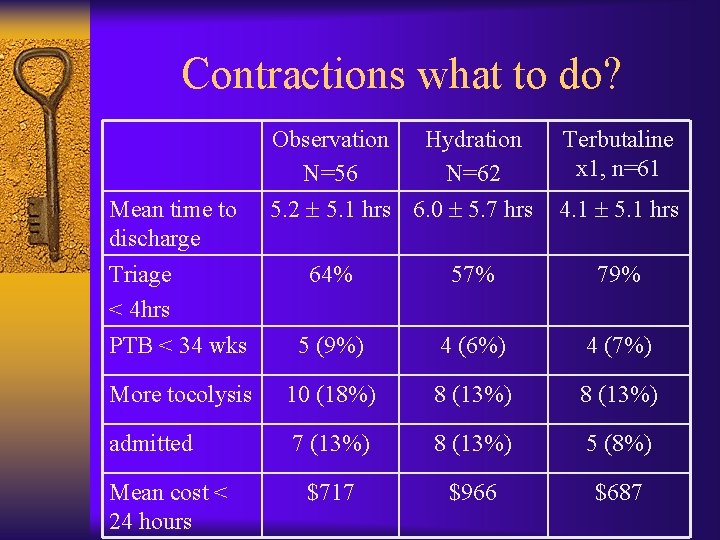
Contractions what to do? Mean time to discharge Observation Hydration N=56 N=62 5. 2 5. 1 hrs 6. 0 5. 7 hrs Terbutaline x 1, n=61 4. 1 5. 1 hrs Triage < 4 hrs PTB < 34 wks 64% 57% 79% 5 (9%) 4 (6%) 4 (7%) More tocolysis 10 (18%) 8 (13%) admitted 7 (13%) 8 (13%) 5 (8%) $717 $966 $687 Mean cost < 24 hours
Case #2 now with contractions ¨ Presents 28 weeks with contractions every 5 minutes, ¨ Repeat exams and labs – Digital cervix some change 1 cm long, medium consistency, posterior, -3 station, closed – Fetal Fibronectin now positive – US length repeated slightly progressed, 1. 2 cm length, 0. 7 cm from tip of funnel to external os, – GBS culture done, (at 24 hours is positive) – Hematocrit 29. 5 ¨ What approach now with short US cervix, positive fetal fibronectin, and slight clinical shortening?
Case #2, Threatened PTL in High Risk (contracts, +FFN, short cervix) ¨ GBS prophylaxis: Penicillin ¨ Given Terbutaline 0. 25 mg SQ/dose tocolysis to allow 48 hours steroids ¨ Given Betamethasone 12 mg IM q 24 hours times 2 doses ¨ ? Fe. SO 4 325 mg TID ¨ Observe in hospital with level 3 NICU
The Recommendations MMWR, Vol 51 (RR-11)
CDC GBS algorithm for Threatened Preterm Delivery ¨ Suggested algorithm for management of threatened preterm delivery (labor or rupture of membranes at <37 weeks’ gestation) which does not proceed rapidly to delivery: – Culture and start IV antibiotics – Culture negative at 48 hrs: stop antibiotics – Culture positive: no data on duration of antibiotics before active labor, when active labor begins give IAP – Culture negative and undelivered within 4 wks: re-screen
Agents for intrapartum prophylaxis ¨ Recommended agents for women with documented penicillin allergy: – Not at high risk for anaphylaxis: cefazolin – At high risk for anaphylaxis: • Clindamycin or erythromycin if susceptibility testing feasible • Vancomycin if erythromycin or clindamycin not options
Antenatal Steroids ¨ Intact Membranes and PTL 24 -34 weeks – Cochrane shows benefit 26 to 34 & 6/7 weeks ¨ PPROM and no chorioamnionitis, 24 -32 wk ¨ Single course recommended – Cochrane 2006 ¨ Doses – 2 doses Betamethasone 12 mg q 24 hours – 4 doses Dexamethasone 6 mg q 12 hours
Antenatal Steroids ¨ Cochrane 2006, 21 studies, n = 3, 885 women, 4, 629 newborns, showing less ¨ Neonatal Death: RR 0. 69 (CI. 58 -. 81) ¨ RDS: RR 0. 66 (CI. 59 -. 73) ¨ IVH: RR 0. 54 (CI. 43 -. 69) ¨ NEC: RR 0. 46 (CI. 29 -. 74) ¨ NICU Ventilator RR 0. 80 (CI. 65 -. 99) ¨ Neonatal Sepsis RR 0. 56 (CI. 38 -. 85) ¨ Develop Delay RR 0. 49 (CI. 24 -1. 00)
Repeat courses of Antenatal Steroids ¨ Cochrane 2006 subgroup weekly repeats, n = 5 -900 – Less perinatal death RR 0. 63 (. 48 -. 92) NNT 7 – Less RDS RR 0. 55 (. 43 -. 72) NNT 9 – Less Chronic Lung RR 0. 72 (. 54 -. 96) NNT 15 ¨ Lancet 2006, RTC single repeat dose, n = 982 – Less RDS RR 0. 82 (. 71 -. 95) NNT = 12 – Severe lung disease RR 0. 60 (. 42 -. 79) NNT = 12 ¨ Pediatrics Feb 2007, single repeat dose, n = 249 – No difference in neonatal death, RDS or IVH – Increased RDS if delivers in first 24 hours after second dose of steroids
Tocolytics: Ca Channel Blockers: dihydropryridines ¨ Cochrance 12 trials of 1, 029 versus any tocolytic, 9 versus betamemetics, Outcomes ¨ ¨ ¨ ¨ Less birth in 48 hrs (vs agonist) RR 0. 72 Less birth in 7 days RR 0. 76 (0. 60 -0. 97) Less birth < 34 weeks RR 0. 83 (0. 69 -99) Less RDS RR 0. 63 (0. 46 -. 88) NNT 14 Less NEC RR 0. 21 (0. 05 -0. 96) Less IVH RR 0. 59 (0. 36 -. 98) NNT 13 Less Adverse Effects NNT of 3 Conclusion: “calcium channel blockers should be preferred to betamimetics”
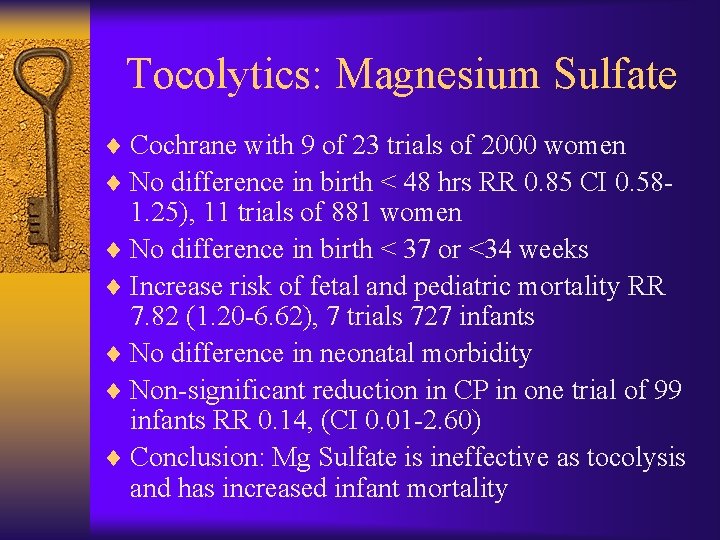
Tocolytics: Magnesium Sulfate ¨ Cochrane with 9 of 23 trials of 2000 women ¨ No difference in birth < 48 hrs RR 0. 85 CI 0. 58 - 1. 25), 11 trials of 881 women ¨ No difference in birth < 37 or <34 weeks ¨ Increase risk of fetal and pediatric mortality RR 7. 82 (1. 20 -6. 62), 7 trials 727 infants ¨ No difference in neonatal morbidity ¨ Non-significant reduction in CP in one trial of 99 infants RR 0. 14, (CI 0. 01 -2. 60) ¨ Conclusion: Mg Sulfate is ineffective as tocolysis and has increased infant mortality
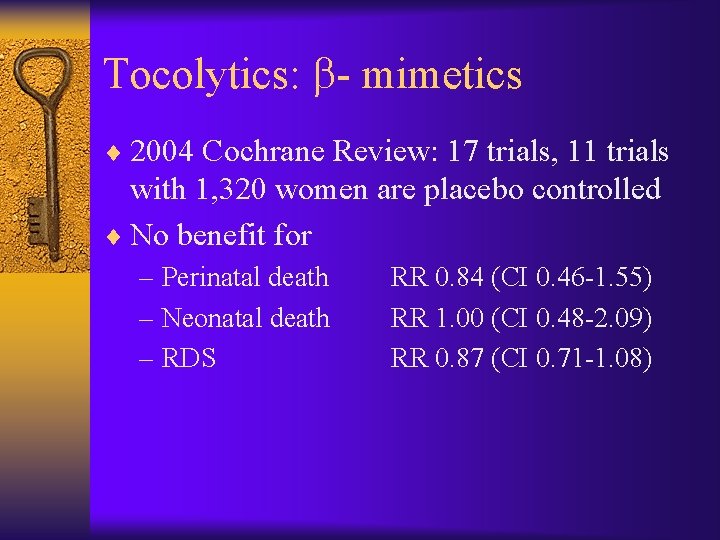
Tocolytics: - mimetics ¨ 2004 Cochrane Review: 17 trials, 11 trials with 1, 320 women are placebo controlled ¨ No benefit for – Perinatal death – Neonatal death – RDS RR 0. 84 (CI 0. 46 -1. 55) RR 1. 00 (CI 0. 48 -2. 09) RR 0. 87 (CI 0. 71 -1. 08)
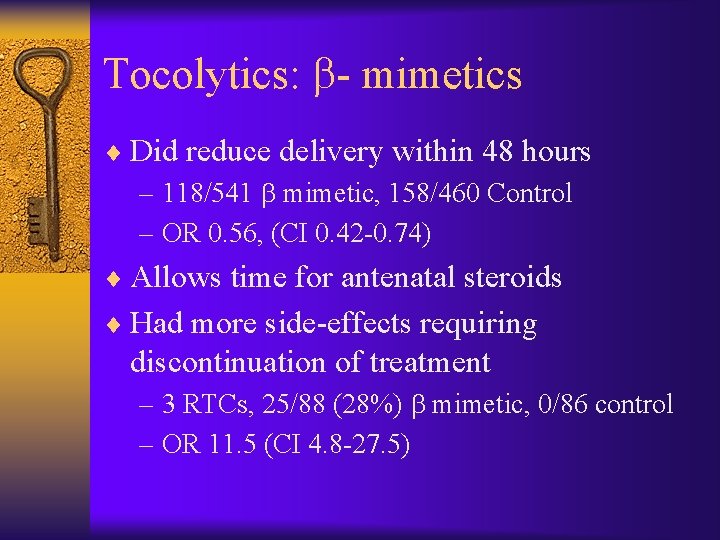
Tocolytics: - mimetics ¨ Did reduce delivery within 48 hours – 118/541 mimetic, 158/460 Control – OR 0. 56, (CI 0. 42 -0. 74) ¨ Allows time for antenatal steroids ¨ Had more side-effects requiring discontinuation of treatment – 3 RTCs, 25/88 (28%) mimetic, 0/86 control – OR 11. 5 (CI 4. 8 -27. 5)
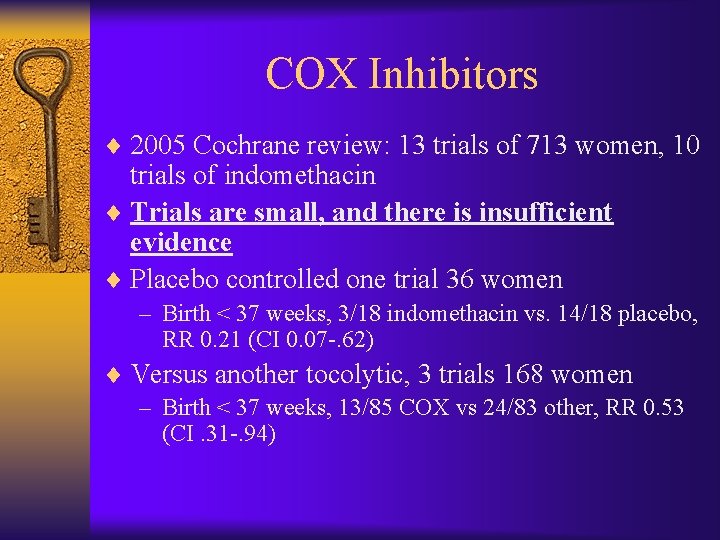
COX Inhibitors ¨ 2005 Cochrane review: 13 trials of 713 women, 10 trials of indomethacin ¨ Trials are small, and there is insufficient evidence ¨ Placebo controlled one trial 36 women – Birth < 37 weeks, 3/18 indomethacin vs. 14/18 placebo, RR 0. 21 (CI 0. 07 -. 62) ¨ Versus another tocolytic, 3 trials 168 women – Birth < 37 weeks, 13/85 COX vs 24/83 other, RR 0. 53 (CI. 31 -. 94)
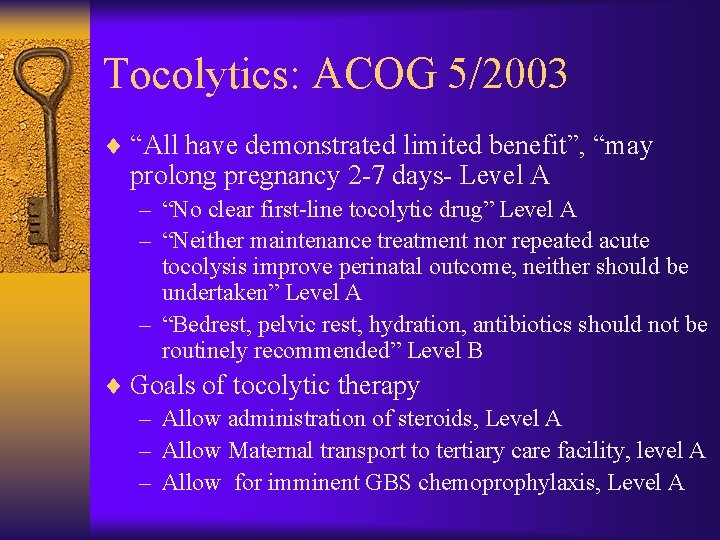
Tocolytics: ACOG 5/2003 ¨ “All have demonstrated limited benefit”, “may prolong pregnancy 2 -7 days- Level A – “No clear first-line tocolytic drug” Level A – “Neither maintenance treatment nor repeated acute tocolysis improve perinatal outcome, neither should be undertaken” Level A – “Bedrest, pelvic rest, hydration, antibiotics should not be routinely recommended” Level B ¨ Goals of tocolytic therapy – Allow administration of steroids, Level A – Allow Maternal transport to tertiary care facility, level A – Allow for imminent GBS chemoprophylaxis, Level A
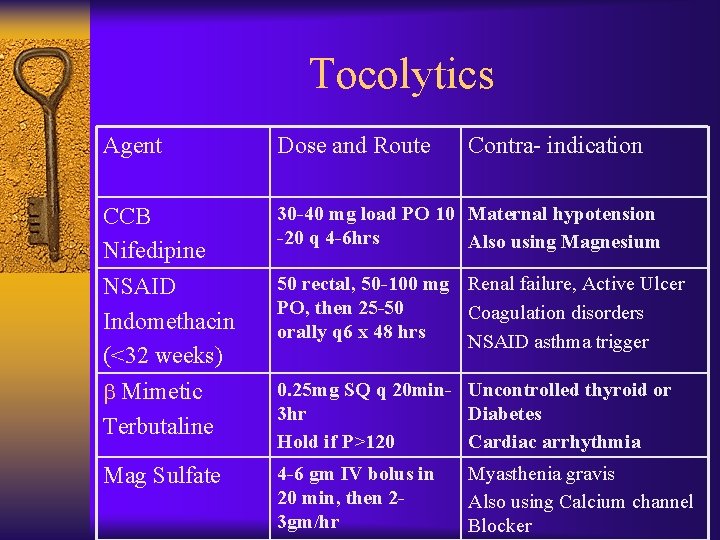
Tocolytics Agent Dose and Route Contra- indication CCB Nifedipine 30 -40 mg load PO 10 Maternal hypotension -20 q 4 -6 hrs Also using Magnesium NSAID Indomethacin (<32 weeks) Mimetic Terbutaline 50 rectal, 50 -100 mg Renal failure, Active Ulcer PO, then 25 -50 Coagulation disorders orally q 6 x 48 hrs NSAID asthma trigger Mag Sulfate 4 -6 gm IV bolus in 20 min, then 23 gm/hr 0. 25 mg SQ q 20 min- Uncontrolled thyroid or 3 hr Diabetes Hold if P>120 Cardiac arrhythmia Myasthenia gravis Also using Calcium channel Blocker
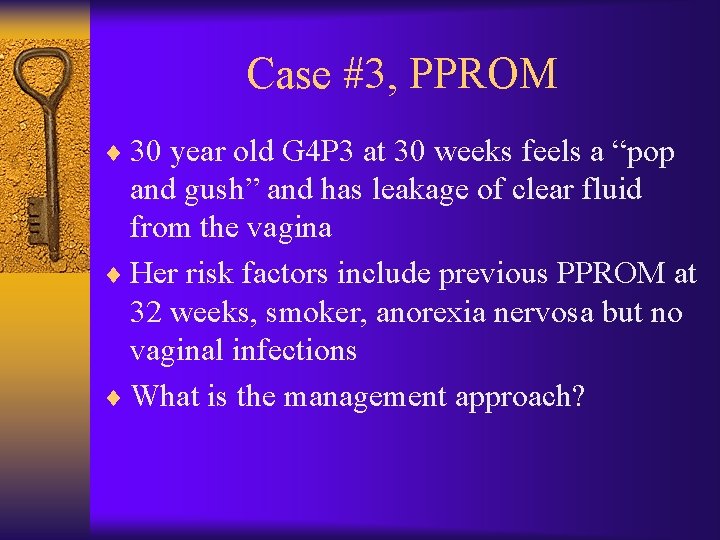
Case #3, PPROM ¨ 30 year old G 4 P 3 at 30 weeks feels a “pop and gush” and has leakage of clear fluid from the vagina ¨ Her risk factors include previous PPROM at 32 weeks, smoker, anorexia nervosa but no vaginal infections ¨ What is the management approach?
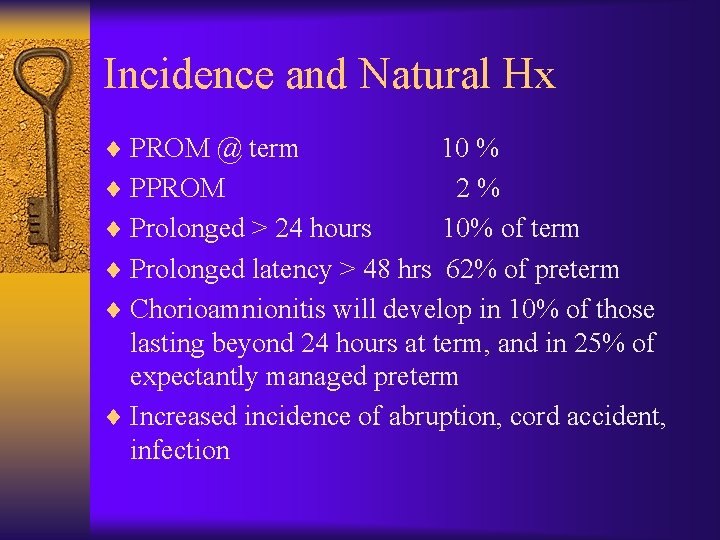
Incidence and Natural Hx ¨ PROM @ term 10 % ¨ PPROM 2% ¨ Prolonged > 24 hours 10% of term ¨ Prolonged latency > 48 hrs 62% of preterm ¨ Chorioamnionitis will develop in 10% of those lasting beyond 24 hours at term, and in 25% of expectantly managed preterm ¨ Increased incidence of abruption, cord accident, infection
PROM Risks ¨ Malnutrition, esp vit C ¨ 1 st and 3 rd Timester and zinc ¨ Smoking and substance abuse ¨ Infections esp staph aureus, GBS, Chlamydia, GC, Trichomonas, Bacteroides Bleeding ¨ Incompetent cervix ¨ Genetic weak collagen ¨ Overdistension or trauma ¨ PPROM recurs 25%
Diagnosis ¨ Typical History, “pop and gush” 90. 3% specific ¨ Nitrazine, ( false positive for blood, BV, semen, turns at p. H 6. 4 -6. 8) 98. 9% sensitive, and 90. 3% accurate ¨ Fern, 87% accurate, onset after 20 weeks, ok with meconium or blood unless 1 to 1 ratio, cervical mucous (fine) vs amniotic (coarse), ¨ Pooling
Diagnosis ¨ AFI, to be used as an adjunct if suspicious, ¨ Amniocentesis with instillation of indigo carmine dye ¨ Vaginal Pool lung maturity tests, PG accurate, LS will decrease with blood, (accurate if Hct <3) and Meconium, FLM not tested on vag pool ¨ Cultures, GBS, GC, Chlamydia, wet mount
Sterile Speculum ¨ The time clock starts with the first digital exam – Studies have shown that infection rate rises with the number of digital exams ( 3 is statistically significant, and 7 exams is worse than 3) – visual estimation on sterile speculum is accurate for cervical effacement and dilation ¨ Keep our fingers out of there !!! ¨ Accurate Dates, term (>34 weeks) vs preterm <34 weeks ¨ Presentation, breech or unstable lie with polyhydramnios with risk of cord prolapse, premie breech calls for C/section route of delivery, use Leopolds or bedside Ultrasound
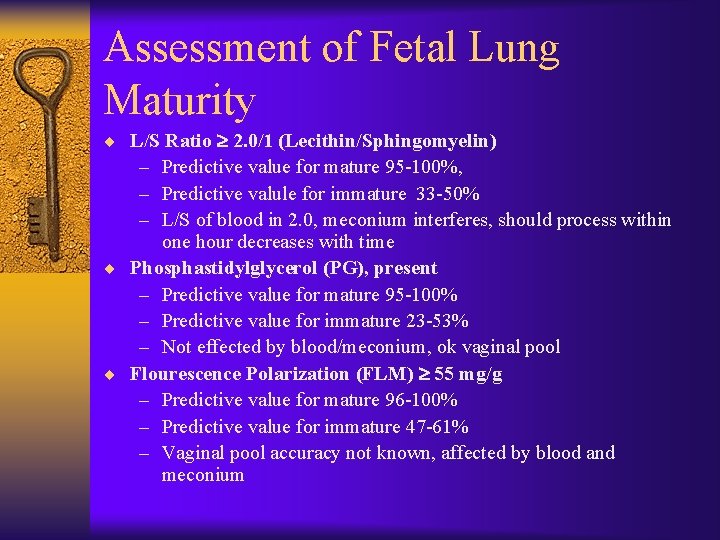
Assessment of Fetal Lung Maturity ¨ L/S Ratio 2. 0/1 (Lecithin/Sphingomyelin) – Predictive value for mature 95 -100%, – Predictive valule for immature 33 -50% – L/S of blood in 2. 0, meconium interferes, should process within one hour decreases with time ¨ Phosphastidylglycerol (PG), present – Predictive value for mature 95 -100% – Predictive value for immature 23 -53% – Not effected by blood/meconium, ok vaginal pool ¨ Flourescence Polarization (FLM) 55 mg/g – Predictive value for mature 96 -100% – Predictive value for immature 47 -61% – Vaginal pool accuracy not known, affected by blood and meconium
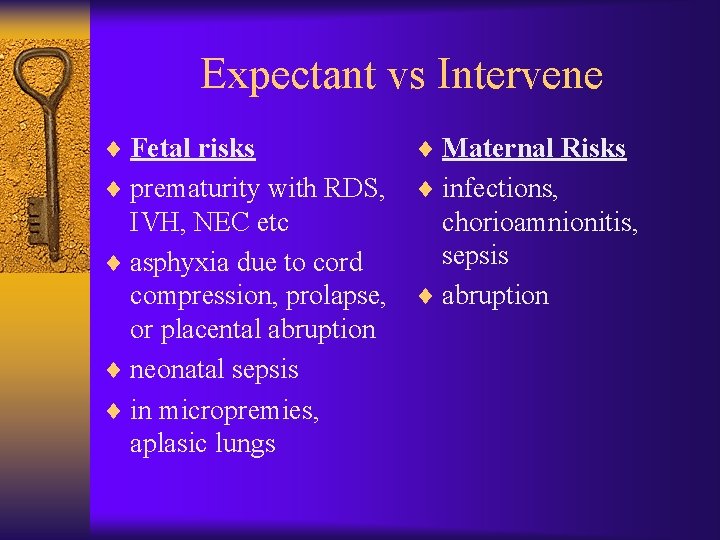
Expectant vs Intervene ¨ Fetal risks ¨ Maternal Risks ¨ prematurity with RDS, ¨ infections, IVH, NEC etc chorioamnionitis, sepsis ¨ asphyxia due to cord compression, prolapse, ¨ abruption or placental abruption ¨ neonatal sepsis ¨ in micropremies, aplasic lungs
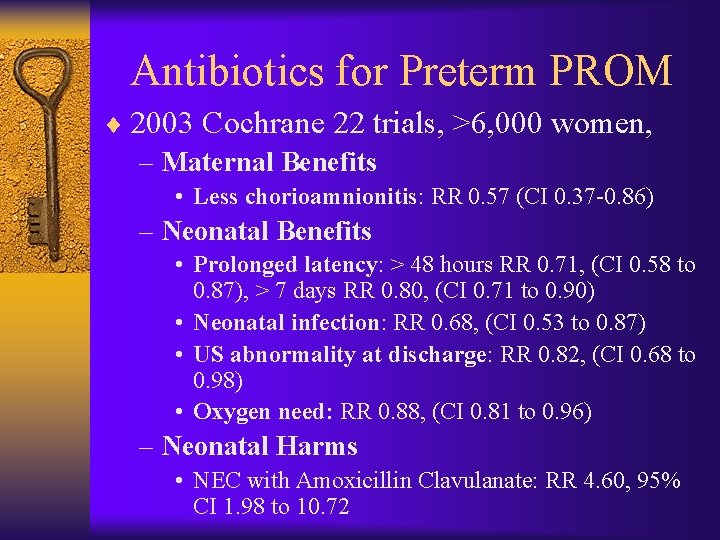
Antibiotics for Preterm PROM ¨ 2003 Cochrane 22 trials, >6, 000 women, – Maternal Benefits • Less chorioamnionitis: RR 0. 57 (CI 0. 37 -0. 86) – Neonatal Benefits • Prolonged latency: > 48 hours RR 0. 71, (CI 0. 58 to 0. 87), > 7 days RR 0. 80, (CI 0. 71 to 0. 90) • Neonatal infection: RR 0. 68, (CI 0. 53 to 0. 87) • US abnormality at discharge: RR 0. 82, (CI 0. 68 to 0. 98) • Oxygen need: RR 0. 88, (CI 0. 81 to 0. 96) – Neonatal Harms • NEC with Amoxicillin Clavulanate: RR 4. 60, 95% CI 1. 98 to 10. 72
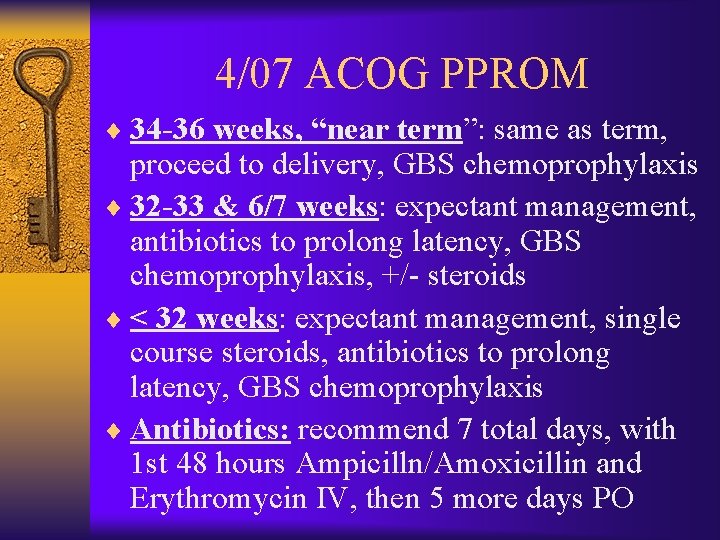
4/07 ACOG PPROM ¨ 34 -36 weeks, “near term”: same as term, proceed to delivery, GBS chemoprophylaxis ¨ 32 -33 & 6/7 weeks: expectant management, antibiotics to prolong latency, GBS chemoprophylaxis, +/- steroids ¨ < 32 weeks: expectant management, single course steroids, antibiotics to prolong latency, GBS chemoprophylaxis ¨ Antibiotics: recommend 7 total days, with 1 st 48 hours Ampicilln/Amoxicillin and Erythromycin IV, then 5 more days PO
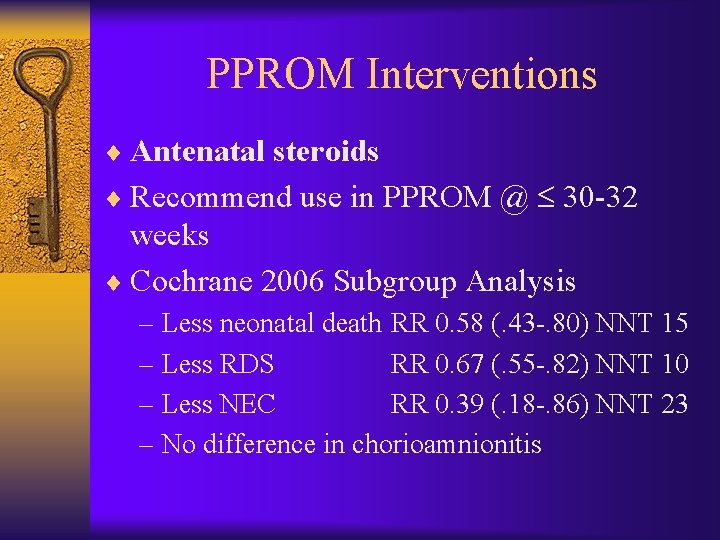
PPROM Interventions ¨ Antenatal steroids ¨ Recommend use in PPROM @ 30 -32 weeks ¨ Cochrane 2006 Subgroup Analysis – Less neonatal death RR 0. 58 (. 43 -. 80) NNT 15 – Less RDS RR 0. 67 (. 55 -. 82) NNT 10 – Less NEC RR 0. 39 (. 18 -. 86) NNT 23 – No difference in chorioamnionitis
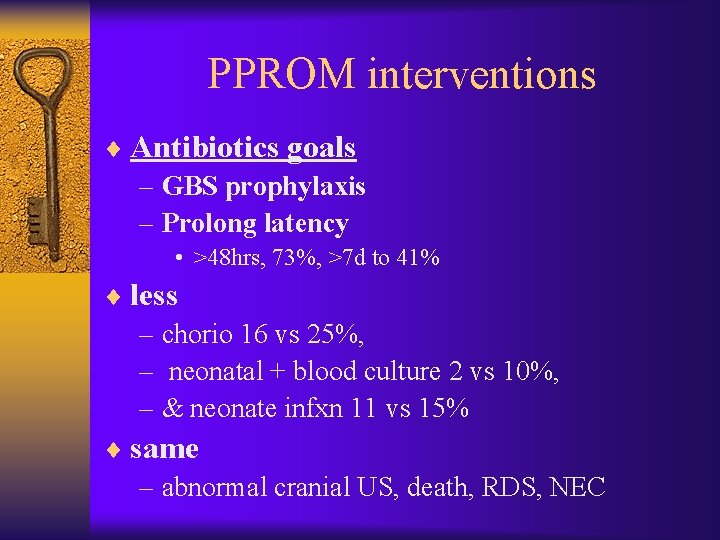
PPROM interventions ¨ Antibiotics goals – GBS prophylaxis – Prolong latency • >48 hrs, 73%, >7 d to 41% ¨ less – chorio 16 vs 25%, – neonatal + blood culture 2 vs 10%, – & neonate infxn 11 vs 15% ¨ same – abnormal cranial US, death, RDS, NEC
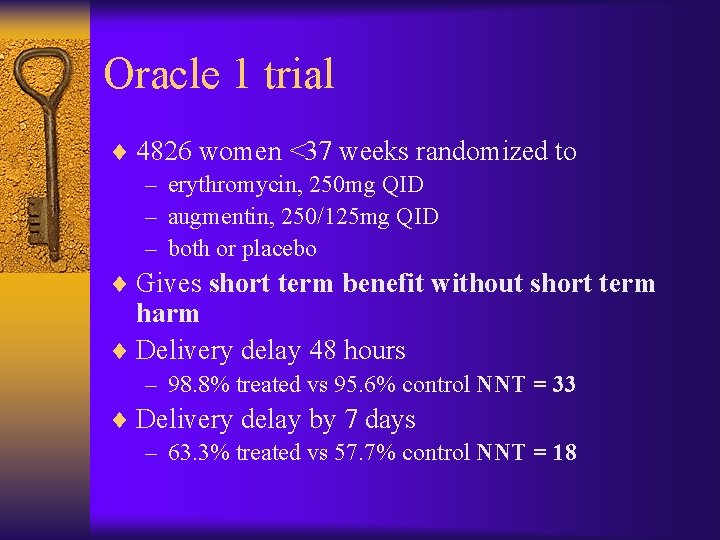
Oracle 1 trial ¨ 4826 women <37 weeks randomized to – erythromycin, 250 mg QID – augmentin, 250/125 mg QID – both or placebo ¨ Gives short term benefit without short term harm ¨ Delivery delay 48 hours – 98. 8% treated vs 95. 6% control NNT = 33 ¨ Delivery delay by 7 days – 63. 3% treated vs 57. 7% control NNT = 18
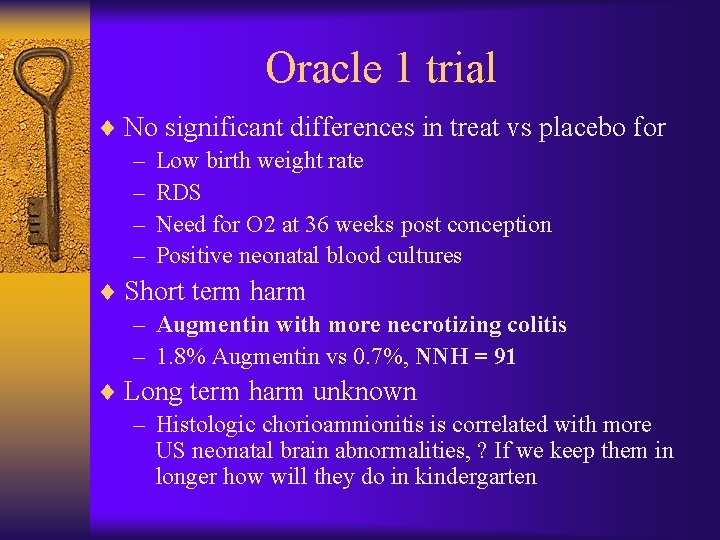
Oracle 1 trial ¨ No significant differences in treat vs placebo for – Low birth weight rate – RDS – Need for O 2 at 36 weeks post conception – Positive neonatal blood cultures ¨ Short term harm – Augmentin with more necrotizing colitis – 1. 8% Augmentin vs 0. 7%, NNH = 91 ¨ Long term harm unknown – Histologic chorioamnionitis is correlated with more US neonatal brain abnormalities, ? If we keep them in longer how will they do in kindergarten
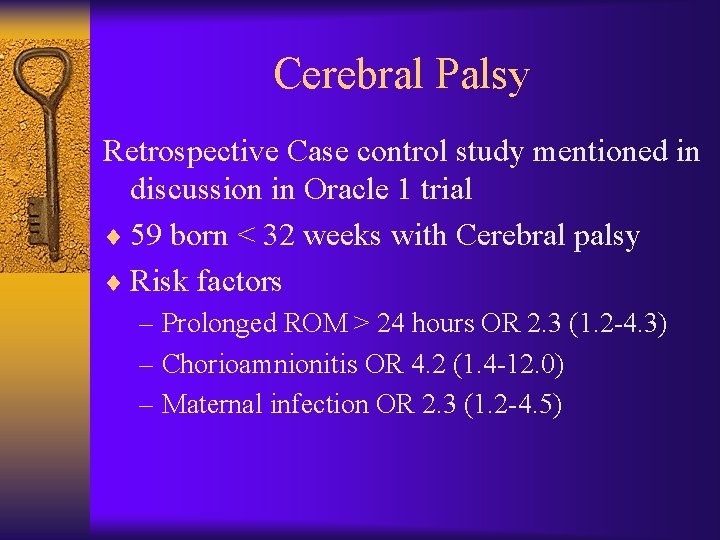
Cerebral Palsy Retrospective Case control study mentioned in discussion in Oracle 1 trial ¨ 59 born < 32 weeks with Cerebral palsy ¨ Risk factors – Prolonged ROM > 24 hours OR 2. 3 (1. 2 -4. 3) – Chorioamnionitis OR 4. 2 (1. 4 -12. 0) – Maternal infection OR 2. 3 (1. 2 -4. 5)
Conclusions ¨ Preterm birth has multi-factorial causes ¨ For prevention of Preterm Birth – Optimize lifestyle and nutrition – Screen for asymptomatic Bacteriuria – Progesterone holds promise in high risk populations ¨ Threatened Preterm Labor is a common problem, yet 50% deliver at term – Before using reactive tocolytics evaluate for possible causes, Preterm contractions due to what? ¨ Interventions that are bottom-line in threatened preterm labor are: – Antenatal steroids – Maternal Transport and delivery at tertiary care center – GBS prophylaxis
Conclusions ¨ Prevent PPROM with good nutrition, smoking and drug cessation, rx infections ¨ secure the diagnosis & keep your fingers out of there ¨ secure the dates, transfer premies to appropriate level NICU/maternal unit, induce near-term PROM ≥ 34 weeks ¨ Antibiotic and Steroid use – Betamethasone 32 weeks – Erythromycin for 48 hours for latency for steroids <32 weeks – GBS prophylaxis
References ¨ Epidemiology/Reviews ¨ Hollier, Lisa, Preventing Preterm Birth, What works, what doesn’t, Obstetrical and Gynecological Survey, 2005, Vol 60, #2, p 124 -131 ¨ Siman, H & Caritis S, Review Article, Drug Therapy, Prevention of Preterm Delivery, NEJM 2007, Aug 2 nd, 357; p 477 -87 ¨ Tonse, R, Epidemiology of Late Preterm (Near-term) Births; Clinical Perinatology 2006, 33: p 751 -763 ¨ ¨ ¨ ACOG Practice Bulletins: October 2001, #31, Assessment of Risk Factors for Preterm Birth May 2003, #43, Management of Preterm Labor Nov 2003, #48, Cervical Insufficiency April 2007, #80 Premature Rupture of the Membranes
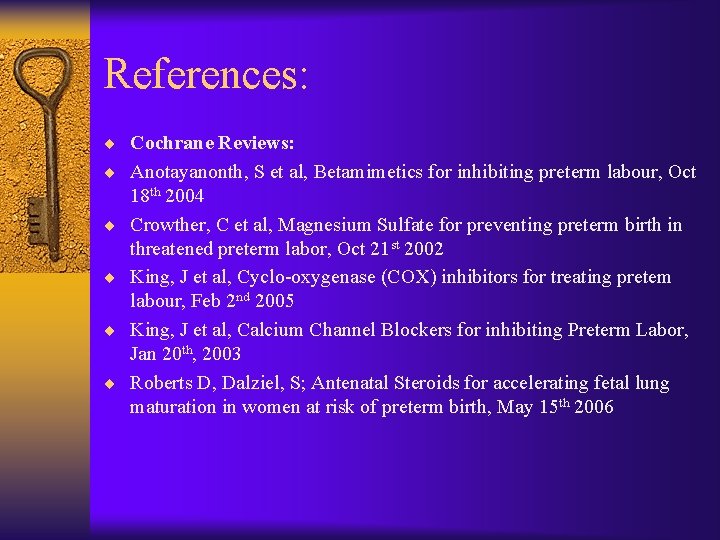
References: ¨ Cochrane Reviews: ¨ Anotayanonth, S et al, Betamimetics for inhibiting preterm labour, Oct ¨ ¨ 18 th 2004 Crowther, C et al, Magnesium Sulfate for preventing preterm birth in threatened preterm labor, Oct 21 st 2002 King, J et al, Cyclo-oxygenase (COX) inhibitors for treating pretem labour, Feb 2 nd 2005 King, J et al, Calcium Channel Blockers for inhibiting Preterm Labor, Jan 20 th, 2003 Roberts D, Dalziel, S; Antenatal Steroids for accelerating fetal lung maturation in women at risk of preterm birth, May 15 th 2006
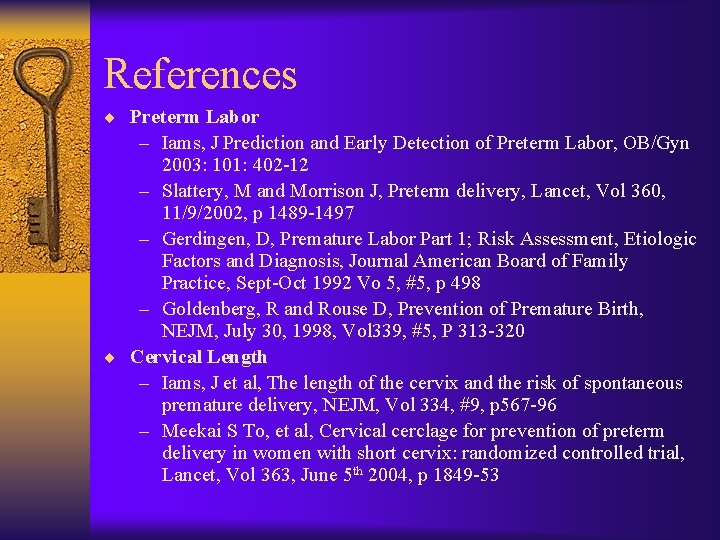
References ¨ Preterm Labor – Iams, J Prediction and Early Detection of Preterm Labor, OB/Gyn 2003: 101: 402 -12 – Slattery, M and Morrison J, Preterm delivery, Lancet, Vol 360, 11/9/2002, p 1489 -1497 – Gerdingen, D, Premature Labor Part 1; Risk Assessment, Etiologic Factors and Diagnosis, Journal American Board of Family Practice, Sept-Oct 1992 Vo 5, #5, p 498 – Goldenberg, R and Rouse D, Prevention of Premature Birth, NEJM, July 30, 1998, Vol 339, #5, P 313 -320 ¨ Cervical Length – Iams, J et al, The length of the cervix and the risk of spontaneous premature delivery, NEJM, Vol 334, #9, p 567 -96 – Meekai S To, et al, Cervical cerclage for prevention of preterm delivery in women with short cervix: randomized controlled trial, Lancet, Vol 363, June 5 th 2004, p 1849 -53
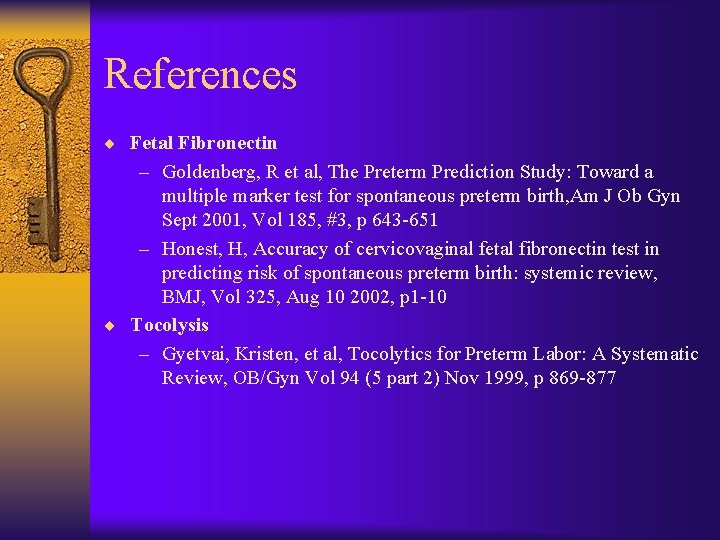
References ¨ Fetal Fibronectin – Goldenberg, R et al, The Preterm Prediction Study: Toward a multiple marker test for spontaneous preterm birth, Am J Ob Gyn Sept 2001, Vol 185, #3, p 643 -651 – Honest, H, Accuracy of cervicovaginal fetal fibronectin test in predicting risk of spontaneous preterm birth: systemic review, BMJ, Vol 325, Aug 10 2002, p 1 -10 ¨ Tocolysis – Gyetvai, Kristen, et al, Tocolytics for Preterm Labor: A Systematic Review, OB/Gyn Vol 94 (5 part 2) Nov 1999, p 869 -877
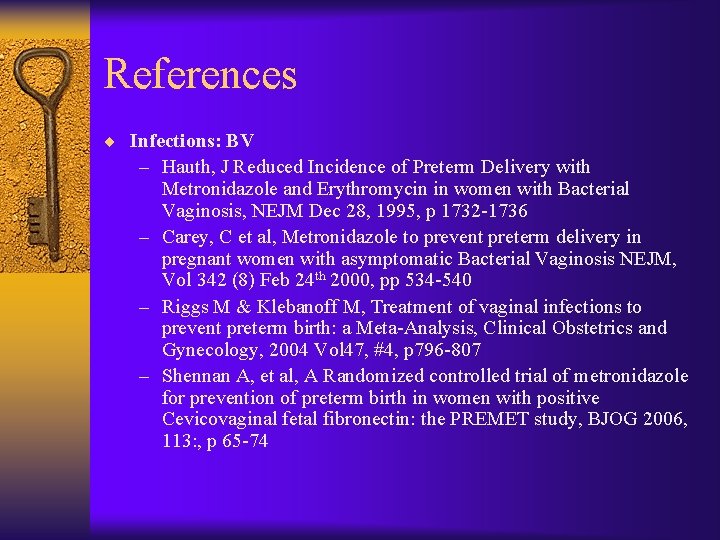
References ¨ Infections: BV – Hauth, J Reduced Incidence of Preterm Delivery with Metronidazole and Erythromycin in women with Bacterial Vaginosis, NEJM Dec 28, 1995, p 1732 -1736 – Carey, C et al, Metronidazole to prevent preterm delivery in pregnant women with asymptomatic Bacterial Vaginosis NEJM, Vol 342 (8) Feb 24 th 2000, pp 534 -540 – Riggs M & Klebanoff M, Treatment of vaginal infections to prevent preterm birth: a Meta-Analysis, Clinical Obstetrics and Gynecology, 2004 Vol 47, #4, p 796 -807 – Shennan A, et al, A Randomized controlled trial of metronidazole for prevention of preterm birth in women with positive Cevicovaginal fetal fibronectin: the PREMET study, BJOG 2006, 113: , p 65 -74
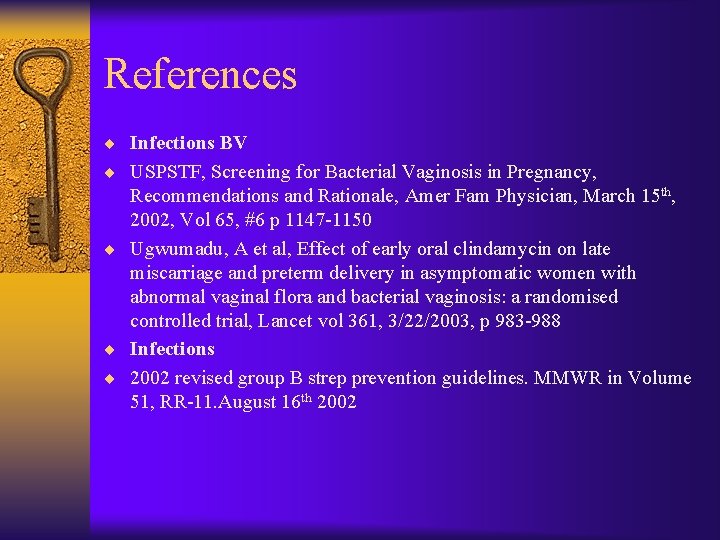
References ¨ Infections BV ¨ USPSTF, Screening for Bacterial Vaginosis in Pregnancy, Recommendations and Rationale, Amer Fam Physician, March 15 th, 2002, Vol 65, #6 p 1147 -1150 ¨ Ugwumadu, A et al, Effect of early oral clindamycin on late miscarriage and preterm delivery in asymptomatic women with abnormal vaginal flora and bacterial vaginosis: a randomised controlled trial, Lancet vol 361, 3/22/2003, p 983 -988 ¨ Infections ¨ 2002 revised group B strep prevention guidelines. MMWR in Volume 51, RR-11. August 16 th 2002
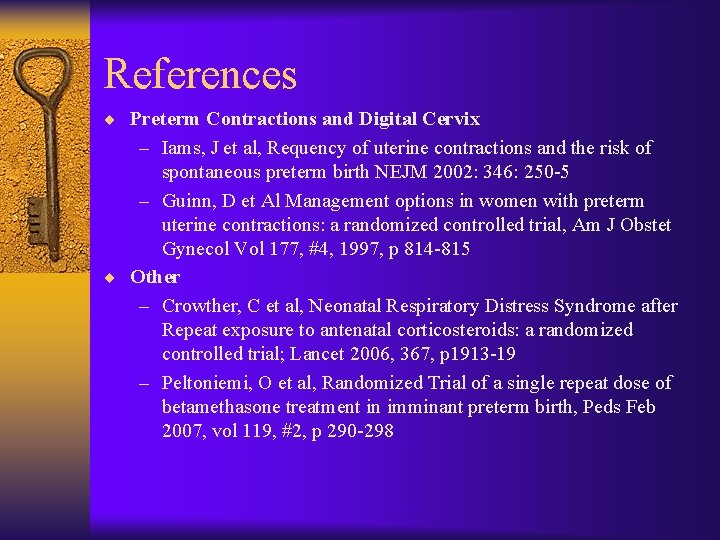
References ¨ Preterm Contractions and Digital Cervix – Iams, J et al, Requency of uterine contractions and the risk of spontaneous preterm birth NEJM 2002: 346: 250 -5 – Guinn, D et Al Management options in women with preterm uterine contractions: a randomized controlled trial, Am J Obstet Gynecol Vol 177, #4, 1997, p 814 -815 ¨ Other – Crowther, C et al, Neonatal Respiratory Distress Syndrome after Repeat exposure to antenatal corticosteroids: a randomized controlled trial; Lancet 2006, 367, p 1913 -19 – Peltoniemi, O et al, Randomized Trial of a single repeat dose of betamethasone treatment in imminant preterm birth, Peds Feb 2007, vol 119, #2, p 290 -298
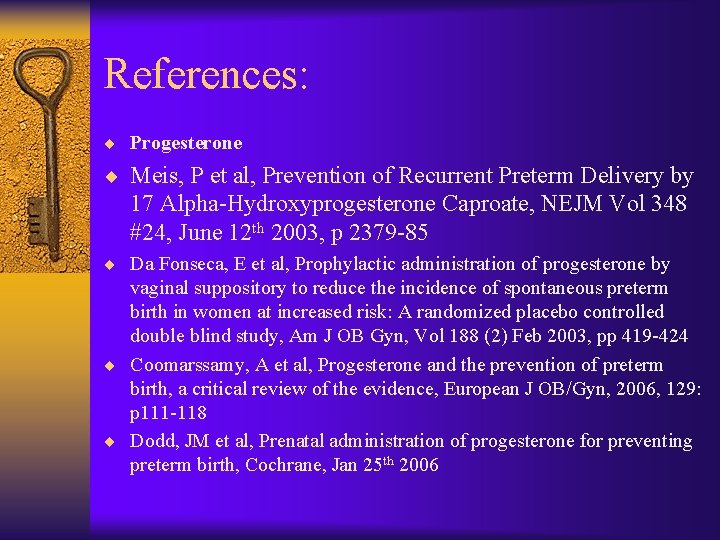
References: ¨ Progesterone ¨ Meis, P et al, Prevention of Recurrent Preterm Delivery by 17 Alpha-Hydroxyprogesterone Caproate, NEJM Vol 348 #24, June 12 th 2003, p 2379 -85 ¨ Da Fonseca, E et al, Prophylactic administration of progesterone by vaginal suppository to reduce the incidence of spontaneous preterm birth in women at increased risk: A randomized placebo controlled double blind study, Am J OB Gyn, Vol 188 (2) Feb 2003, pp 419 -424 ¨ Coomarssamy, A et al, Progesterone and the prevention of preterm birth, a critical review of the evidence, European J OB/Gyn, 2006, 129: p 111 -118 ¨ Dodd, JM et al, Prenatal administration of progesterone for preventing preterm birth, Cochrane, Jan 25 th 2006
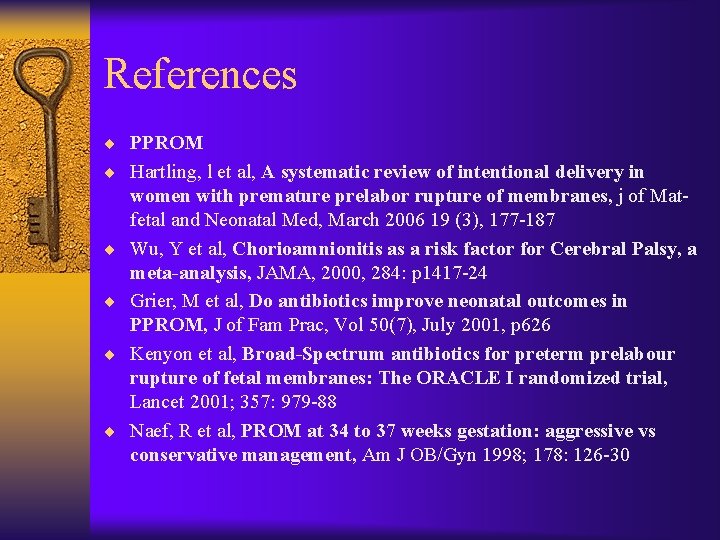
References ¨ PPROM ¨ Hartling, l et al, A systematic review of intentional delivery in ¨ ¨ women with premature prelabor rupture of membranes, j of Matfetal and Neonatal Med, March 2006 19 (3), 177 -187 Wu, Y et al, Chorioamnionitis as a risk factor for Cerebral Palsy, a meta-analysis, JAMA, 2000, 284: p 1417 -24 Grier, M et al, Do antibiotics improve neonatal outcomes in PPROM, J of Fam Prac, Vol 50(7), July 2001, p 626 Kenyon et al, Broad-Spectrum antibiotics for preterm prelabour rupture of fetal membranes: The ORACLE I randomized trial, Lancet 2001; 357: 979 -88 Naef, R et al, PROM at 34 to 37 weeks gestation: aggressive vs conservative management, Am J OB/Gyn 1998; 178: 126 -30
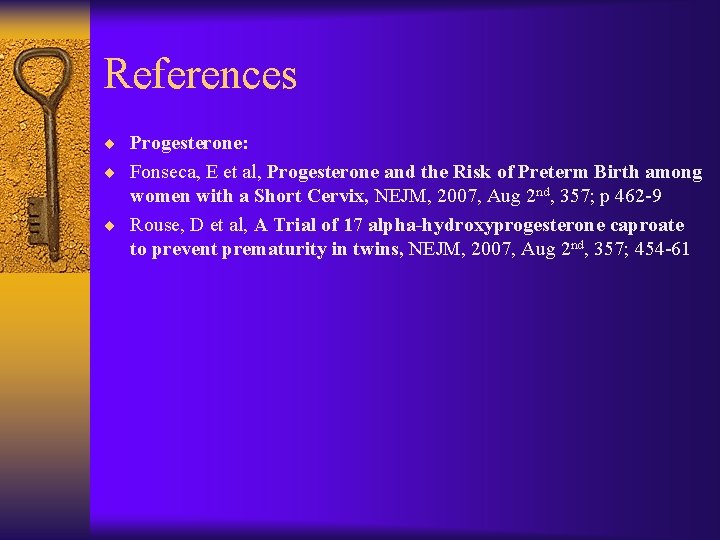
References ¨ Progesterone: ¨ Fonseca, E et al, Progesterone and the Risk of Preterm Birth among women with a Short Cervix, NEJM, 2007, Aug 2 nd, 357; p 462 -9 ¨ Rouse, D et al, A Trial of 17 alpha-hydroxyprogesterone caproate to prevent prematurity in twins, NEJM, 2007, Aug 2 nd, 357; 454 -61
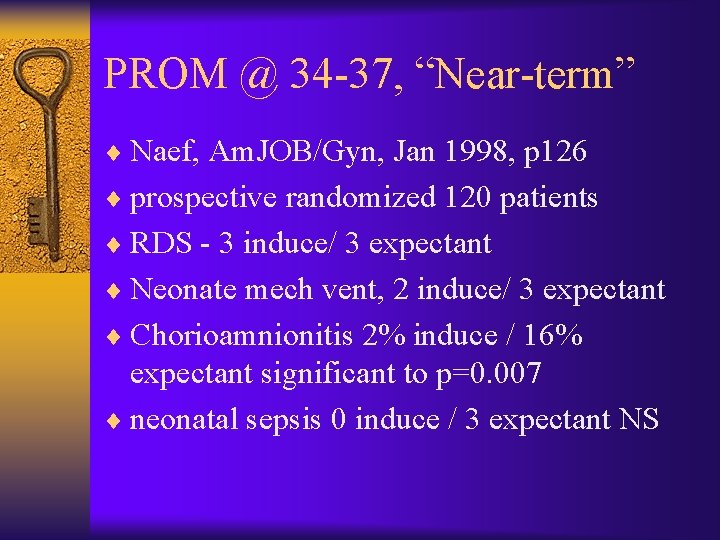
PROM @ 34 -37, “Near-term” ¨ Naef, Am. JOB/Gyn, Jan 1998, p 126 ¨ prospective randomized 120 patients ¨ RDS - 3 induce/ 3 expectant ¨ Neonate mech vent, 2 induce/ 3 expectant ¨ Chorioamnionitis 2% induce / 16% expectant significant to p=0. 007 ¨ neonatal sepsis 0 induce / 3 expectant NS
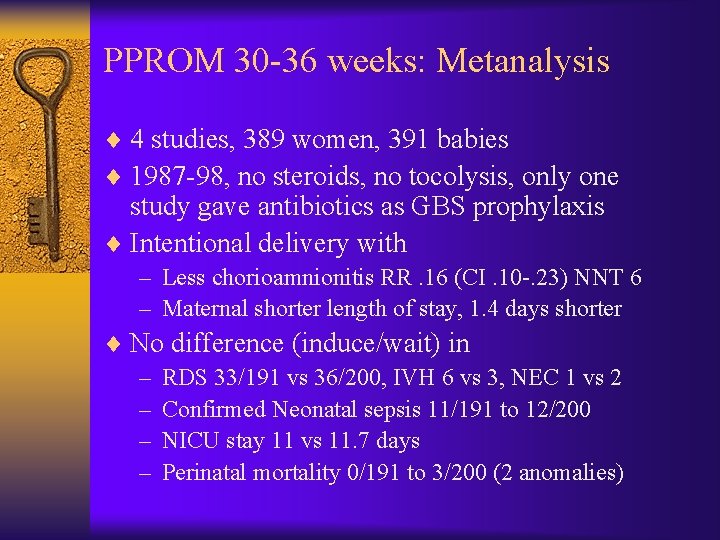
PPROM 30 -36 weeks: Metanalysis ¨ 4 studies, 389 women, 391 babies ¨ 1987 -98, no steroids, no tocolysis, only one study gave antibiotics as GBS prophylaxis ¨ Intentional delivery with – Less chorioamnionitis RR. 16 (CI. 10 -. 23) NNT 6 – Maternal shorter length of stay, 1. 4 days shorter ¨ No difference (induce/wait) in – RDS 33/191 vs 36/200, IVH 6 vs 3, NEC 1 vs 2 – Confirmed Neonatal sepsis 11/191 to 12/200 – NICU stay 11 vs 11. 7 days – Perinatal mortality 0/191 to 3/200 (2 anomalies)
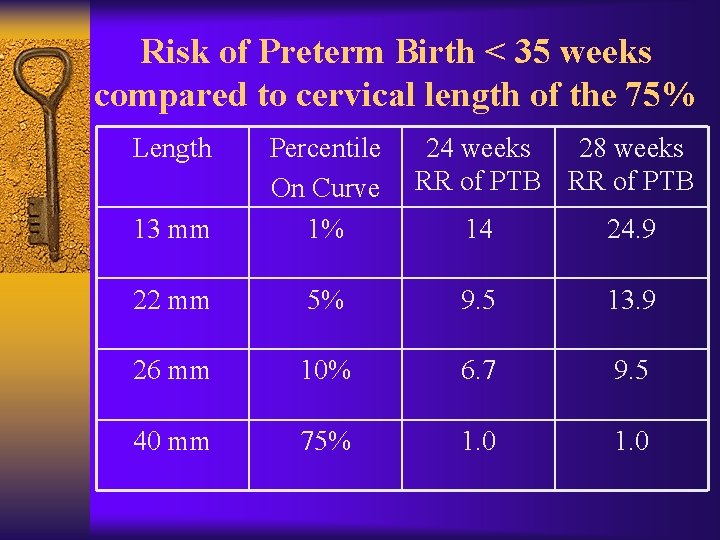
Risk of Preterm Birth < 35 weeks compared to cervical length of the 75% Length 13 mm Percentile On Curve 1% 22 mm 24 weeks 28 weeks RR of PTB 14 24. 9 5% 9. 5 13. 9 26 mm 10% 6. 7 9. 5 40 mm 75% 1. 0
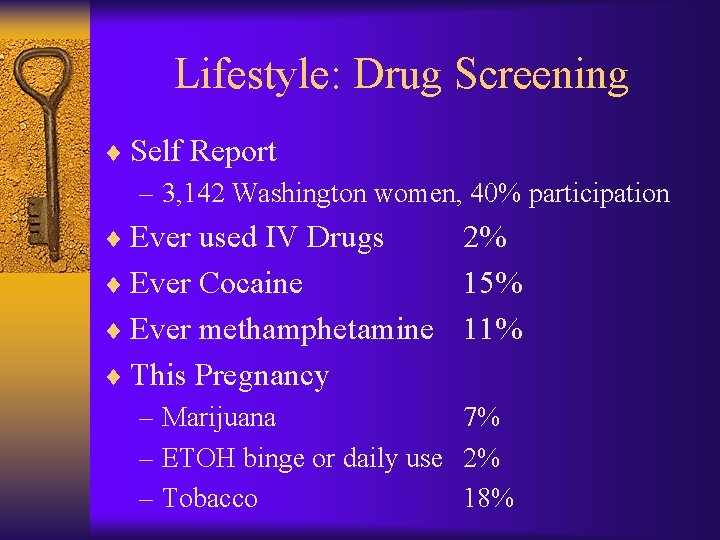
Lifestyle: Drug Screening ¨ Self Report – 3, 142 Washington women, 40% participation ¨ Ever used IV Drugs 2% ¨ Ever Cocaine 15% ¨ Ever methamphetamine 11% ¨ This Pregnancy – Marijuana 7% – ETOH binge or daily use 2% – Tobacco 18%
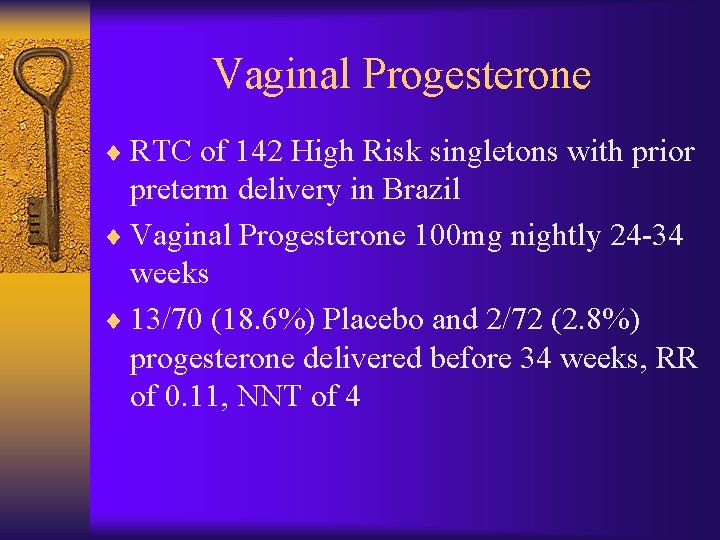
Vaginal Progesterone ¨ RTC of 142 High Risk singletons with prior preterm delivery in Brazil ¨ Vaginal Progesterone 100 mg nightly 24 -34 weeks ¨ 13/70 (18. 6%) Placebo and 2/72 (2. 8%) progesterone delivered before 34 weeks, RR of 0. 11, NNT of 4
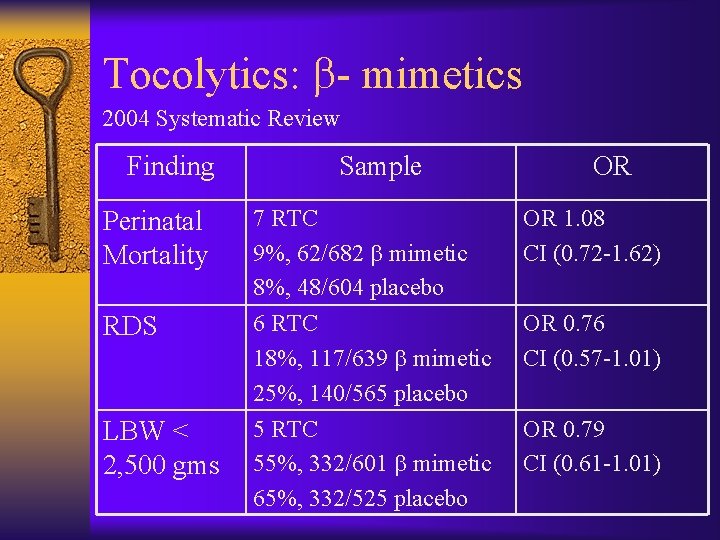
Tocolytics: - mimetics 2004 Systematic Review Finding Sample OR Perinatal Mortality 7 RTC 9%, 62/682 mimetic 8%, 48/604 placebo OR 1. 08 CI (0. 72 -1. 62) RDS 6 RTC 18%, 117/639 mimetic 25%, 140/565 placebo 5 RTC 55%, 332/601 mimetic 65%, 332/525 placebo OR 0. 76 CI (0. 57 -1. 01) LBW < 2, 500 gms OR 0. 79 CI (0. 61 -1. 01)
- Slides: 89