
PreStack Depth Migration of Dual Azimuth Surveys Incorporating
- Slides: 13
Pre-Stack Depth Migration of Dual. Azimuth Surveys Incorporating Azimuthal P-Wave Anisotropy Phil Whitfield Fiona Dewey B. V. Malcolm King Western. Geco Wintershall Noordzee Monarch Geophysical
Overview • • Project outline and illumination comparisons Illustration of azimuthal velocity variations Butterfly gathers 5 possible solutions Chosen workflow – dual anisotropy Results Conclusions
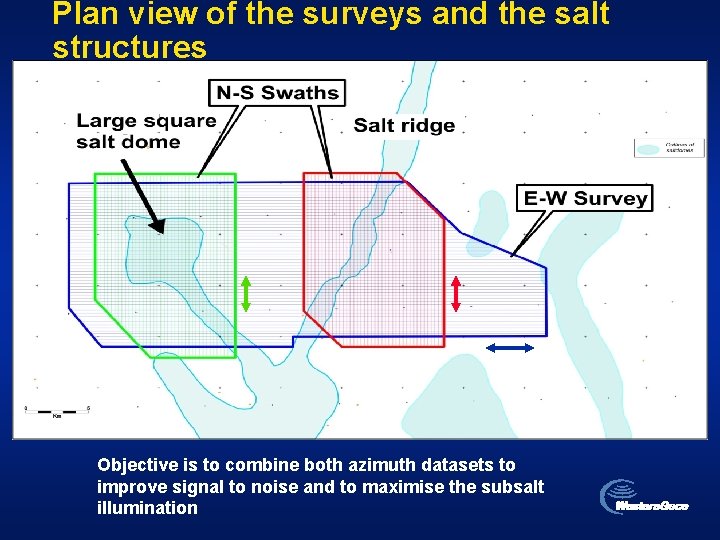
Plan view of the surveys and the salt structures Objective is to combine both azimuth datasets to improve signal to noise and to maximise the subsalt illumination
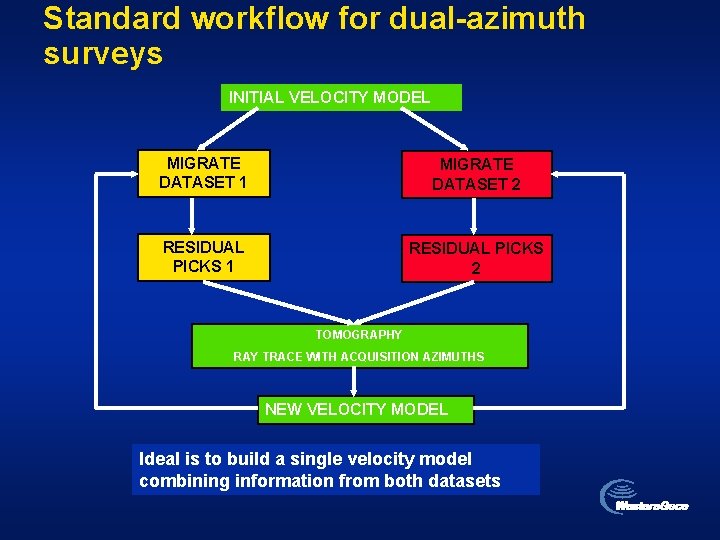
Standard workflow for dual-azimuth surveys INITIAL VELOCITY MODEL MIGRATE DATASET 1 MIGRATE DATASET 2 RESIDUAL PICKS 1 RESIDUAL PICKS 2 TOMOGRAPHY RAY TRACE WITH ACQUISITION AZIMUTHS NEW VELOCITY MODEL Ideal is to build a single velocity model combining information from both datasets
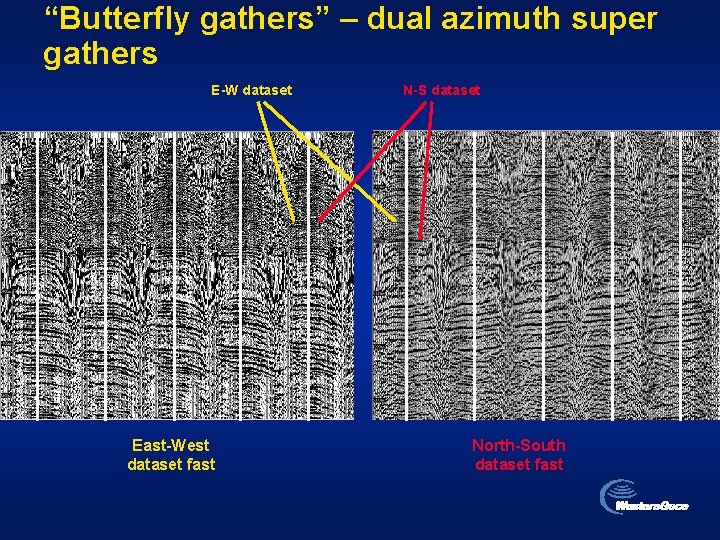
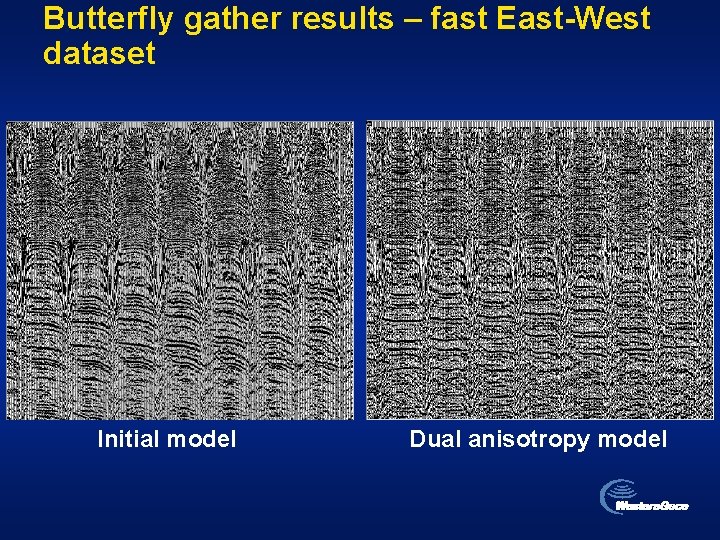
“Butterfly gathers” – dual azimuth super gathers E-W dataset East-West dataset fast N-S dataset North-South dataset fast
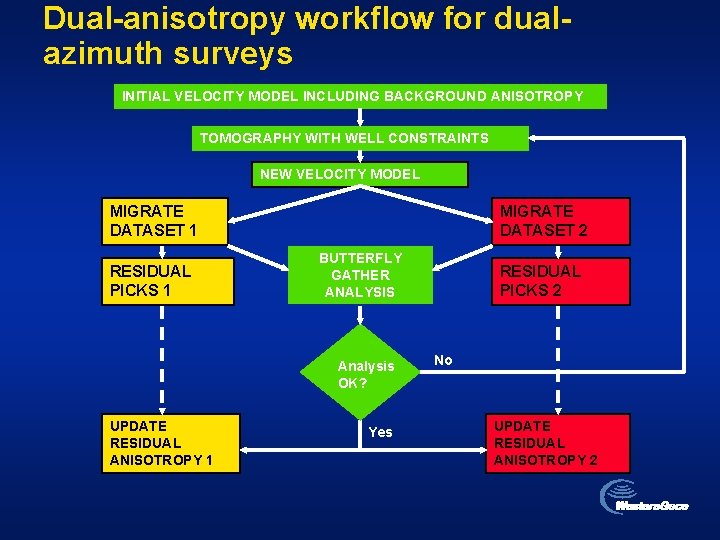
Dual-anisotropy workflow for dualazimuth surveys INITIAL VELOCITY MODEL INCLUDING BACKGROUND ANISOTROPY TOMOGRAPHY WITH WELL CONSTRAINTS NEW VELOCITY MODEL MIGRATE DATASET 1 RESIDUAL PICKS 1 MIGRATE DATASET 2 BUTTERFLY GATHER ANALYSIS Analysis OK? UPDATE RESIDUAL ANISOTROPY 1 Yes RESIDUAL PICKS 2 No UPDATE RESIDUAL ANISOTROPY 2
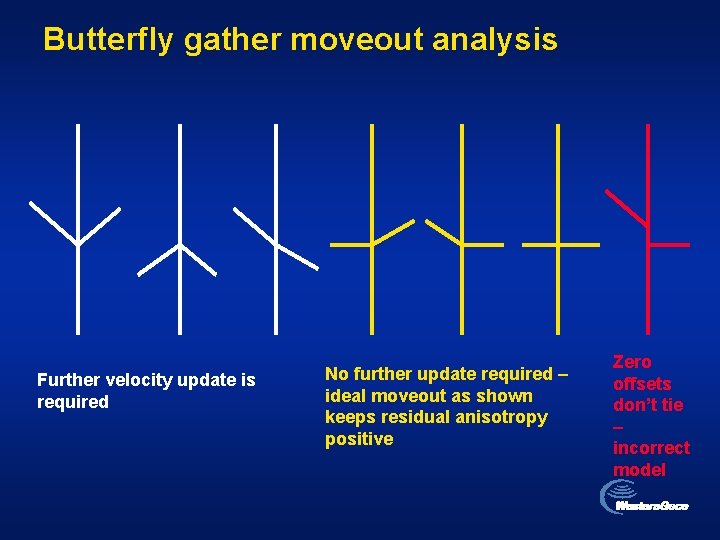
Butterfly gather moveout analysis Further velocity update is required No further update required – ideal moveout as shown keeps residual anisotropy positive Zero offsets don’t tie – incorrect model
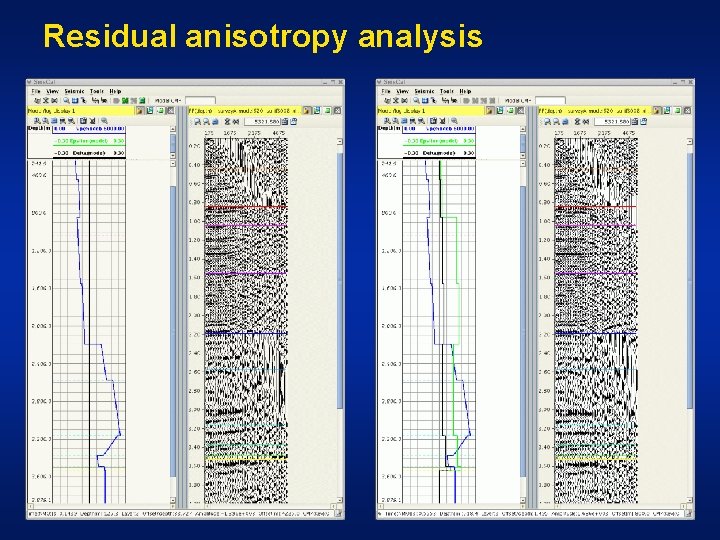
Residual anisotropy analysis
Overview • • Project outline and illumination comparisons Illustration of azimuthal velocity variations Butterfly gathers 5 possible solutions Chosen workflow – dual anisotropy Results Conclusions
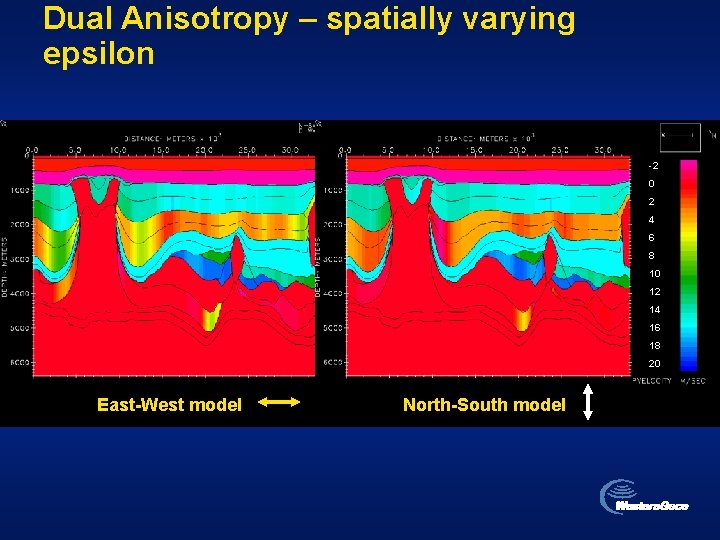
Dual Anisotropy – spatially varying epsilon -2 0 2 4 6 8 10 12 14 16 18 20 East-West model North-South model
Butterfly gather results – fast East-West dataset Initial model Dual anisotropy model
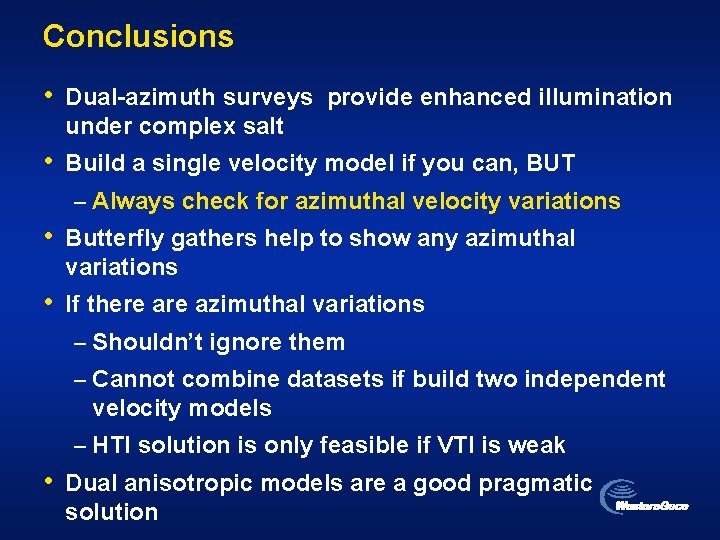
Conclusions • Dual-azimuth surveys provide enhanced illumination under complex salt • Build a single velocity model if you can, BUT – Always check for azimuthal velocity variations • Butterfly gathers help to show any azimuthal variations • If there azimuthal variations – Shouldn’t ignore them – Cannot combine datasets if build two independent velocity models – HTI solution is only feasible if VTI is weak • Dual anisotropic models are a good pragmatic solution
Acknowledgements • Wintershall Noordzee B. V. • Energie Beheer Nederland B. V. • Petro-Canada Colleagues at Western. Geco: Emmanuel Saragoussi, Peter Szabo, Richard Whitebread Chris Soufleris, Steve Horne, Phil Kitchenside, Tamara Khlussovich Sergei Tcherkashnev for Walkaway VSP analysis