
PRESSURE WINDS AND CIRCULATION PATTERNS Obvious Next Questions
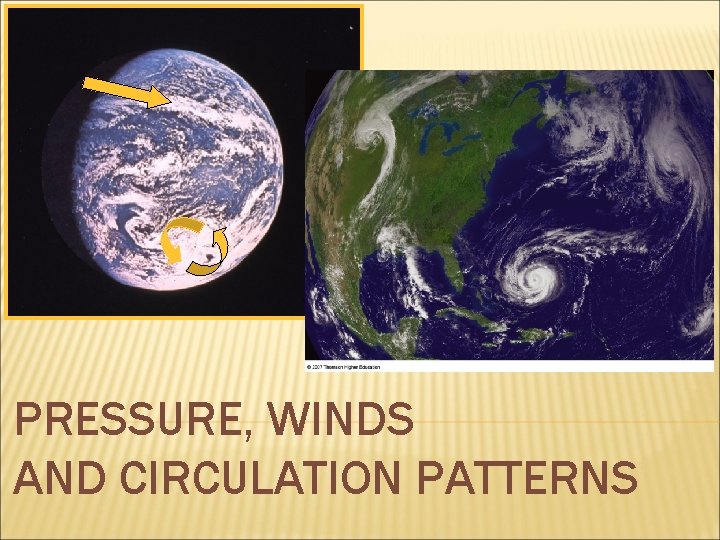
PRESSURE, WINDS AND CIRCULATION PATTERNS
Obvious Next Questions: How do insolation and heat energy transfer processes relate to Weather and Climate phenomena on Earth? WEATHER AND CLIMATE Weather: refers to the condition of atmospheric elements at a given time, and for a specific area. Climate: average of weather conditions for 30+ years (including atmospheric anomalies). Weather and Climate are of prime interest to the Physical Geographer because they affect and are interrelated with all of Earth’s environments.
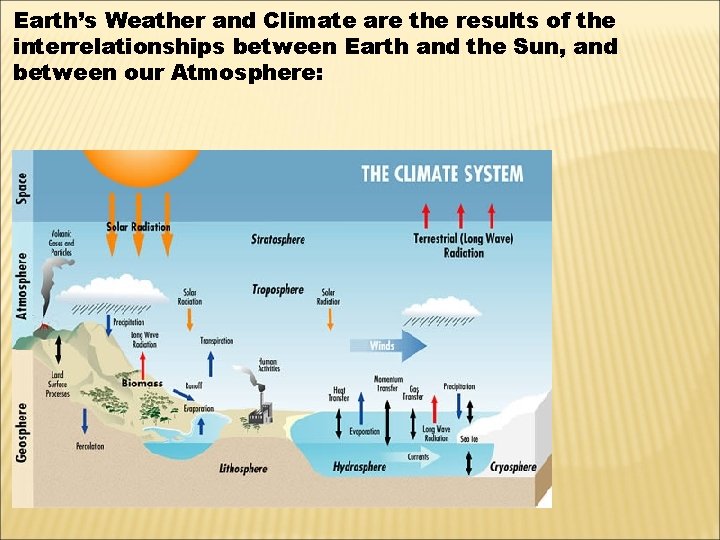
Earth’s Weather and Climate are the results of the interrelationships between Earth and the Sun, and between our Atmosphere:
First, Let’s Recall the 5+ Basic Elements of the Atmosphere – the main ingredients of weather and climate -- Also called Elements of Weather and Climate • Solar Energy -- Insolation and Heat Energy Transfer • Temperature In this segment, we’ll discuss the next two elements: • • • + Pressure Wind Precipitation Air Masses (and Fronts)
PRESSURE, WINDS AND CIRCULATION PATTERNS q Atmospheric Pressure Basic Pressure Systems – High & Low Pressure v Pressure Variations – Vertical and Horizontal v Mapping Pressure Distribution – Isobars, Pressure Gradients, Global Pressure Belts v q Winds and Circulation Patterns Pressure – Wind Relationships v Wind Modifiers – The Coriolis Effect, Friction v Surface Wind Systems – Global, Upper Air, Seasonal, Local v Ocean – Wind Relationships – Ocean Currents, El Nino, La Nina and the Sothern Oscillation v
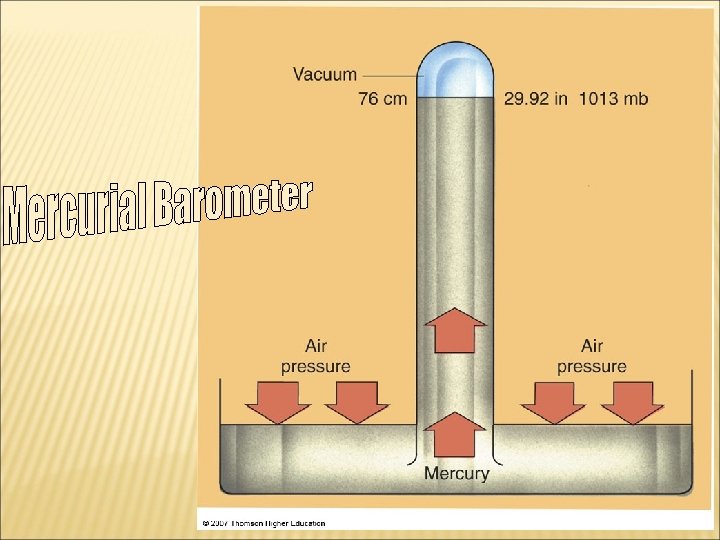
PRESSURE v Pressure is the weight of the atmosphere Atmosphere as a whole has considerable weight and exerts average pressure of about 14. 7 lbs. /sq. in. § § Ø at sea level a column of air one inch square weighs 14. 7 lbs this 14. 7 lbs of pressure exerts pressure forcing mercury in a tube to rise 29. 92 inches a device used to measure air pressure is called a barometer – hence, barometric pressure Pressure is usually measured in millibars (mb) – 29. 92 inches is translated into 1013. 2 millibars Atmospheric Pressure is important because it directly affects atmospheric circulation – the differences in pressure create our wind systems, and the movement of the winds drive our ocean
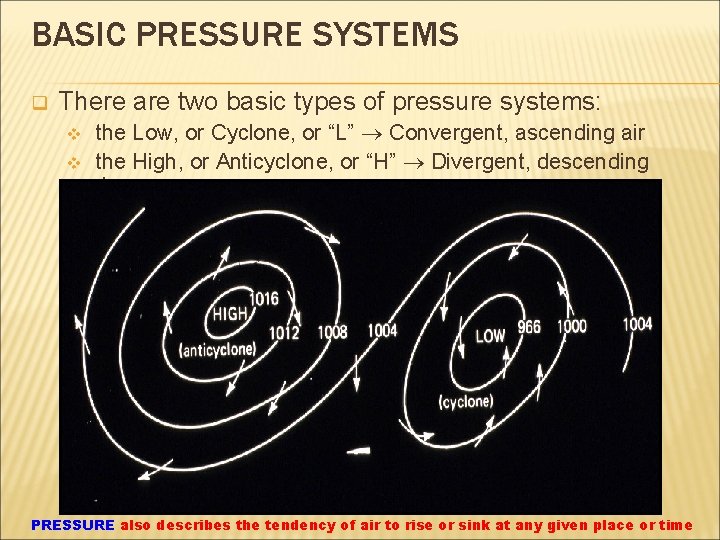
BASIC PRESSURE SYSTEMS q There are two basic types of pressure systems: v v the Low, or Cyclone, or “L” Convergent, ascending air the High, or Anticyclone, or “H” Divergent, descending air PRESSURE also describes the tendency of air to rise or sink at any given place or time
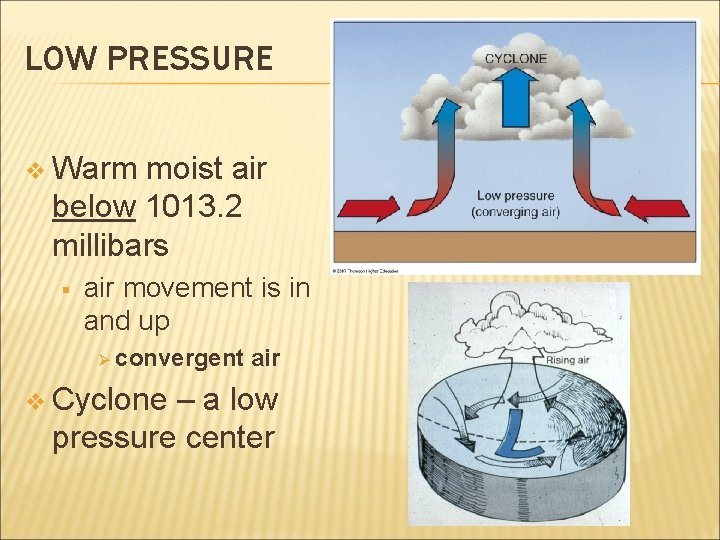
LOW PRESSURE v Warm moist air below 1013. 2 millibars § air movement is in and up Ø convergent v Cyclone air – a low pressure center
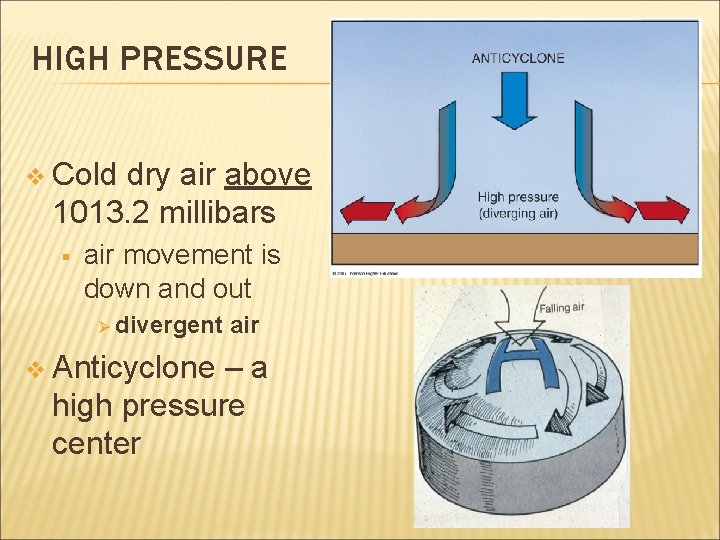
HIGH PRESSURE v Cold dry air above 1013. 2 millibars § air movement is down and out Ø divergent v Anticyclone air –a high pressure center
PRESSURE VARIATIONS 1 q Vertical Variations – § Air pressure decreases with elevation – pressure on top of Mt. Everest is only about 1/3 rd of that at sea level § The higher we go, air density decreases as the air molecules become more diffused and widely spaced § Air tends to rise or sink as a result of its density – at ground level, air density is governed by its temperature – As air is heated, it expands, becomes less dense, thinner, and rises § § Reduced air pressure also means less oxygen per breath – that’s why airplane cabins are pressurized
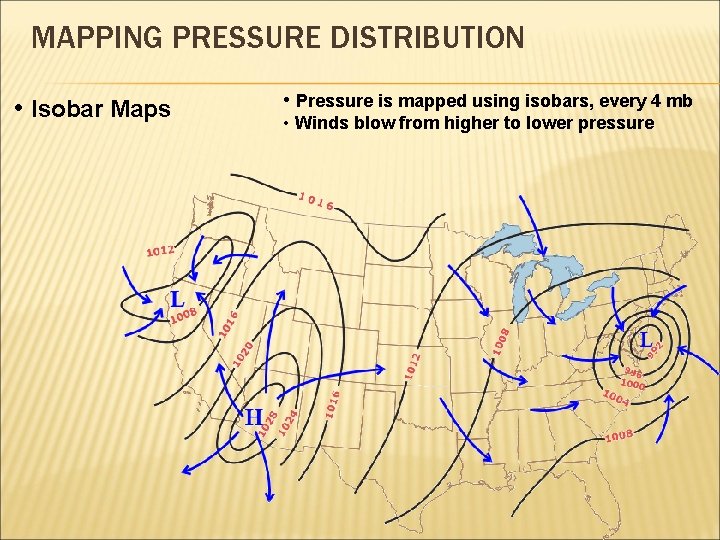
MAPPING PRESSURE DISTRIBUTION • Isobar Maps • Pressure is mapped using isobars, every 4 mb • Winds blow from higher to lower pressure
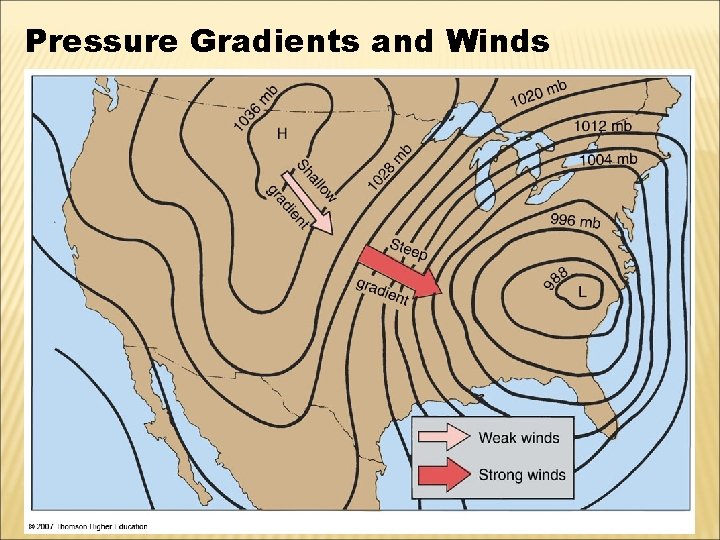
Pressure Gradients and Winds
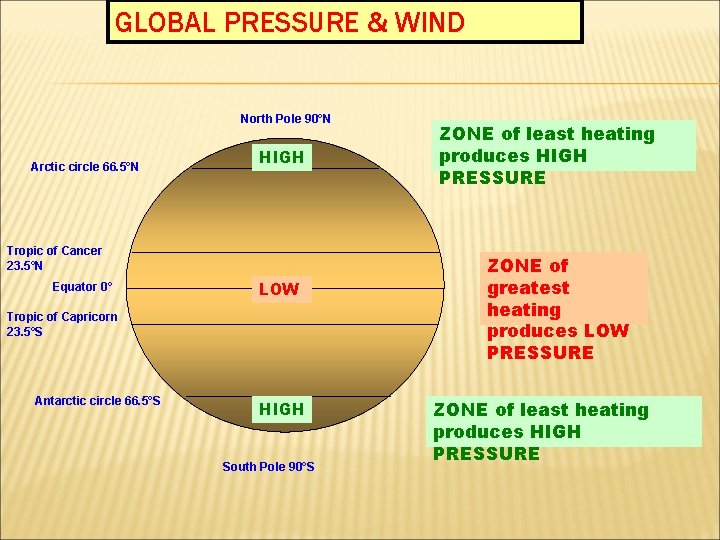
GLOBAL PRESSURE & WIND North Pole 90°N Arctic circle 66. 5°N HIGH Tropic of Cancer 23. 5°N Equator 0° LOW Tropic of Capricorn 23. 5°S Antarctic circle 66. 5°S HIGH South Pole 90°S ZONE of least heating produces HIGH PRESSURE ZONE of greatest heating produces LOW PRESSURE ZONE of least heating produces HIGH PRESSURE
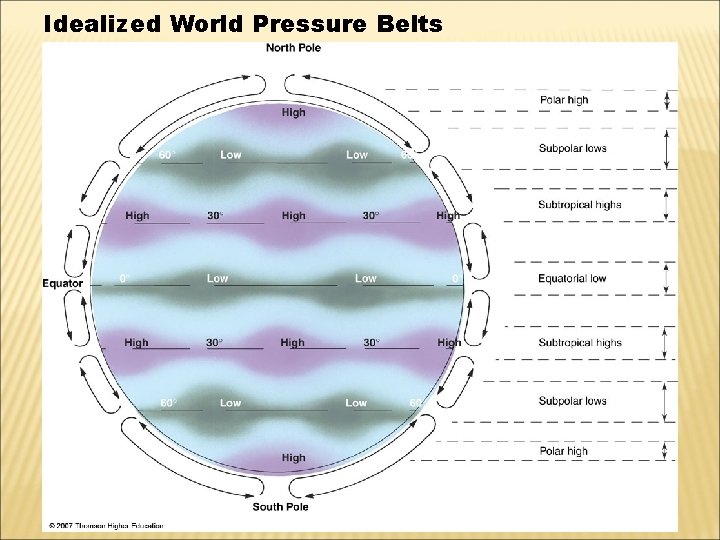
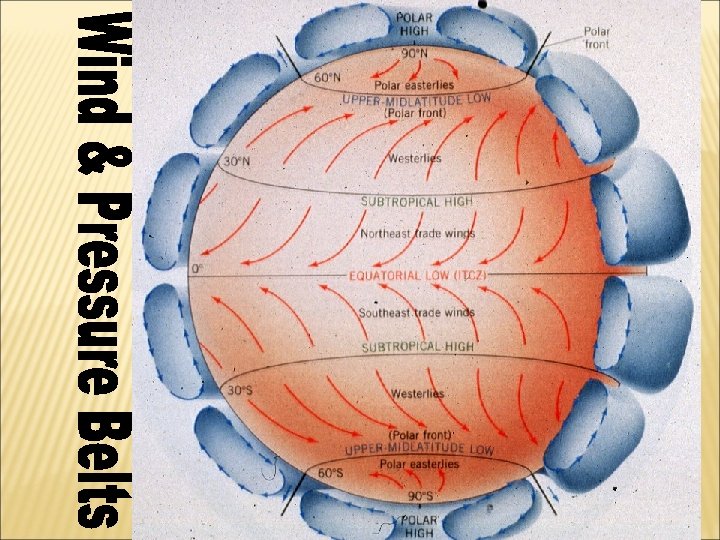
Idealized World Pressure Belts
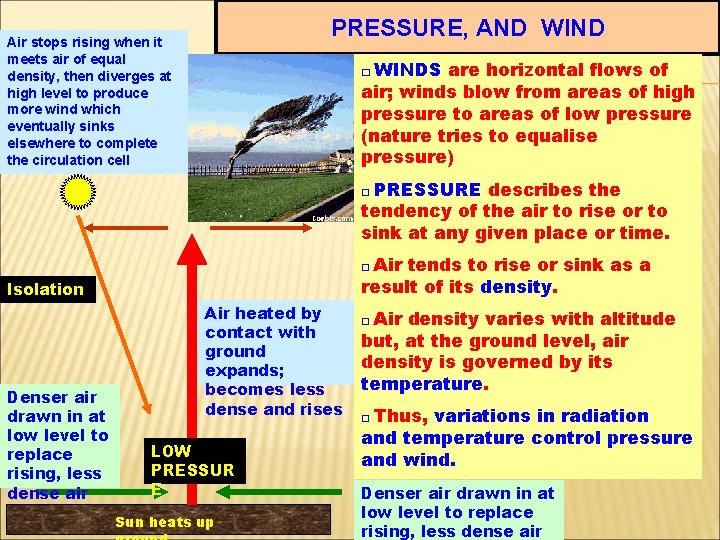
PRESSURE, AND WIND Air stops rising when it meets air of equal density, then diverges at high level to produce more wind which eventually sinks elsewhere to complete the circulation cell WINDS are horizontal flows of air; winds blow from areas of high pressure to areas of low pressure (nature tries to equalise pressure) � PRESSURE describes the tendency of the air to rise or to sink at any given place or time. � Air tends to rise or sink as a result of its density. � Isolation Denser air drawn in at low level to replace rising, less dense air Air heated by contact with ground expands; becomes less dense and rises LOW PRESSUR E Sun heats up Air density varies with altitude but, at the ground level, air density is governed by its temperature. � Thus, variations in radiation and temperature control pressure and wind. � Denser air drawn in at low level to replace rising, less dense air
WIND AND CIRCULATION PATTERNS q Wind is the horizontal movement of air in response to differences in pressure § § q Basic Wind Patterns -- induced by Pressure differences Ø Ø q Winds are the means to balancing: (a) the uneven distribution of pressure, and (b) radiational heating and cooling Winds also influence the rate and distribution of evaporation, and thus, precipitation Linear -- Pressure Gradients and Winds (Fig. 5. 5) Circular -- Cyclones (L), Anticyclones (H) and Winds (Fig. 5. 9) Wind Modifiers: § § Friction and Wind (effective up to about 1000 m above the surface – reduces wind speed) The Coriolis Effect and Wind – deflection due to rotation (Fig. 5. 6)
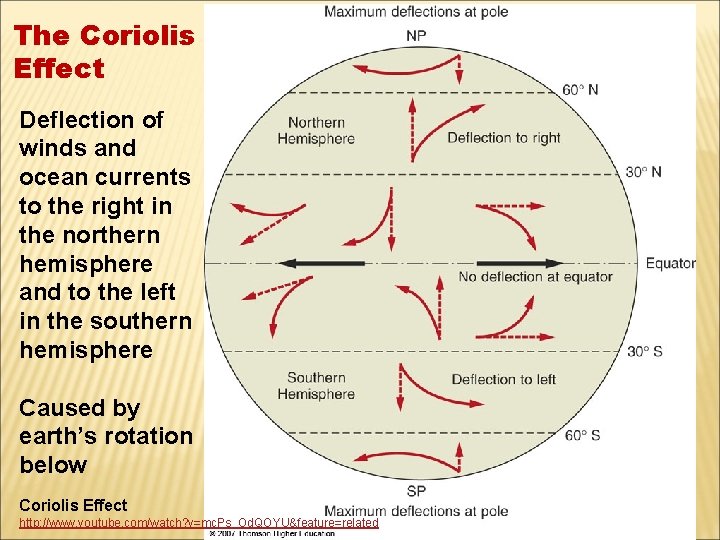
The Coriolis Effect Deflection of winds and ocean currents to the right in the northern hemisphere and to the left in the southern hemisphere Caused by earth’s rotation below Coriolis Effect http: //www. youtube. com/watch? v=mc. Ps_Od. QOYU&feature=related
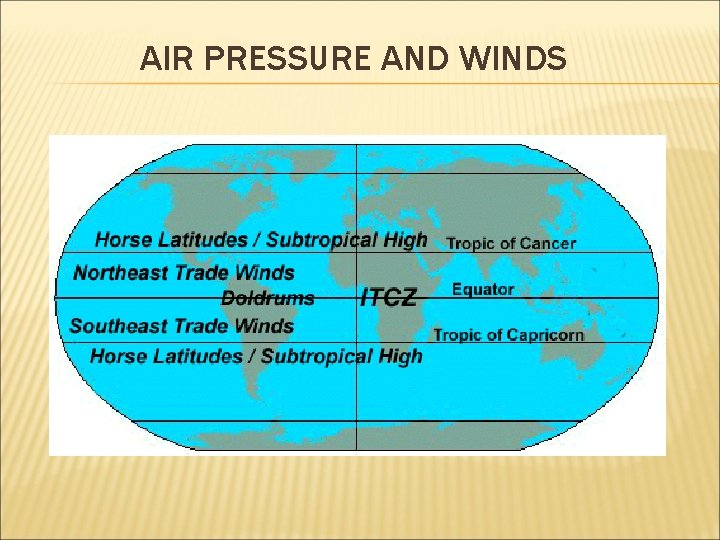
AIR PRESSURE AND WINDS
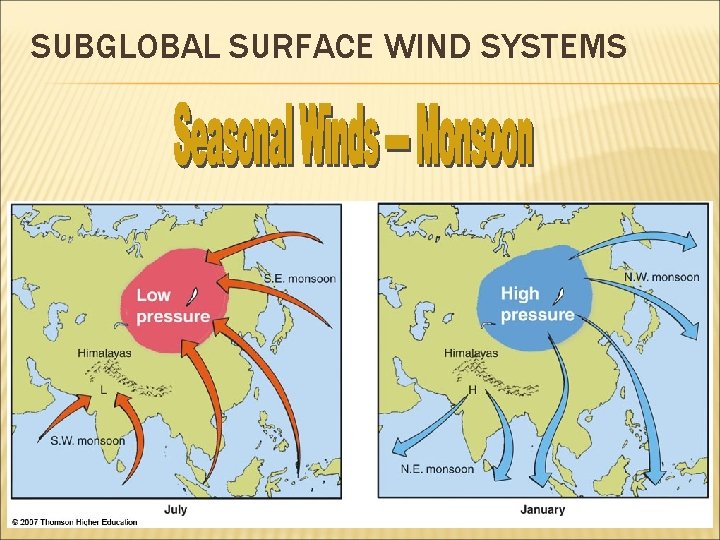
SUBGLOBAL SURFACE WIND SYSTEMS
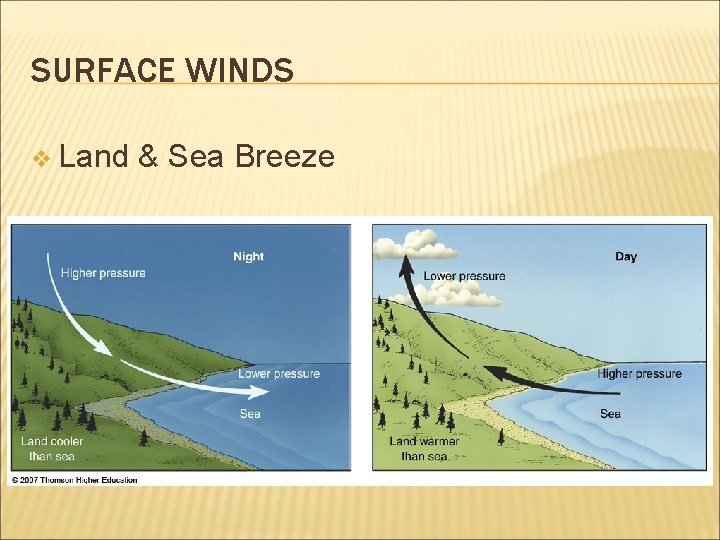
SURFACE WINDS v Land & Sea Breeze
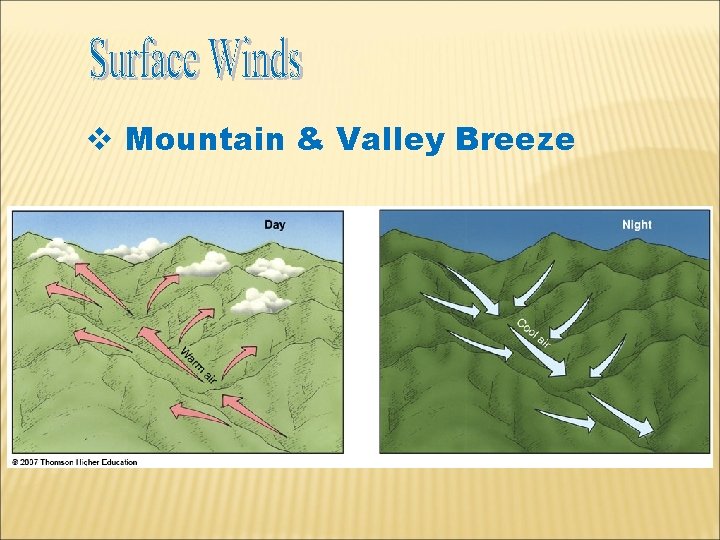
v Mountain & Valley Breeze
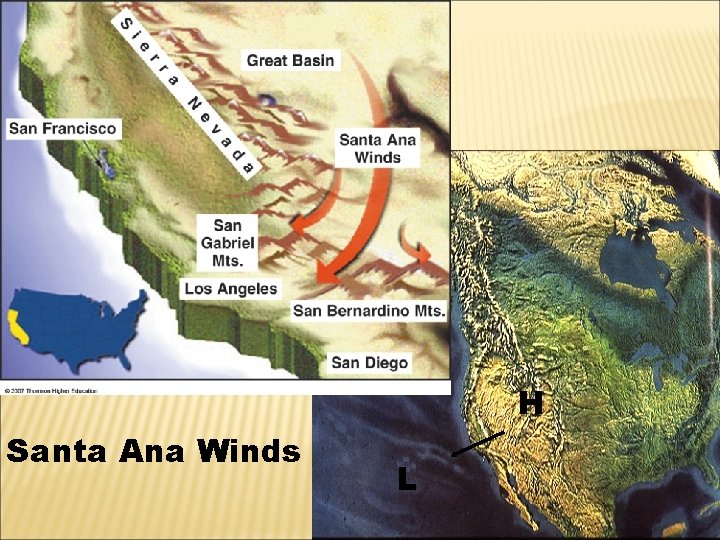
H Santa Ana Winds L
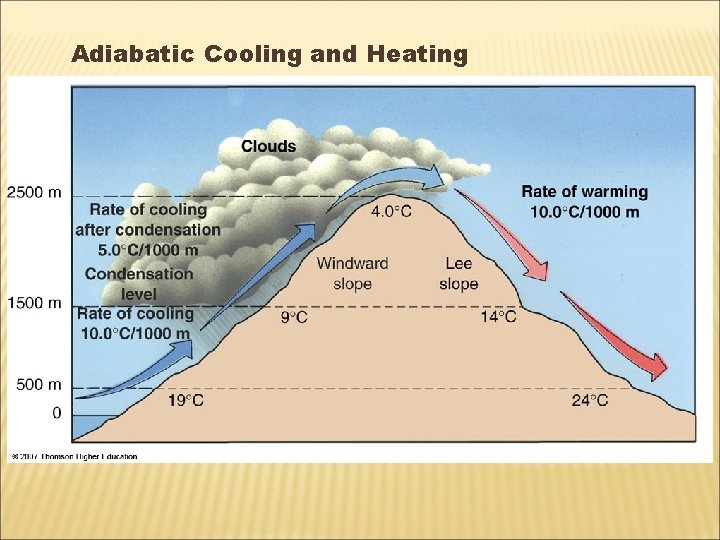
Adiabatic Cooling and Heating
- Slides: 27