
Pressure Wave Reflection at the Heart Why arterial
- Slides: 9
Pressure Wave Reflection at the Heart Why arterial stiffness is the major cause of heart failure, stroke and myocardial ischemia.
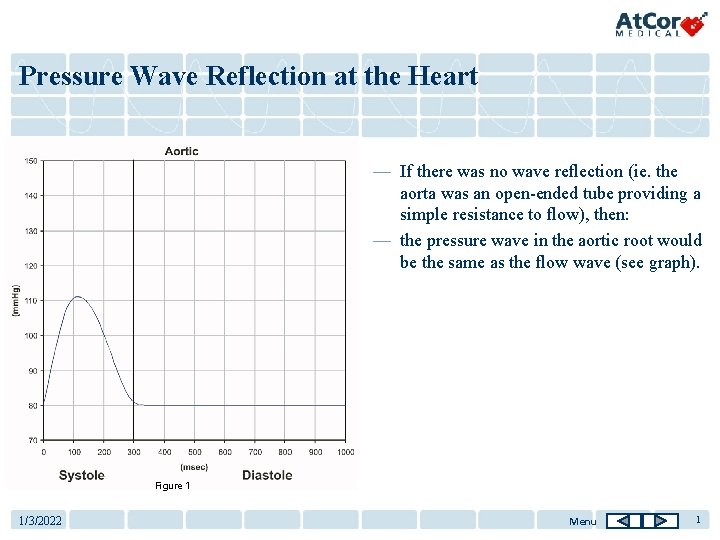
Pressure Wave Reflection at the Heart — If there was no wave reflection (ie. the aorta was an open-ended tube providing a simple resistance to flow), then: — the pressure wave in the aortic root would be the same as the flow wave (see graph). Figure 1 1/3/2022 Menu 1
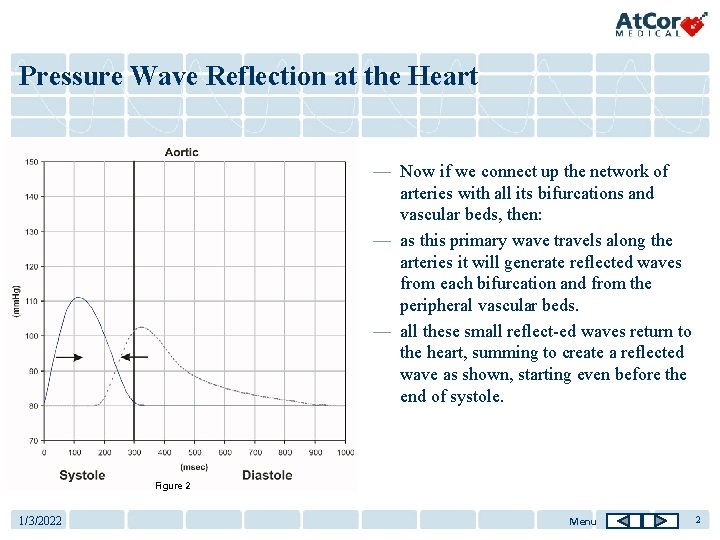
Pressure Wave Reflection at the Heart — Now if we connect up the network of arteries with all its bifurcations and vascular beds, then: — as this primary wave travels along the arteries it will generate reflected waves from each bifurcation and from the peripheral vascular beds. — all these small reflect-ed waves return to the heart, summing to create a reflected wave as shown, starting even before the end of systole. Figure 2 1/3/2022 Menu 2
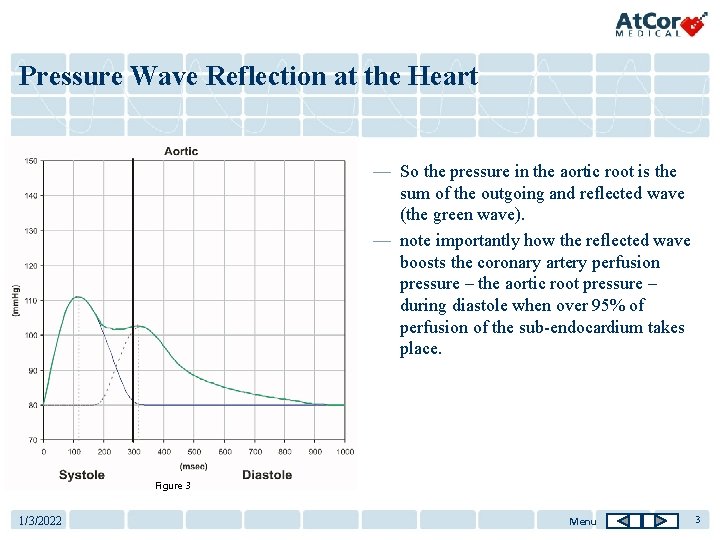
Pressure Wave Reflection at the Heart — So the pressure in the aortic root is the sum of the outgoing and reflected wave (the green wave). — note importantly how the reflected wave boosts the coronary artery perfusion pressure – the aortic root pressure – during diastole when over 95% of perfusion of the sub-endocardium takes place. Figure 3 1/3/2022 Menu 3
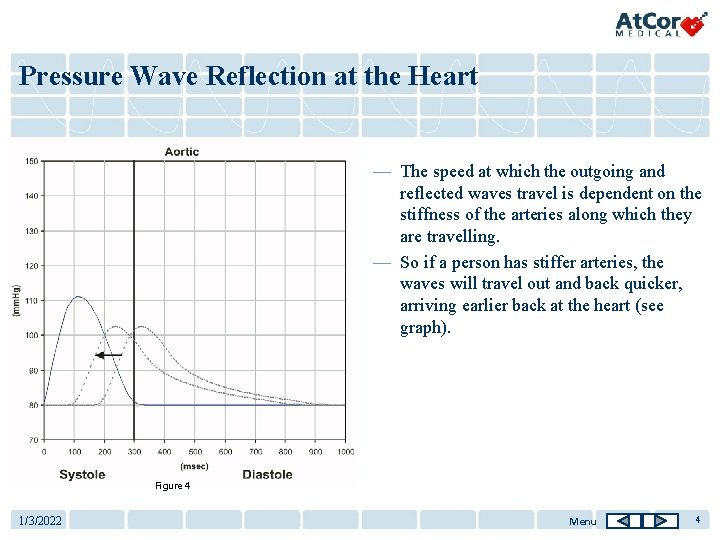
Pressure Wave Reflection at the Heart — The speed at which the outgoing and reflected waves travel is dependent on the stiffness of the arteries along which they are travelling. — So if a person has stiffer arteries, the waves will travel out and back quicker, arriving earlier back at the heart (see graph). Figure 4 1/3/2022 Menu 4
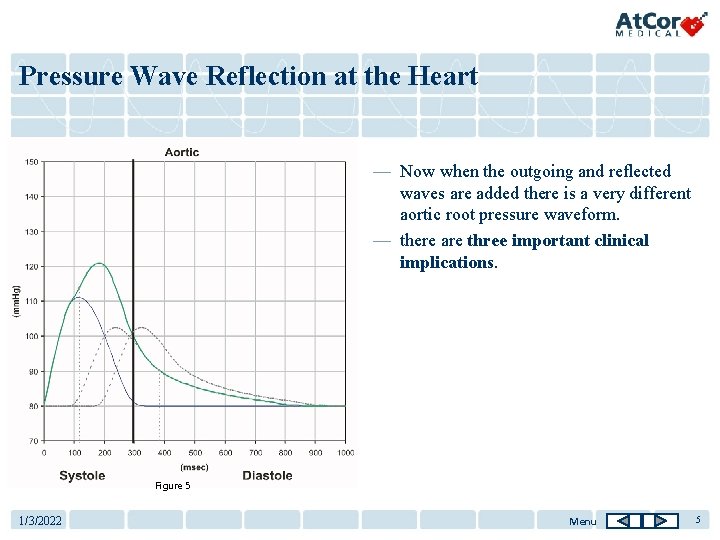
Pressure Wave Reflection at the Heart — Now when the outgoing and reflected waves are added there is a very different aortic root pressure waveform. — there are three important clinical implications. Figure 5 1/3/2022 Menu 5
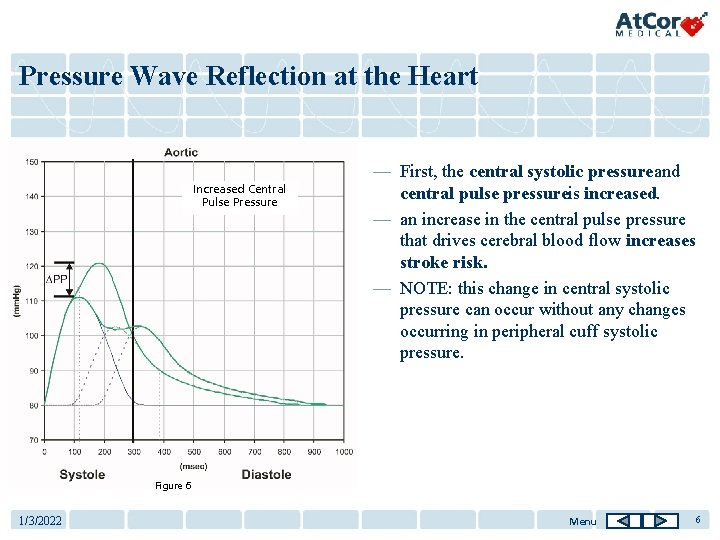
Pressure Wave Reflection at the Heart Increased Central Pulse Pressure — First, the central systolic pressure and central pulse pressureis increased. — an increase in the central pulse pressure that drives cerebral blood flow increases stroke risk. — NOTE: this change in central systolic pressure can occur without any changes occurring in peripheral cuff systolic pressure. Figure 6 1/3/2022 Menu 6
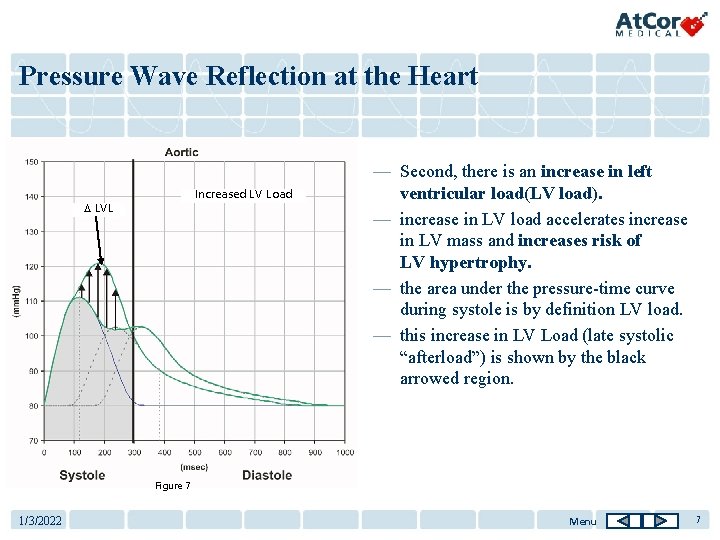
Pressure Wave Reflection at the Heart Increased LV Load D LVL — Second, there is an increase in left ventricular load(LV load). — increase in LV load accelerates increase in LV mass and increases risk of LV hypertrophy. — the area under the pressure-time curve during systole is by definition LV load. — this increase in LV Load (late systolic “afterload”) is shown by the black arrowed region. Figure 7 1/3/2022 Menu 7
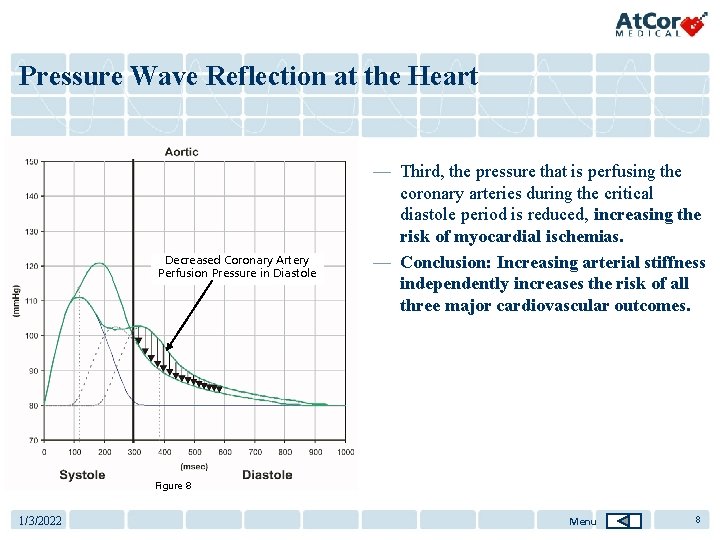
Pressure Wave Reflection at the Heart Decreased Coronary Artery Perfusion Pressure in Diastole — Third, the pressure that is perfusing the coronary arteries during the critical diastole period is reduced, increasing the risk of myocardial ischemias. — Conclusion: Increasing arterial stiffness independently increases the risk of all three major cardiovascular outcomes. Figure 8 1/3/2022 Menu 8