
PRESSURE VESSELS DESIGN PROCEDURES Engr Butch G Bataller
PRESSURE VESSELS DESIGN PROCEDURES Engr. Butch G. Bataller Ch. E 192 Process Equipment Design September 20, 2011
Pressure Vessels v Closed vessel having an internal pressure between 15 psig to 3000 psig v ASME Boiler and Pressure Vessel Code contains rules for the design, fabrication and inspection of boilers and pressure vessels v May include reflux drum, storage tanks, heat exchangers, chemical reactors, distillation columns, absorption tower, stripping columns, etc.
PV Design: Shell Thickness v In general, the minimum wall thickness of welded metal plates subject to pressure, excluding corrosion allowances, should not be less than 2. 4 mm v a function of the ultimate tensile strength of the metal at operating temperature, operating pressure, vessel diameter and welding joint efficiency
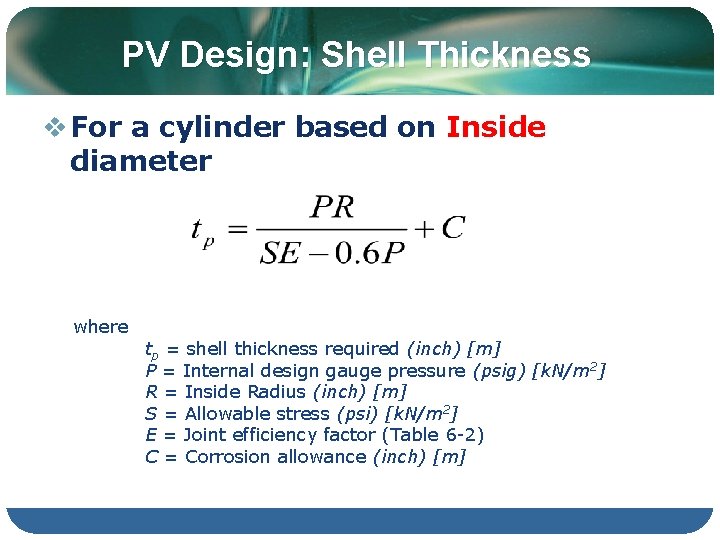
PV Design: Shell Thickness v For a cylinder based on Inside diameter where tp = shell thickness required (inch) [m] P = Internal design gauge pressure (psig) [k. N/m 2] R = Inside Radius (inch) [m] S = Allowable stress (psi) [k. N/m 2] E = Joint efficiency factor (Table 6 -2) C = Corrosion allowance (inch) [m]
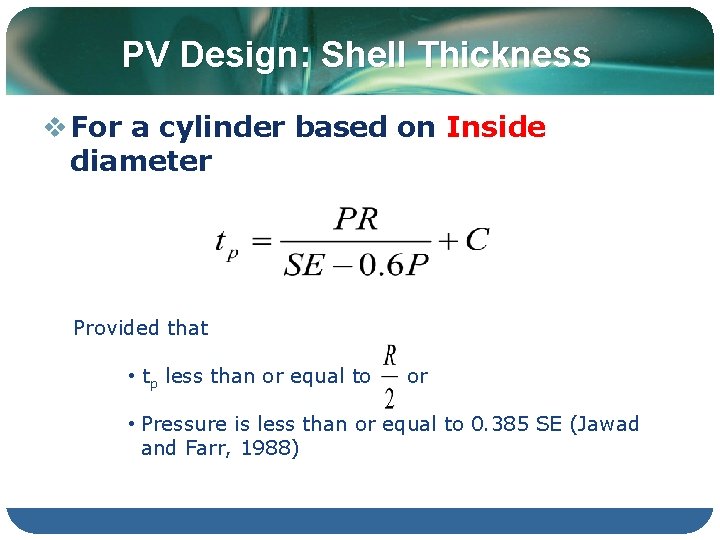
PV Design: Shell Thickness v For a cylinder based on Inside diameter Provided that • tp less than or equal to or • Pressure is less than or equal to 0. 385 SE (Jawad and Farr, 1988)
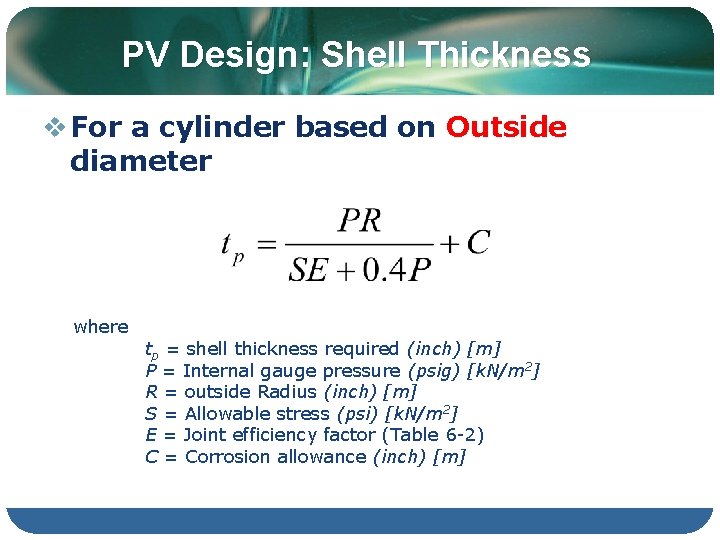
PV Design: Shell Thickness v For a cylinder based on Outside diameter where tp = shell thickness required (inch) [m] P = Internal gauge pressure (psig) [k. N/m 2] R = outside Radius (inch) [m] S = Allowable stress (psi) [k. N/m 2] E = Joint efficiency factor (Table 6 -2) C = Corrosion allowance (inch) [m]
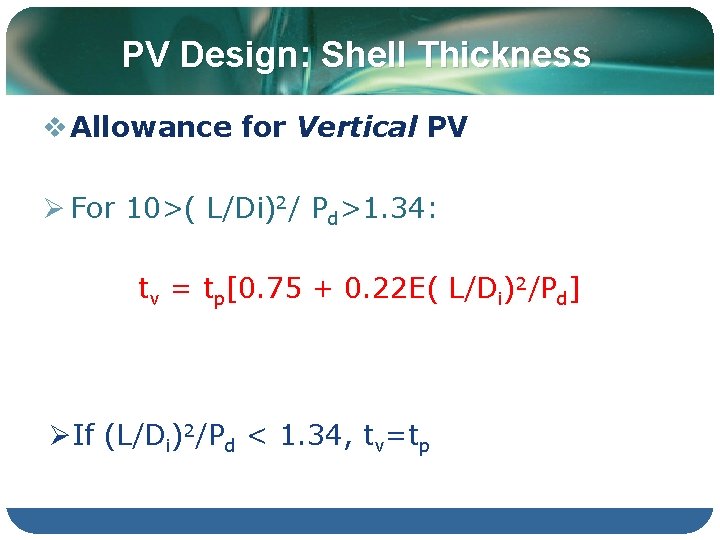
PV Design: Shell Thickness v Allowance for Vertical PV Ø For 10>( L/Di)2/ Pd>1. 34: tv = tp[0. 75 + 0. 22 E( L/Di)2/Pd] ØIf (L/Di)2/Pd < 1. 34, tv=tp
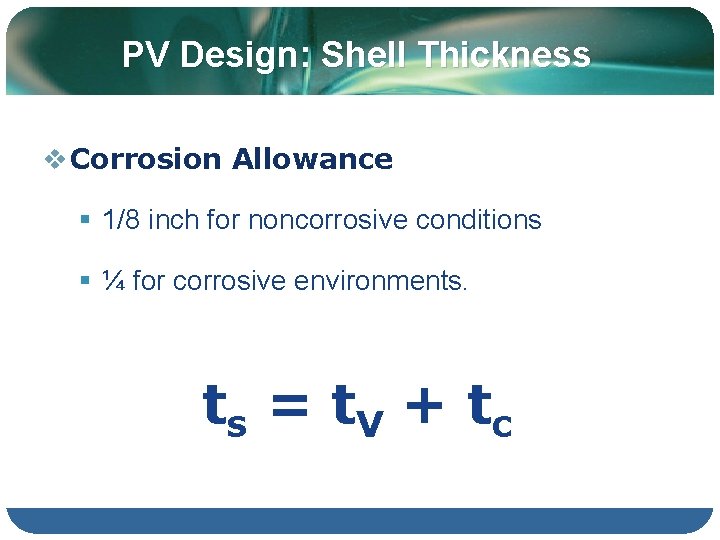
PV Design: Shell Thickness v Corrosion Allowance § 1/8 inch for noncorrosive conditions § ¼ for corrosive environments. ts = t V + t c
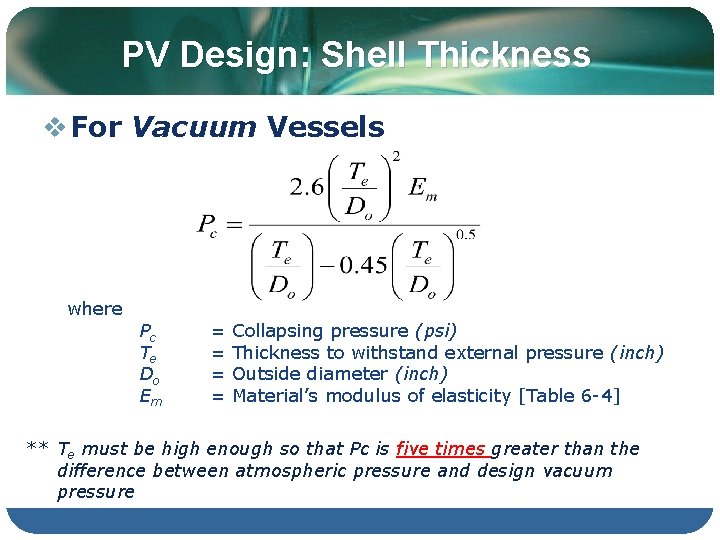
PV Design: Shell Thickness v For Vacuum Vessels where Pc Te Do Em = = Collapsing pressure (psi) Thickness to withstand external pressure (inch) Outside diameter (inch) Material’s modulus of elasticity [Table 6 -4] ** Te must be high enough so that Pc is five times greater than the difference between atmospheric pressure and design vacuum pressure
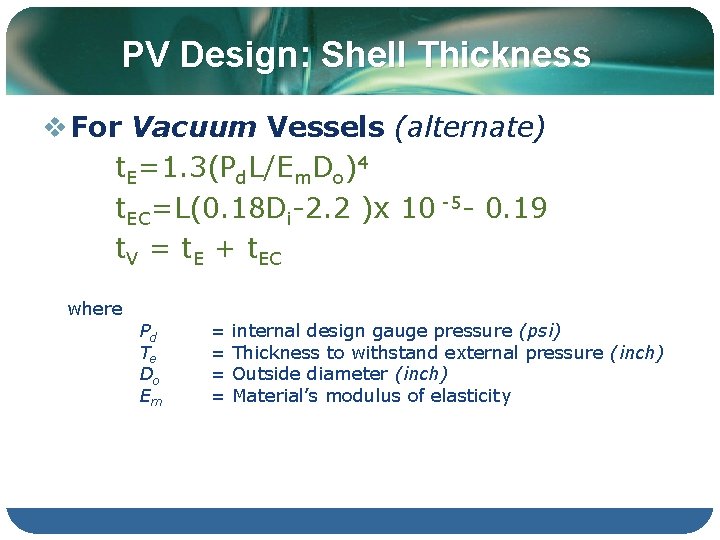
PV Design: Shell Thickness v For Vacuum Vessels (alternate) t. E=1. 3(Pd. L/Em. Do)4 t. EC=L(0. 18 Di-2. 2 )x 10 -5 - 0. 19 t. V = t. E + t. EC where Pd Te Do Em = = internal design gauge pressure (psi) Thickness to withstand external pressure (inch) Outside diameter (inch) Material’s modulus of elasticity
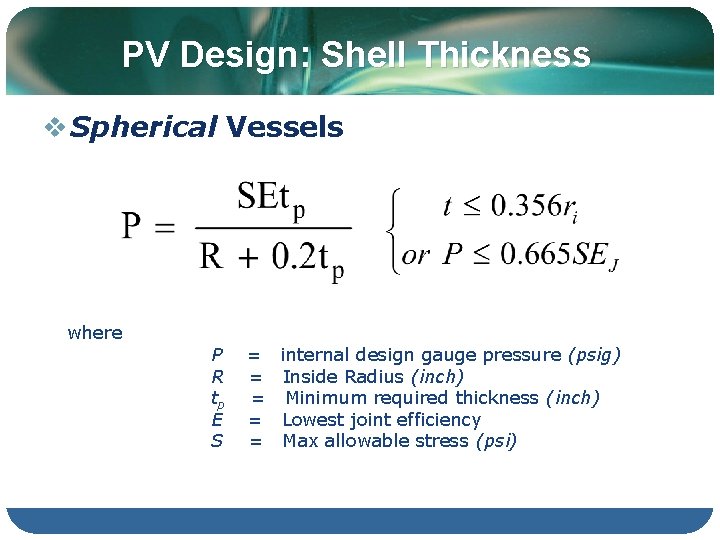
PV Design: Shell Thickness v Spherical Vessels where P R tp E S = = = internal design gauge pressure (psig) Inside Radius (inch) Minimum required thickness (inch) Lowest joint efficiency Max allowable stress (psi)
Design Temperature v design temperature may be equal to operating temperatue plus 50 o. F
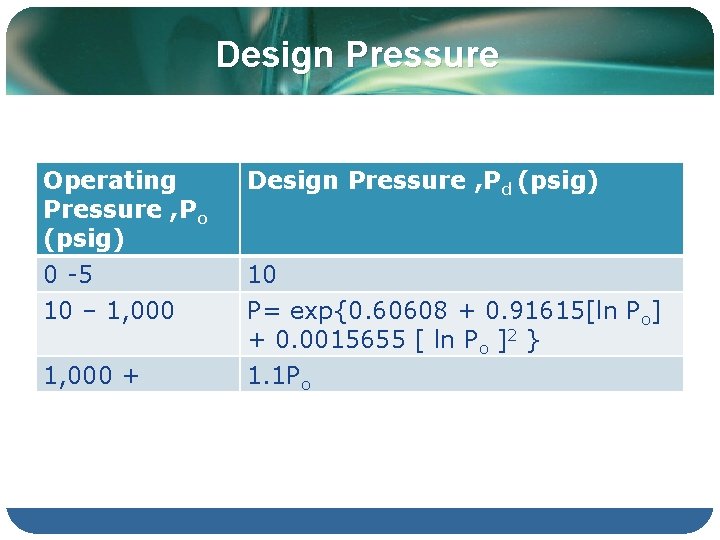
Design Pressure Operating Pressure , Po (psig) 0 -5 Design Pressure , Pd (psig) 10 – 1, 000 P= exp{0. 60608 + 0. 91615[ln Po] + 0. 0015655 [ ln Po ]2 } 1. 1 Po 1, 000 + 10
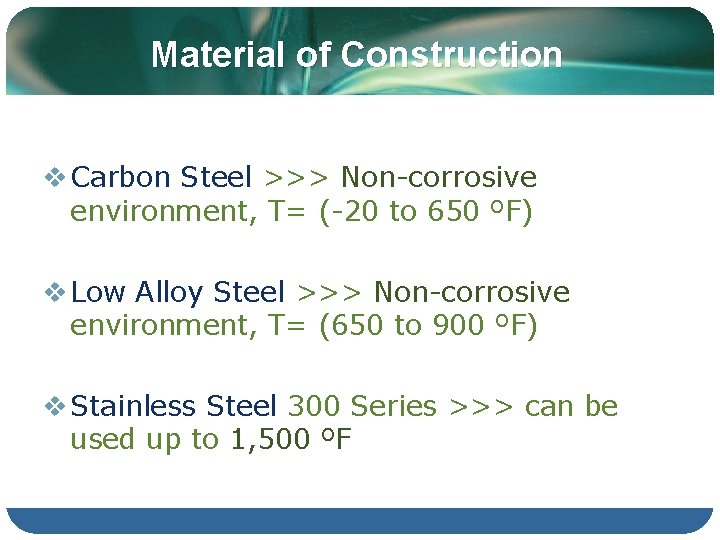
Material of Construction v Carbon Steel >>> Non-corrosive environment, T= (-20 to 650 OF) v Low Alloy Steel >>> Non-corrosive environment, T= (650 to 900 OF) v Stainless Steel 300 Series >>> can be used up to 1, 500 OF
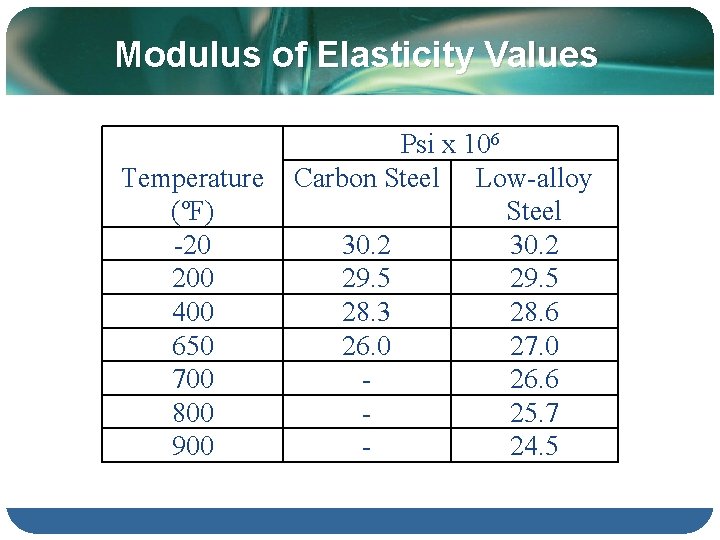
Modulus of Elasticity Values Temperature (ºF) -20 200 400 650 700 800 900 Psi x 106 Carbon Steel Low-alloy Steel 30. 2 29. 5 28. 3 28. 6 26. 0 27. 0 26. 6 25. 7 24. 5
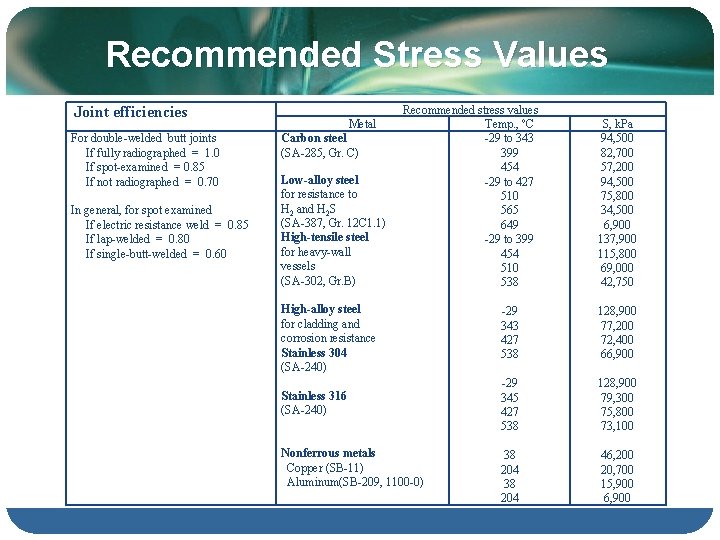
Recommended Stress Values Joint efficiencies For double-welded butt joints If fully radiographed = 1. 0 If spot-examined = 0. 85 If not radiographed = 0. 70 In general, for spot examined If electric resistance weld = 0. 85 If lap-welded = 0. 80 If single-butt-welded = 0. 60 Metal Carbon steel (SA-285, Gr. C) Low-alloy steel for resistance to H 2 and H 2 S (SA-387, Gr. 12 C 1. 1) High-tensile steel for heavy-wall vessels (SA-302, Gr. B) Recommended stress values Temp. , ºC -29 to 343 399 454 -29 to 427 510 565 649 -29 to 399 454 510 538 S, k. Pa 94, 500 82, 700 57, 200 94, 500 75, 800 34, 500 6, 900 137, 900 115, 800 69, 000 42, 750 High-alloy steel for cladding and corrosion resistance Stainless 304 (SA-240) -29 343 427 538 128, 900 77, 200 72, 400 66, 900 Stainless 316 (SA-240) -29 345 427 538 128, 900 79, 300 75, 800 73, 100 38 204 46, 200 20, 700 15, 900 6, 900 Nonferrous metals Copper (SB-11) Aluminum(SB-209, 1100 -0)
Sample Problem Determine thickness of a 5 meter inside diameter spherical tank for handling a corrosive liquid at a design pressure and temperature of 300 KPa and 27 F, respectively. The material of construction is made of carbon steel.
Sample Problem v If the height of the tank is 35 m, what is the thickness of the tank incorporating earthquake and wind load? v What if the given pressure is an operating pressure?
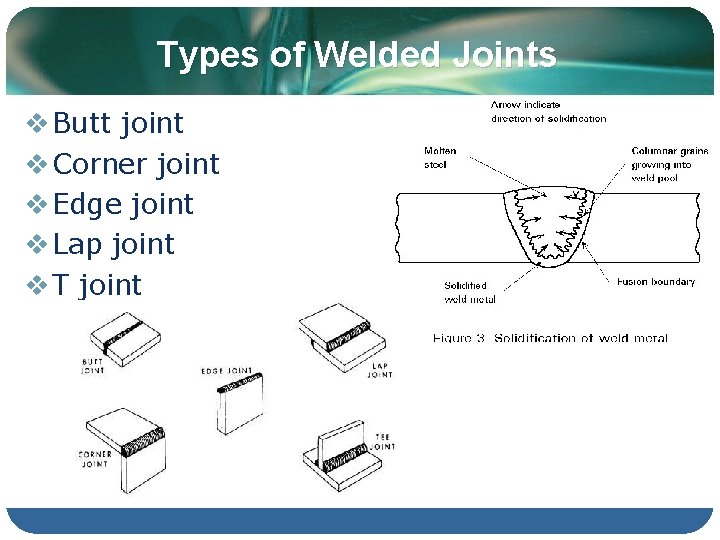
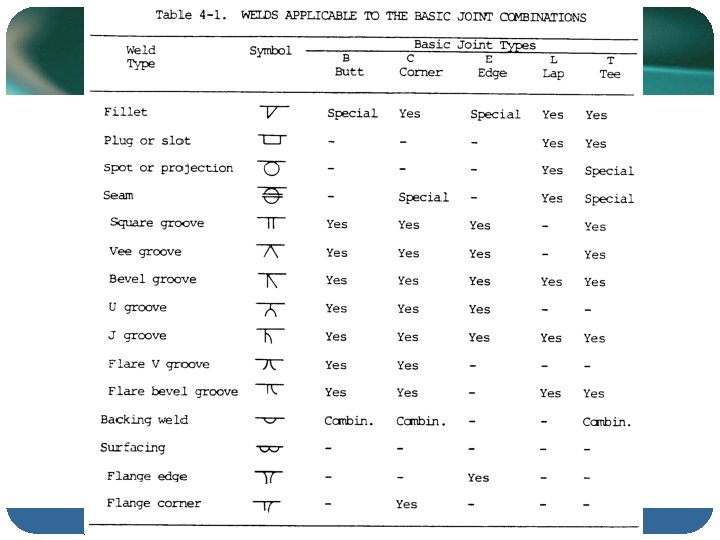
Types of Welded Joints v Butt joint v Corner joint v Edge joint v Lap joint v T joint
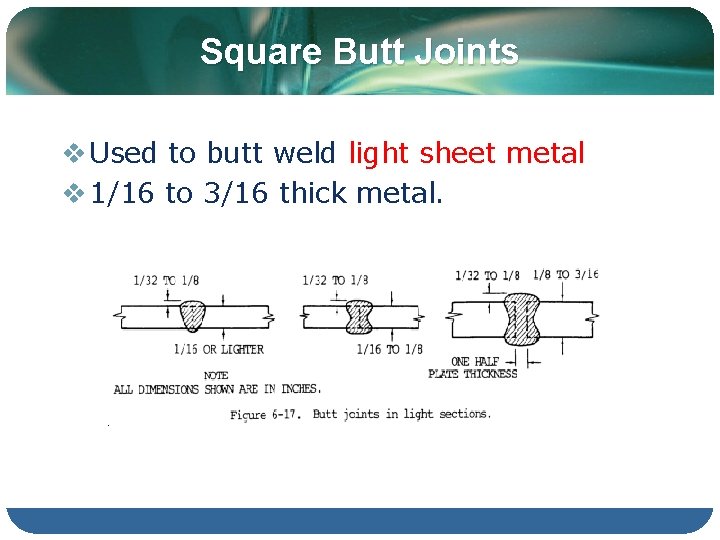
Square Butt Joints v Used to butt weld light sheet metal v 1/16 to 3/16 thick metal.
Beveled Butt Joints v Used to butt weld heavier pieces of metal together v 3/8 to ½ inch metal can welded using a single V or U joint v ½ Inch metal and up can be welded using a double V or U joint
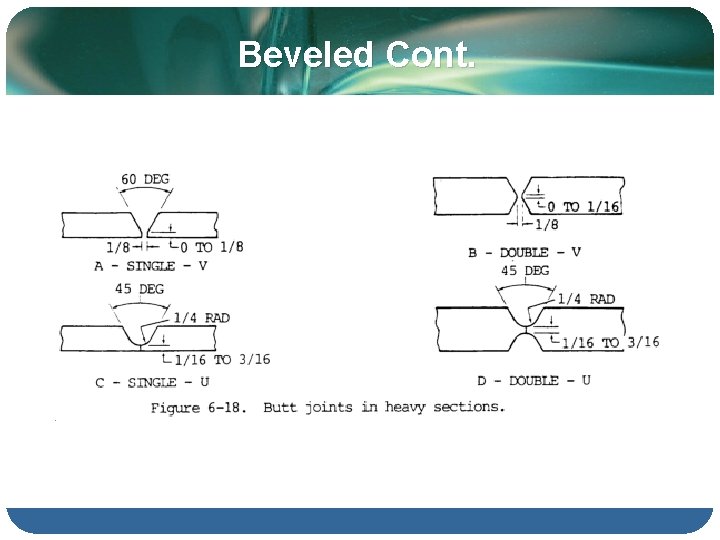
Beveled Cont.
Corner Joints v Used to join to pieces of metal that are approximately right angles to each other v Closed corner joint is used on light sheet metal were strength is not required at the joint v Half open corner joint is used on heavier metal when welding can only be done on one side. Used when load is not severe.
Corner Cont. v Open corner joint is used on heavy material. It is the strongest of the corner joints v Corner joints on heavy material are welded on both sides The outside first then reinforced on the inside
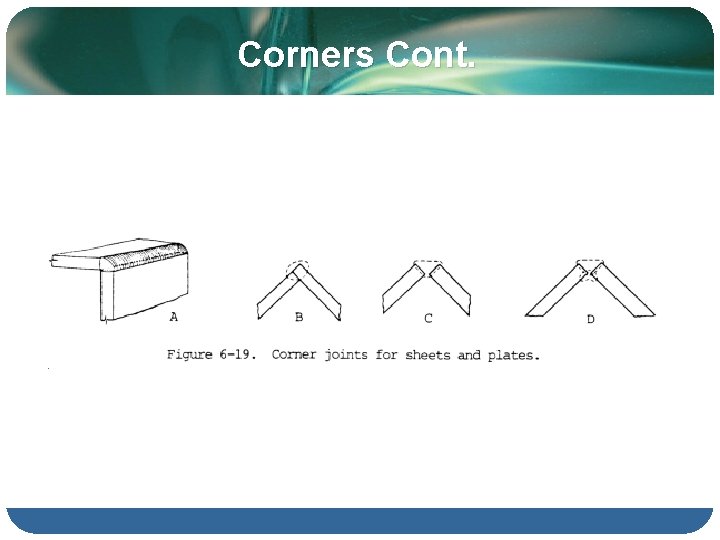
Corners Cont.
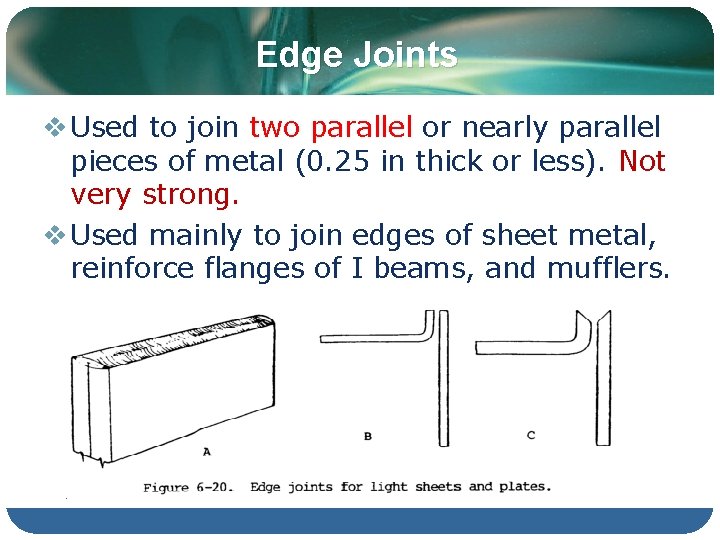
Edge Joints v Used to join two parallel or nearly parallel pieces of metal (0. 25 in thick or less). Not very strong. v Used mainly to join edges of sheet metal, reinforce flanges of I beams, and mufflers.
Lap Joints v Used to join two overlapping pieces of metal v Single lap joint welded from one side v Single lap joint welded from two sides develops full strength v Off set lap joint is used when two pieces of metal need to be joined in the same plain.
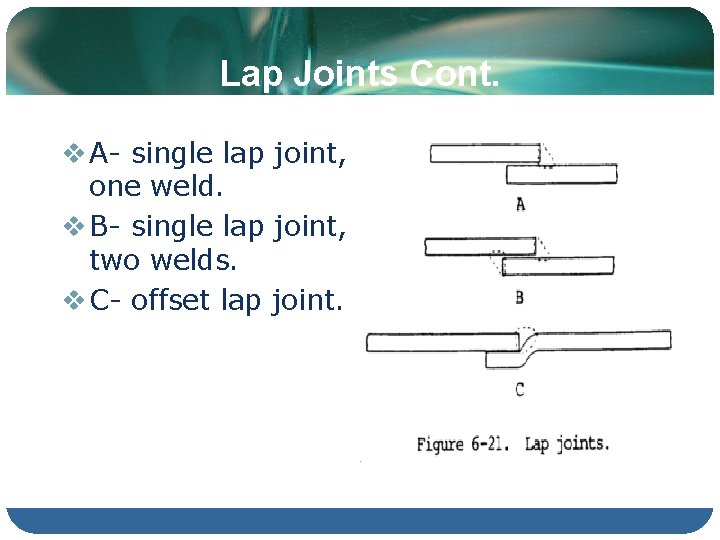
Lap Joints Cont. v A- single lap joint, one weld. v B- single lap joint, two welds. v C- offset lap joint.
Tee Joints v Used to join two pieces of metal that are approximately 90 degrees to each other, but the surface of one piece of metal is not in the same plain as the other metal.
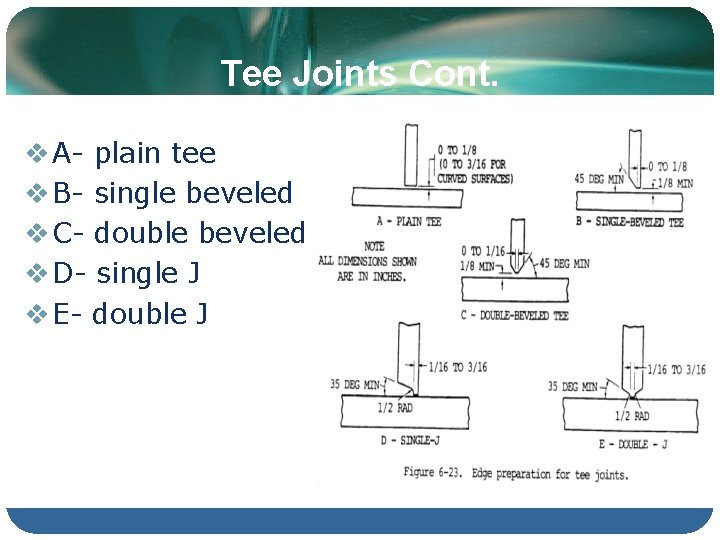
Tee Joints Cont. v A- plain tee v B- single beveled v C- double beveled v D- single J v E- double J
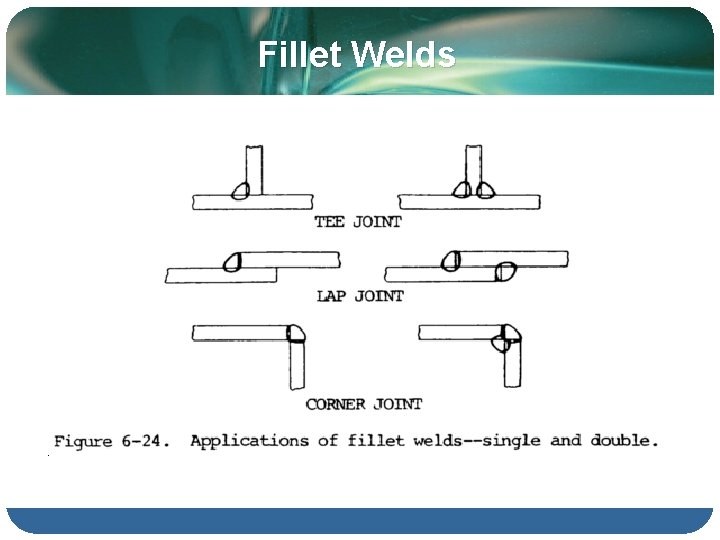
Types of Welds v Fillet weld- basic weld used. Used when joining two pieces of metal without preparing the surface of the metal first. v Groove weld- basic weld, used when preparing the metal before welding it into place.
Fillet Welds
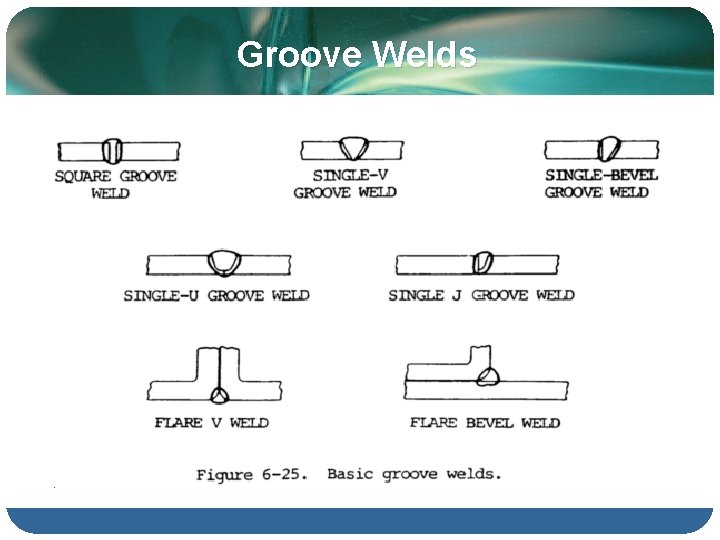
Groove Welds
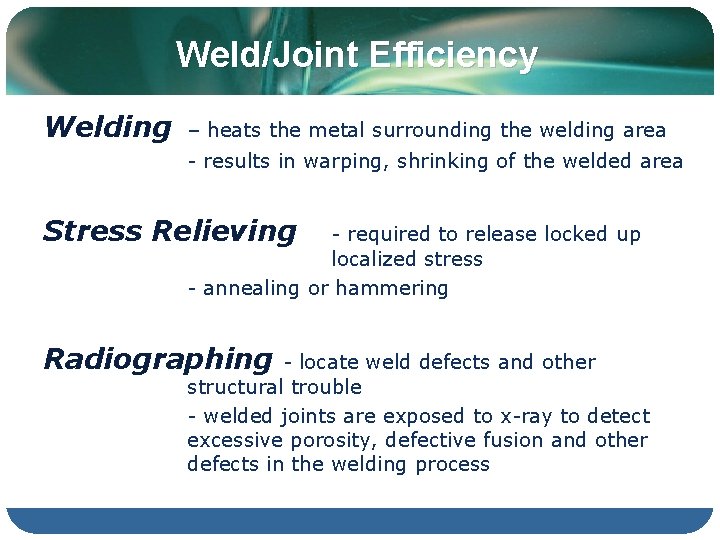
Weld/Joint Efficiency Welding – heats the metal surrounding the welding area - results in warping, shrinking of the welded area Stress Relieving - required to release locked up localized stress - annealing or hammering Radiographing - locate weld defects and other structural trouble - welded joints are exposed to x-ray to detect excessive porosity, defective fusion and other defects in the welding process
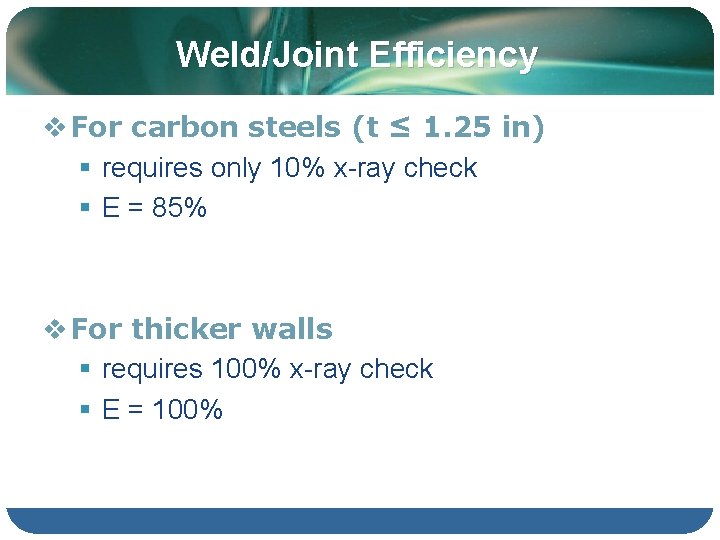
Weld/Joint Efficiency v For carbon steels (t ≤ 1. 25 in) § requires only 10% x-ray check § E = 85% v For thicker walls § requires 100% x-ray check § E = 100%
Weld/Joint Efficiency v Longitudinal joints should be butt- welded v Vessels in lethal application should be butt -welded and fully radiographed v All vessels fabricated on carbon or alloy steel requires post-heat treatment v All welded joints of cryogenic tanks must be butt welded, postweld heat treated and X- ray examined
v For double butt joint, the following are the corresponding efficiencies Full radiography Spot radiography No radiography 100% 85% 70 % ** when welded joint efficiency is not known, assume a no spot radiography
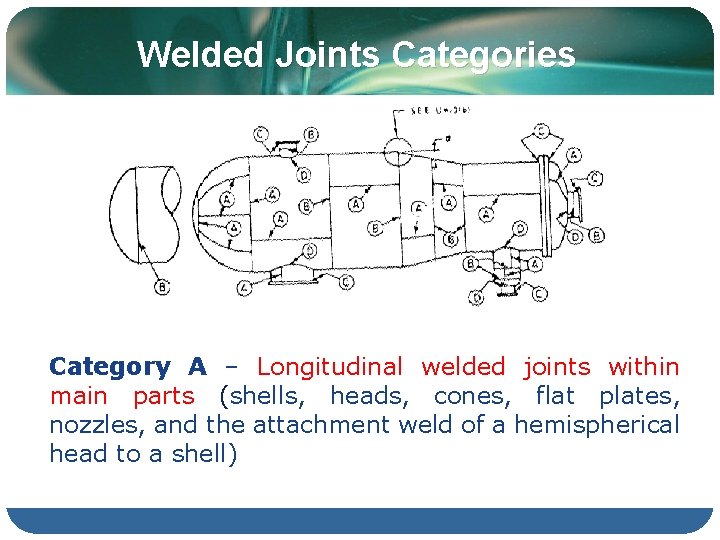
Welded Joints Categories Category A – Longitudinal welded joints within main parts (shells, heads, cones, flat plates, nozzles, and the attachment weld of a hemispherical head to a shell)
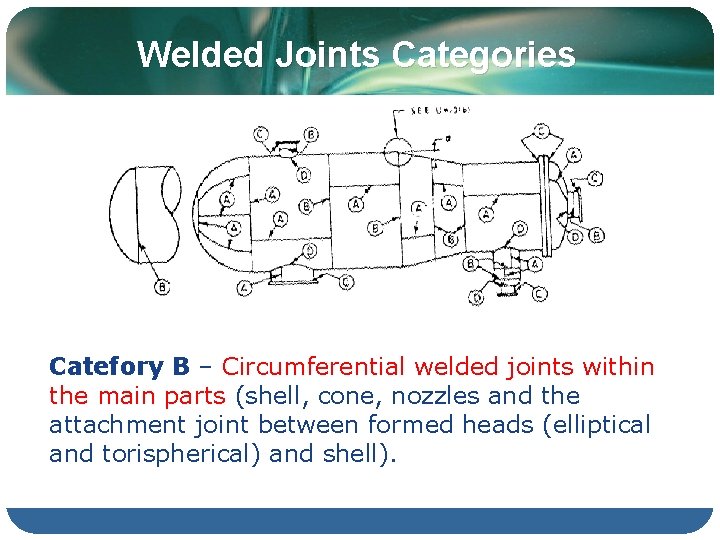
Welded Joints Categories Catefory B – Circumferential welded joints within the main parts (shell, cone, nozzles and the attachment joint between formed heads (elliptical and torispherical) and shell).
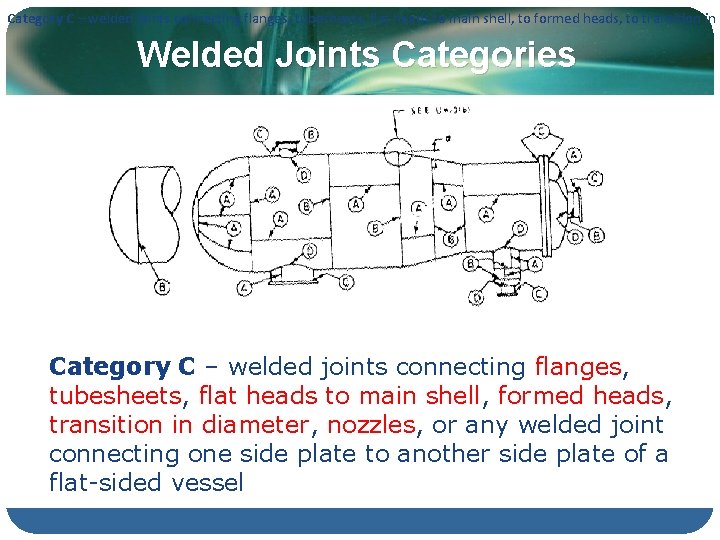
Category C – welded joints connecting flanges, tubesheets, flat heads to main shell, to formed heads, to transition in d Welded Joints Categories Category C – welded joints connecting flanges, tubesheets, flat heads to main shell, formed heads, transition in diameter, nozzles, or any welded joint connecting one side plate to another side plate of a flat-sided vessel
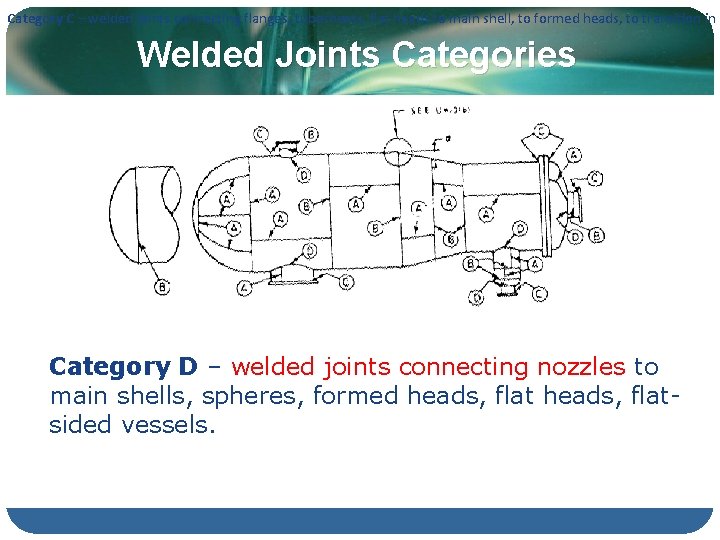
Category C – welded joints connecting flanges, tubesheets, flat heads to main shell, to formed heads, to transition in d Welded Joints Categories Category D – welded joints connecting nozzles to main shells, spheres, formed heads, flatsided vessels.
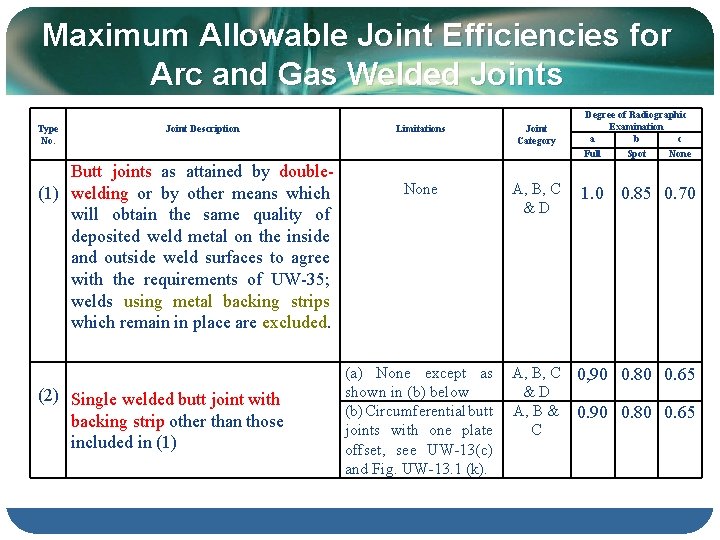
Maximum Allowable Joint Efficiencies for Arc and Gas Welded Joints Type No. Joint Description Limitations Joint Category Degree of Radiographic Examination a b c Full Butt joints as attained by double(1) welding or by other means which will obtain the same quality of deposited weld metal on the inside and outside weld surfaces to agree with the requirements of UW-35; welds using metal backing strips which remain in place are excluded. (2) Single welded butt joint with backing strip other than those included in (1) None (a) None except as shown in (b) below (b) Circumferential butt joints with one plate offset, see UW-13(c) and Fig. UW-13. 1 (k). A, B, C &D Spot None 1. 0 0. 85 0. 70 A, B, C 0, 90 0. 80 0. 65 &D A, B & 0. 90 0. 80 0. 65 C
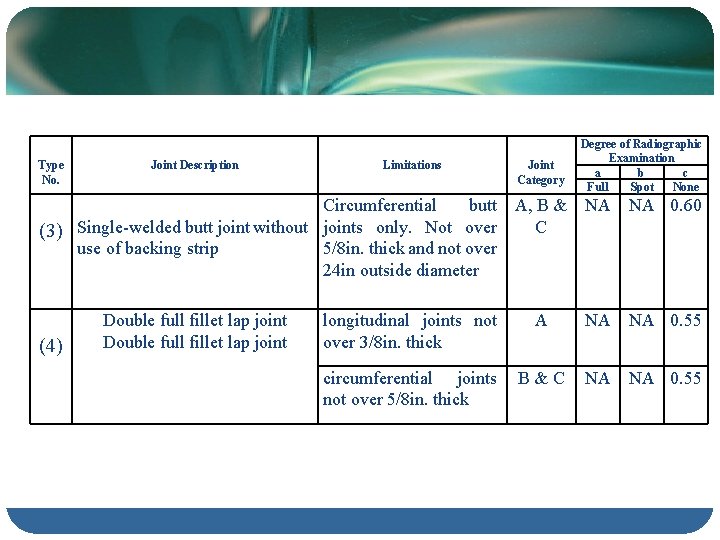
Type No. Joint Description Limitations Circumferential butt (3) Single-welded butt joint without joints only. Not over use of backing strip 5/8 in. thick and not over 24 in outside diameter (4) Double full fillet lap joint Joint Category Degree of Radiographic Examination a b c Full Spot None A, B & NA C NA 0. 60 longitudinal joints not over 3/8 in. thick A NA NA 0. 55 circumferential joints not over 5/8 in. thick B&C NA NA 0. 55
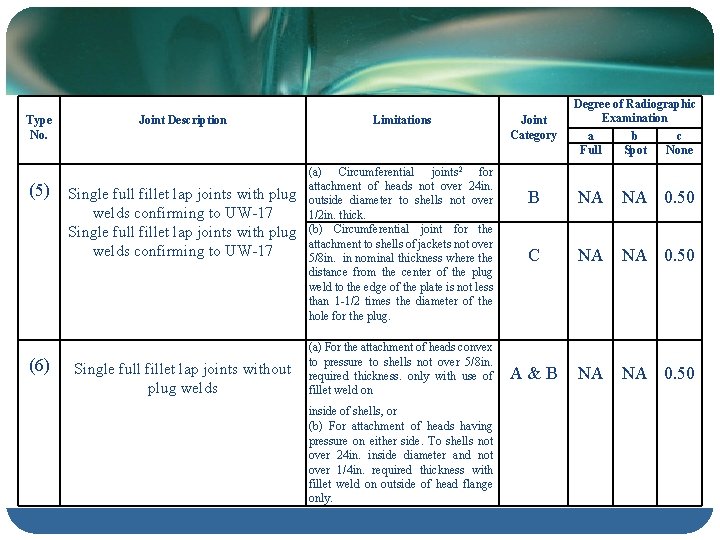
Type No. (5) (6) Joint Description Single full fillet lap joints with plug welds confirming to UW-17 Single full fillet lap joints without plug welds Limitations (a) Circumferential joints 2 for attachment of heads not over 24 in. outside diameter to shells not over 1/2 in. thick. (b) Circumferential joint for the attachment to shells of jackets not over 5/8 in. in nominal thickness where the distance from the center of the plug weld to the edge of the plate is not less than 1 -1/2 times the diameter of the hole for the plug. (a) For the attachment of heads convex to pressure to shells not over 5/8 in. required thickness. only with use of fillet weld on inside of shells, or (b) For attachment of heads having pressure on either side. To shells not over 24 in. inside diameter and not over 1/4 in. required thickness with fillet weld on outside of head flange only. Joint Category Degree of Radiographic Examination a b c Full Spot None B NA NA 0. 50 C NA NA 0. 50 A&B NA NA 0. 50
- Slides: 45