
Pressure Vessel Measurements and Modelling of Metal Solubility

Pressure Vessel Measurements and Modelling of Metal Solubility in Aqueous Processes Vladimiros G. Papangelakis Dept. of Chemical Engineering & Applied Chemistry, University of Toronto, Canada Reagents Feed Vent Discharge
Outline · · · Acid concentration measurements p. H measurements Chemical modeling Examples Conclusions 1
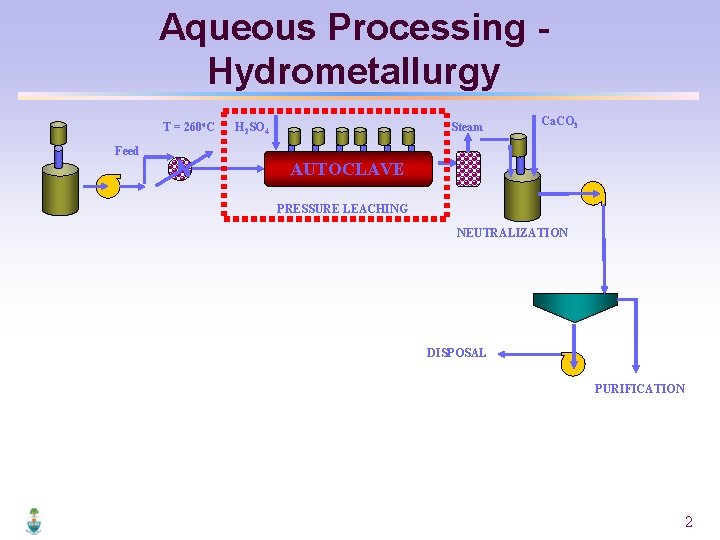
Aqueous Processing Hydrometallurgy T = 260 o. C H 2 SO 4 Steam Ca. CO 3 Feed AUTOCLAVE PRESSURE LEACHING NEUTRALIZATION DISPOSAL PURIFICATION 2
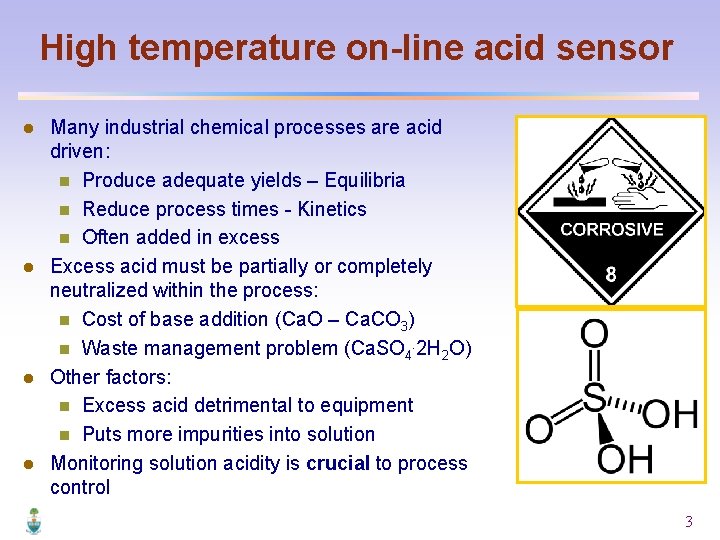
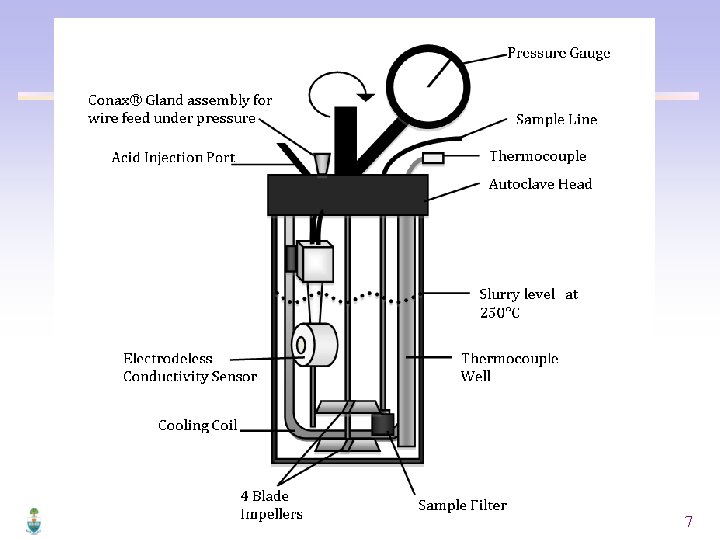
High temperature on-line acid sensor l l Many industrial chemical processes are acid driven: n Produce adequate yields – Equilibria n Reduce process times - Kinetics n Often added in excess Excess acid must be partially or completely neutralized within the process: n Cost of base addition (Ca. O – Ca. CO 3) n Waste management problem (Ca. SO 4. 2 H 2 O) Other factors: n Excess acid detrimental to equipment n Puts more impurities into solution Monitoring solution acidity is crucial to process control 3
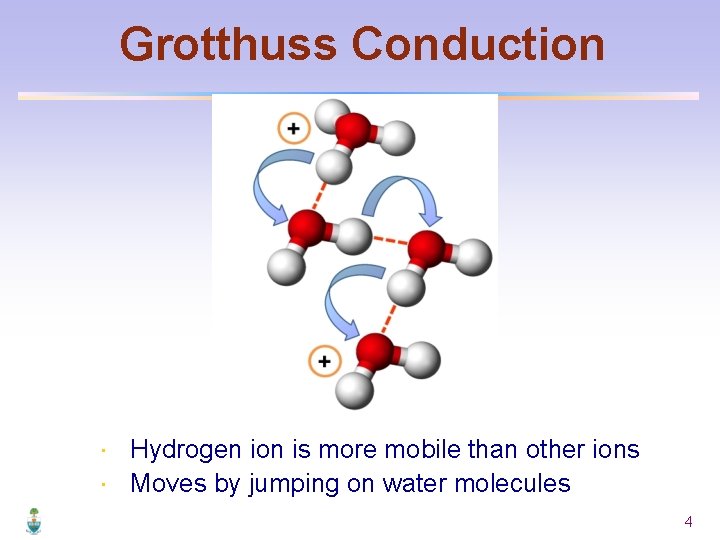
Grotthuss Conduction Hydrogen ion is more mobile than other ions Moves by jumping on water molecules 4
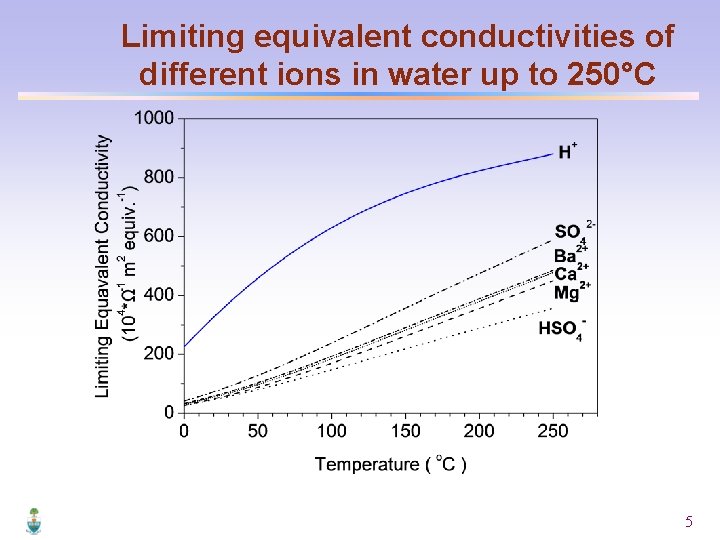
Limiting equivalent conductivities of different ions in water up to 250°C 5
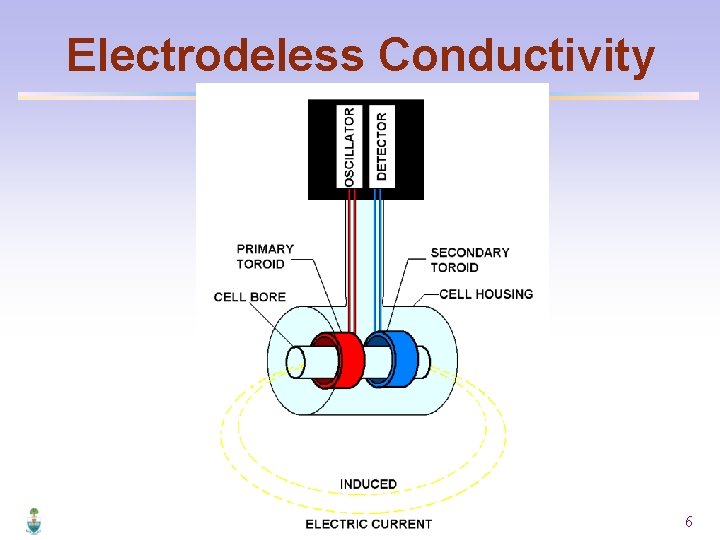
Electrodeless Conductivity 6
7
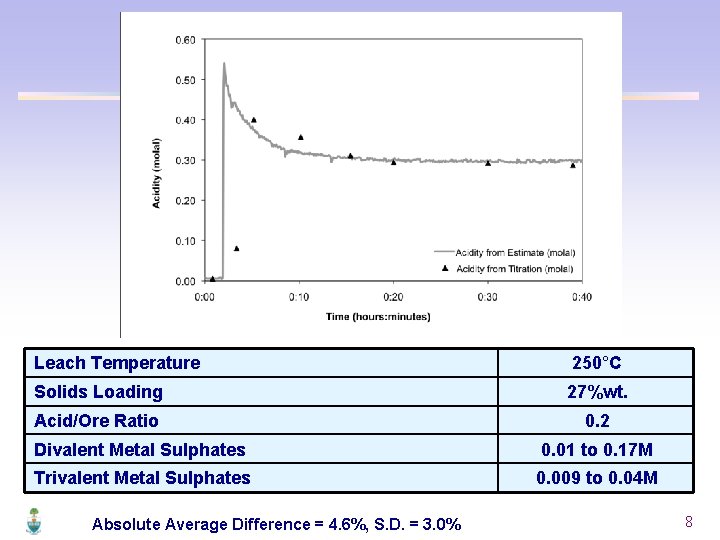
Leach Temperature 250°C Solids Loading 27%wt. Acid/Ore Ratio 0. 2 Divalent Metal Sulphates 0. 01 to 0. 17 M Trivalent Metal Sulphates 0. 009 to 0. 04 M Absolute Average Difference = 4. 6%, S. D. = 3. 0% 8
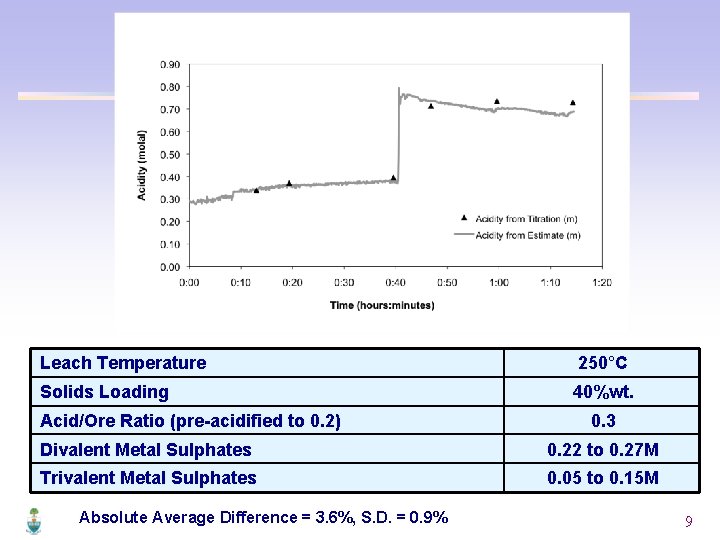
Leach Temperature 250°C Solids Loading 40%wt. Acid/Ore Ratio (pre-acidified to 0. 2) 0. 3 Divalent Metal Sulphates 0. 22 to 0. 27 M Trivalent Metal Sulphates 0. 05 to 0. 15 M Absolute Average Difference = 3. 6%, S. D. = 0. 9% 9
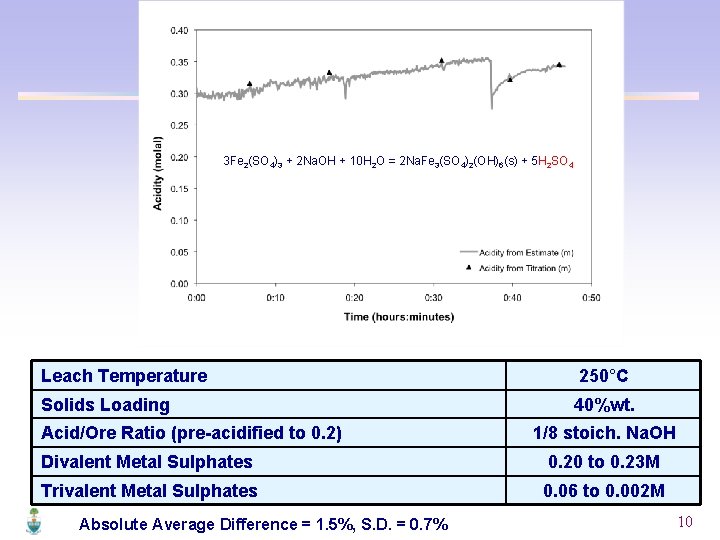
3 Fe 2(SO 4)3 + 2 Na. OH + 10 H 2 O = 2 Na. Fe 3(SO 4)2(OH)6(s) + 5 H 2 SO 4 Leach Temperature 250°C Solids Loading 40%wt. Acid/Ore Ratio (pre-acidified to 0. 2) 1/8 stoich. Na. OH Divalent Metal Sulphates 0. 20 to 0. 23 M Trivalent Metal Sulphates 0. 06 to 0. 002 M Absolute Average Difference = 1. 5%, S. D. = 0. 7% 10
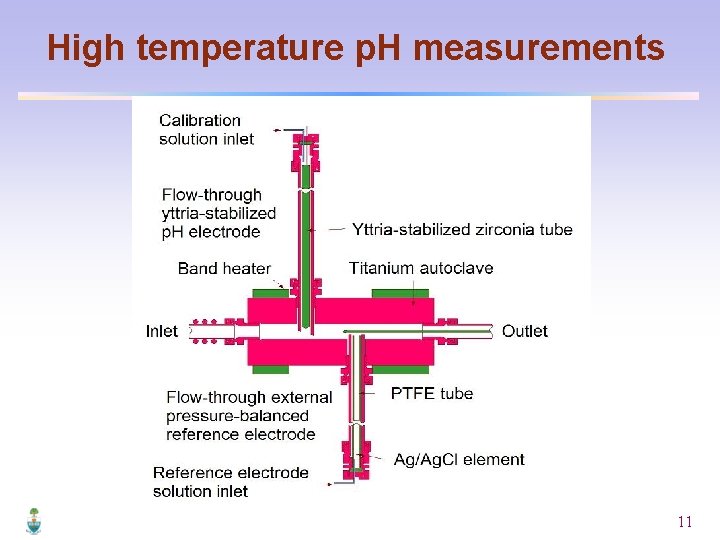
High temperature p. H measurements 11
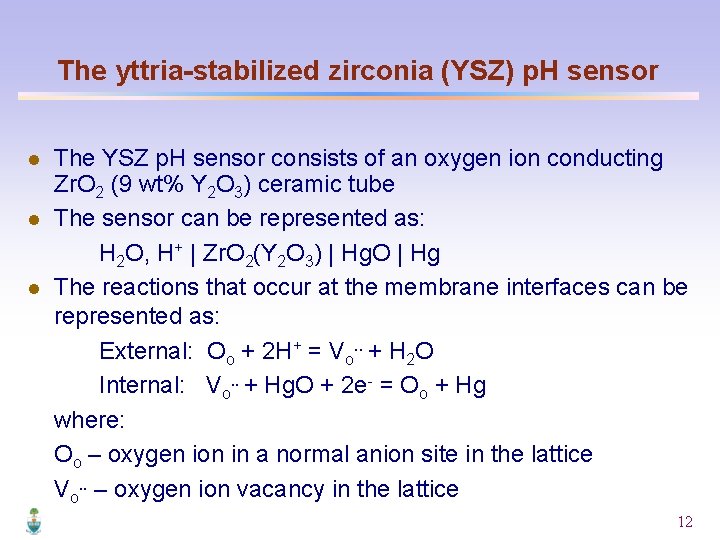
The yttria-stabilized zirconia (YSZ) p. H sensor l l l The YSZ p. H sensor consists of an oxygen ion conducting Zr. O 2 (9 wt% Y 2 O 3) ceramic tube The sensor can be represented as: H 2 O, H+ | Zr. O 2(Y 2 O 3) | Hg. O | Hg The reactions that occur at the membrane interfaces can be represented as: External: Oo + 2 H+ = Vo. . + H 2 O Internal: Vo. . + Hg. O + 2 e- = Oo + Hg where: Oo – oxygen ion in a normal anion site in the lattice Vo. . – oxygen ion vacancy in the lattice 12
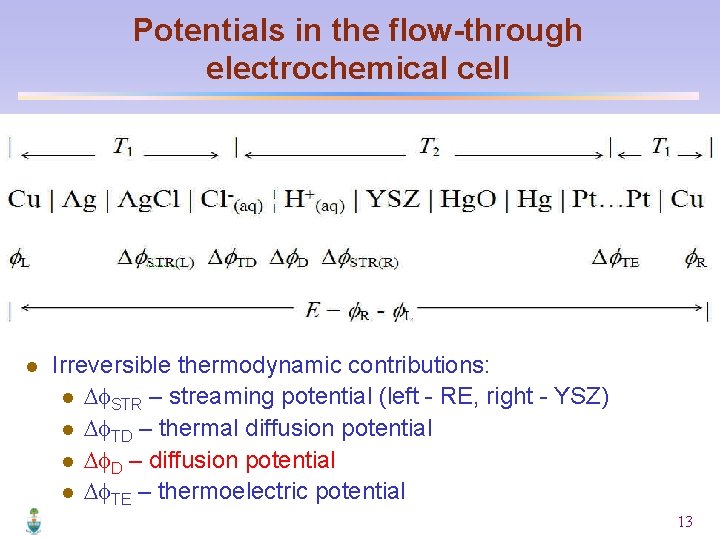
Potentials in the flow-through electrochemical cell l Irreversible thermodynamic contributions: l Df. STR – streaming potential (left - RE, right - YSZ) l Df. TD – thermal diffusion potential l Df. D – diffusion potential l Df. TE – thermoelectric potential 13

Calculation of the diffusion potential (Henderson equation) l l l (A) – acidic solution (B) – reference electrode solution (i) – ith ionic species l – ionic conductivity, taken from OLI Systems software z – valence m – molality, taken from OLI Systems software 14
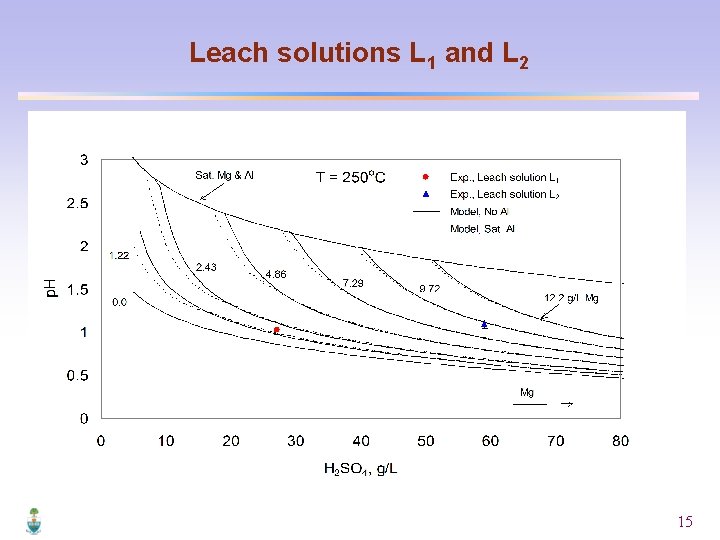
Leach solutions L 1 and L 2 15
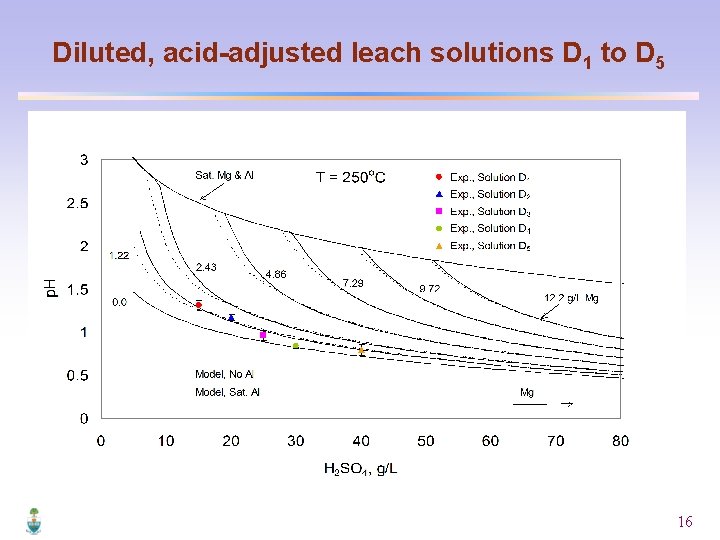
Diluted, acid-adjusted leach solutions D 1 to D 5 16
![Prediction of [H 2 SO 4]25 C to attain p. HT=1 based on [Mg](http://slidetodoc.com/presentation_image_h/170df4ede2928305462fddee79ce9435/image-18.jpg "Prediction of [H 2 SO 4]25 C to attain p. HT=1 based on [Mg")
Prediction of [H 2 SO 4]25 C to attain p. HT=1 based on [Mg 2+]25 C and [Ni 2+]25 C 17
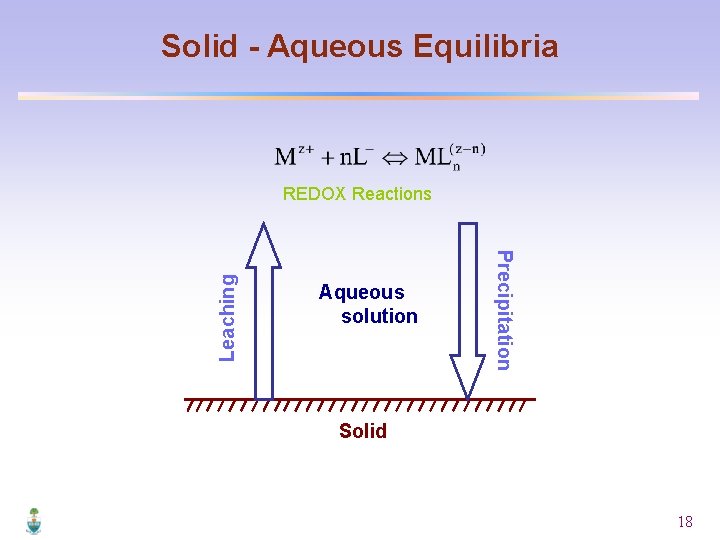
Solid - Aqueous Equilibria Aqueous solution Precipitation Leaching REDOX Reactions Solid 18
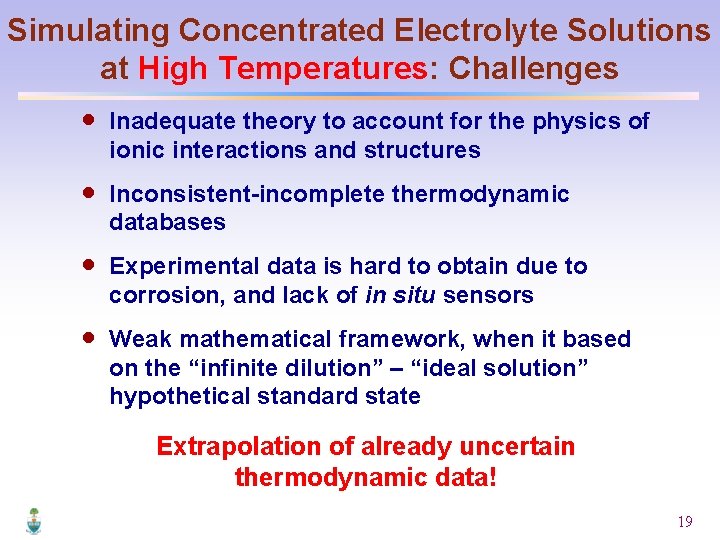
Simulating Concentrated Electrolyte Solutions at High Temperatures: Challenges · Inadequate theory to account for the physics of ionic interactions and structures · Inconsistent-incomplete thermodynamic databases · Experimental data is hard to obtain due to corrosion, and lack of in situ sensors · Weak mathematical framework, when it based on the “infinite dilution” – “ideal solution” hypothetical standard state Extrapolation of already uncertain thermodynamic data! 19
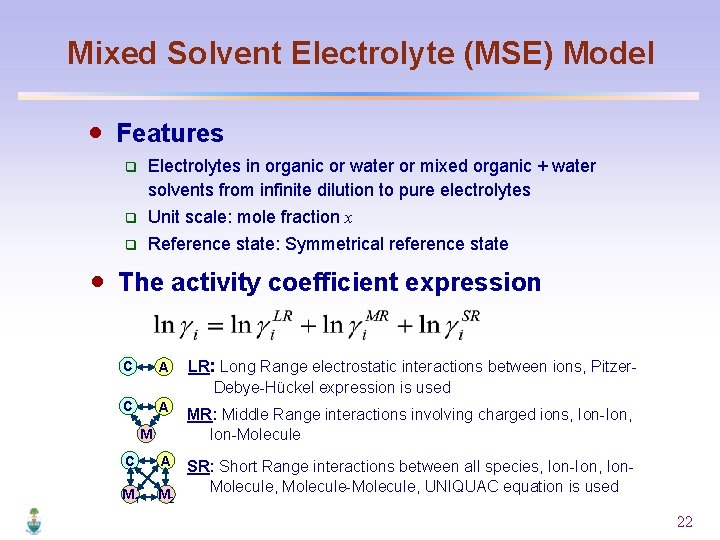
Mixed Solvent Electrolyte (MSE) Model · Features q Electrolytes in organic or water or mixed organic + water solvents from infinite dilution to pure electrolytes Unit scale: mole fraction x q Reference state: Symmetrical reference state q · The activity coefficient expression C A LR: Long Range electrostatic interactions between ions, Pitzer. Debye-Hückel expression is used C A MR: Middle Range interactions involving charged ions, Ion-Ion, Ion-Molecule C A M 1 M 2 SR: Short Range interactions between all species, Ion-Ion, Ion. Molecule, Molecule-Molecule, UNIQUAC equation is used M 22
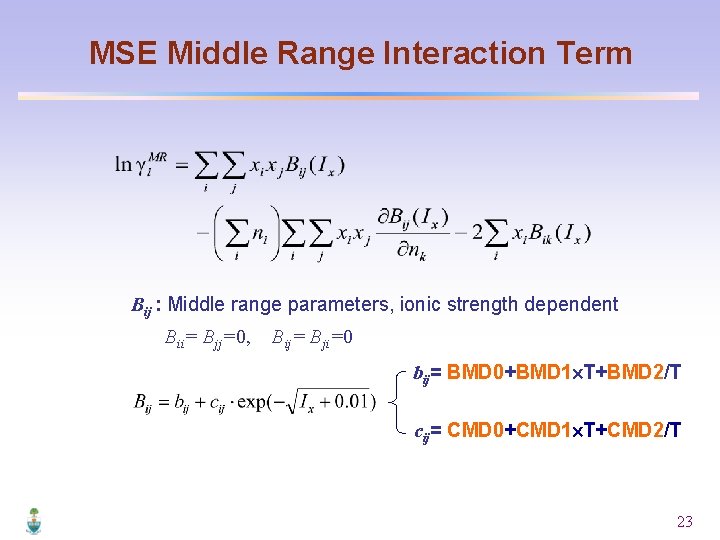
MSE Middle Range Interaction Term Bij : Middle range parameters, ionic strength dependent Bii= Bjj=0, Bij= Bji=0 bij= BMD 0+BMD 1 T+BMD 2/T cij= CMD 0+CMD 1 T+CMD 2/T 23
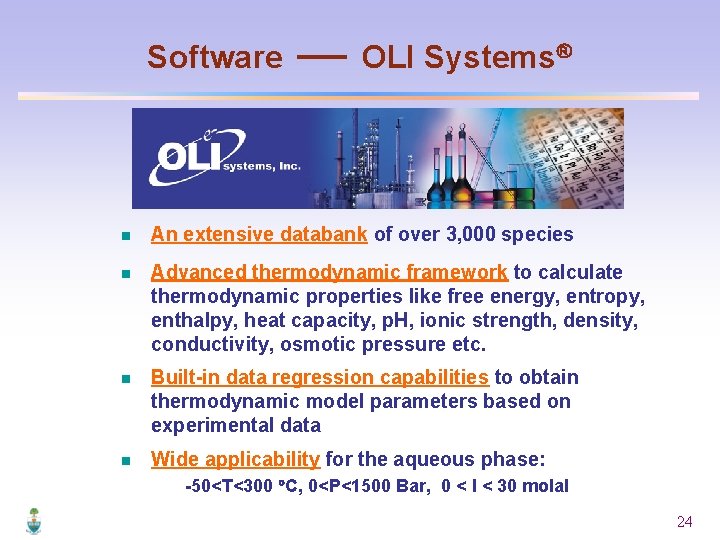
Software OLI Systems n An extensive databank of over 3, 000 species n Advanced thermodynamic framework to calculate thermodynamic properties like free energy, entropy, enthalpy, heat capacity, p. H, ionic strength, density, conductivity, osmotic pressure etc. n Built-in data regression capabilities to obtain thermodynamic model parameters based on experimental data n Wide applicability for the aqueous phase: -50<T<300 C, 0<P<1500 Bar, 0 < I < 30 molal 24
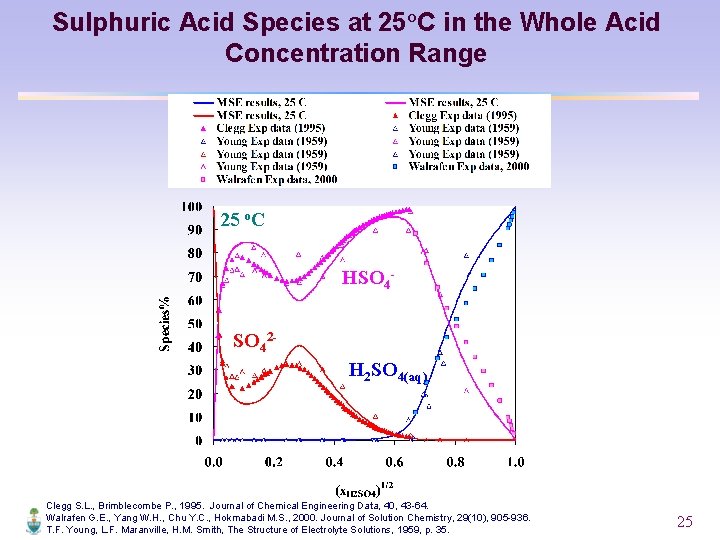
Sulphuric Acid Species at 25°C in the Whole Acid Concentration Range 25 o. C HSO 42 H 2 SO 4(aq) Clegg S. L. , Brimblecombe P. , 1995. Journal of Chemical Engineering Data, 40, 43 -64. Walrafen G. E. , Yang W. H. , Chu Y. C. , Hokmabadi M. S. , 2000. Journal of Solution Chemistry, 29(10), 905 -936. T. F. Young, L. F. Maranville, H. M. Smith, The Structure of Electrolyte Solutions, 1959, p. 35. 25

MSE model prediction of sulphuric acid species vs. temperature in H 2 SO 4 -Na. Cl-H 2 O system Dickson A. G. , Wesolowski D. J. , Palmer D. A. , Mesmer R. E. , 1990. Dissociation Constant of Bisulfate Ion in Aqueous Sodium Chloride Solutions to 250°C. J. of Phys. Chemistry, 94, 7978 -7985. 26
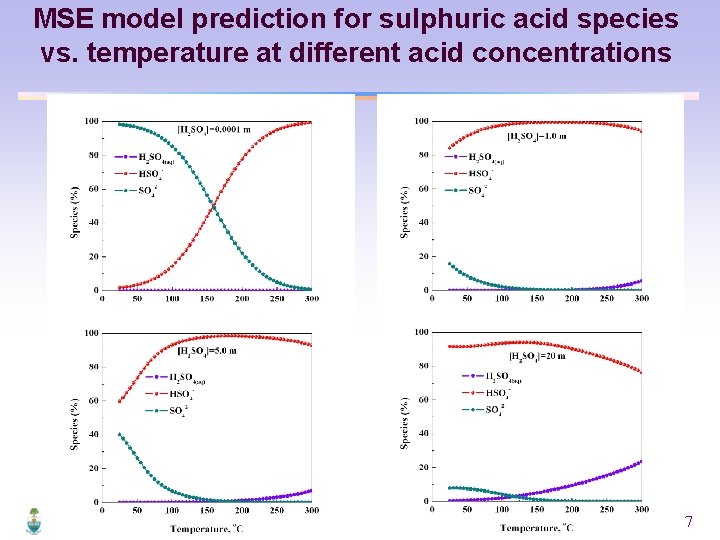
MSE model prediction for sulphuric acid species vs. temperature at different acid concentrations 27

Anhydrite Solubility in PAL Solutions vs. Ni. SO 4 concentration from 150 to 200°C 28
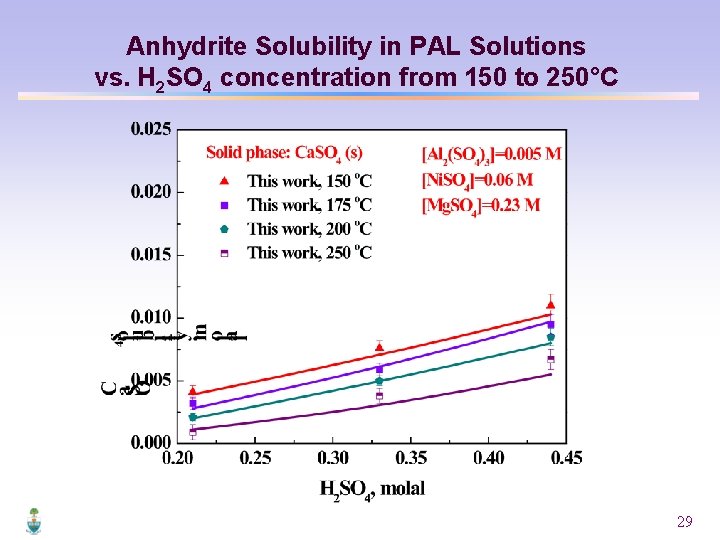
Anhydrite Solubility in PAL Solutions vs. H 2 SO 4 concentration from 150 to 250°C 29

Prediction of anhydrite solubility in different electrolyte solutions: Scaling potential 30
Conclusions · New sensors have been developed for stoichiometric acid and p. H measurements as in multicomponent systems at high temperatures · Application of thermodynamics is becoming an essential tool in industrial process design and development · OLI Systems offer the best available software for chemical modelling of both low and high temperature industrial processes · Proprietary databanks have been developed at the Uof. T and are growing for applications in hydrometallurgy 31
Acknowledgments Anglo American plc Barrick Gold Corporation Norilsk Nickel Sherritt International Corporation Vale Inco Ltd. 32
- Slides: 31