
Pressure Switch for Corrosive Ultrapure Liquids Series SWT

- Slides: 17
Pressure Switch for Corrosive & Ultra-pure Liquids • Series SWT Product Education Course
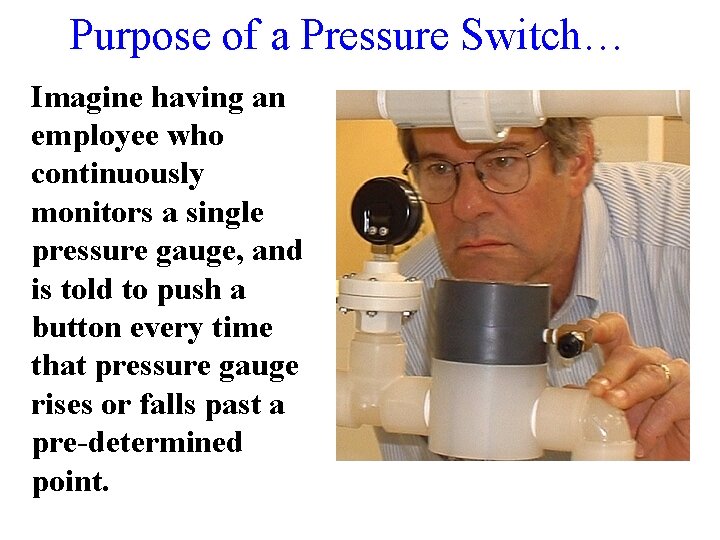
Purpose of a Pressure Switch… Imagine having an employee who continuously monitors a single pressure gauge, and is told to push a button every time that pressure gauge rises or falls past a pre-determined point.
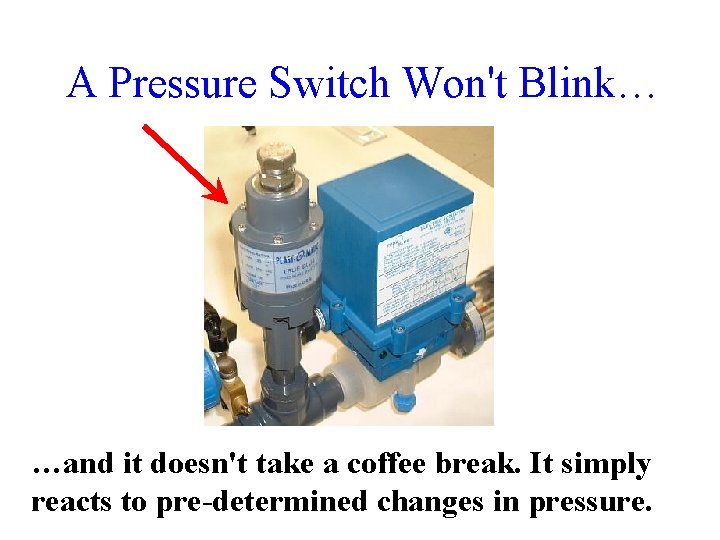
A Pressure Switch Won't Blink… …and it doesn't take a coffee break. It simply reacts to pre-determined changes in pressure.
Uses of a Pressure Switch: 1. As a control element, to actuate a pump, valve or other control device, when pressure rises or falls to a set point in a liquid piping system. 2. As a safety device, to signal an alarm if pressure exceeds a dangerous high or low. 3. As a sensor, to signal a counter, computer program, or other recording mechanism.
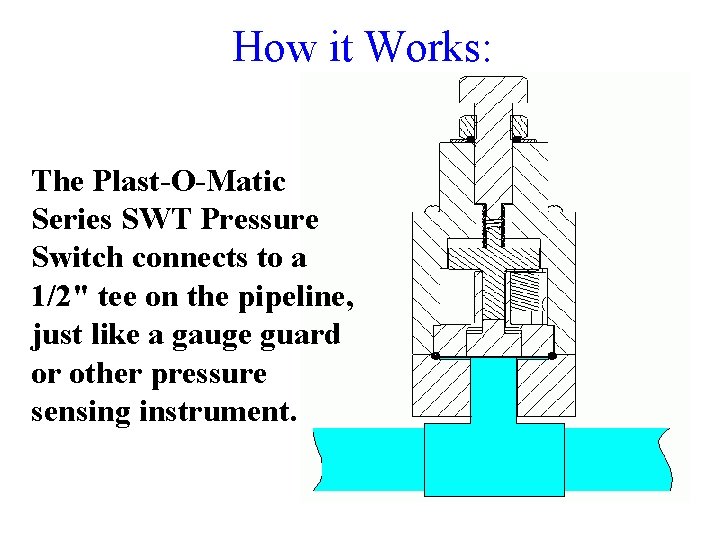
How it Works: The Plast-O-Matic Series SWT Pressure Switch connects to a 1/2" tee on the pipeline, just like a gauge guard or other pressure sensing instrument.
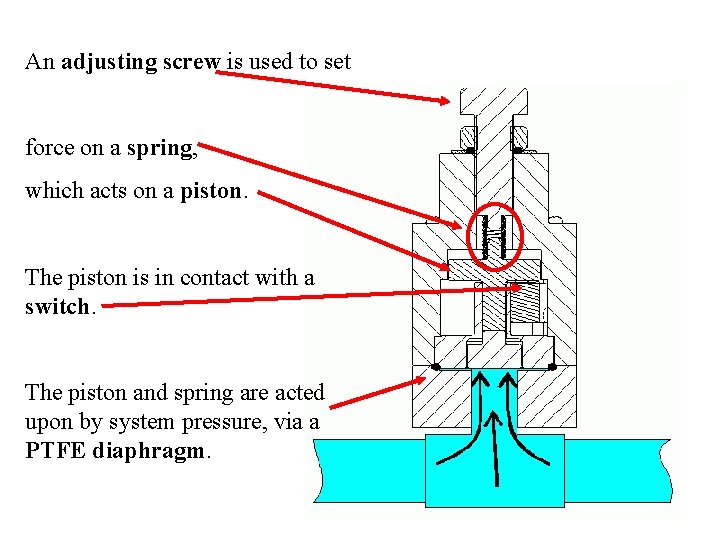
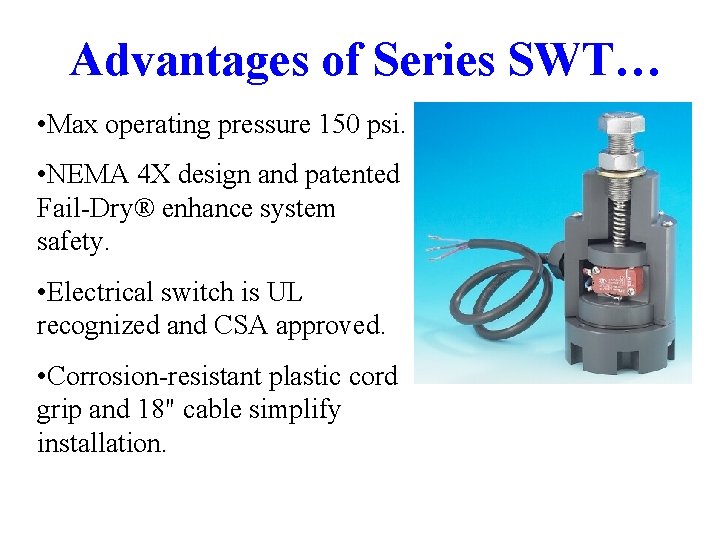
An adjusting screw is used to set force on a spring, which acts on a piston. The piston is in contact with a switch. The piston and spring are acted upon by system pressure, via a PTFE diaphragm.
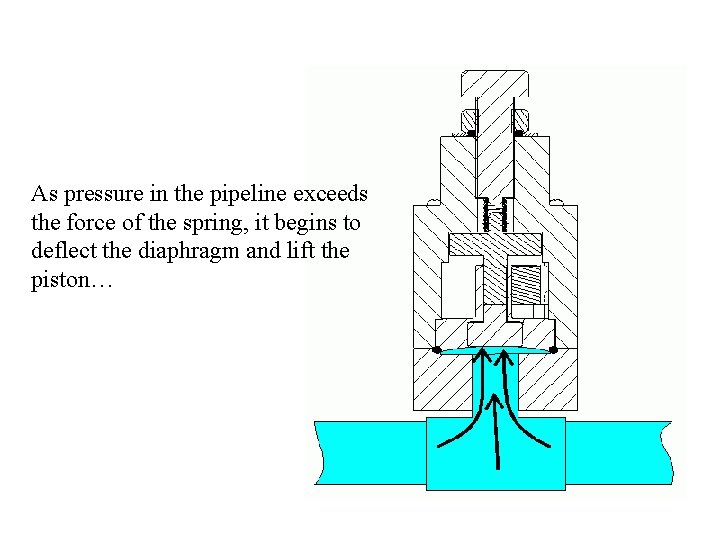
As pressure in the pipeline exceeds the force of the spring, it begins to deflect the diaphragm and lift the piston…
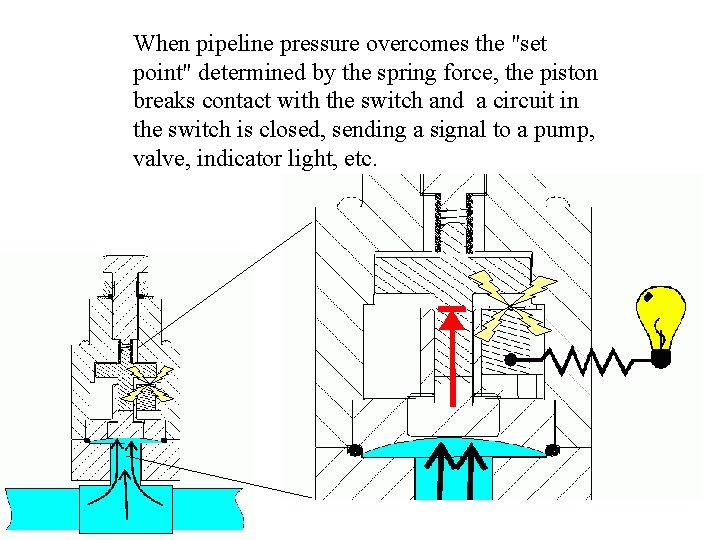
When pipeline pressure overcomes the "set point" determined by the spring force, the piston breaks contact with the switch and a circuit in the switch is closed, sending a signal to a pump, valve, indicator light, etc.
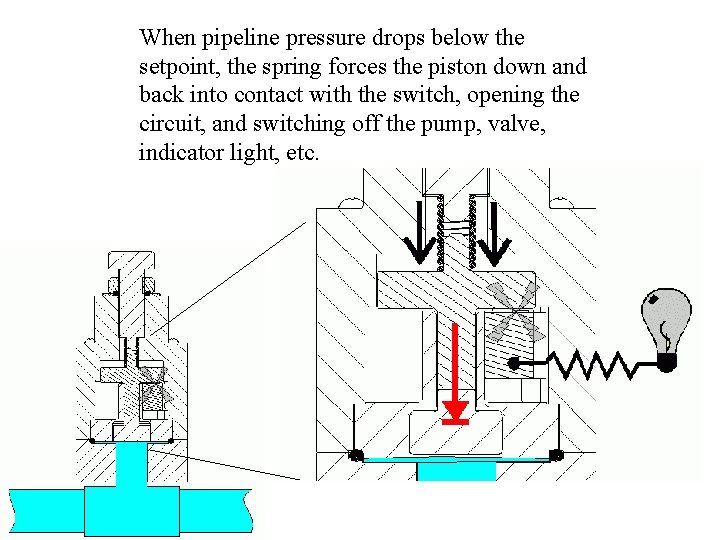
When pipeline pressure drops below the setpoint, the spring forces the piston down and back into contact with the switch, opening the circuit, and switching off the pump, valve, indicator light, etc.
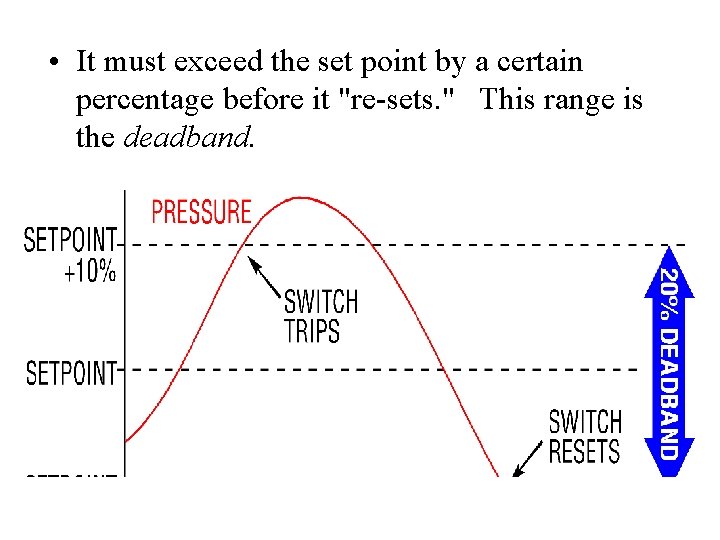
BUT the Switch doesn’t re-set immediately at the set point… Friction, mechanical play in the switch mechanism, inertia of moving parts, energy lost in the spring as the spring actuates, and other physical forces result in deadband, also called hysteresis. Deadband is the difference between the switch actuation pressure when pressure is rising, and actual switch de-actuation pressure when the pressure is falling.
• It must exceed the set point by a certain percentage before it "re-sets. " This range is the deadband.
Deadband (or hysteresis) is NOT a negative. . . • Without hysteresis, the switch would quickly end up "hunting. " In other words, if actuation and deactuation pressures were the same, the switch would bounce back and forth, not knowing if the pressure is too high or too low. Soon the pump or valve would be turned on, off, on, off…the system would be pulsating, pressure would oscillate…chaos would ensue.
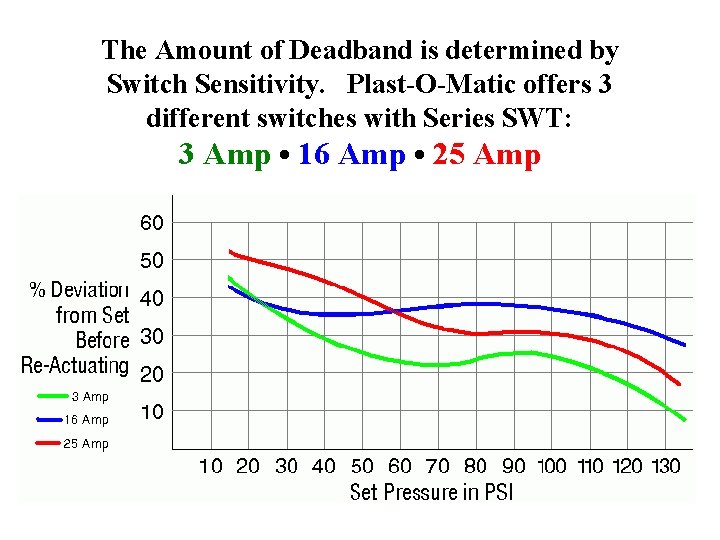
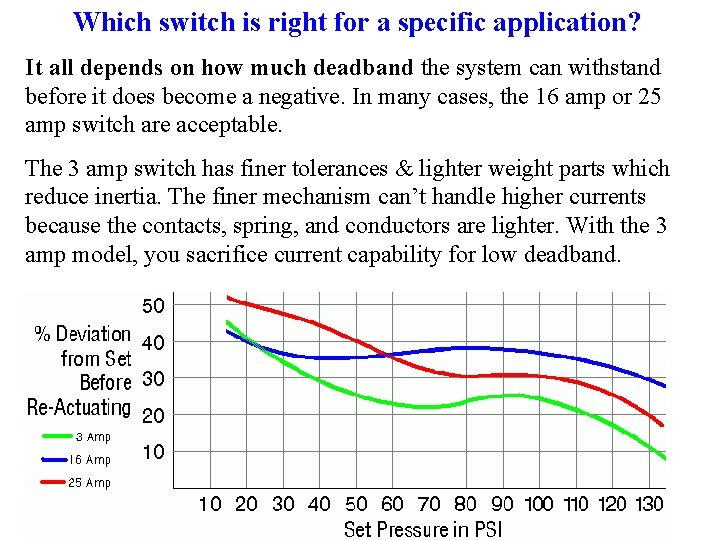
The Amount of Deadband is determined by Switch Sensitivity. Plast-O-Matic offers 3 different switches with Series SWT: 3 Amp • 16 Amp • 25 Amp
Which switch is right for a specific application? It all depends on how much deadband the system can withstand before it does become a negative. In many cases, the 16 amp or 25 amp switch are acceptable. The 3 amp switch has finer tolerances & lighter weight parts which reduce inertia. The finer mechanism can’t handle higher currents because the contacts, spring, and conductors are lighter. With the 3 amp model, you sacrifice current capability for low deadband.
Advantages of Series SWT… • Max operating pressure 150 psi. • NEMA 4 X design and patented Fail-Dry® enhance system safety. • Electrical switch is UL recognized and CSA approved. • Corrosion-resistant plastic cord grip and 18" cable simplify installation.
Advantages, continued… • Better piston design and piston guidance vs. competition enhances reliability and accuracy. • Tested to 1, 000 cycles in laboratory conditions. • PTFE diaphragm with no wetted metals or elastomers ideal for ultra-pure liquids -- No Gauge Guard required!
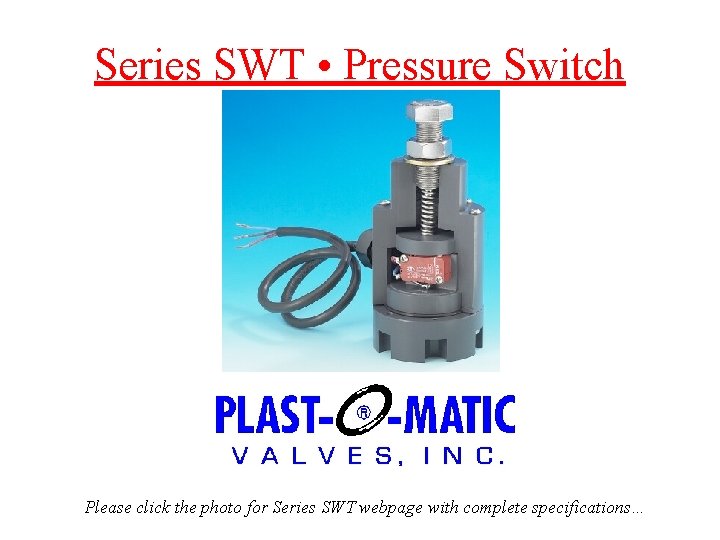
Series SWT • Pressure Switch Please click the photo for Series SWT webpage with complete specifications…