
Pressure on Solids Learning objectives Calculate the pressure
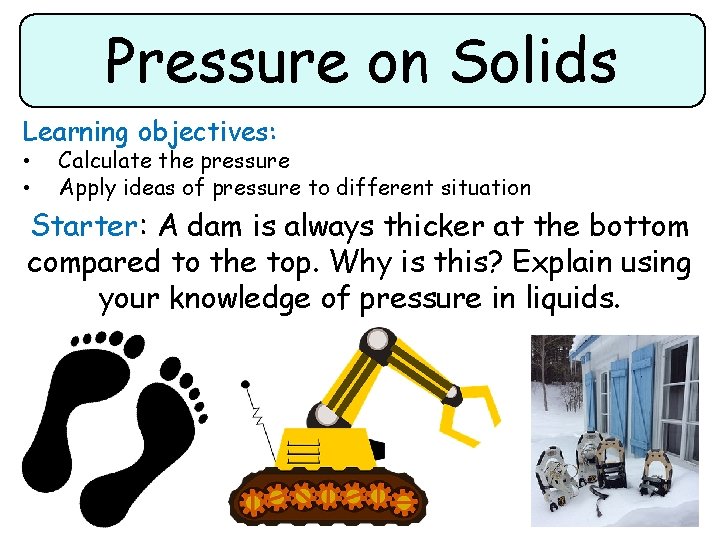
Pressure on Solids Learning objectives: • • Calculate the pressure Apply ideas of pressure to different situation Starter: A dam is always thicker at the bottom compared to the top. Why is this? Explain using your knowledge of pressure in liquids.
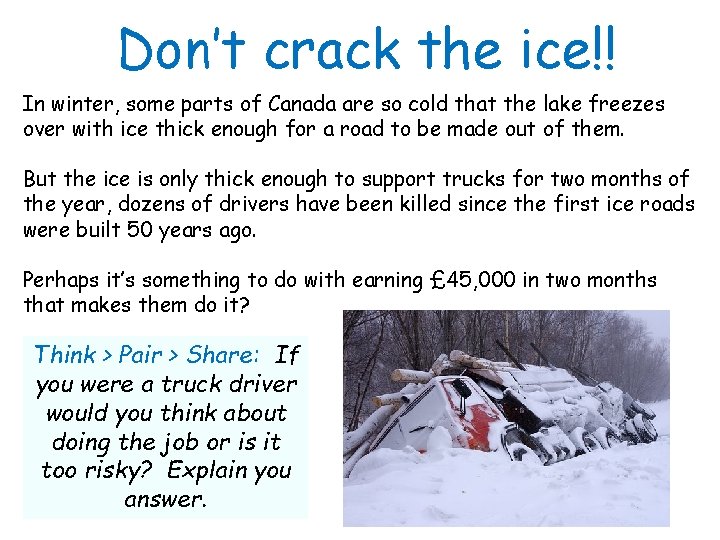
Don’t crack the ice!! In winter, some parts of Canada are so cold that the lake freezes over with ice thick enough for a road to be made out of them. But the ice is only thick enough to support trucks for two months of the year, dozens of drivers have been killed since the first ice roads were built 50 years ago. Perhaps it’s something to do with earning £ 45, 000 in two months that makes them do it? Think > Pair > Share: If you were a truck driver would you think about doing the job or is it too risky? Explain you answer.
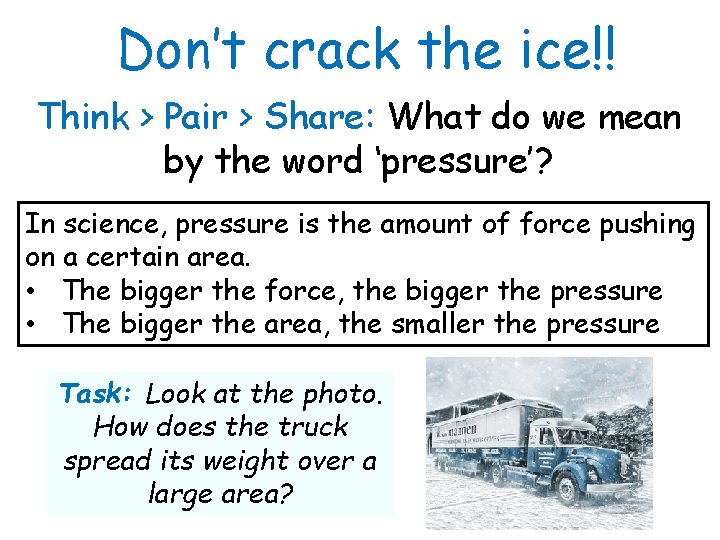
Don’t crack the ice!! Think > Pair > Share: What do we mean by the word ‘pressure’? In science, pressure is the amount of force pushing on a certain area. • The bigger the force, the bigger the pressure • The bigger the area, the smaller the pressure Task: Look at the photo. How does the truck spread its weight over a large area?
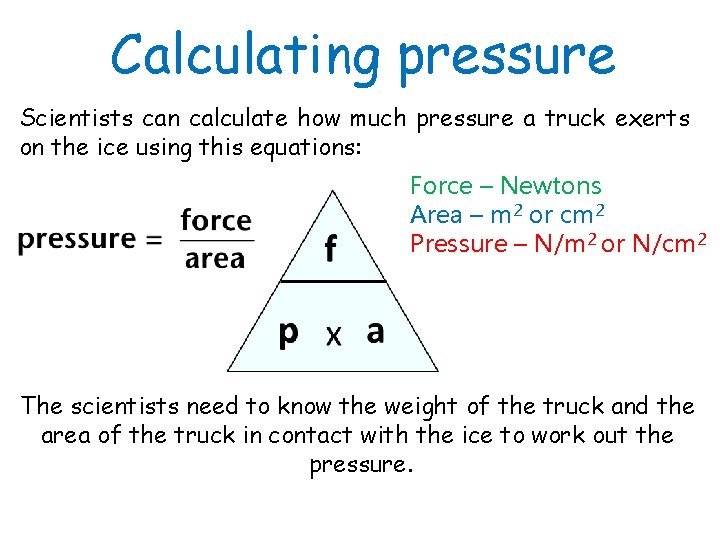
Calculating pressure Scientists can calculate how much pressure a truck exerts on the ice using this equations: Force – Newtons Area – m 2 or cm 2 Pressure – N/m 2 or N/cm 2 The scientists need to know the weight of the truck and the area of the truck in contact with the ice to work out the pressure.
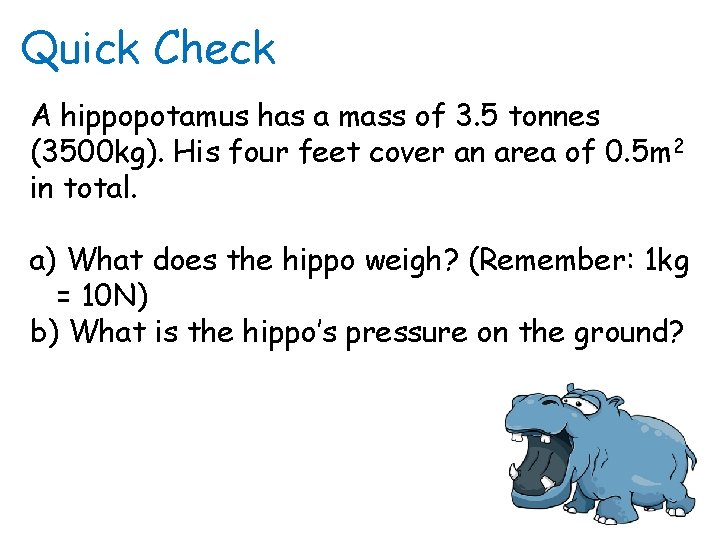
Quick Check A hippopotamus has a mass of 3. 5 tonnes (3500 kg). His four feet cover an area of 0. 5 m 2 in total. a) What does the hippo weigh? (Remember: 1 kg = 10 N) b) What is the hippo’s pressure on the ground?
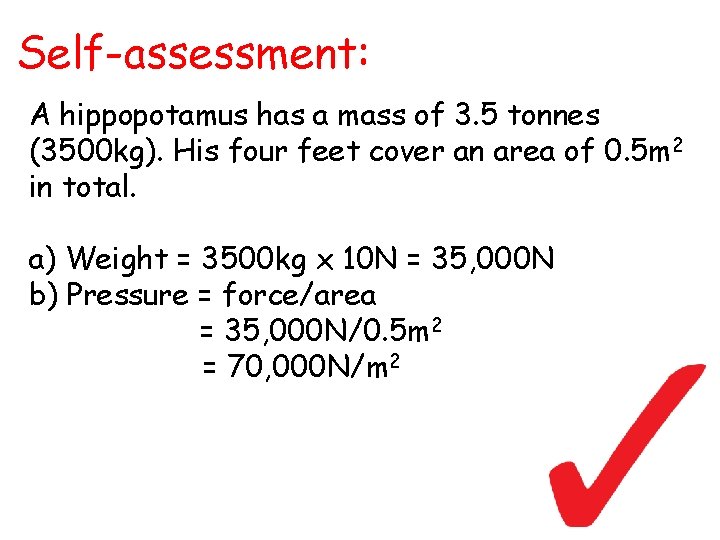
Self-assessment: A hippopotamus has a mass of 3. 5 tonnes (3500 kg). His four feet cover an area of 0. 5 m 2 in total. a) Weight = 3500 kg x 10 N = 35, 000 N b) Pressure = force/area = 35, 000 N/0. 5 m 2 = 70, 000 N/m 2
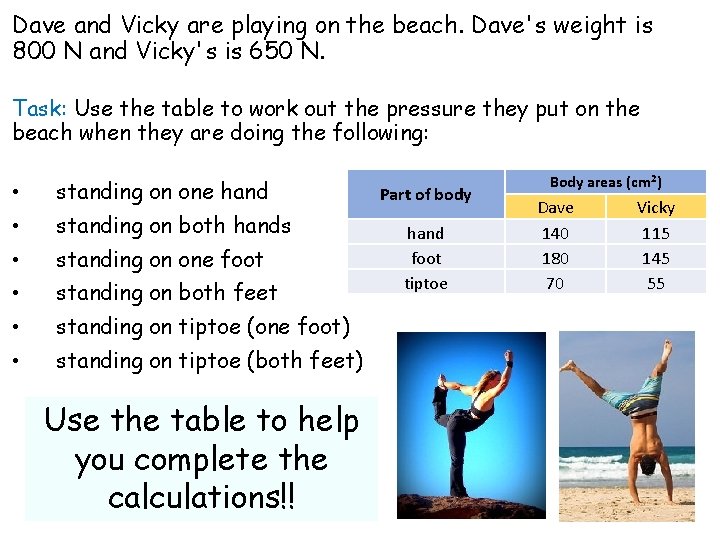
Dave and Vicky are playing on the beach. Dave's weight is 800 N and Vicky's is 650 N. Task: Use the table to work out the pressure they put on the beach when they are doing the following: • standing on one hand • standing on both hands • standing on one foot • standing on both feet • standing on tiptoe (one foot) • standing on tiptoe (both feet) Use the table to help you complete the calculations!! Part of body hand foot tiptoe Body areas (cm 2) Dave 140 180 70 Vicky 115 145 55
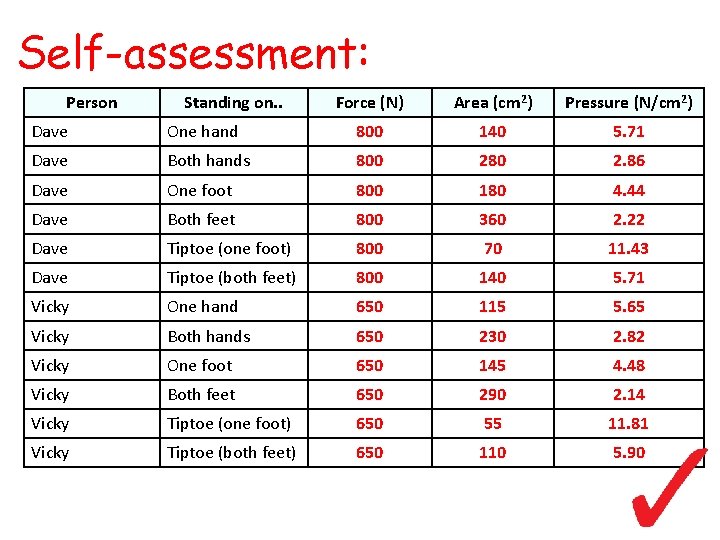
Self-assessment: Person Standing on. . Force (N) Area (cm 2) Pressure (N/cm 2) Dave One hand 800 140 5. 71 Dave Both hands 800 280 2. 86 Dave One foot 800 180 4. 44 Dave Both feet 800 360 2. 22 Dave Tiptoe (one foot) 800 70 11. 43 Dave Tiptoe (both feet) 800 140 5. 71 Vicky One hand 650 115 5. 65 Vicky Both hands 650 230 2. 82 Vicky One foot 650 145 4. 48 Vicky Both feet 650 290 2. 14 Vicky Tiptoe (one foot) 650 55 11. 81 Vicky Tiptoe (both feet) 650 110 5. 90
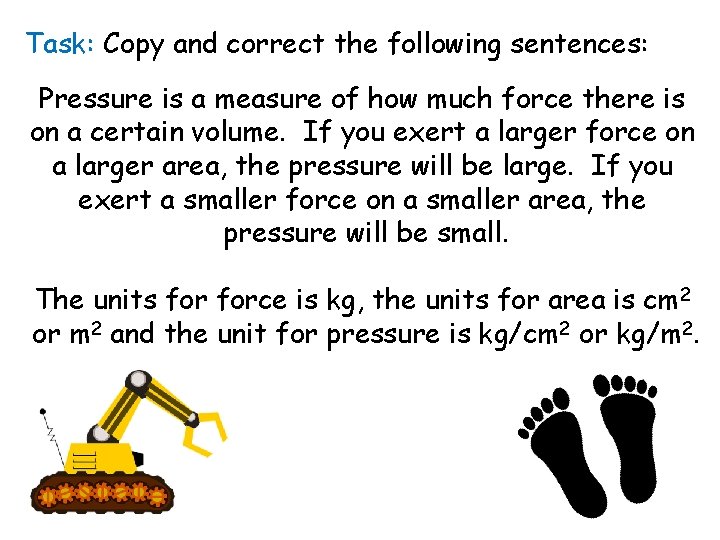
Task: Copy and correct the following sentences: Pressure is a measure of how much force there is on a certain volume. If you exert a larger force on a larger area, the pressure will be large. If you exert a smaller force on a smaller area, the pressure will be small. The units force is kg, the units for area is cm 2 or m 2 and the unit for pressure is kg/cm 2 or kg/m 2.
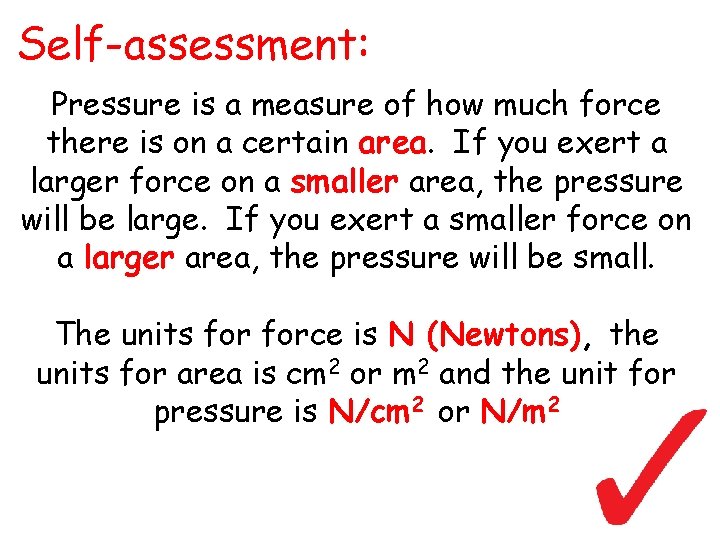
Self-assessment: Pressure is a measure of how much force there is on a certain area. If you exert a larger force on a smaller area, the pressure will be large. If you exert a smaller force on a larger area, the pressure will be small. The units force is N (Newtons), the units for area is cm 2 or m 2 and the unit for pressure is N/cm 2 or N/m 2
- Slides: 10