
Pressure of a gas Kinetic theory of gases


- Slides: 9
Pressure of a gas
Kinetic theory of gases • The particles of a gas are in constant rapid random motion • The forces between the particles is negligible • The particles collide with each other and with the walls of the container. All the collisions are perfectly elastic. (no kinetic energy is lost) • The time for the collisions is negligible compared to the time between collisions • The volume of the particles is negligible compared to the volume of the gas
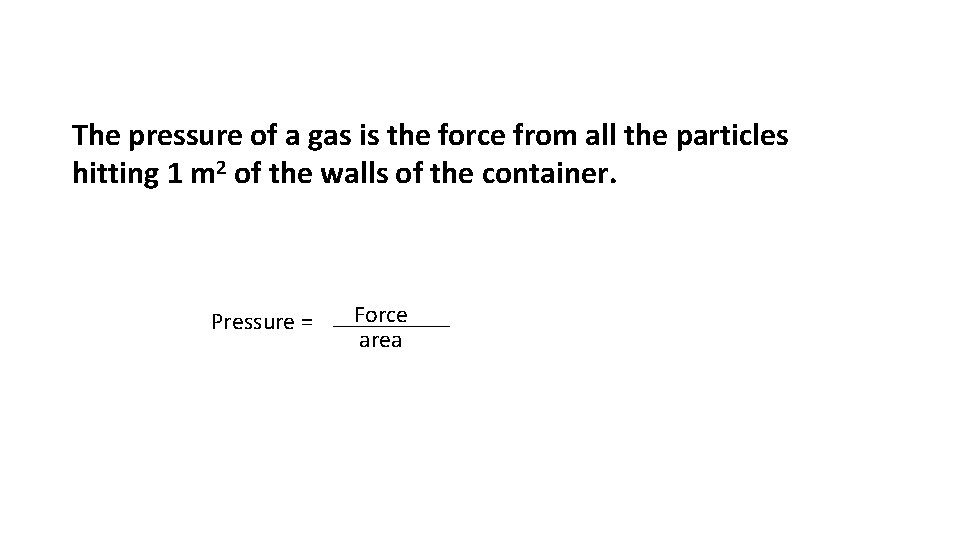
The pressure of a gas is the force from all the particles hitting 1 m 2 of the walls of the container. Pressure = Force _______ area
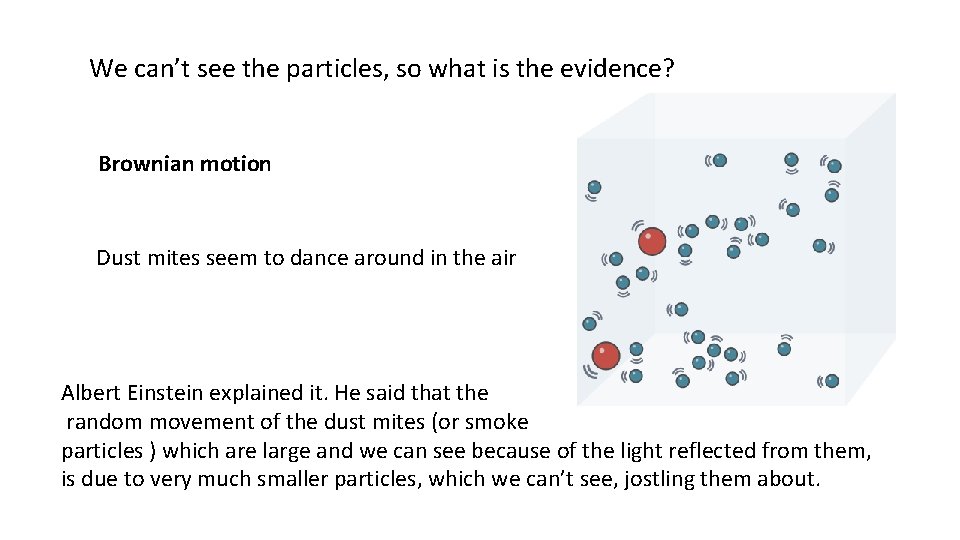
We can’t see the particles, so what is the evidence? Brownian motion Dust mites seem to dance around in the air Albert Einstein explained it. He said that the random movement of the dust mites (or smoke particles ) which are large and we can see because of the light reflected from them, is due to very much smaller particles, which we can’t see, jostling them about.
https: //www. youtube. com/watch? v=UDj 7 BXA 1 CHU
What happens if we raise the temperature of a gas but keep the volume the same http: //www. passmyexams. co. uk/GCSE/physics/pressuretemperature-relationship-of-gas-pressure-law. html
Because the temperature increases the average kinetic energy of the particles, they hit the walls of the container harder and more often and so the pressure increases Draw a graph of pressure and temperature (⁰C)
https: //www. youtube. com/watch? v=s. Ebx. Lr. P_ZCU
The experimenter says ‘it makes the molecules contract’ What is wrong with this statement?