
Pressure Injury Risk Awareness Training RAT Presented by
Pressure Injury Risk Awareness Training (RAT) Presented by: The Virginia Department of Behavioral Health and Developmental Services The Office of Integrated Health Supports Network 1
DSP's and caregivers- you will learn important risk factors associated with pressure injuries, learn to recognize signs and symptoms, and the importance of reporting. Who benefits from this training? Support Coordinators-you will learn important risk factors associated with pressure injuries, understand the signs and symptoms that DSP's and caregivers are going to recognize and provide in documentation, and learn diagnosis that may be associated with risk factors. 2

Objectives 1. Define Pressure Injury 2. Identify (3) risk factors for pressure injuries. 3. State (4) signs/symptoms of a pressure injury. 4. Identify the importance of changes in skin. 5. State (4) treatments for pressure injury. 6. List (4) prevention strategies for pressure injuries. 7. Identify (2) professional sources for help with pressure injuries. 3
What is a pressure injury? A pressure injury to the skin is a result of constant pressure due to impaired mobility. The pressure results in reduced blood flow and eventually causes cell death, skin breakdown, and the development of and open wound. Pressure injury can occur in persons who are wheelchair bound or bed-bound, sometimes even after a short time (2 to 6 hours). If the conditions leading to the pressure injury are not rapidly corrected, the localized skin damage will spread to deeper tissue layers affecting muscle, tendon, and bone. Common sites include the sacrum (tailbone), back, buttocks, heels, back of the head, and elbows. If not adequately treated, open ulcers can become a source of pain, disability, and infection. (Zeller, Lynm, & Glass, 2006) 4

Risk factors for pressure injury • • Shearing and friction Moisture Decreased movement Decreased sensation Circulatory problems Poor nutrition Age (Harvard Health Publishing, 2020) 5

Common sites of Pressure Injury Any part of the body can develop pressure injuries, but most at risk are parts overlying a bony prominence. 6
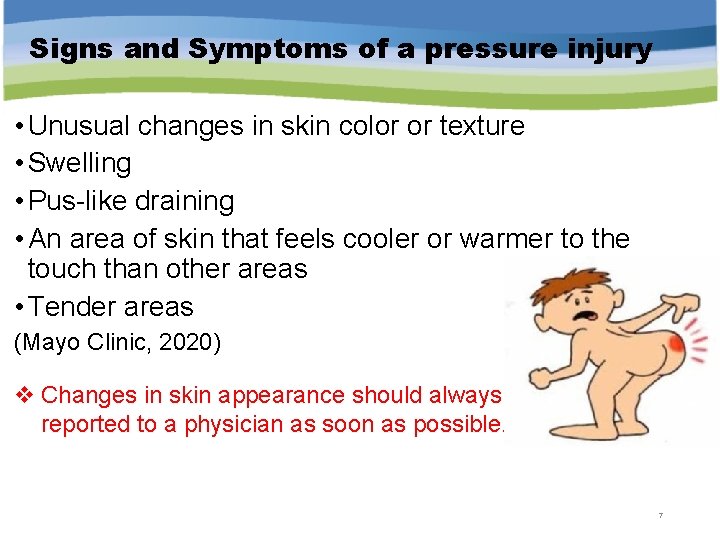
Signs and Symptoms of a pressure injury • Unusual changes in skin color or texture • Swelling • Pus-like draining • An area of skin that feels cooler or warmer to the touch than other areas • Tender areas (Mayo Clinic, 2020) v Changes in skin appearance should always be reported to a physician as soon as possible. 7

How pressure injuries are diagnosed ? Pressure injury identification is supported by a variety of assessment tools. These tools include skin visualization techniques and risk assessment tools (Borzdynski, Mc. Guiness and Miller, 2015). v The Braden Scale for Predicting Pressure Ulcer Risk, is a tool that was developed in 1987 by Barbara Braden and Nancy Bergstrom. The purpose of the scale is to help health professionals, especially nurses, assess a patient's risk of developing a pressure ulcer. v The Norton risk-assessment scale which was published in 1962 as the first mean of evaluating pressure ulcers risk. The scale is used in the evaluation of pressure injury risk based on factors such as mobility or physical condition. Healthcare professionals who can stage a PI include physicians, nurses and board-certified wound specialists. (Board certified wound specials arehealthcare professionals who have received additional training and education in order to set for a national board certification examination. (American Board of Wound Management, 2019). 8
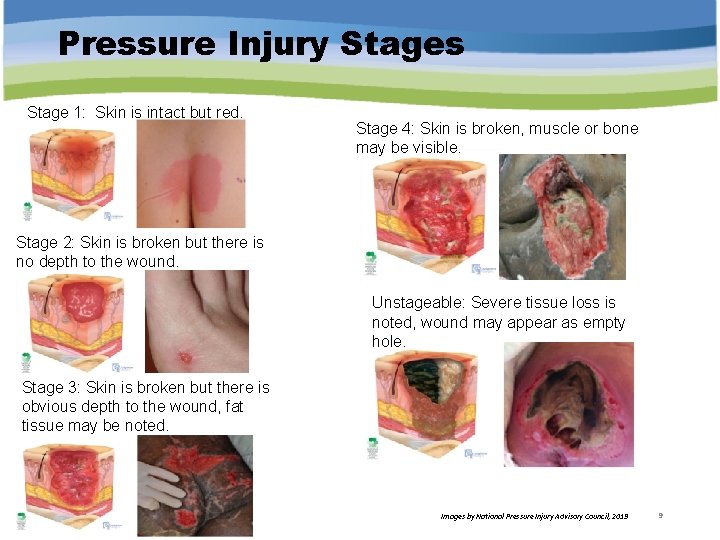
Pressure Injury Stages Stage 1: Skin is intact but red. Stage 4: Skin is broken, muscle or bone may be visible. Stage 2: Skin is broken but there is no depth to the wound. Unstageable: Severe tissue loss is noted, wound may appear as empty hole. Stage 3: Skin is broken but there is obvious depth to the wound, fat tissue may be noted. Images by National Pressure Injury Advisory Council, 2019 9
Importance of reporting change Many individuals with intellectual and developmental disabilities cannot report discomfort or pain. Being unable to reposition oneself or unable to ambulate is a risk factor for pressure injury. Evidence suggests non-verbal individuals are at a higher risk for under-treatment of pain. Identifying an individual is experiencing pain and treating it improves daily living, their ability to participate in enjoyed activities, and increases risk of depression (Lewis, 2011). Pain is a key sign of the presence of a pressure injury (Mc. Ginnis et al. , 2014) Any changes noted in color, temperature, or presence of skin breakdown should be reported immediately. To report a change contact the nurse. If nursing is not available, the individual should be taken to their PCP or an Urgent Care if issue is found on a weekend. Delay in seeking care can result in further injury and breakdown. 10
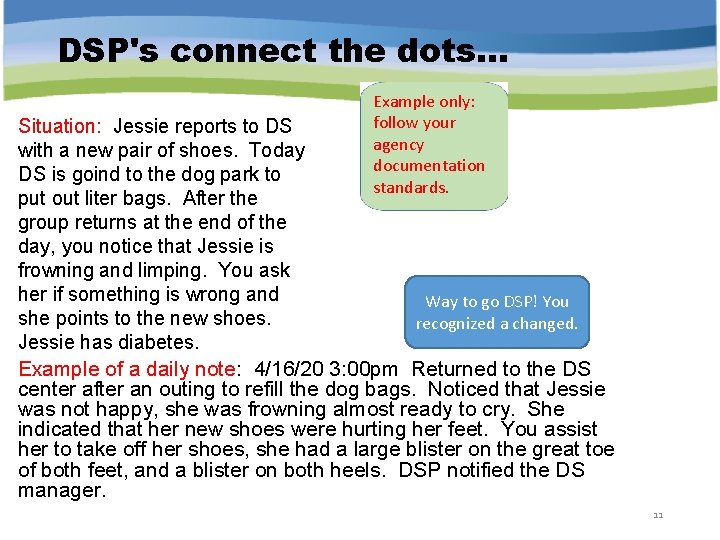
DSP's connect the dots. . . Situation: Jessie reports to DS with a new pair of shoes. Today DS is goind to the dog park to put out liter bags. After the group returns at the end of the day, you notice that Jessie is frowning and limping. You ask her if something is wrong and she points to the new shoes. Jessie has diabetes. Example only: follow your agency documentation standards. Way to go DSP! You recognized a changed. Example of a daily note: 4/16/20 3: 00 pm Returned to the DS center after an outing to refill the dog bags. Noticed that Jessie was not happy, she was frowning almost ready to cry. She indicated that her new shoes were hurting her feet. You assist her to take off her shoes, she had a large blister on the great toe of both feet, and a blister on both heels. DSP notified the DS manager. 11
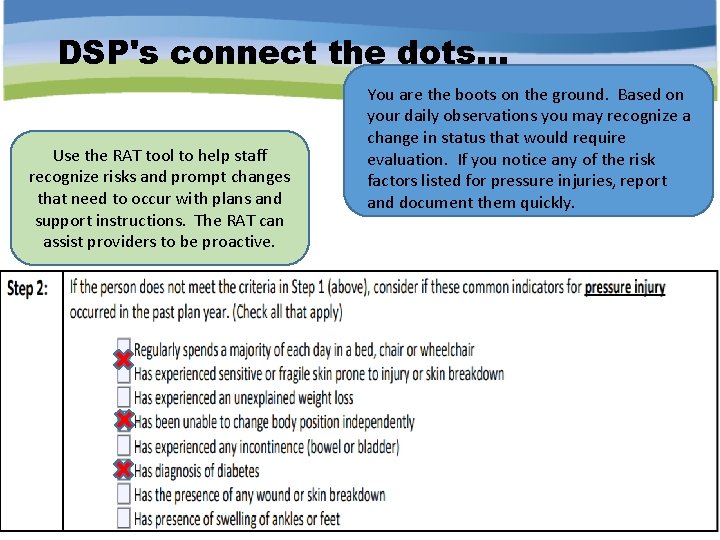
DSP's connect the dots. . . Use the RAT tool to help staff recognize risks and prompt changes that need to occur with plans and support instructions. The RAT can assist providers to be proactive. You are the boots on the ground. Based on your daily observations you may recognize a change in status that would require evaluation. If you notice any of the risk factors listed for pressure injuries, report and document them quickly. 12
Treatment begins with a physician and possible referral to a wound specialist. Each situation will be assessed individualized strategies implemented. Treatments for Pressure injury v Identify the source of pressure. Minimize pressure by utilizing wedges, frequent turning, and repositioning ever 2 hours. v. Minimize shear and friction to reduce the damage to tissue. v. Control moisture-skin should be kept clean and dry. v. Pain management-pressure injuries are painful and may require oral medication for pain, especially around treatment times. v. Barrier ointments should be used after incontinence episodes to protect skin. v. Wound care may be required based on severity. Training for the nurse and staff on care in between appointments will be provided. 13
Positioning- shifting weight at least every 2 hours Prevention Strategies are critical! Specialty equipment- air and foam mattresses are available to redistribute weight, standers, specialized wheelchair with pressure relieving cushion. Pillows-can assist in shifting weight and taking pressure off boney prominences. Wedges- help with turning and repositioning and keeping boney areas off surfaces. Keep skin clean and dry- washing the area with a product approved by the PCP or wound care. Skin should be free from urine, stool, and sweat. Skin protectants-barrier creams and ointments help prevent breakdown in skin folds, perineum, and sacral areas. They protect skin from the corrosive nature of urine and feces. Protocols- written by medical professionals for staff to follow to address positioning, use of DME equipment, and skin treatments. 14
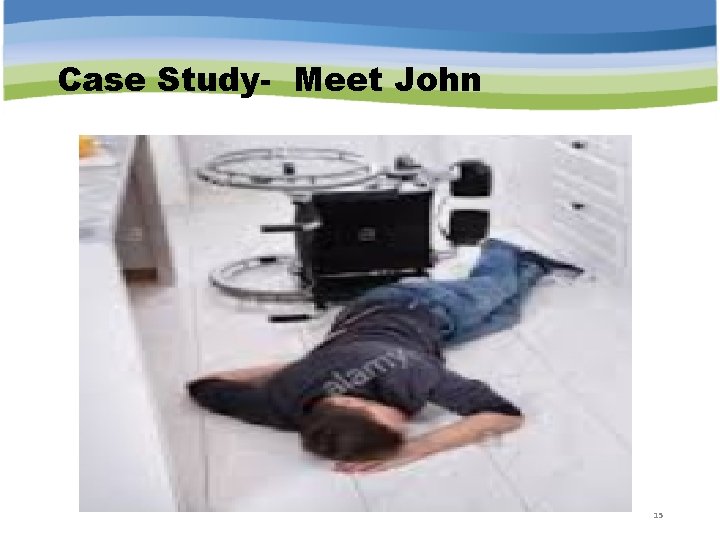
Case Study- Meet John 15
Case Study • John is a friendly and fun-loving guy. He is diagnosed with Cerebral Palsy, GERD, Diabetes insulin dependent, and chronic constipation. He is verbal and has a good sense of humor. He really loves going to his day program. John has slow movements and requires assistance to stand pivot. If lying in the bed he can roll from side to side using the bed rails. When John becomes upset, he will wiggle out of his wheelchair onto the floor when staff are not looking. On the floor he refuses to let the staff help him back into his wheelchair. John has a behavior plan that states steps staff are to follow in the event John refuses to accept help. Today, John became very agitated when he could not go to his day program. John wiggled out of his wheelchair onto the floor. Staff tried to get him up, but he would slap at them and try to spit in their face. Finally, the staff gave up and told John to let them know when he was ready to get back in his chair. • John sat in the floor for 3 hours. Finally, he asked for help and staff put him in on the bed. HIs clothes were wet due to incontinence. As staff provided hygiene and put on dry clothes, they noticed that John had two areas of red skin: one on his right cheek and the other on his left knee. 16
Apply what you've learned Name three interventions that could have prevented John from developing pressure injury: 1. ______________ 2. ______________ 3. ______________ 17
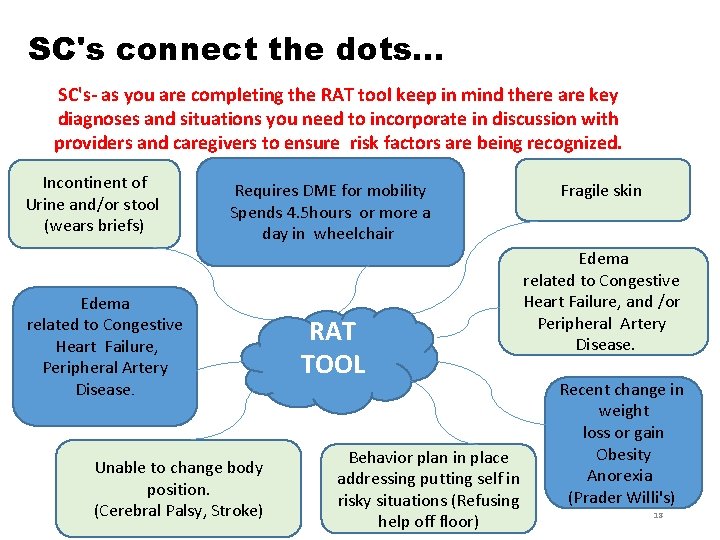
SC's connect the dots. . . SC's- as you are completing the RAT tool keep in mind there are key diagnoses and situations you need to incorporate in discussion with providers and caregivers to ensure risk factors are being recognized. Incontinent of Urine and/or stool (wears briefs) Requires DME for mobility Spends 4. 5 hours or more a day in wheelchair Edema related to Congestive Heart Failure, Peripheral Artery Disease. Unable to change body position. (Cerebral Palsy, Stroke) RAT TOOL Behavior plan in place addressing putting self in risky situations (Refusing help off floor) Fragile skin Edema related to Congestive Heart Failure, and /or Peripheral Artery Disease. Recent change in weight loss or gain Obesity Anorexia (Prader Willi's) 18
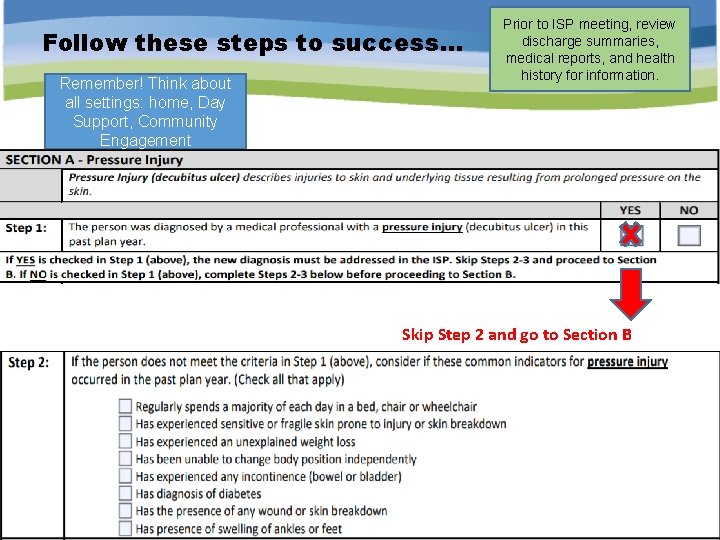
Follow these steps to success… Remember! Think about all settings: home, Day Support, Community Engagement Prior to ISP meeting, review discharge summaries, medical reports, and health history for information. Skip Step 2 and go to Section B 19
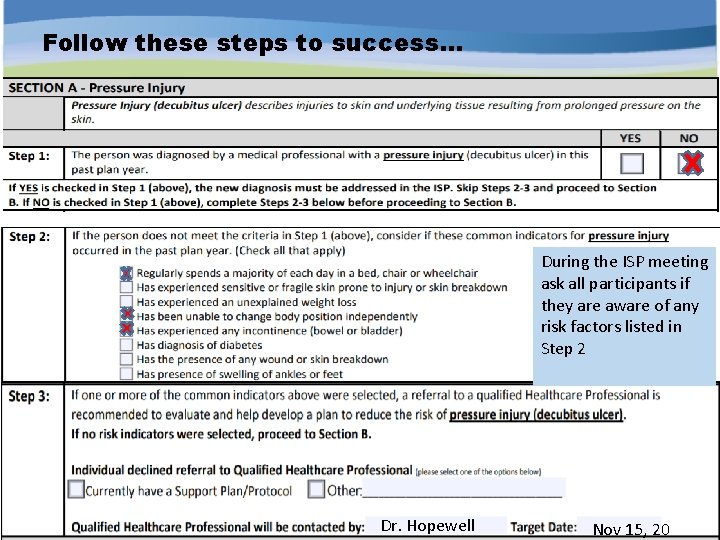
Follow these steps to success… During the ISP meeting ask all participants if they are aware of any risk factors listed in Step 2 Dr. Hopewell 20 Nov 15, 20
21
References American Board of Wound Management (2019). Board certification. Retrieved from http: //www. abwmcertified. org/abwm-certified/board-certification/ Borzdynski, C. J. , Mc. Guiness, W. , and Miller C. (2015). Comparing visual and objective skin assessment with pressure injury risk. International Wound Journal. Retrieved from https: //www. researchgate. net/profile/Caroline_Borzdynski/publication/280119914_Comparing visual_and_objective_skin_assessment_with_pressure_injury_risk/links/55 bf 26 ba 08 aec 0 e 5 f 445 ecd 3/Compar ing-visual-and-objectiveskin-assessment-with-pressure-injury-risk. pdf Edsberg, L. E. , Black, J. M. , Goldberg, M. , Mc. Nichol, L. , Moore, L. and Sieggreen, M. (2016). Revised national pressure ulcer advisory panel pressure injury staging system. Journal of Wound, Ostomy and Continence Nursing. 43(6). 585 -597. DOI: 10. 1097/WON. 0000000281 Gray, M. & Giuliano, K. K. (2018). Incontinence-associated dermatitis, characteristics and relationship to pressure injury: A multisite epidemiologic analysis. Journal of Wound, Ostomy and Continence Nursing. 45(1). 63 -67. DOI: 10. 1097/WON. 0000000390 Harvard Health Publishing. (n. d. ). Bedsores (Decubitus Ulcers). Retrieved from https: //www. health. harvard. edu/a_to_z/bedsores -decubitus-ulcers-a-to-z Lewis, S. , Dirksen, S. , Heitkemper, M. , Bucher, L. , & Camera, I. (2011). Medical-surgical nursing: Assessment and management of clinical problems (8 th dition). Pain (p. 127 -151). St. Louis, MO: Elsevier Mosby. Mayo Clinic (2020). Bedsores (pressure ulcers). Retrieved from https: //www. mayoclinic. org/diseases-conditions/bedsores/symptoms-causes/syc-20355893 Mc. Ginnis, E. , Briggs, M. , Collinson, M. , Wilson, L. , Dealey, C. , Brown, J. , … Nixon, J. (2014). Pressure ulcer related pain in community populations: A prevalence survey. BMC Nursing, 13(16), 1 -10. doi: 10. 1186/1472 -6955 -13 -6 Schwartz, D. , Magen, Y. K. , Levy, A. , and Gefen, A. (2018). Effects of humidity on skin friction against medical textiles as related to prevention of pressure injuries. International Wound Journal, 15(5). https: //doi. org/10. 1111/iwj. 12937 Zeller, J. L. , Lynm, C. , & Glass, R. M. (2006). Pressure Ulcers. Jama, 296(8), 1020. doi: 10. 1001/jama. 296. 8. 1020 22
- Slides: 22