
PRESSURE FLUID STATICS Objectives Review concepts of pressure
PRESSURE & FLUID STATICS
Objectives • Review concepts of pressure, and absolute and gage pressure. • Calculate the forces exerted by a fluid at rest on plane or curved submerged surfaces. • Analyze the stability of floating and submerged bodies. 2
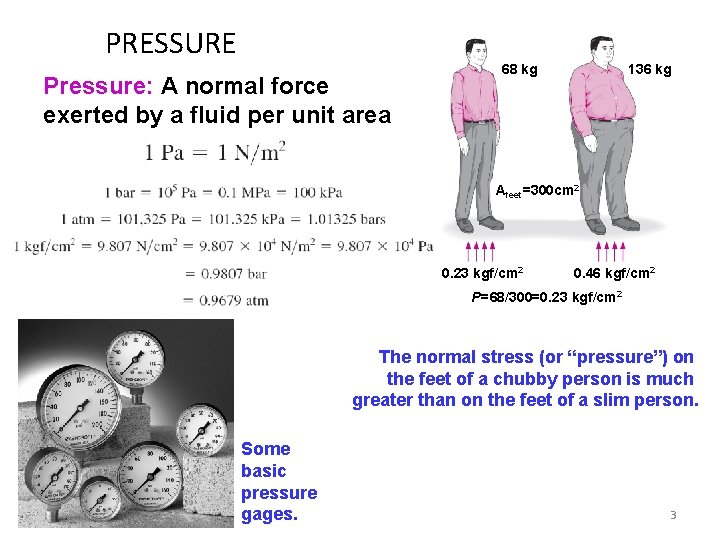
PRESSURE Pressure: A normal force exerted by a fluid per unit area 68 kg 136 kg Afeet=300 cm 2 0. 23 kgf/cm 2 0. 46 kgf/cm 2 P=68/300=0. 23 kgf/cm 2 The normal stress (or “pressure”) on the feet of a chubby person is much greater than on the feet of a slim person. Some basic pressure gages. 3
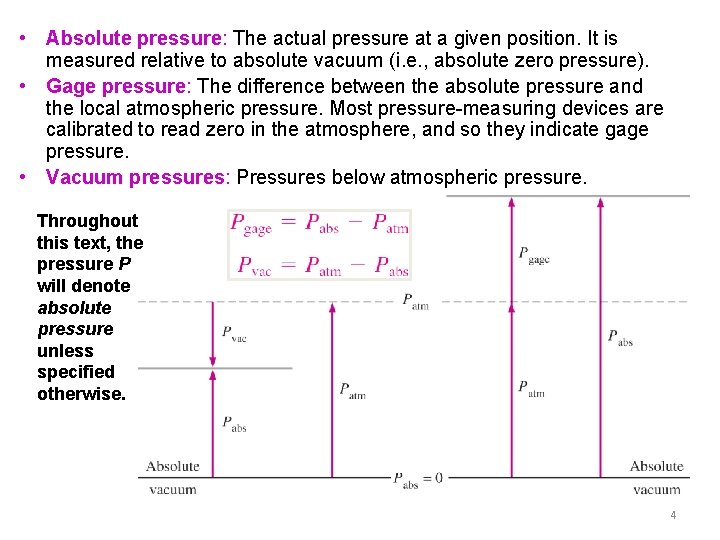
• Absolute pressure: The actual pressure at a given position. It is measured relative to absolute vacuum (i. e. , absolute zero pressure). • Gage pressure: The difference between the absolute pressure and the local atmospheric pressure. Most pressure-measuring devices are calibrated to read zero in the atmosphere, and so they indicate gage pressure. • Vacuum pressures: Pressures below atmospheric pressure. Throughout this text, the pressure P will denote absolute pressure unless specified otherwise. 4
Example 1 A vacuum gage connected to a chamber reads 40 k. Pa at a location where the atmospheric pressure is 100 k. Pa. Determine the absolute pressure in the chamber. 5
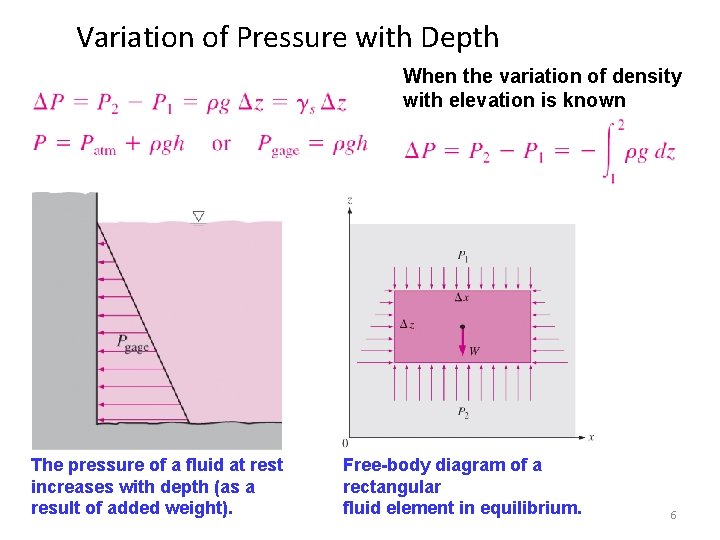
Variation of Pressure with Depth When the variation of density with elevation is known The pressure of a fluid at rest increases with depth (as a result of added weight). Free-body diagram of a rectangular fluid element in equilibrium. 6
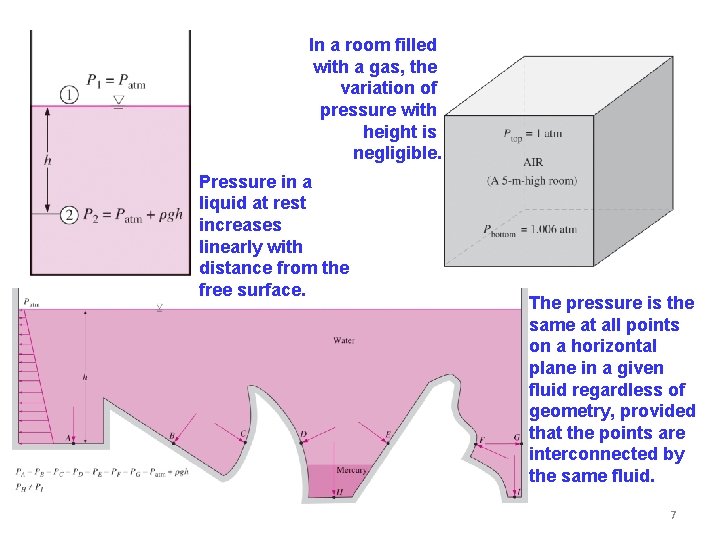
In a room filled with a gas, the variation of pressure with height is negligible. Pressure in a liquid at rest increases linearly with distance from the free surface. The pressure is the same at all points on a horizontal plane in a given fluid regardless of geometry, provided that the points are interconnected by the same fluid. 7
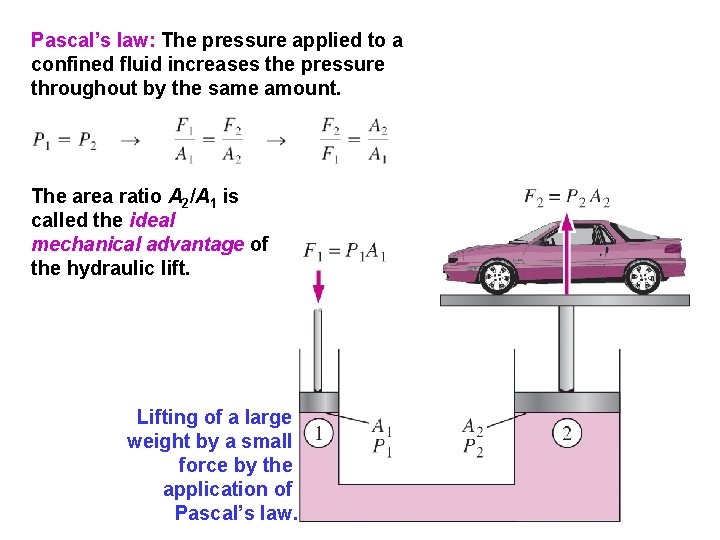
Pascal’s law: The pressure applied to a confined fluid increases the pressure throughout by the same amount. The area ratio A 2/A 1 is called the ideal mechanical advantage of the hydraulic lift. Lifting of a large weight by a small force by the application of Pascal’s law. 8
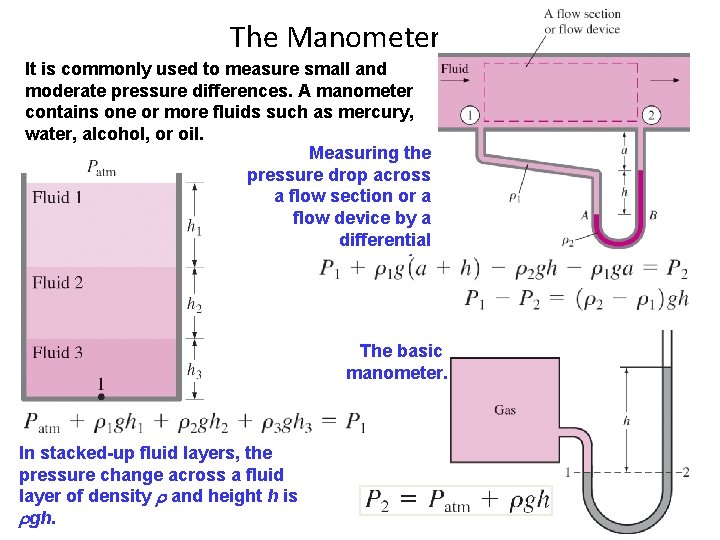
The Manometer It is commonly used to measure small and moderate pressure differences. A manometer contains one or more fluids such as mercury, water, alcohol, or oil. Measuring the pressure drop across a flow section or a flow device by a differential manometer. The basic manometer. In stacked-up fluid layers, the pressure change across a fluid layer of density and height h is gh. 9
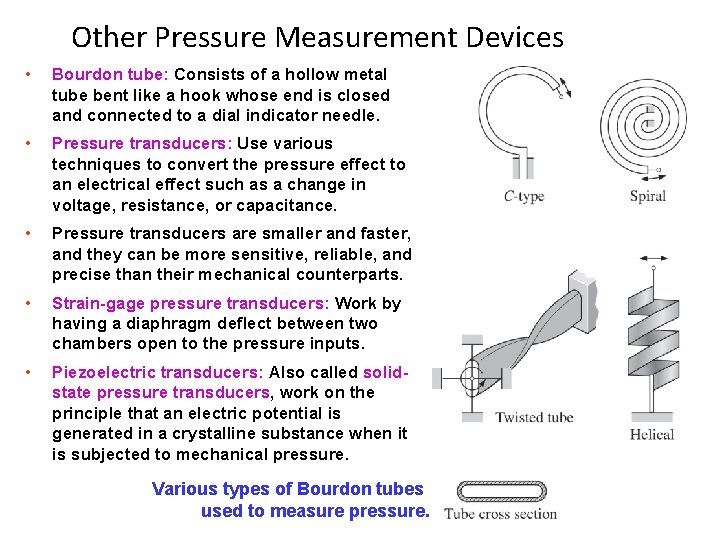
Other Pressure Measurement Devices • Bourdon tube: Consists of a hollow metal tube bent like a hook whose end is closed and connected to a dial indicator needle. • Pressure transducers: Use various techniques to convert the pressure effect to an electrical effect such as a change in voltage, resistance, or capacitance. • Pressure transducers are smaller and faster, and they can be more sensitive, reliable, and precise than their mechanical counterparts. • Strain-gage pressure transducers: Work by having a diaphragm deflect between two chambers open to the pressure inputs. • Piezoelectric transducers: Also called solidstate pressure transducers, work on the principle that an electric potential is generated in a crystalline substance when it is subjected to mechanical pressure. Various types of Bourdon tubes used to measure pressure. 10
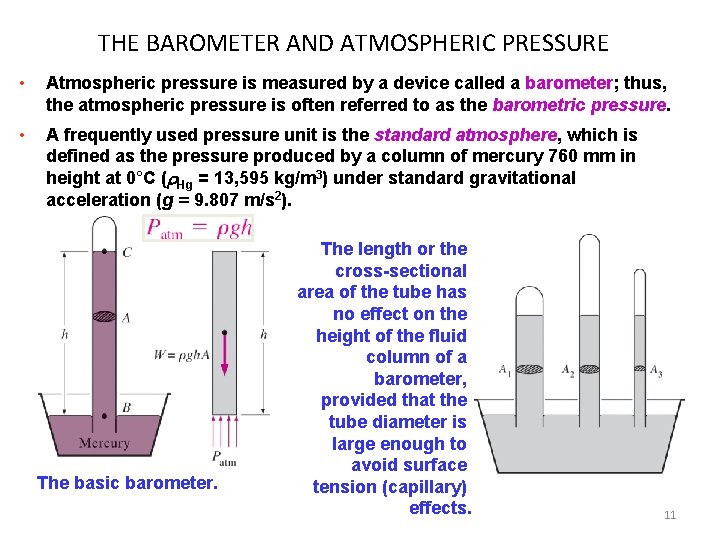
THE BAROMETER AND ATMOSPHERIC PRESSURE • Atmospheric pressure is measured by a device called a barometer; thus, the atmospheric pressure is often referred to as the barometric pressure. • A frequently used pressure unit is the standard atmosphere, which is defined as the pressure produced by a column of mercury 760 mm in height at 0°C ( Hg = 13, 595 kg/m 3) under standard gravitational acceleration (g = 9. 807 m/s 2). The basic barometer. The length or the cross-sectional area of the tube has no effect on the height of the fluid column of a barometer, provided that the tube diameter is large enough to avoid surface tension (capillary) effects. 11
Example 2 The gage pressure in a liquid at a depth of 3 m is read to be 28 k. Pa. Determine the gage pressure in the same liquid at a depth of 9 m. 12
Example 3 The absolute pressure in water at depth of 5 m is read to be 145 k. Pa. Determine a) the local atmospheric pressure. b) the absolute pressure at a depth of 5 m if a liquid whose specific gravity is 0. 85 at the same location. 13
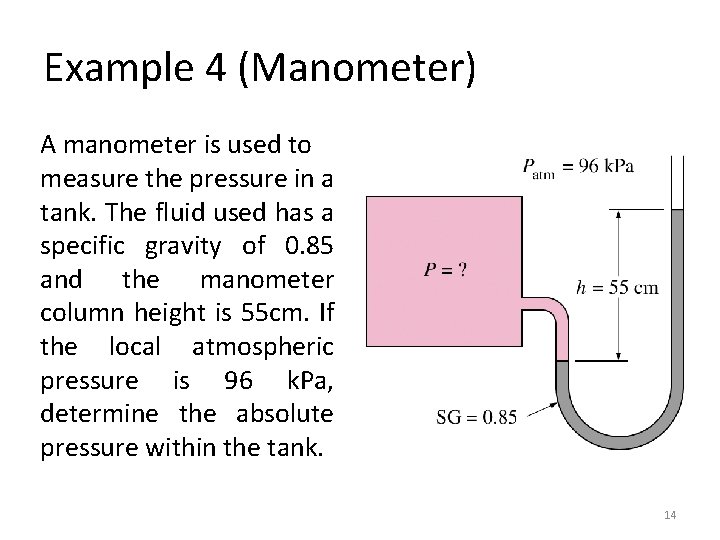
Example 4 (Manometer) A manometer is used to measure the pressure in a tank. The fluid used has a specific gravity of 0. 85 and the manometer column height is 55 cm. If the local atmospheric pressure is 96 k. Pa, determine the absolute pressure within the tank. 14
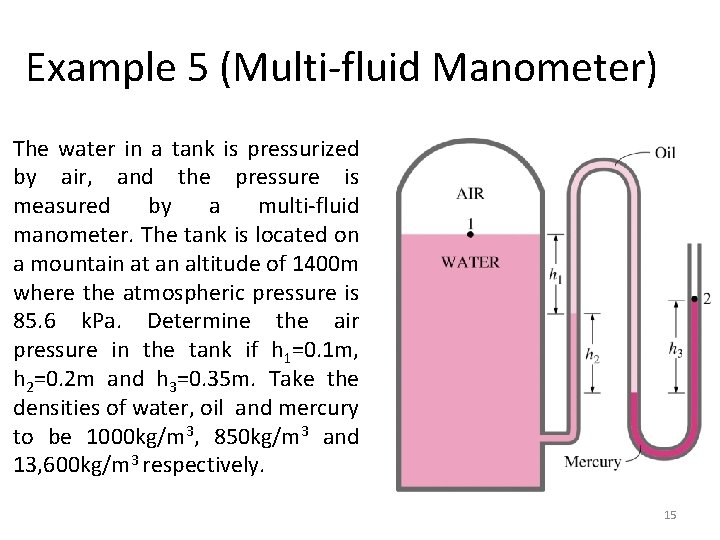
Example 5 (Multi-fluid Manometer) The water in a tank is pressurized by air, and the pressure is measured by a multi-fluid manometer. The tank is located on a mountain at an altitude of 1400 m where the atmospheric pressure is 85. 6 k. Pa. Determine the air pressure in the tank if h 1=0. 1 m, h 2=0. 2 m and h 3=0. 35 m. Take the densities of water, oil and mercury to be 1000 kg/m 3, 850 kg/m 3 and 13, 600 kg/m 3 respectively. 15
Fluid Statics • Fluid statics: Deals with problems associated with fluids at rest. • The fluid can be either gaseous or liquid. • Fluid statics is generally referred to as hydrostatics when the fluid is a liquid and as aerostatics when the fluid is a gas. • In fluid statics, there is no relative motion between adjacent fluid layers, and thus there are no shear (tangential) stresses in the fluid trying to deform it. • The only stress we deal with in fluid statics is the normal stress, which is the pressure, and the variation of pressure is due only to the weight of the fluid. • The topic of fluid statics has significance only in gravity fields. • The design of many engineering systems such as water dams and liquid storage tanks requires the determination of the forces acting on the surfaces using fluid statics. 16
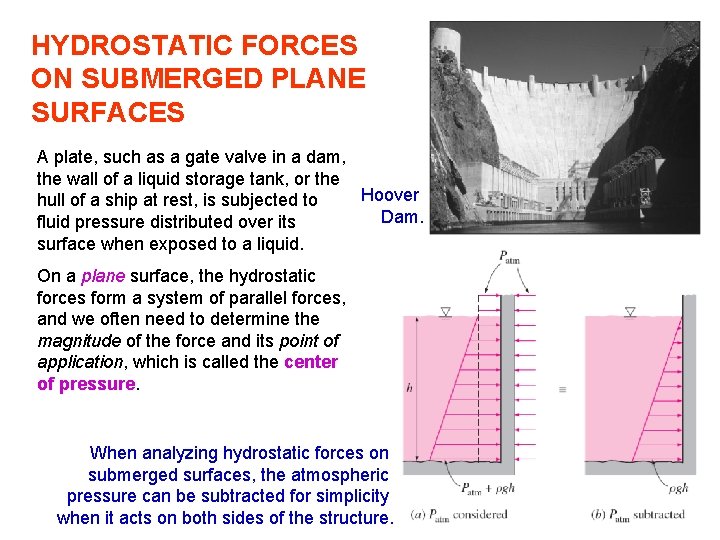
HYDROSTATIC FORCES ON SUBMERGED PLANE SURFACES A plate, such as a gate valve in a dam, the wall of a liquid storage tank, or the Hoover hull of a ship at rest, is subjected to Dam. fluid pressure distributed over its surface when exposed to a liquid. On a plane surface, the hydrostatic forces form a system of parallel forces, and we often need to determine the magnitude of the force and its point of application, which is called the center of pressure. When analyzing hydrostatic forces on submerged surfaces, the atmospheric pressure can be subtracted for simplicity when it acts on both sides of the structure. 17
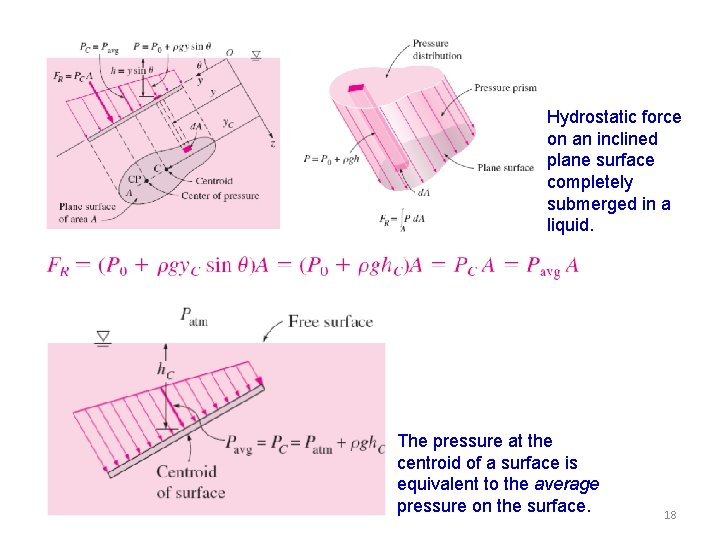
Hydrostatic force on an inclined plane surface completely submerged in a liquid. The pressure at the centroid of a surface is equivalent to the average pressure on the surface. 18
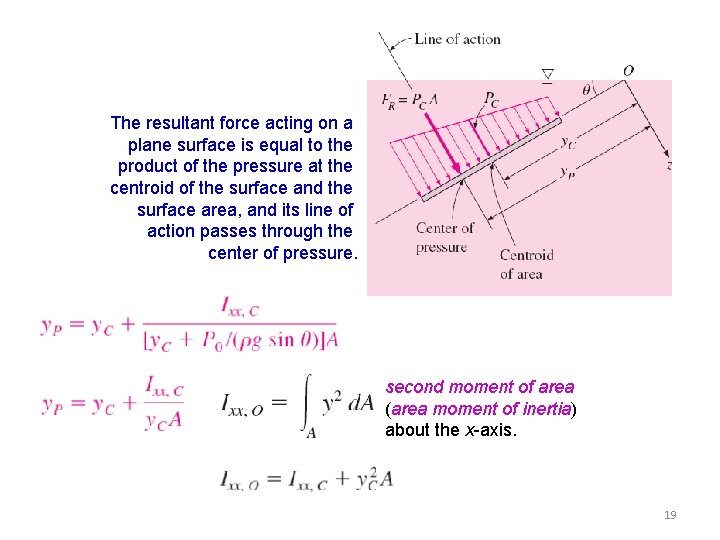
The resultant force acting on a plane surface is equal to the product of the pressure at the centroid of the surface and the surface area, and its line of action passes through the center of pressure. second moment of area (area moment of inertia) about the x-axis. 19
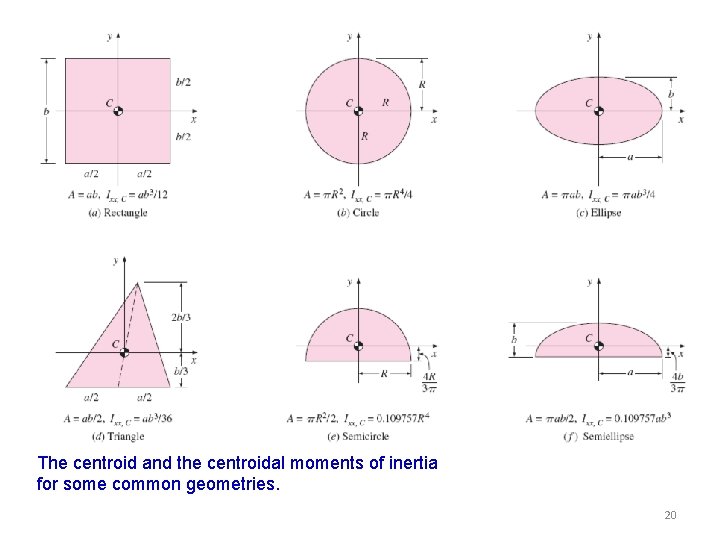
The centroid and the centroidal moments of inertia for some common geometries. 20
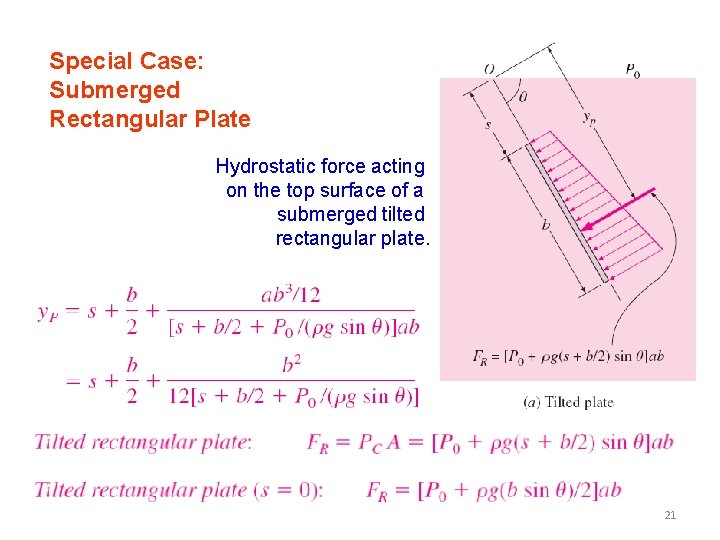
Special Case: Submerged Rectangular Plate Hydrostatic force acting on the top surface of a submerged tilted rectangular plate. 21
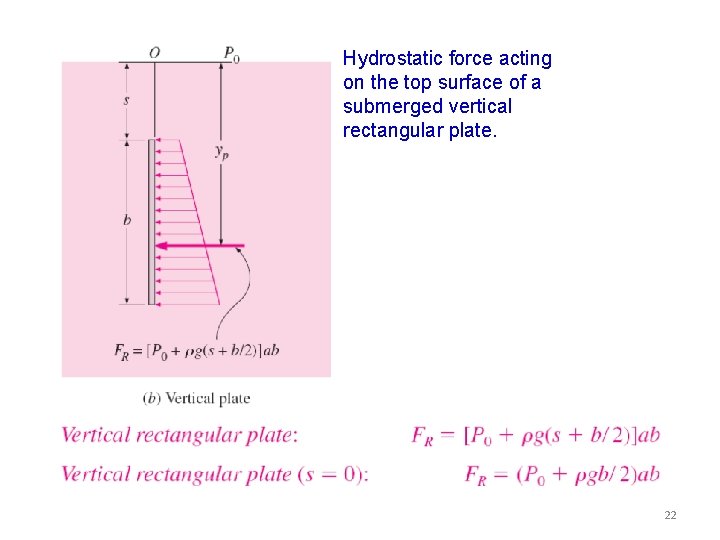
Hydrostatic force acting on the top surface of a submerged vertical rectangular plate. 22
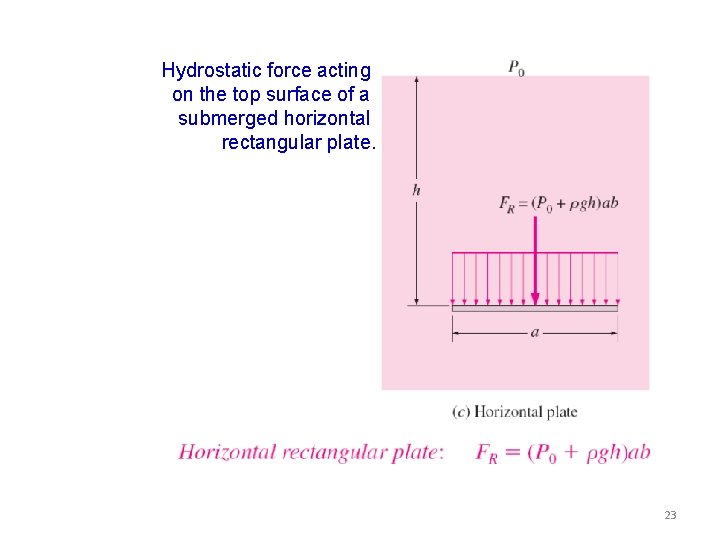
Hydrostatic force acting on the top surface of a submerged horizontal rectangular plate. 23
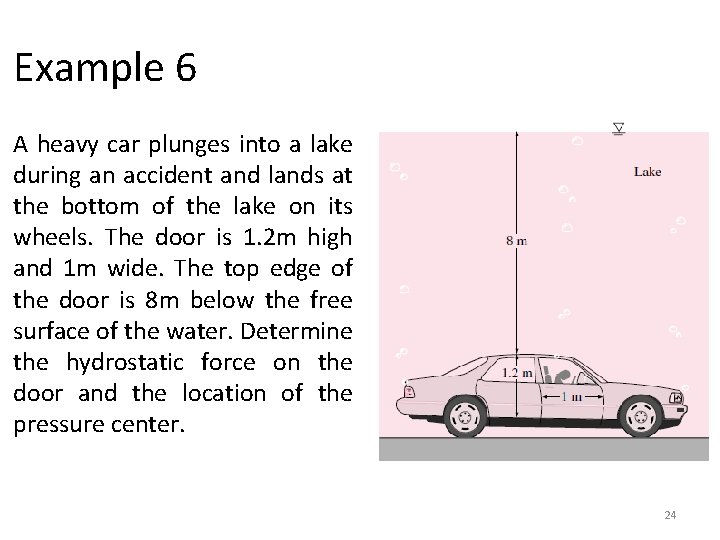
Example 6 A heavy car plunges into a lake during an accident and lands at the bottom of the lake on its wheels. The door is 1. 2 m high and 1 m wide. The top edge of the door is 8 m below the free surface of the water. Determine the hydrostatic force on the door and the location of the pressure center. 24
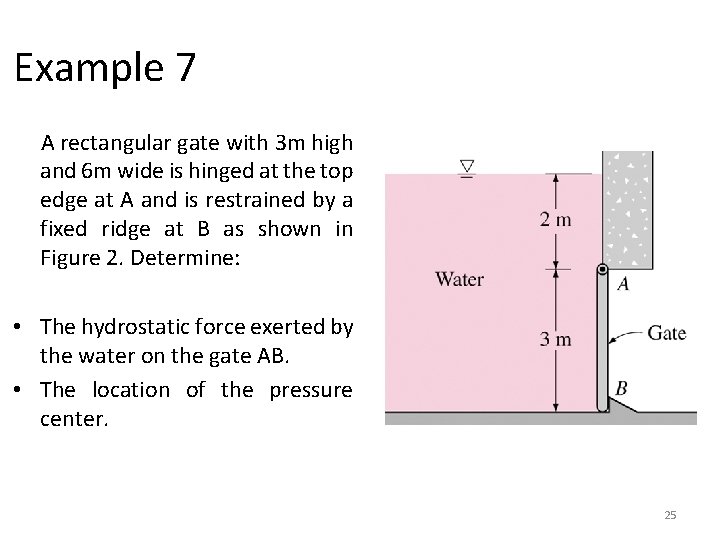
Example 7 A rectangular gate with 3 m high and 6 m wide is hinged at the top edge at A and is restrained by a fixed ridge at B as shown in Figure 2. Determine: • The hydrostatic force exerted by the water on the gate AB. • The location of the pressure center. 25
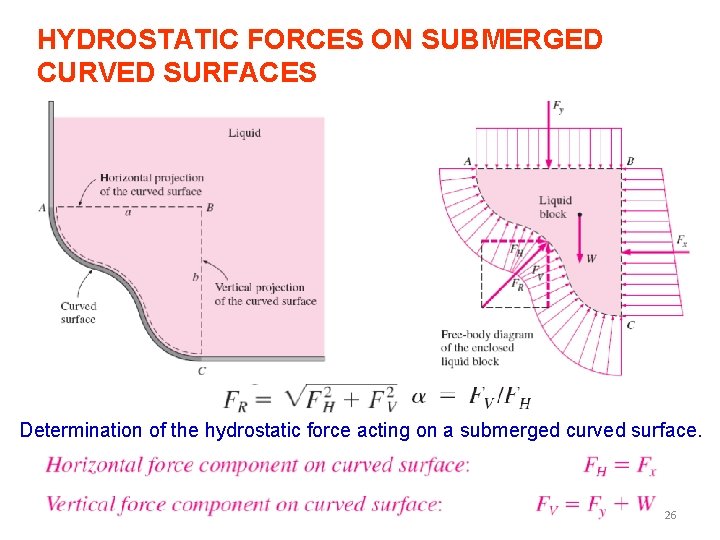
HYDROSTATIC FORCES ON SUBMERGED CURVED SURFACES Determination of the hydrostatic force acting on a submerged curved surface. 26
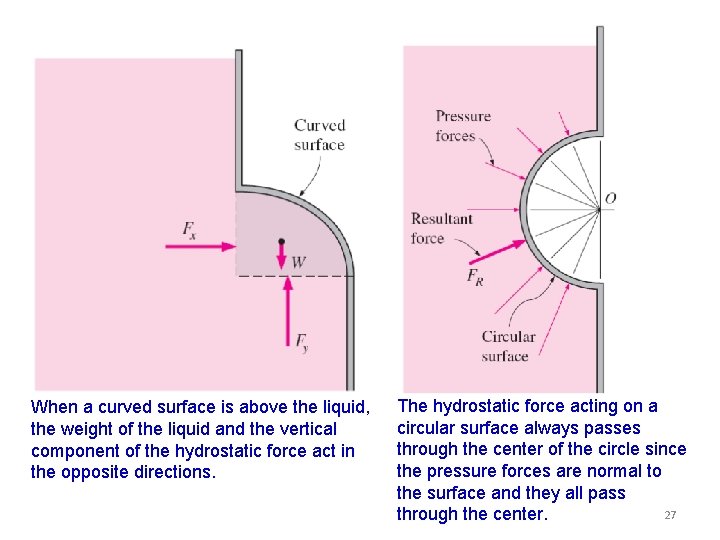
When a curved surface is above the liquid, the weight of the liquid and the vertical component of the hydrostatic force act in the opposite directions. The hydrostatic force acting on a circular surface always passes through the center of the circle since the pressure forces are normal to the surface and they all pass 27 through the center.
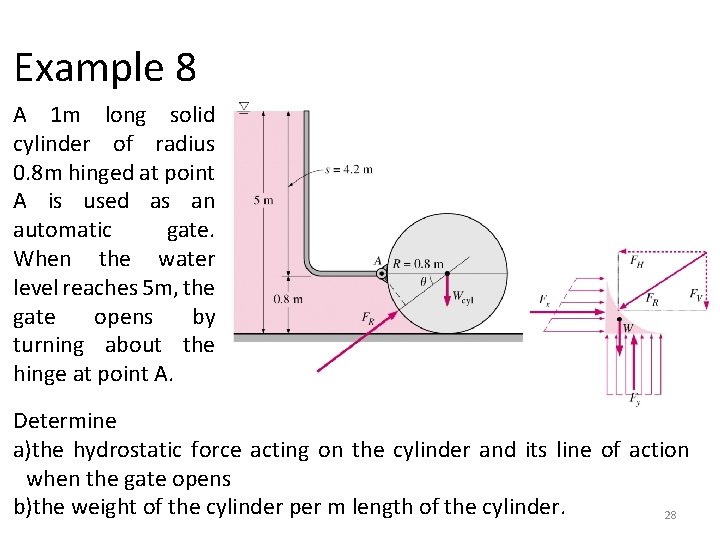
Example 8 A 1 m long solid cylinder of radius 0. 8 m hinged at point A is used as an automatic gate. When the water level reaches 5 m, the gate opens by turning about the hinge at point A. Determine a)the hydrostatic force acting on the cylinder and its line of action when the gate opens b)the weight of the cylinder per m length of the cylinder. 28
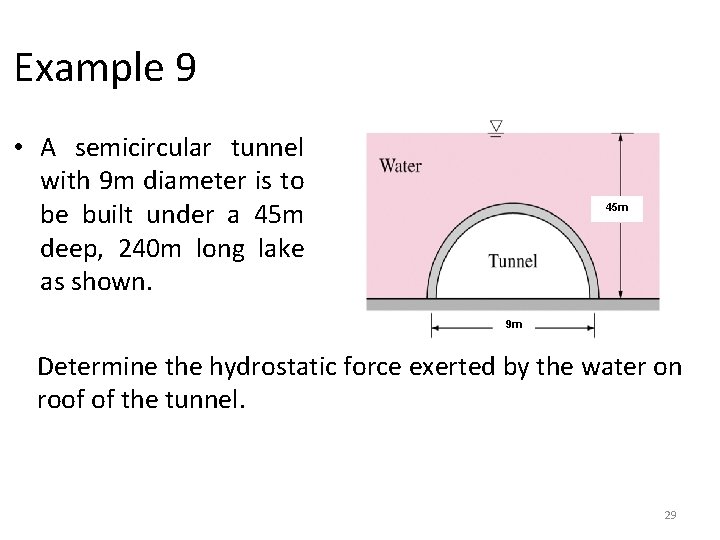
Example 9 • A semicircular tunnel with 9 m diameter is to be built under a 45 m deep, 240 m long lake as shown. 45 m 9 m Determine the hydrostatic force exerted by the water on roof of the tunnel. 29
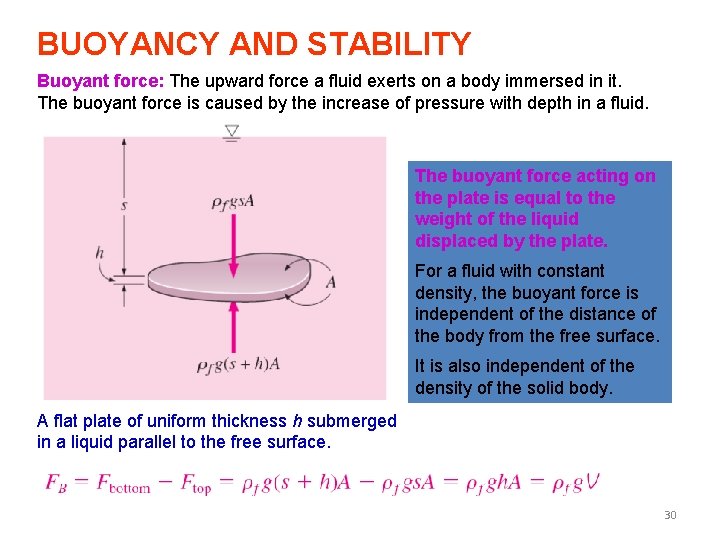
BUOYANCY AND STABILITY Buoyant force: The upward force a fluid exerts on a body immersed in it. The buoyant force is caused by the increase of pressure with depth in a fluid. The buoyant force acting on the plate is equal to the weight of the liquid displaced by the plate. For a fluid with constant density, the buoyant force is independent of the distance of the body from the free surface. It is also independent of the density of the solid body. A flat plate of uniform thickness h submerged in a liquid parallel to the free surface. 30
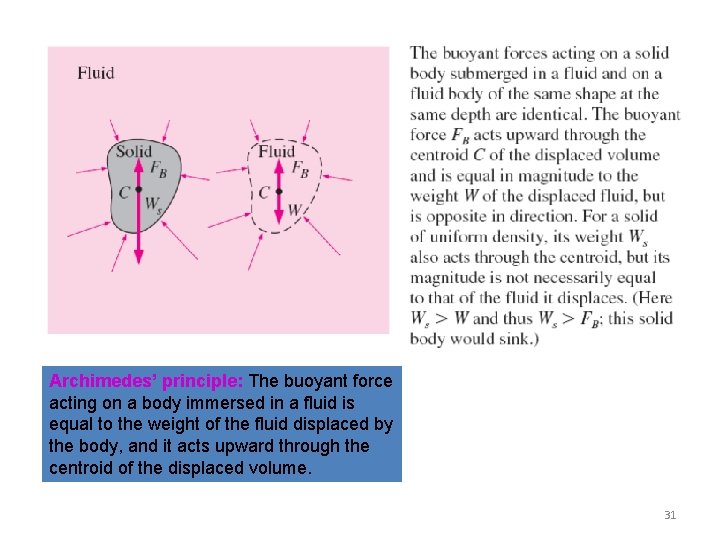
Archimedes’ principle: The buoyant force acting on a body immersed in a fluid is equal to the weight of the fluid displaced by the body, and it acts upward through the centroid of the displaced volume. 31
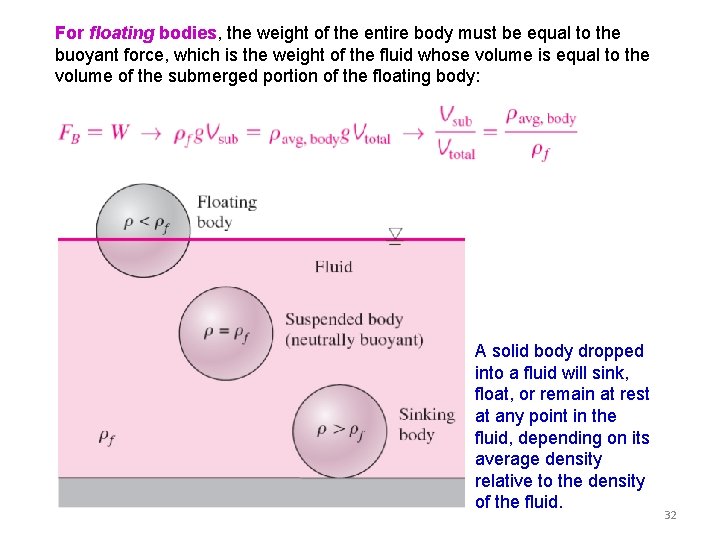
For floating bodies, the weight of the entire body must be equal to the buoyant force, which is the weight of the fluid whose volume is equal to the volume of the submerged portion of the floating body: A solid body dropped into a fluid will sink, float, or remain at rest at any point in the fluid, depending on its average density relative to the density of the fluid. 32
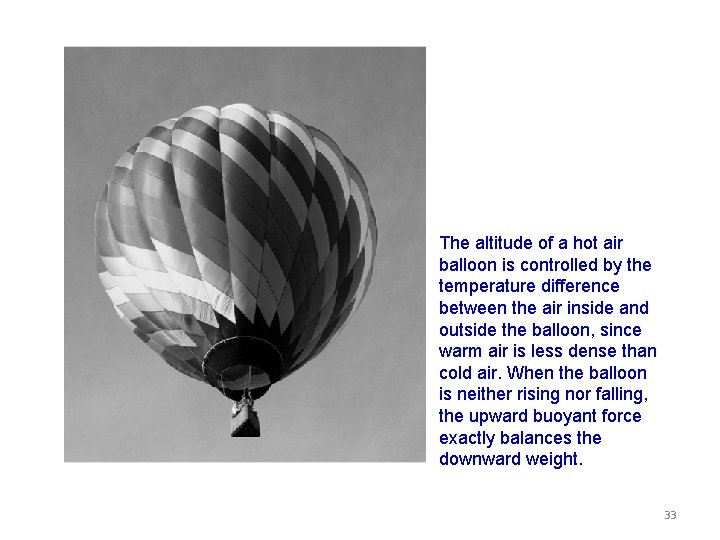
The altitude of a hot air balloon is controlled by the temperature difference between the air inside and outside the balloon, since warm air is less dense than cold air. When the balloon is neither rising nor falling, the upward buoyant force exactly balances the downward weight. 33
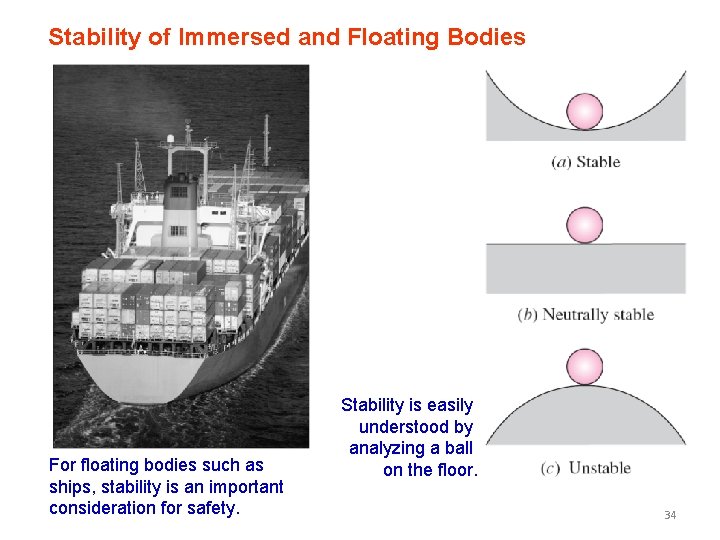
Stability of Immersed and Floating Bodies For floating bodies such as ships, stability is an important consideration for safety. Stability is easily understood by analyzing a ball on the floor. 34
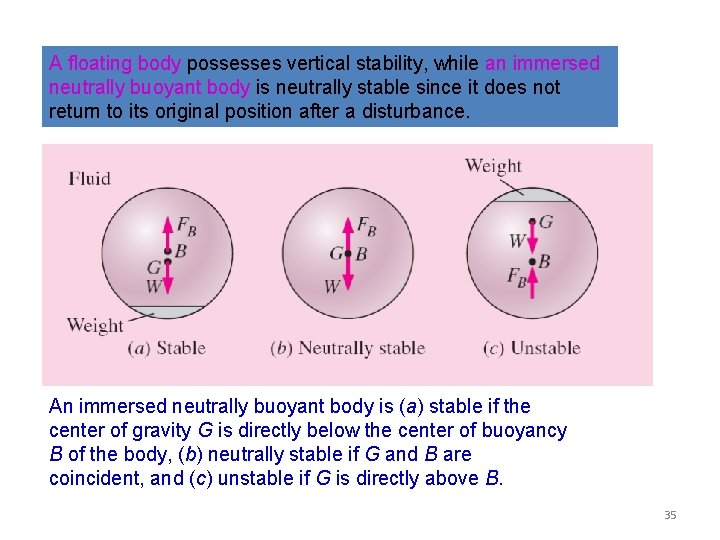
A floating body possesses vertical stability, while an immersed neutrally buoyant body is neutrally stable since it does not return to its original position after a disturbance. An immersed neutrally buoyant body is (a) stable if the center of gravity G is directly below the center of buoyancy B of the body, (b) neutrally stable if G and B are coincident, and (c) unstable if G is directly above B. 35
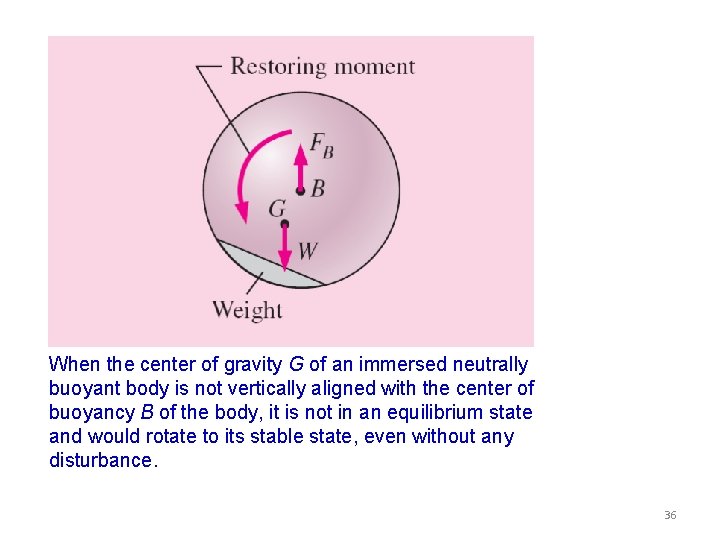
When the center of gravity G of an immersed neutrally buoyant body is not vertically aligned with the center of buoyancy B of the body, it is not in an equilibrium state and would rotate to its stable state, even without any disturbance. 36
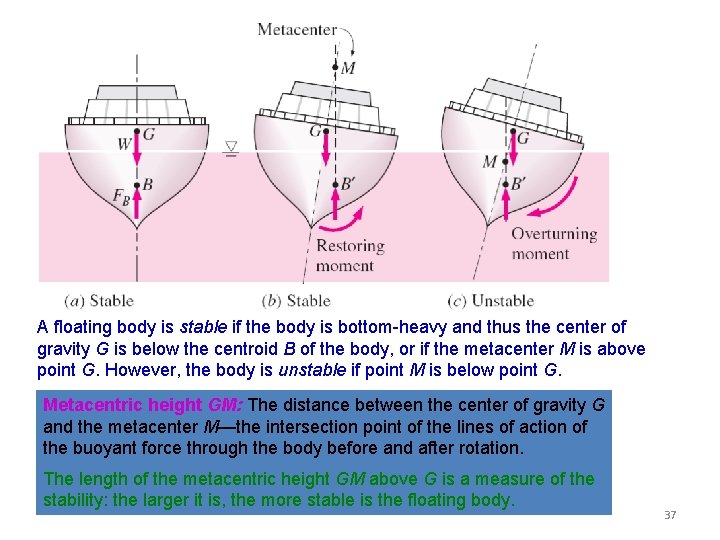
A floating body is stable if the body is bottom-heavy and thus the center of gravity G is below the centroid B of the body, or if the metacenter M is above point G. However, the body is unstable if point M is below point G. Metacentric height GM: The distance between the center of gravity G and the metacenter M—the intersection point of the lines of action of the buoyant force through the body before and after rotation. The length of the metacentric height GM above G is a measure of the stability: the larger it is, the more stable is the floating body. 37
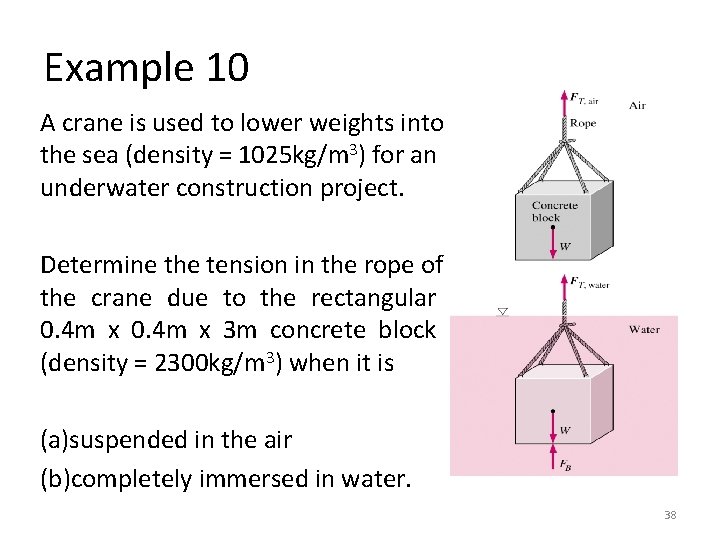
Example 10 A crane is used to lower weights into the sea (density = 1025 kg/m 3) for an underwater construction project. Determine the tension in the rope of the crane due to the rectangular 0. 4 m x 3 m concrete block (density = 2300 kg/m 3) when it is (a)suspended in the air (b)completely immersed in water. 38
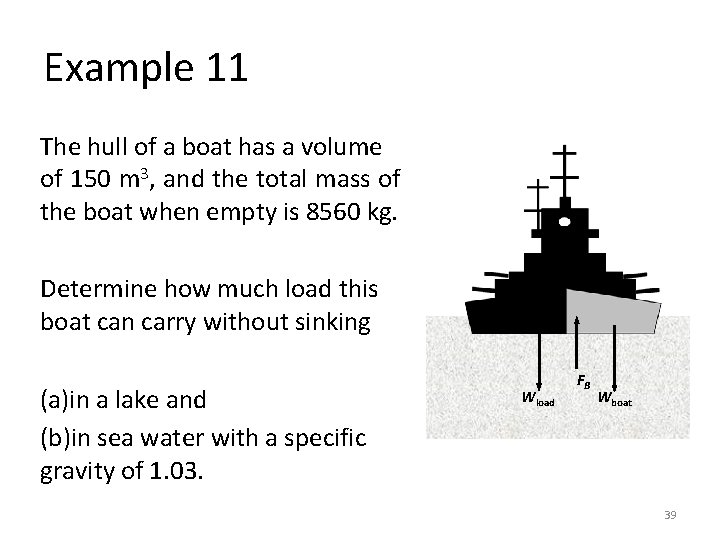
Example 11 The hull of a boat has a volume of 150 m 3, and the total mass of the boat when empty is 8560 kg. Determine how much load this boat can carry without sinking (a)in a lake and (b)in sea water with a specific gravity of 1. 03. Wload FB Wboat 39
Summary • Pressure – Variation of pressure with depth • The manometer and the atmospheric pressure • Hydrostatic Forces on Submerged Plane Surfaces – Special Case: Submerged Rectangular Plate • Hydrostatic Forces on Submerged Curved Surfaces • Buoyancy and Stability – Stability of Immersed and Floating Bodies 40
- Slides: 40