
Press Working Terminologies and Elements of Dies and





- Slides: 18
Press Working Terminologies and Elements of Dies and Strip Layout
Press Work Press machines and press tools are considered as a backbone of modern machine shop of large industrial set up, producing wide range of articles such as vehicle bodies, electrical accessories, utensils, etc. large number of metal components can be produced in short interval time without the removal of the metal in the form of chips.
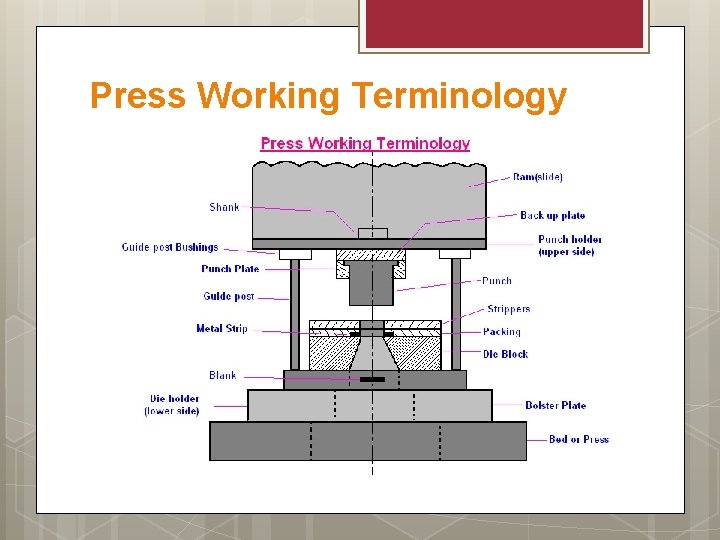
Press Working Terminology
Bed: The bed is lower part of press frame that serves as a table on which a bolster plate is mounted. Bolster Plate: Bolster plate is a thick plate secured to the press bed, which is used for locating and supporting the die assembly. Its thickness is usually 5 to 12. 5 cm. Die Set: Die set is unit assembly which incorporates a lower and upper shoe, two or more guide posts and guide post bushings. Die: Die is the female part of a complete tool for producing work in a press. It is also referred to a complete tool consisting of pair of mating members for producing work in press.
Die Block: It is the block or a plate which contains the die cavity. Lower Shoe: The lower shoe of a die set is generally mounted on the upper plate of a press. The die block is mounted on the lower shoe. The guide posts are also mounted in it. Punch: Punch is the male component of the die assembly which is directly or indirectly moved by or fastened to the press ram or slide. Upper Shoe: It is the upper part of the die set which contain die post bushings. Punch Plate: The punch plate or punch retainer fits closely over the body of the punch and holds it in proper relative position.
Back Up Plate: It is also called pressure plate. It is placed so that the intensity of pressure does not become excessive on punch holder. The plate distributes the pressure over a wide area and intensity of pressure on the punch holder is reduced to avoid crushing. Stripper: Stripper is a plate which is used to strip the metal strip from a cutting or non-cutting punch or die. It may also guide the strip. Knock Out: Knock out mechanism is used to remove the work piece from a die. It is connected to and operated by the press ram. Pitman: Pitman is a connecting rod which is used to transmit the motion from the main drive shaft to the press slide.
Principle accessories of common press Base C – Frame Ram Pitman Crank shaft Crown Clutch Brake Tie Rods
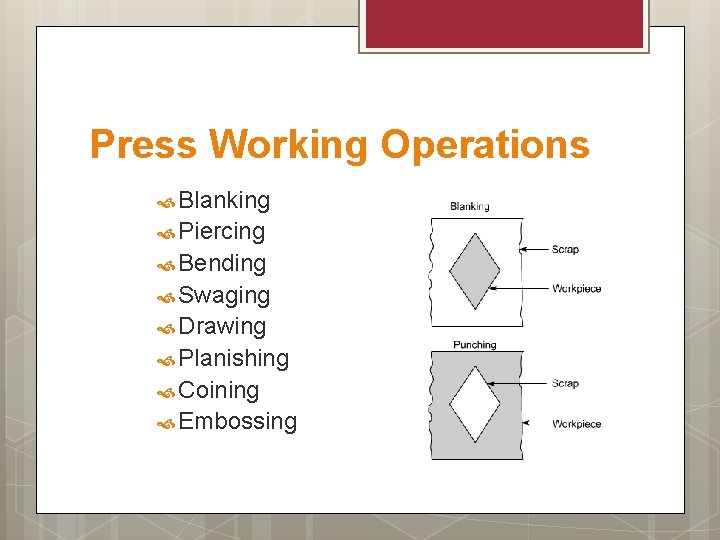
Press Working Operations Blanking Piercing Bending Swaging Drawing Planishing Coining Embossing
Types of Dies are classified according to the type of press operation and according to the method of operation. Cutting Dies Progressive Dies Compound Dies Combination Dies
Cutting Dies Cutting dies are used to cut the metal. They use cutting and shearing action for cutting the metal. Examples of cutting dies are blanking dies, piercing dies, perforating dies, notching dies, trimming dies, shaving dies and nibbling dies, etc. Forming Dies Forming dies change the shape of the blank without removing any stock. Example of forming dies are drawing dies, bending dies and squeezing dies. According to the method of operation, dies are classified as simple dies, compound dies, combination dies, progressive dies, transfer dies, etc.
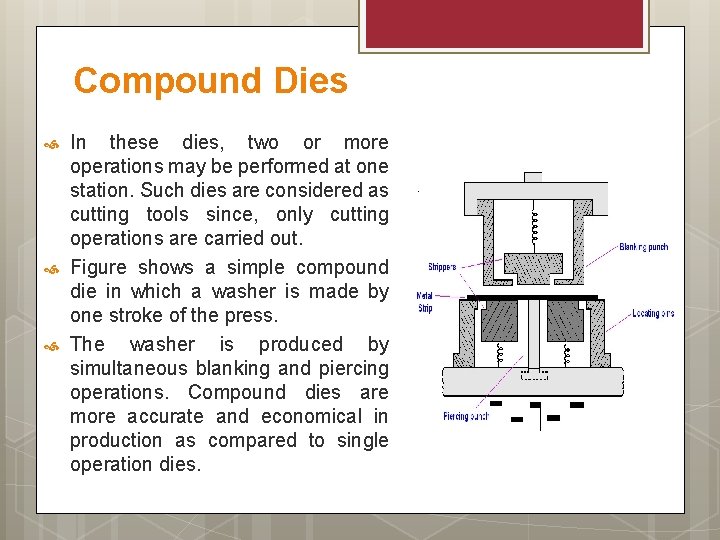
Compound Dies In these dies, two or more operations may be performed at one station. Such dies are considered as cutting tools since, only cutting operations are carried out. Figure shows a simple compound die in which a washer is made by one stroke of the press. The washer is produced by simultaneous blanking and piercing operations. Compound dies are more accurate and economical in production as compared to single operation dies.
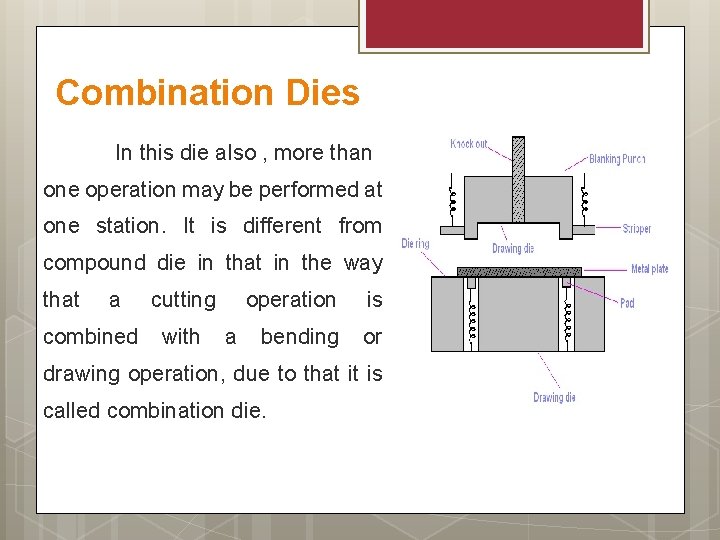
Combination Dies In this die also , more than one operation may be performed at one station. It is different from compound die in that in the way that a combined cutting with a operation is bending or drawing operation, due to that it is called combination die.
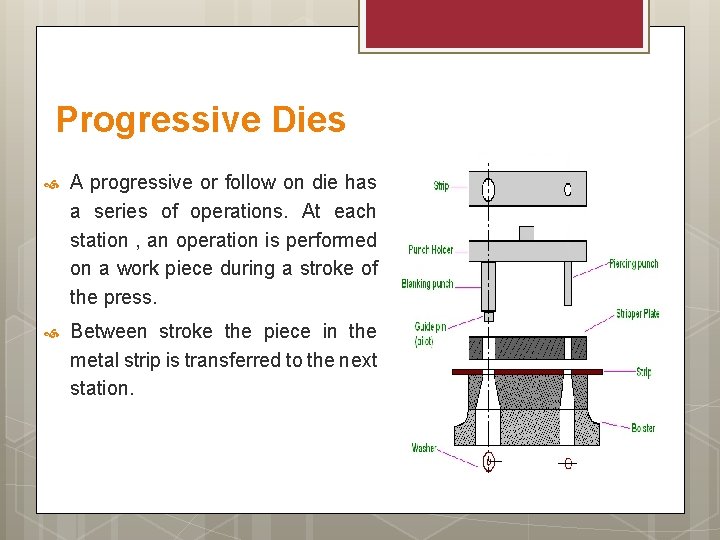
Progressive Dies A progressive or follow on die has a series of operations. At each station , an operation is performed on a work piece during a stroke of the press. Between stroke the piece in the metal strip is transferred to the next station.
A finished work piece is made at each stroke of the press. While the piercing punch cuts a hole in the stroke , the blanking punch blanks out a portion of the metal in which a hole had been pierced at a previous station. Thus after the first stroke , when only a hole will be punched , each stroke of the press produces a finished washer.
Bending