
PRESS PRAY PRAISE DEPRESSION ANXIETYWHEN PRESSING THROUGH TO

- Slides: 24
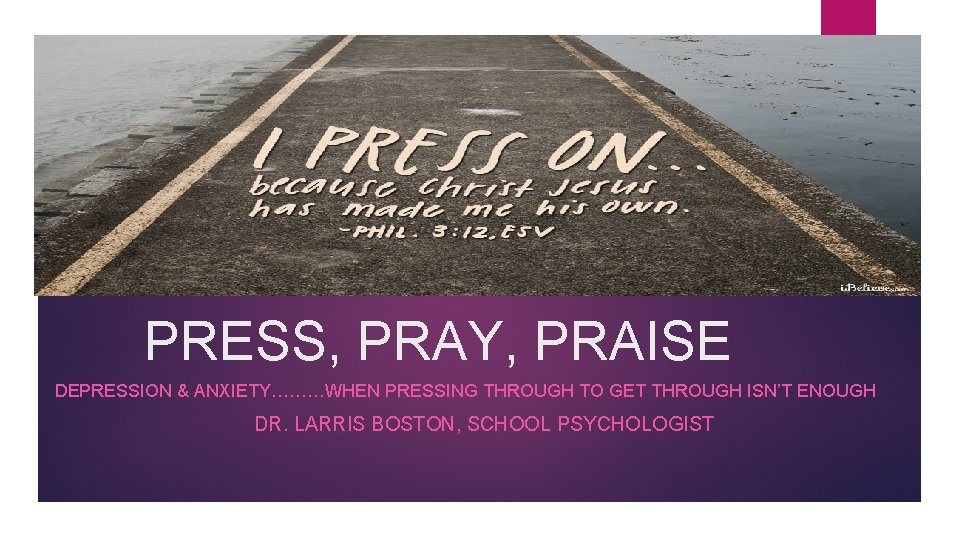
PRESS, PRAY, PRAISE DEPRESSION & ANXIETY………WHEN PRESSING THROUGH TO GET THROUGH ISN’T ENOUGH DR. LARRIS BOSTON, SCHOOL PSYCHOLOGIST
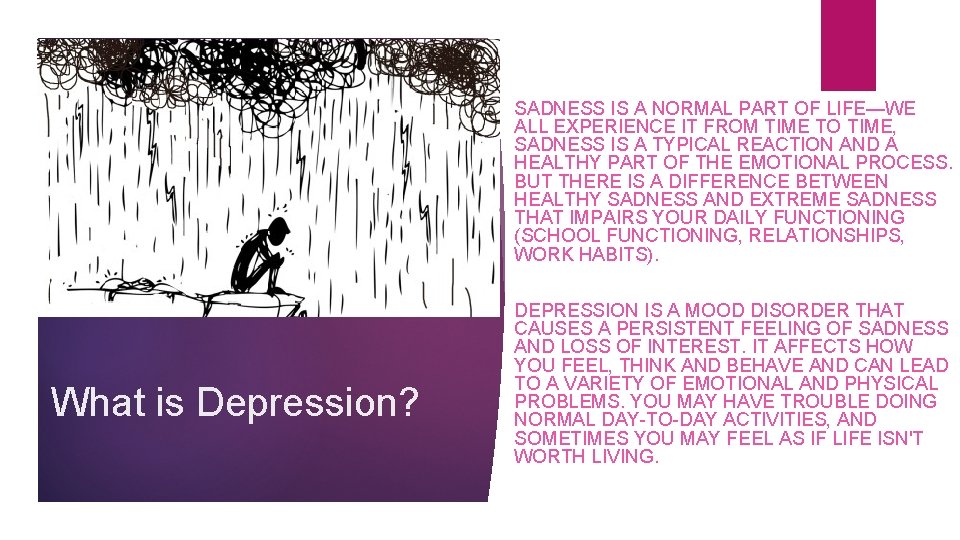
SADNESS IS A NORMAL PART OF LIFE—WE ALL EXPERIENCE IT FROM TIME TO TIME, SADNESS IS A TYPICAL REACTION AND A HEALTHY PART OF THE EMOTIONAL PROCESS. BUT THERE IS A DIFFERENCE BETWEEN HEALTHY SADNESS AND EXTREME SADNESS THAT IMPAIRS YOUR DAILY FUNCTIONING (SCHOOL FUNCTIONING, RELATIONSHIPS, WORK HABITS). What is Depression? DEPRESSION IS A MOOD DISORDER THAT CAUSES A PERSISTENT FEELING OF SADNESS AND LOSS OF INTEREST. IT AFFECTS HOW YOU FEEL, THINK AND BEHAVE AND CAN LEAD TO A VARIETY OF EMOTIONAL AND PHYSICAL PROBLEMS. YOU MAY HAVE TROUBLE DOING NORMAL DAY-TO-DAY ACTIVITIES, AND SOMETIMES YOU MAY FEEL AS IF LIFE ISN'T WORTH LIVING.
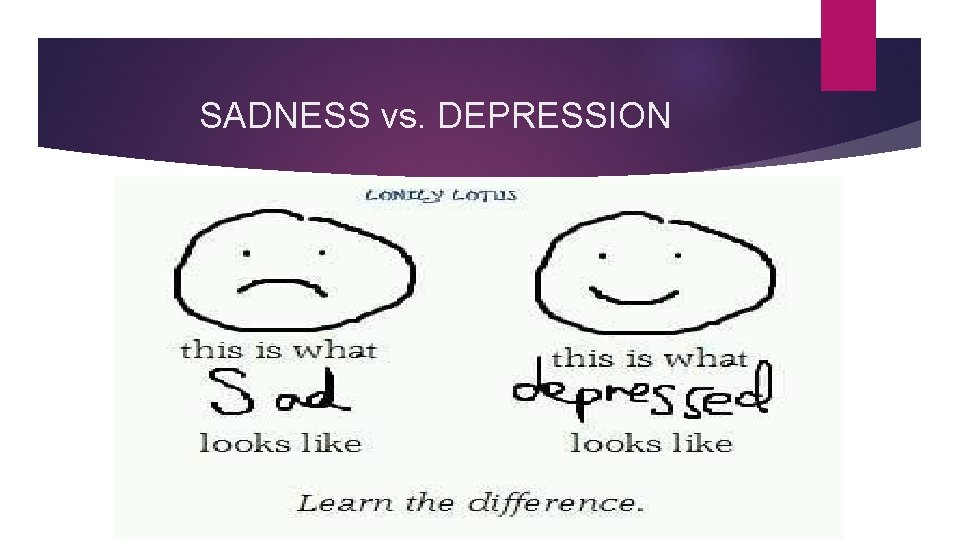
SADNESS vs. DEPRESSION
DEPRESSION SADNESS vs. - Is a NORMAL human emotion. We’ve all experienced it & we all will again. - Usually triggered by a difficult, hurtful, challenging, or disappointing event, experience, or situation (we tend to feel sad about something). - When that something changes, our emotional hurt fades, and when we’ve adjusted or gotten over the loss or disappointment, our sadness lessens. - AN ABNORMAL EMOTIONAL STATE, A MENTAL ILLNESS THAT AFFECTS OUR THINKING, EMOTIONS, PERCEPTIONS, AND BEHAVIORS IN PERSISTENT AND CHRONIC WAYS. - FEELING SAD ABOUT EVERYTHING. DEPRESSION DOES NOT NECESSARILY REQUIRE A DIFFICULT EVENT OR SITUATION, A LOSS, OR A CHANGE OF CIRCUMSTANCE AS A TRIGGER. IN FACT, IT OFTEN OCCURS IN THE ABSENCE OF ANY SUCH TRIGGERS. - PEOPLE’S LIVES ON PAPER MIGHT BE TOTALLY FINE AND YET THEY STILL FEEL HORRIBLE.
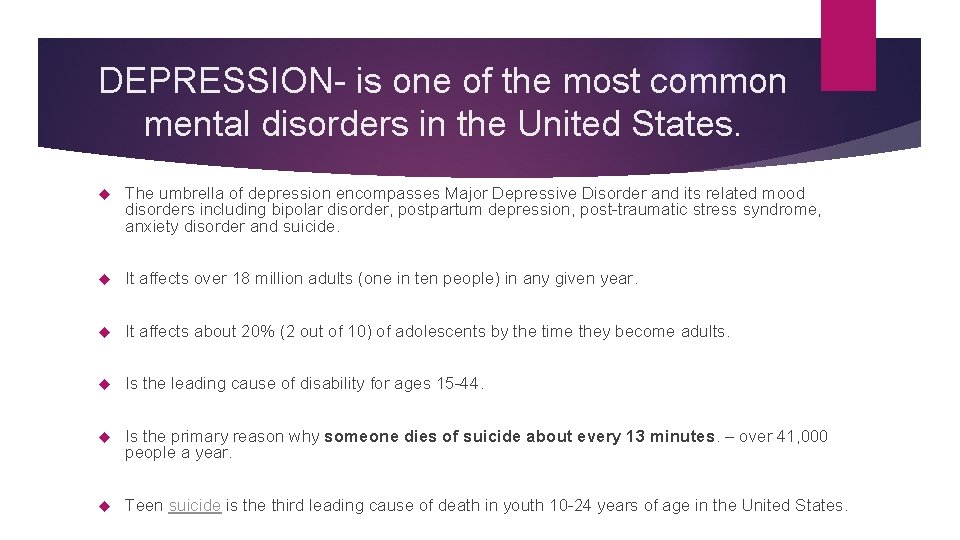
DEPRESSION- is one of the most common mental disorders in the United States. The umbrella of depression encompasses Major Depressive Disorder and its related mood disorders including bipolar disorder, postpartum depression, post-traumatic stress syndrome, anxiety disorder and suicide. It affects over 18 million adults (one in ten people) in any given year. It affects about 20% (2 out of 10) of adolescents by the time they become adults. Is the leading cause of disability for ages 15 -44. Is the primary reason why someone dies of suicide about every 13 minutes. – over 41, 000 people a year. Teen suicide is the third leading cause of death in youth 10 -24 years of age in the United States.
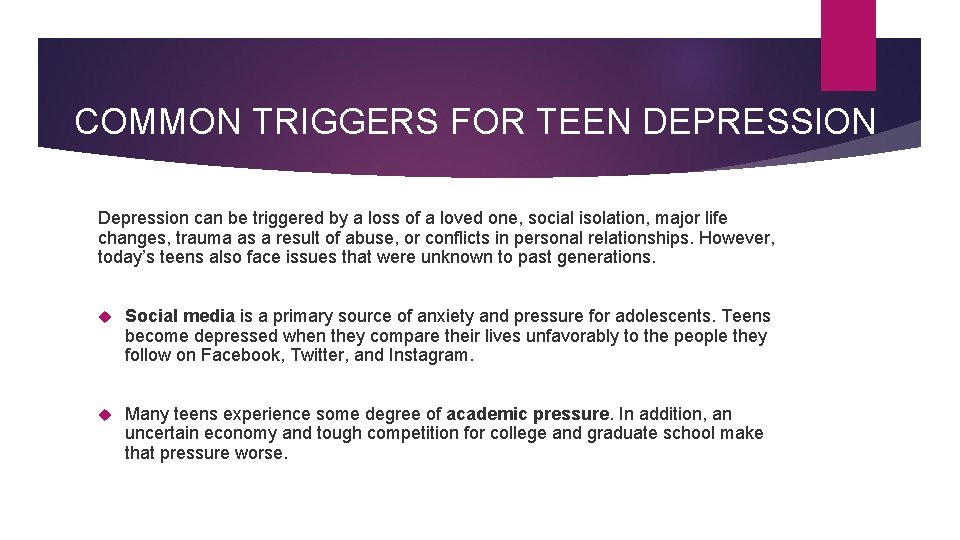
COMMON TRIGGERS FOR TEEN DEPRESSION Depression can be triggered by a loss of a loved one, social isolation, major life changes, trauma as a result of abuse, or conflicts in personal relationships. However, today’s teens also face issues that were unknown to past generations. Social media is a primary source of anxiety and pressure for adolescents. Teens become depressed when they compare their lives unfavorably to the people they follow on Facebook, Twitter, and Instagram. Many teens experience some degree of academic pressure. In addition, an uncertain economy and tough competition for college and graduate school make that pressure worse.
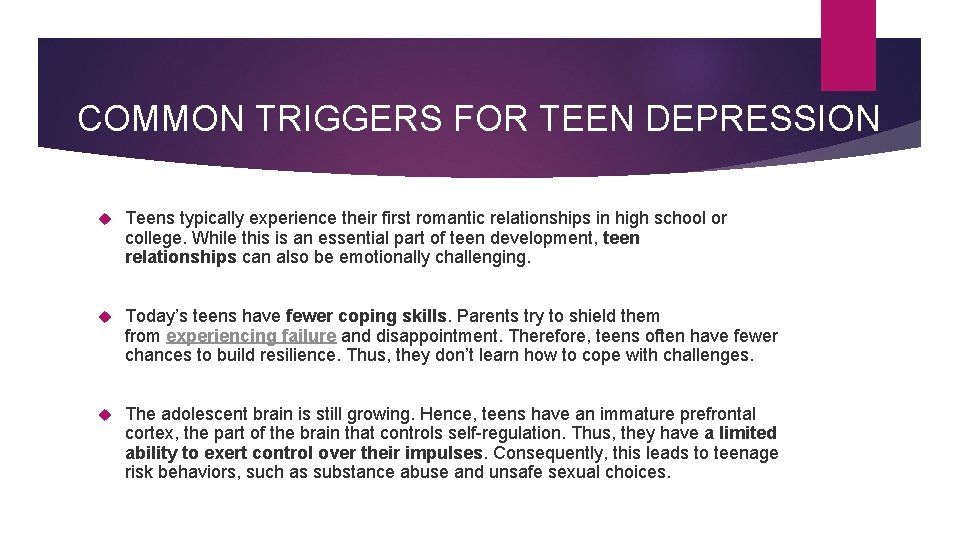
COMMON TRIGGERS FOR TEEN DEPRESSION Teens typically experience their first romantic relationships in high school or college. While this is an essential part of teen development, teen relationships can also be emotionally challenging. Today’s teens have fewer coping skills. Parents try to shield them from experiencing failure and disappointment. Therefore, teens often have fewer chances to build resilience. Thus, they don’t learn how to cope with challenges. The adolescent brain is still growing. Hence, teens have an immature prefrontal cortex, the part of the brain that controls self-regulation. Thus, they have a limited ability to exert control over their impulses. Consequently, this leads to teenage risk behaviors, such as substance abuse and unsafe sexual choices.
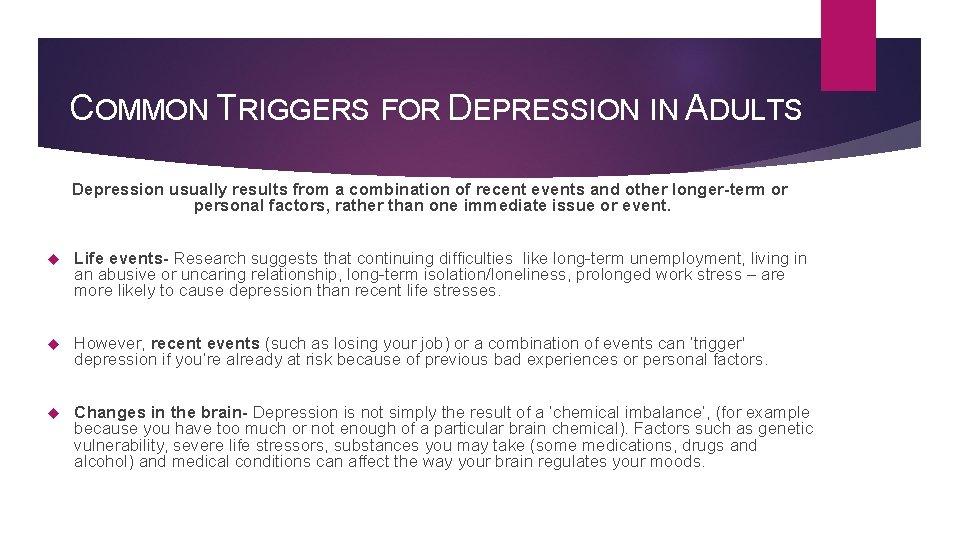
COMMON TRIGGERS FOR DEPRESSION IN ADULTS Depression usually results from a combination of recent events and other longer-term or personal factors, rather than one immediate issue or event. Life events- Research suggests that continuing difficulties like long-term unemployment, living in an abusive or uncaring relationship, long-term isolation/loneliness, prolonged work stress – are more likely to cause depression than recent life stresses. However, recent events (such as losing your job) or a combination of events can ‘trigger' depression if you’re already at risk because of previous bad experiences or personal factors. Changes in the brain- Depression is not simply the result of a ‘chemical imbalance’, (for example because you have too much or not enough of a particular brain chemical). Factors such as genetic vulnerability, severe life stressors, substances you may take (some medications, drugs and alcohol) and medical conditions can affect the way your brain regulates your moods.
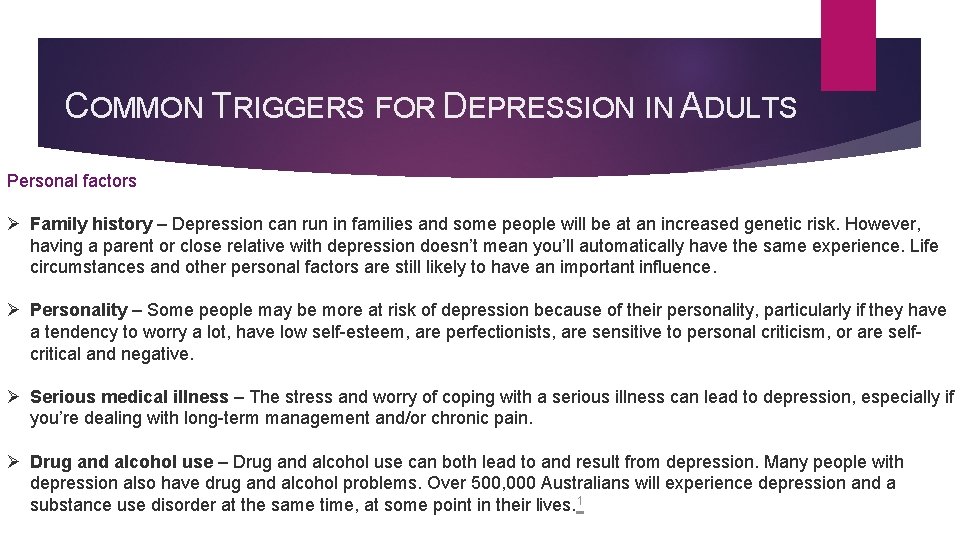
COMMON TRIGGERS FOR DEPRESSION IN ADULTS Personal factors Ø Family history – Depression can run in families and some people will be at an increased genetic risk. However, having a parent or close relative with depression doesn’t mean you’ll automatically have the same experience. Life circumstances and other personal factors are still likely to have an important influence. Ø Personality – Some people may be more at risk of depression because of their personality, particularly if they have a tendency to worry a lot, have low self-esteem, are perfectionists, are sensitive to personal criticism, or are selfcritical and negative. Ø Serious medical illness – The stress and worry of coping with a serious illness can lead to depression, especially if you’re dealing with long-term management and/or chronic pain. Ø Drug and alcohol use – Drug and alcohol use can both lead to and result from depression. Many people with depression also have drug and alcohol problems. Over 500, 000 Australians will experience depression and a substance use disorder at the same time, at some point in their lives. 1
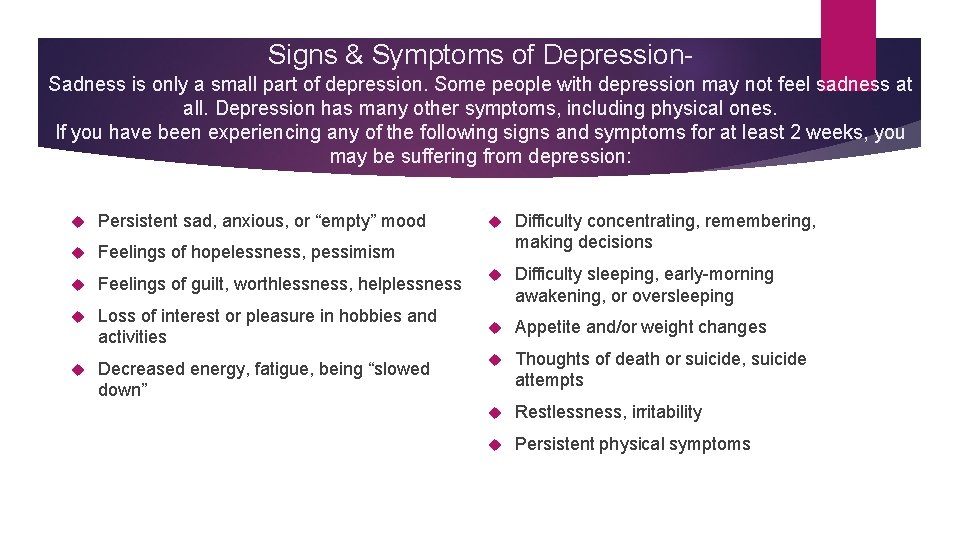
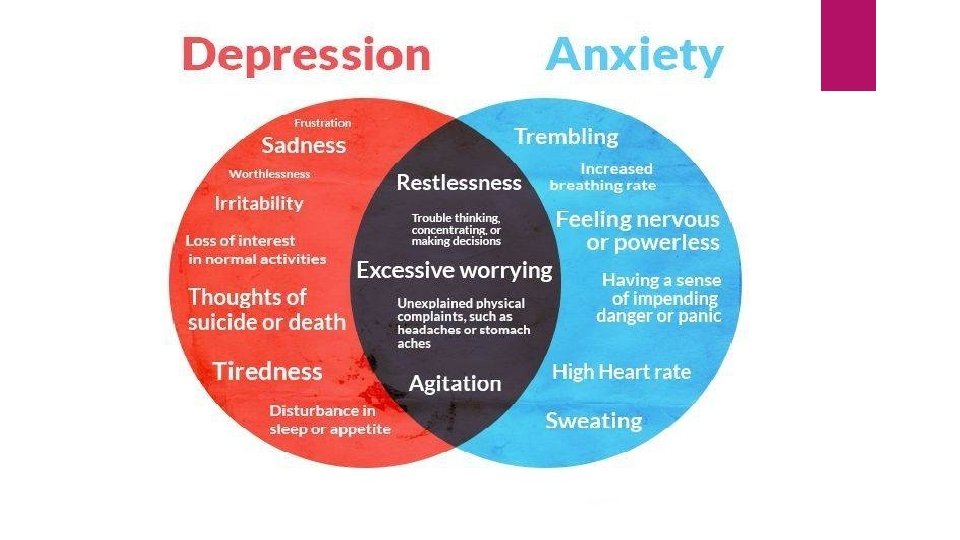
Signs & Symptoms of Depression. Sadness is only a small part of depression. Some people with depression may not feel sadness at all. Depression has many other symptoms, including physical ones. If you have been experiencing any of the following signs and symptoms for at least 2 weeks, you may be suffering from depression: Persistent sad, anxious, or “empty” mood Feelings of hopelessness, pessimism Feelings of guilt, worthlessness, helplessness Loss of interest or pleasure in hobbies and activities Decreased energy, fatigue, being “slowed down” Difficulty concentrating, remembering, making decisions Difficulty sleeping, early-morning awakening, or oversleeping Appetite and/or weight changes Thoughts of death or suicide, suicide attempts Restlessness, irritability Persistent physical symptoms
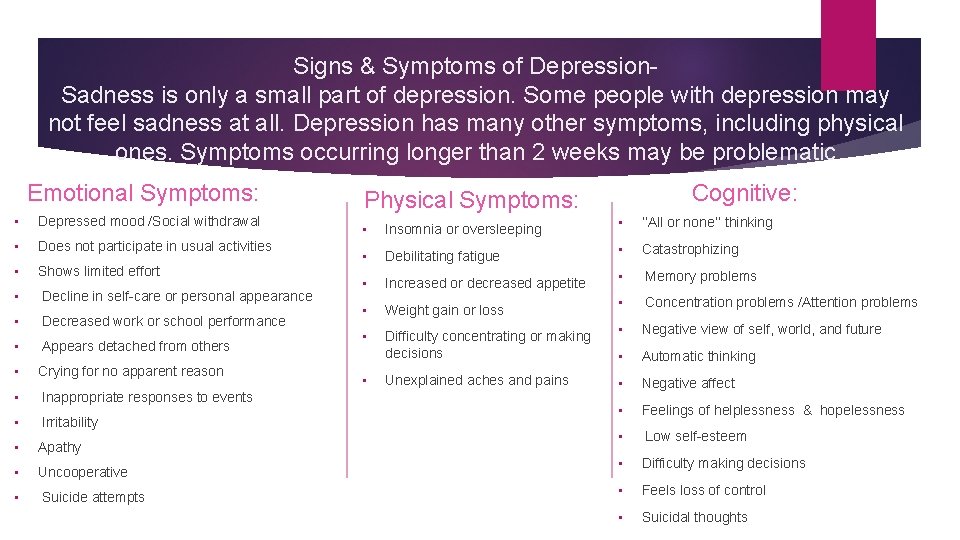
Signs & Symptoms of Depression. Sadness is only a small part of depression. Some people with depression may not feel sadness at all. Depression has many other symptoms, including physical ones. Symptoms occurring longer than 2 weeks may be problematic Emotional Symptoms: • Depressed mood /Social withdrawal • Does not participate in usual activities • Shows limited effort • • Decline in self-care or personal appearance Decreased work or school performance Appears detached from others Crying for no apparent reason • Inappropriate responses to events • Irritability • Apathy • Uncooperative • Suicide attempts Cognitive: Physical Symptoms: • Insomnia or oversleeping • ‘‘All or none’’ thinking • Debilitating fatigue • Catastrophizing • Increased or decreased appetite • Memory problems • Weight gain or loss • Concentration problems /Attention problems • Difficulty concentrating or making decisions • Negative view of self, world, and future • Automatic thinking Unexplained aches and pains • Negative affect • Feelings of helplessness & hopelessness • • Low self-esteem • Difficulty making decisions • Feels loss of control • Suicidal thoughts
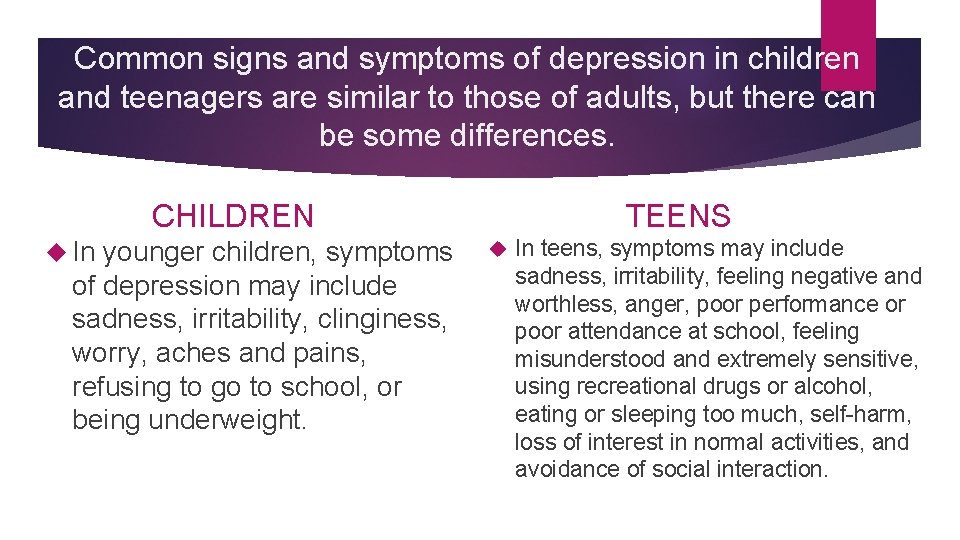
Common signs and symptoms of depression in children and teenagers are similar to those of adults, but there can be some differences. TEENS CHILDREN In younger children, symptoms of depression may include sadness, irritability, clinginess, worry, aches and pains, refusing to go to school, or being underweight. In teens, symptoms may include sadness, irritability, feeling negative and worthless, anger, poor performance or poor attendance at school, feeling misunderstood and extremely sensitive, using recreational drugs or alcohol, eating or sleeping too much, self-harm, loss of interest in normal activities, and avoidance of social interaction.
Living with Depression Treatment Diagnosis A mental health professional, such as a psychiatrist, psychologist, social worker, or mental health counselor, who should discuss with you any family history of depression or other mental disorder, and get a complete history of your symptoms. A diagnosis of depression usually depends on frequency and duration- requiring certain symptoms to occur for two weeks or more. Episodes may occur only once in a lifetime or may be recurrent, chronic, or longstanding. In some cases, they seem to last forever. Symptoms may appear to be precipitated by life crises. At other times, they may seem to occur at random. Medicines (antidepressant) are often used to treat depression. Psychotherapy (where a person talks with a trained professional about his or her thoughts and feeling) or a combination of the two. Remember: No two people are affected the same way by depression. There is no “onesize-fits-all” for treatment. It may take some trial and error to find the treatment that works best for you. Cognitive Behavioral Therapy (CBT)-CBT interventions for depression generally focus on helping clients become more engaged in activities that they value and have given up since becoming depressed. Treatment also involves helping clients evaluate negative beliefs about themselves, the world, and the future that lead to them feel depressed.
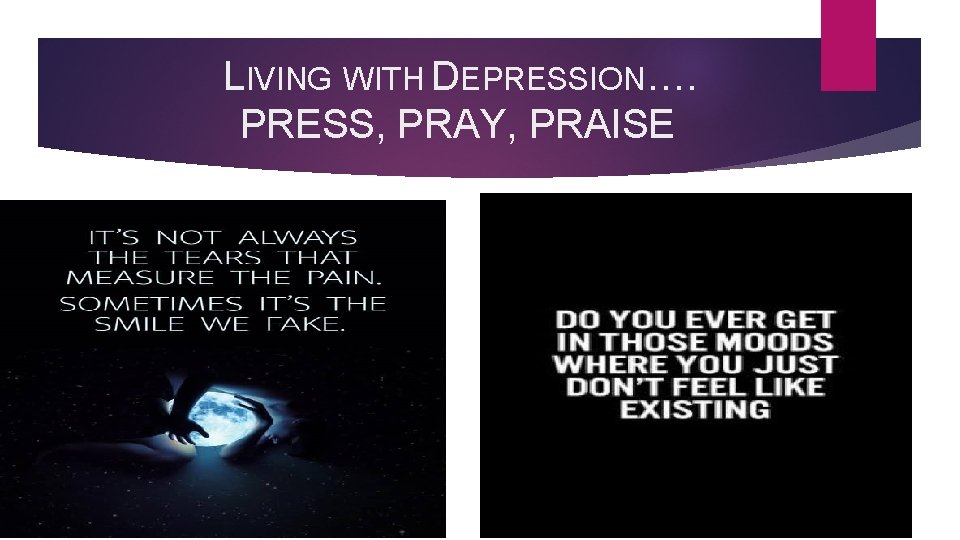
LIVING WITH DEPRESSION…. PRESS, PRAY, PRAISE
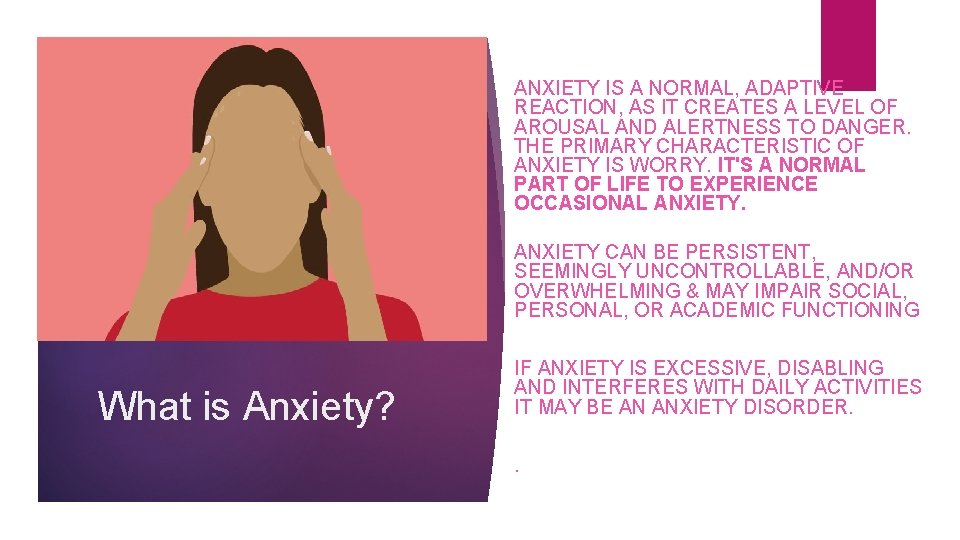
ANXIETY IS A NORMAL, ADAPTIVE REACTION, AS IT CREATES A LEVEL OF AROUSAL AND ALERTNESS TO DANGER. THE PRIMARY CHARACTERISTIC OF ANXIETY IS WORRY. IT'S A NORMAL PART OF LIFE TO EXPERIENCE OCCASIONAL ANXIETY CAN BE PERSISTENT, SEEMINGLY UNCONTROLLABLE, AND/OR OVERWHELMING & MAY IMPAIR SOCIAL, PERSONAL, OR ACADEMIC FUNCTIONING What is Anxiety? IF ANXIETY IS EXCESSIVE, DISABLING AND INTERFERES WITH DAILY ACTIVITIES IT MAY BE AN ANXIETY DISORDER. .
Anxiety is one of the most common experiences of children and adults. • National prevalence data indicate that nearly 40 million people in the United States (18%) experience an anxiety disorder in any given year. • Approximately 8% of children and teenagers experience an anxiety disorder with most people developing symptoms before age 21. • Only about one-third of those suffering from an anxiety disorder receive treatment, even though the disorders are highly treatable.
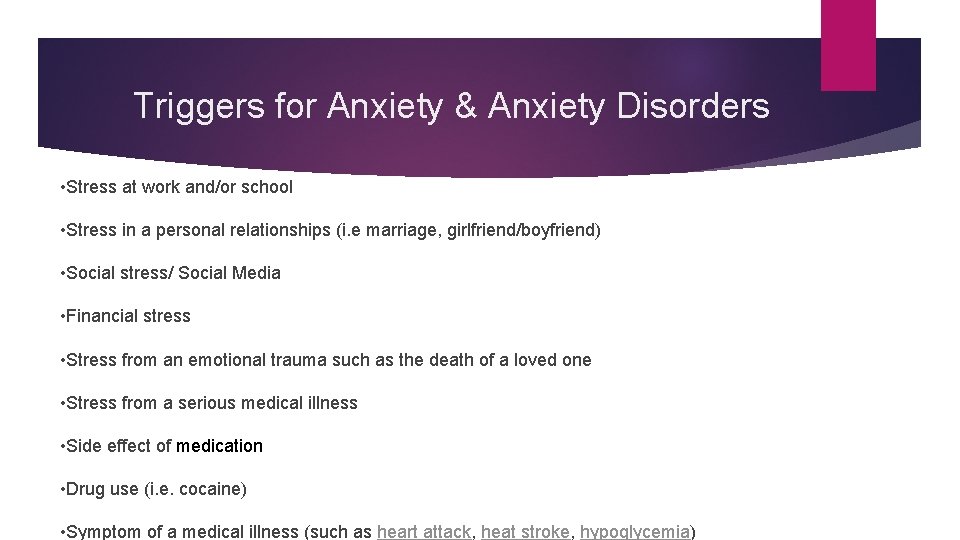
Triggers for Anxiety & Anxiety Disorders • Stress at work and/or school • Stress in a personal relationships (i. e marriage, girlfriend/boyfriend) • Social stress/ Social Media • Financial stress • Stress from an emotional trauma such as the death of a loved one • Stress from a serious medical illness • Side effect of medication • Drug use (i. e. cocaine) • Symptom of a medical illness (such as heart attack, heat stroke, hypoglycemia)
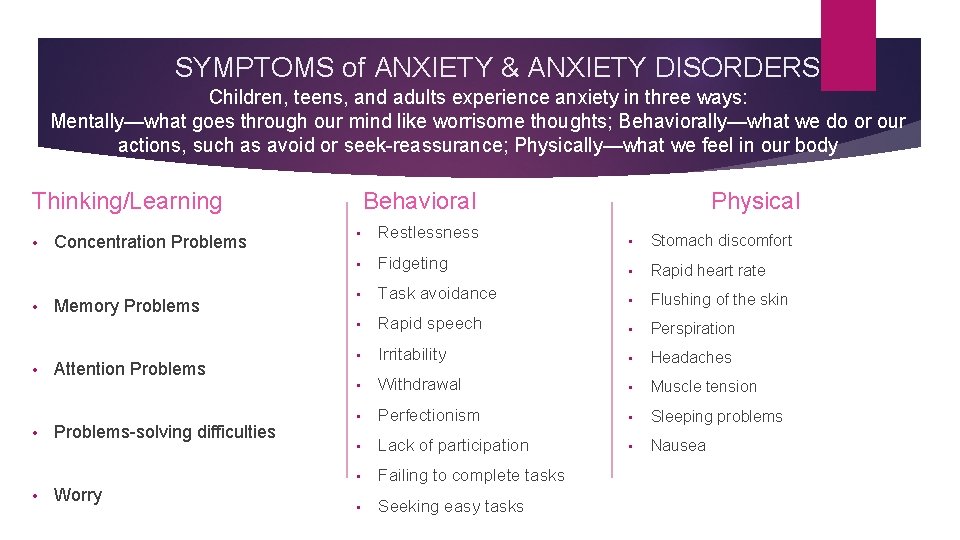
SYMPTOMS of ANXIETY & ANXIETY DISORDERS Children, teens, and adults experience anxiety in three ways: Mentally—what goes through our mind like worrisome thoughts; Behaviorally—what we do or our actions, such as avoid or seek-reassurance; Physically—what we feel in our body Behavioral Thinking/Learning • • • Concentration Problems Memory Problems Attention Problems-solving difficulties Worry • Restlessness • Physical • Stomach discomfort Fidgeting • Rapid heart rate • Task avoidance • Flushing of the skin • Rapid speech • Perspiration • Irritability • Headaches • Withdrawal • Muscle tension • Perfectionism • Sleeping problems • Lack of participation • Nausea • Failing to complete tasks • Seeking easy tasks
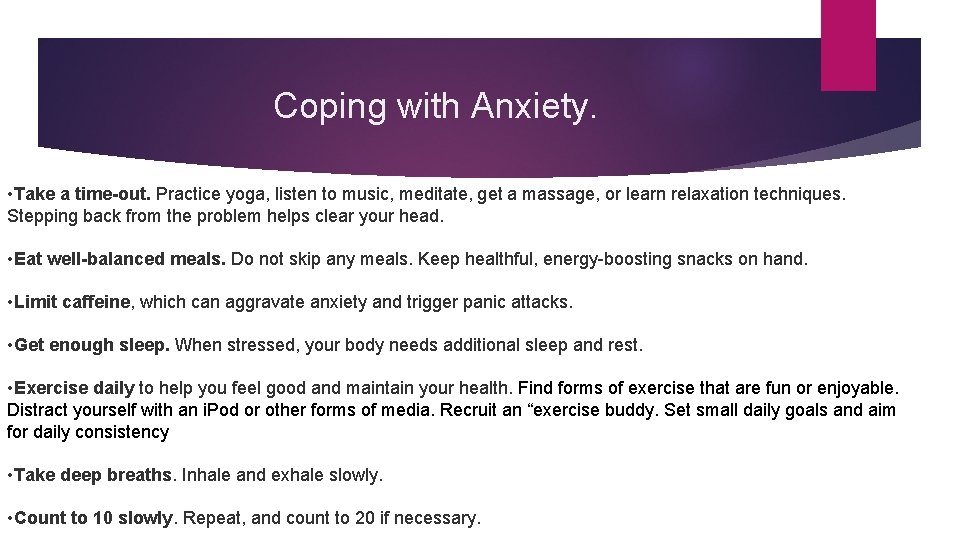
Coping with Anxiety. • Take a time-out. Practice yoga, listen to music, meditate, get a massage, or learn relaxation techniques. Stepping back from the problem helps clear your head. • Eat well-balanced meals. Do not skip any meals. Keep healthful, energy-boosting snacks on hand. • Limit caffeine, which can aggravate anxiety and trigger panic attacks. • Get enough sleep. When stressed, your body needs additional sleep and rest. • Exercise daily to help you feel good and maintain your health. Find forms of exercise that are fun or enjoyable. Distract yourself with an i. Pod or other forms of media. Recruit an “exercise buddy. Set small daily goals and aim for daily consistency • Take deep breaths. Inhale and exhale slowly. • Count to 10 slowly. Repeat, and count to 20 if necessary.
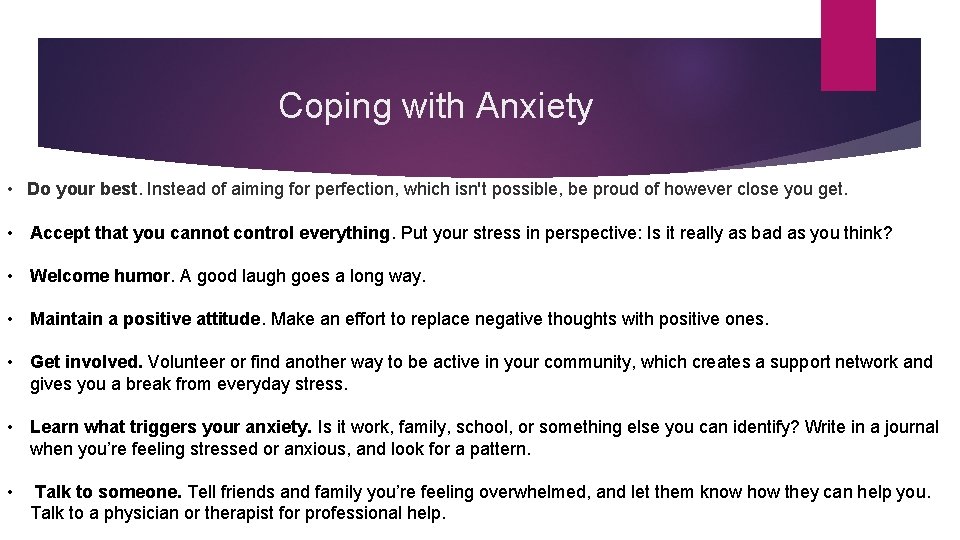
Coping with Anxiety • Do your best. Instead of aiming for perfection, which isn't possible, be proud of however close you get. • Accept that you cannot control everything. Put your stress in perspective: Is it really as bad as you think? • Welcome humor. A good laugh goes a long way. • Maintain a positive attitude. Make an effort to replace negative thoughts with positive ones. • Get involved. Volunteer or find another way to be active in your community, which creates a support network and gives you a break from everyday stress. • Learn what triggers your anxiety. Is it work, family, school, or something else you can identify? Write in a journal when you’re feeling stressed or anxious, and look for a pattern. • Talk to someone. Tell friends and family you’re feeling overwhelmed, and let them know how they can help you. Talk to a physician or therapist for professional help.
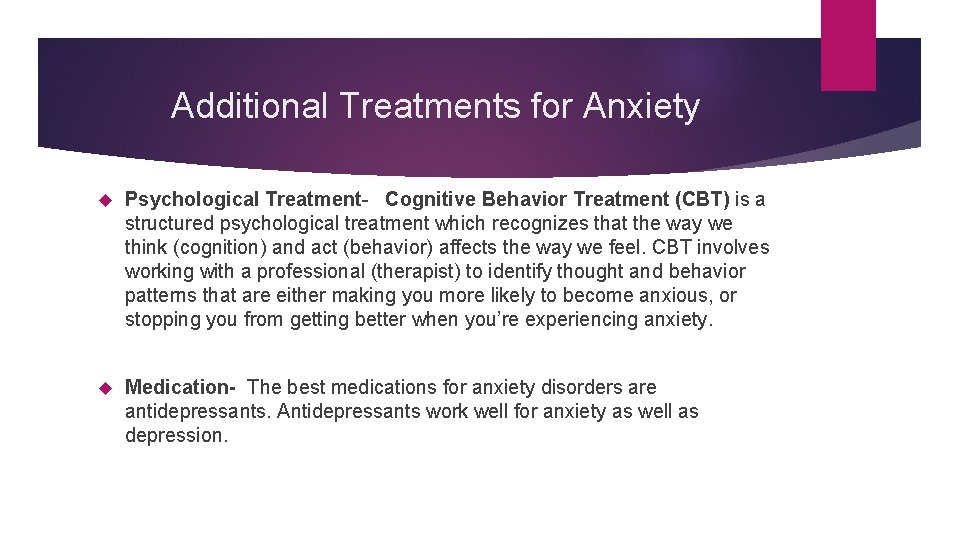
Additional Treatments for Anxiety Psychological Treatment- Cognitive Behavior Treatment (CBT) is a structured psychological treatment which recognizes that the way we think (cognition) and act (behavior) affects the way we feel. CBT involves working with a professional (therapist) to identify thought and behavior patterns that are either making you more likely to become anxious, or stopping you from getting better when you’re experiencing anxiety. Medication- The best medications for anxiety disorders are antidepressants. Antidepressants work well for anxiety as well as depression.
Additional Resources… PRESS, PRAY, PRAISE HOTLINES • National Suicide Prevention Lifeline: - 1 -800 -273 -8255 ( 24 hours/ 7 days) • Natioinal Hopeline Network: 1 -800 -SUICIDE • National Alliance on Mental Illness Help. Line: - 1 -800 -950 -6264 (Monday- Friday, 10 a. m. to 6 p. m. EST) • Teen Line: 1 -800 -852 -8336 (Everyday 6 pm-10 pm) • Planned Parenthood: 1 -800 -230 -7526 • LGBTQ Hotline: 1 -888 -843 -4564 (Monday - Friday, 4 p. m. to 12 a. m. EST, Saturday, 12 p. m. to 5 p. m. EST)