
PreSession Breakout for Articulation Officers July 7 2020
Pre-Session Breakout for Articulation Officers July 7, 2020

Session Description This session is intended as a training and collaboration session for all articulation officers, new and experienced. Discussion topics will include the role of the articulation officer in the curricular process, updates on the Course Identification Numbering (C-ID) System, Associate Degree for Transfer, and Transfer Model Curriculum submissions to the Chancellor’s Office, ASSIST updates, expanding Advanced Placement (AP) policies to include International Baccalaureate (IB) and College-Level Examination Program CLEP, and competency based education and credit for prior learning. 2
Overview of our time together: • C-ID Updates, Eric Wada • Credit for Prior Learning, Benjamin Mudgett • Competency Based Education, IB and CLEP policies, Cheryl Aschenbach • Chancellor’s Office support of articulation, Bob Quinn and Devin Rodriguez • Role of the AO in Curriculum, Tiffany Tran • ASSIST Updates, Holly Demé 3
• Overview of Pathable Platform April Lonero ASCCC • Poll #1: How many years of experience do you have in articulation? 4
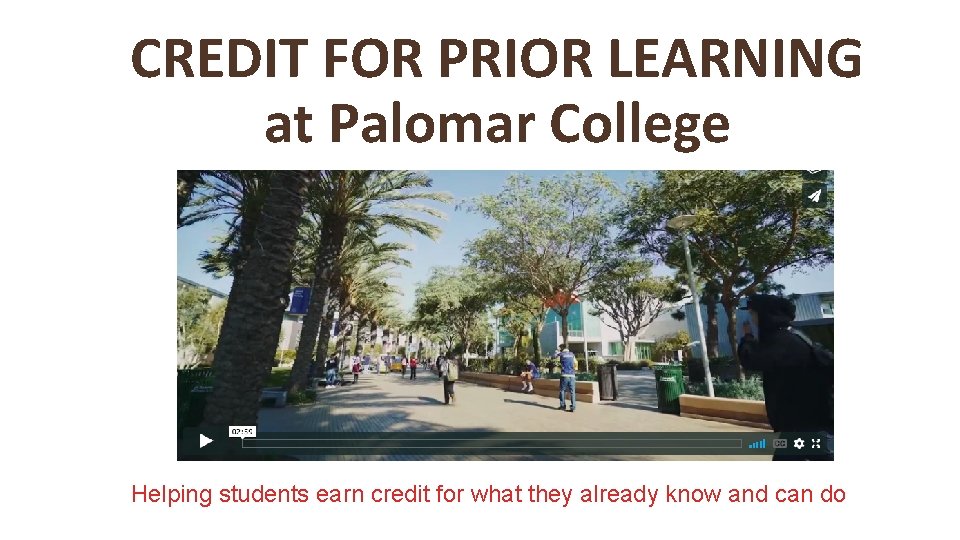
CREDIT FOR PRIOR LEARNING at Palomar College Helping students earn credit for what they already know and can do
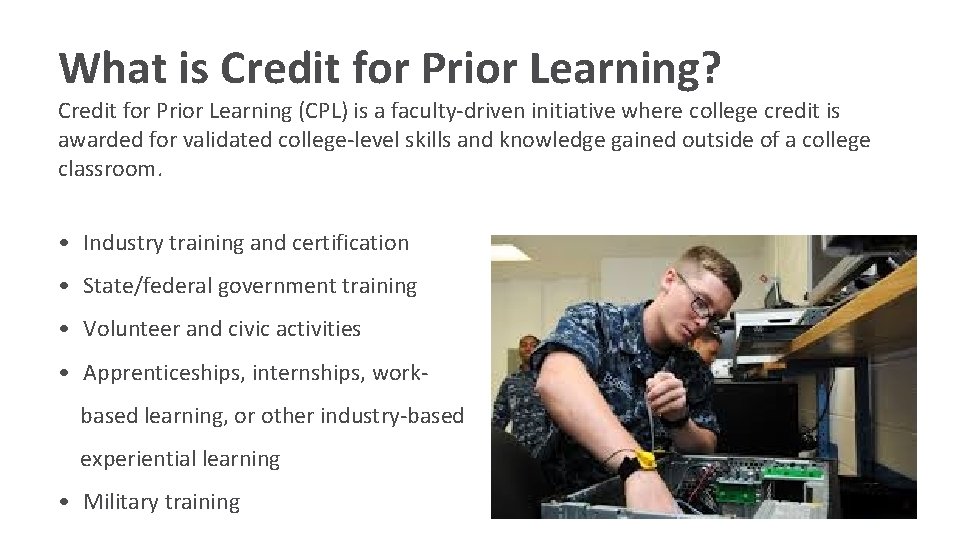
What is Credit for Prior Learning? Credit for Prior Learning (CPL) is a faculty-driven initiative where college credit is awarded for validated college-level skills and knowledge gained outside of a college classroom. • Industry training and certification • State/federal government training • Volunteer and civic activities • Apprenticeships, internships, workbased learning, or other industry-based experiential learning • Military training
Credit for Prior Learning in California In 2018, Governor Brown signed two bills that mandate Credit for Prior Learning in California Community Colleges: SB 1071 - Public postsecondary education: Chancellor of the California Community Colleges: policy to award course credit for prior military education, training and service. AB 1786 - Community Colleges: academic credit for prior military experience
Palomar College leads the way… Palomar College was recently awarded a grant by the CA Community College Chancellor’s Office Foundation to begin CPL work with our faculty to develop learning assessment methods and streamline internal processes to award credit and remove the onus on students to pursue this option. Palomar will also implement a Credit for Prior Learning BP/AP by spring 2020 to be used as a potential BP/AP for other CA Community Colleges. Contact the Curriculum Committee CPL workgroup at cpl@palomar. edu Ben Mudgett - Articulation Officer Candace Rose - Curriculum Technical Reviewer & Media Studies Faculty Nichol Roe - Associate Dean of Workforce Development and Extended Studies Tina Barlolong - Veterans Counselor
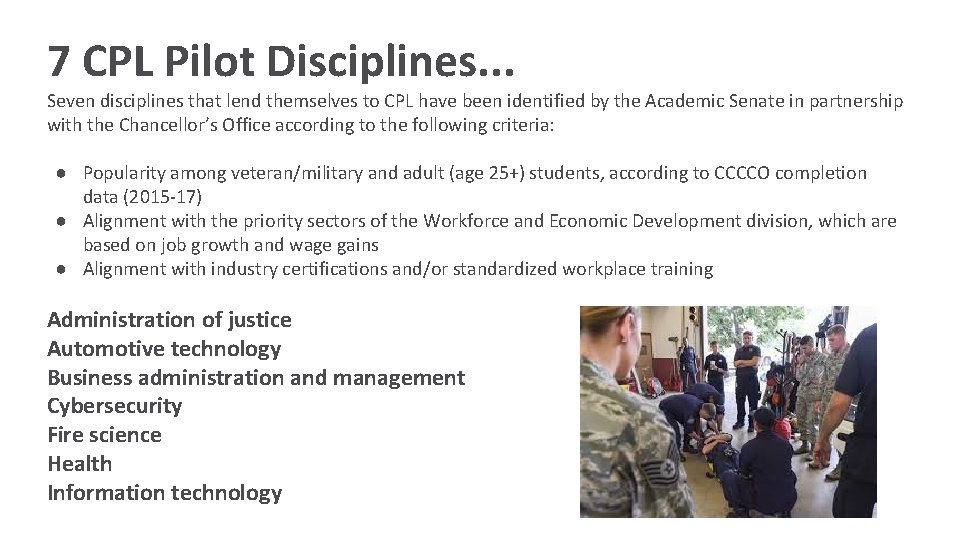
7 CPL Pilot Disciplines. . . Seven disciplines that lend themselves to CPL have been identified by the Academic Senate in partnership with the Chancellor’s Office according to the following criteria: ● Popularity among veteran/military and adult (age 25+) students, according to CCCCO completion data (2015 -17) ● Alignment with the priority sectors of the Workforce and Economic Development division, which are based on job growth and wage gains ● Alignment with industry certifications and/or standardized workplace training Administration of justice Automotive technology Business administration and management Cybersecurity Fire science Health Information technology
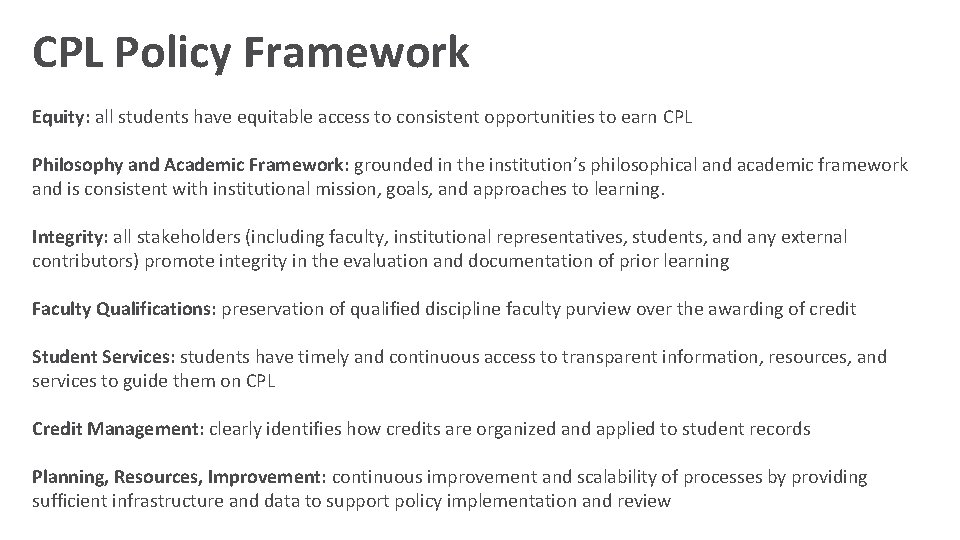
CPL Policy Framework Equity: all students have equitable access to consistent opportunities to earn CPL Philosophy and Academic Framework: grounded in the institution’s philosophical and academic framework and is consistent with institutional mission, goals, and approaches to learning. Integrity: all stakeholders (including faculty, institutional representatives, students, and any external contributors) promote integrity in the evaluation and documentation of prior learning Faculty Qualifications: preservation of qualified discipline faculty purview over the awarding of credit Student Services: students have timely and continuous access to transparent information, resources, and services to guide them on CPL Credit Management: clearly identifies how credits are organized and applied to student records Planning, Resources, Improvement: continuous improvement and scalability of processes by providing sufficient infrastructure and data to support policy implementation and review
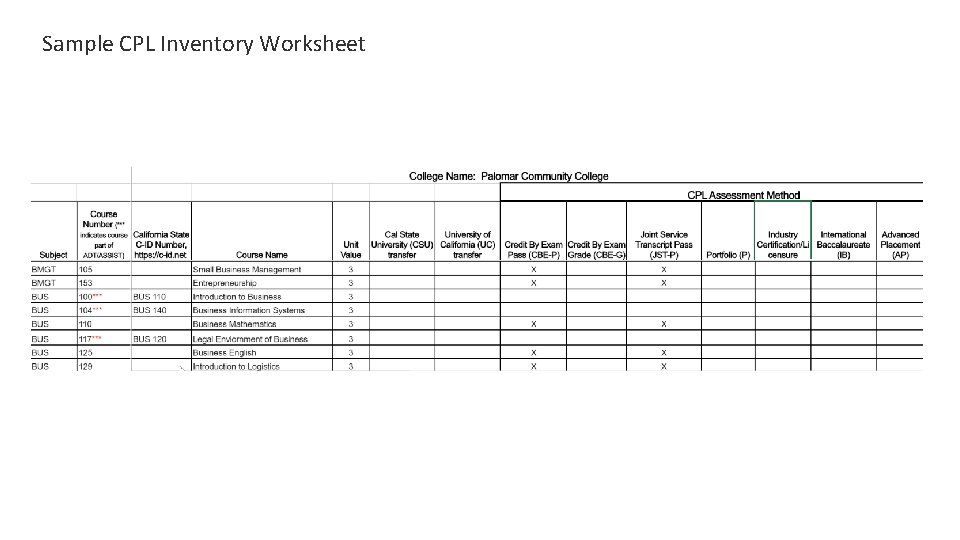
Sample CPL Inventory Worksheet
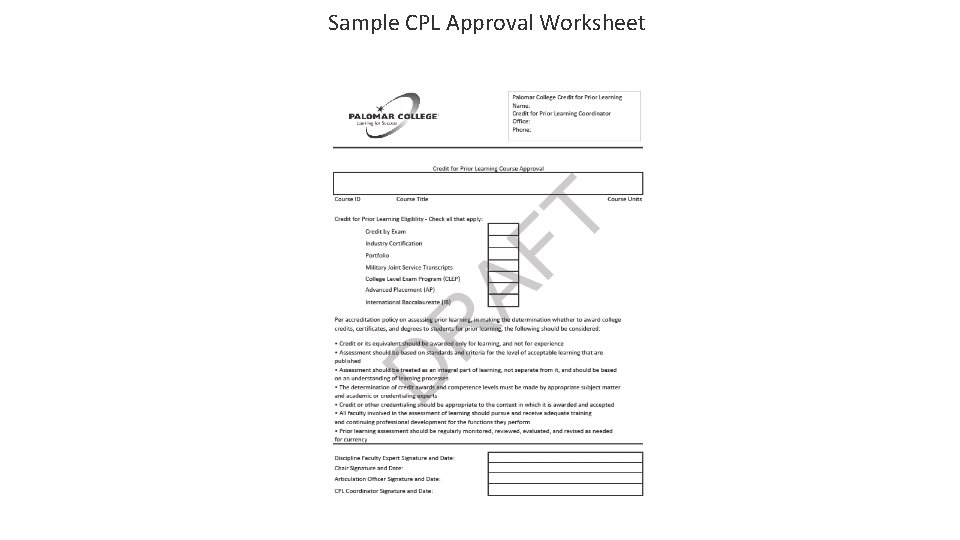
Sample CPL Approval Worksheet
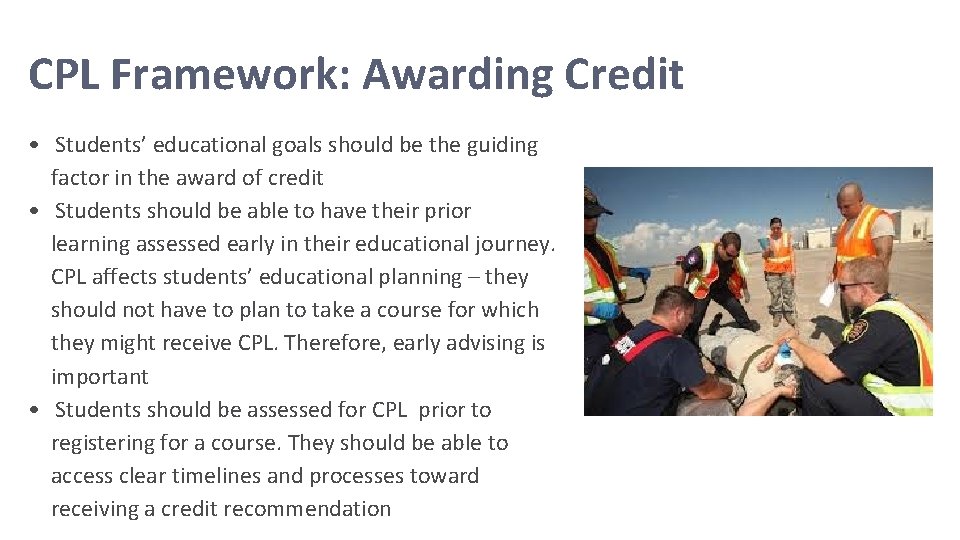
CPL Framework: Awarding Credit • Students’ educational goals should be the guiding factor in the award of credit • Students should be able to have their prior learning assessed early in their educational journey. CPL affects students’ educational planning – they should not have to plan to take a course for which they might receive CPL. Therefore, early advising is important • Students should be assessed for CPL prior to registering for a course. They should be able to access clear timelines and processes toward receiving a credit recommendation
CPL Framework: Awarding Credit ● Faculty should be encouraged to award credit in General Education or program requirements before electives. Too much elective credit can negatively impact students’ financial aid. For veteran and military students, consider a “shadow” educational plan that contains a placeholder for the course in which CPL is anticipated; this avoids the student getting too close to the financial limits on VA benefits ● Rely on existing minimum/maximum credit allowances already stipulated in transfer policy for prior learning credit ● Follow accreditation requirements ● If the student intends to transfer, consider the policies at their transfer destination
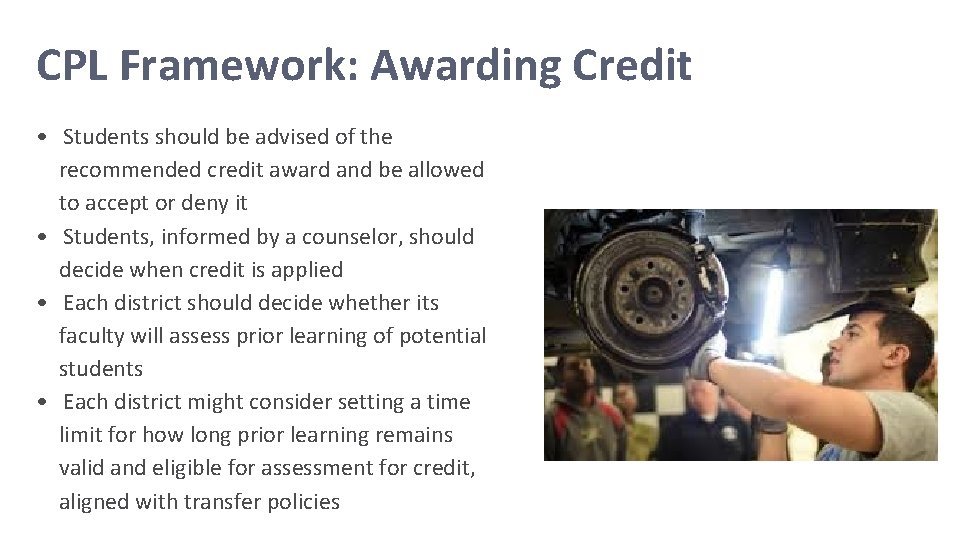
CPL Framework: Awarding Credit • Students should be advised of the recommended credit award and be allowed to accept or deny it • Students, informed by a counselor, should decide when credit is applied • Each district should decide whether its faculty will assess prior learning of potential students • Each district might consider setting a time limit for how long prior learning remains valid and eligible for assessment for credit, aligned with transfer policies
CPL Framework: Transcribing Credit The system, districts, and campuses should track student outcomes related to CPL and therefore should collect data related to number of CPL units awarded each term, trends in awarding CPL credit, outcomes of students who earn CPL (parsed by number of units earned, when they were earned), and other metrics.
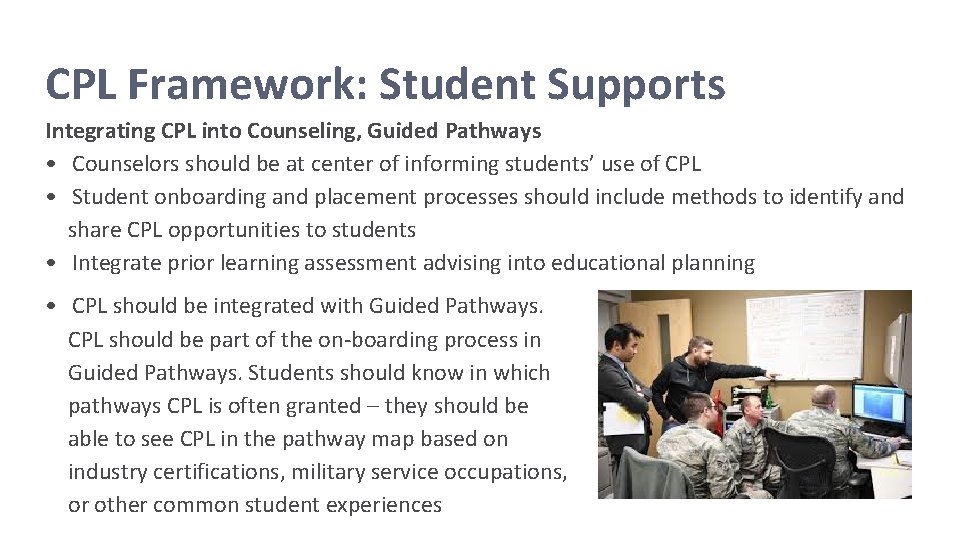
CPL Framework: Student Supports Integrating CPL into Counseling, Guided Pathways • Counselors should be at center of informing students’ use of CPL • Student onboarding and placement processes should include methods to identify and share CPL opportunities to students • Integrate prior learning assessment advising into educational planning • CPL should be integrated with Guided Pathways. CPL should be part of the on-boarding process in Guided Pathways. Students should know in which pathways CPL is often granted – they should be able to see CPL in the pathway map based on industry certifications, military service occupations, or other common student experiences
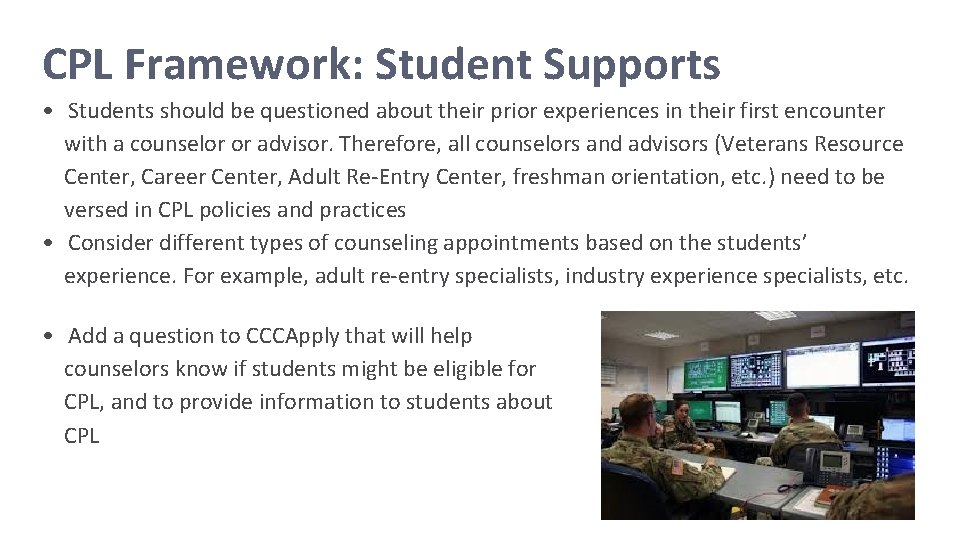
CPL Framework: Student Supports • Students should be questioned about their prior experiences in their first encounter with a counselor or advisor. Therefore, all counselors and advisors (Veterans Resource Center, Career Center, Adult Re-Entry Center, freshman orientation, etc. ) need to be versed in CPL policies and practices • Consider different types of counseling appointments based on the students’ experience. For example, adult re-entry specialists, industry experience specialists, etc. • Add a question to CCCApply that will help counselors know if students might be eligible for CPL, and to provide information to students about CPL
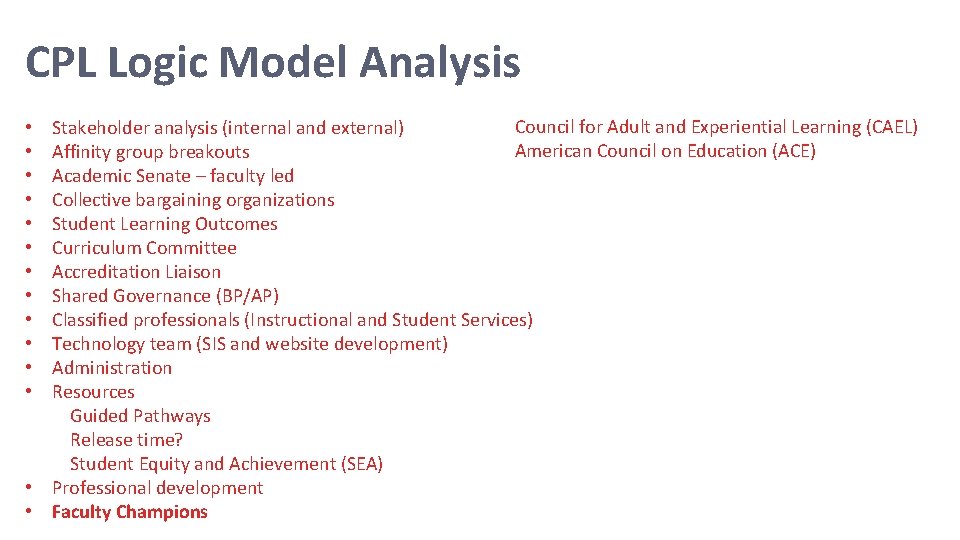
CPL Logic Model Analysis Council for Adult and Experiential Learning (CAEL) Stakeholder analysis (internal and external) American Council on Education (ACE) Affinity group breakouts Academic Senate – faculty led Collective bargaining organizations Student Learning Outcomes Curriculum Committee Accreditation Liaison Shared Governance (BP/AP) Classified professionals (Instructional and Student Services) Technology team (SIS and website development) Administration Resources Guided Pathways Release time? Student Equity and Achievement (SEA) • Professional development • Faculty Champions • • •
Thank You! Palomar College Future CPL Coordinator cpl@palomar. edu
C-ID Update Eric Wada ASCCC C-ID Curriculum Director Folsom Lake College
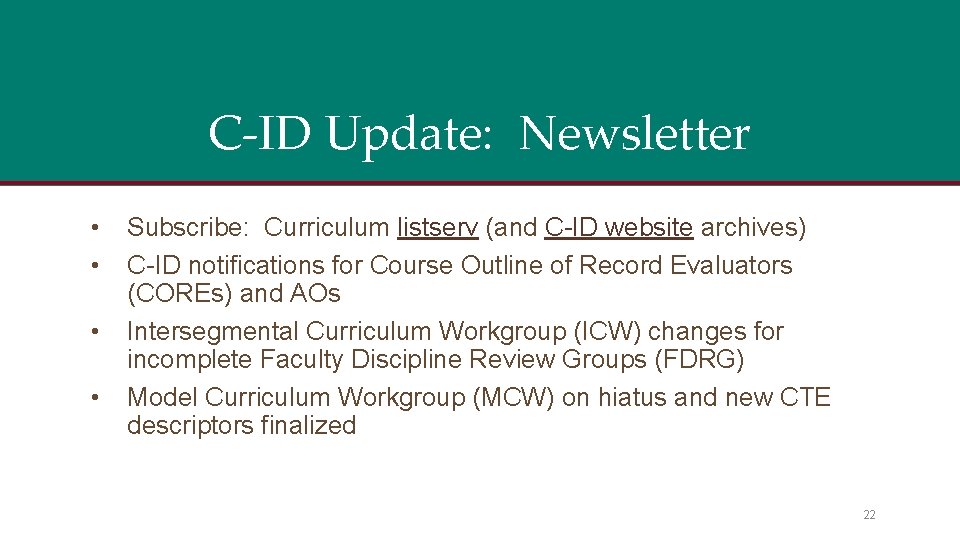
C-ID Update: Newsletter • • Subscribe: Curriculum listserv (and C-ID website archives) C-ID notifications for Course Outline of Record Evaluators (COREs) and AOs Intersegmental Curriculum Workgroup (ICW) changes for incomplete Faculty Discipline Review Groups (FDRG) Model Curriculum Workgroup (MCW) on hiatus and new CTE descriptors finalized 22
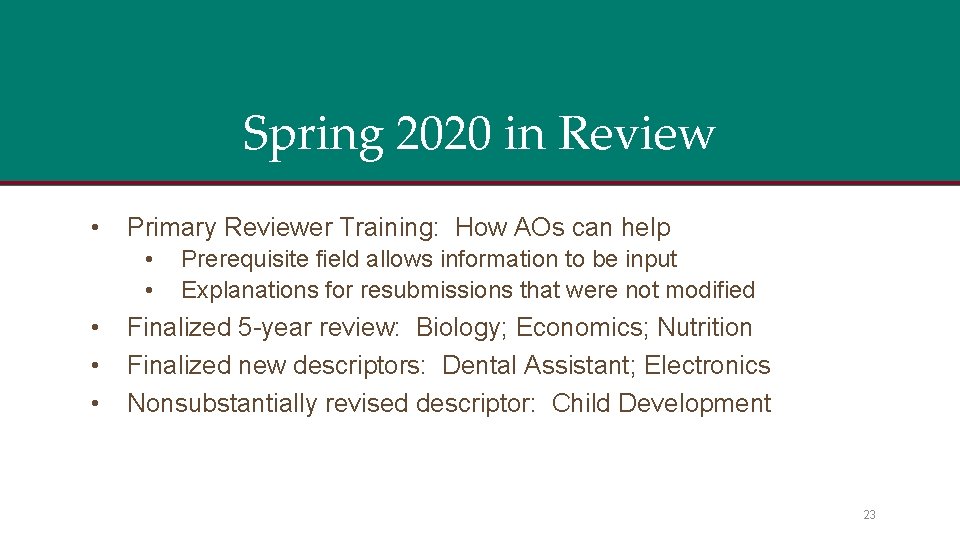
Spring 2020 in Review • Primary Reviewer Training: How AOs can help • • • Prerequisite field allows information to be input Explanations for resubmissions that were not modified Finalized 5 -year review: Biology; Economics; Nutrition Finalized new descriptors: Dental Assistant; Electronics Nonsubstantially revised descriptor: Child Development 23
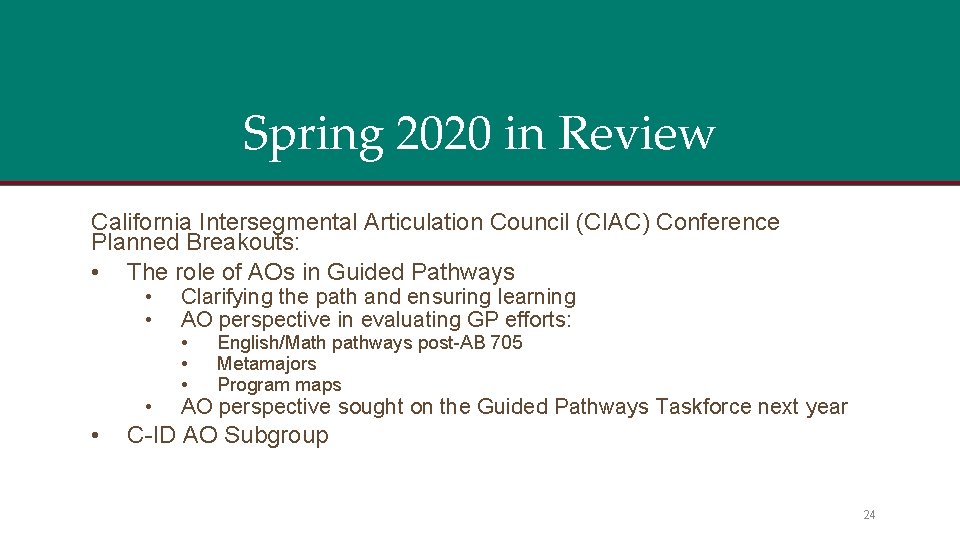
Spring 2020 in Review California Intersegmental Articulation Council (CIAC) Conference Planned Breakouts: • The role of AOs in Guided Pathways • • • Clarifying the path and ensuring learning AO perspective in evaluating GP efforts: • AO perspective sought on the Guided Pathways Taskforce next year • • • English/Math pathways post-AB 705 Metamajors Program maps C-ID AO Subgroup 24
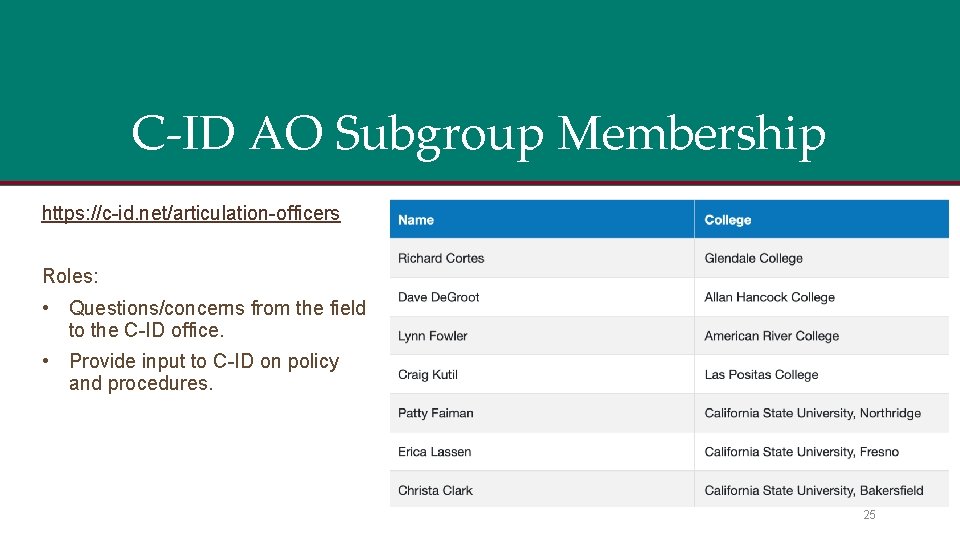
C-ID AO Subgroup Membership https: //c-id. net/articulation-officers Roles: • Questions/concerns from the field to the C-ID office. • Provide input to C-ID on policy and procedures. 25
Looking Ahead • • • FDRG and CORE recruitment Transfer Model Curriculum (TMC) and C-ID descriptors: Commence and complete in-progress reviews UC Transfer Pathway and TMC discussions 26
Contact Information AO networking event at 1 pm C-ID specific questions: support@c-id. net Curriculum and Governance questions: info@asccc. org 27
Credit for Prior Learning Benjamin Mudgett Articulation Officer Palomar College Polls #2 and #3: • How familiar are you with crosswalking learning outcomes? • How familiar are you with experiential learning?
Cheryl Aschenbach ASCCC • Expanding Advanced Placement (AP) policies to include International Baccalaureate (IB) and College-Level Examination Program (CLEP) • Competency based education (CBE) For more information on this topic, please consider attending Breakout Session 3 on Wednesday, July 8 th from 1: 00 p. m. - 2: 15 p. m. 29
Support and Resources for Articulation Officers
Introductions CCC Chancellor’s Office • • Bob Quinn, Academic Affairs, Specialist Devin Rodriguez, Associate Governmental Program Analyst 31
Presentation Change Please Note: For a detailed session on the Submission of ADTs and Double Counting, Wednesday July 9 at 2: 45 p. m. 32
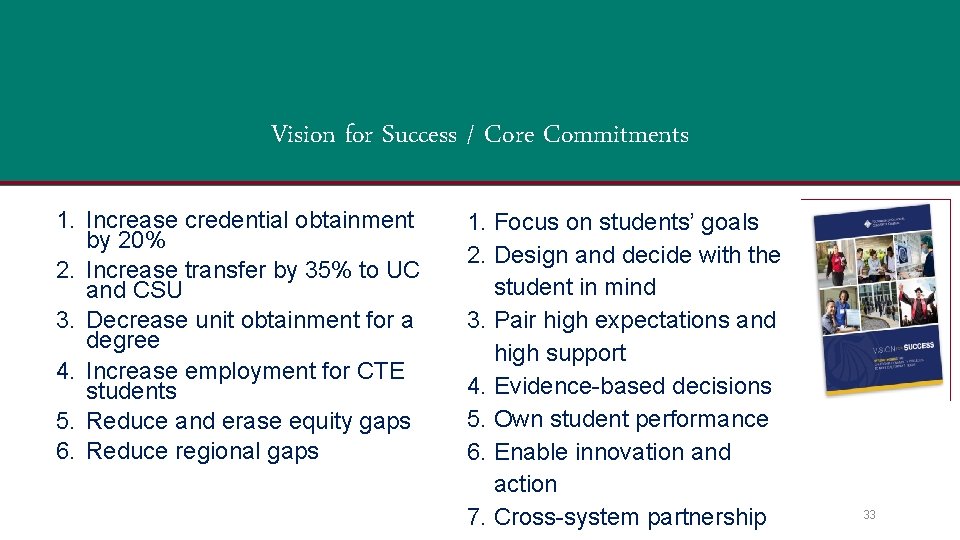
Vision for Success / Core Commitments 1. Increase credential obtainment by 20% 2. Increase transfer by 35% to UC and CSU 3. Decrease unit obtainment for a degree 4. Increase employment for CTE students 5. Reduce and erase equity gaps 6. Reduce regional gaps 1. Focus on students’ goals 2. Design and decide with the student in mind 3. Pair high expectations and high support 4. Evidence-based decisions 5. Own student performance 6. Enable innovation and action 7. Cross-system partnership 33
Call to Action for Equity 1. Systemwide review of police and first responder training and curriculum. 2. Campus leaders host open dialogue and address campus climate. 3. Campuses audit classroom climate and create an action plan to create inclusive classrooms and anti-racism curriculum. 4. District Boards review and update your Equity plans with urgency. 5. Shorten the time for the full implementation of the DEI Integration Plan 6. Engage in the Vision Resource Center “Community Colleges for Change. ” 34
Our Responsibilities • • Represent the Chancellor's Office on statewide policy development committees as related to supporting transfer and articulation objectives Provide leadership on statewide, intersegmental projects that support and further develop transfer and articulation activities Administer technical assistance to the colleges in the areas of transfer and articulation Promote an established communication network of transfer and articulation personnel to foster two-way communication between the colleges and the Chancellor's Office 35
Examples of Support We Provide • • • Transfer-related policy information or clarification Annual New AO training, a two-day session each September Transfer data support Annual reporting and dissemination of college articulation activities Committees and Advisories, including the state-level AO Regional Representatives committee Intersegmental transfer-related support 36
Additional Support Contacts • Articulation officer statewide regional representative - Your regional representative is a great resource for questions, and can keep you in the loop regarding upcoming regional meetings to attend. If you do not know your regional representative please contact us. • The ASSIST Coordination Site at help@assist. org – Request training and Subscribe to the ASSIST Resource Center News to receive the latest updates. 37
COVID-19 Updates Related to Transfer Be sure to check the link below often for new information and updates about transfer programs during the crisis. • A Degree with a Guarantee • Transfer FAQ’s https: //www. cccco. edu/About-Us/Chancellors Office/Divisions/Communications-and-Marketing/Novel. Coronavirus/students/transfer 38
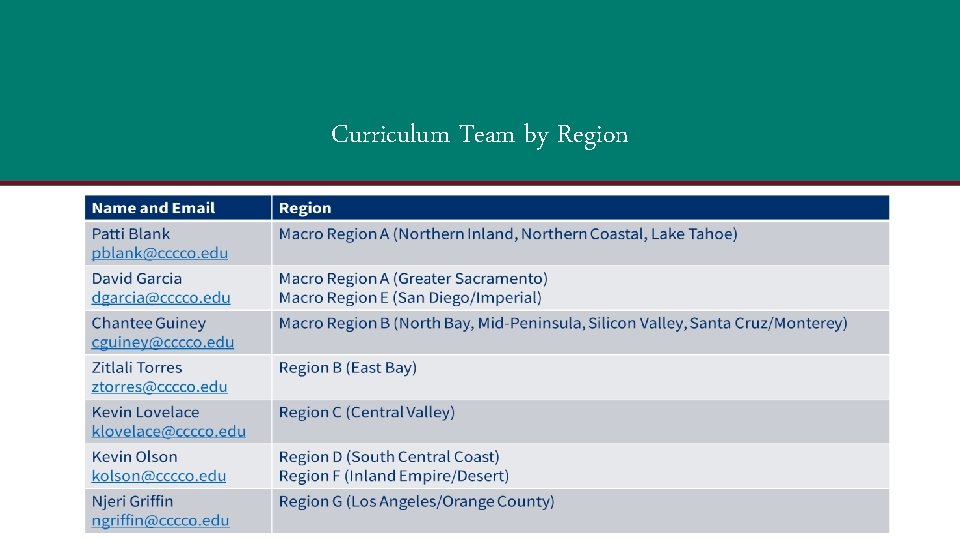
Curriculum Team by Region 39
We are here to support you Noncredit – Chantee Guiney (cguiney@cccco. edu); Neil Kelly (nkelly@cccco. edu) ADT Submissions – Kevin Olson (kolson@cccco. edu); Njeri Griffin (ngriffin@cccco. edu) Financial Aid – Gina Browne (gbrowne@cccco. edu) Apportionment - Wrenna Finche (wfinche@cccco. edu) Articulation & Transfer – Bob Quinn (bquinn@cccco. edu); Devin Rodriguez (drodriguez@cccco. edu) Competency Based Education – Chantee Guiney (cguiney@cccco. edu) Credit for Prior Learning – Chantee Guiney (cguiney@cccco. edu) 40
CCC Chancellor’s Office Contact Information Bob Quinn Academic Affairs, Specialist bquinn@cccco. edu Devin Rodriguez, Associate Governmental Program Analyst drodriguez@cccco. edu 41
Articulation Officer Role in Curriculum Tiffany Tran Irvine Valley College Counseling Faculty/Articulation Officer
Definition of Articulation ● Articulation is the process by which community college courses are granted appropriate credit at other higher education institutions. ● Articulation is faculty and curriculum driven. ● Successful articulation creates an academic pathway that eases students’ transitions.
ASCCC Resolutions Number: 04. 01 Fall 1992 ○ Articulation Officer serve as a resource to curriculum committee. ○ Articulation Officer be a campus priority, including with clerical assistance. Number: 04. 01 Fall 1998 ○ Articulation Officer and Transfer Center Director be faculty positions. ○ Articulation Officer and Transfer Center Director be full-time or, in cases of smaller colleges, at least a fifty percent assignment.
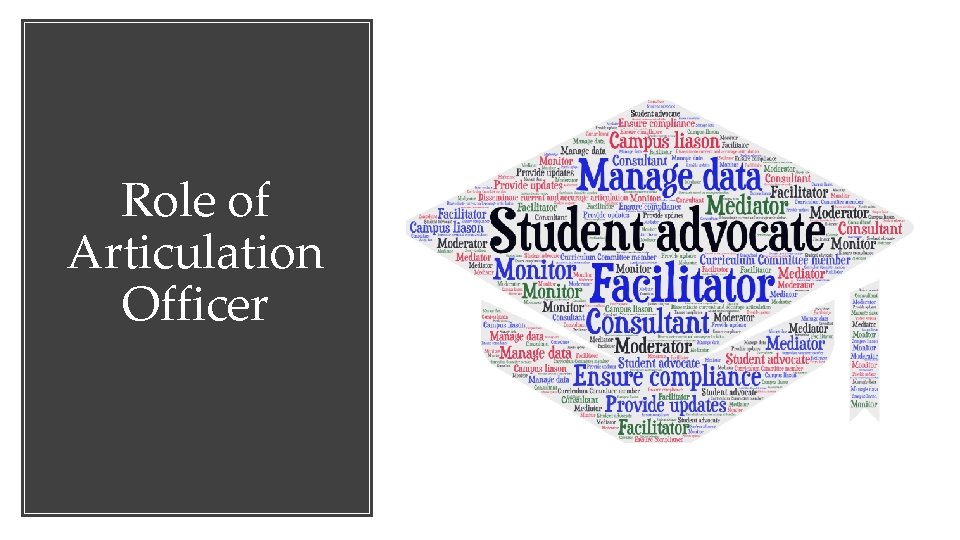
Role of Articulation Officer
Key Team Members ● ● ● ● UC articulation officers and staff from UC Office of the President CSU articulation officers and staff from CSU Chancellor’s Office Discipline faculty Private schools and out-of-state articulation officers Counselors Curriculum Chair and Curriculum Committee members Evaluators Publications Matriculation staff Transfer Center staff District-wide articulation Regional articulation officers California Community Colleges Chancellor’s Office Deans, VPI and VPSS Academic Senate executive officers, local and statewide
Programs ● ASSIST. ORG ● C-ID (Course Identification) Number ● ADT (Associate Degree from Transfer) and TMC (Transfer Model Curriculum) ● CPL (Credit for Prior Learning) ● IB (International Baccalaureate) and CLEP (College Level Examination Program) Policies ● CBE (Competency Based Education)
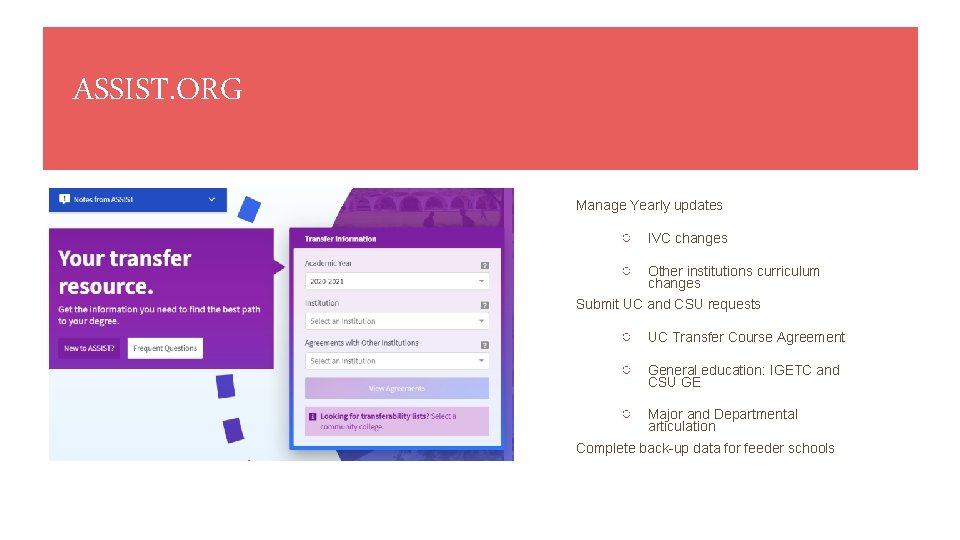
ASSIST. ORG Manage Yearly updates ○ IVC changes ○ Other institutions curriculum changes Submit UC and CSU requests ○ UC Transfer Course Agreement ○ General education: IGETC and CSU GE ○ Major and Departmental articulation Complete back-up data for feeder schools
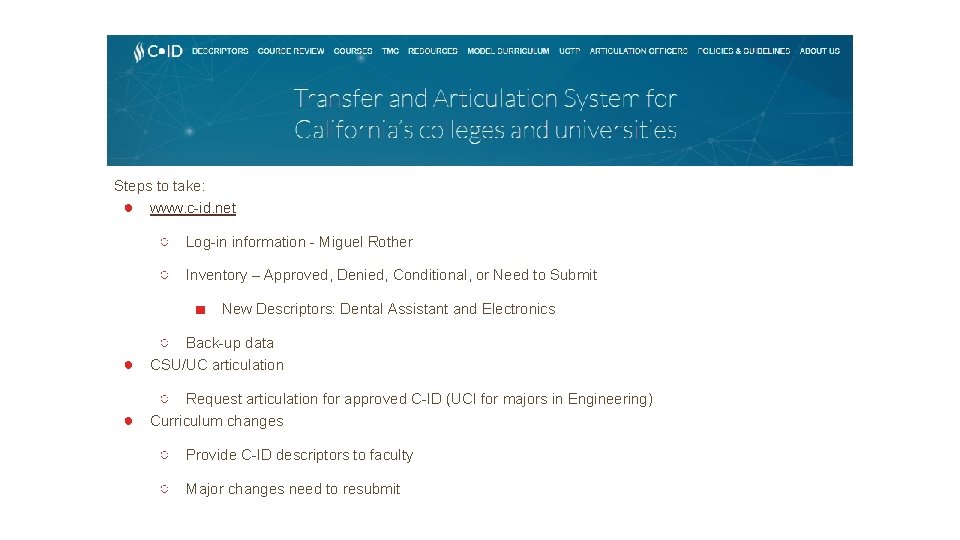
Steps to take: ● www. c-id. net ○ Log-in information - Miguel Rother ○ Inventory – Approved, Denied, Conditional, or Need to Submit ■ New Descriptors: Dental Assistant and Electronics ○ Back-up data ● CSU/UC articulation ○ Request articulation for approved C-ID (UCI for majors in Engineering) ● Curriculum changes ○ Provide C-ID descriptors to faculty ○ Major changes need to resubmit
ADT CSU - Steps to take: ○ Templates for Approved Transfer Model – Must have most updated template ○ Progress Report ○ Program Course Approval Handbook ○ Discipline faculty, C-ID (approved or Submitted 45 days), ASSIST documentation, assist with template and narrative, and CSU AO TMC – Steps to take: ○ Business – upcoming changes. Notify business, math, and counseling faculty. Assist with updating template and narrative.
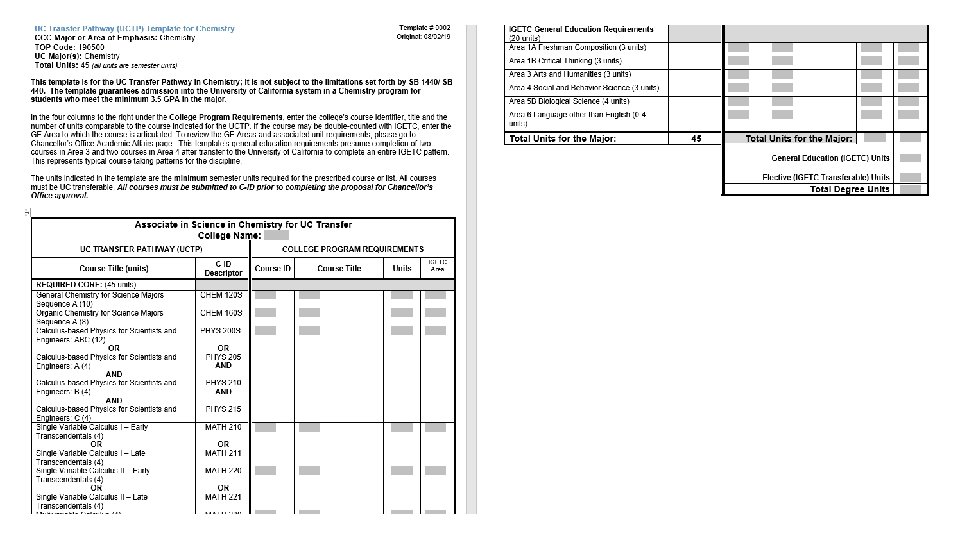
UCTP ○ Chemistry – Associate of Science in Chemistry for UC Transfer ○ Physics – Associate of Science in Physics for UC Transfer Steps to take: • Inform Curriculum Chair and members • Inform discipline faculty • Mandated or not • Compare with local degree • C-ID courses
On the horizon…. ADT and UCTP Alignment ○ Anthropology ○ Business ○ Economics ○ History ○ Mathematics ○ Philosophy ○ Sociology
CPL (Credit for Prior Learning) Title 5 section 55050 Credit for Prior learning ○ Credit by exam/assessment for prior experience or learning – If possible, awarding IGETC, CSU GE and local general education requirements ○ Evaluation of joint Services Transcripts ○ Evaluation of student-created portfolios ○ Evaluation of industry-recognized credential documentation ○ Evaluation of standardized exams Steps to take: ○ Update Board Policy and Administrative Regulation ○ Inform Curriculum Committee chair and members, CE faculty and Veterans Office, Counseling and Admissions and Records ○ Check-in with four-year universities
CPL Pilots in seven disciplines Seven disciplines ● ○ Administrative of Justice ○ Automotive Technology ○ Cyber Security ○ Business Administration and Management ○ Fire Science ○ Health ○ Information Technology Steps to take: ○ Inform: Curriculum Chair and members, Faculty (CE), Veterans Office, Admissions and Records, and Counseling ○ Check-in with four-year universities on granting of credit
IB and CLEP Steps to take: ○ Review/update catalog ■ IGETC - IB ■ CSU GE - IB and CLEP ■ Local ? ? ○ Inform Curriculum Committee chair and members ○ Work with discipline faculty ○ Inform counselors and Transfer Center staff ○ Notify Admissions and Records to annotate on students’ transcripts
Competency-Based Education ● Competencies are identified and students are frequently assessed ● Students are not allowed to continue until they have demonstrated mastery of the identified competencies

Tiffany Tran ttran 76@ivc. edu (949)451 -5324
ASSIST Updates • When will the missing CSU GE/IGETC/UCTCA courses be added to the public reports? • When will a Workflow print and/or download feature be made available for decision saving? • When will all maintenance reports that were available in the legacy system be available/working in the new system? • What is the status of the re-institution of Explore Majors? • When will new features be available such as the display of multiple major agreements at one time for comparison or the availability of a “pinboard” feature on the public site, etc. ? Holly Demé ASSIST Program Manager 60
Poll #4 • How many years do you plan on working in articulation? 61
- Slides: 61