
Preserving Our Past and Present for the Future
- Slides: 13
Preserving Our Past and Present for the Future Generations Raj Reddy Carnegie Mellon University June 15, 2017 Keynote Speech at International Conference on Digital Resources Sharing and Application (DRSA 2017) Zhejiang University, Hangzhou, China 1
Preserving Our Cultural Heritage for Future Generations · Preserving Culture · Much is Freely Available on the web · Wikipedia: Donation Model · New Trend: Free Online Access and pay for physical copy · Neural Networks and Deep Learning by Michael Nielsen http: //neuralnetworksanddeeplearning. com · Except Commercially Published Copyrighted Knowledge · Most Important Works are Copyrighted and must be preserved! · Books, Newspapers, Music, Movies and Video, and Paintings · Multiple Media: All Created In Digital Representation Now · Enable Universal Access to All Knowledge · Online Digital Access · Instantly Available · To Anyone, Anywhere in the World, in Any Language, and · Searchable, Findable And Processable · By Humans and Intelligent Agents · PDF/A: New Standard Format for Archiving · Future Generations? · Next Millennium: Y 3 K – 40 Generations?
Preserving Our Past: CADAL and The Million Book Project of 2002 · Y 2 K: Technology for Large Scale scanning became available around 2000 · No need to cutup books · OCR over 99* correct · Not orphan languages · Pre-1923 manuscripts from libraries in US, China and India · MOU between CMU and ZJU signed 2002 · Scanned over Million Books in China · Google Scanning of Books started around 2007 · Over 20 million scanned · but not accessible pending litigation · We Need to Continue Preservation of the Past and Expand to Newspapers, Music, Movies, Paintings and Software
Preserving Our Present: Accessing and Archiving Born Digital Content • At present, there is no cogent plan for saving born-digital entities for future generations. • Unlike webpages, copyright protected objects are being lost forever except for a few best sellers. • GRAND CHALLENGE: Create a Digital Archive Of All Born Digital Content: Books, newspapers, paintings, music, movies, software, etc. from now in perpetuity • Instantly Available to Anyone, Anywhere In The World, in any language and searchable, findable and processable by humans and intelligent agents. • Requires a Government Ordinance within which all the born-digital content is captured and archived before it is irretrievably lost.
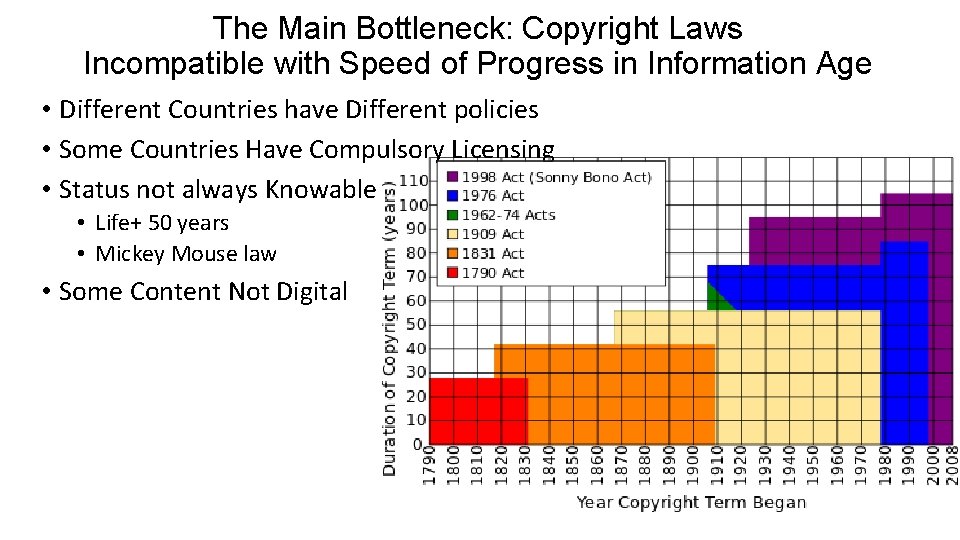
The Main Bottleneck: Copyright Laws Incompatible with Speed of Progress in Information Age • Different Countries have Different policies • Some Countries Have Compulsory Licensing • Status not always Knowable • Life+ 50 years • Mickey Mouse law • Some Content Not Digital
Universal Copy Right Summit • Fixed Copyright Term for 100 years from the Date of Creation • Require Registration and Self Archiving and Renewal Every 10 years • Life + 50 and other Arcane laws superseded • For options such as Royalties for number of access • Online Global Copyright Registry • OPT-IN: Owner can reduce the Copyright Period • Public Domain Works • Orphan and/or Abandoned works and Government Publications • Digital Depository • All Media that Enjoys Copyright Protection Should be Archived with Relevant Mete Data • Books, Music, Movies, Newspapers, Paintings • Ordinance requiring all publishers of all media to submit a digital copy (along with usually required physical copies) to the National Archive
Technical Issues • How to Better Preserve Our Culture, Heritage and Creative Works. • Establish a Digital Cultural Conservancy of the World • A Thousand Year Archive of All Books, Newspapers, Music, Movies, and Paintings • How Can We Be Sure We Can Read or View Books, Newspapers, Music, Movies, Paintings etc. Created Long Ago? • PDF/A • In a World Where File Formats Change Monthly, How Can We Retrieve and Experience Archived Content? • Format conversion Tools • VM Ware • Who pays to maintain our ability to access artifacts? Stakeholders: • • • Government Libraries Media e. Commerce companies Authors and Creators (of Books, Movies, Music, Newspapers, Paintings etc)
National Digital Archive of China (NDAC) • Establish National Digital Archives of China as part of State Administration of Cultural Heritage • Industry and Universities may provide Technology, Training and Management support • Government shall provide space, personnel, equipment and operating costs of INDAC. • Digital Depository for All Born Digital Copyrighted Works • Software and Tools to enable drag-drop-and click submission of the copyrighted work to the NDA without Leaving the Office/Home • Such material would be released to the public only when the work is out-of-copyright or when requested by the author/publisher on an opt -in basis.
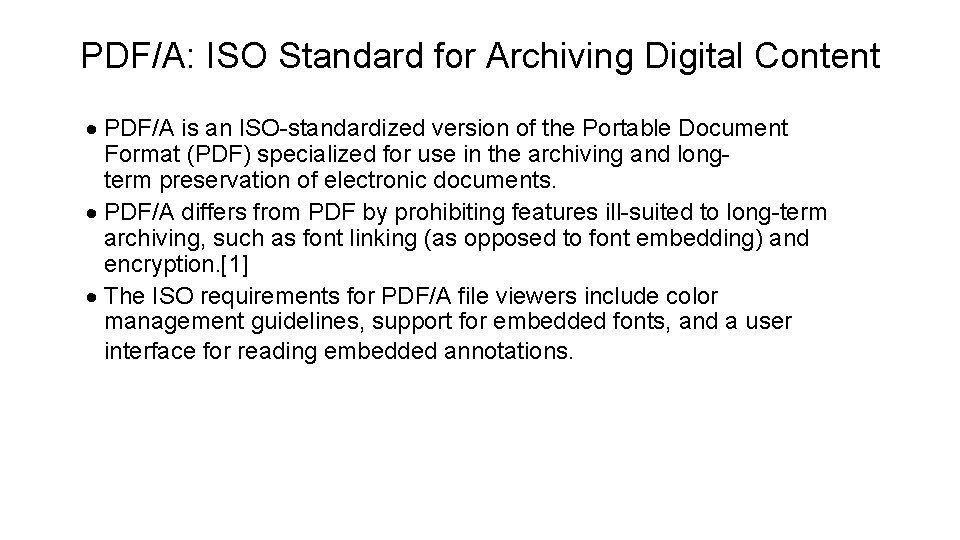
PDF/A: ISO Standard for Archiving Digital Content · PDF/A is an ISO-standardized version of the Portable Document Format (PDF) specialized for use in the archiving and longterm preservation of electronic documents. · PDF/A differs from PDF by prohibiting features ill-suited to long-term archiving, such as font linking (as opposed to font embedding) and encryption. [1] · The ISO requirements for PDF/A file viewers include color management guidelines, support for embedded fonts, and a user interface for reading embedded annotations.
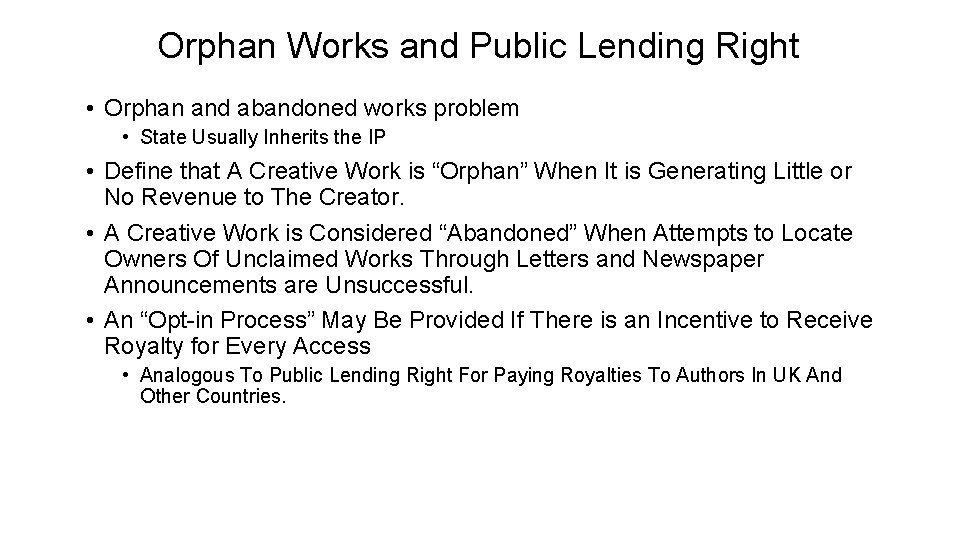
Orphan Works and Public Lending Right • Orphan and abandoned works problem • State Usually Inherits the IP • Define that A Creative Work is “Orphan” When It is Generating Little or No Revenue to The Creator. • A Creative Work is Considered “Abandoned” When Attempts to Locate Owners Of Unclaimed Works Through Letters and Newspaper Announcements are Unsuccessful. • An “Opt-in Process” May Be Provided If There is an Incentive to Receive Royalty for Every Access • Analogous To Public Lending Right For Paying Royalties To Authors In UK And Other Countries.
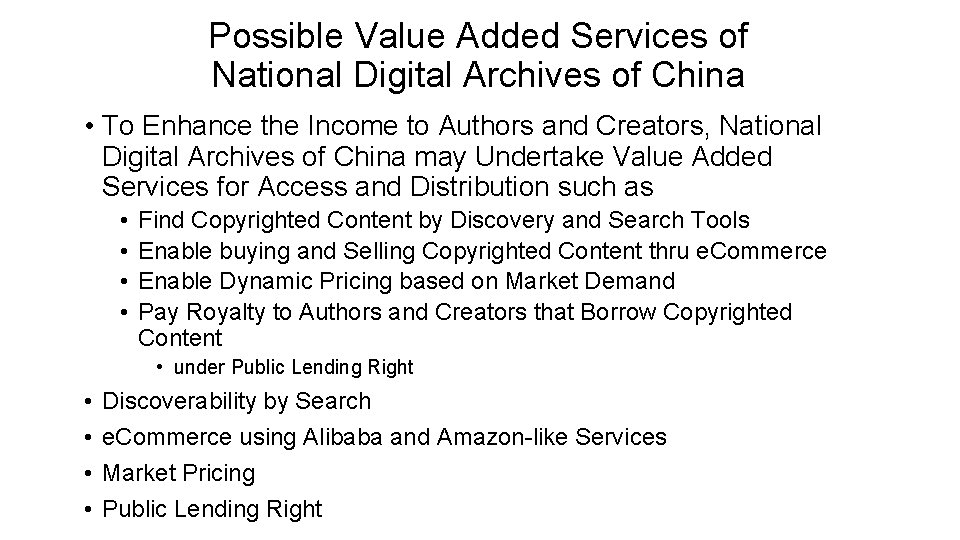
Possible Value Added Services of National Digital Archives of China • To Enhance the Income to Authors and Creators, National Digital Archives of China may Undertake Value Added Services for Access and Distribution such as • • Find Copyrighted Content by Discovery and Search Tools Enable buying and Selling Copyrighted Content thru e. Commerce Enable Dynamic Pricing based on Market Demand Pay Royalty to Authors and Creators that Borrow Copyrighted Content • under Public Lending Right • • Discoverability by Search e. Commerce using Alibaba and Amazon-like Services Market Pricing Public Lending Right
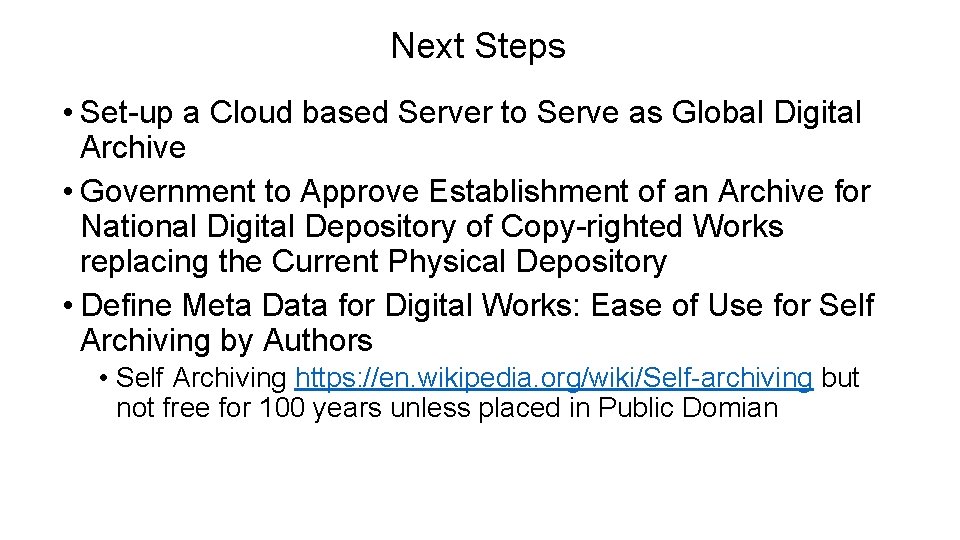
Next Steps • Set-up a Cloud based Server to Serve as Global Digital Archive • Government to Approve Establishment of an Archive for National Digital Depository of Copy-righted Works replacing the Current Physical Depository • Define Meta Data for Digital Works: Ease of Use for Self Archiving by Authors • Self Archiving https: //en. wikipedia. org/wiki/Self-archiving but not free for 100 years unless placed in Public Domian
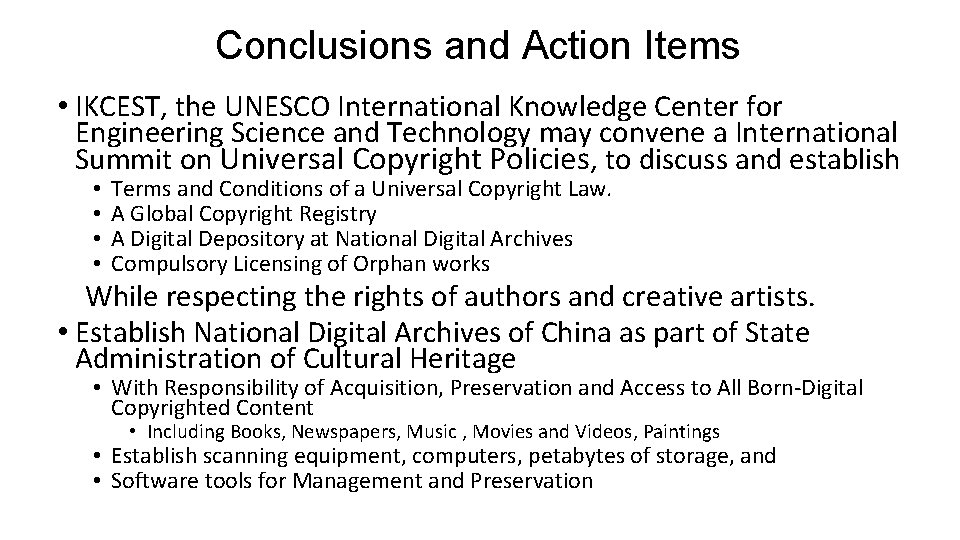
Conclusions and Action Items • IKCEST, the UNESCO International Knowledge Center for Engineering Science and Technology may convene a International Summit on Universal Copyright Policies, to discuss and establish • • Terms and Conditions of a Universal Copyright Law. A Global Copyright Registry A Digital Depository at National Digital Archives Compulsory Licensing of Orphan works While respecting the rights of authors and creative artists. • Establish National Digital Archives of China as part of State Administration of Cultural Heritage • With Responsibility of Acquisition, Preservation and Access to All Born-Digital Copyrighted Content • Including Books, Newspapers, Music , Movies and Videos, Paintings • Establish scanning equipment, computers, petabytes of storage, and • Software tools for Management and Preservation