
Preserved face inversion effects in adults with autism
- Slides: 10
Preserved face inversion effects in adults with autism spectrum disorder (ASD): an event related potential study Paula P. Tavares 1, Susana S. Mouga 1, 2, Guiomar G. Oliveira 1, 2, 3, 4, Miguel S. Castelo-Branco 1 Institute 2 Unidade for Biomedical Imaging and Life Science, Faculty of Medicine, University of Coimbra, Portugal de Neurodesenvolvimento e Autismo do Serviço do Centro de Desenvolvimento da Criança, Pediatric Hospital, Centro Hospitalar e Universitário de Coimbra, Portugal 3 University 4 Centro Clinic of Pediatrics, Faculty of Medicine, University of Coimbra, Portugal de Investigação e Formação Clínica, Pediatric Hospital, Centro Hospitalar e Universitário de Coimbra, Portugal
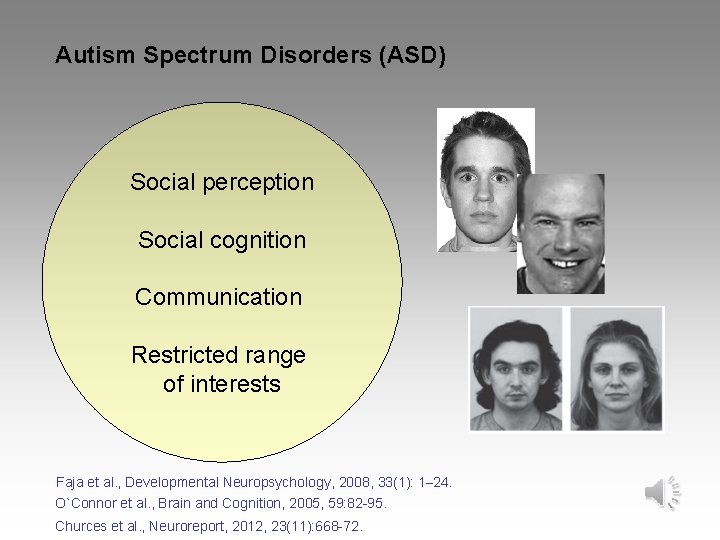
Autism Spectrum Disorders (ASD) Social perception Social cognition Communication Restricted range of interests Faja et al. , Developmental Neuropsychology, 2008, 33(1): 1– 24. O`Connor et al. , Brain and Cognition, 2005, 59: 82 -95. Churces et al. , Neuroreport, 2012, 23(11): 668 -72.
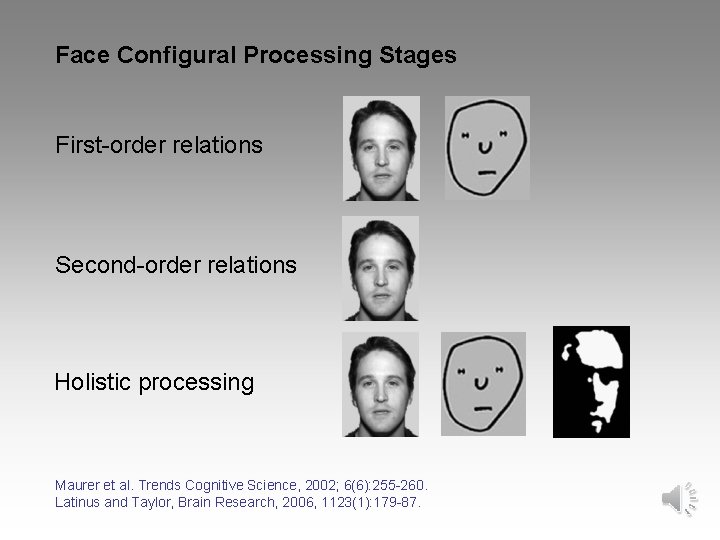
Face Configural Processing Stages First-order relations Second-order relations Holistic processing Maurer et al. Trends Cognitive Science, 2002; 6(6): 255 -260. Latinus and Taylor, Brain Research, 2006, 1123(1): 179 -87.
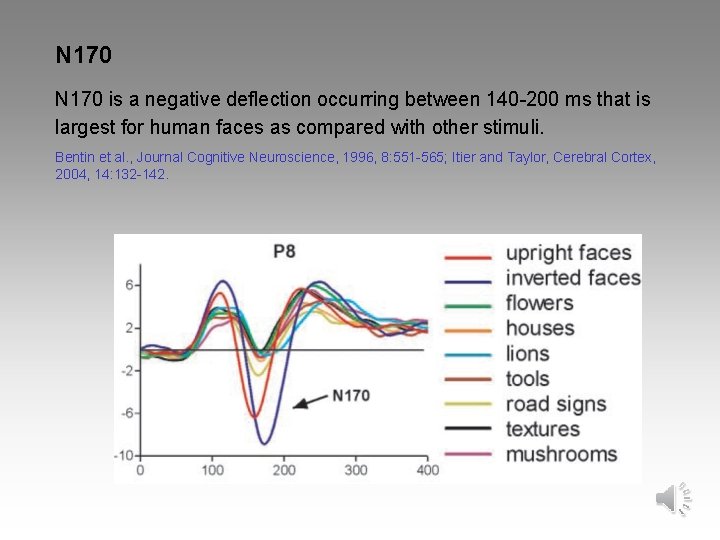
N 170 is a negative deflection occurring between 140 -200 ms that is largest for human faces as compared with other stimuli. Bentin et al. , Journal Cognitive Neuroscience, 1996, 8: 551 -565; Itier and Taylor, Cerebral Cortex, 2004, 14: 132 -142.
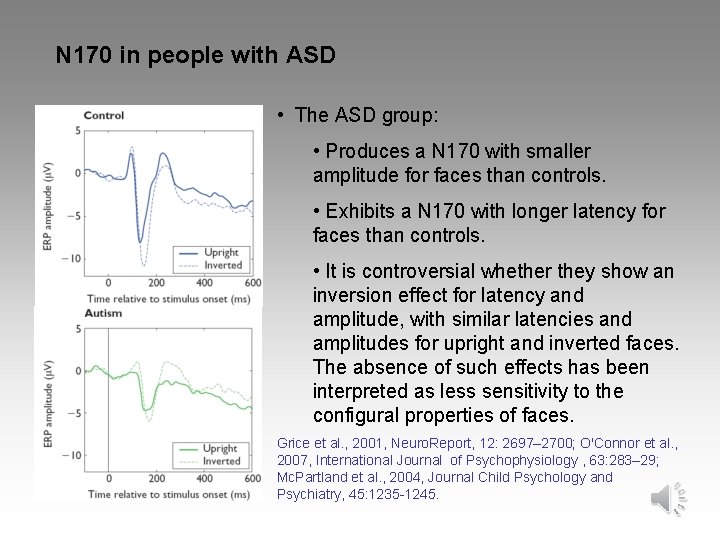
N 170 in people with ASD • The ASD group: • Produces a N 170 with smaller amplitude for faces than controls. • Exhibits a N 170 with longer latency for faces than controls. • It is controversial whether they show an inversion effect for latency and amplitude, with similar latencies and amplitudes for upright and inverted faces. The absence of such effects has been interpreted as less sensitivity to the configural properties of faces. Grice et al. , 2001, Neuro. Report, 12: 2697– 2700; O'Connor et al. , 2007, International Journal of Psychophysiology , 63: 283– 29; Mc. Partland et al. , 2004, Journal Child Psychology and Psychiatry, 45: 1235 -1245.
Goal of the present research To investigate whether the anomalies in face processing presented by people with ASD are due to a basic deficit in the neural system involved in identifying that a face is present.
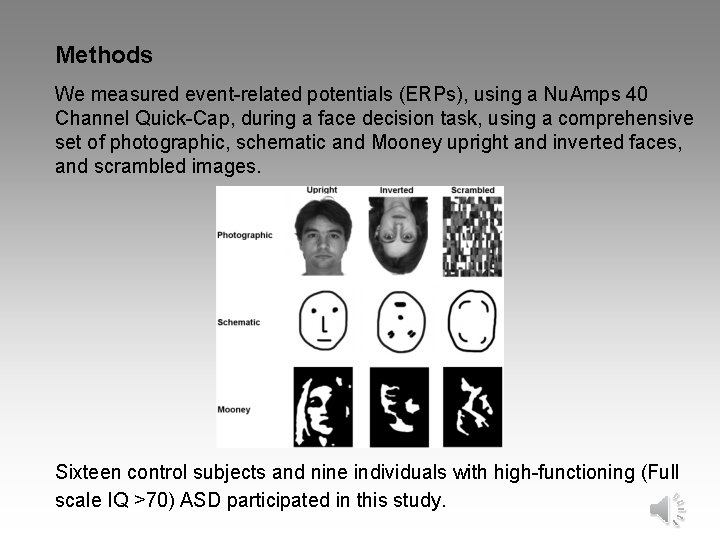
Methods We measured event-related potentials (ERPs), using a Nu. Amps 40 Channel Quick-Cap, during a face decision task, using a comprehensive set of photographic, schematic and Mooney upright and inverted faces, and scrambled images. Sixteen control subjects and nine individuals with high-functioning (Full scale IQ >70) ASD participated in this study.
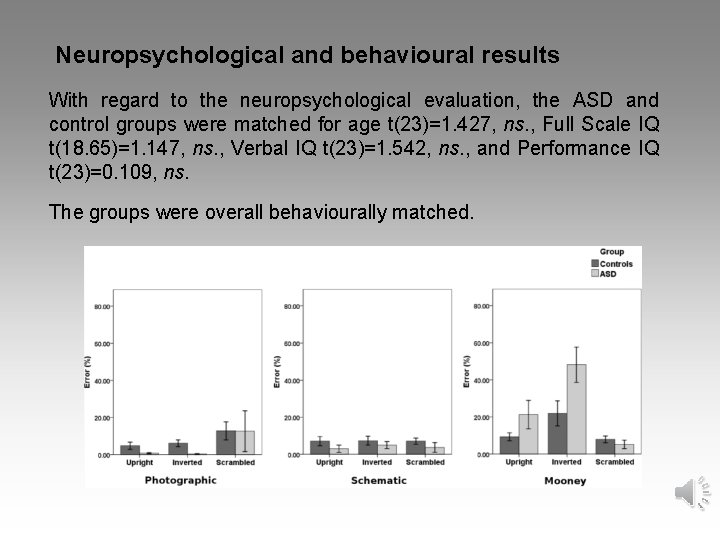
Neuropsychological and behavioural results With regard to the neuropsychological evaluation, the ASD and control groups were matched for age t(23)=1. 427, ns. , Full Scale IQ t(18. 65)=1. 147, ns. , Verbal IQ t(23)=1. 542, ns. , and Performance IQ t(23)=0. 109, ns. The groups were overall behaviourally matched.
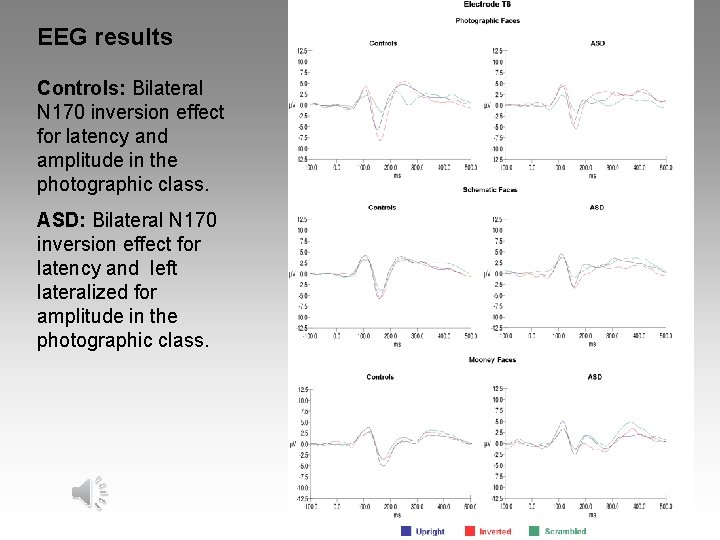
EEG results Controls: Bilateral N 170 inversion effect for latency and amplitude in the photographic class. ASD: Bilateral N 170 inversion effect for latency and left lateralized for amplitude in the photographic class.
Conclusions • People with ASD: • show preserved configural processing as assessed by latency and amplitude inversion effects in the N 170 peaks, under performance matched conditions. • were able to recognize with great accuracy the faces from the non-faces in all classes. • Our results: • do not support reports of superior local processing and impairment in integrative processing. • are in agreement with theories such as the enhanced perceptual functioning model.