
Preservation of Samples for RETS REMP and RW
- Slides: 29
Preservation of Samples for RETS, REMP and RW Bob Litman Radiochemistry Laboratory Basics Presented in coordination with GEL Laboratories, LLC www. gel. com problem solved
Abstract Nuclear Power Plants have special radioanalytical needs for several different classes of samples required by their operating licenses. The general sample categories can be characterized by the amount and type of radionuclides they contain. In order from highest to lowest activity they are radioactive waste (and associated characterization samples), routine liquid and gaseous effluent samples, and radiological environmental monitoring samples. Each step in the overall chain of information from sampling plan to final results is important. One of the elements that is often taken for granted is sample preservation. In order to provide assurance that the radionuclide of interest is not compromised during sampling, storage and transport of the sample the proper preservation must be performed for each radionuclide in each particular matrix. The preservation requirements for radionuclides (in particular 14 C, iodines, tritium, 55 Fe, TRUs and 90 Sr) most commonly analyzed for the three general categories of samples and the different matrices that comprise these categories will be discussed. www. gel. com problem solved
What is Preservation? A physical or chemical process that minimizes the potential for loss of the analyte (in this case a radionuclide) during the time period from sampling to aliquanting for analysis www. gel. com problem solved
What is a Holding Time? Can be defined in two different ways (both are correct and apply to radionuclides): • Time period during which the preserved sample will have negligible loss of analyte (radionuclide) • Time period during which the radionuclide (analyte) will retain enough activity so that detection limits can be achieved (also referred to as radiological holding time) www. gel. com problem solved
Loss Mechanisms • • Precipitation Adsorption Volatilization Chemical reaction producing one of the first three • Decay www. gel. com problem solved
Preservation Categories Radionuclides fall into three categories: – Metals – Volatiles – Non-metals The chemical forms of each radionuclide are important when deciding preservation technique www. gel. com problem solved
Matrices Considered • Liquids – Waste liquids – Surface water – Well water • Air Particulate Filters – Glass fiber – Polymeric • Solids – Soils – Resins – Vegetation www. gel. com problem solved
Who Decides How Samples Should Be Preserved? • The project team (i. e. , you!) • Know the standard preservation techniques • Communicate – the technique chosen should be coordinated with the laboratory, before collection www. gel. com problem solved
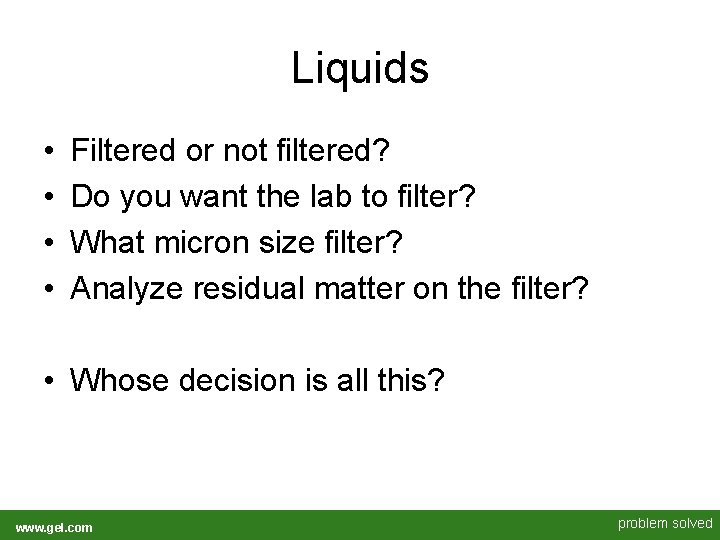
Liquids • • Filtered or not filtered? Do you want the lab to filter? What micron size filter? Analyze residual matter on the filter? • Whose decision is all this? www. gel. com problem solved
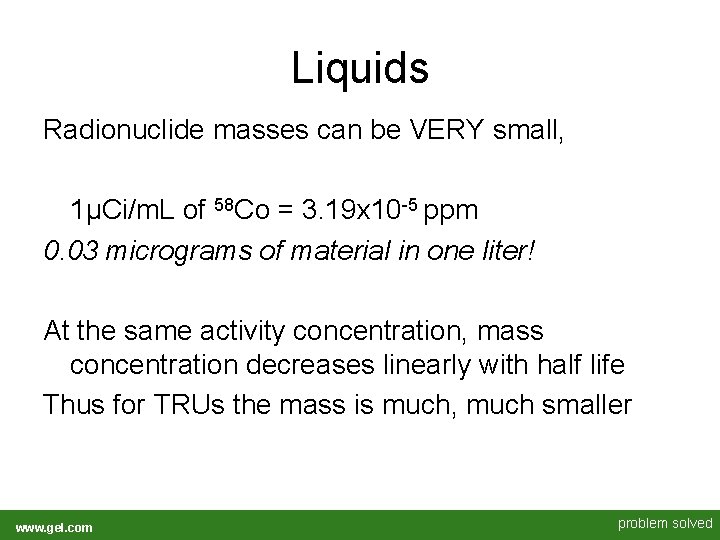
Liquids Radionuclide masses can be VERY small, 1μCi/m. L of 58 Co = 3. 19 x 10 -5 ppm 0. 03 micrograms of material in one liter! At the same activity concentration, mass concentration decreases linearly with half life Thus for TRUs the mass is much, much smaller www. gel. com problem solved
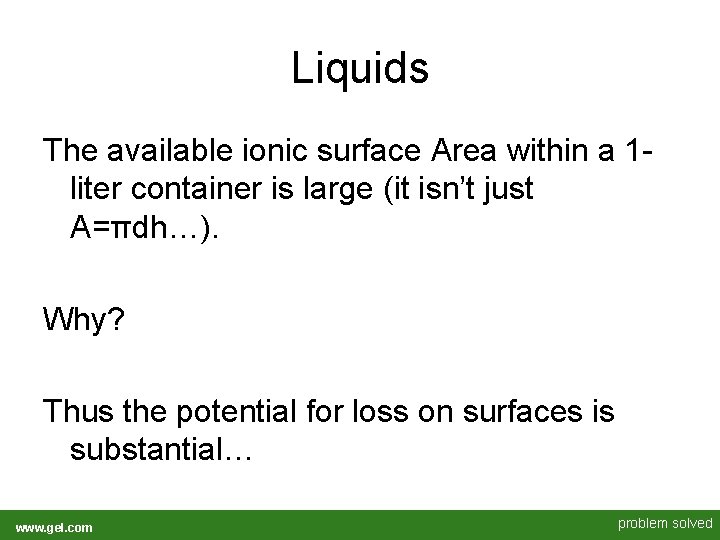
Liquids The available ionic surface Area within a 1 liter container is large (it isn’t just A=πdh…). Why? Thus the potential for loss on surfaces is substantial… www. gel. com problem solved
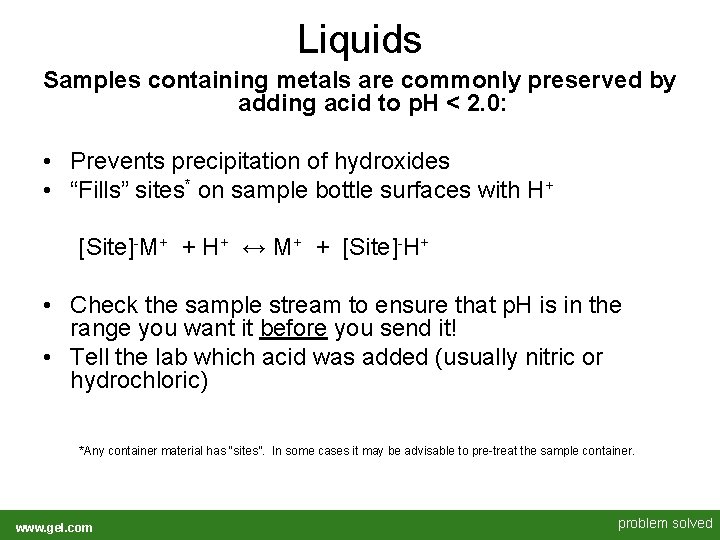
Liquids Samples containing metals are commonly preserved by adding acid to p. H < 2. 0: • Prevents precipitation of hydroxides • “Fills” sites* on sample bottle surfaces with H+ [Site]-M+ + H+ ↔ M+ + [Site]-H+ • Check the sample stream to ensure that p. H is in the range you want it before you send it! • Tell the lab which acid was added (usually nitric or hydrochloric) *Any container material has “sites”. In some cases it may be advisable to pre-treat the sample container. www. gel. com problem solved
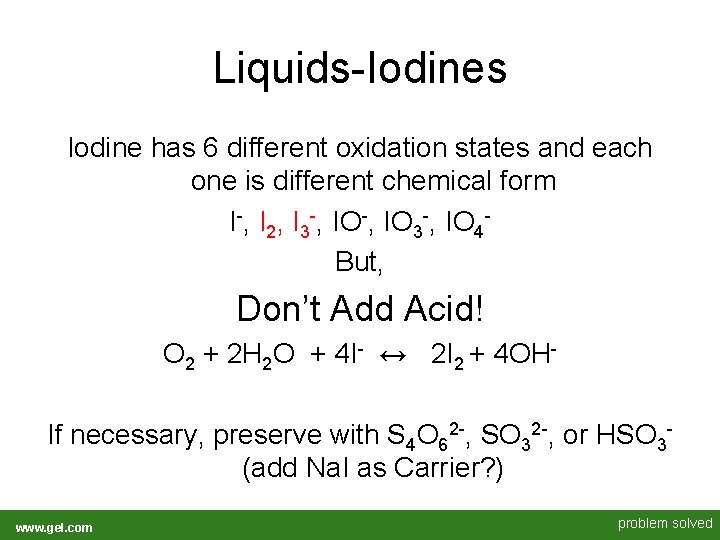
Liquids-Iodines Iodine has 6 different oxidation states and each one is different chemical form I-, I 2, I 3 -, IO 4 But, Don’t Add Acid! O 2 + 2 H 2 O + 4 I- ↔ 2 I 2 + 4 OHIf necessary, preserve with S 4 O 62 -, SO 32 -, or HSO 3(add Na. I as Carrier? ) www. gel. com problem solved
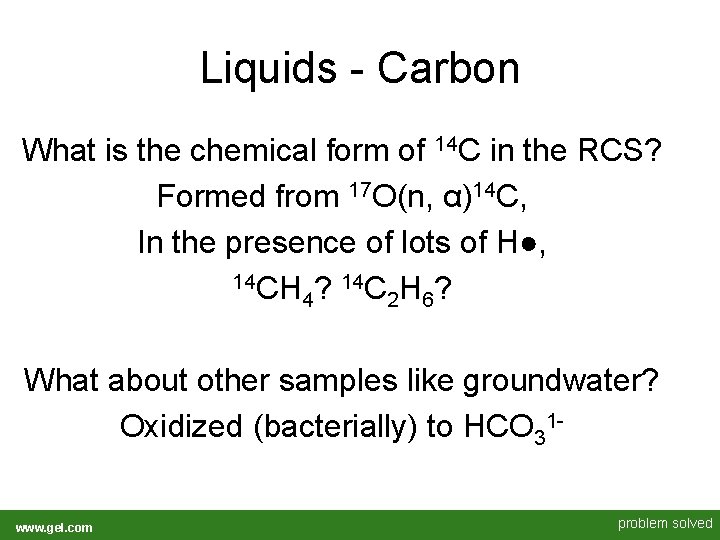
Liquids - Carbon What is the chemical form of 14 C in the RCS? Formed from 17 O(n, α)14 C, In the presence of lots of H●, 14 CH ? 14 C H ? 4 2 6 What about other samples like groundwater? Oxidized (bacterially) to HCO 31 www. gel. com problem solved
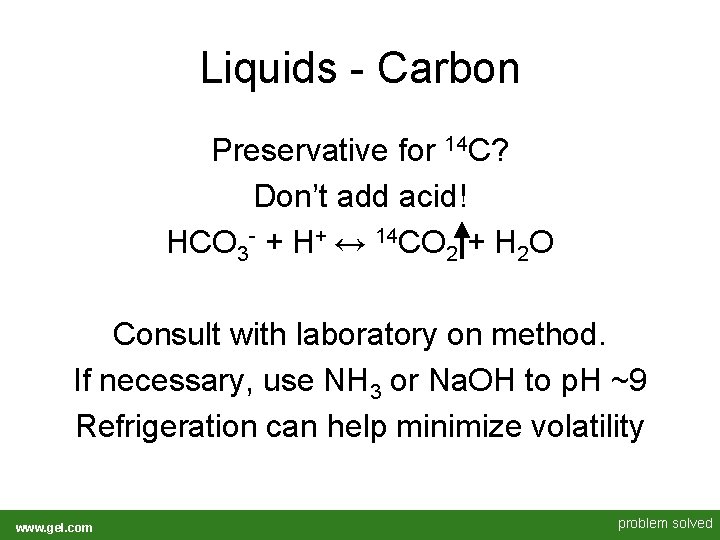
Liquids - Carbon Preservative for 14 C? Don’t add acid! HCO 3 - + H+ ↔ 14 CO 2 + H 2 O Consult with laboratory on method. If necessary, use NH 3 or Na. OH to p. H ~9 Refrigeration can help minimize volatility www. gel. com problem solved
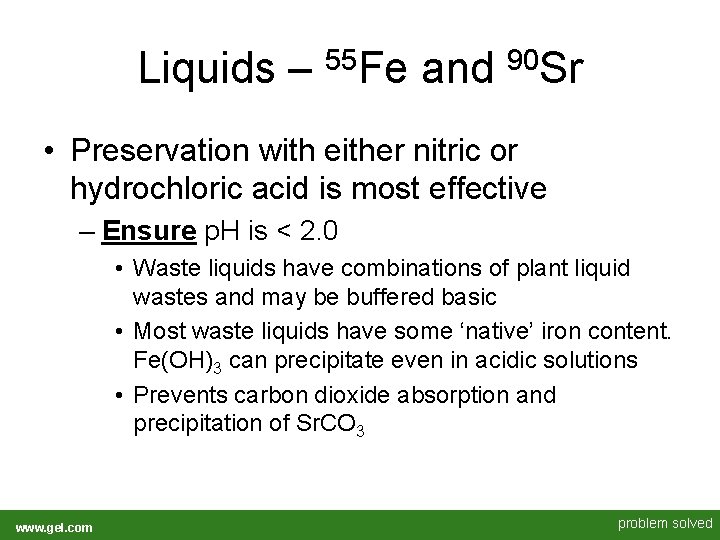
Liquids – 55 Fe and 90 Sr • Preservation with either nitric or hydrochloric acid is most effective – Ensure p. H is < 2. 0 • Waste liquids have combinations of plant liquid wastes and may be buffered basic • Most waste liquids have some ‘native’ iron content. Fe(OH)3 can precipitate even in acidic solutions • Prevents carbon dioxide absorption and precipitation of Sr. CO 3 www. gel. com problem solved
Liquids - TRU • Nitric acid preservation is recommended – Ensure p. H is < 2. 0 • Carrier addition is recommended – La, Ce, Nd • Do not delay transport as the mass concentration is far less than that of the activation products www. gel. com problem solved
Liquids - Tritium • Preservation Required? • What is the chemical form? www. gel. com problem solved
Liquids – General Preserve: • As soon as practicable after collection • If compositing samples, preserve at the beginning not at the end • If storing prior to analysis for extended period of time consider adding tracers/carriers (tell the lab!) www. gel. com problem solved
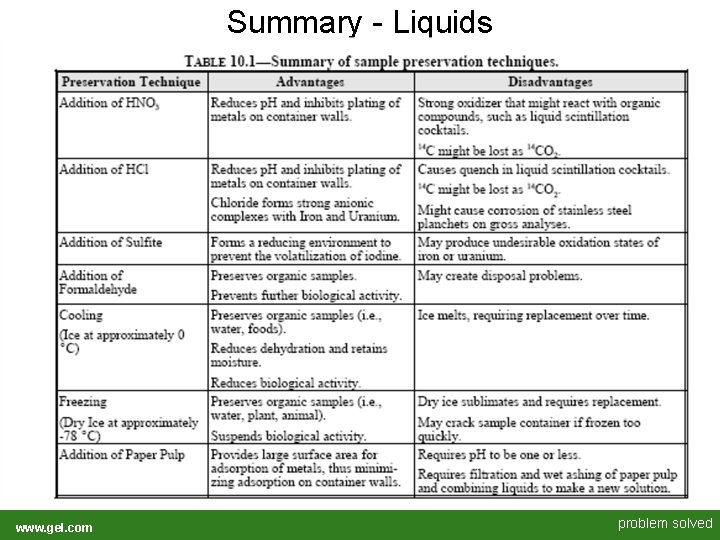
Summary - Liquids www. gel. com problem solved
Solids - Soils In order to assess how to preserve, you first need to know: – Will the entire sample be used? – Will the sample be homogenized at the lab? – Should miscellaneous detritus (sticks, stones, worms) be removed? www. gel. com problem solved
Solids - Soils Depending on the radionuclide needed: • Should the sample be frozen? • Shipped under nitrogen? • Freeze or refrigerate? • Wet weight or dry weight for results? – Drying temperature? – Freeze drying acceptable? • Total digestion or leaching to be used? www. gel. com problem solved
Solids - Soils What about the following? – 129, 125, 131 I – 3 H – 14 C Anything special required? www. gel. com problem solved
Solids - Resins • Think “estimate”* • Think “non-homogeneous”* • Whole Sample? • Preserve dry, wet or semi-wet? • If stored before shipment, under inert atmosphere? • Don’t freeze… *especially when analysis is on 10 CFR 61 radionuclides www. gel. com problem solved
Solids - Vegetation • Critical factors: – Moisture content is high (75 -98%) – Material changes quickly (hours to days) – Distinguish surface from internal contamination? • Refrigerate or freeze? www. gel. com problem solved
Solids- Summary • No universal preservation techniques – Specified by Project • If frozen, care needs to be taken to ensure sub-sampling is representative • Wet or dry weight? – Will determine preservation – Project specific • Volatiles are a concern with solids as well www. gel. com problem solved
Particulate Filters • Fold filter in half (sample on itself) • Slide filter into glassine-style envelope • Ship between two blank filters (could be polymeric, or glass fiber) in Petri-style container www. gel. com problem solved
Particulate Filters • Avoid situations which can induce a static charge on the sample • Avoid adhering to another medium for shipment as the adhesive may affect the analysis www. gel. com problem solved
Summary • Choose a preservation technique that ensures minimal loss of radionuclide • Identify requirements to laboratory (holding times, preservation techniques used, carriers added, etc. ) • Several aliquants of the sample may be required as different radionuclides require different preservation www. gel. com problem solved