
presents Role of Skin Perfusion Assessment with Transcutaneous
- Slides: 31
presents Role of Skin Perfusion Assessment with Transcutaneous Oximetry A. Wayne Evans M. D. Medical Director – Skin Oxygen Measurement info@so 2 m. ca Medical Director - Medical Oxygen Research md@mo 2 r. ca Medical Director - Assistant Professor - Department of Anaesthesia - University of Toronto wayne. evans@utoronto. ca Chair, Section on Hyperbaric Medicine – Ontario Medical Association Medical Consultant: Radiation Late Effects Clinic & Hyperbaric Medicine Unit – UHN
Learning Objectives: 1. What non-invasive options are there for perfusion assessment ? 2. What is tcp. O 2 ? 3. Determine how skin perfusion assessment with tcp. O 2 may assist in decision making.
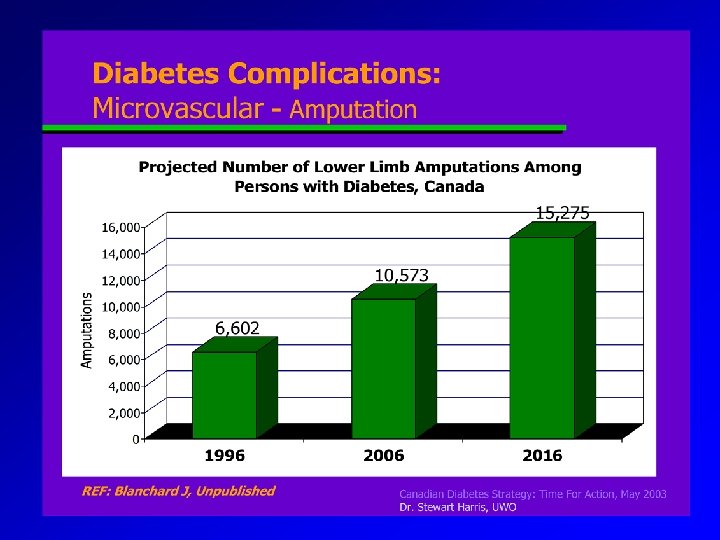
Why Focus on the Diabetic Foot ? • Lets look at the natural history faced by the diabetic: Wayne Evans, M. D.
Wayne Evans, M. D.
Wayne Evans, M. D.
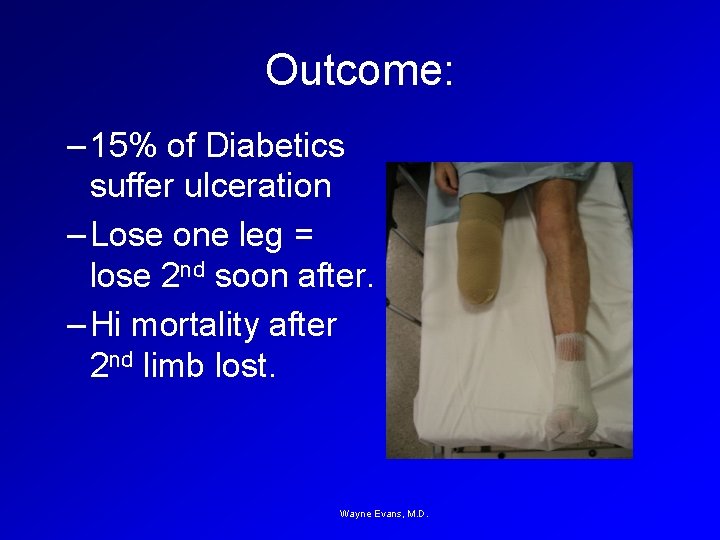
Outcome: – 15% of Diabetics suffer ulceration – Lose one leg = lose 2 nd soon after. – Hi mortality after 2 nd limb lost. Wayne Evans, M. D.
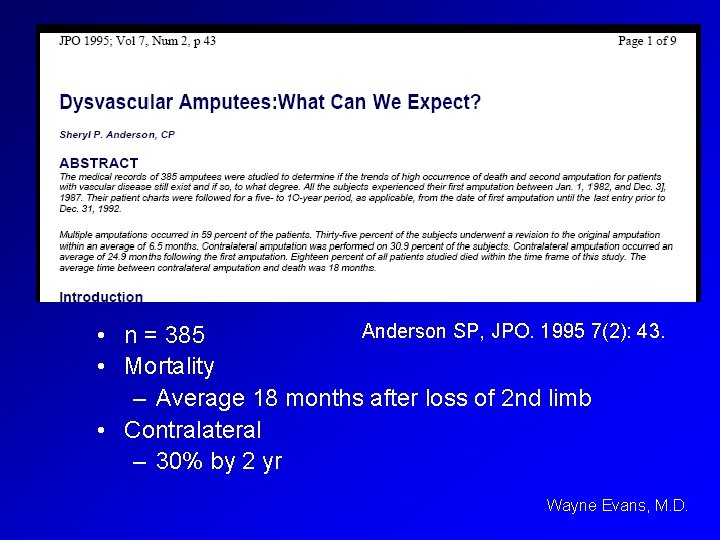
Anderson SP, JPO. 1995 7(2): 43. • n = 385 • Mortality – Average 18 months after loss of 2 nd limb • Contralateral – 30% by 2 yr Wayne Evans, M. D.
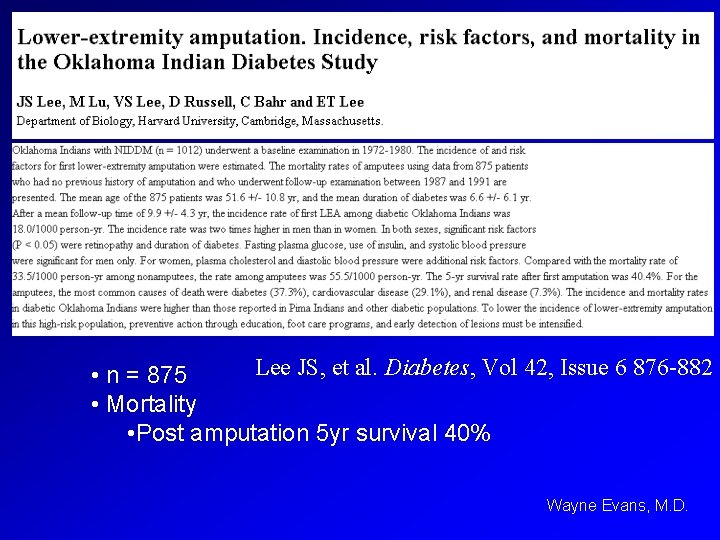
Lee JS, et al. Diabetes, Vol 42, Issue 6 876 -882 • n = 875 • Mortality • Post amputation 5 yr survival 40% Wayne Evans, M. D.
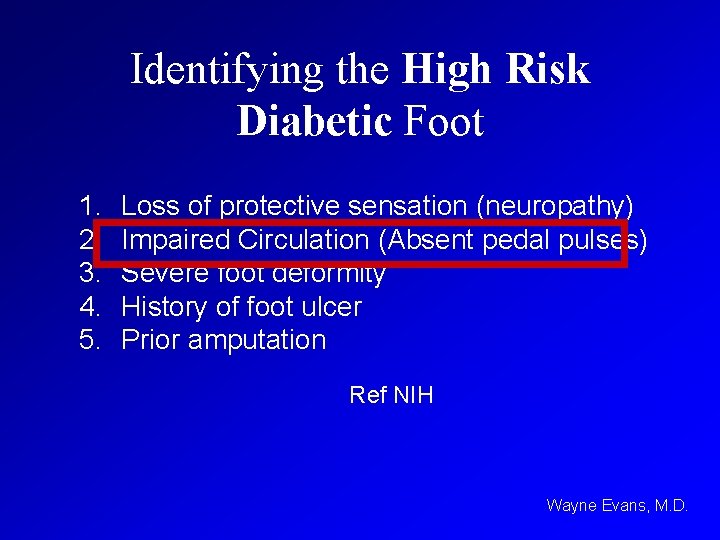
Identifying the High Risk Diabetic Foot 1. 2. 3. 4. 5. Loss of protective sensation (neuropathy) Impaired Circulation (Absent pedal pulses) Severe foot deformity History of foot ulcer Prior amputation Ref NIH Wayne Evans, M. D.
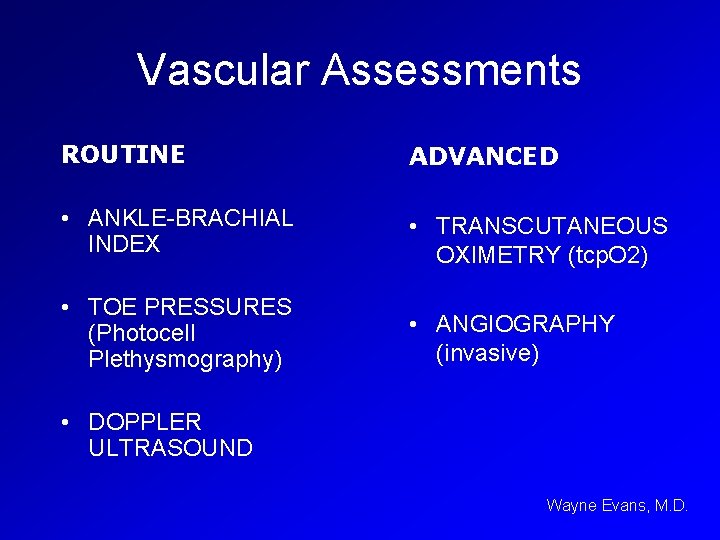
Vascular Assessments ROUTINE ADVANCED • ANKLE-BRACHIAL INDEX • TOE PRESSURES (Photocell Plethysmography) • DOPPLER ULTRASOUND • TRANSCUTANEOUS OXIMETRY (tcp. O 2) • ANGIOGRAPHY (invasive) Wayne Evans, M. D.
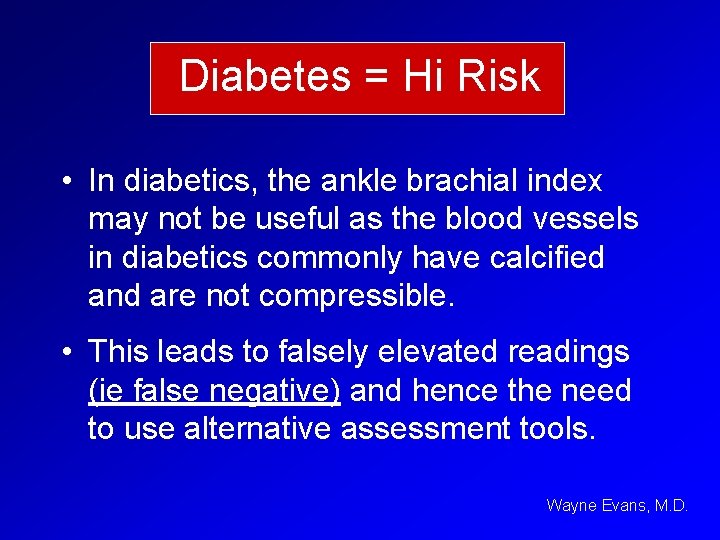
Diabetes = Hi Risk • In diabetics, the ankle brachial index may not be useful as the blood vessels in diabetics commonly have calcified and are not compressible. • This leads to falsely elevated readings (ie false negative) and hence the need to use alternative assessment tools. Wayne Evans, M. D.
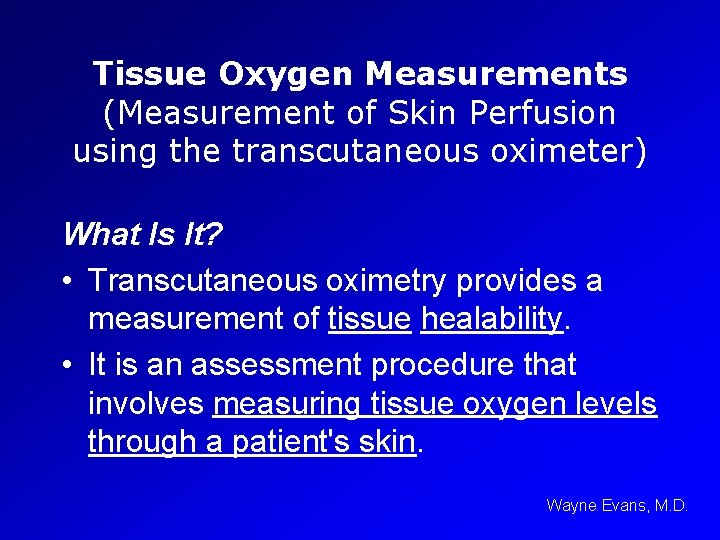
Tissue Oxygen Measurements (Measurement of Skin Perfusion using the transcutaneous oximeter) What Is It? • Transcutaneous oximetry provides a measurement of tissue healability. • It is an assessment procedure that involves measuring tissue oxygen levels through a patient's skin. Wayne Evans, M. D.
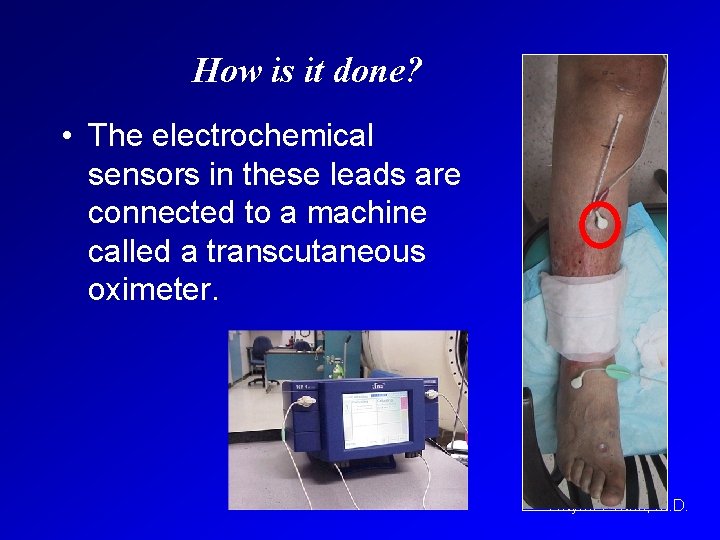
How is it done? • The electrochemical sensors in these leads are connected to a machine called a transcutaneous oximeter. Wayne Evans, M. D.
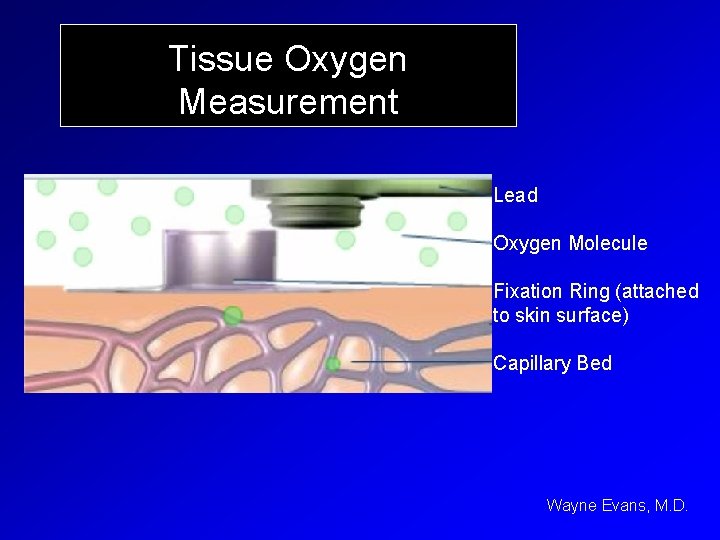
Tissue Oxygen Measurement Lead Oxygen Molecule Fixation Ring (attached to skin surface) Capillary Bed Wayne Evans, M. D.
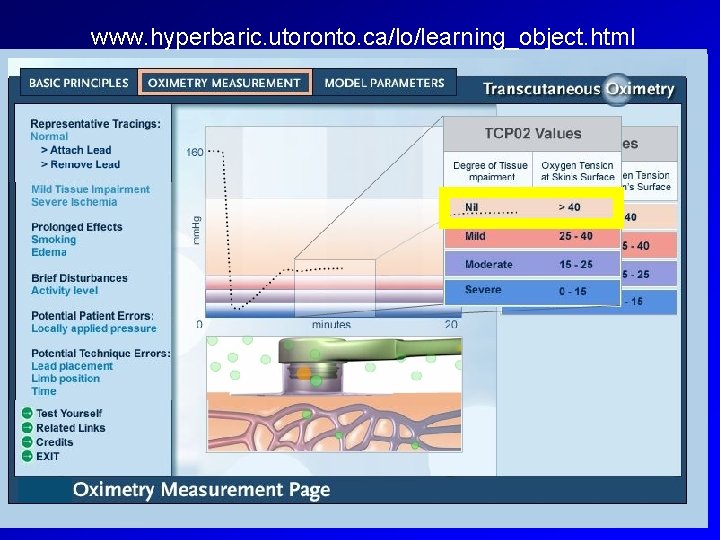
www. hyperbaric. utoronto. ca/lo/learning_object. html Wayne Evans, M. D.
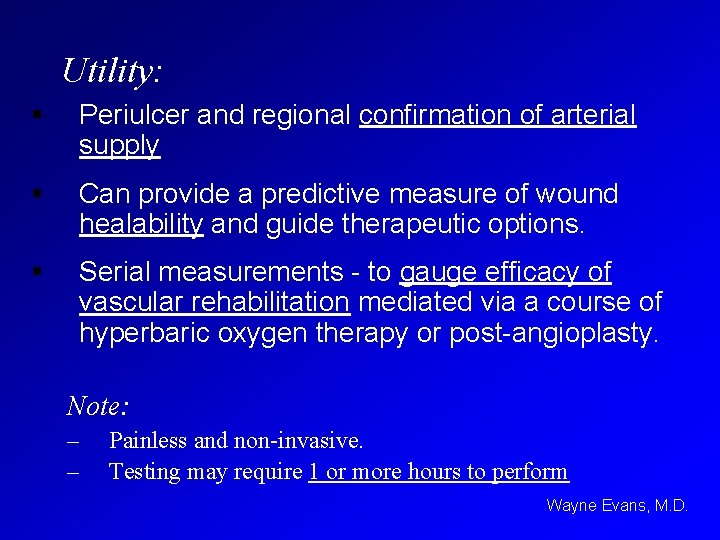
Utility: § Periulcer and regional confirmation of arterial supply § Can provide a predictive measure of wound healability and guide therapeutic options. § Serial measurements - to gauge efficacy of vascular rehabilitation mediated via a course of hyperbaric oxygen therapy or post-angioplasty. Note: – – Painless and non-invasive. Testing may require 1 or more hours to perform Wayne Evans, M. D.
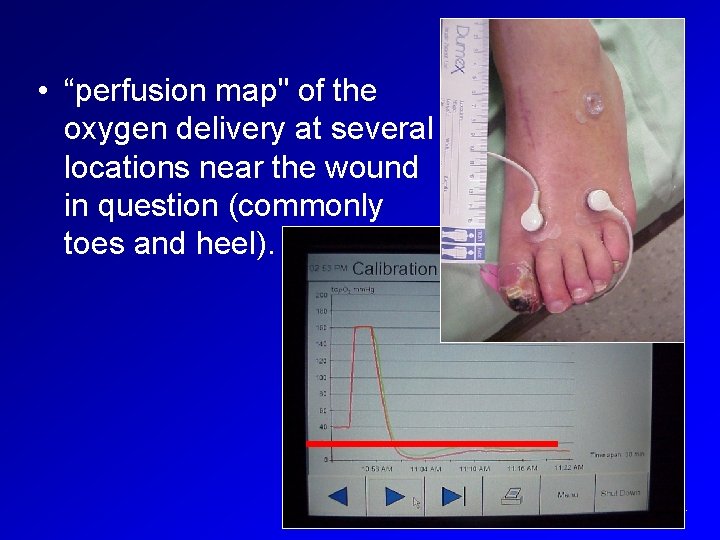
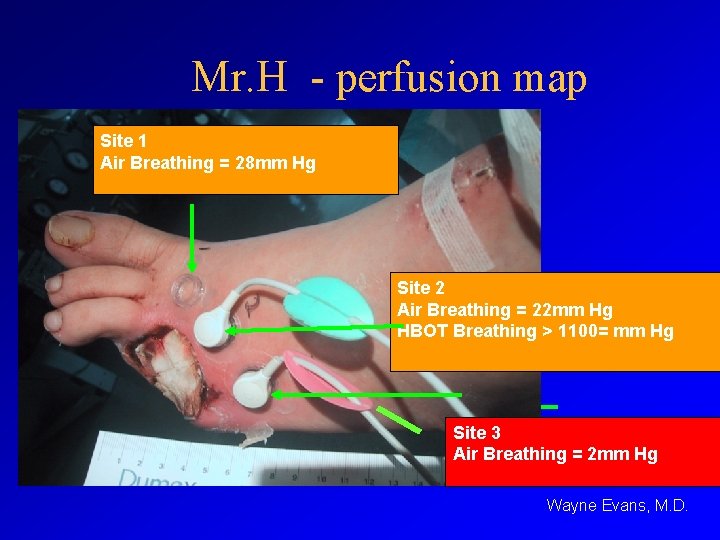
• “perfusion map" of the oxygen delivery at several locations near the wound in question (commonly toes and heel). Wayne Evans, M. D.
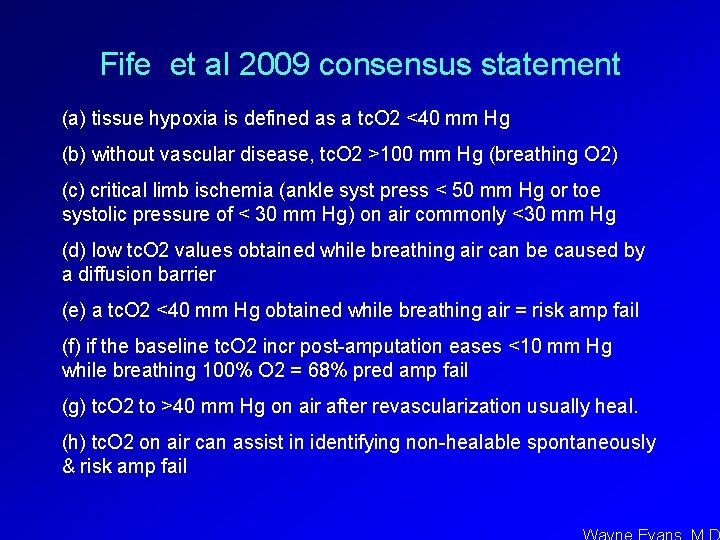
Literature: Undersea Hyperb Med. 2009 Jan. Feb; 36(1): 43 -53. Transcutaneous oximetry in clinical practice: consensus statements from an expert panel based on evidence. Fife CE, Smart DR, Sheffield PJ, Hopf HW, Hawkins G, Clarke D. Wayne Evans, M. D.
Fife et al 2009 consensus statement (a) tissue hypoxia is defined as a tc. O 2 <40 mm Hg (b) without vascular disease, tc. O 2 >100 mm Hg (breathing O 2) (c) critical limb ischemia (ankle syst press < 50 mm Hg or toe systolic pressure of < 30 mm Hg) on air commonly <30 mm Hg (d) low tc. O 2 values obtained while breathing air can be caused by a diffusion barrier (e) a tc. O 2 <40 mm Hg obtained while breathing air = risk amp fail (f) if the baseline tc. O 2 incr post-amputation eases <10 mm Hg while breathing 100% O 2 = 68% pred amp fail (g) tc. O 2 to >40 mm Hg on air after revascularization usually heal. (h) tc. O 2 on air can assist in identifying non-healable spontaneously & risk amp fail
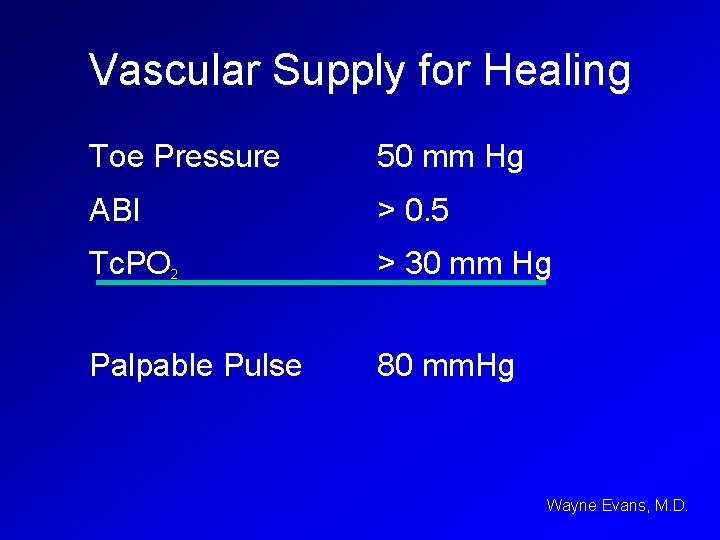
Vascular Supply for Healing Toe Pressure 50 mm Hg ABI > 0. 5 Tc. PO 2 > 30 mm Hg Palpable Pulse 80 mm. Hg Wayne Evans, M. D.
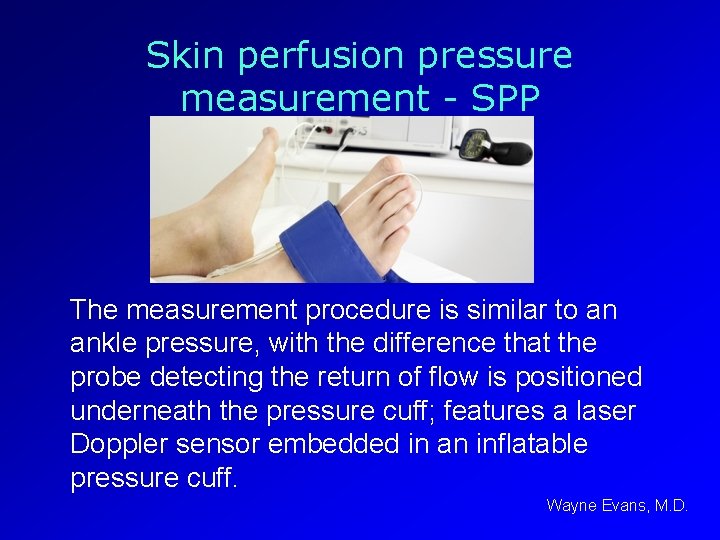
Skin perfusion pressure measurement - SPP The measurement procedure is similar to an ankle pressure, with the difference that the probe detecting the return of flow is positioned underneath the pressure cuff; features a laser Doppler sensor embedded in an inflatable pressure cuff. Wayne Evans, M. D.
SPP Literature: Wounds 2009; 21(11) Prediction of Wound Healing Outcome using Skin Perfusion Pressure & Transcutaneous Oximetry Takkin Lo et al • N = 100 concurrent SPP and tcp. O 2 • SPP is emerging as a reliable and objective measurement tool in wound evaluation and other distal arterial assessments. Wayne Evans, M. D.
SPP Literature: J Am Coll Cardiol 2015; 65: 931 -41 Evaluation and Treatment of Patients with Lower Extremity Peripheral Artery Disease: Consensus Definitions from Peripheral Academic Research Consortium (PARC) Patel et al Consensus that Skin Perfusion Pressure (SPP) should be used as a hemodynamic definition for CLI. Wayne Evans, M. D.
tcp. O 2 Literature: Wound Repair Regen. 2002 Jul-Aug; 10(4): 198 -207. The predictive value of transcutaneous oxygen tension measurement in diabetic lower extremity ulcers treated with hyperbaric oxygen therapy: a retrospective analysis of 1, 144 patients. Fife CE, Buyukcakir C, Otto GH, Sheffield PJ, Warriner RA, Love TL, Mader J. Wayne Evans, M. D.
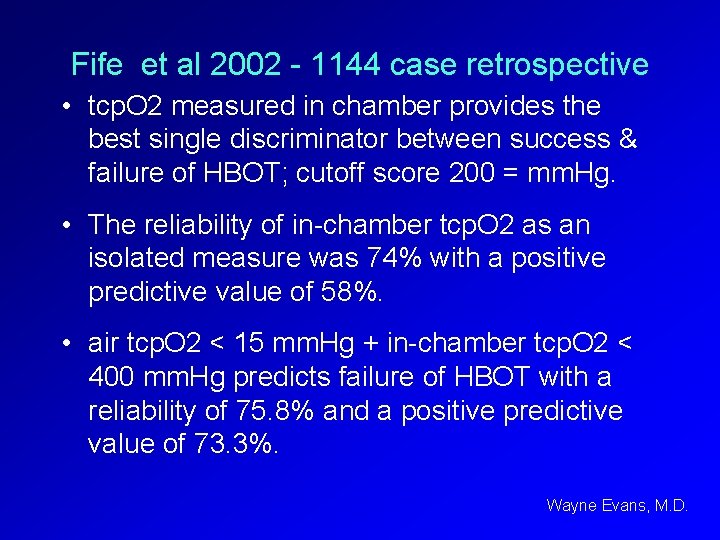
Fife et al 2002 - 1144 case retrospective • tcp. O 2 measured in chamber provides the best single discriminator between success & failure of HBOT; cutoff score 200 = mm. Hg. • The reliability of in-chamber tcp. O 2 as an isolated measure was 74% with a positive predictive value of 58%. • air tcp. O 2 < 15 mm. Hg + in-chamber tcp. O 2 < 400 mm. Hg predicts failure of HBOT with a reliability of 75. 8% and a positive predictive value of 73. 3%. Wayne Evans, M. D.
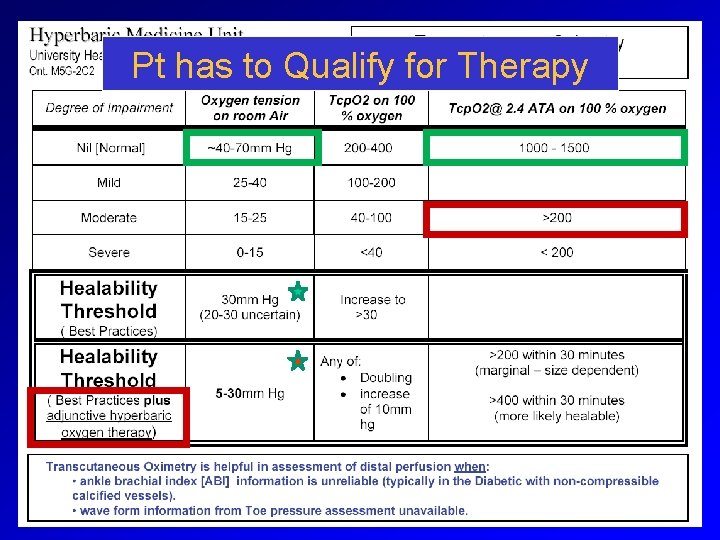
Pt has to Qualify for Therapy Wayne Evans, M. D.
Mr. H - perfusion map Site 1 Air Breathing = 28 mm Hg Site 2 Air Breathing = 22 mm Hg HBOT Breathing > 1100= mm Hg Site 3 Air Breathing = 2 mm Hg Wayne Evans, M. D.
Now in Mississauga – Halton! so 2 m. ca f 905. 614. 0201 t 905. 614. 0057 Wayne Evans f 416. 444. 0202 t 416. 366. 1999
Learning Objectives: 1. What non-invasive options are there for perfusion assessment ? 2. What is tcp. O 2 ? 3. Determine how skin perfusion assessment with tcp. O 2 may assist in decision making.
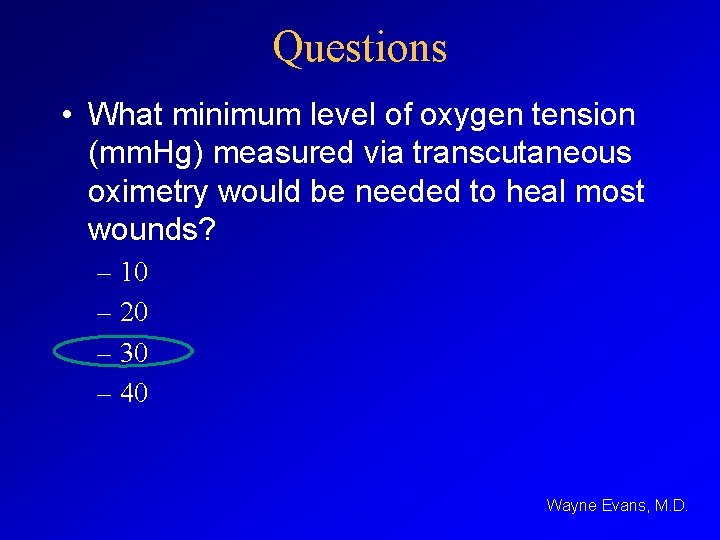
Questions • What minimum level of oxygen tension (mm. Hg) measured via transcutaneous oximetry would be needed to heal most wounds? – 10 – 20 – 30 – 40 Wayne Evans, M. D.