
Presenting your research ONE Powerpoint or PDF slide
- Slides: 17
Presenting your research �ONE Powerpoint or PDF slide � 2 minutes �Simple – not expecting much
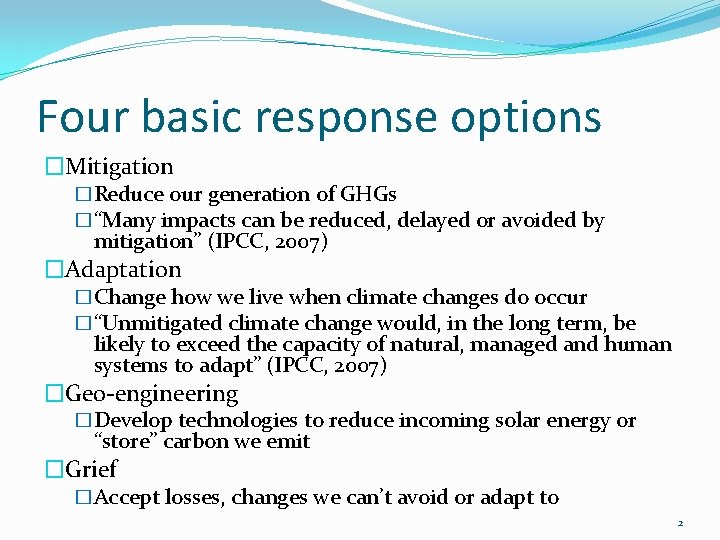
Four basic response options �Mitigation �Reduce our generation of GHGs �“Many impacts can be reduced, delayed or avoided by mitigation” (IPCC, 2007) �Adaptation �Change how we live when climate changes do occur �“Unmitigated climate change would, in the long term, be likely to exceed the capacity of natural, managed and human systems to adapt” (IPCC, 2007) �Geo-engineering �Develop technologies to reduce incoming solar energy or “store” carbon we emit �Grief �Accept losses, changes we can’t avoid or adapt to 2
Adaptation, Geoengineering and Grieving
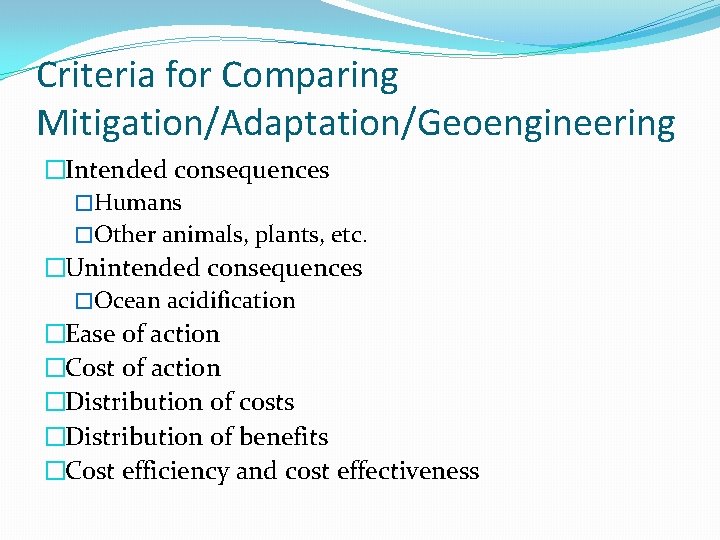
Criteria for Comparing Mitigation/Adaptation/Geoengineering �Intended consequences �Humans �Other animals, plants, etc. �Unintended consequences �Ocean acidification �Ease of action �Cost of action �Distribution of costs �Distribution of benefits �Cost efficiency and cost effectiveness
Adaptation �Exposure �Vulnerability �Adaptive capacity �Adaptation �Resilience
Why adaptation vs. mitigation? �Timescale mismatch – changes will happen even IF we return to prior levels eventually. Impacts are coming and so will need to adapt. �Vulnerability is increasing – adaptation to climate impacts are growing even without growing climate change because of demographic shifts, particularly to the coast and other vulnerable areas. �Impacts are going to happen and vulnerable are demanding help.
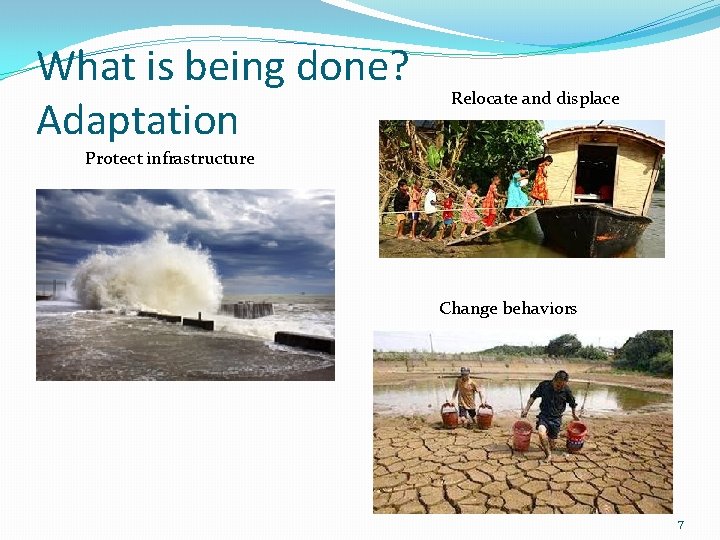
What is being done? Adaptation Relocate and displace Protect infrastructure Change behaviors 7
Preparing for Climate Change �Vicki Arroyo, The Rockefeller Foundation grantee �Climate change and resilience.
Caveats on adaptation �Climate change not main cause of vulnerabilities � Flooding and cyclone risks are due mainly to demographic shifts � Reduced water availability due to population not climate change �Political implications � “Poor and vulnerable” will find it hard/impossible to adapt � “Rich and vulnerable” who can adapt easily have weak incentives to help others �What adaptation can’t do: � Many people won’t be able to adapt because of lack of resources. � Loss and damage negotiations of Warsaw (2013): “Residual damage” (Parry et al) when society doesn’t make all the changes need to fully adapt, with some remaining damage � Animals and plants cannot adapt.
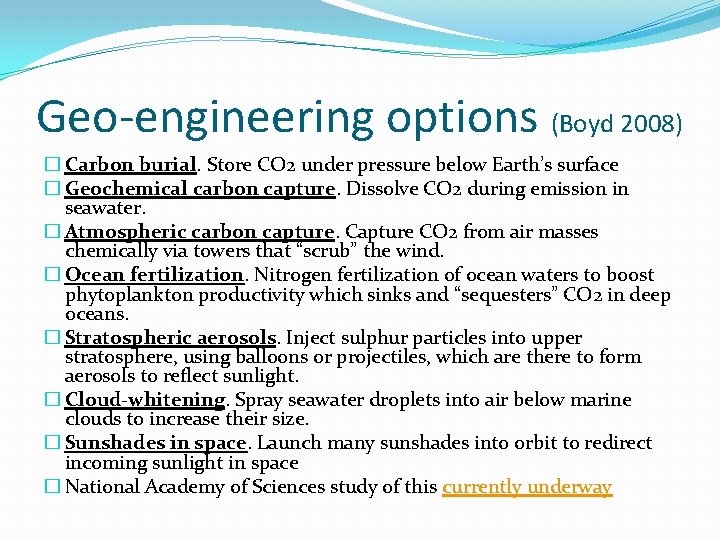
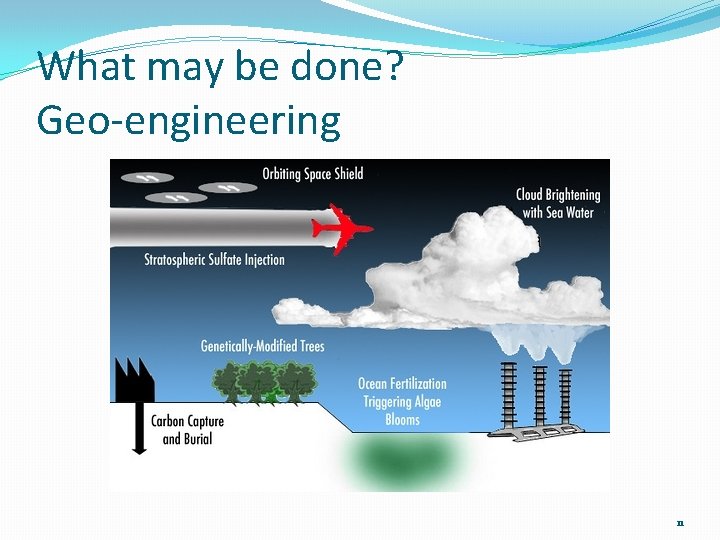
Geo-engineering options (Boyd 2008) � Carbon burial. Store CO 2 under pressure below Earth’s surface � Geochemical carbon capture. Dissolve CO 2 during emission in seawater. � Atmospheric carbon capture. Capture CO 2 from air masses chemically via towers that “scrub” the wind. � Ocean fertilization. Nitrogen fertilization of ocean waters to boost phytoplankton productivity which sinks and “sequesters” CO 2 in deep oceans. � Stratospheric aerosols. Inject sulphur particles into upper stratosphere, using balloons or projectiles, which are there to form aerosols to reflect sunlight. � Cloud-whitening. Spray seawater droplets into air below marine clouds to increase their size. � Sunshades in space. Launch many sunshades into orbit to redirect incoming sunlight in space � National Academy of Sciences study of this currently underway
What may be done? Geo-engineering 11
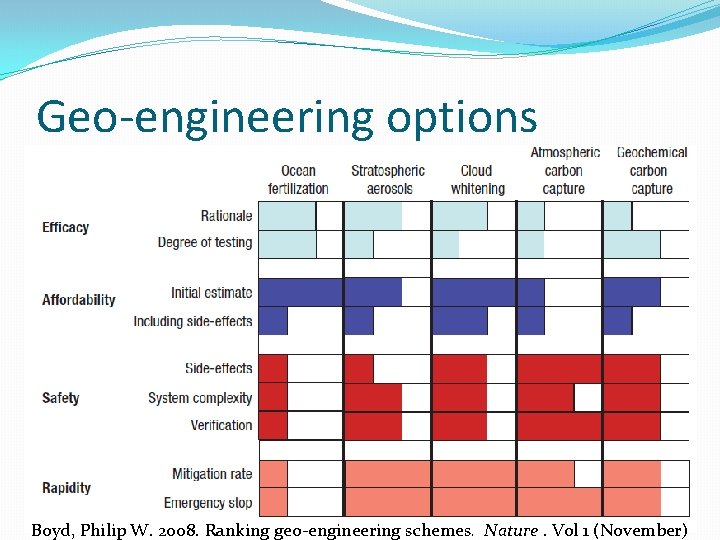
Geo-engineering options Boyd, Philip W. 2008. Ranking geo-engineering schemes. Nature. Vol 1 (November)
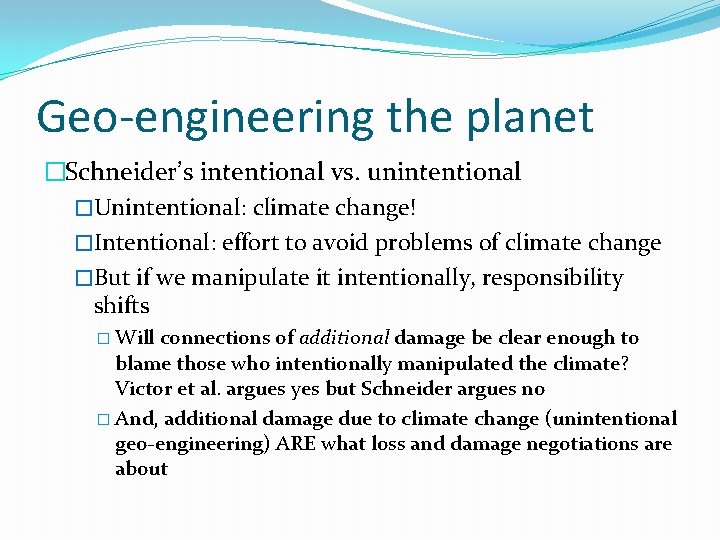
Geo-engineering the planet �Schneider’s intentional vs. unintentional �Unintentional: climate change! �Intentional: effort to avoid problems of climate change �But if we manipulate it intentionally, responsibility shifts � Will connections of additional damage be clear enough to blame those who intentionally manipulated the climate? Victor et al. argues yes but Schneider argues no � And, additional damage due to climate change (unintentional geo-engineering) ARE what loss and damage negotiations are about
Geo-engineering caveats �May not fix climate change problem �At all �For long periods of time �Doesn’t fix other CO 2 problems, e. g. , ocean acidification �Side effects �Inability to control perfectly �Moral hazard: reduced efforts toward mitigation
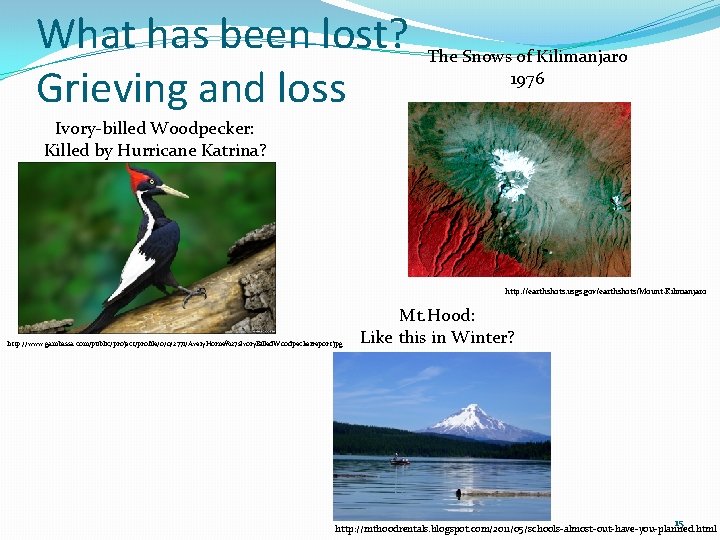
What has been lost? Grieving and loss The Snows of Kilimanjaro 1976 Ivory-billed Woodpecker: Killed by Hurricane Katrina? http: //earthshots. usgs. gov/earthshots/Mount-Kilimanjaro http: //www. gambassa. com/public/project/profile/0/0/2771/Avery. Horne%27 s. Ivory. Billed. Woodpeckerreport. jpg Mt. Hood: Like this in Winter? 15 http: //mthoodrentals. blogspot. com/2011/05/schools-almost-out-have-you-planned. html
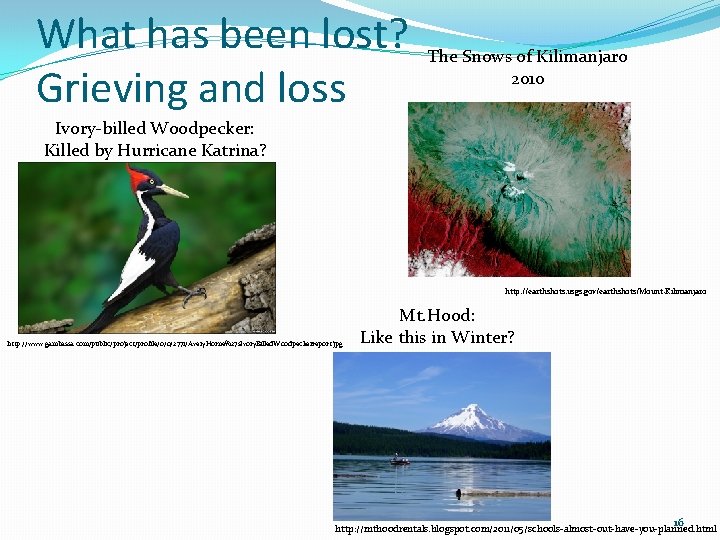
What has been lost? Grieving and loss The Snows of Kilimanjaro 2010 Ivory-billed Woodpecker: Killed by Hurricane Katrina? http: //earthshots. usgs. gov/earthshots/Mount-Kilimanjaro http: //www. gambassa. com/public/project/profile/0/0/2771/Avery. Horne%27 s. Ivory. Billed. Woodpeckerreport. jpg Mt. Hood: Like this in Winter? 16 http: //mthoodrentals. blogspot. com/2011/05/schools-almost-out-have-you-planned. html
What should we do?