
Presenting Data and Other Information to Our District
- Slides: 45
Presenting Data and Other Information to Our District Stakeholders Ann Feldman MELLC Meeting February 28, 2014
Goal of This Presentation Set the stage for 2014 to 2015 budget requests for the ELL department to the School Committee. Kindergarten program in every school. Additional ESL teachers to meet the need of our growing population Parent Information Center Assessment Specialist (ESL certified) I will be incorporating a couple of skills needed to deliver successful data presentations via Power. Point.
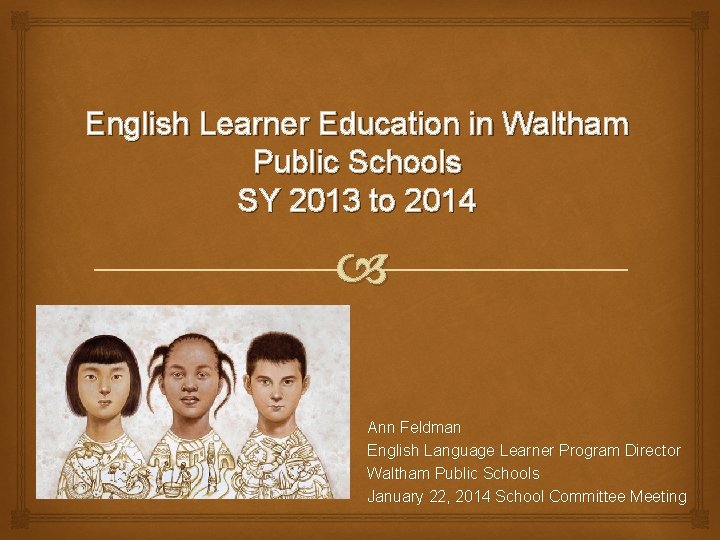
English Learner Education in Waltham Public Schools SY 2013 to 2014 Ann Feldman English Language Learner Program Director Waltham Public Schools January 22, 2014 School Committee Meeting
Thank You for This Invitation!
Waltham Demographics
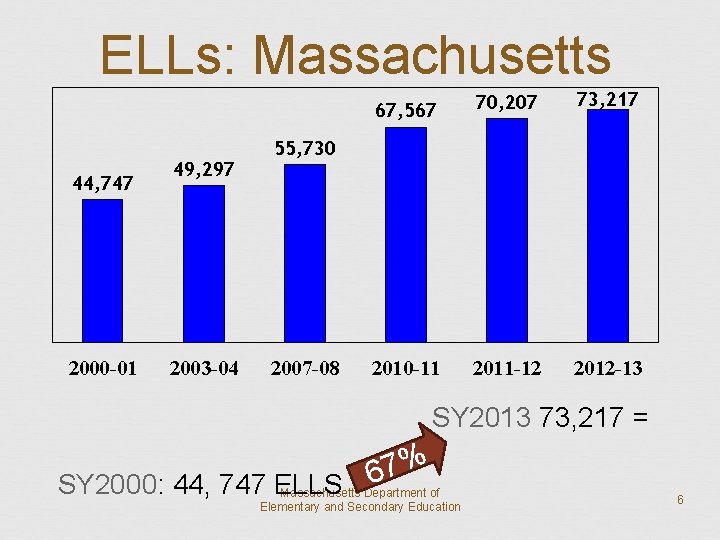
ELLs: Massachusetts 44, 747 2000 -01 49, 297 2003 -04 67, 567 70, 207 73, 217 2010 -11 2011 -12 2012 -13 55, 730 2007 -08 SY 2013 73, 217 = % 7 6 SY 2000: 44, 747 ELLS Massachusetts Department of Elementary and Secondary Education 6
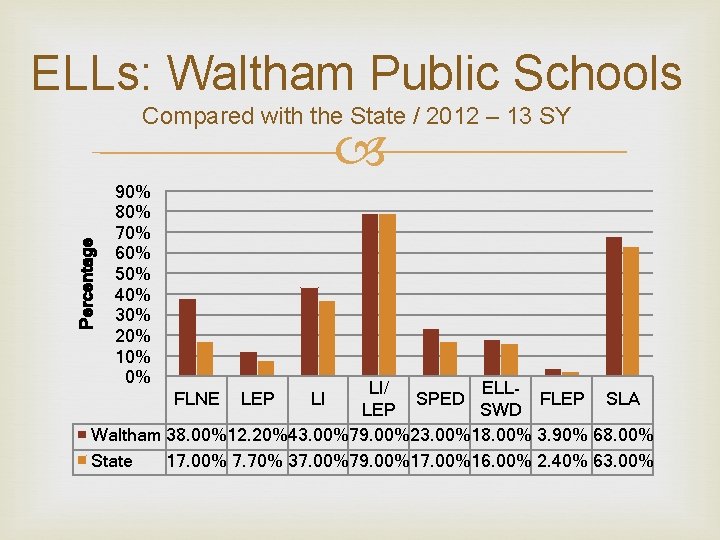
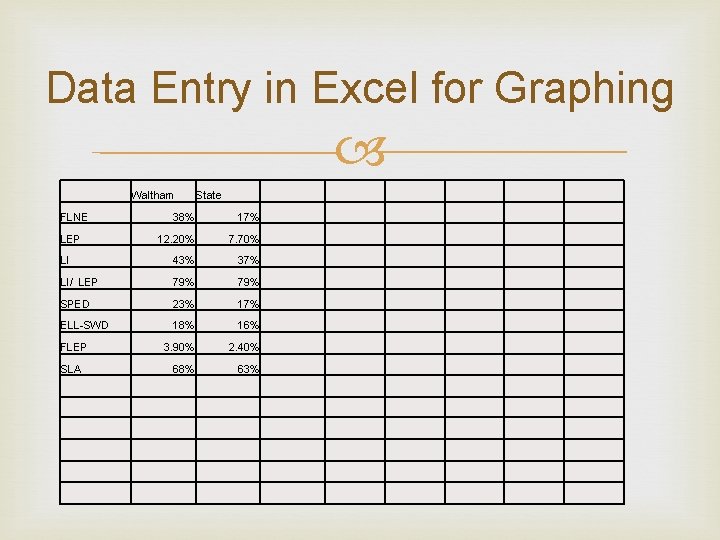
ELLs: Waltham Public Schools Compared with the State / 2012 – 13 SY Percentage 90% 80% 70% 60% 50% 40% 30% 20% 10% 0% LI/ ELLSPED FLEP SLA LEP SWD Waltham 38. 00%12. 20%43. 00%79. 00%23. 00%18. 00% 3. 90% 68. 00% State 17. 00% 7. 70% 37. 00%79. 00%17. 00%16. 00% 2. 40% 63. 00% FLNE LEP LI
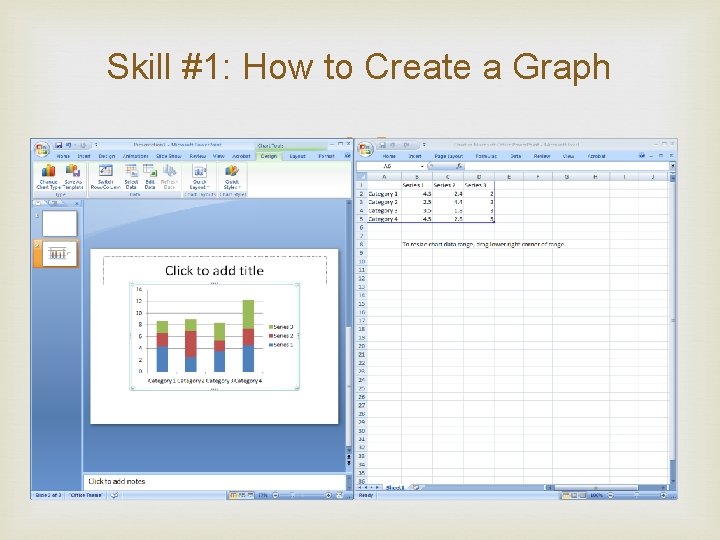
Skill #1: How to Create a Graph
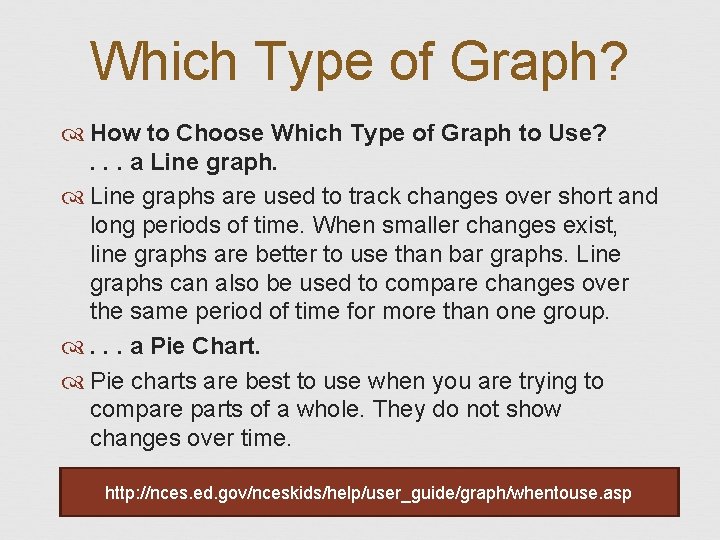
Which Type of Graph? How to Choose Which Type of Graph to Use? . . . a Line graphs are used to track changes over short and long periods of time. When smaller changes exist, line graphs are better to use than bar graphs. Line graphs can also be used to compare changes over the same period of time for more than one group. . . . a Pie Chart. Pie charts are best to use when you are trying to compare parts of a whole. They do not show changes over time. http: //nces. ed. gov/nceskids/help/user_guide/graph/whentouse. asp
Data Entry in Excel for Graphing Waltham FLNE State 38% 17% 12. 20% 7. 70% LI 43% 37% LI/ LEP 79% SPED 23% 17% ELL-SWD 18% 16% 3. 90% 2. 40% 68% 63% LEP FLEP SLA
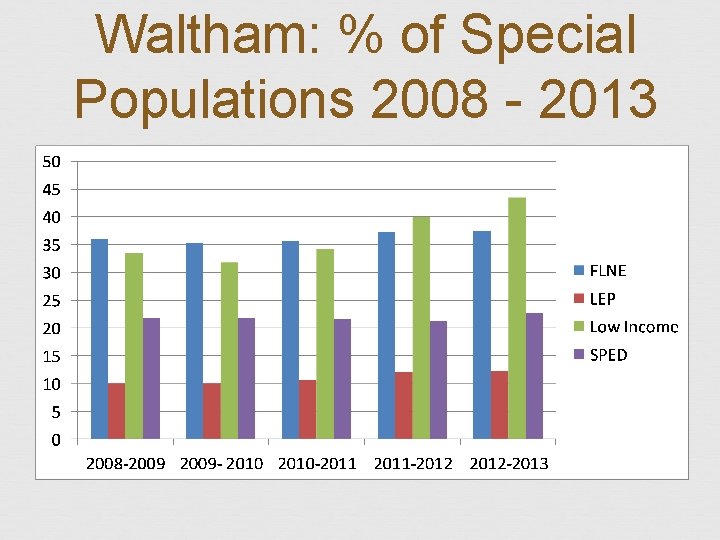
Waltham: % of Special Populations 2008 - 2013
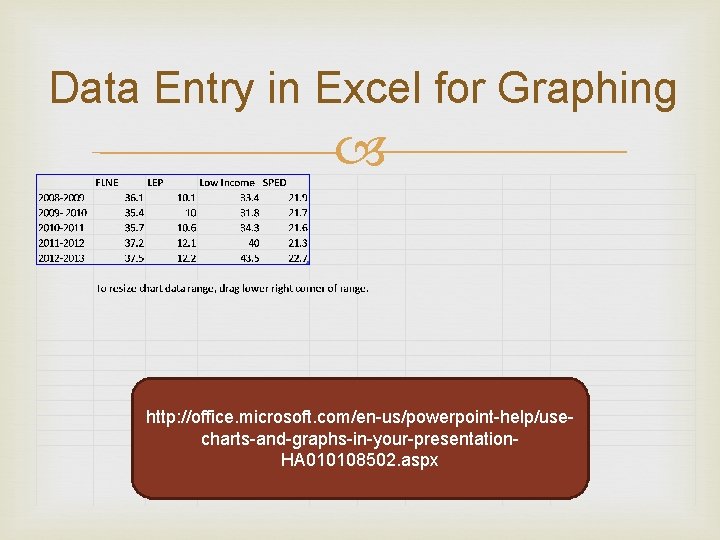
Data Entry in Excel for Graphing http: //office. microsoft. com/en-us/powerpoint-help/usecharts-and-graphs-in-your-presentation. HA 010108502. aspx
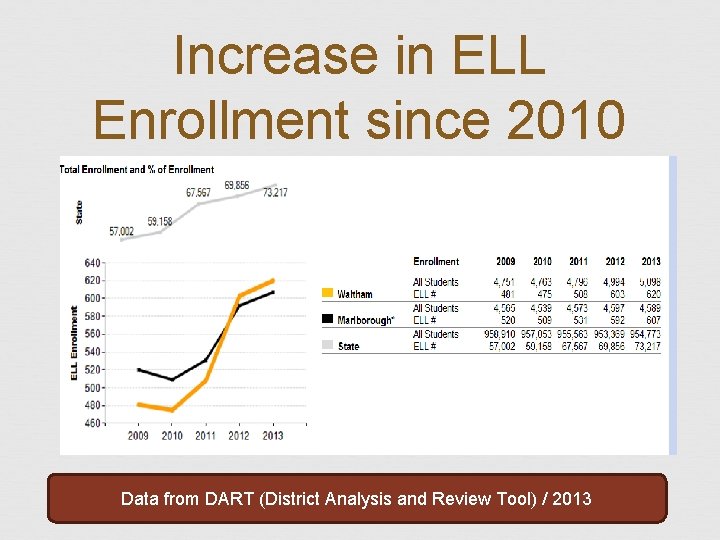
Increase in ELL Enrollment since 2010 Data from DART (District Analysis and Review Tool) / 2013
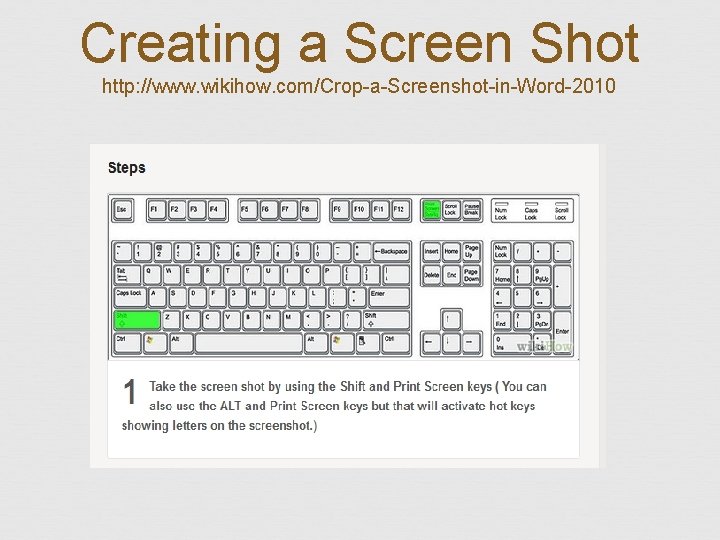
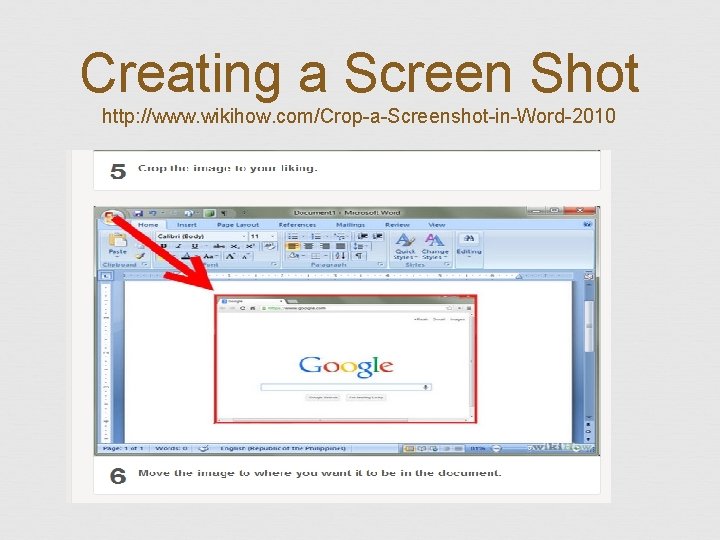
Creating a Screen Shot http: //www. wikihow. com/Crop-a-Screenshot-in-Word-2010
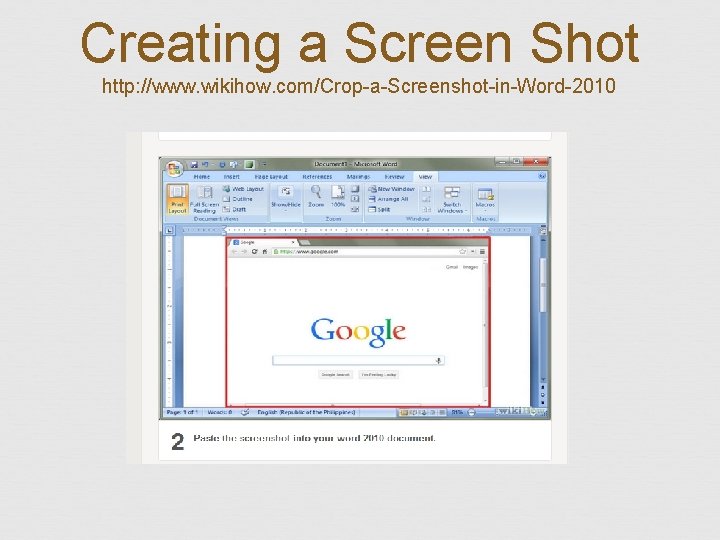
Creating a Screen Shot http: //www. wikihow. com/Crop-a-Screenshot-in-Word-2010
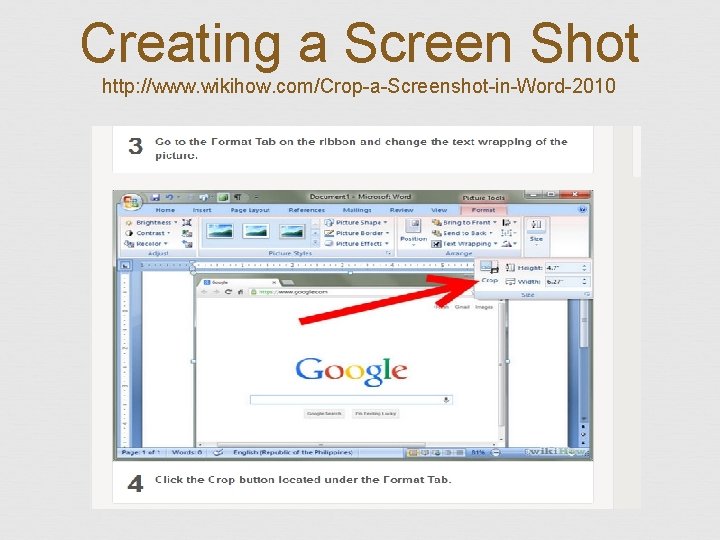
Creating a Screen Shot http: //www. wikihow. com/Crop-a-Screenshot-in-Word-2010
Creating a Screen Shot http: //www. wikihow. com/Crop-a-Screenshot-in-Word-2010
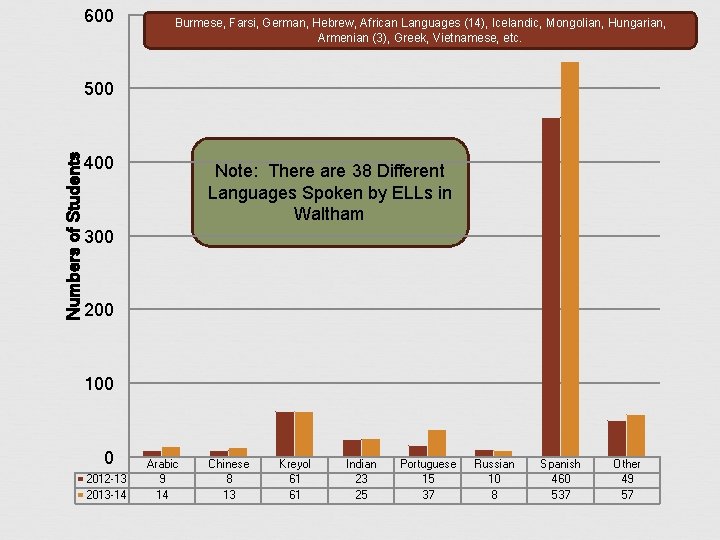
600 Burmese, Farsi, German, Hebrew, African Languages (14), Icelandic, Mongolian, Hungarian, Armenian (3), Greek, Vietnamese, etc. Numbers of Students 500 400 Note: There are 38 Different Languages Spoken by ELLs in Waltham 300 200 100 0 2012 -13 2013 -14 Arabic 9 14 Chinese 8 13 Kreyol 61 61 Indian 23 25 Portuguese 15 37 Russian 10 8 Spanish 460 537 Other 49 57
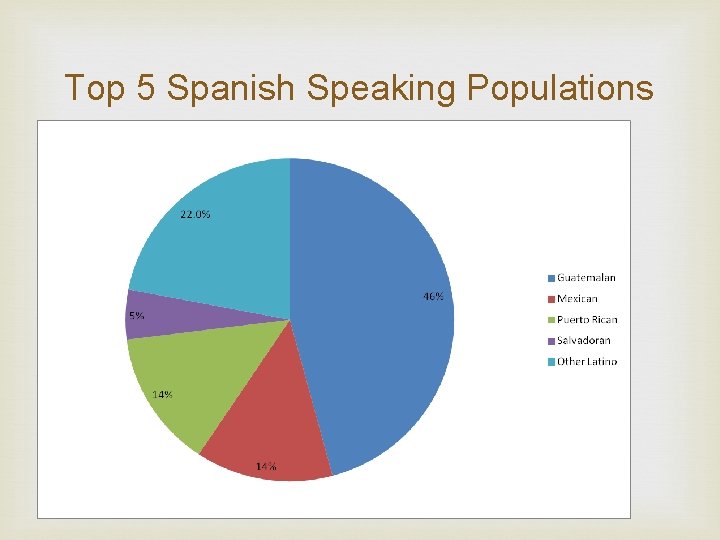
Top 5 Spanish Speaking Populations
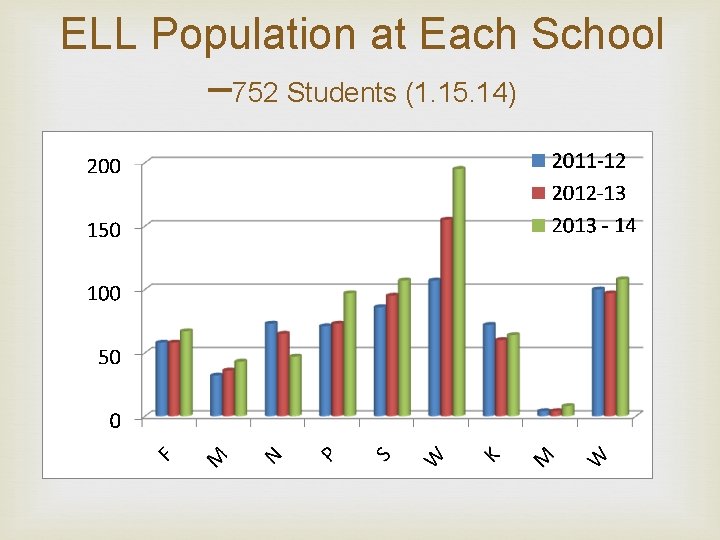
ELL Population at Each School – 752 Students (1. 15. 14)
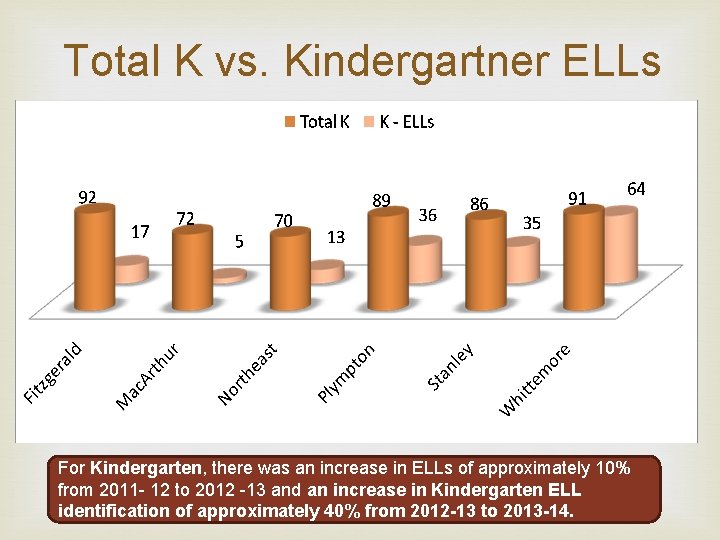
Total K vs. Kindergartner ELLs For Kindergarten, there was an increase in ELLs of approximately 10% from 2011 - 12 to 2012 -13 and an increase in Kindergarten ELL identification of approximately 40% from 2012 -13 to 2013 -14.
Compliance For a comprehensive guidance overview about English learner education, please see “Transitional Guidance on Identification, Assessment, Placement, and Reclassification of English Language Learners. ”
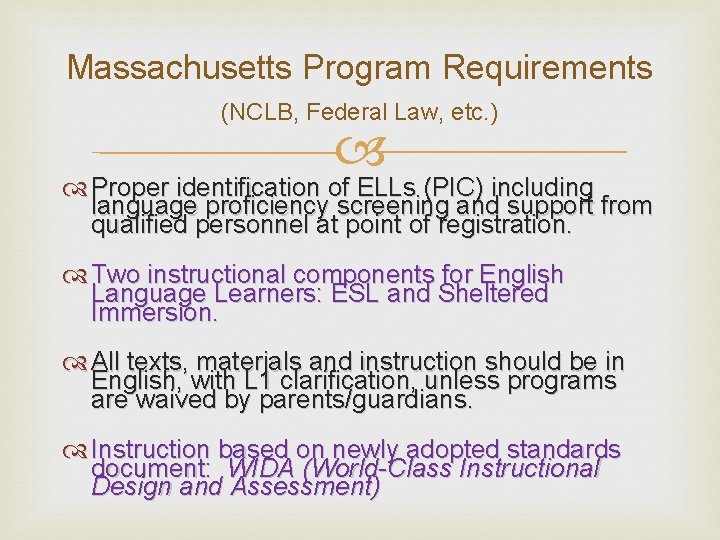
Massachusetts Program Requirements (NCLB, Federal Law, etc. ) Proper identification of ELLs (PIC) including language proficiency screening and support from qualified personnel at point of registration. Two instructional components for English Language Learners: ESL and Sheltered Immersion. All texts, materials and instruction should be in English, with L 1 clarification, unless programs are waived by parents/guardians. Instruction based on newly adopted standards document: WIDA (World-Class Instructional Design and Assessment)
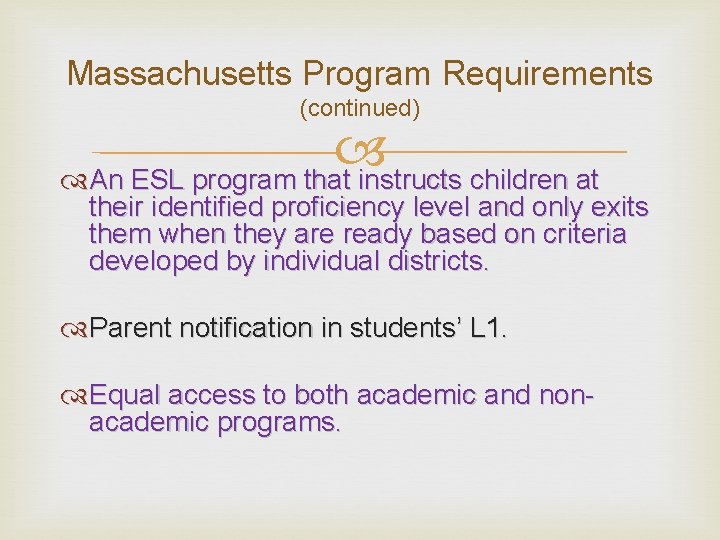
Massachusetts Program Requirements (continued) An ESL program that instructs children at their identified proficiency level and only exits them when they are ready based on criteria developed by individual districts. Parent notification in students’ L 1. Equal access to both academic and nonacademic programs.
Massachusetts Program Requirements (continued) Annual assessment of all English learners (WIDA ACCESS for ELLs) as well as MCAS tests. Translations/interpretations in students L 1: report cards, conferences, events, etc. to ensure families’ civil rights.
ESL and Sheltered Content Instruction
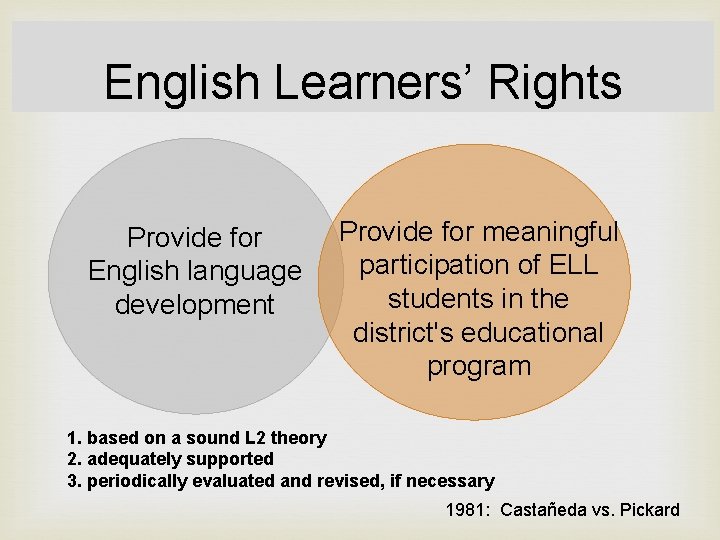
English Learners’ Rights Provide for English language development Provide for meaningful participation of ELL students in the district's educational program 1. based on a sound L 2 theory 2. adequately supported 3. periodically evaluated and revised, if necessary 1981: Castañeda vs. Pickard
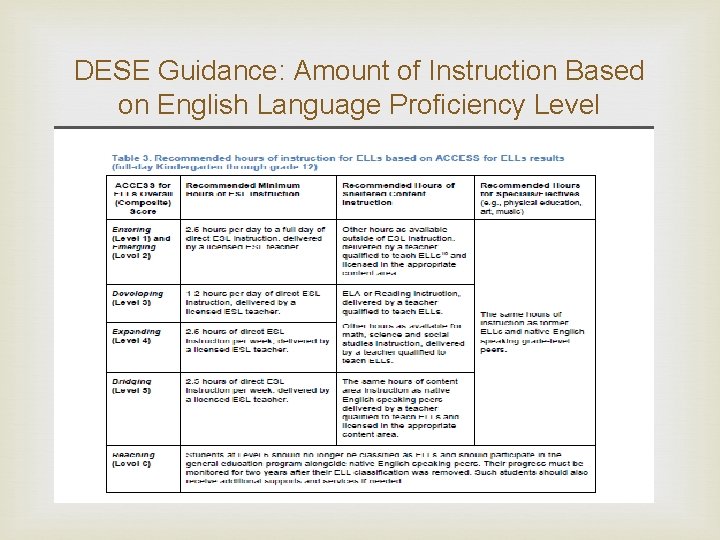
DESE Guidance: Amount of Instruction Based on English Language Proficiency Level
Our Accomplishments
Students Making Progress District-Wide Students have made progress vis-à-vis language acquisition and academic achievement. Students are receiving more direct ESL services than in 2012 to 2013, but our numbers have increased exponentially since last year and there is a greater need for more staff. More ELLs are integrated into general education classrooms with pull-out ESL support.
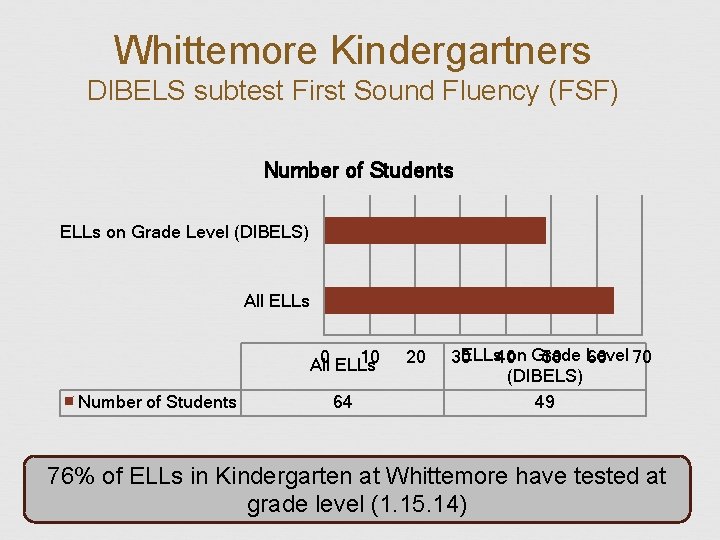
Whittemore Kindergartners DIBELS subtest First Sound Fluency (FSF) Number of Students ELLs on Grade Level (DIBELS) All ELLs 0 ELLs 10 All Number of Students 64 20 ELLs 40 on Grade 30 50 Level 60 70 (DIBELS) 49 76% of ELLs in Kindergarten at Whittemore have tested at grade level (1. 15. 14)
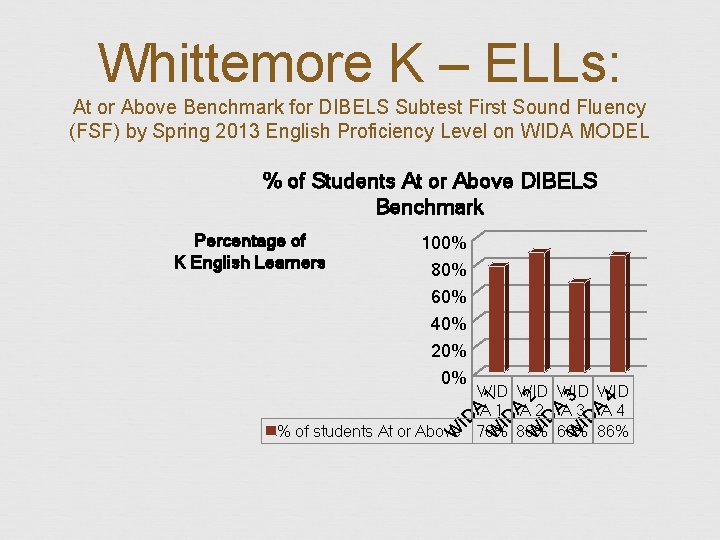
Whittemore K – ELLs: At or Above Benchmark for DIBELS Subtest First Sound Fluency (FSF) by Spring 2013 English Proficiency Level on WIDA MODEL % of Students At or Above DIBELS Benchmark Percentage of K English Learners 100% 80% 60% 40% 20% 0% 4 ID A 3 W ID A 2 W ID A W W ID A 1 WID WID A 1 A 2 A 3 A 4 % of students At or Above 78% 88% 66% 86%
ELL-SWD Focus Group English learners with disabilities focus group meets monthly to address identification, programing and assessment.
Coach: Kennedy MS Genevra Valvo, our new instructional coach, has provided much-needed support for teachers and students at Kennedy. She is doing instructional modeling, working with individual students, curriculum development, and conducting workshops for staff and administration.
SEI Teacher and Administrator Courses 130 teachers and 30 administrators will have taken the required SEI endorsement courses by the end of our second cohort year.
Bilingual Parent Advisory Council For the past 1 ½ years, parents, staff and administrators have been meeting monthly to support our diverse families. Last year, we discussed MCAS administration, offered hands on assistance with technology and Edline, and spoke about parent teacher conferences. This year we will have math and literacy workshops, presentations celebrating specific cultures of our families and our Second Annual talent show at the end of the school year. See schedule for this year’s BPAC Meetings
Our Challenges
Students Coming In Each Month During School Year It is difficult to gauge exactly what our ELL instructional needs will be because our culturally and linguistically diverse students enter the district throughout the school year. We also cannot anticipate what these students’ instructional needs are (their levels of English language proficiency. ) Our numbers have increased by 20+% this year (compared to last) which was totally unanticipated as well.
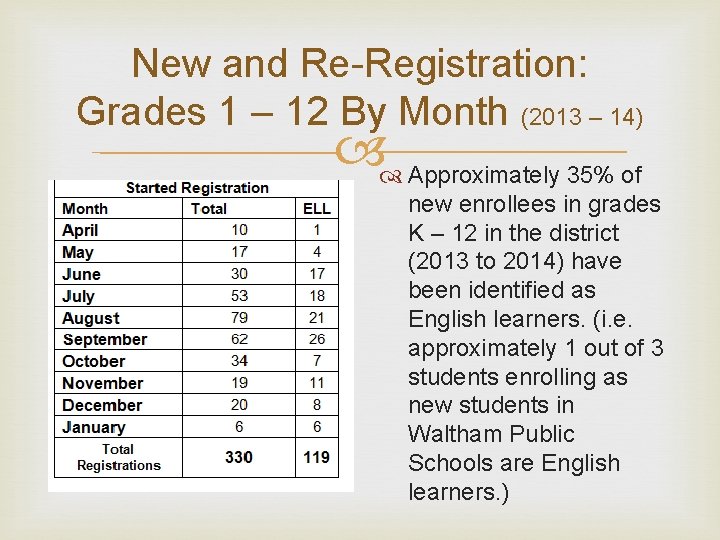
New and Re-Registration: Grades 1 – 12 By Month (2013 – 14) Approximately 35% of new enrollees in grades K – 12 in the district (2013 to 2014) have been identified as English learners. (i. e. approximately 1 out of 3 students enrolling as new students in Waltham Public Schools are English learners. )
Challenges: Reporting of ACCESS Results WIDA ACCESS results are not reported until late in May. Last year, our students did better than expected and many of them were transitioned into mainstream classes; they still were required to have direct ESL instruction as per guidelines.
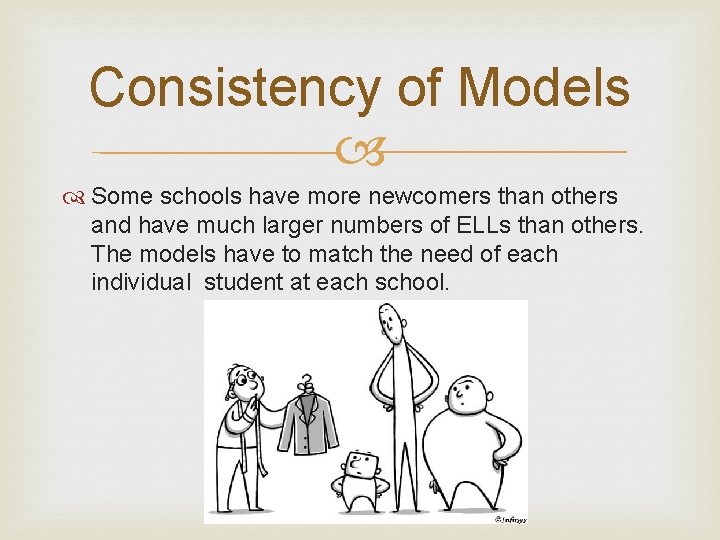
Consistency of Models Some schools have more newcomers than others and have much larger numbers of ELLs than others. The models have to match the need of each individual student at each school.
Our Hope Moving Forward
The Goal of Our ELL Program The purpose of our program is to accelerate English language literacy so that our second language learners will be successful in all of their academic endeavors, while at the same time valuing the social and cultural knowledge that these children bring to school. We appreciate your support in order to make this a reality!
Questions? Comments?
Ann Feldman School Email: annfeldman@k 12. waltham. ma. us Office Phone: 781. 314. 5498