
Presenters Special Agents Monika Borsy Carlos Berroya FAA
Presenters : Special Agents Monika Borsy & Carlos Berroya FAA Hazardous Materials Regulations For Passengers Federal Aviation Administration 1
FAA Hazardous Materials Program § In 1997 the Dangerous Goods/Cargo Security Program was established as a result of Valu. Jet Airlines Flight 592 crash into the Florida Everglades caused by the actuation of improperly prepared unexpended oxygen generators. § In November 2002, the FAA reenergized its Hazardous Materials Program after the Department of Transportation split responsibility for the oversight of cargo security from hazardous material, with cargo security becoming the purview of the Department of Homeland Security and hazardous materials returning to the FAA from the Transportation Security Administration. § As a result of this change in responsibility, the FAA is focused solely on the safe transportation of hazardous materials by air. FAA Hazardous Materials Regulations For Passengers Federal Aviation Administration 2
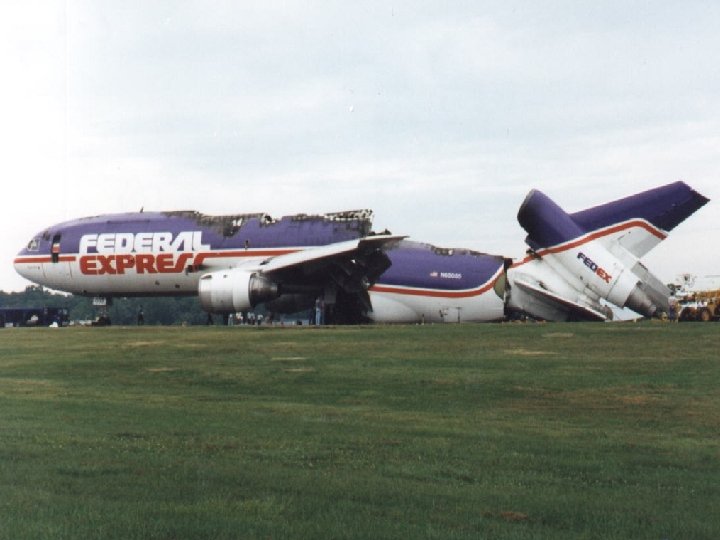
Program Priorities Prevent fatalities resulting from improperly shipped Hazardous Materials in U. S. air commerce by: • Conducting assessments of Air Carriers, Shippers, and Repair Stations • Responding to incidents, accidents and discrepancy reports • Implementing aggressive outreach and education programs to create awareness and ensure compliance with the hazardous material regulations • Gathering and analyzing data to identify and combat dangerous trends before they become a problem FAA Hazardous Materials Regulations For Passengers Federal Aviation Administration 3
FAA Hazardous Materials Regulations For Passengers Federal Aviation Administration 4
FAA Hazardous Materials Regulations For Passengers Federal Aviation Administration 5
Hazardous Material Regulations § 49 Code of Federal Regulations (49 CFR) FAA Hazardous Materials Regulations For Passengers Federal Aviation Administration 6
Air Carrier Discrepancy Reporting 49 CFR 175. 31 • Carriers must report undeclared hazmat in cargo or passenger checked baggage. • This still applies even if TSA discovers the hazmat during screening of checked bag. FAA Hazardous Materials Regulations For Passengers Federal Aviation Administration 7
Passenger Hazardous Materials Exceptions (49 CFR, 175. 10) • Passengers & crew can only carry certain personal-use hazardous materials such as medicinal and toilet articles • See http: //ash. faa. gov for details on what can and cannot be carried in baggage and in the aircraft cabin Passengers can receive warnings or stiff fines from the FAA—something that is becoming more common as airport screeners find more hazmat in baggage. FAA Hazardous Materials Regulations For Passengers Federal Aviation Administration 8
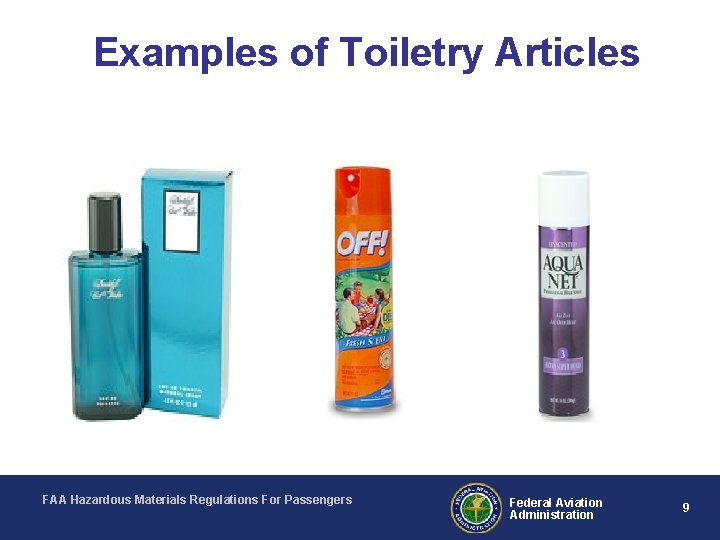
Examples of Toiletry Articles FAA Hazardous Materials Regulations For Passengers Federal Aviation Administration 9
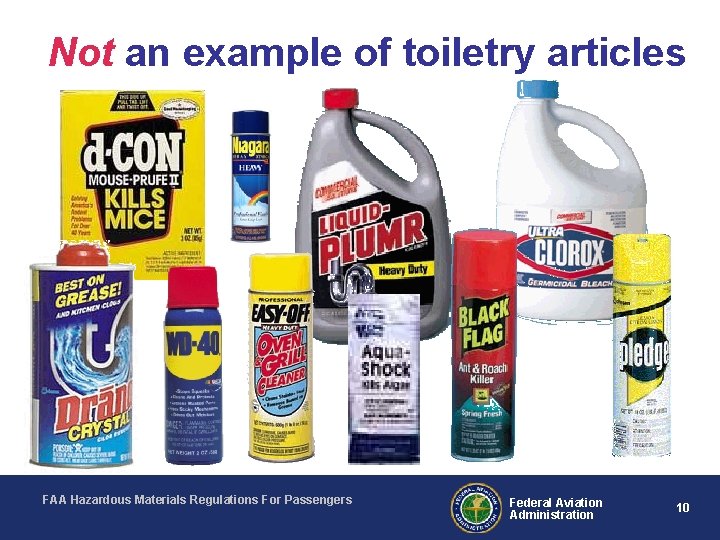
Not an example of toiletry articles FAA Hazardous Materials Regulations For Passengers Federal Aviation Administration 10
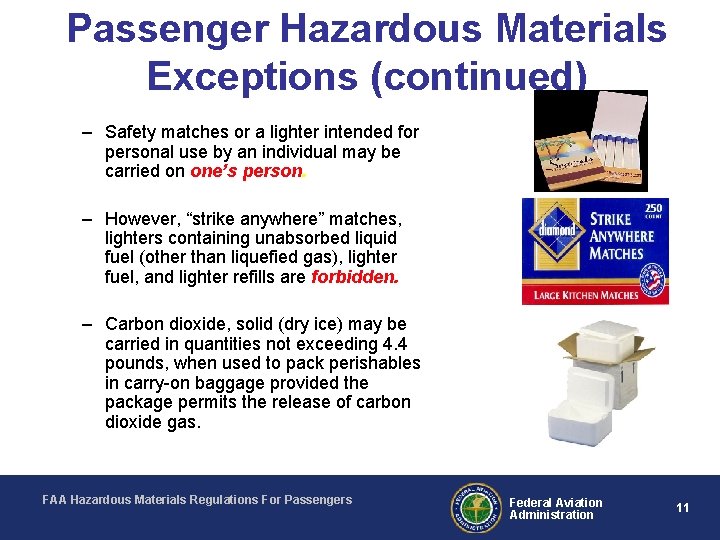
Passenger Hazardous Materials Exceptions (continued) – Safety matches or a lighter intended for personal use by an individual may be carried on one’s person. – However, “strike anywhere” matches, lighters containing unabsorbed liquid fuel (other than liquefied gas), lighter fuel, and lighter refills are forbidden. – Carbon dioxide, solid (dry ice) may be carried in quantities not exceeding 4. 4 pounds, when used to pack perishables in carry-on baggage provided the package permits the release of carbon dioxide gas. FAA Hazardous Materials Regulations For Passengers Federal Aviation Administration 11
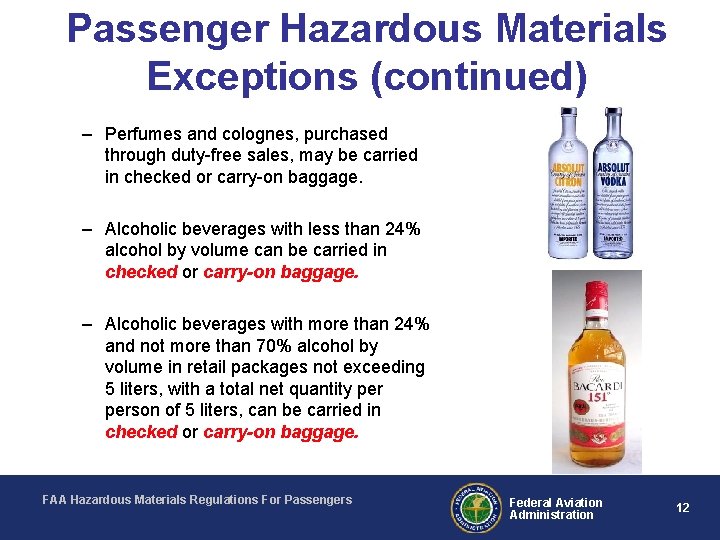
Passenger Hazardous Materials Exceptions (continued) – Perfumes and colognes, purchased through duty-free sales, may be carried in checked or carry-on baggage. – Alcoholic beverages with less than 24% alcohol by volume can be carried in checked or carry-on baggage. – Alcoholic beverages with more than 24% and not more than 70% alcohol by volume in retail packages not exceeding 5 liters, with a total net quantity person of 5 liters, can be carried in checked or carry-on baggage. FAA Hazardous Materials Regulations For Passengers Federal Aviation Administration 12
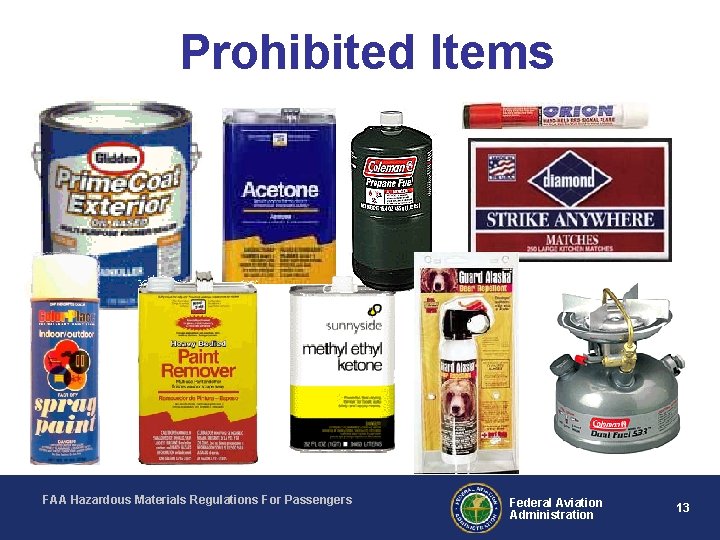
Prohibited Items FAA Hazardous Materials Regulations For Passengers Federal Aviation Administration 13
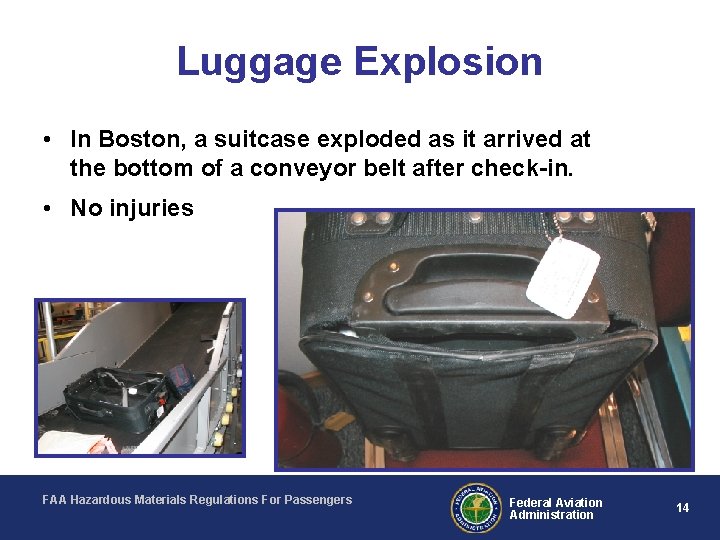
Luggage Explosion • In Boston, a suitcase exploded as it arrived at the bottom of a conveyor belt after check-in. • No injuries FAA Hazardous Materials Regulations For Passengers Federal Aviation Administration 14
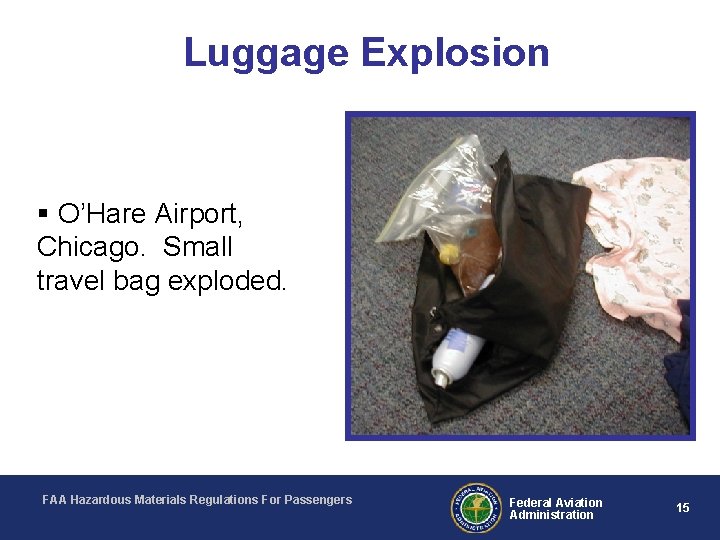
Luggage Explosion § O’Hare Airport, Chicago. Small travel bag exploded. FAA Hazardous Materials Regulations For Passengers Federal Aviation Administration 15
Cause? § A damaged hairspray can (flammable aerosol) was found in the luggage. Static discharge from the luggage conveyor belt was the suspected ignition source. FAA Hazardous Materials Regulations For Passengers Federal Aviation Administration 16
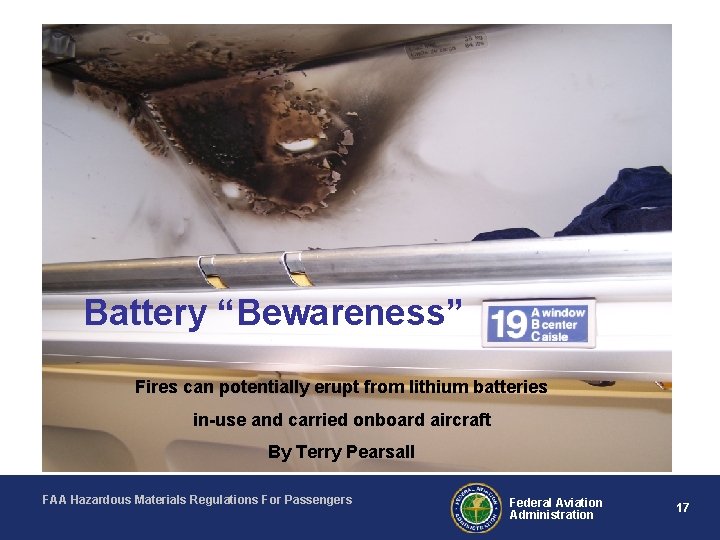
Battery “Bewareness” Fires can potentially erupt from lithium batteries in-use and carried onboard aircraft By Terry Pearsall FAA Hazardous Materials Regulations For Passengers Federal Aviation Administration 17
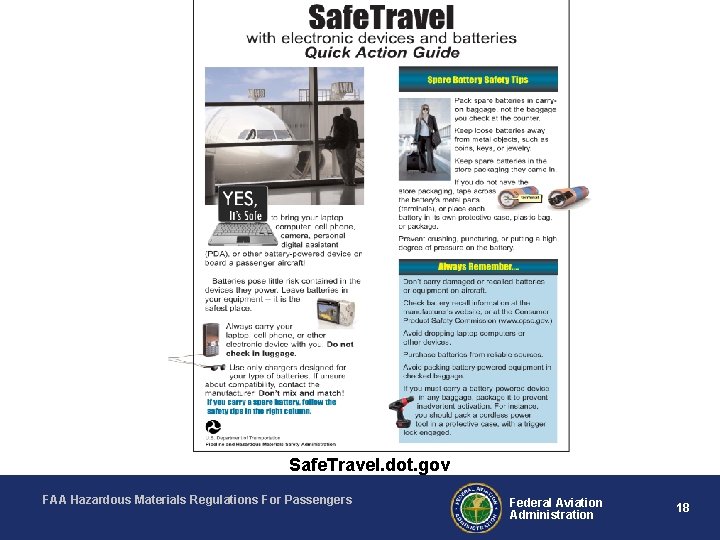
Safe. Travel. dot. gov FAA Hazardous Materials Regulations For Passengers Federal Aviation Administration 18
Notification to Passengers Federal law forbids the carriage of hazardous materials aboard aircraft in your luggage or on your person. A violation can result in five years' imprisonment and penalties of $250, 000 or more (49 U. S. C. 5124). Hazardous materials include explosives, compressed gases, flammable liquids and solids, oxidizers, poisons, corrosives and radioactive materials. Examples: Paints, lighter fluid, fireworks, tear gases, oxygen bottles, and radiopharmaceuticals. There are special exceptions for small quantities (up to 70 ounces total) of medicinal and toilet articles carried in your luggage and certain smoking materials carried on your person. For further information contact your airline representative. FAA Hazardous Materials Regulations For Passengers Federal Aviation Administration 19
Resources FAA Hazardous Materials http: //ash. faa. gov/Hazmat. asp PHMSA Office of Hazardous Materials http: //Safe. Travel. dot. gov FAA Hazardous Materials Regulations For Passengers Federal Aviation Administration 20
- Slides: 20