
Presenters Disclosure Faculty Afsaneh Moradi Joanna Richards Relationships




- Slides: 25
Presenters’ Disclosure Faculty: Afsaneh Moradi, Joanna Richards Relationships with commercial interests: None. Potential for conflict(s) of interest: None. Mitigating Potential Bias • The information presented is based on available data and evaluation findings. All efforts have been made to provide fair and balanced perspectives. • If you have concerns of commercial bias, please contact Afsaneh Moradi (amoradi@doctorsofbc. ca) or Joanna Richards (Joanna. Richards@gov. bc. ca)
Starting Up a Primary Care Network Afsaneh Moradi Acting Director Community, Partnerships and Integration Doctors of BC Joanna Richards Director Primary Health Care, Primary Care Access Branch Ministry of Health
Agenda 1. 2. 3. 4. 5. 6. 7. 8. Welcome Vision & Context for Primary Care Journey from EOI to Service Plan Expression of Interest Unpacked Learning from Community Experience PCN Service Plan Unpacked Questions and Discussion Summary and Closing
A story of two neighbours
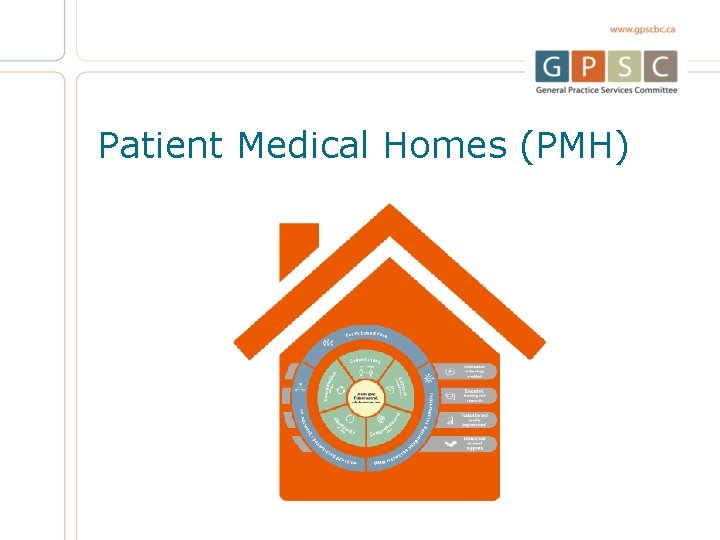
Patient Medical Homes (PMH)
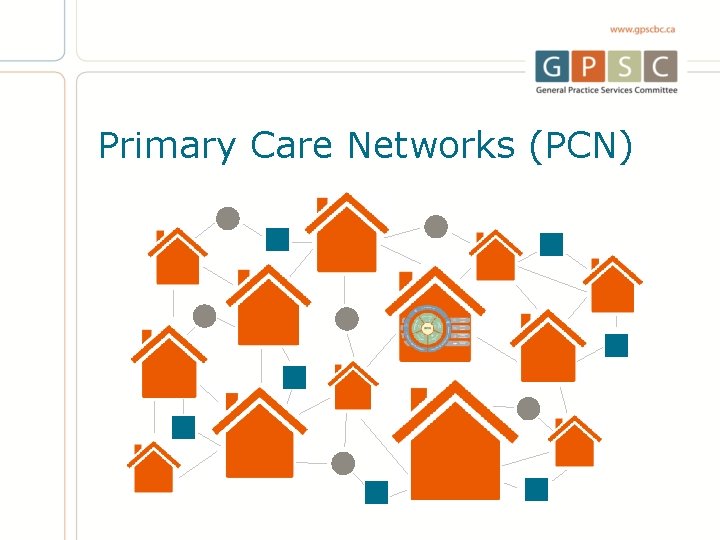
Primary Care Networks (PCN)
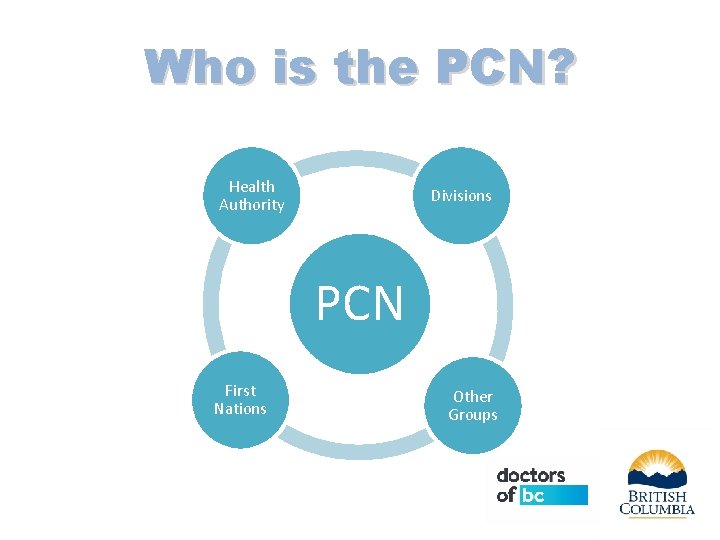
Who is the PCN? Health Authority Divisions PCN First Nations Other Groups
PCN Goal “ PCNs will be designed to meet the needs of individuals and ensure the comprehensive suite of primary care services are accessible by the community population they serve. ” - PCN Policy Direction 2017
Back to foundations Attachment
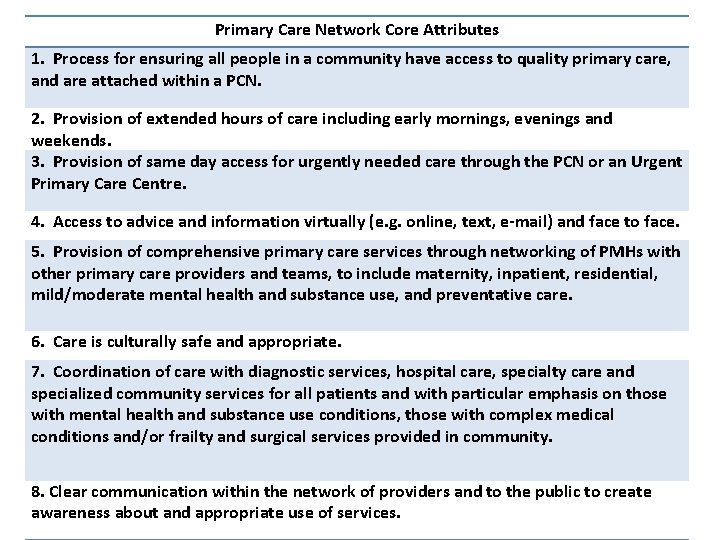
Primary Care Network Core Attributes 1. Process for ensuring all people in a community have access to quality primary care, and are attached within a PCN. 2. Provision of extended hours of care including early mornings, evenings and weekends. 3. Provision of same day access for urgently needed care through the PCN or an Urgent Primary Care Centre. 4. Access to advice and information virtually (e. g. online, text, e-mail) and face to face. 5. Provision of comprehensive primary care services through networking of PMHs with other primary care providers and teams, to include maternity, inpatient, residential, mild/moderate mental health and substance use, and preventative care. 6. Care is culturally safe and appropriate. 7. Coordination of care with diagnostic services, hospital care, specialty care and specialized community services for all patients and with particular emphasis on those with mental health and substance use conditions, those with complex medical conditions and/or frailty and surgical services provided in community. 8. Clear communication within the network of providers and to the public to create awareness about and appropriate use of services.
JOURNEY FROM EOI TO SERVICE PLANNING
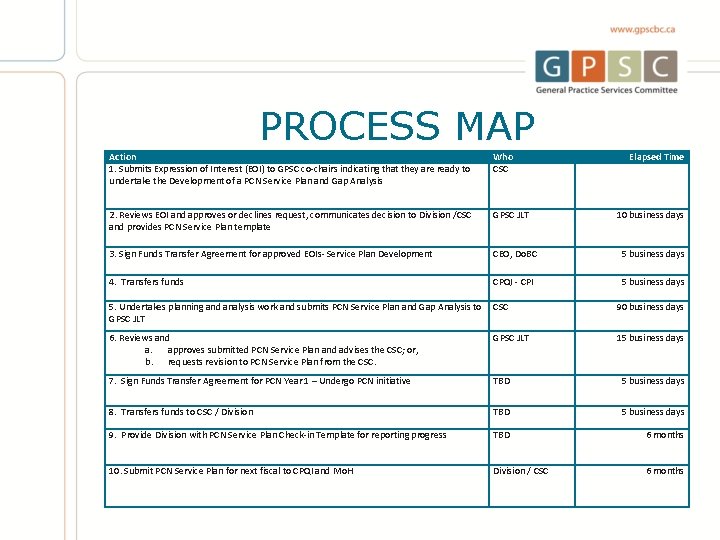
PROCESS MAP Action 1. Submits Expression of Interest (EOI) to GPSC co-chairs indicating that they are ready to undertake the Development of a PCN Service Plan and Gap Analysis Who CSC Elapsed Time 2. Reviews EOI and approves or declines request, communicates decision to Division /CSC and provides PCN Service Plan template GPSC JLT 3. Sign Funds Transfer Agreement for approved EOIs- Service Plan Development CEO, Do. BC 5 business days 4. Transfers funds CPQI - CPI 5 business days 10 business days 5. Undertakes planning and analysis work and submits PCN Service Plan and Gap Analysis to CSC GPSC JLT 90 business days 6. Reviews and a. approves submitted PCN Service Plan and advises the CSC; or, b. requests revision to PCN Service Plan from the CSC. GPSC JLT 15 business days 7. Sign Funds Transfer Agreement for PCN Year 1 – Undergo PCN initiative TBD 5 business days 8. Transfers funds to CSC / Division TBD 5 business days 9. Provide Division with PCN Service Plan Check-in Template for reporting progress TBD 6 months 10. Submit PCN Service Plan for next fiscal to CPQI and Mo. H Division / CSC 6 months
EXPRESSION OF INTEREST UNPACKED
LEARNING FROM COMMUNITY EXPERIENCE
Key Questions • What did you do in preparing your EOI that you think was critical to its being successful? • What did you start with ? • How were you able to report such a large number of doctors ready to do PCN? • How did you convey the concept in terms physicians could relate to? • How did you convey such a solid sense of partnership in the EOI? • What were the key success factors for you? • What are your final thought for others?
PCN SERVICE PLAN UNPACKED
PCN Service Plan Unpacked • 5 key parts: o o o Gap Analysis Identifying Existing Services Redesigning vs. Net New Budget Growth plan
Phased Approach with Existing and New Resources • Phase 1 – formation of PCN, focus on attachment • Phase 2 – service redesign, building teams, progress on the eight core attributes • Linkages with SCSPs
What are the gaps? • Understanding community primary care needs will involve: o Determining the primary care attachment gap o Determining population needs and opportunities
What is access like now? • Identifying existing primary care services in the PCN will involve: o Defining the number of practices engaged in PCN development o Identifying the current state of access in the PCN o Availability of urgent primary care services in the PCN
Redesign vs. Net New • Service plans will indicate how services will be redesigned to: o Target gaps in the primary care system identified using family practice EMR data, health authority, and other health system data o Align with the comprehensive suite of primary care services
Budget and Growth • Service plans will: o outline a budget for change management and the implementation of phase 1 (attachment) and phase 2 (redesign) o outline how the PCN will expand include other providers and geographic regions in over the next three years
QUESTIONS AND DISCUSSION
SUMMARY AND CLOSING