
Presenter Joe Duffy Senior Educational Psychologist Professional Academic



- Slides: 23
Presenter: Joe Duffy, Senior Educational Psychologist/ Professional & Academic Tutor, QUB 11 th & 12 th February 2014
Outline of presentation § SEBD as a SEN § Assessment framework • Types of support § Managing challenging situations
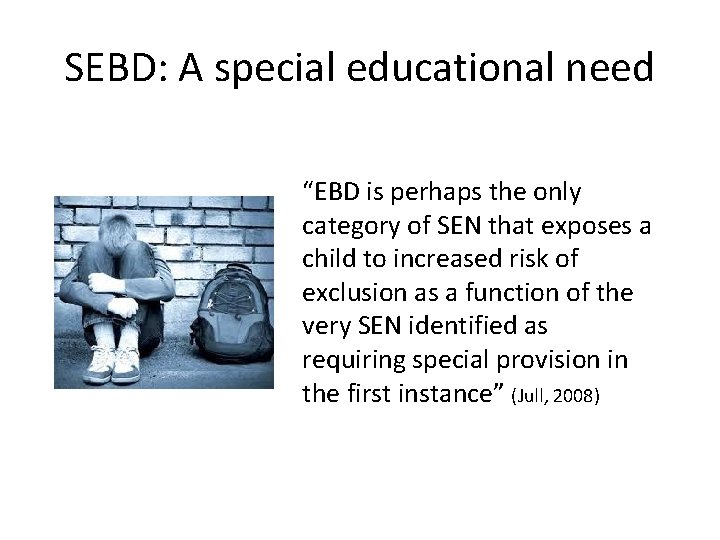
SEBD: A special educational need “EBD is perhaps the only category of SEN that exposes a child to increased risk of exclusion as a function of the very SEN identified as requiring special provision in the first instance” (Jull, 2008)
Social, Emotional & Behavioural Difficulties SEBD § SEBD; BESD; EBD? ? ? § Social, mental & emotional health (SMEH) – Children & Families Bill (2013) § An administrative SEN category (within the context of the Code of Practice, 1996) § “…. an imprecise umbrella term, always difficult to define, although it is quite clear that many children and young people to whom the term is applied have complex and chronic difficulties, which place them at risk of school and wider social exclusion” (Source: Appendix 1 from 2006 SEBDA Business Plan)
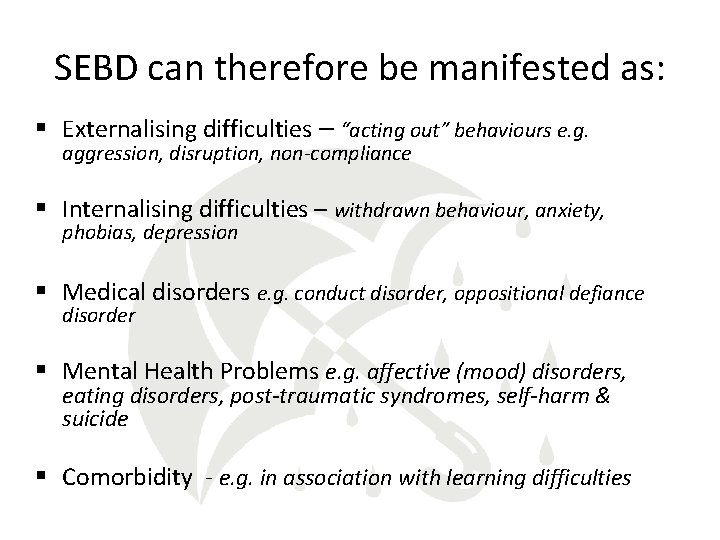
SEBD can therefore be manifested as: § Externalising difficulties – “acting out” behaviours e. g. aggression, disruption, non-compliance § Internalising difficulties – withdrawn behaviour, anxiety, phobias, depression § Medical disorders e. g. conduct disorder, oppositional defiance disorder § Mental Health Problems e. g. affective (mood) disorders, eating disorders, post-traumatic syndromes, self-harm & suicide § Comorbidity - e. g. in association with learning difficulties
Understanding SEBD
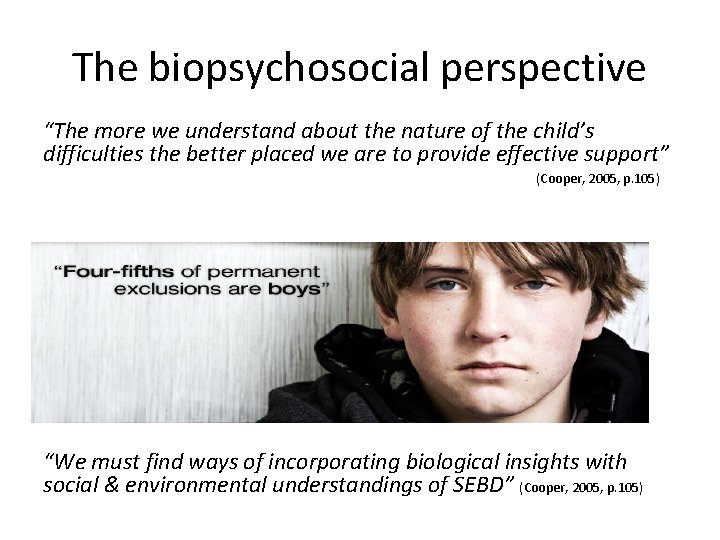
The biopsychosocial perspective “The more we understand about the nature of the child’s difficulties the better placed we are to provide effective support” (Cooper, 2005, p. 105) “We must find ways of incorporating biological insights with social & environmental understandings of SEBD” (Cooper, 2005, p. 105)
The 5 Ps approach to understanding SEBD Risk Factors Triggers, setting events Predisposing Resilience Protective Problem Situation Precipitating Maintaining Factors Behaviours Presenting Perpetuating
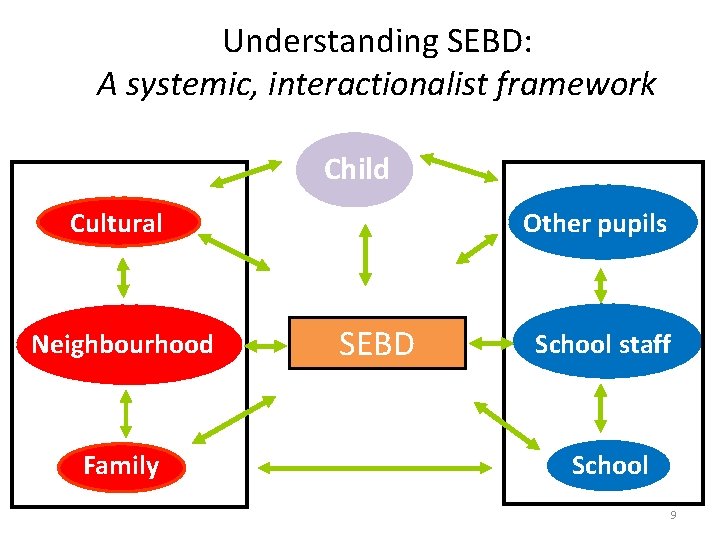
Understanding SEBD: A systemic, interactionalist framework Child Cultural Neighbourhood Family Other pupils SEBD School staff School 9
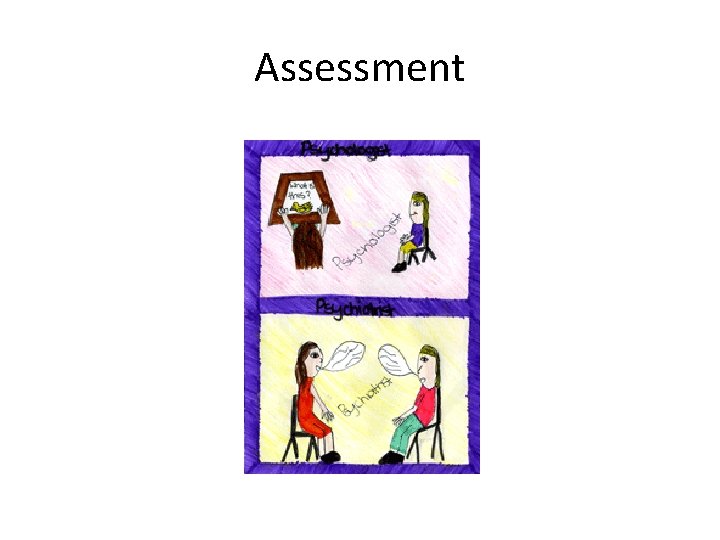
Assessment
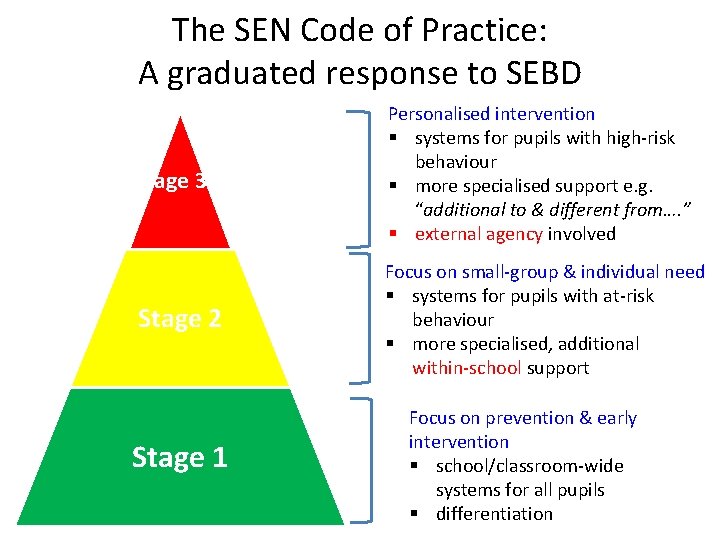
The SEN Code of Practice: A graduated response to SEBD Stage 3 -5 Personalised intervention § systems for pupils with high-risk behaviour § more specialised support e. g. “additional to & different from…. ” § external agency involved Stage 2 Focus on small-group & individual need § systems for pupils with at-risk behaviour § more specialised, additional within-school support Stage 1 Focus on prevention & early intervention § school/classroom-wide systems for all pupils § differentiation
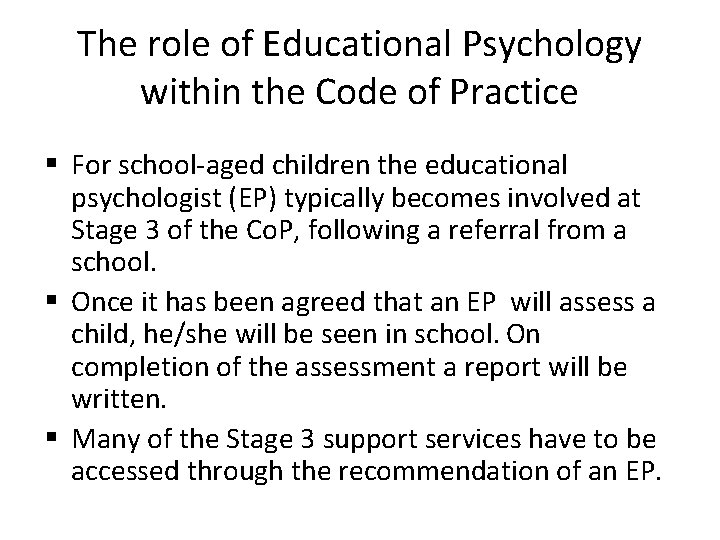
The role of Educational Psychology within the Code of Practice § For school-aged children the educational psychologist (EP) typically becomes involved at Stage 3 of the Co. P, following a referral from a school. § Once it has been agreed that an EP will assess a child, he/she will be seen in school. On completion of the assessment a report will be written. § Many of the Stage 3 support services have to be accessed through the recommendation of an EP.
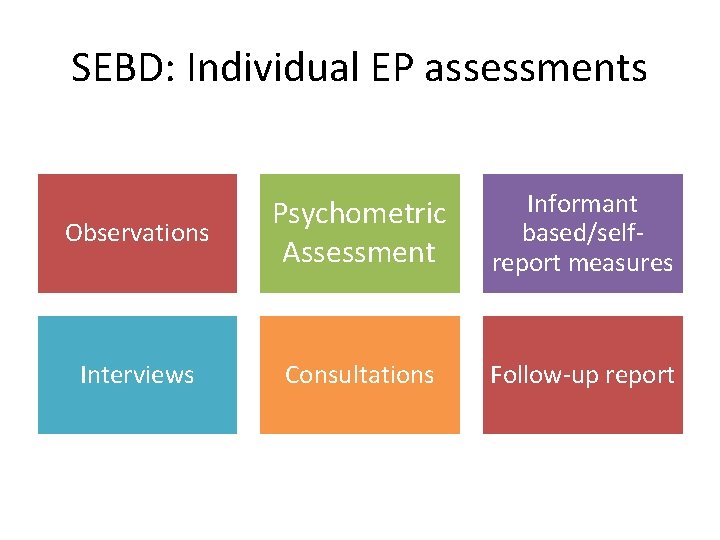
SEBD: Individual EP assessments Observations Psychometric Assessment Informant based/selfreport measures Interviews Consultations Follow-up report
Types of Support
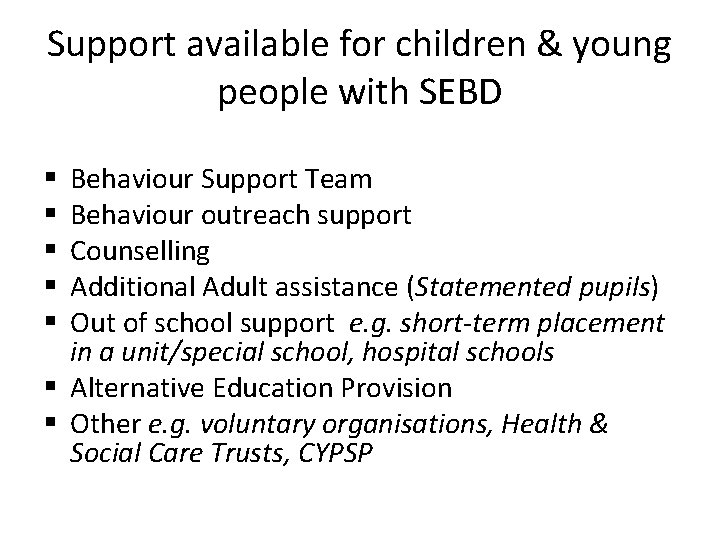
Support available for children & young people with SEBD Behaviour Support Team Behaviour outreach support Counselling Additional Adult assistance (Statemented pupils) Out of school support e. g. short-term placement in a unit/special school, hospital schools § Alternative Education Provision § Other e. g. voluntary organisations, Health & Social Care Trusts, CYPSP § § §
Managing SEBD in challenging situations
Challenging behaviours! A “challenging” behaviour can be one which is perceived as a management difficulty for a staff member e. g. “High frequency, low intensity behaviours” (e. g. after Elton, 1989)
Managing challenging situations Being prepared – effective policies, planning Understanding child & adolescent development Awareness of theories on anger & aggression Staff training - self-awareness & reflection Knowing how to access appropriate ELB & other support services e. g. re. Critical Incidents • The four “C”s – an integrated (“team”) approach to meeting the needs of pupils with SEBD • • •
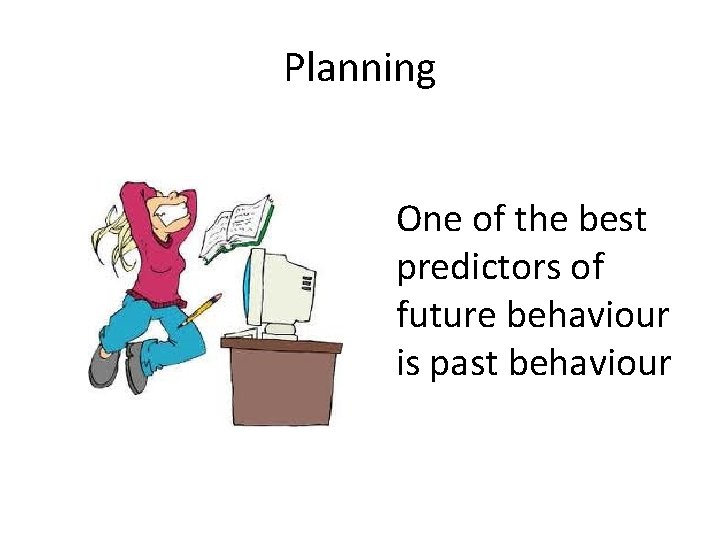
Planning One of the best predictors of future behaviour is past behaviour
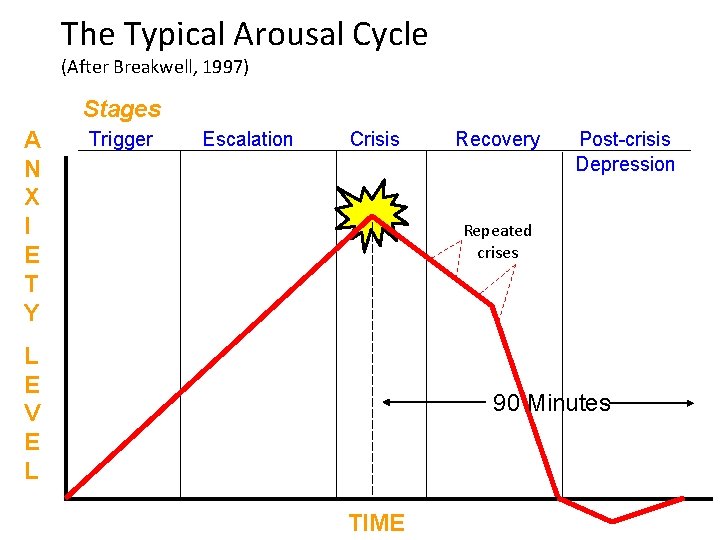
The Typical Arousal Cycle (After Breakwell, 1997) Stages A N X I E T Y Trigger Escalation Crisis Recovery Post-crisis Depression Repeated crises L E V E L 90 Minutes TIME
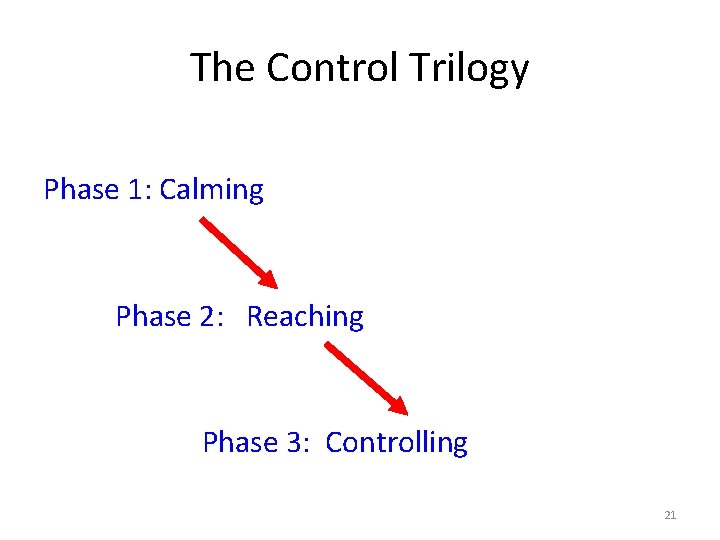
The Control Trilogy Phase 1: Calming Phase 2: Reaching Phase 3: Controlling 21
The Four “C”s § Communication § Contribution § Commitment § Collaboration
Thank you