
Presenter Heidi Wittmer Dept of Environmental Politics Authors
- Slides: 18
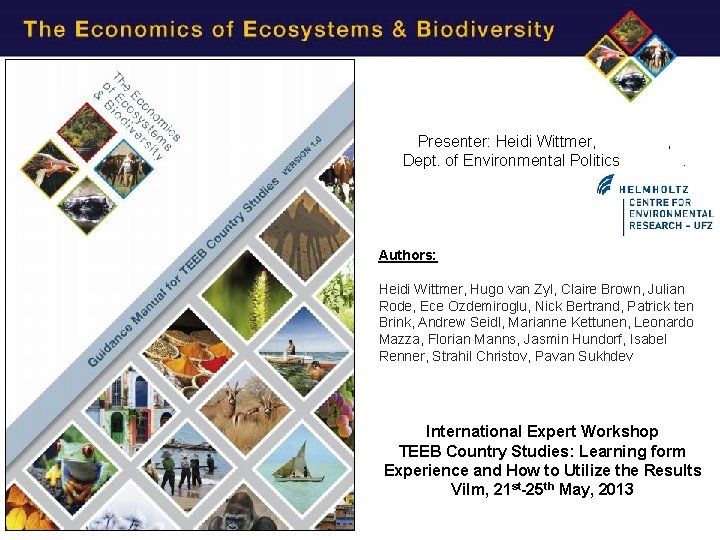
Presenter: Heidi Wittmer, Dept. of Environmental Politics , . Authors: Heidi Wittmer, Hugo van Zyl, Claire Brown, Julian Rode, Ece Ozdemiroglu, Nick Bertrand, Patrick ten Brink, Andrew Seidl, Marianne Kettunen, Leonardo Mazza, Florian Manns, Jasmin Hundorf, Isabel Renner, Strahil Christov, Pavan Sukhdev International Expert Workshop TEEB Country Studies: Learning form Experience and How to Utilize the Results Vilm, 21 st-25 th May, 2013
TEEB Guidance Manual for Country Studies Focus: Guidance for countries which would like to do a TEEBCountry-Study (TCS). Target audience: Person(s) in charge of conducting a TCS or a TEEB project. Format: Guidance to address the practical problems of doing a TCS. Problems, experience, obstacles and pitfalls from on-going projects being compiled and integrated at all stages of the guidance manual. Timeline: First draft available by mid 2013 on the TEEB-webpage. Launch at Trondheim conference for biodiversity May 28 th 2013 The final version will be available by 2015.
Structure of the Talk and the Manual 1. What is a TEEB country study and why does it make sense to do one? 2. Scoping: How to set up the study? 3. How to do the study? Six Steps 4. What to do with the results?
Chapter 1: What is TEEB and how does it integrate into the Policy Landscape? 1. 1 Understand TEEB 1. 2 Identify your reasons for doing a TCS 1. 3 Identify TEEB-related processes and decide whether to do a TCS in this context
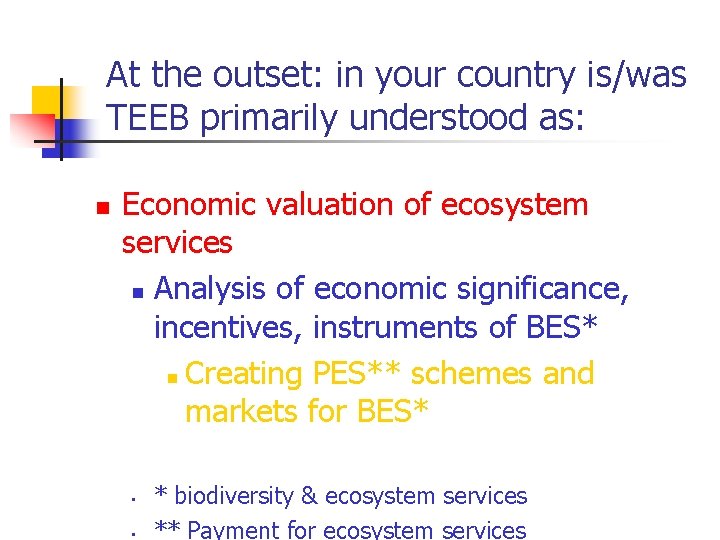
At the outset: in your country is/was TEEB primarily understood as: n Economic valuation of ecosystem services n Analysis of economic significance, incentives, instruments of BES* n Creating PES** schemes and markets for BES* • • * biodiversity & ecosystem services ** Payment for ecosystem services
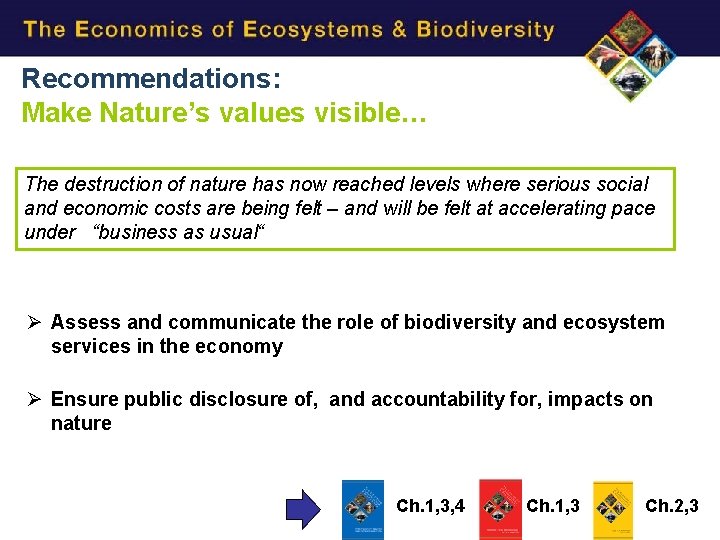
Recommendations: Make Nature’s values visible… The destruction of nature has now reached levels where serious social and economic costs are being felt – and will be felt at accelerating pace under “business as usual“ Ø Assess and communicate the role of biodiversity and ecosystem services in the economy Ø Ensure public disclosure of, and accountability for, impacts on nature Ch. 1, 3, 4 Ch. 1, 3 Ch. 2, 3
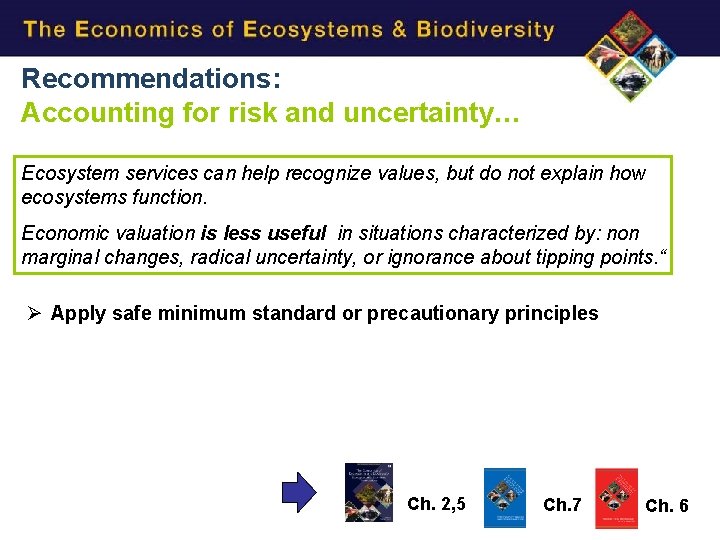
Recommendations: Accounting for risk and uncertainty… Ecosystem services can help recognize values, but do not explain how ecosystems function. Economic valuation is less useful in situations characterized by: non marginal changes, radical uncertainty, or ignorance about tipping points. “ Ø Apply safe minimum standard or precautionary principles Ch. 2, 5 Ch. 7 Ch. 6
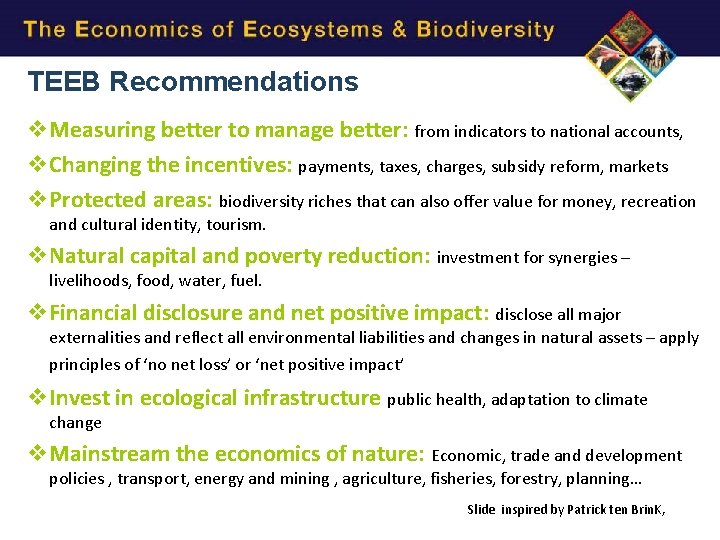
TEEB Recommendations v. Measuring better to manage better: from indicators to national accounts, v. Changing the incentives: payments, taxes, charges, subsidy reform, markets v. Protected areas: biodiversity riches that can also offer value for money, recreation and cultural identity, tourism. v. Natural capital and poverty reduction: investment for synergies – livelihoods, food, water, fuel. v. Financial disclosure and net positive impact: disclose all major externalities and reflect all environmental liabilities and changes in natural assets – apply principles of ‘no net loss’ or ‘net positive impact’ v. Invest in ecological infrastructure public health, adaptation to climate change v. Mainstream the economics of nature: Economic, trade and development policies , transport, energy and mining , agriculture, fisheries, forestry, planning… Slide inspired by Patrick ten Brin. K,
How was your TCS (discussion) started: n Policy decision by environmental ministry n Policy involving more than environment ministry (in initiation) n Science or NGO or donor started to push discussion and played an important role in convincing policy…
Was/is your TCS policydriven? And if so: n A specific question from policy n An unspecific request: „economic arguments for nature protection“ n A decision to do TEEB before knowing what exactly to address
Did/do you consider ‚open architecture‘? n Yes, important element of our TCS n We considered, and decided on a limited role n Did not consider, or decided totally against
Your biggest concern: n The scientific credibility of our TCS n The political relevance of our TCS n The legitimacy of our TCS
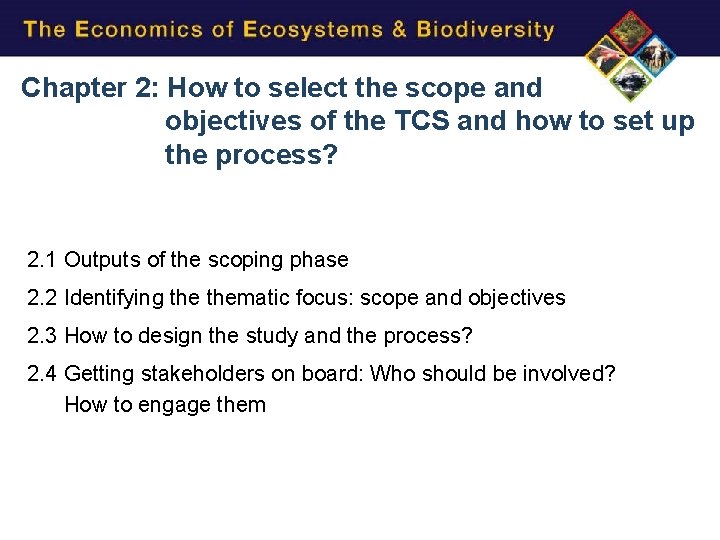
Chapter 2: How to select the scope and objectives of the TCS and how to set up the process? 2. 1 Outputs of the scoping phase 2. 2 Identifying thematic focus: scope and objectives 2. 3 How to design the study and the process? 2. 4 Getting stakeholders on board: Who should be involved? How to engage them
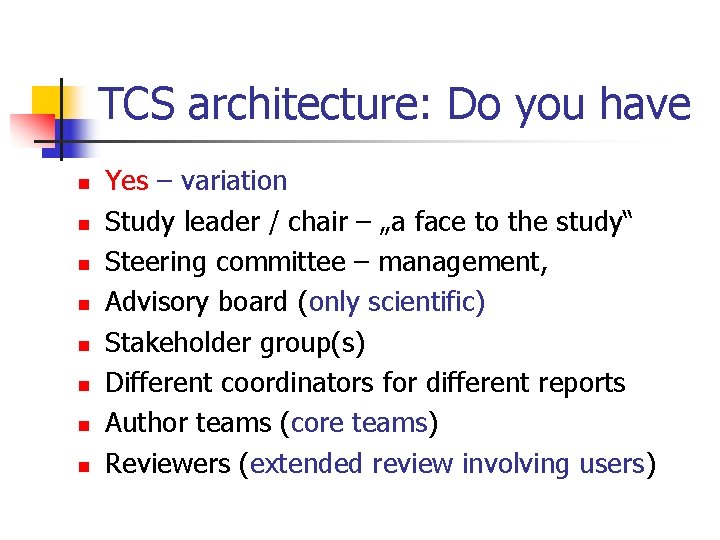
TCS architecture: Do you have n n n n Yes – variation Study leader / chair – „a face to the study“ Steering committee – management, Advisory board (only scientific) Stakeholder group(s) Different coordinators for different reports Author teams (core teams) Reviewers (extended review involving users)
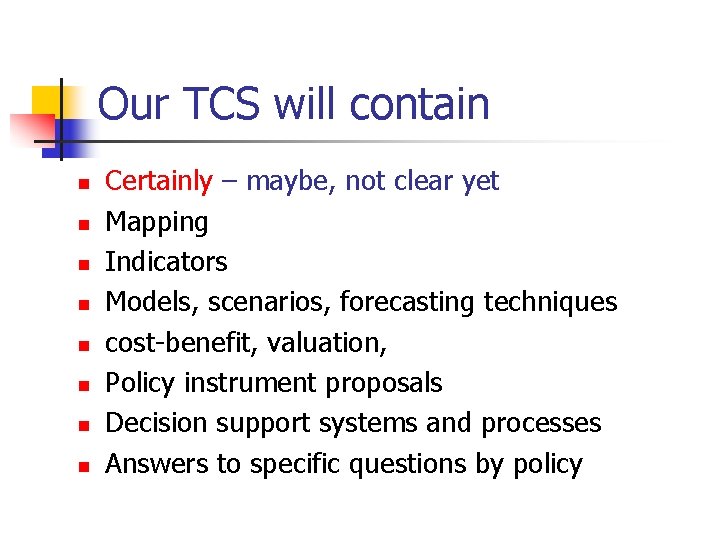
Our TCS will contain n n n n Certainly – maybe, not clear yet Mapping Indicators Models, scenarios, forecasting techniques cost-benefit, valuation, Policy instrument proposals Decision support systems and processes Answers to specific questions by policy
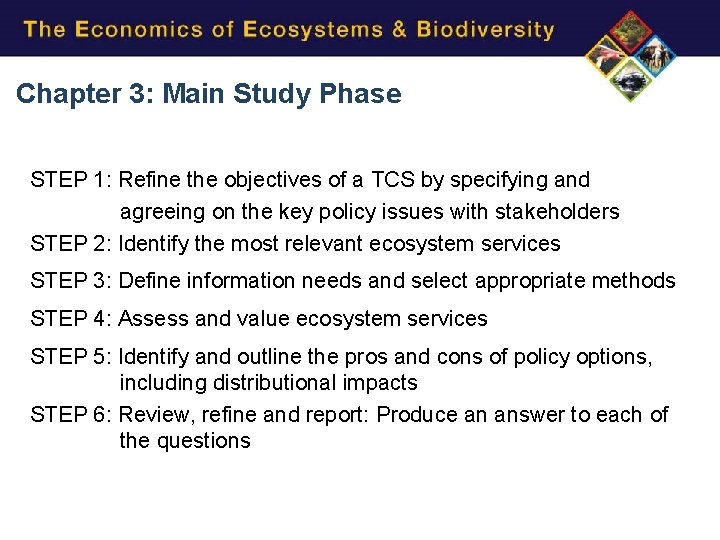
Chapter 3: Main Study Phase STEP 1: Refine the objectives of a TCS by specifying and agreeing on the key policy issues with stakeholders STEP 2: Identify the most relevant ecosystem services STEP 3: Define information needs and select appropriate methods STEP 4: Assess and value ecosystem services STEP 5: Identify and outline the pros and cons of policy options, including distributional impacts STEP 6: Review, refine and report: Produce an answer to each of the questions
Chapter 4: How to use the findings and recommendations of the TCS? 4. 1 Stakeholder engagement for using the TCS findings 4. 2 Communicate the findings 4. 3 Think beyond the TCS Create stories that relate to policy concerns at this particular moment in time
Specific challenges of TCS… • Show the „added value“ of a TEEB-approach – of an economic perspective – Gap analysis, feasibility study… – The economics vs. The politics of ES & Biodiv • Balance credibility – relevance – legitimacy – Governance structure, open architecture, involving other ministries • Translate results into arguments for policy debates – Beyond the „converted“ – Impact on the ground