
Presenter Gust Callas Esq Social Media and Its
- Slides: 47
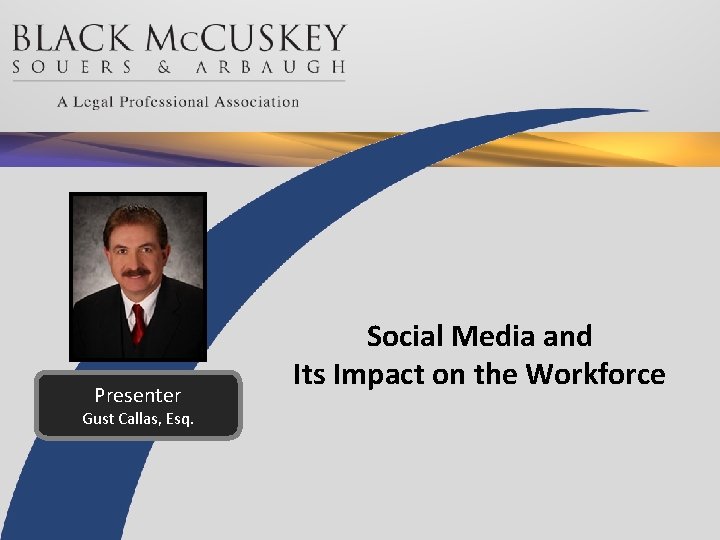
Presenter Gust Callas, Esq. Social Media and Its Impact on the Workforce
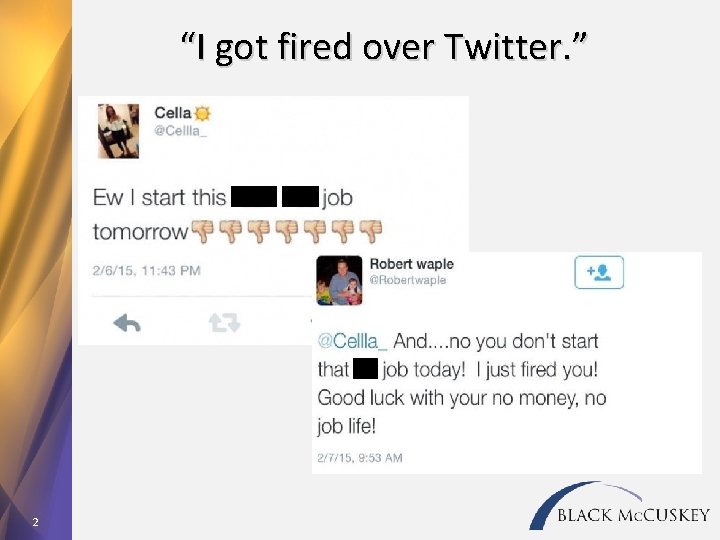
“I got fired over Twitter. ” 2
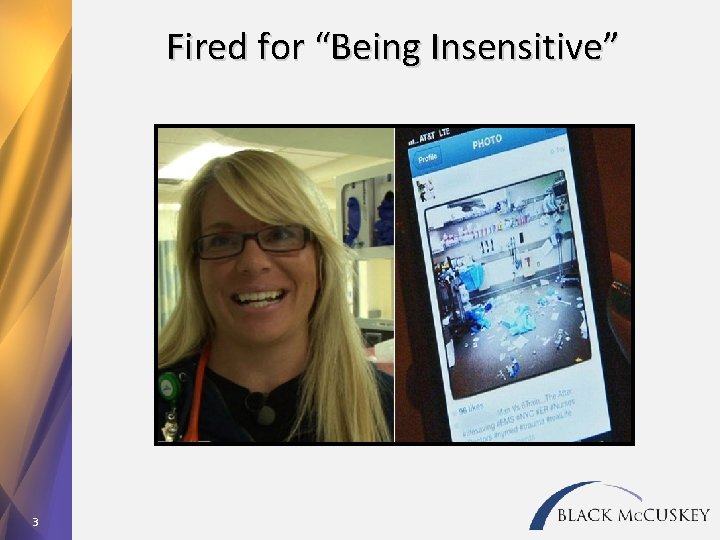
Fired for “Being Insensitive” 3
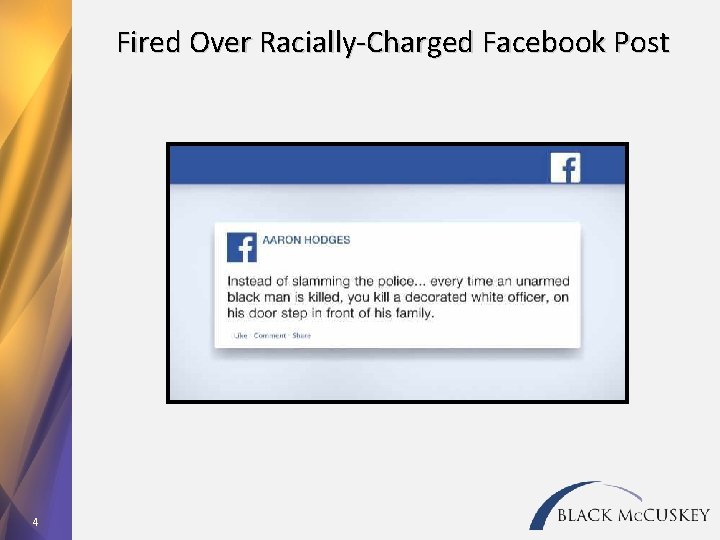
Fired Over Racially-Charged Facebook Post 4
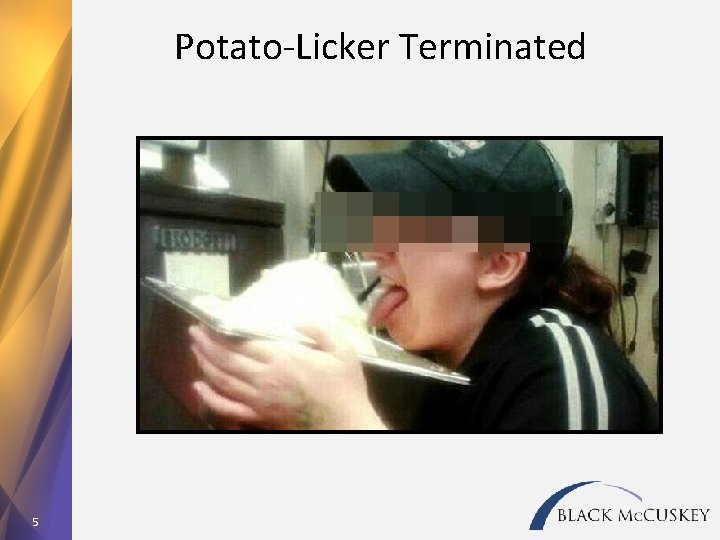
Potato-Licker Terminated 5
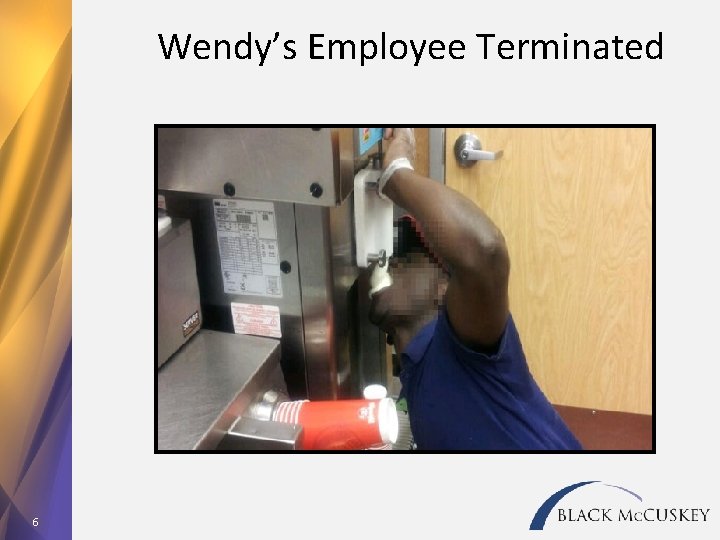
Wendy’s Employee Terminated 6
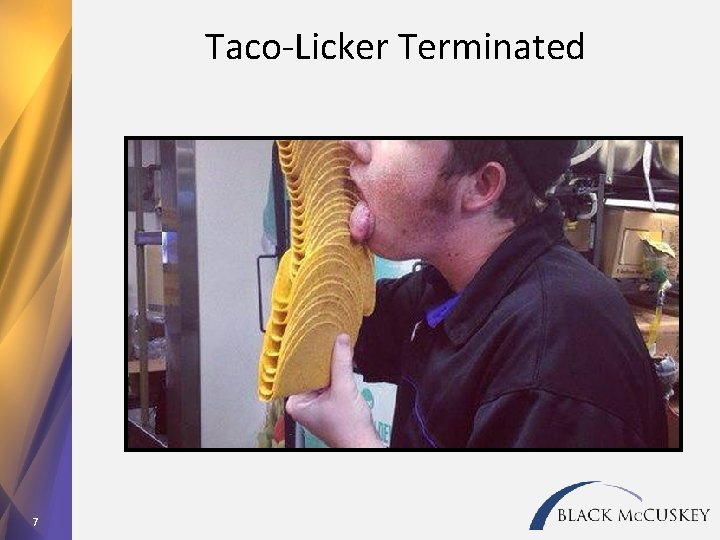
Taco-Licker Terminated 7
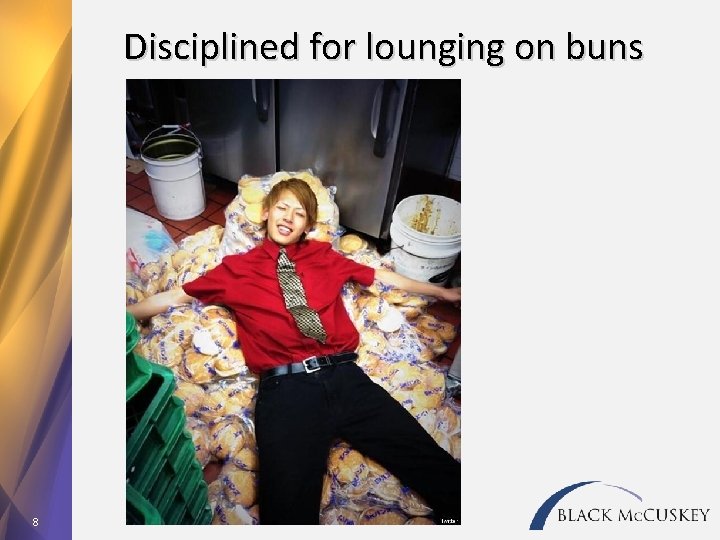
Disciplined for lounging on buns 8
Macot’s Facebook post gets him fired "Andrew Kurtz, 24, of New Brighton, one of the 18 men who take turns posing as pierogies in a crowd-pleasing race after the fifth inning of every game at PNC Park, was dismissed by the team Thursday because he posted disparaging remarks about the Pirates on his Facebook page. . . "(His message was) aimed at team president Frank Coonelly, general manager Neal Huntington and manager John Russell. It read: 'Coonelly extended the contracts of Russell and Huntington through the 2011 season. That means a 19 -straight losing streak. Way to go Pirates. '" 9
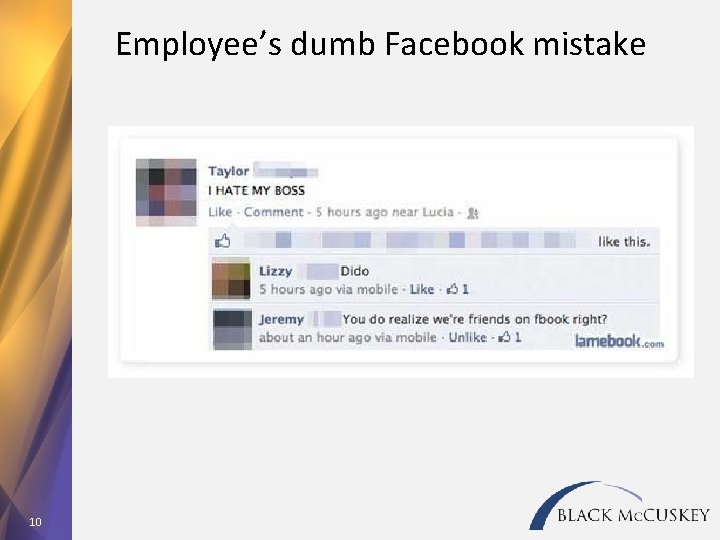
Employee’s dumb Facebook mistake 10
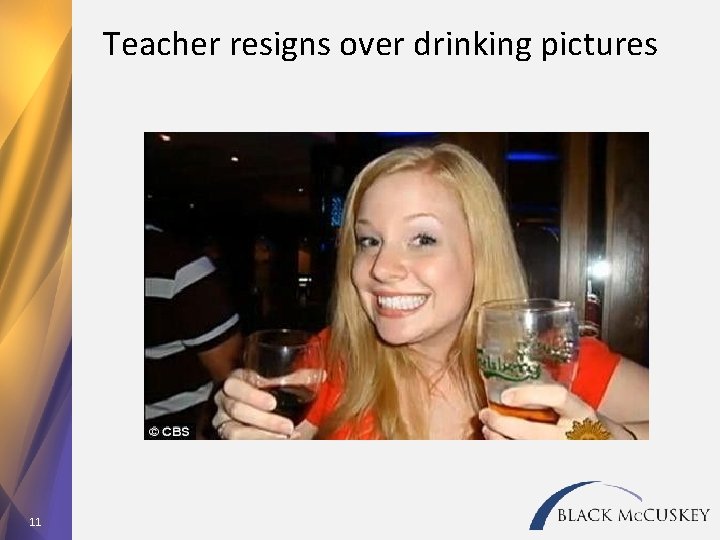
Teacher resigns over drinking pictures 11
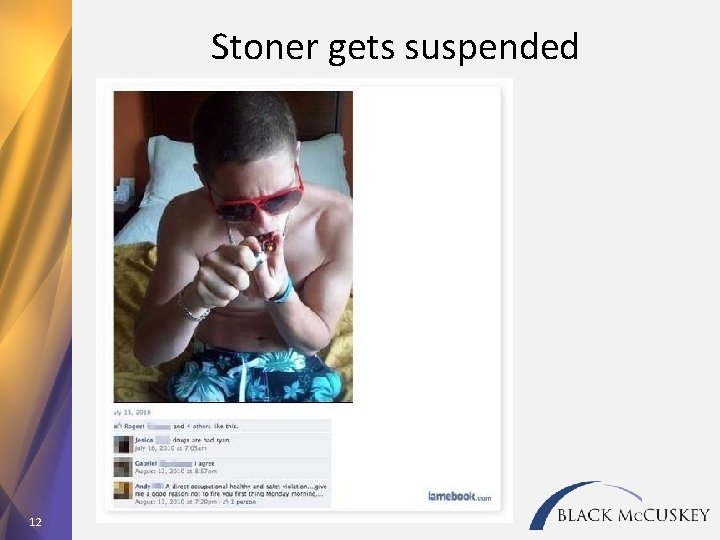
Stoner gets suspended 12
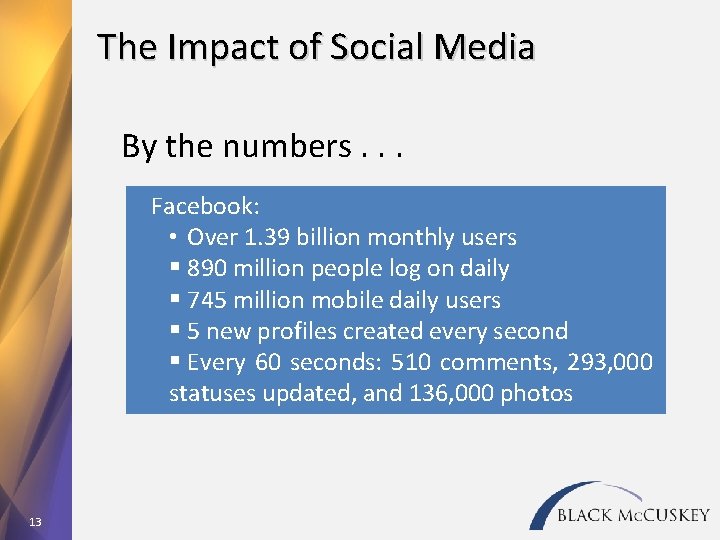
The Impact of Social Media By the numbers. . . § Facebook: • Over 1. 39 billion monthly users § 890 million people log on daily § 745 million mobile daily users § 5 new profiles created every second § Every 60 seconds: 510 comments, 293, 000 statuses updated, and 136, 000 photos 13
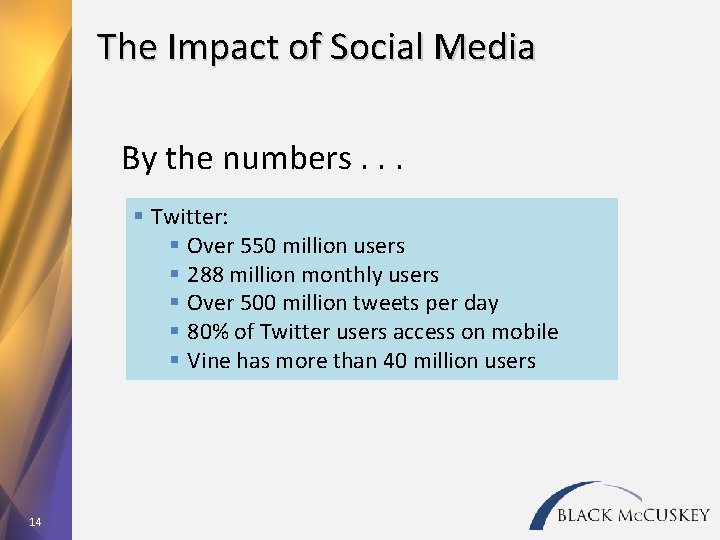
The Impact of Social Media By the numbers. . . § Twitter: § Over 550 million users § 288 million monthly users § Over 500 million tweets per day § 80% of Twitter users access on mobile § Vine has more than 40 million users 14
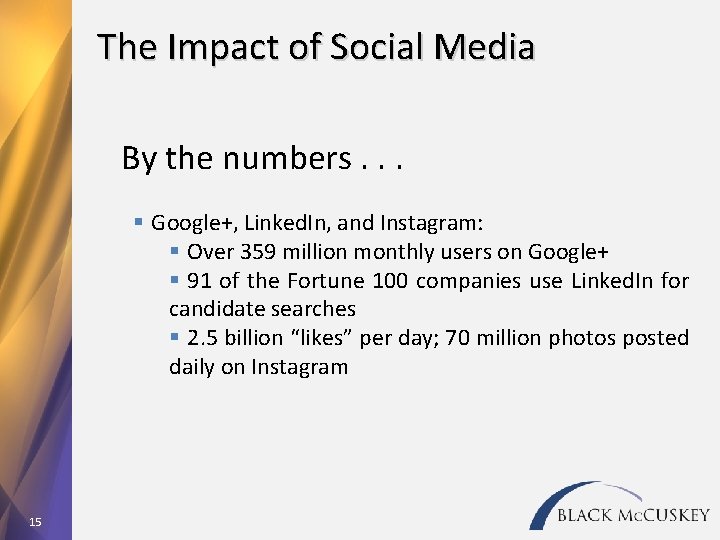
The Impact of Social Media By the numbers. . . § Google+, Linked. In, and Instagram: § Over 359 million monthly users on Google+ § 91 of the Fortune 100 companies use Linked. In for candidate searches § 2. 5 billion “likes” per day; 70 million photos posted daily on Instagram 15
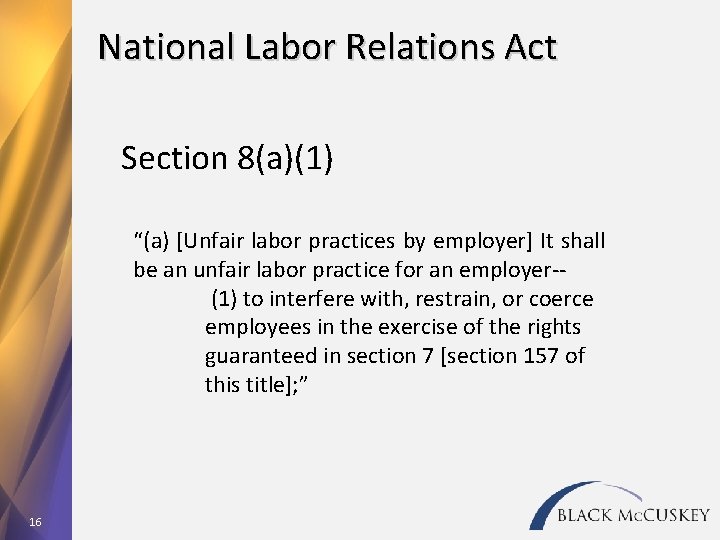
National Labor Relations Act Section 8(a)(1) “(a) [Unfair labor practices by employer] It shall be an unfair labor practice for an employer-(1) to interfere with, restrain, or coerce employees in the exercise of the rights guaranteed in section 7 [section 157 of this title]; ” 16
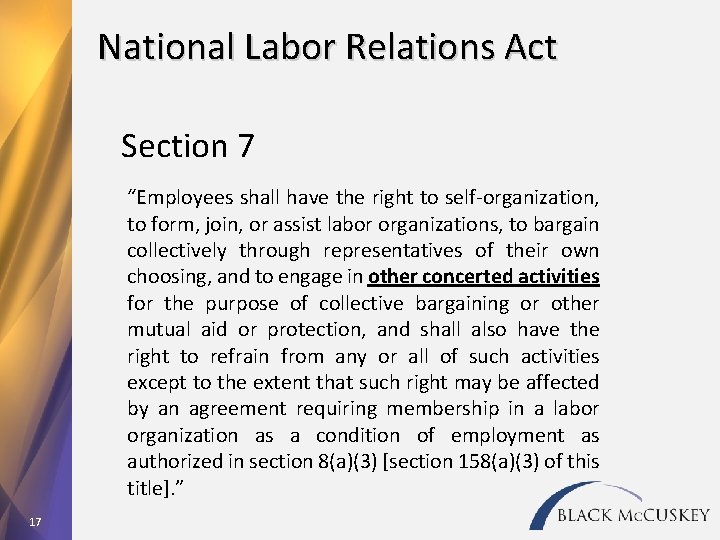
National Labor Relations Act Section 7 “Employees shall have the right to self-organization, to form, join, or assist labor organizations, to bargain collectively through representatives of their own choosing, and to engage in other concerted activities for the purpose of collective bargaining or other mutual aid or protection, and shall also have the right to refrain from any or all of such activities except to the extent that such right may be affected by an agreement requiring membership in a labor organization as a condition of employment as authorized in section 8(a)(3) [section 158(a)(3) of this title]. ” 17
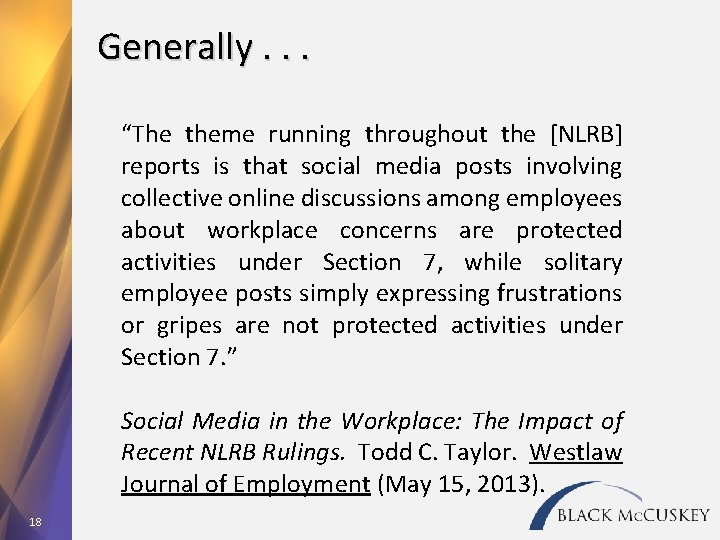
Generally. . . “The theme running throughout the [NLRB] reports is that social media posts involving collective online discussions among employees about workplace concerns are protected activities under Section 7, while solitary employee posts simply expressing frustrations or gripes are not protected activities under Section 7. ” Social Media in the Workplace: The Impact of Recent NLRB Rulings. Todd C. Taylor. Westlaw Journal of Employment (May 15, 2013). 18
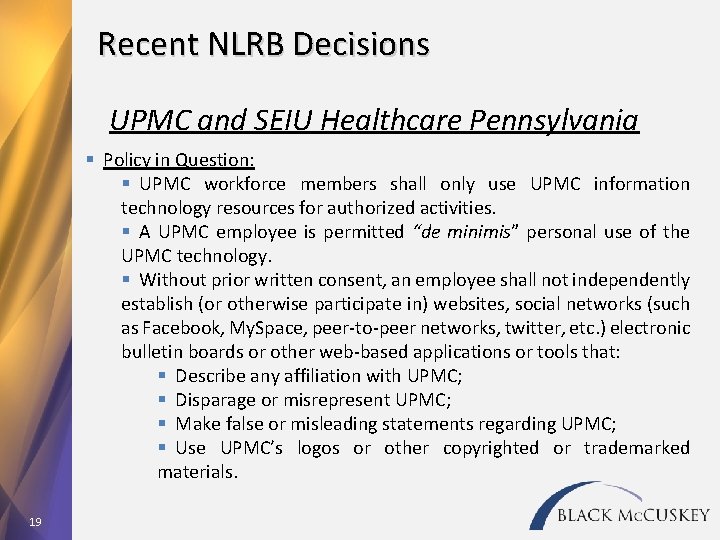
Recent NLRB Decisions UPMC and SEIU Healthcare Pennsylvania § Policy in Question: § UPMC workforce members shall only use UPMC information technology resources for authorized activities. § A UPMC employee is permitted “de minimis” personal use of the UPMC technology. § Without prior written consent, an employee shall not independently establish (or otherwise participate in) websites, social networks (such as Facebook, My. Space, peer-to-peer networks, twitter, etc. ) electronic bulletin boards or other web-based applications or tools that: § Describe any affiliation with UPMC; § Disparage or misrepresent UPMC; § Make false or misleading statements regarding UPMC; § Use UPMC’s logos or other copyrighted or trademarked materials. 19
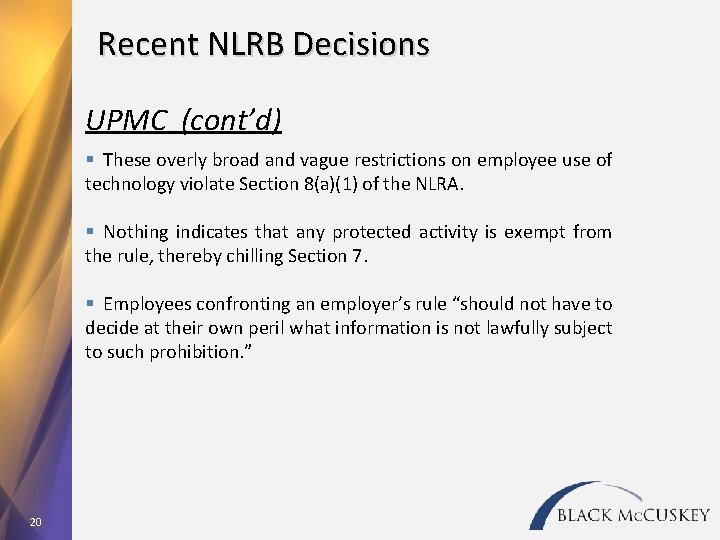
Recent NLRB Decisions UPMC (cont’d) § These overly broad and vague restrictions on employee use of technology violate Section 8(a)(1) of the NLRA. § Nothing indicates that any protected activity is exempt from the rule, thereby chilling Section 7. § Employees confronting an employer’s rule “should not have to decide at their own peril what information is not lawfully subject to such prohibition. ” 20
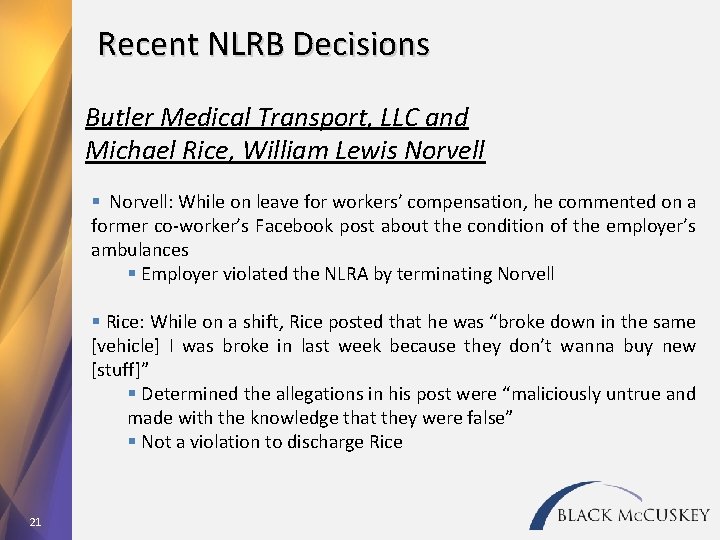
Recent NLRB Decisions Butler Medical Transport, LLC and Michael Rice, William Lewis Norvell § Norvell: While on leave for workers’ compensation, he commented on a former co-worker’s Facebook post about the condition of the employer’s ambulances § Employer violated the NLRA by terminating Norvell § Rice: While on a shift, Rice posted that he was “broke down in the same [vehicle] I was broke in last week because they don’t wanna buy new [stuff]” § Determined the allegations in his post were “maliciously untrue and made with the knowledge that they were false” § Not a violation to discharge Rice 21
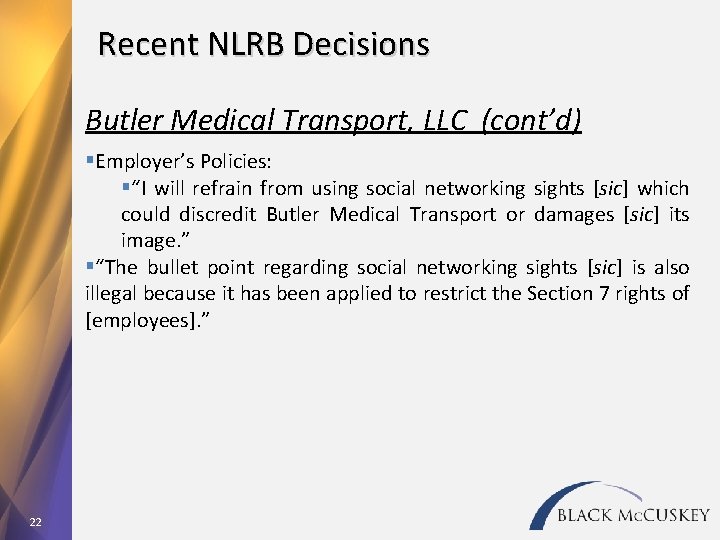
Recent NLRB Decisions Butler Medical Transport, LLC (cont’d) §Employer’s Policies: §“I will refrain from using social networking sights [sic] which could discredit Butler Medical Transport or damages [sic] its image. ” §“The bullet point regarding social networking sights [sic] is also illegal because it has been applied to restrict the Section 7 rights of [employees]. ” 22
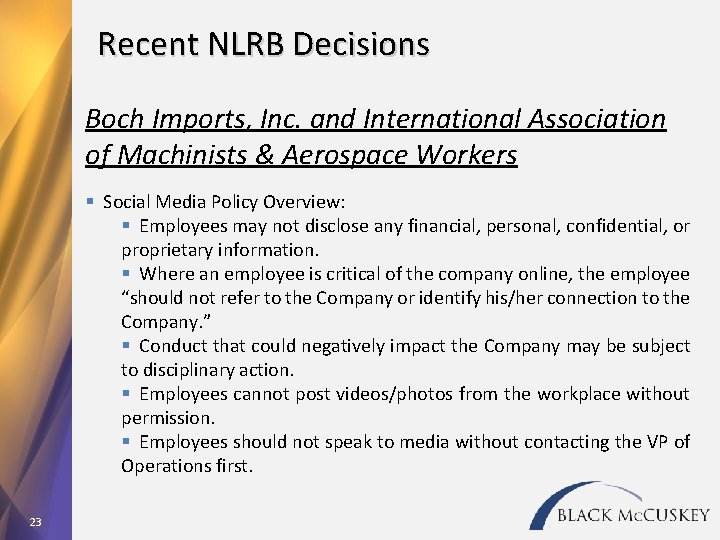
Recent NLRB Decisions Boch Imports, Inc. and International Association of Machinists & Aerospace Workers § Social Media Policy Overview: § Employees may not disclose any financial, personal, confidential, or proprietary information. § Where an employee is critical of the company online, the employee “should not refer to the Company or identify his/her connection to the Company. ” § Conduct that could negatively impact the Company may be subject to disciplinary action. § Employees cannot post videos/photos from the workplace without permission. § Employees should not speak to media without contacting the VP of Operations first. 23
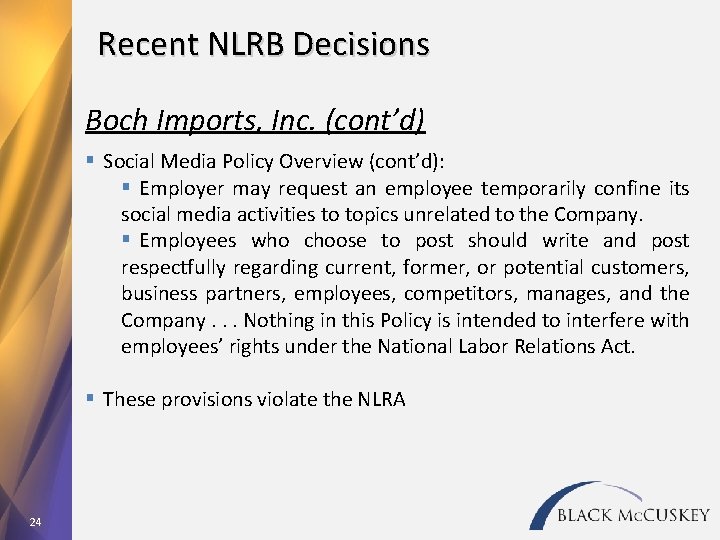
Recent NLRB Decisions Boch Imports, Inc. (cont’d) § Social Media Policy Overview (cont’d): § Employer may request an employee temporarily confine its social media activities to topics unrelated to the Company. § Employees who choose to post should write and post respectfully regarding current, former, or potential customers, business partners, employees, competitors, manages, and the Company. . . Nothing in this Policy is intended to interfere with employees’ rights under the National Labor Relations Act. § These provisions violate the NLRA 24
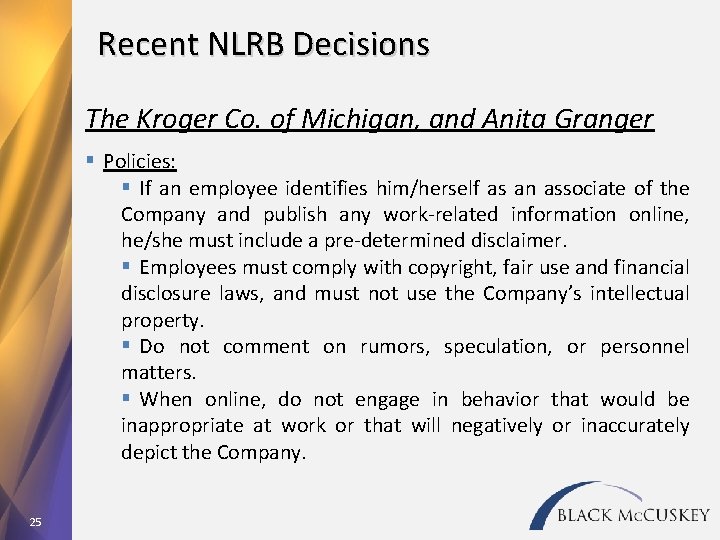
Recent NLRB Decisions The Kroger Co. of Michigan, and Anita Granger § Policies: § If an employee identifies him/herself as an associate of the Company and publish any work-related information online, he/she must include a pre-determined disclaimer. § Employees must comply with copyright, fair use and financial disclosure laws, and must not use the Company’s intellectual property. § Do not comment on rumors, speculation, or personnel matters. § When online, do not engage in behavior that would be inappropriate at work or that will negatively or inaccurately depict the Company. 25
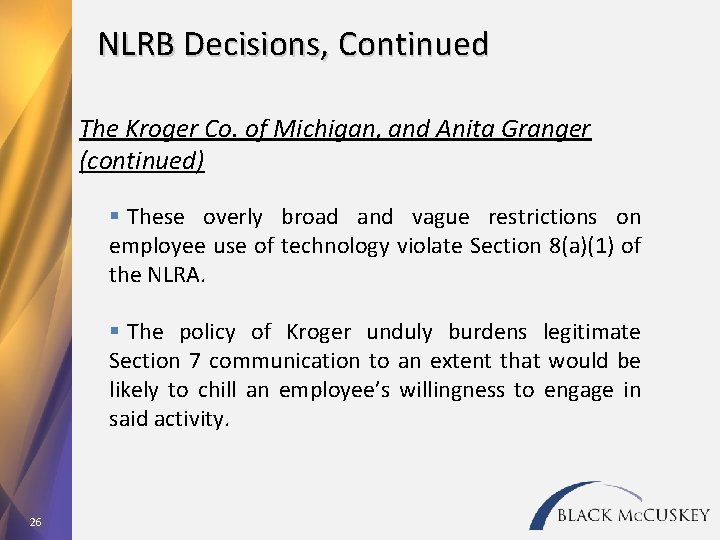
NLRB Decisions, Continued The Kroger Co. of Michigan, and Anita Granger (continued) § These overly broad and vague restrictions on employee use of technology violate Section 8(a)(1) of the NLRA. § The policy of Kroger unduly burdens legitimate Section 7 communication to an extent that would be likely to chill an employee’s willingness to engage in said activity. 26
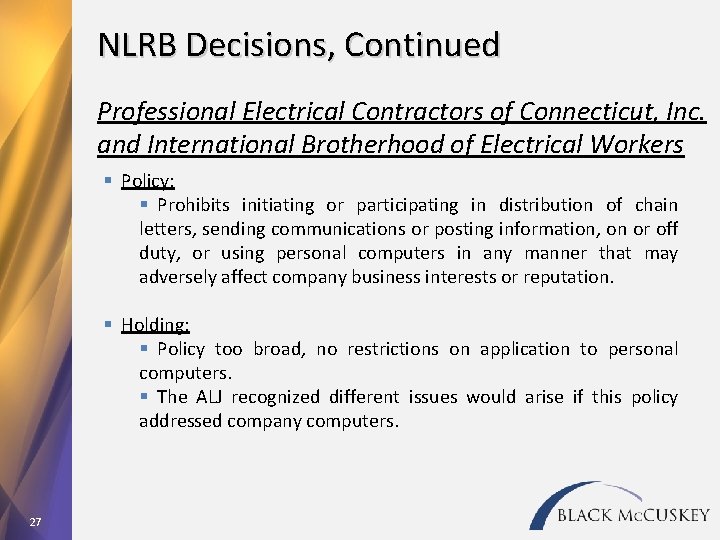
NLRB Decisions, Continued Professional Electrical Contractors of Connecticut, Inc. and International Brotherhood of Electrical Workers § Policy: § Prohibits initiating or participating in distribution of chain letters, sending communications or posting information, on or off duty, or using personal computers in any manner that may adversely affect company business interests or reputation. § Holding: § Policy too broad, no restrictions on application to personal computers. § The ALJ recognized different issues would arise if this policy addressed company computers. 27
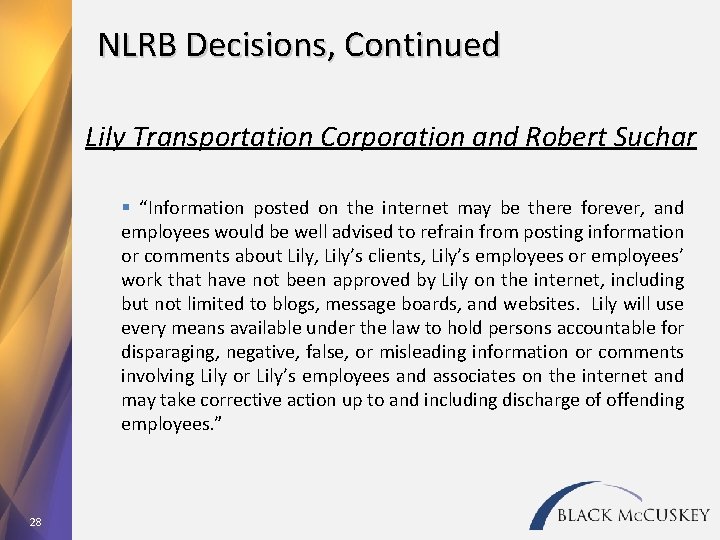
NLRB Decisions, Continued Lily Transportation Corporation and Robert Suchar § “Information posted on the internet may be there forever, and employees would be well advised to refrain from posting information or comments about Lily, Lily’s clients, Lily’s employees or employees’ work that have not been approved by Lily on the internet, including but not limited to blogs, message boards, and websites. Lily will use every means available under the law to hold persons accountable for disparaging, negative, false, or misleading information or comments involving Lily or Lily’s employees and associates on the internet and may take corrective action up to and including discharge of offending employees. ” 28
NLRB Decisions, Continued Lily Transportation Corporation and Robert Suchar (continued) § ALJ held: § Rule chills employees in the exercise of their Section 7 rights § “This provision prohibits the posting of any information without the approval of the Respondent. The rule does not distinguish between disclosing information about customers or company business, which is conceivably lawful, and any information, which is inherently overbroad. ” 29
NLRB Decisions, Continued Landry’s Inc. , Bubba Gump Shrimp Co. Restaurants, Inc. , and Sophia Flores § 2012 Social Media Policy: § In order to post on external social media sites for work purposes, you will need prior approval from the Vice President of Marketing and acknowledge receipt of the Company’s Standards for Social Media Representatives. § While your free time is generally not subject to any restriction by the Company, the Company urges all employees not to post information regarding the Company, their jobs, or other employees which could lead to morale issues in the workplace or detrimentally affect the Company’s business. 30
NLRB Decisions, Continued Landry’s Inc. , Bubba Gump Shrimp Co. Restaurants, Inc. , and Sophia Flores (continued) § Policy does not violate the NLRA. § “[It] does not explicitly prohibit employees from posting their own job-related information or information regarding the jobs of coworkers, or personal information regarding coworkers, or information regarding the company. Rather it urges employees not to do so if such information is likely to create morale problems. Without more, it would be reasonable for employees reading this language to conclude that the Respondent generally frowns upon all job-related postings of any type. ” § “It is not the job-related subject matter of the postings that are of concern. . . Rather the manner in which the subject matter is articulated and debated among the employees. ” 31
NLRB Decisions, Continued Richmond District Neighborhood Center and Ian Callaghan § May 2012: staff meeting held to discuss pros and cons of working for Employer § July 2012: rehire letters sent to Callaghan and Moore § August 2012: Moore contacted Callaghan through Facebook § Callaghan’s profile was set to “just my friends” § Callaghan was Facebook friends with another employee, a manager, and a former student § Screenshot of the conversation was eventually forwarded to the human resources manager § August 13, 2012: letters sent rescinding rehire offers 32
NLRB Decisions, Continued Richmond District Neighborhood Center (cont’d) § Ruling: The August 2012 conversation was a continuation of the May 2012 staff meeting. § Employees were engaged in concerted activity when voicing their disagreement with management’s running of the teen program § However, while employees are permitted some leeway for impulsive behavior when engaged in concerted activity, the NLRB found that certain comments in the Facebook conversation jeopardized the program’s funding § Employer lawfully concluded that the employees were unfit for further service 33
NLRB Decisions, Continued Richmond District Neighborhood Center (update) § On appeal, the NLRB affirmed the ALJ’s decision, finding: “[T]he pervasive advocacy of insubordination in the Facebook posts, comprised of numerous detailed descriptions of specific insubordinate acts, constituted conduct objectively so egregious as to lose the Act’s protection and render Callaghan and Moore unfit for further service. ” 34
When is a “Like” protected? Three D, LLC and Jillian Sanzone, Vincent Spinella § Employees, upon filing taxes, learned they owed money to the state. § Facebook post: “Maybe someone should do the owners of Triple Play a favor and buy it from them. They can’t even do the tax paperwork correctly!!! Now I OWE money. . . Wtf!!!!” § Another employee’s post: “I owe too. Such [a jerk]. ” § Discharged for “loyalty” problems § Third employee “liked” initial status. § When asked why, he explained he stood behind other commenters and was terminated. 35
When is a “Like” protected? Three D, LLC (continued) § On Appeal, the NLRB held: § “In the context of the ongoing dialogue among employees about tax withholding, Sanzone’s comment [“I owe too. Such [a jerk]. ”] effectively endorsed La. France’s complaint that she owed money on her taxes due to a taxwithholding error” by the Employer. § “While Spinella’s ‘like’ [of La. France’s initial status update] is more ambiguous, we treat it for purposes of our analysis as expressing agreement with La. France’s original complaint. ” 36
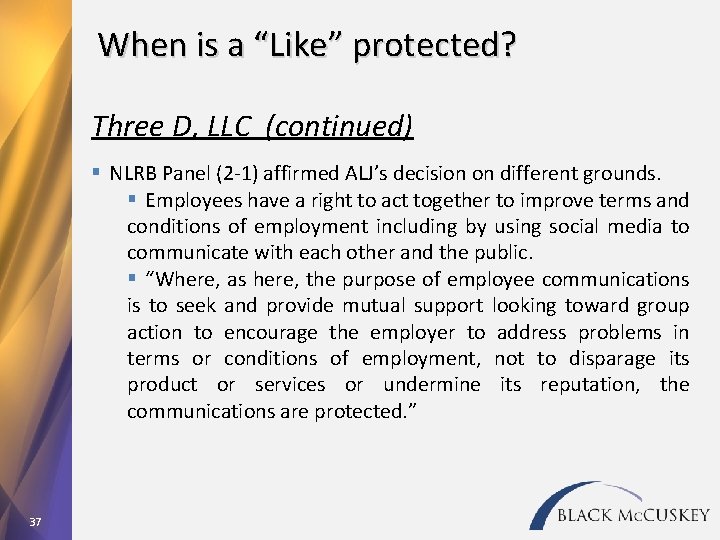
When is a “Like” protected? Three D, LLC (continued) § NLRB Panel (2 -1) affirmed ALJ’s decision on different grounds. § Employees have a right to act together to improve terms and conditions of employment including by using social media to communicate with each other and the public. § “Where, as here, the purpose of employee communications is to seek and provide mutual support looking toward group action to encourage the employer to address problems in terms or conditions of employment, not to disparage its product or services or undermine its reputation, the communications are protected. ” 37
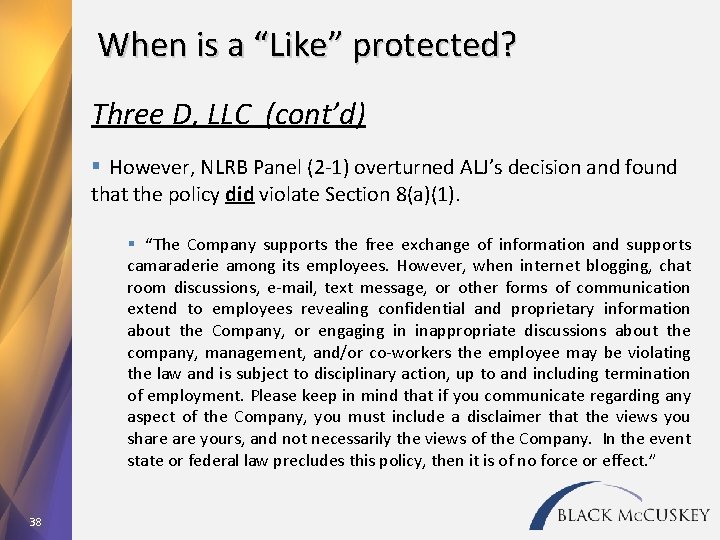
When is a “Like” protected? Three D, LLC (cont’d) § However, NLRB Panel (2 -1) overturned ALJ’s decision and found that the policy did violate Section 8(a)(1). § “The Company supports the free exchange of information and supports camaraderie among its employees. However, when internet blogging, chat room discussions, e-mail, text message, or other forms of communication extend to employees revealing confidential and proprietary information about the Company, or engaging in inappropriate discussions about the company, management, and/or co-workers the employee may be violating the law and is subject to disciplinary action, up to and including termination of employment. Please keep in mind that if you communicate regarding any aspect of the Company, you must include a disclaimer that the views you share yours, and not necessarily the views of the Company. In the event state or federal law precludes this policy, then it is of no force or effect. ” 38
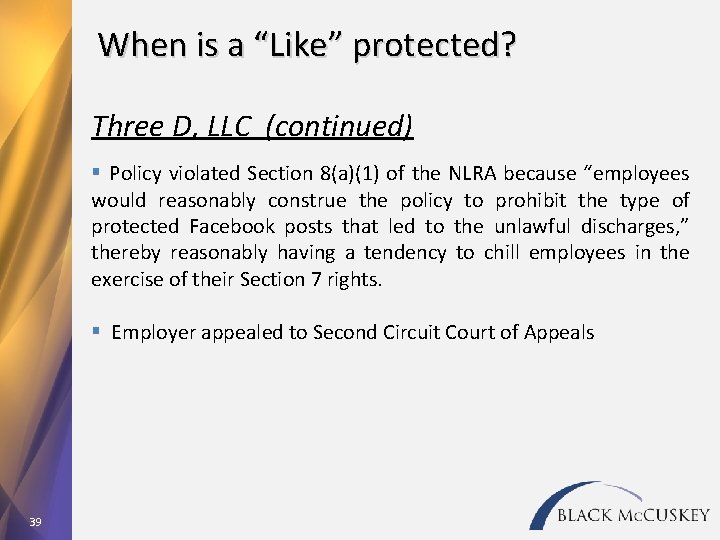
When is a “Like” protected? Three D, LLC (continued) § Policy violated Section 8(a)(1) of the NLRA because “employees would reasonably construe the policy to prohibit the type of protected Facebook posts that led to the unlawful discharges, ” thereby reasonably having a tendency to chill employees in the exercise of their Section 7 rights. § Employer appealed to Second Circuit Court of Appeals 39
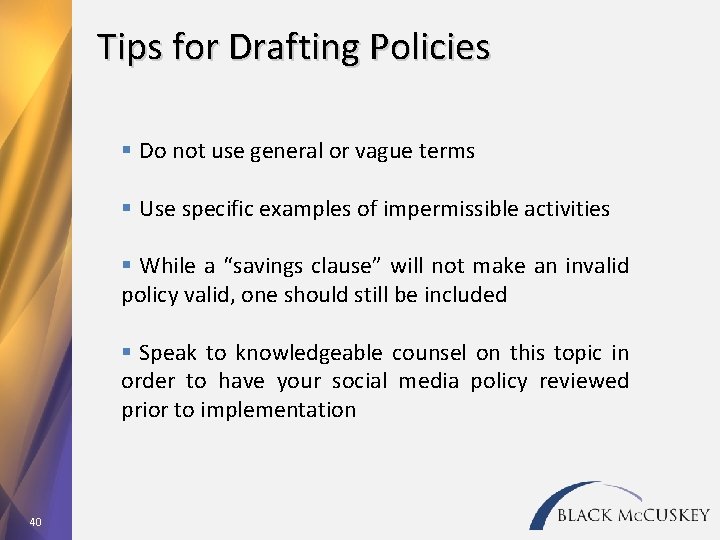
Tips for Drafting Policies § Do not use general or vague terms § Use specific examples of impermissible activities § While a “savings clause” will not make an invalid policy valid, one should still be included § Speak to knowledgeable counsel on this topic in order to have your social media policy reviewed prior to implementation 40
Background Checks/Reviews § If a human resources manager researches a candidate’s online profile, he/she may learn the applicant’s race, sex, age, religion, and/or disability. § This information cannot be considered as part of the hiring process. § Further, employers may open itself to disparate impact claims if the employer recruits primarily or exclusively through Facebook. 41
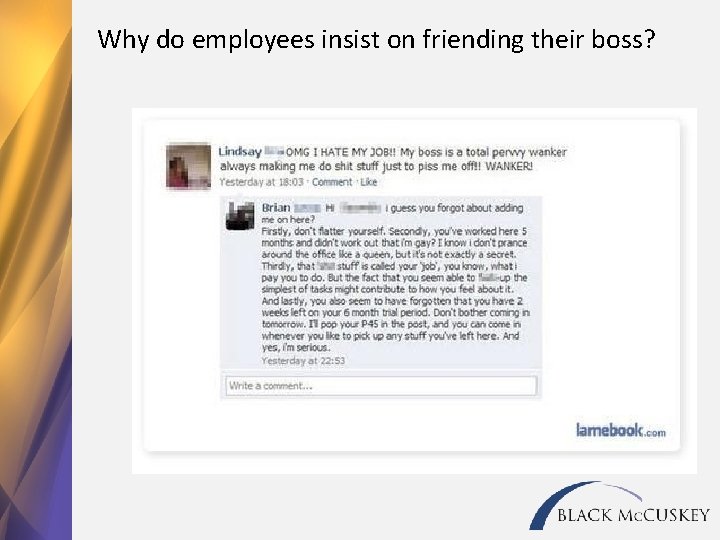
Why do employees insist on friending their boss?
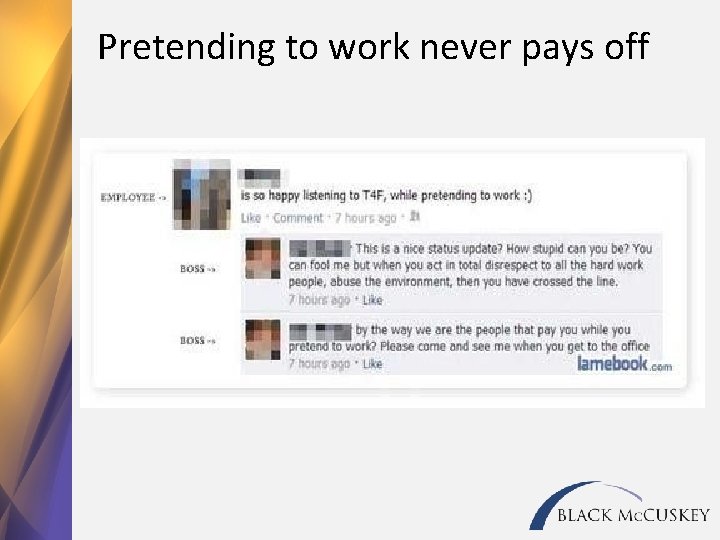
Pretending to work never pays off
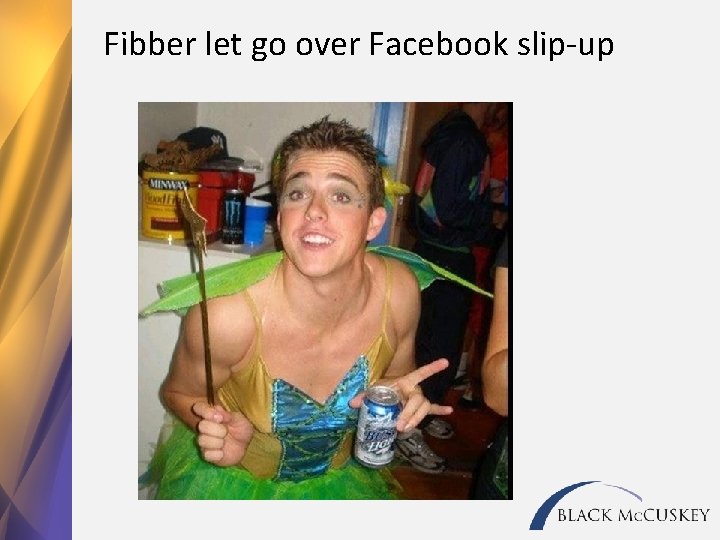
Fibber let go over Facebook slip-up
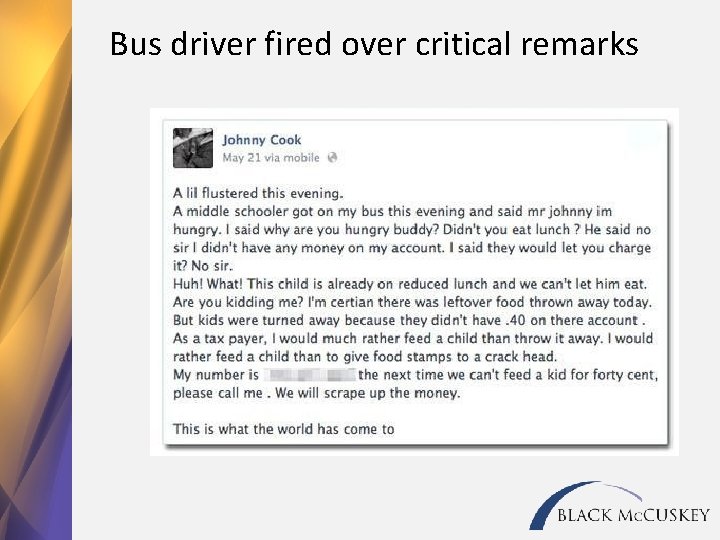
Bus driver fired over critical remarks
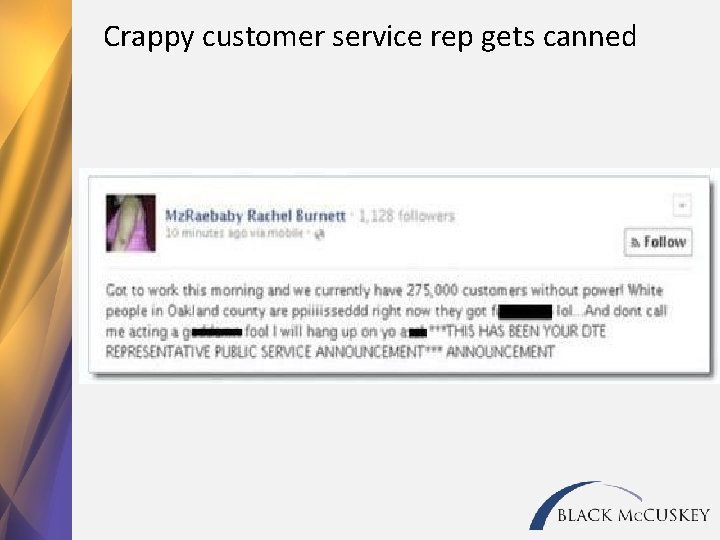
Crappy customer service rep gets canned
Questions