
Presenter Disclosure Information Paul M Ridker MD FACC
- Slides: 27
Presenter Disclosure Information Paul M Ridker, MD, FACC Dr Ridker is listed as a co-inventor on patents held by the Brigham and Women’s Hospital that relate to the use of inflammatory biomarkers in cardiovascular disease that have been licensed to Seimens and Astra. Zeneca. Dr Ridker is the Principal Investigator of JUPITER, an investigator initiated trial funded by Astra. Zeneca. Dr Ridker has served as a consultant to Astra. Zeneca, Novartis, Merck, Schering Plough, ISIS, Vascular Biogenics (modest). Dr Ridker has received grant support from the NHLBI, the NCI, the Donald W Reynolds Foundation, the Doris Duke Foundation, the Leducq Foundation, Astra. Zeneca, Sanofi. Aventis, Novartis and Merck (significant)
JUPITER ACC March 30, 2009 CRP Reduction, LDL Reduction, and Cardiovascular Event Rates After Initiation of Rosuvastatin: The JUPITER Trial Paul Ridker*, Eleanor Danielson, Francisco Fonseca*, Jacques Genest*, Antonio Gotto*, John Kastelein*, Wolfgang Koenig*, Peter Libby*, Alberto Lorenzatti*, Jean Mac. Fadyen, Borge Nordestgaard*, James Shepherd*, James Willerson, and Robert Glynn* on behalf of the JUPITER Trial Study Group An Investigator Initiated Trial Funded by Astra. Zeneca, USA * These authors have received research grant support and/or consultation fees from one or more statin manufacturers, including Astra-Zeneca. Dr Ridker is a co-inventor on patents held by the Brigham and Women’s Hospital that relate to the use of inflammatory biomarkers in cardiovascular disease that have been licensed to Dade-Behring and Astra. Zeneca.
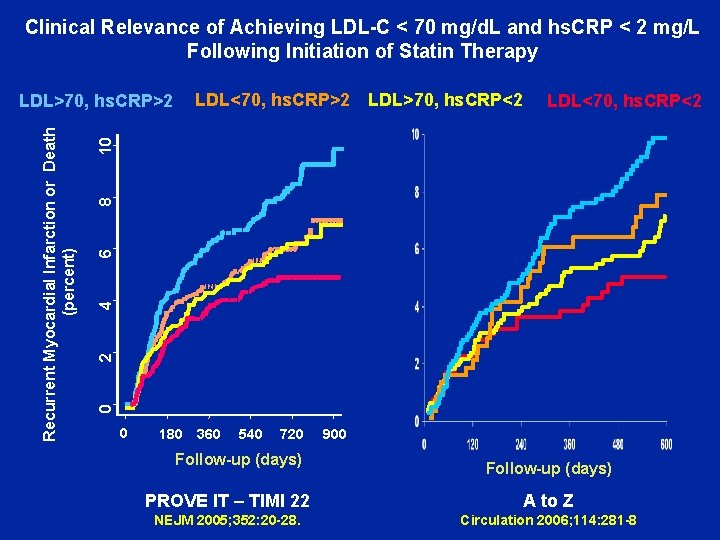
JUPITER Background and Prior Work Current statin guidelines emphasize the need to achieve specific goals for LDLC to maximize clinical outcomes. However, accumulating data indicates that statin therapy has greatest efficacy in the presence of inflammation and that statins reduce the inflammatory biomarker hs. CRP in a manner largely independent of LDLC. Further, in both the PROVE IT – TIMI 22 and A to Z trials of patients with acute coronary ischemia treated with statin therapy, the best clinical outcomes occurred among those who not only achieved LDLC < 70 mg/d. L, but who also achieved hs. CRP levels < 2 mg/L. In both of these trials, even greater clinical benefits accrued when hs. CRP levels were further reduced below 1 mg/L.
JUPITER Background and Prior Work These prior data are consistent with the understanding that atherothrombosis is a disorder of both hyperlipidemia and inflammation, and that statins have anti-inflammatory as well as lipid-lowering properties. Despite the consistency of these data, whether achieving lower levels of hs. CRP after initiation of statin therapy is associated with improved clinical outcomes in a similar manner to that associated with achieving lower levels of LDLC remains highly controversial. We prospectively tested this hypothesis in the large-scale JUPITER trial.
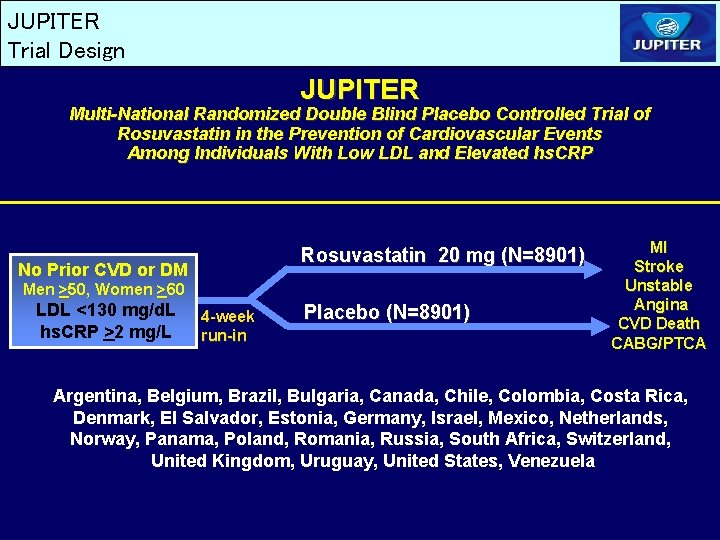
JUPITER Trial Design JUPITER Multi-National Randomized Double Blind Placebo Controlled Trial of Rosuvastatin in the Prevention of Cardiovascular Events Among Individuals With Low LDL and Elevated hs. CRP Rosuvastatin 20 mg (N=8901) No Prior CVD or DM Men >50, Women >60 LDL <130 mg/d. L hs. CRP >2 mg/L 4 -week run-in Placebo (N=8901) MI Stroke Unstable Angina CVD Death CABG/PTCA Argentina, Belgium, Brazil, Bulgaria, Canada, Chile, Colombia, Costa Rica, Denmark, El Salvador, Estonia, Germany, Israel, Mexico, Netherlands, Norway, Panama, Poland, Romania, Russia, South Africa, Switzerland, United Kingdom, Uruguay, United States, Venezuela
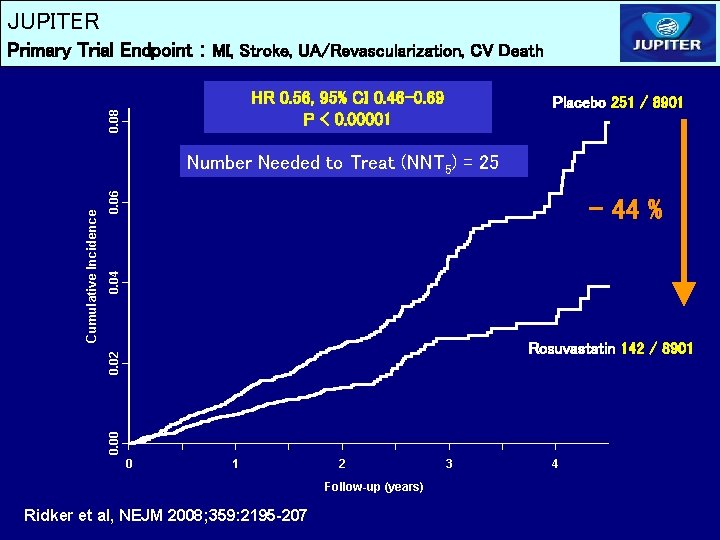
JUPITER Primary Trial Endpoint : MI, Stroke, UA/Revascularization, CV Death 0. 08 HR 0. 56, 95% CI 0. 46 -0. 69 P < 0. 00001 Placebo 251 / 8901 0. 06 0. 04 - 44 % Rosuvastatin 142 / 8901 0. 00 0. 02 Cumulative Incidence Number Needed to Treat (NNT 5) = 25 0 1 2 Follow-up (years) Ridker et al, NEJM 2008; 359: 2195 -207 3 4
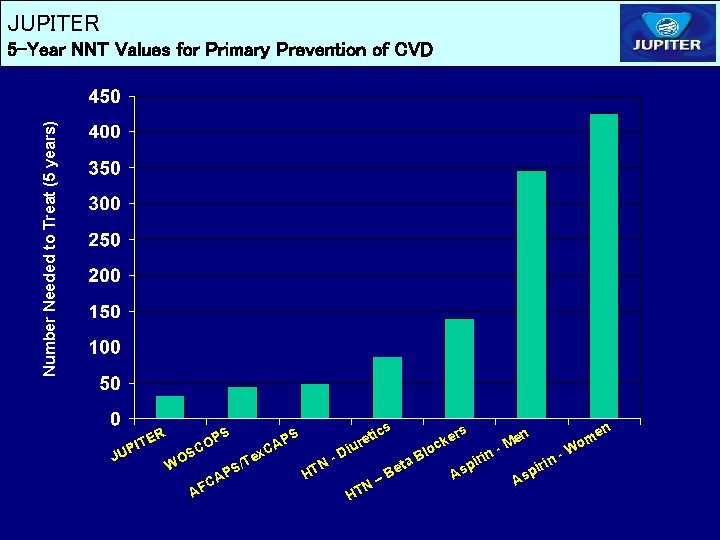
JUPITER Number Needed to Treat (5 years) 5 -Year NNT Values for Primary Prevention of CVD R JU E PIT S OP C S WO /Te S AP A FC ics S AP C x et iur D N- HT B N– HT lo B eta ers k c As in pir - n Me As p n i r i W en m o
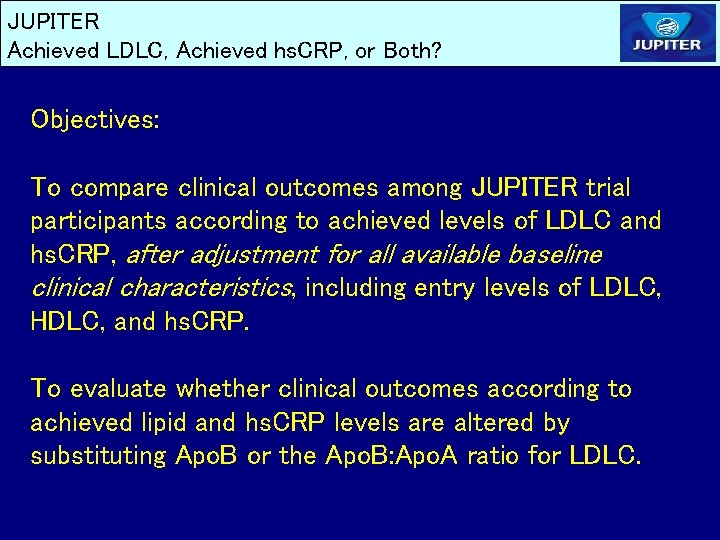
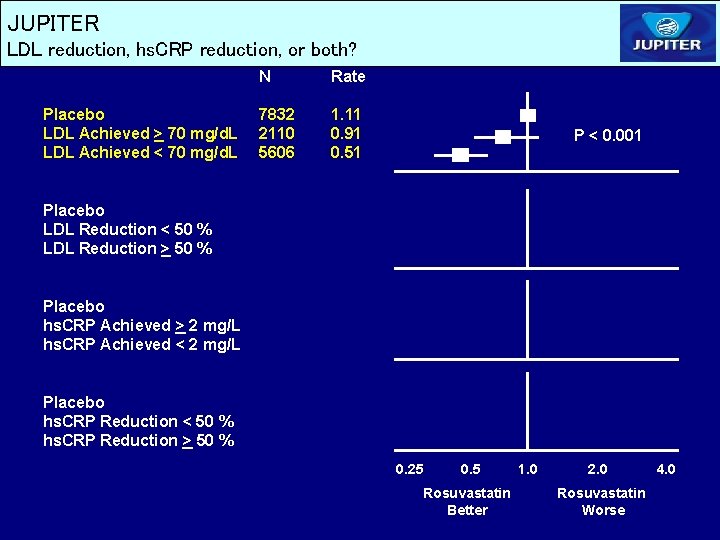
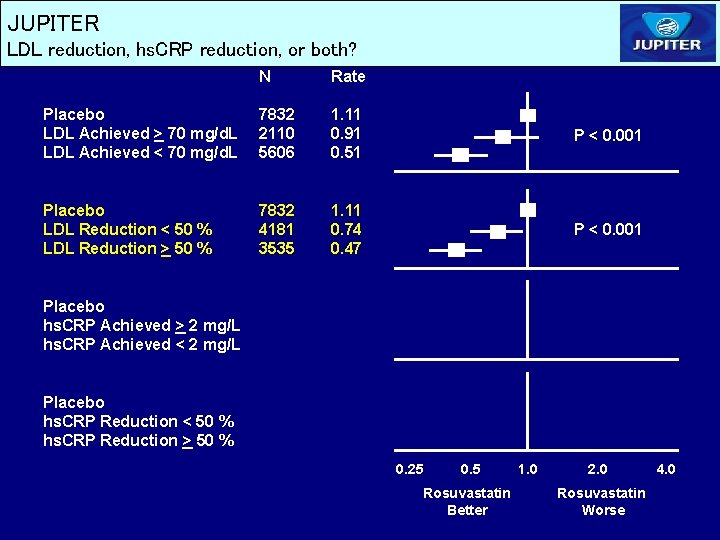
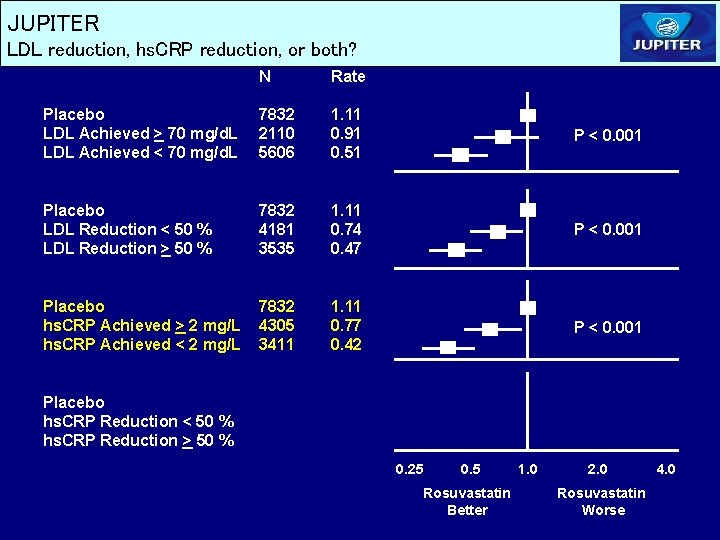
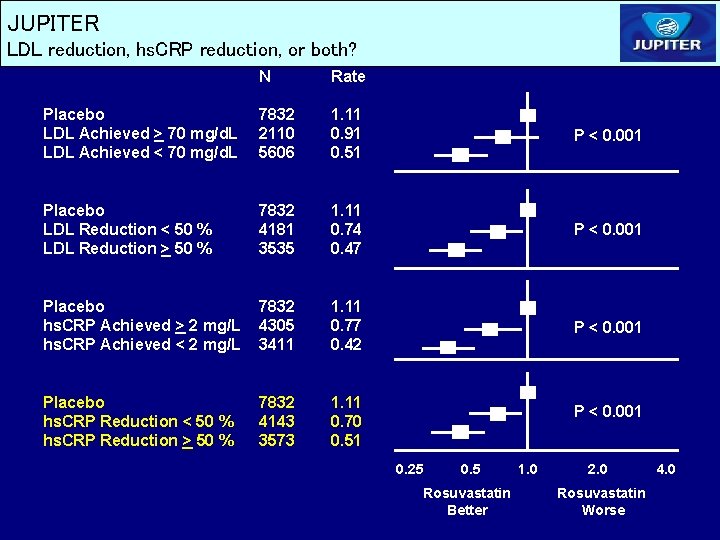
JUPITER Achieved LDLC, Achieved hs. CRP, or Both? Objectives: To compare clinical outcomes among JUPITER trial participants according to achieved levels of LDLC and hs. CRP, after adjustment for all available baseline clinical characteristics, including entry levels of LDLC, HDLC, and hs. CRP. To evaluate whether clinical outcomes according to achieved lipid and hs. CRP levels are altered by substituting Apo. B or the Apo. B: Apo. A ratio for LDLC.
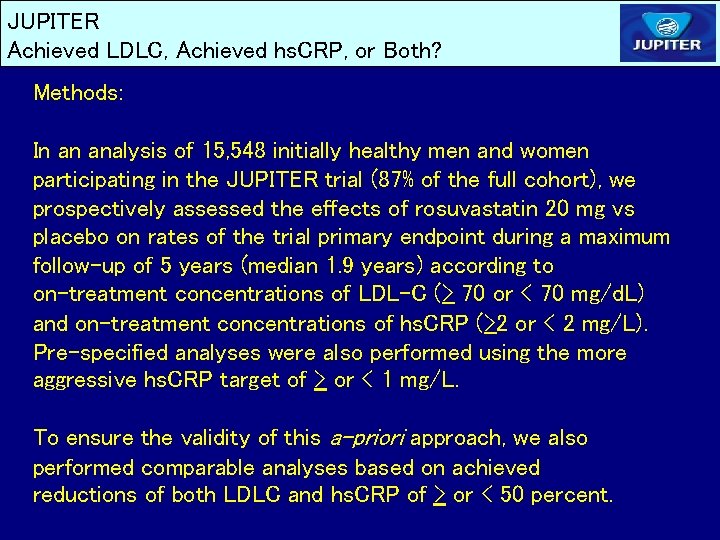
JUPITER Achieved LDLC, Achieved hs. CRP, or Both? Methods: In an analysis of 15, 548 initially healthy men and women participating in the JUPITER trial (87% of the full cohort), we prospectively assessed the effects of rosuvastatin 20 mg vs placebo on rates of the trial primary endpoint during a maximum follow-up of 5 years (median 1. 9 years) according to on-treatment concentrations of LDL-C (> 70 or < 70 mg/d. L) and on-treatment concentrations of hs. CRP (>2 or < 2 mg/L). Pre-specified analyses were also performed using the more aggressive hs. CRP target of > or < 1 mg/L. To ensure the validity of this a-priori approach, we also performed comparable analyses based on achieved reductions of both LDLC and hs. CRP of > or < 50 percent.
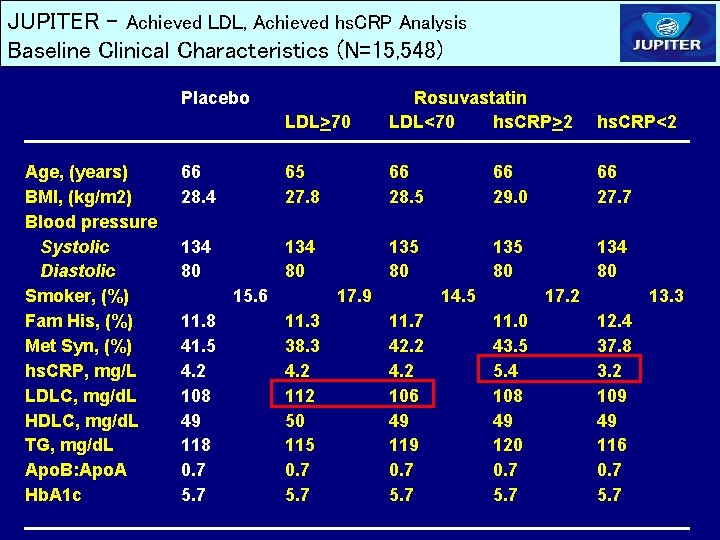
JUPITER – Achieved LDL, Achieved hs. CRP Analysis Baseline Clinical Characteristics (N=15, 548) Placebo Age, (years) BMI, (kg/m 2) Blood pressure Systolic Diastolic Smoker, (%) Fam His, (%) Met Syn, (%) hs. CRP, mg/L LDLC, mg/d. L HDLC, mg/d. L TG, mg/d. L Apo. B: Apo. A Hb. A 1 c LDL>70 Rosuvastatin LDL<70 hs. CRP>2 hs. CRP<2 66 28. 4 65 27. 8 66 28. 5 66 29. 0 66 27. 7 134 80 135 80 134 80 15. 6 11. 8 41. 5 4. 2 108 49 118 0. 7 5. 7 17. 9 11. 3 38. 3 4. 2 112 50 115 0. 7 5. 7 14. 5 11. 7 42. 2 4. 2 106 49 119 0. 7 5. 7 17. 2 11. 0 43. 5 5. 4 108 49 120 0. 7 5. 7 13. 3 12. 4 37. 8 3. 2 109 49 116 0. 7 5. 7
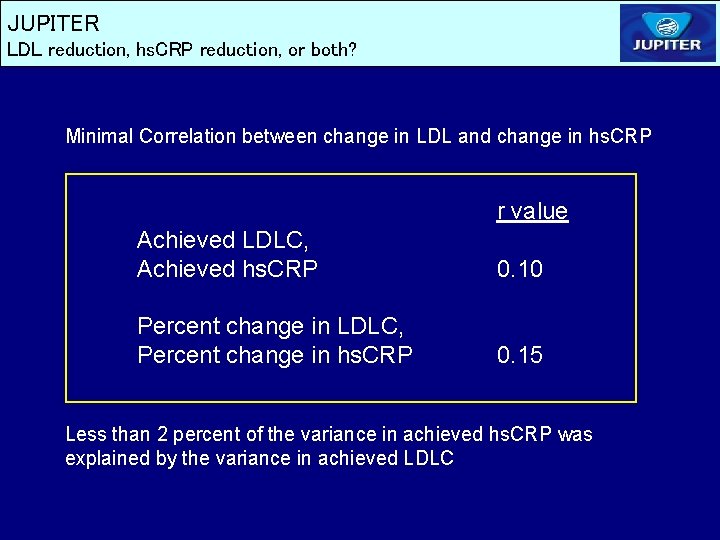
JUPITER LDL reduction, hs. CRP reduction, or both? Minimal Correlation between change in LDL and change in hs. CRP r value Achieved LDLC, Achieved hs. CRP 0. 10 Percent change in LDLC, Percent change in hs. CRP 0. 15 Less than 2 percent of the variance in achieved hs. CRP was explained by the variance in achieved LDLC
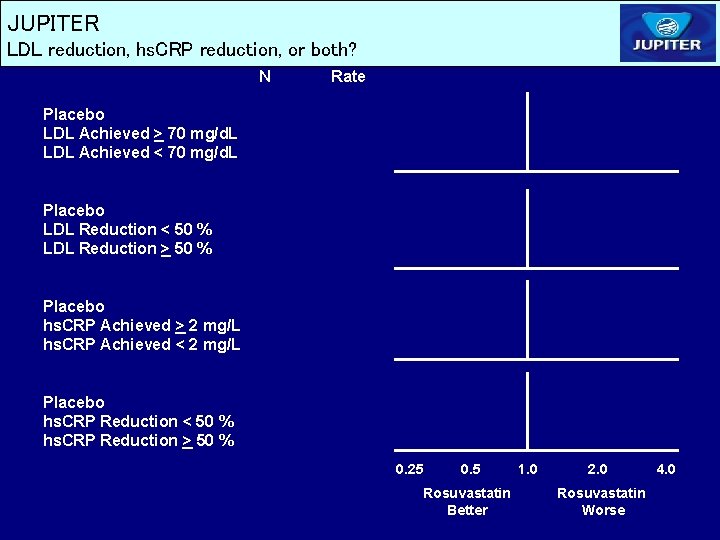
JUPITER LDL reduction, hs. CRP reduction, or both? N Rate Placebo LDL Achieved > 70 mg/d. L LDL Achieved < 70 mg/d. L Placebo LDL Reduction < 50 % LDL Reduction > 50 % Placebo hs. CRP Achieved > 2 mg/L hs. CRP Achieved < 2 mg/L Placebo hs. CRP Reduction < 50 % hs. CRP Reduction > 50 % 0. 25 0. 5 Rosuvastatin Better 1. 0 2. 0 Rosuvastatin Worse 4. 0
JUPITER LDL reduction, hs. CRP reduction, or both? Placebo LDL Achieved > 70 mg/d. L LDL Achieved < 70 mg/d. L N Rate 7832 2110 5606 1. 11 0. 91 0. 51 P < 0. 001 Placebo LDL Reduction < 50 % LDL Reduction > 50 % Placebo hs. CRP Achieved > 2 mg/L hs. CRP Achieved < 2 mg/L Placebo hs. CRP Reduction < 50 % hs. CRP Reduction > 50 % 0. 25 0. 5 Rosuvastatin Better 1. 0 2. 0 Rosuvastatin Worse 4. 0
JUPITER LDL reduction, hs. CRP reduction, or both? N Rate Placebo LDL Achieved > 70 mg/d. L LDL Achieved < 70 mg/d. L 7832 2110 5606 1. 11 0. 91 0. 51 P < 0. 001 Placebo LDL Reduction < 50 % LDL Reduction > 50 % 7832 4181 3535 1. 11 0. 74 0. 47 P < 0. 001 Placebo hs. CRP Achieved > 2 mg/L hs. CRP Achieved < 2 mg/L Placebo hs. CRP Reduction < 50 % hs. CRP Reduction > 50 % 0. 25 0. 5 Rosuvastatin Better 1. 0 2. 0 Rosuvastatin Worse 4. 0
JUPITER LDL reduction, hs. CRP reduction, or both? N Rate Placebo LDL Achieved > 70 mg/d. L LDL Achieved < 70 mg/d. L 7832 2110 5606 1. 11 0. 91 0. 51 P < 0. 001 Placebo LDL Reduction < 50 % LDL Reduction > 50 % 7832 4181 3535 1. 11 0. 74 0. 47 P < 0. 001 Placebo hs. CRP Achieved > 2 mg/L hs. CRP Achieved < 2 mg/L 7832 4305 3411 1. 11 0. 77 0. 42 P < 0. 001 Placebo hs. CRP Reduction < 50 % hs. CRP Reduction > 50 % 0. 25 0. 5 Rosuvastatin Better 1. 0 2. 0 Rosuvastatin Worse 4. 0
JUPITER LDL reduction, hs. CRP reduction, or both? N Rate Placebo LDL Achieved > 70 mg/d. L LDL Achieved < 70 mg/d. L 7832 2110 5606 1. 11 0. 91 0. 51 P < 0. 001 Placebo LDL Reduction < 50 % LDL Reduction > 50 % 7832 4181 3535 1. 11 0. 74 0. 47 P < 0. 001 Placebo hs. CRP Achieved > 2 mg/L hs. CRP Achieved < 2 mg/L 7832 4305 3411 1. 11 0. 77 0. 42 P < 0. 001 Placebo hs. CRP Reduction < 50 % hs. CRP Reduction > 50 % 7832 4143 3573 1. 11 0. 70 0. 51 P < 0. 001 0. 25 0. 5 Rosuvastatin Better 1. 0 2. 0 Rosuvastatin Worse 4. 0
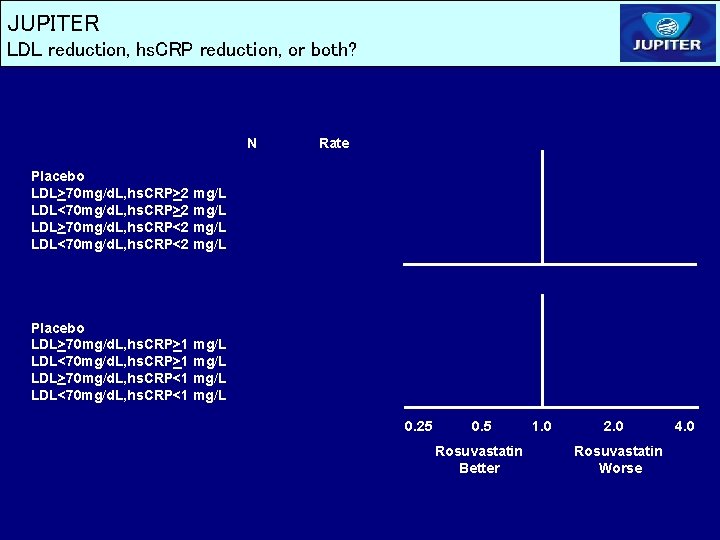
JUPITER LDL reduction, hs. CRP reduction, or both? N Rate Placebo LDL>70 mg/d. L, hs. CRP>2 mg/L LDL<70 mg/d. L, hs. CRP>2 mg/L LDL>70 mg/d. L, hs. CRP<2 mg/L LDL<70 mg/d. L, hs. CRP<2 mg/L Placebo LDL>70 mg/d. L, hs. CRP>1 mg/L LDL<70 mg/d. L, hs. CRP>1 mg/L LDL>70 mg/d. L, hs. CRP<1 mg/L LDL<70 mg/d. L, hs. CRP<1 mg/L 0. 25 0. 5 Rosuvastatin Better 1. 0 2. 0 Rosuvastatin Worse 4. 0
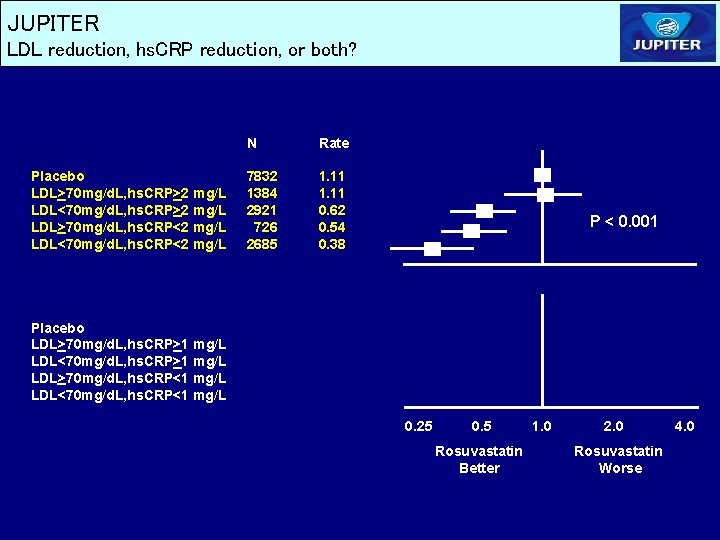
JUPITER LDL reduction, hs. CRP reduction, or both? Placebo LDL>70 mg/d. L, hs. CRP>2 mg/L LDL<70 mg/d. L, hs. CRP>2 mg/L LDL>70 mg/d. L, hs. CRP<2 mg/L LDL<70 mg/d. L, hs. CRP<2 mg/L N Rate 7832 1384 2921 726 2685 1. 11 0. 62 0. 54 0. 38 P < 0. 001 Placebo LDL>70 mg/d. L, hs. CRP>1 mg/L LDL<70 mg/d. L, hs. CRP>1 mg/L LDL>70 mg/d. L, hs. CRP<1 mg/L LDL<70 mg/d. L, hs. CRP<1 mg/L 0. 25 0. 5 Rosuvastatin Better 1. 0 2. 0 Rosuvastatin Worse 4. 0
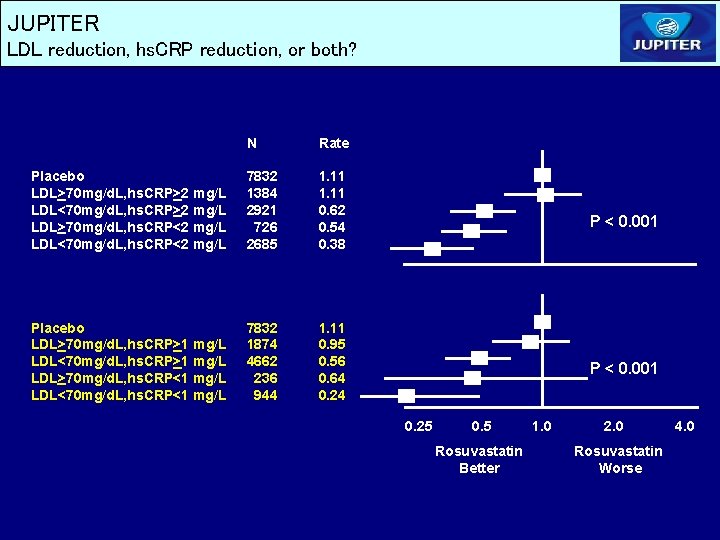
JUPITER LDL reduction, hs. CRP reduction, or both? N Rate Placebo LDL>70 mg/d. L, hs. CRP>2 mg/L LDL<70 mg/d. L, hs. CRP>2 mg/L LDL>70 mg/d. L, hs. CRP<2 mg/L LDL<70 mg/d. L, hs. CRP<2 mg/L 7832 1384 2921 726 2685 1. 11 0. 62 0. 54 0. 38 Placebo LDL>70 mg/d. L, hs. CRP>1 mg/L LDL<70 mg/d. L, hs. CRP>1 mg/L LDL>70 mg/d. L, hs. CRP<1 mg/L LDL<70 mg/d. L, hs. CRP<1 mg/L 7832 1874 4662 236 944 1. 11 0. 95 0. 56 0. 64 0. 24 P < 0. 001 0. 25 0. 5 Rosuvastatin Better 1. 0 2. 0 Rosuvastatin Worse 4. 0
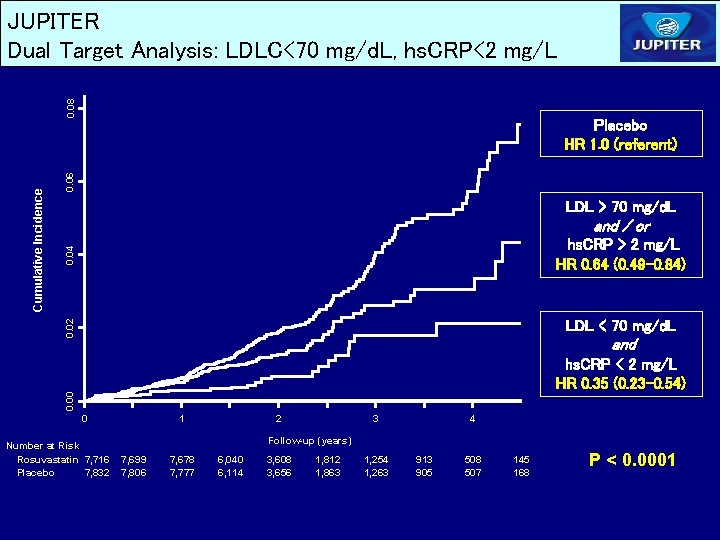
0. 06 Placebo HR 1. 0 (referent) LDL > 70 mg/d. L 0. 04 and / or hs. CRP > 2 mg/L HR 0. 64 (0. 49 -0. 84) 0. 02 Cumulative Incidence 0. 08 JUPITER Dual Target Analysis: LDLC<70 mg/d. L, hs. CRP<2 mg/L LDL < 70 mg/d. L and 0. 00 hs. CRP < 2 mg/L HR 0. 35 (0. 23 -0. 54) 0 Number at Risk Rosuvastatin 7, 716 Placebo 7, 832 1 2 3 4 Follow-up (years) 7, 699 7, 806 7, 678 7, 777 6, 040 6, 114 3, 608 3, 656 1, 812 1, 863 1, 254 1, 263 913 905 508 507 145 168 P < 0. 0001
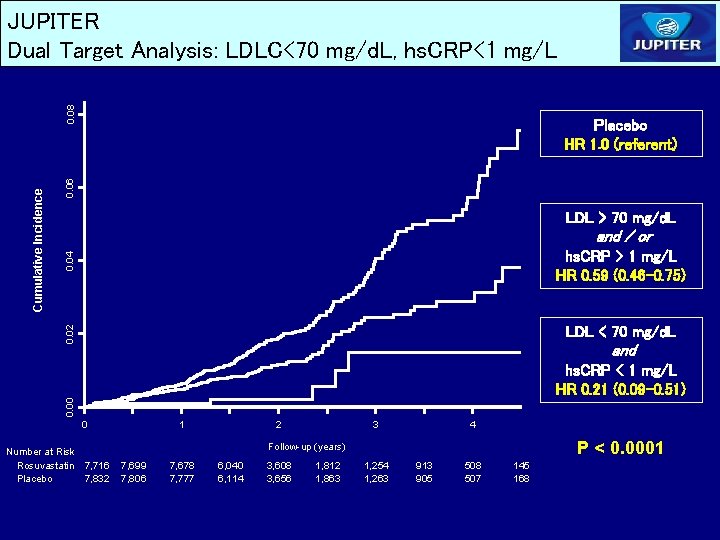
0. 06 Placebo HR 1. 0 (referent) LDL > 70 mg/d. L 0. 04 and / or hs. CRP > 1 mg/L HR 0. 59 (0. 46 -0. 75) 0. 02 Cumulative Incidence 0. 08 JUPITER Dual Target Analysis: LDLC<70 mg/d. L, hs. CRP<1 mg/L LDL < 70 mg/d. L and 0. 00 hs. CRP < 1 mg/L HR 0. 21 (0. 09 -0. 51) 0 Number at Risk Rosuvastatin 7, 716 Placebo 7, 832 1 2 3 4 P < 0. 0001 Follow-up (years) 7, 699 7, 806 7, 678 7, 777 6, 040 6, 114 3, 608 3, 656 1, 812 1, 863 1, 254 1, 263 913 905 508 507 145 168
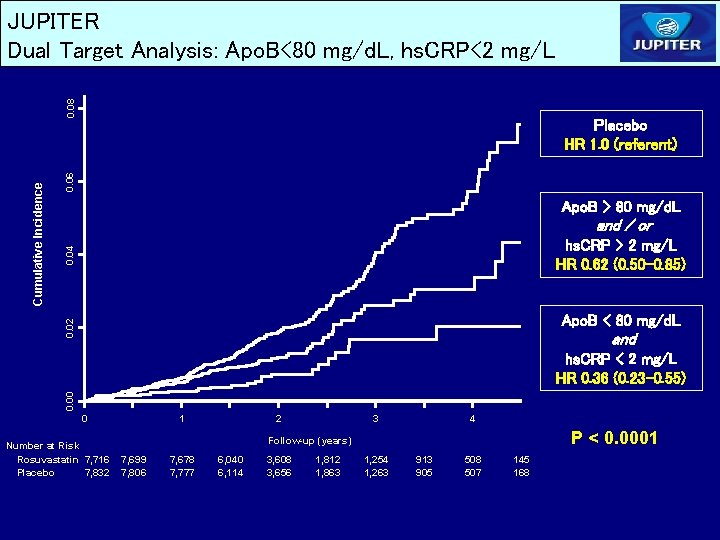
0. 06 Placebo HR 1. 0 (referent) Apo. B > 80 mg/d. L and / or 0. 04 hs. CRP > 2 mg/L HR 0. 62 (0. 50 -0. 85) Apo. B < 80 mg/d. L 0. 02 Cumulative Incidence 0. 08 JUPITER Dual Target Analysis: Apo. B<80 mg/d. L, hs. CRP<2 mg/L and 0. 00 hs. CRP < 2 mg/L HR 0. 36 (0. 23 -0. 55) 0 Number at Risk Rosuvastatin 7, 716 Placebo 7, 832 1 2 3 4 P < 0. 0001 Follow-up (years) 7, 699 7, 806 7, 678 7, 777 6, 040 6, 114 3, 608 3, 656 1, 812 1, 863 1, 254 1, 263 913 905 508 507 145 168
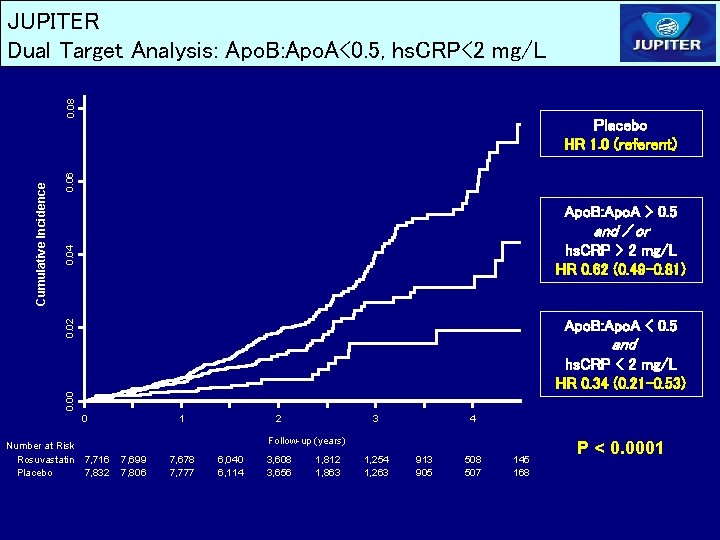
0. 06 Placebo HR 1. 0 (referent) Apo. B: Apo. A > 0. 5 0. 04 and / or hs. CRP > 2 mg/L HR 0. 62 (0. 49 -0. 81) 0. 02 Cumulative Incidence 0. 08 JUPITER Dual Target Analysis: Apo. B: Apo. A<0. 5, hs. CRP<2 mg/L Apo. B: Apo. A < 0. 5 and 0. 00 hs. CRP < 2 mg/L HR 0. 34 (0. 21 -0. 53) 0 Number at Risk Rosuvastatin 7, 716 Placebo 7, 832 1 2 3 4 Follow-up (years) 7, 699 7, 806 7, 678 7, 777 6, 040 6, 114 3, 608 3, 656 1, 812 1, 863 1, 254 1, 263 913 905 508 507 145 168 P < 0. 0001
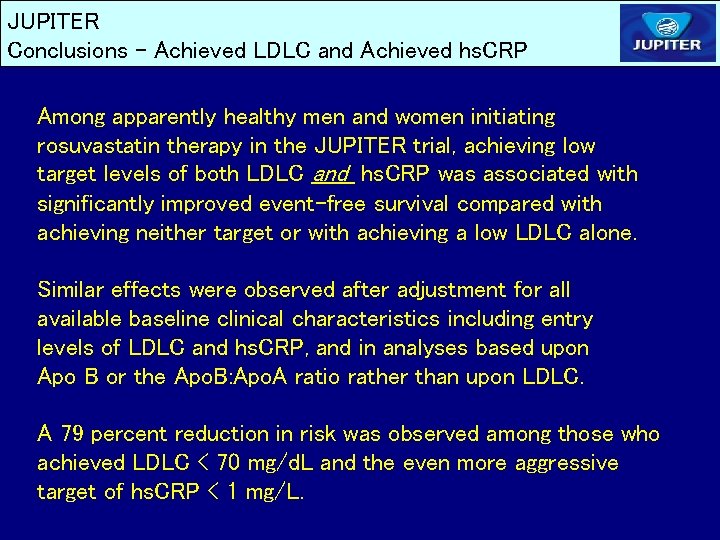
JUPITER Conclusions – Achieved LDLC and Achieved hs. CRP Among apparently healthy men and women initiating rosuvastatin therapy in the JUPITER trial, achieving low target levels of both LDLC and hs. CRP was associated with significantly improved event-free survival compared with achieving neither target or with achieving a low LDLC alone. Similar effects were observed after adjustment for all available baseline clinical characteristics including entry levels of LDLC and hs. CRP, and in analyses based upon Apo B or the Apo. B: Apo. A ratio rather than upon LDLC. A 79 percent reduction in risk was observed among those who achieved LDLC < 70 mg/d. L and the even more aggressive target of hs. CRP < 1 mg/L.
Clinical Relevance of Achieving LDL-C < 70 mg/d. L and hs. CRP < 2 mg/L Following Initiation of Statin Therapy LDL<70, hs. CRP>2 LDL>70, hs. CRP<2 2 4 6 8 10 LDL<70, hs. CRP<2 0 Recurrent Myocardial Infarction or Death (percent) LDL>70, hs. CRP>2 0 180 360 540 720 Follow-up (days) 900 Follow-up (days) PROVE IT – TIMI 22 A to Z NEJM 2005; 352: 20 -28. Circulation 2006; 114: 281 -8
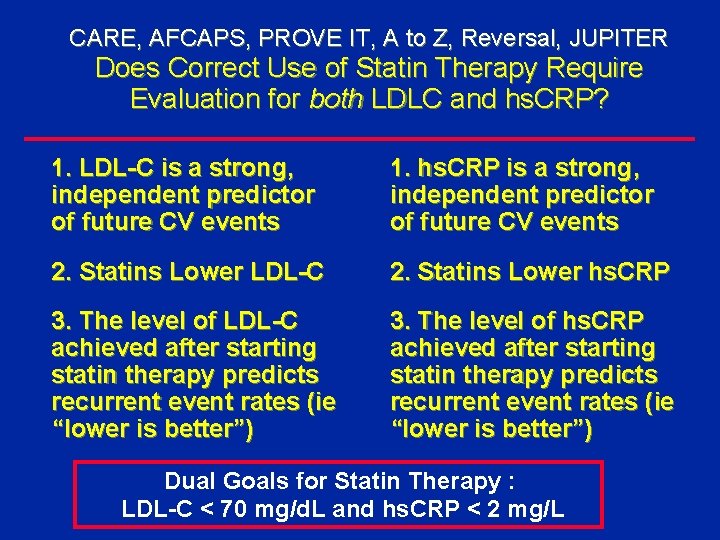
CARE, AFCAPS, PROVE IT, A to Z, Reversal, JUPITER Does Correct Use of Statin Therapy Require Evaluation for both LDLC and hs. CRP? 1. LDL-C is a strong, independent predictor of future CV events 1. hs. CRP is a strong, independent predictor of future CV events 2. Statins Lower LDL-C 2. Statins Lower hs. CRP 3. The level of LDL-C achieved after starting statin therapy predicts recurrent event rates (ie “lower is better”) 3. The level of hs. CRP achieved after starting statin therapy predicts recurrent event rates (ie “lower is better”) Dual Goals for Statin Therapy : LDL-C < 70 mg/d. L and hs. CRP < 2 mg/L
JUPITER Public Health Implications For patients with raised LDLC or raised hs. CRP, initial interventions should include dietary restriction, exercise, and smoking cessation. However, as demonstrated in these prospective data, for those initiating drug therapy in primary prevention, reductions in both LDLC and hs. CRP are indicators of the success of treatment with statin therapy. We thank the 17, 802 patients and the >1, 000 investigators worldwide for their personal time, effort, and commitment to the JUPITER trial. www. brighamandwomens. org/jupitertrial