
Presenter Disclosure Information Christopher P Cannon MD Results
- Slides: 20
Presenter Disclosure Information Christopher P. Cannon, MD Results of the Multinational Etoricoxib and Diclofenac Arthritis Long-term (MEDAL) Study Program: Cardiovascular Outcomes Following Long-term Treatment with Etoricoxib vs Diclofenac in Patients with Osteoarthritis and Rheumatoid Arthritis DISCLOSURE INFORMATION: The following relationships exist related to this presentation: Research grant support from Accumetrics, Astra. Zeneca, Merck/Schering-Plough, and Schering-Plough and has spoken at symposia sponsored by and served on scientific advisory boards for Astra. Zeneca, Bristol-Myers Squibb, Glaxo Smith Kline, Merck, Pfizer, Sanofi-Aventis, Merck/Schering-Plough, Schering. Plough, and Vertex Trial sponsor: Merck 1
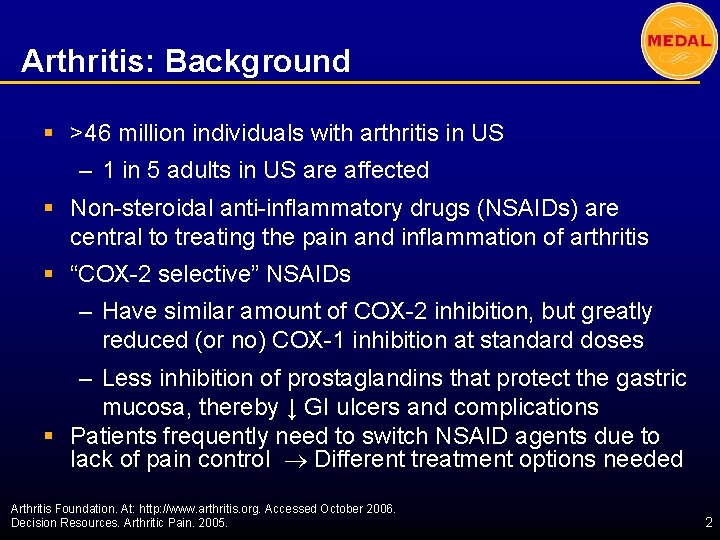
Arthritis: Background § >46 million individuals with arthritis in US – 1 in 5 adults in US are affected § Non-steroidal anti-inflammatory drugs (NSAIDs) are central to treating the pain and inflammation of arthritis § “COX-2 selective” NSAIDs – Have similar amount of COX-2 inhibition, but greatly reduced (or no) COX-1 inhibition at standard doses – Less inhibition of prostaglandins that protect the gastric mucosa, thereby ↓ GI ulcers and complications § Patients frequently need to switch NSAID agents due to lack of pain control Different treatment options needed Arthritis Foundation. At: http: //www. arthritis. org. Accessed October 2006. Decision Resources. Arthritic Pain. 2005. 2
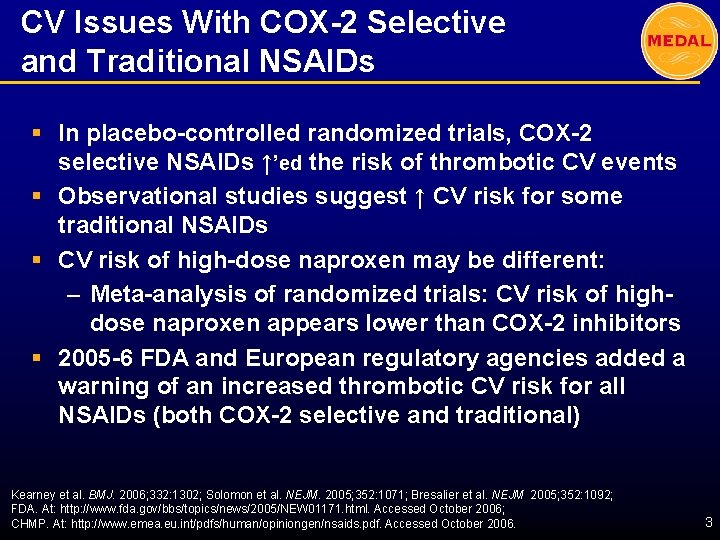
CV Issues With COX-2 Selective and Traditional NSAIDs § In placebo-controlled randomized trials, COX-2 selective NSAIDs ↑’ed the risk of thrombotic CV events § Observational studies suggest ↑ CV risk for some traditional NSAIDs § CV risk of high-dose naproxen may be different: – Meta-analysis of randomized trials: CV risk of highdose naproxen appears lower than COX-2 inhibitors § 2005 -6 FDA and European regulatory agencies added a warning of an increased thrombotic CV risk for all NSAIDs (both COX-2 selective and traditional) Kearney et al. BMJ. 2006; 332: 1302; Solomon et al. NEJM. 2005; 352: 1071; Bresalier et al. NEJM 2005; 352: 1092; FDA. At: http: //www. fda. gov/bbs/topics/news/2005/NEW 01171. html. Accessed October 2006; CHMP. At: http: //www. emea. eu. int/pdfs/human/opiniongen/nsaids. pdf. Accessed October 2006. 3
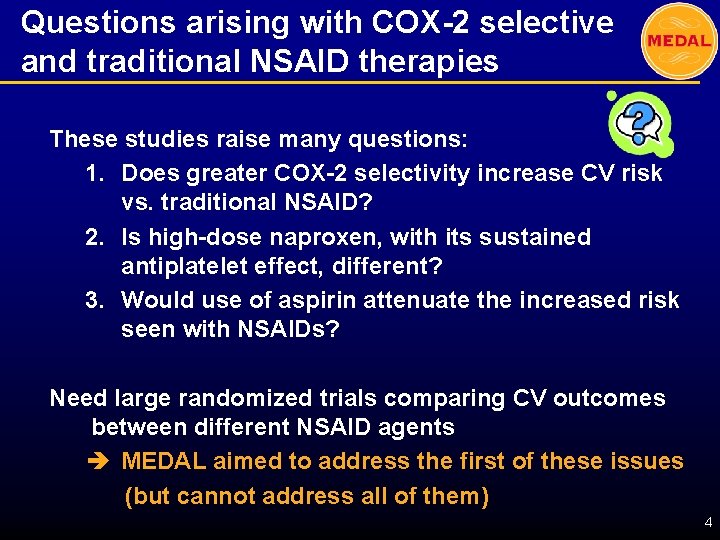
Questions arising with COX-2 selective and traditional NSAID therapies These studies raise many questions: 1. Does greater COX-2 selectivity increase CV risk vs. traditional NSAID? 2. Is high-dose naproxen, with its sustained antiplatelet effect, different? 3. Would use of aspirin attenuate the increased risk seen with NSAIDs? Need large randomized trials comparing CV outcomes between different NSAID agents è MEDAL aimed to address the first of these issues (but cannot address all of them) 4
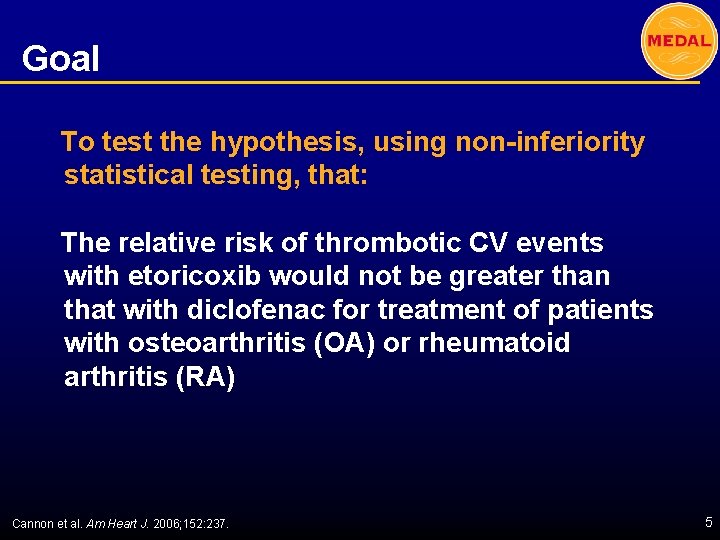
Goal To test the hypothesis, using non-inferiority statistical testing, that: The relative risk of thrombotic CV events with etoricoxib would not be greater than that with diclofenac for treatment of patients with osteoarthritis (OA) or rheumatoid arthritis (RA) Cannon et al. Am Heart J. 2006; 152: 237. 5
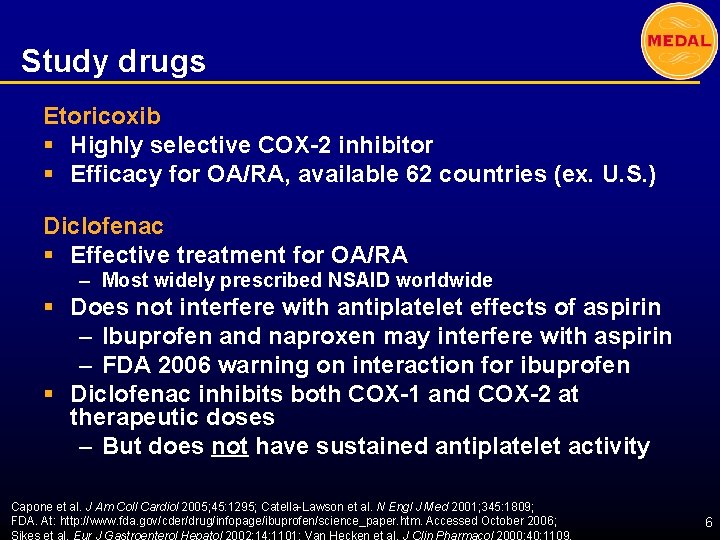
Study drugs Etoricoxib § Highly selective COX-2 inhibitor § Efficacy for OA/RA, available 62 countries (ex. U. S. ) Diclofenac § Effective treatment for OA/RA – Most widely prescribed NSAID worldwide § Does not interfere with antiplatelet effects of aspirin – Ibuprofen and naproxen may interfere with aspirin – FDA 2006 warning on interaction for ibuprofen § Diclofenac inhibits both COX-1 and COX-2 at therapeutic doses – But does not have sustained antiplatelet activity Capone et al. J Am Coll Cardiol 2005; 45: 1295; Catella-Lawson et al. N Engl J Med 2001; 345: 1809; FDA. At: http: //www. fda. gov/cder/drug/infopage/ibuprofen/science_paper. htm. Accessed October 2006; Sikes et al. Eur J Gastroenterol Hepatol 2002; 14: 1101; Van Hecken et al. J Clin Pharmacol 2000; 40: 1109. 6
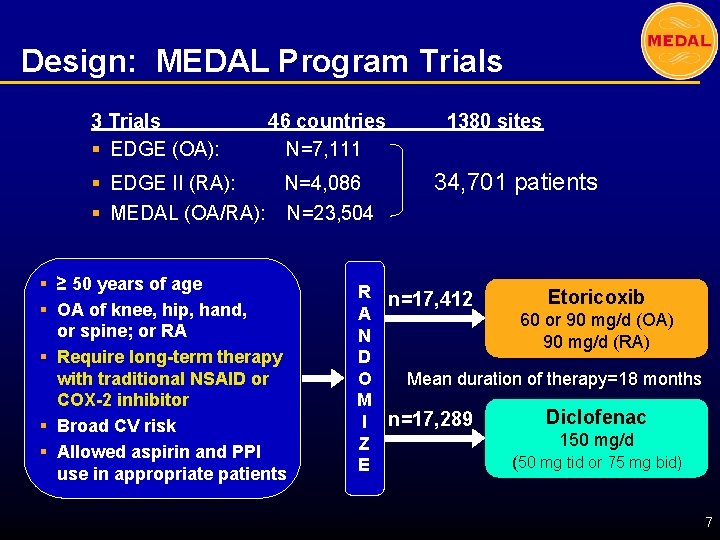
Design: MEDAL Program Trials 3 Trials § EDGE (OA): 46 countries N=7, 111 § EDGE II (RA): N=4, 086 § MEDAL (OA/RA): N=23, 504 § ≥ 50 years of age § OA of knee, hip, hand, or spine; or RA § Require long-term therapy with traditional NSAID or COX-2 inhibitor § Broad CV risk § Allowed aspirin and PPI use in appropriate patients 1380 sites 34, 701 patients R n=17, 412 Etoricoxib A 60 or 90 mg/d (OA) N 90 mg/d (RA) D Mean duration of therapy=18 months O M Diclofenac I n=17, 289 150 mg/d Z (50 mg tid or 75 mg bid) E 7
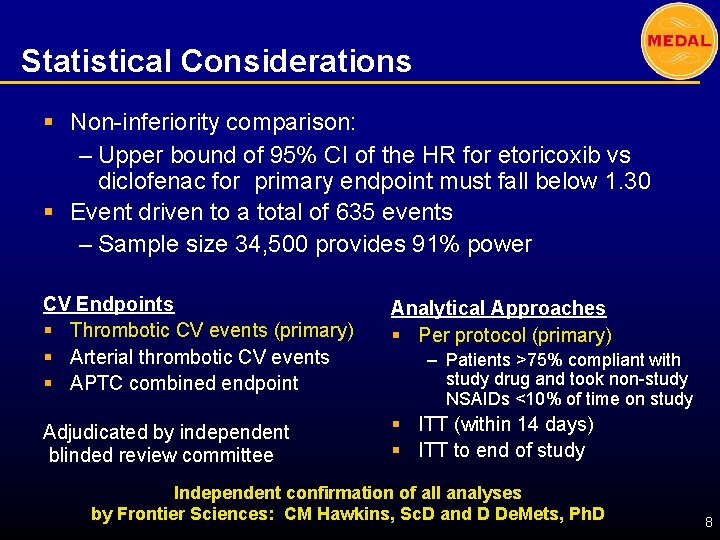
Statistical Considerations § Non-inferiority comparison: – Upper bound of 95% CI of the HR for etoricoxib vs diclofenac for primary endpoint must fall below 1. 30 § Event driven to a total of 635 events – Sample size 34, 500 provides 91% power CV Endpoints § Thrombotic CV events (primary) § Arterial thrombotic CV events § APTC combined endpoint Analytical Approaches § Per protocol (primary) Adjudicated by independent blinded review committee § ITT (within 14 days) § ITT to end of study – Patients >75% compliant with study drug and took non-study NSAIDs <10% of time on study Independent confirmation of all analyses by Frontier Sciences: CM Hawkins, Sc. D and D De. Mets, Ph. D 8
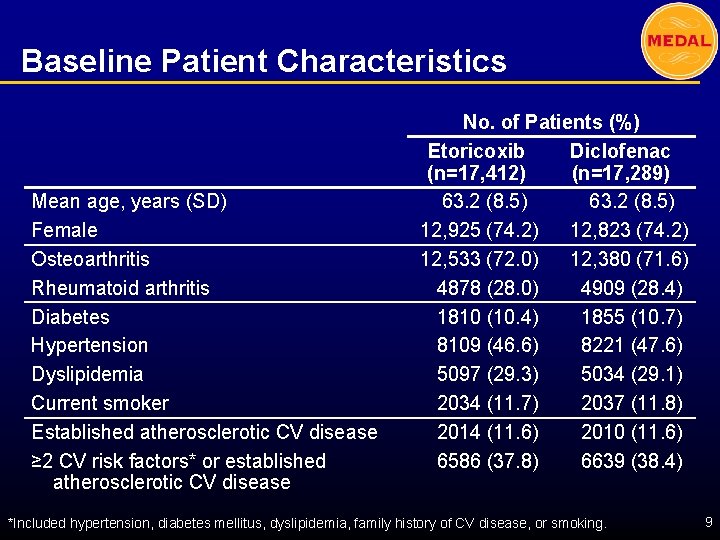
Baseline Patient Characteristics Mean age, years (SD) Female Osteoarthritis Rheumatoid arthritis Diabetes Hypertension Dyslipidemia Current smoker Established atherosclerotic CV disease ≥ 2 CV risk factors* or established atherosclerotic CV disease No. of Patients (%) Etoricoxib Diclofenac (n=17, 412) (n=17, 289) 63. 2 (8. 5) 12, 925 (74. 2) 12, 823 (74. 2) 12, 533 (72. 0) 12, 380 (71. 6) 4878 (28. 0) 4909 (28. 4) 1810 (10. 4) 1855 (10. 7) 8109 (46. 6) 8221 (47. 6) 5097 (29. 3) 5034 (29. 1) 2034 (11. 7) 2037 (11. 8) 2014 (11. 6) 2010 (11. 6) 6586 (37. 8) 6639 (38. 4) *Included hypertension, diabetes mellitus, dyslipidemia, family history of CV disease, or smoking. 9
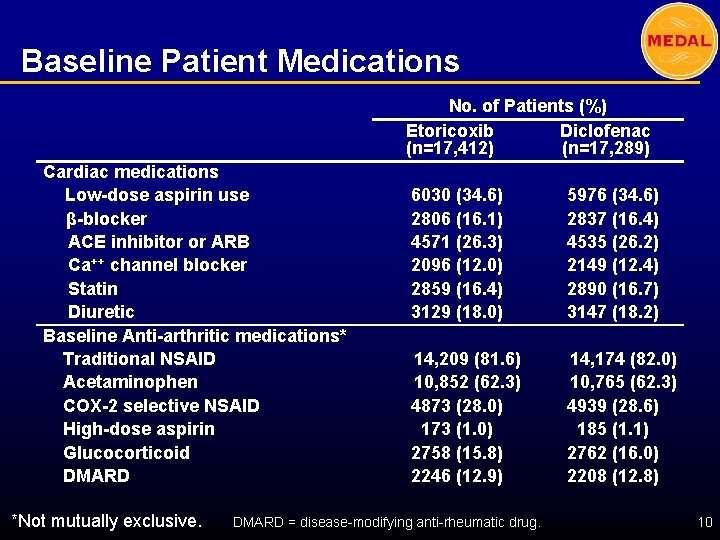
Baseline Patient Medications No. of Patients (%) Etoricoxib Diclofenac (n=17, 412) (n=17, 289) Cardiac medications Low-dose aspirin use β-blocker ACE inhibitor or ARB Ca++ channel blocker Statin Diuretic Baseline Anti-arthritic medications* Traditional NSAID Acetaminophen COX-2 selective NSAID High-dose aspirin Glucocorticoid DMARD *Not mutually exclusive. 6030 (34. 6) 2806 (16. 1) 4571 (26. 3) 2096 (12. 0) 2859 (16. 4) 3129 (18. 0) 5976 (34. 6) 2837 (16. 4) 4535 (26. 2) 2149 (12. 4) 2890 (16. 7) 3147 (18. 2) 14, 209 (81. 6) 10, 852 (62. 3) 4873 (28. 0) 173 (1. 0) 2758 (15. 8) 2246 (12. 9) 14, 174 (82. 0) 10, 765 (62. 3) 4939 (28. 6) 185 (1. 1) 2762 (16. 0) 2208 (12. 8) DMARD = disease-modifying anti-rheumatic drug. 10
Primary Results Does the COX-2 selective NSAID etoricoxib have an increased risk of thrombotic CV events compared with the traditional NSAID diclofenac? 11
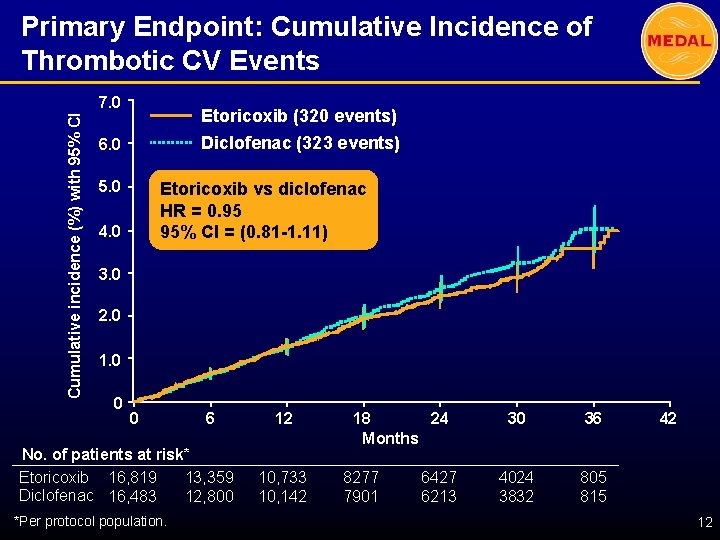
Primary Endpoint: Cumulative Incidence of Thrombotic CV Events Cumulative incidence (%) with 95% CI 7. 0 Etoricoxib (320 events) Diclofenac (323 events) 6. 0 5. 0 Etoricoxib vs diclofenac HR = 0. 95 95% CI = (0. 81 -1. 11) 4. 0 3. 0 2. 0 1. 0 0 0 6 No. of patients at risk* Etoricoxib 16, 819 13, 359 Diclofenac 16, 483 12, 800 *Per protocol population. 12 10, 733 10, 142 18 24 Months 8277 7901 6427 6213 30 36 4024 3832 805 815 42 12
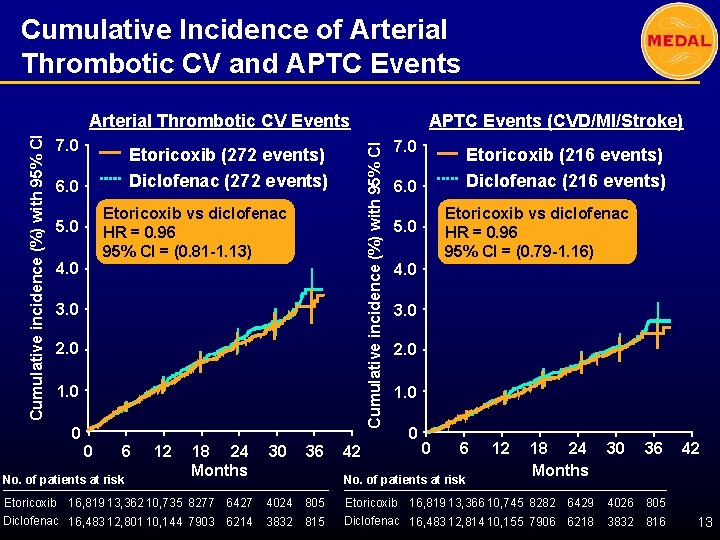
Cumulative Incidence of Arterial Thrombotic CV and APTC Events 7. 0 Etoricoxib (272 events) Diclofenac (272 events) 6. 0 Etoricoxib vs diclofenac HR = 0. 96 95% CI = (0. 81 -1. 13) 5. 0 4. 0 3. 0 2. 0 1. 0 0 0 6 No. of patients at risk 12 18 24 Months Etoricoxib 16, 819 13, 362 10, 735 8277 6427 Diclofenac 16, 483 12, 801 10, 144 7903 6214 30 36 APTC Events (CVD/MI/Stroke) Cumulative incidence (%) with 95% CI Arterial Thrombotic CV Events 42 7. 0 Etoricoxib (216 events) Diclofenac (216 events) 6. 0 Etoricoxib vs diclofenac HR = 0. 96 95% CI = (0. 79 -1. 16) 5. 0 4. 0 3. 0 2. 0 1. 0 0 0 6 No. of patients at risk 4024 805 3832 815 12 18 24 Months Etoricoxib 16, 819 13, 366 10, 745 8282 6429 Diclofenac 16, 483 12, 814 10, 155 7906 6218 30 36 42 4026 805 3832 816 13
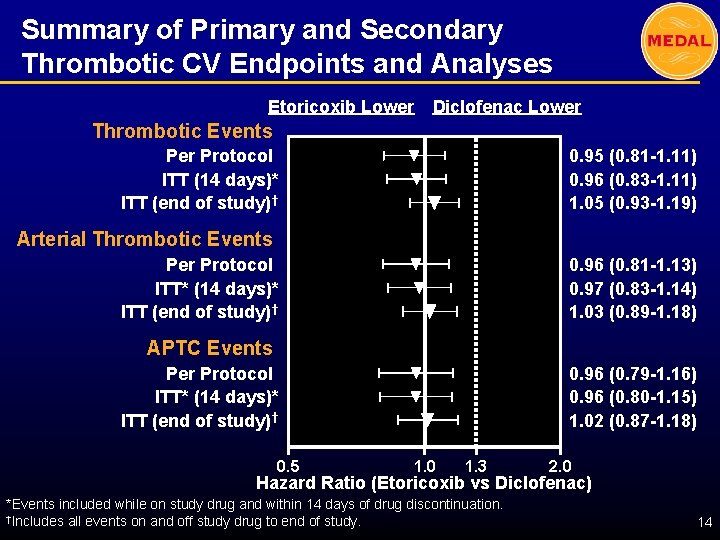
Summary of Primary and Secondary Thrombotic CV Endpoints and Analyses Etoricoxib Lower Diclofenac Lower Thrombotic Events Per Protocol ITT (14 days)* ITT (end of study)† 0. 95 (0. 81 -1. 11) 0. 96 (0. 83 -1. 11) 1. 05 (0. 93 -1. 19) Arterial Thrombotic Events Per Protocol ITT* (14 days)* ITT (end of study)† 0. 96 (0. 81 -1. 13) 0. 97 (0. 83 -1. 14) 1. 03 (0. 89 -1. 18) APTC Events Per Protocol ITT* (14 days)* ITT (end of study)† 0. 5 0. 96 (0. 79 -1. 16) 0. 96 (0. 80 -1. 15) 1. 02 (0. 87 -1. 18) 1. 0 1. 3 2. 0 Hazard Ratio (Etoricoxib vs Diclofenac) *Events included while on study drug and within 14 days of drug discontinuation. †Includes all events on and off study drug to end of study. 14
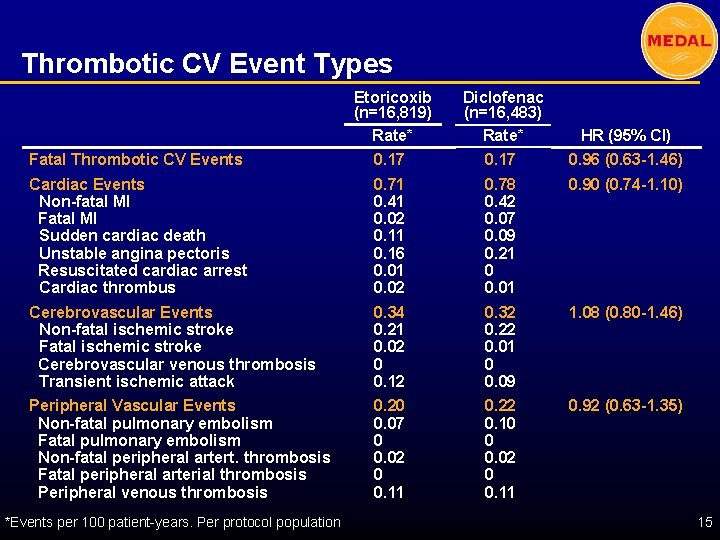
Thrombotic CV Event Types Etoricoxib (n=16, 819) Rate* Diclofenac (n=16, 483) Rate* HR (95% CI) Fatal Thrombotic CV Events 0. 17 0. 96 (0. 63 -1. 46) Cardiac Events Non-fatal MI Fatal MI Sudden cardiac death Unstable angina pectoris Resuscitated cardiac arrest Cardiac thrombus 0. 71 0. 41 0. 02 0. 11 0. 16 0. 01 0. 02 0. 78 0. 42 0. 07 0. 09 0. 21 0 0. 01 0. 90 (0. 74 -1. 10) Cerebrovascular Events Non-fatal ischemic stroke Fatal ischemic stroke Cerebrovascular venous thrombosis Transient ischemic attack 0. 34 0. 21 0. 02 0 0. 12 0. 32 0. 22 0. 01 0 0. 09 1. 08 (0. 80 -1. 46) Peripheral Vascular Events Non-fatal pulmonary embolism Fatal pulmonary embolism Non-fatal peripheral artert. thrombosis Fatal peripheral arterial thrombosis Peripheral venous thrombosis 0. 20 0. 07 0 0. 02 0 0. 11 0. 22 0. 10 0 0. 02 0 0. 11 0. 92 (0. 63 -1. 35) *Events per 100 patient-years. Per protocol population 15
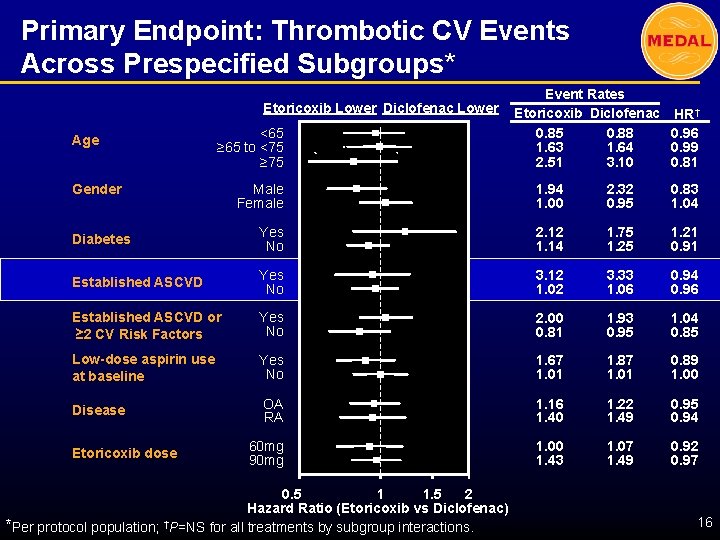
Primary Endpoint: Thrombotic CV Events Across Prespecified Subgroups* Etoricoxib Lower Diclofenac Lower Age <65 ≥ 65 to <75 ≥ 75 Gender Event Rates Etoricoxib Diclofenac HR† 0. 85 0. 88 0. 96 1. 63 1. 64 0. 99 2. 51 3. 10 0. 81 Male Female 1. 94 1. 00 2. 32 0. 95 0. 83 1. 04 Diabetes Yes No 2. 12 1. 14 1. 75 1. 21 0. 91 Established ASCVD Yes No 3. 12 1. 02 3. 33 1. 06 0. 94 0. 96 Established ASCVD or ≥ 2 CV Risk Factors Yes No 2. 00 0. 81 1. 93 0. 95 1. 04 0. 85 Low-dose aspirin use at baseline Yes No 1. 67 1. 01 1. 87 1. 01 0. 89 1. 00 Disease OA RA 1. 16 1. 40 1. 22 1. 49 0. 95 0. 94 60 mg 90 mg 1. 00 1. 43 1. 07 1. 49 0. 92 0. 97 Etoricoxib dose 0. 5 1 1. 5 2 Hazard Ratio (Etoricoxib vs Diclofenac) † *Per protocol population; P=NS for all treatments by subgroup interactions. 16
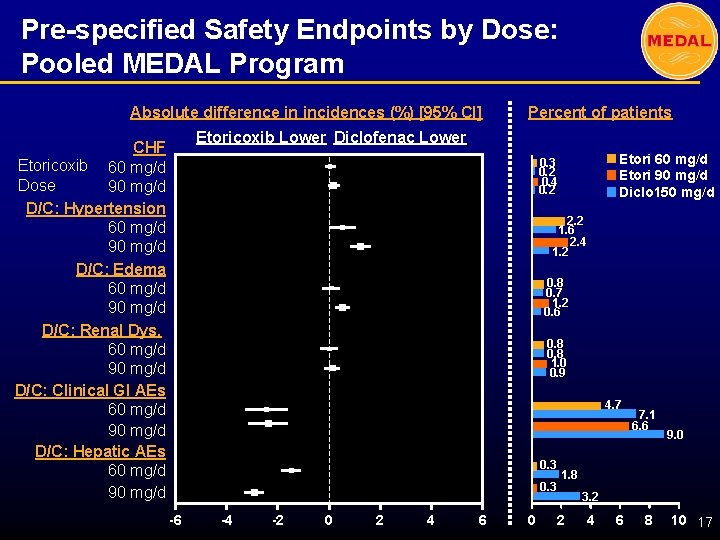
Pre-specified Safety Endpoints by Dose: Pooled MEDAL Program Absolute difference in incidences (%) [95% CI] Percent of patients Etoricoxib Lower Diclofenac Lower CHF Etoricoxib 60 mg/d Dose 90 mg/d D/C: Hypertension 60 mg/d 90 mg/d D/C: Edema 60 mg/d 90 mg/d D/C: Renal Dys. 60 mg/d 90 mg/d D/C: Clinical GI AEs 60 mg/d 90 mg/d D/C: Hepatic AEs 60 mg/d 90 mg/d Etori 60 mg/d Etori 90 mg/d Diclo 150 mg/d 0. 3 0. 2 0. 4 0. 2 2. 2 1. 6 2. 4 1. 2 0. 8 0. 7 1. 2 0. 6 0. 8 1. 0 0. 9 4. 7 0. 3 -6 -4 -2 0 2 4 6 0 7. 1 6. 6 9. 0 1. 8 3. 2 2 4 6 8 10 17
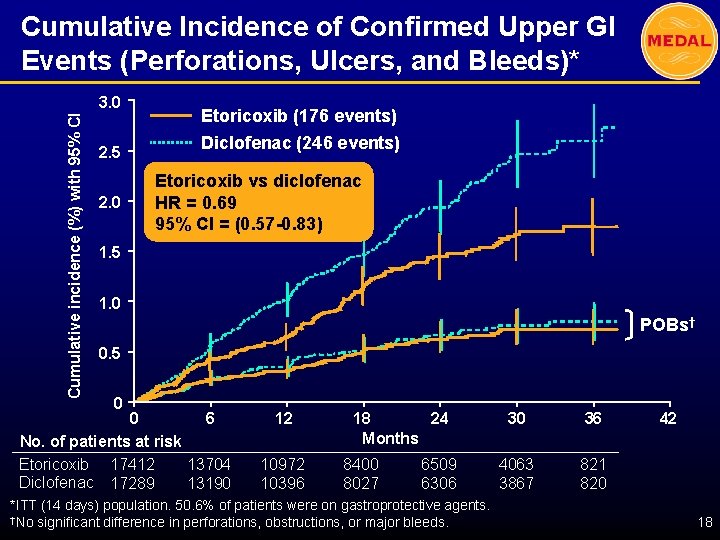
Cumulative Incidence of Confirmed Upper GI Events (Perforations, Ulcers, and Bleeds)* Cumulative incidence (%) with 95% CI 3. 0 2. 5 2. 0 Etoricoxib (176 events) Diclofenac (246 events) Etoricoxib vs diclofenac HR = 0. 69 95% CI = (0. 57 -0. 83) 1. 5 1. 0 POBs† 0. 5 0 0 6 No. of patients at risk Etoricoxib 17412 13704 Diclofenac 17289 13190 12 10972 10396 18 24 Months 8400 8027 6509 6306 *ITT (14 days) population. 50. 6% of patients were on gastroprotective agents. †No significant difference in perforations, obstructions, or major bleeds. 30 36 4063 3867 821 820 42 18
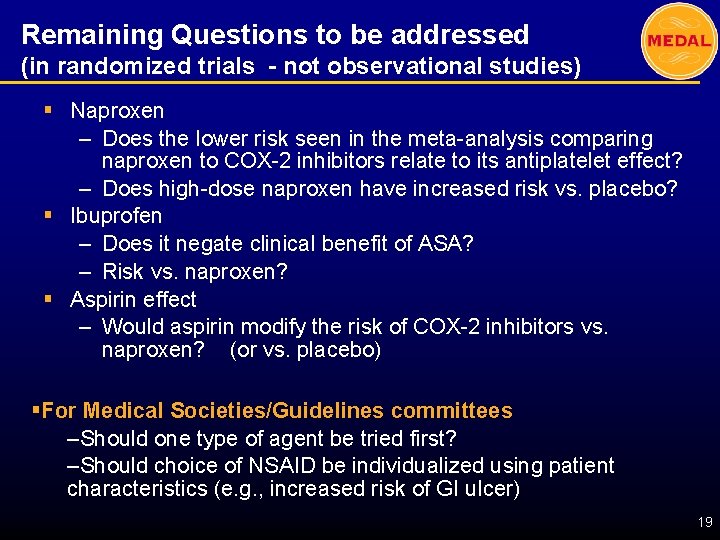
Remaining Questions to be addressed (in randomized trials - not observational studies) § Naproxen – Does the lower risk seen in the meta-analysis comparing naproxen to COX-2 inhibitors relate to its antiplatelet effect? – Does high-dose naproxen have increased risk vs. placebo? § Ibuprofen – Does it negate clinical benefit of ASA? – Risk vs. naproxen? § Aspirin effect – Would aspirin modify the risk of COX-2 inhibitors vs. naproxen? (or vs. placebo) §For Medical Societies/Guidelines committees –Should one type of agent be tried first? –Should choice of NSAID be individualized using patient characteristics (e. g. , increased risk of GI ulcer) 19
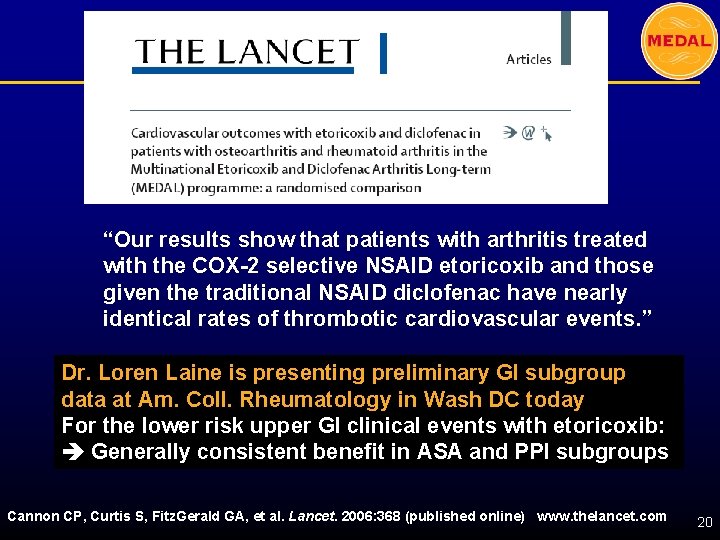
“Our results show that patients with arthritis treated with the COX-2 selective NSAID etoricoxib and those given the traditional NSAID diclofenac have nearly identical rates of thrombotic cardiovascular events. ” Dr. Loren Laine is presenting preliminary GI subgroup data at Am. Coll. Rheumatology in Wash DC today For the lower risk upper GI clinical events with etoricoxib: Generally consistent benefit in ASA and PPI subgroups Cannon CP, Curtis S, Fitz. Gerald GA, et al. Lancet. 2006: 368 (published online) www. thelancet. com 20