
Presented by Vishnu R Nair 5 th year
Presented by, Vishnu. R. Nair, 5 th year Pharm. D, Date of presentation: 09. 02. 2018

GENERAL INTRODUCTION
- BETA-2 AGONISTS ( Also known as Beta-2 adrenergic receptor agonists) represent drugs that come under the class of “BRONCHODILATORS” - Drugs relax & enlarge (dilate) airways in lungs makes breathing easier - Primarily used to treat asthma & other pulmonary disorders like COPD - Classified into: 1. SABA(Short-Acting Beta-2 Agonists) 2. LABA(Long-Acting Beta-2 -Agonists).

MECHANISM OF ACTION
- Beta-2 -agonists bind to beta-2 -receptors (coupled with stimulatory G- protein of adenyl cyclase enzyme) of bronchial smooth muscle of lung enzyme increases concentration of Cyclic-AMP levels in lung leads to reduction of Ca++ concentration within cells activation of protein kinase A leads to increased membrane potassium conductance causes smooth muscle relaxation & bronchodilation. - Activation of beta-adrenergic receptors causes relaxation of smooth muscle in the lung causes dilation & opening of airways.
ADVERSE EFFECTS
§ Adverse effects include: 1. Headache 2. Anxiety 3. Nausea 4. Muscle tremors 5. Nervousness 6. Increased / irregular heartbeats(Palpitations).
SHORT-ACTING BETA-2 AGONISTS(SABA)
§ Also known as “Quick-acting”, “Reliever” / “Rescue” medications § These drugs relieve acute asthma symptoms/ attacks very quickly, by opening the airways § Rescue medications are considered best for treating sudden asthma symptoms § Action of inhaled bronchodilators starts within minutes(post-inhalation) lasts for 2 -4 hours § SABA also used before exercise, to prevent exercise-induced asthma.
§ Include: 1. Salbutamol(albuterol) 2. Levosalbutamol(levalbuterol) 3. Metaproterenol 4. Pirbuterol 5. Isoproterenol(Isoprenaline) 6. Terbutaline sulphate.
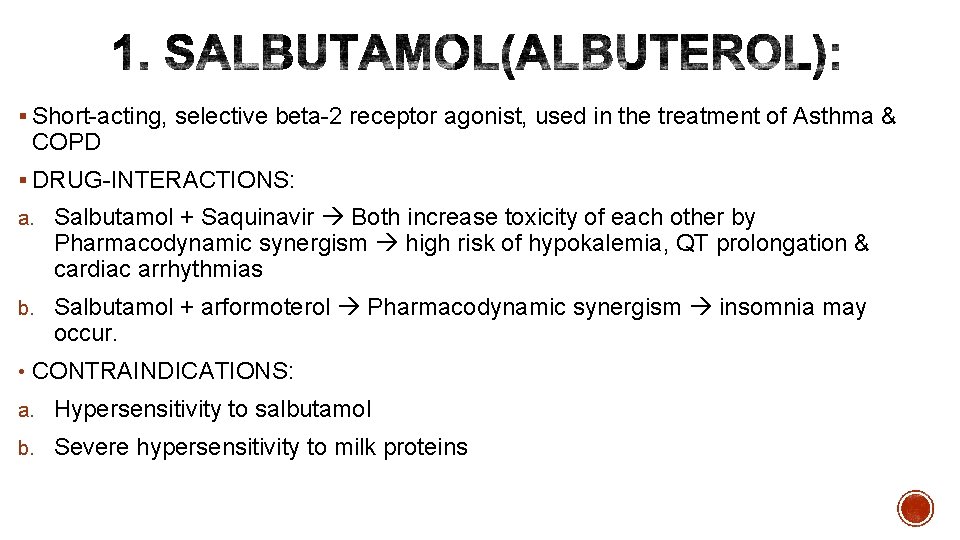
§ Short-acting, selective beta-2 receptor agonist, used in the treatment of Asthma & COPD § DRUG-INTERACTIONS: a. Salbutamol + Saquinavir Both increase toxicity of each other by Pharmacodynamic synergism high risk of hypokalemia, QT prolongation & cardiac arrhythmias b. Salbutamol + arformoterol Pharmacodynamic synergism insomnia may occur. • CONTRAINDICATIONS: a. Hypersensitivity to salbutamol b. Severe hypersensitivity to milk proteins
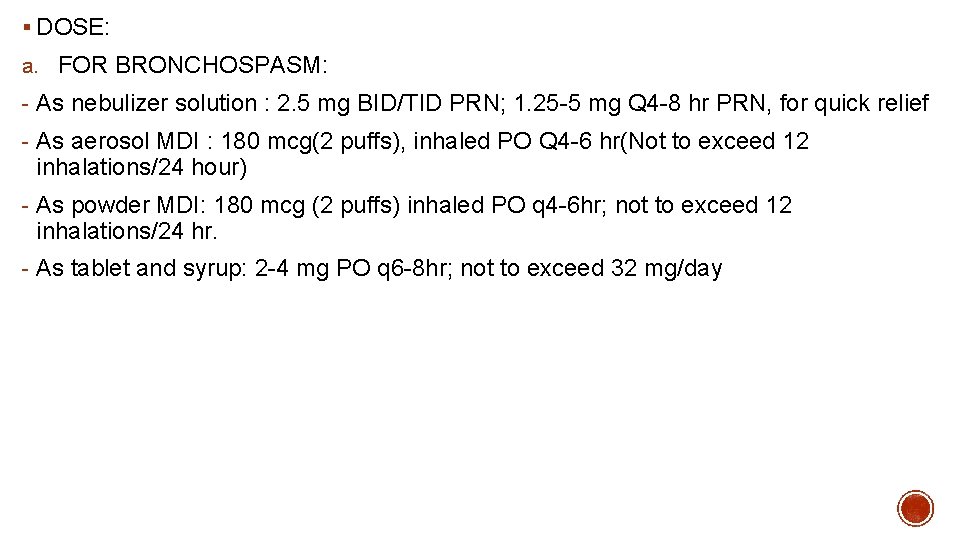
§ DOSE: a. FOR BRONCHOSPASM: - As nebulizer solution : 2. 5 mg BID/TID PRN; 1. 25 -5 mg Q 4 -8 hr PRN, for quick relief - As aerosol MDI : 180 mcg(2 puffs), inhaled PO Q 4 -6 hr(Not to exceed 12 inhalations/24 hour) - As powder MDI: 180 mcg (2 puffs) inhaled PO q 4 -6 hr; not to exceed 12 inhalations/24 hr. - As tablet and syrup: 2 -4 mg PO q 6 -8 hr; not to exceed 32 mg/day
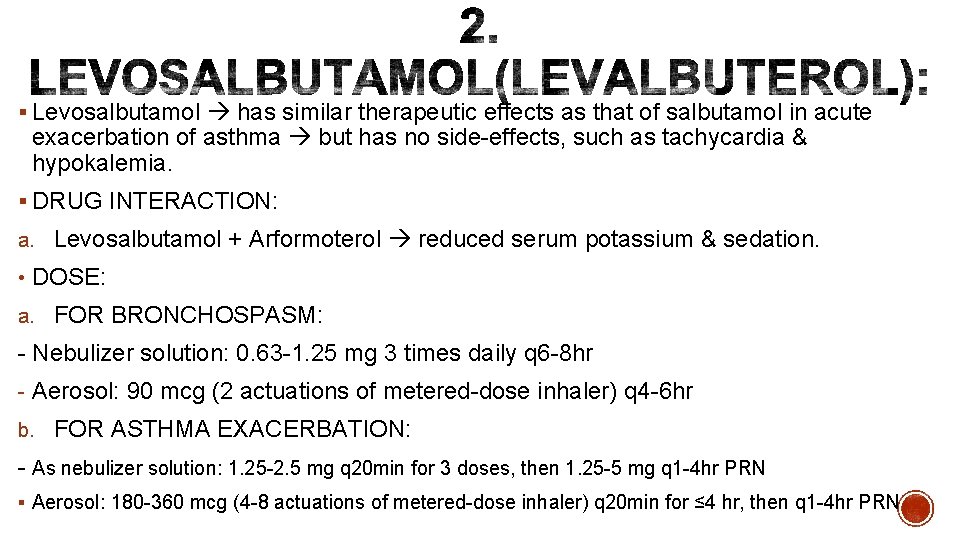
§ Levosalbutamol has similar therapeutic effects as that of salbutamol in acute exacerbation of asthma but has no side-effects, such as tachycardia & hypokalemia. § DRUG INTERACTION: a. Levosalbutamol + Arformoterol reduced serum potassium & sedation. • DOSE: a. FOR BRONCHOSPASM: - Nebulizer solution: 0. 63 -1. 25 mg 3 times daily q 6 -8 hr - Aerosol: 90 mcg (2 actuations of metered-dose inhaler) q 4 -6 hr b. FOR ASTHMA EXACERBATION: - As nebulizer solution: 1. 25 -2. 5 mg q 20 min for 3 doses, then 1. 25 -5 mg q 1 -4 hr PRN § Aerosol: 180 -360 mcg (4 -8 actuations of metered-dose inhaler) q 20 min for ≤ 4 hr, then q 1 -4 hr PRN
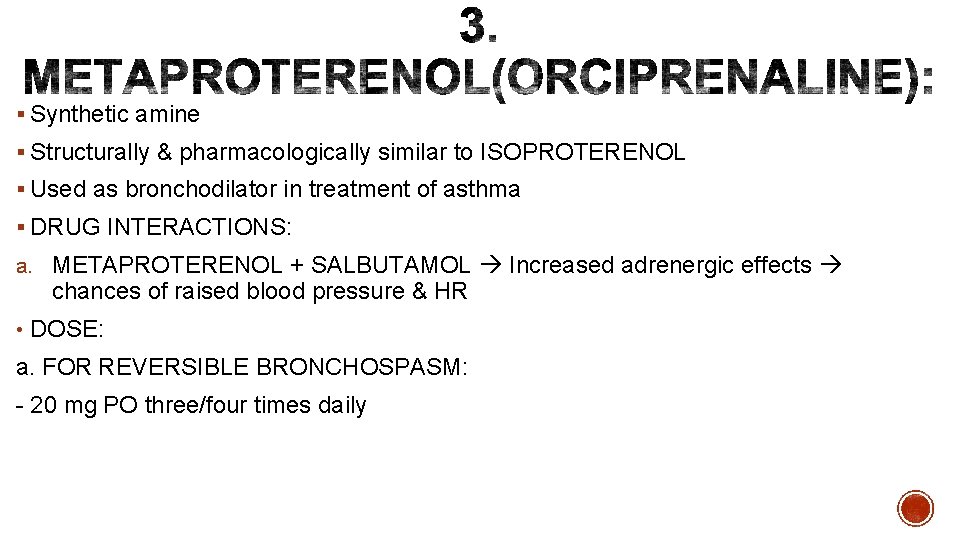
§ Synthetic amine § Structurally & pharmacologically similar to ISOPROTERENOL § Used as bronchodilator in treatment of asthma § DRUG INTERACTIONS: a. METAPROTERENOL + SALBUTAMOL Increased adrenergic effects chances of raised blood pressure & HR • DOSE: a. FOR REVERSIBLE BRONCHOSPASM: - 20 mg PO three/four times daily
§ Beta-agonist bronchodilator, used in asthma treatment for reversal of acute bronchospasm, & also as maintenance medication to prevent future attacks. § DOSE: For Asthma Maintenance : - 1 -2 actuations q 4 -6 hr PRN; not to exceed 12 actuations/day
§ Non-selective beta-adrenergic receptor agonist § Also known as ISOPRENALINE § Used in management of shock, heart block/cardiac arrest & bronchospasm § DOSE: a. For Bronchospasm during anesthesia: § 0. 01 -0. 02 mg IV, repeat PRN
§ Resorcinol , is a SABA, used as bronchodilator § DOSE: a. For Bronchospasm: i. As PO: § Initiate at 2. 5 mg three/four times daily PO § Maintenance: 5 mg three times daily PO q 6 hr while patient is awake; reduce dose to 2. 5 mg q 6 hr § Not to exceed 15 mg/day ii. As s. c: § 0. 25 mg q 15 -30 min x 3 doses PRN in lateral deltoid § Not to exceed 0. 5 mg/4 hr
LONG-ACTING BETA-2 AGONISTS(LABA)
- The long-acting bronchodilators are used to provide control ( NOT QUICK RELIEF ) of asthma. - They should only be used in conjunction with INHALED STEROIDS for long-term control of asthma symptoms. - Used twice a day. - Long-acting beta-agonist bronchodilators increase the risk of death from asthma and should only be used as additional treatment for people who are also using an inhaled steroid.
§ Examples of LABA include: 1. Formoterol 2. Arformoterol 3. Salmeterol 4. Indacaterol 5. Vilanterol 6. Olodaterol.
§ Inhaled LABA, used in the management of asthma, COPD & exercise-induced bronchospasm. § DRUG INTERACTION: a. Formoterol + CPZ Prolongation of QTc interval b. Formoterol + Amiodarone/Dronedarone Prolongation of QTc interval • DOSE: a. 20 mcg, inhaled via nebulizer, q 12 hr(For long-term maintenance treatment of COPD)
§ R-enantiomer of formoterol § Potent, highly specific, nebulized, LABA § Approved by US-FDA for long-term maintenance treatment of bronchoconstriction in patients with COPD § DRUG INTERACTION: a. Arformoterol + Linezolid increased effects of former, by pharmacodynamic synergism high risk of acute hypertensive episode • DOSE: - 15 mcg inhaled via nebulization twice daily (AM & PM) - Not to exceed 30 mcg/day
§ Inhalational LABA § Can be used in combination with FLUTICASONE § DRUG INTERACTION: a. Salmeterol + indinavir increased levels of salmeterol increased toxicity. § DOSES: a. For asthma prevention & maintenance: - 1 inhalation (50 mcg) twice daily; not to exceed twice daily administration b. For COPD maintenance: - 1 inhalation (50 mcg) twice daily; not to exceed twice daily administration.
- LABA, used in COPD as bronchodilator - Can also be used in combination with GLYCOPYRROLATE(Utibron Neohaler) - ADRs: a. Post-inhalational cough(>10%) b. Nasopharyngitis (6. 5%) c. Headache (5. 1%). - DRUG INTERACTION: a. Indacaterol + Umeclidinium bromide / Vilanterol increased toxicity of each other increased HR & B. P
§ DOSE: IN COPD: - Long-acting beta 2 -agonist indicated for long-term, once-daily maintenance bronchodilator treatment of airflow obstruction in patients with chronic obstructive pulmonary disease (COPD), including chronic bronchitis and/or emphysema - 75 mcg inhaled orally q. Day; not to exceed once daily - Limitations of use: 1. Not indicated for acute deteriorations of COPD 1. Not indicated for asthma
§ Selective LABA, with inherent 24 -hour activity for once-daily asthma treatment § Used in combination as: a. Vilanterol + Fluticasone propionate b. Vilanterol + Fluticasone + Umeclidinium bromide • ADRs: a. Nasopharyngitis (9%) b. URTI (7%) c. Anticholinergic effects (with umeclidinium) d. Headache (7%) e. Oropharyngeal candidiasis(6%)
§ DOSE: a. With FLUTICASONE: - For COPD: 25 mcg/100 mcg (1 actuation), inhaled PO q. Day - For asthma : (25 mcg/100 mcg or 25 mcg/200 mcg per actuation) once daily via oral inhalation b. WITH UMECLIDINIUM BROMIDE: - For COPD: 62. 5 mcg/25 mcg (1 actuation), inhaled PO q. Day c. VILANTEROL + FLUTICASONE + UMECLIDINIUM COMBINATION: - For COPD: 1 inhalation PO q. Day(100 mcg/62. 5 mcg/25 mcg).
§ LABA, that activates specific BETA-2 -ADRENERGIC receptors on the surface of smooth muscle cells, increasing the levels of intracellular CYCLIC-AMP, thereby causing smooth muscle relaxation. § Has been reported to cause nasopharyngitis more compared to other LABAs § DRUG INTERACTIONS: a. Olodaterol + Amitriptyline prolongation of QTc interval increased risk of ventricular arrhythmias • Indicated for maintenance bronchodilator treatment in patients with COPD(including chronic bronchitis &/ emphysema), with airflow obstruction • DOSE: - 5 mcg(2 actuations), inhaled PO, q. Day, at the same time of the day - Not to exceed 2 inhalations every 24 hours.

THANK YOU!!!
- Slides: 29