
Presented By Mrs Shalini Assistant Professor in Maths
Presented By: Mrs. Shalini Assistant Professor in Maths
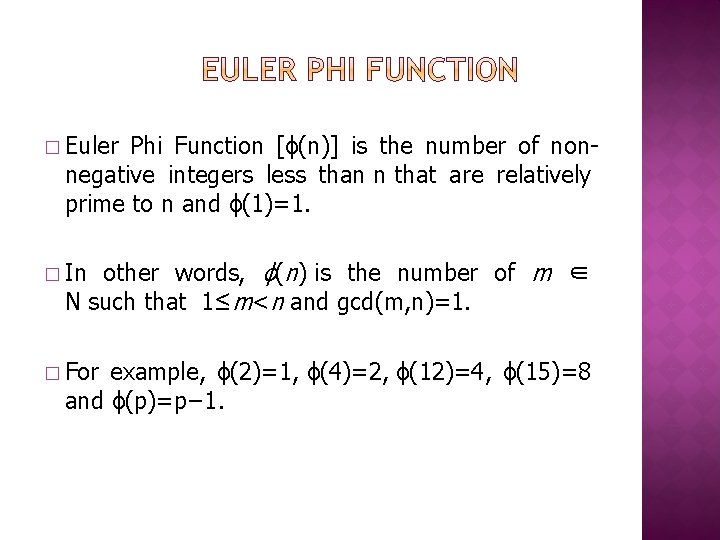
� Euler Phi Function [ϕ(n)] is the number of nonnegative integers less than n that are relatively prime to n and ϕ(1)=1. other words, ϕ(n) is the number of m ∈ N such that 1≤m<n and gcd(m, n)=1. � In � For example, ϕ(2)=1, ϕ(4)=2, ϕ(12)=4, ϕ(15)=8 and ϕ(p)=p− 1.
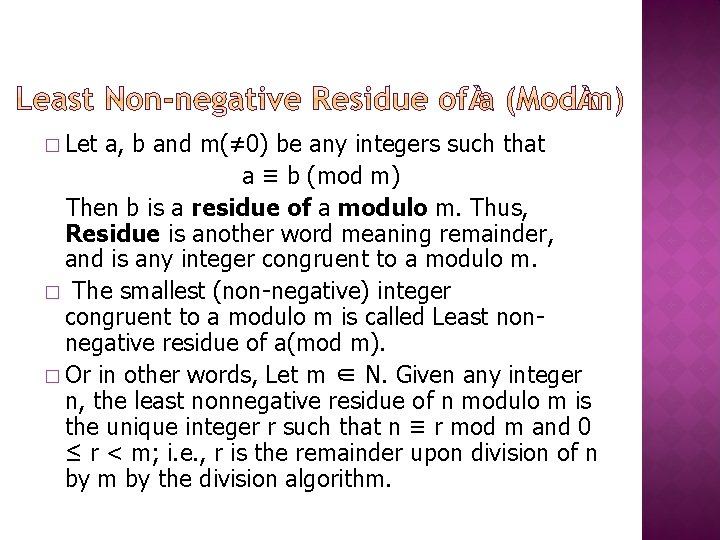
� Let a, b and m(≠ 0) be any integers such that a ≡ b (mod m) Then b is a residue of a modulo m. Thus, Residue is another word meaning remainder, and is any integer congruent to a modulo m. � The smallest (non-negative) integer congruent to a modulo m is called Least nonnegative residue of a(mod m). � Or in other words, Let m ∈ N. Given any integer n, the least nonnegative residue of n modulo m is the unique integer r such that n ≡ r mod m and 0 ≤ r < m; i. e. , r is the remainder upon division of n by m by the division algorithm.
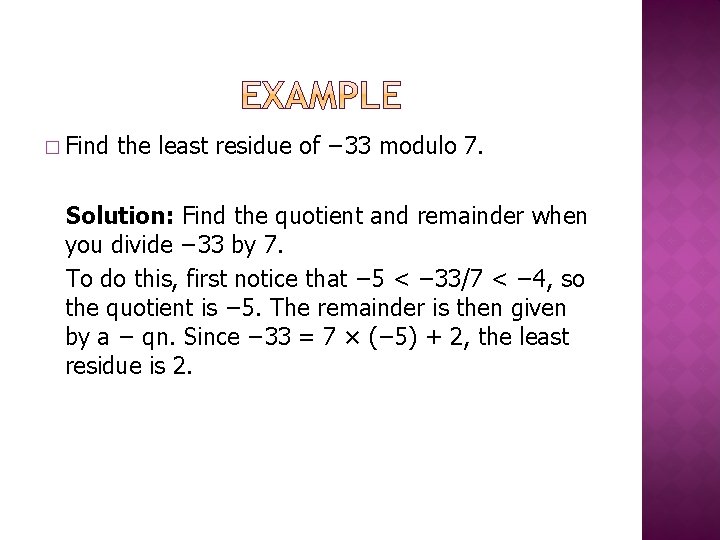
� Find the least residue of − 33 modulo 7. Solution: Find the quotient and remainder when you divide − 33 by 7. To do this, first notice that − 5 < − 33/7 < − 4, so the quotient is − 5. The remainder is then given by a − qn. Since − 33 = 7 × (− 5) + 2, the least residue is 2.
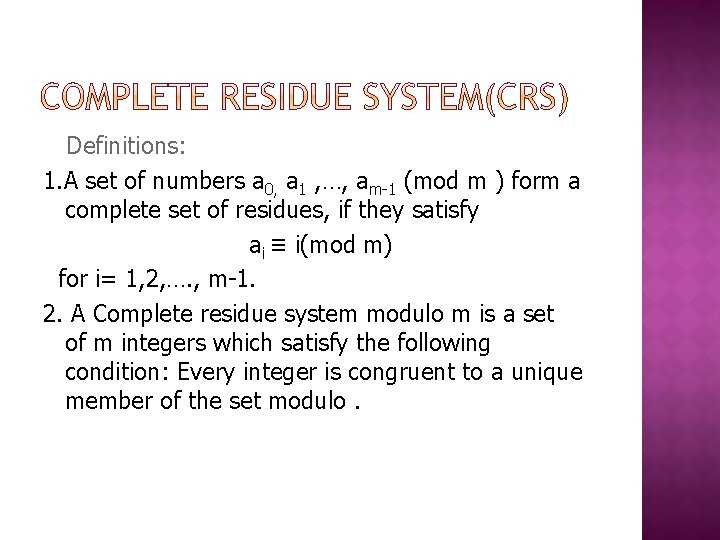
Definitions: 1. A set of numbers a 0, a 1 , …, am-1 (mod m ) form a complete set of residues, if they satisfy ai ≡ i(mod m) for i= 1, 2, …. , m-1. 2. A Complete residue system modulo m is a set of m integers which satisfy the following condition: Every integer is congruent to a unique member of the set modulo.
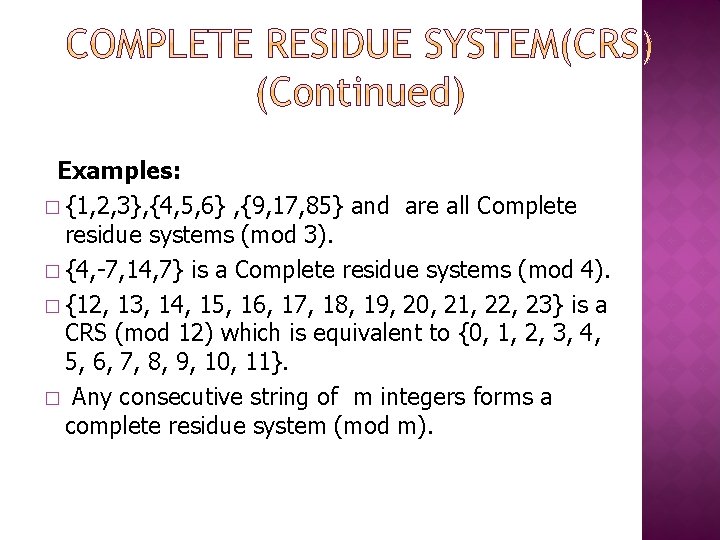
Examples: � {1, 2, 3}, {4, 5, 6} , {9, 17, 85} and are all Complete residue systems (mod 3). � {4, -7, 14, 7} is a Complete residue systems (mod 4). � {12, 13, 14, 15, 16, 17, 18, 19, 20, 21, 22, 23} is a CRS (mod 12) which is equivalent to {0, 1, 2, 3, 4, 5, 6, 7, 8, 9, 10, 11}. � Any consecutive string of m integers forms a complete residue system (mod m).
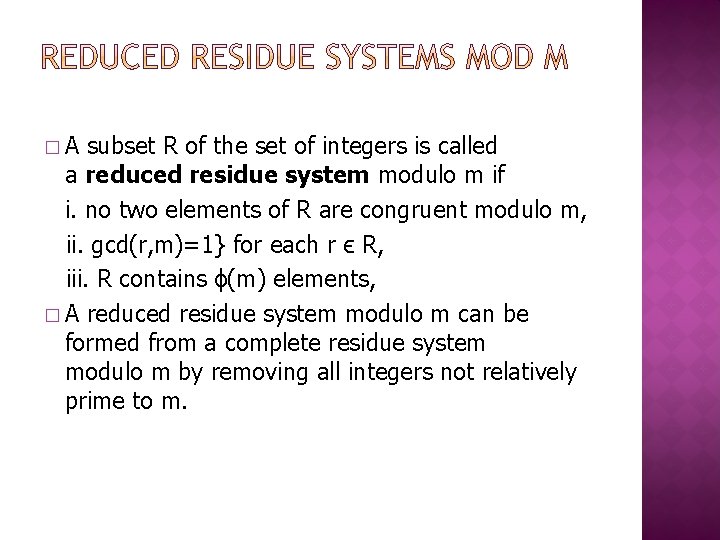
�A subset R of the set of integers is called a reduced residue system modulo m if i. no two elements of R are congruent modulo m, ii. gcd(r, m)=1} for each r ϵ R, iii. R contains ɸ(m) elements, � A reduced residue system modulo m can be formed from a complete residue system modulo m by removing all integers not relatively prime to m.
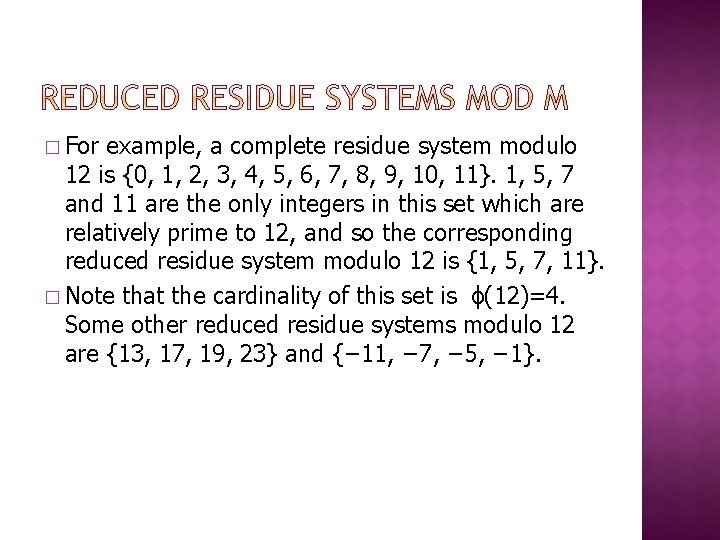
� For example, a complete residue system modulo 12 is {0, 1, 2, 3, 4, 5, 6, 7, 8, 9, 10, 11}. 1, 5, 7 and 11 are the only integers in this set which are relatively prime to 12, and so the corresponding reduced residue system modulo 12 is {1, 5, 7, 11}. � Note that the cardinality of this set is ɸ(12)=4. Some other reduced residue systems modulo 12 are {13, 17, 19, 23} and {− 11, − 7, − 5, − 1}.
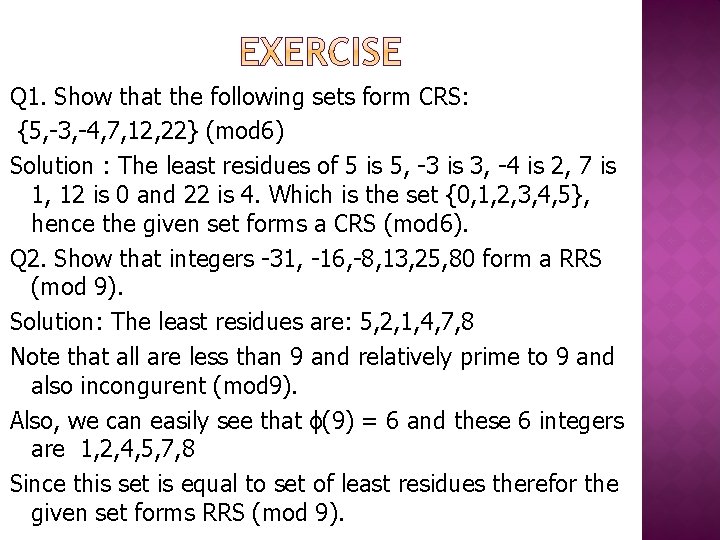
Q 1. Show that the following sets form CRS: {5, -3, -4, 7, 12, 22} (mod 6) Solution : The least residues of 5 is 5, -3 is 3, -4 is 2, 7 is 1, 12 is 0 and 22 is 4. Which is the set {0, 1, 2, 3, 4, 5}, hence the given set forms a CRS (mod 6). Q 2. Show that integers -31, -16, -8, 13, 25, 80 form a RRS (mod 9). Solution: The least residues are: 5, 2, 1, 4, 7, 8 Note that all are less than 9 and relatively prime to 9 and also incongurent (mod 9). Also, we can easily see that ɸ(9) = 6 and these 6 integers are 1, 2, 4, 5, 7, 8 Since this set is equal to set of least residues therefor the given set forms RRS (mod 9).
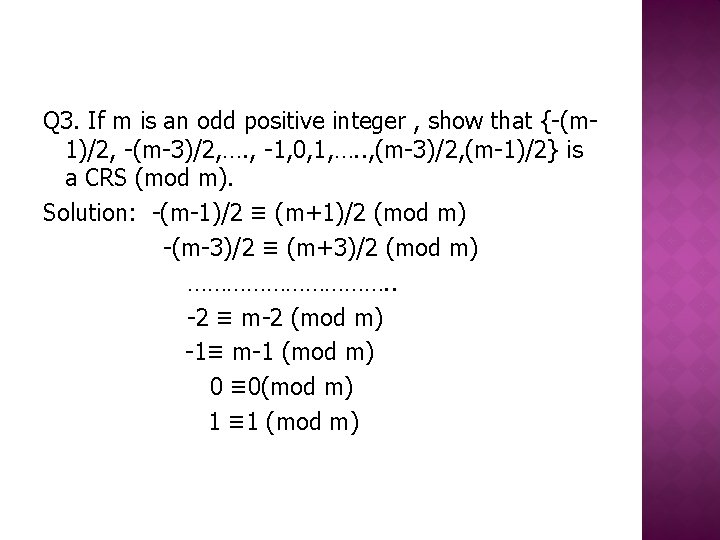
Q 3. If m is an odd positive integer , show that {-(m 1)/2, -(m-3)/2, …. , -1, 0, 1, …. . , (m-3)/2, (m-1)/2} is a CRS (mod m). Solution: -(m-1)/2 ≡ (m+1)/2 (mod m) -(m-3)/2 ≡ (m+3)/2 (mod m) ……………. . -2 ≡ m-2 (mod m) -1≡ m-1 (mod m) 0 ≡ 0(mod m) 1 ≡ 1 (mod m)
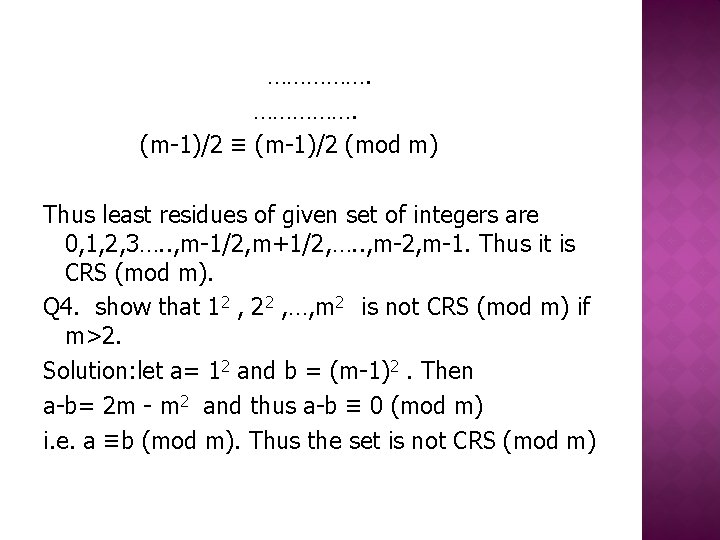
……………. (m-1)/2 ≡ (m-1)/2 (mod m) Thus least residues of given set of integers are 0, 1, 2, 3…. . , m-1/2, m+1/2, …. . , m-2, m-1. Thus it is CRS (mod m). Q 4. show that 12 , 22 , …, m 2 is not CRS (mod m) if m>2. Solution: let a= 12 and b = (m-1)2. Then a-b= 2 m - m 2 and thus a-b ≡ 0 (mod m) i. e. a ≡b (mod m). Thus the set is not CRS (mod m)
- Slides: 11