
presented by Michael Morse University of Utah morsechem
presented by: Michael Morse, University of Utah morse@chem. utah. edu Power. Points of all of my presentations to this group are available at: https: //chem. utah. edu/directory/morse/research-group/index. php Just click on A/P Chemistry Powerpoints and you can download and use them as you like.
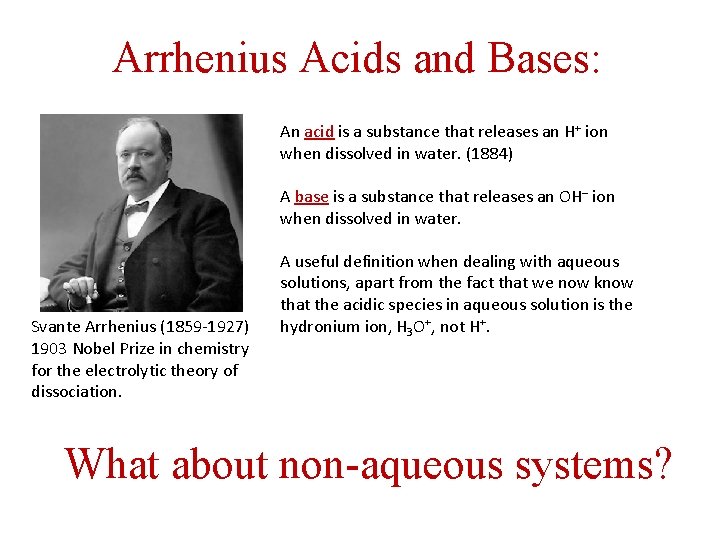
Arrhenius Acids and Bases: An acid is a substance that releases an H+ ion when dissolved in water. (1884) A base is a substance that releases an OH‒ ion when dissolved in water. Svante Arrhenius (1859 -1927) 1903 Nobel Prize in chemistry for the electrolytic theory of dissociation. A useful definition when dealing with aqueous solutions, apart from the fact that we now know that the acidic species in aqueous solution is the hydronium ion, H 3 O+, not H+. What about non-aqueous systems?
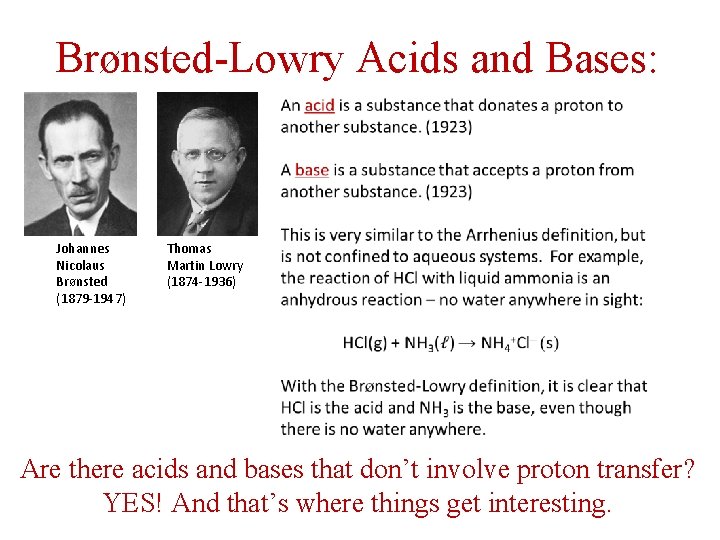
Brønsted-Lowry Acids and Bases: Johannes Nicolaus Brønsted (1879 -1947) Thomas Martin Lowry (1874 -1936) Are there acids and bases that don’t involve proton transfer? YES! And that’s where things get interesting.
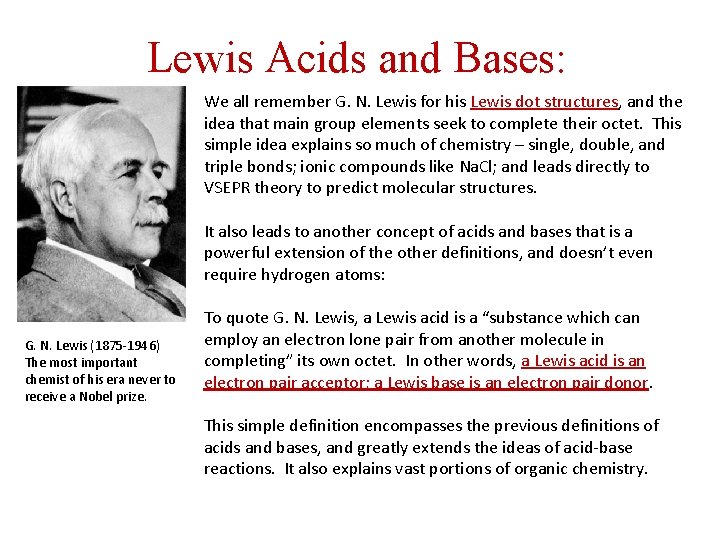
Lewis Acids and Bases: We all remember G. N. Lewis for his Lewis dot structures, and the idea that main group elements seek to complete their octet. This simple idea explains so much of chemistry – single, double, and triple bonds; ionic compounds like Na. Cl; and leads directly to VSEPR theory to predict molecular structures. It also leads to another concept of acids and bases that is a powerful extension of the other definitions, and doesn’t even require hydrogen atoms: G. N. Lewis (1875 -1946) The most important chemist of his era never to receive a Nobel prize. To quote G. N. Lewis, a Lewis acid is a “substance which can employ an electron lone pair from another molecule in completing” its own octet. In other words, a Lewis acid is an electron pair acceptor; a Lewis base is an electron pair donor. This simple definition encompasses the previous definitions of acids and bases, and greatly extends the ideas of acid-base reactions. It also explains vast portions of organic chemistry.

+ H is a Lewis acid: As an example, a bare proton is an incredibly strong Lewis acid. It is such a strong acid that it really doesn’t exist in any realistic chemical environment. It will immediately react with any lone pair it can find: Lewis’ idea that an acid is a substance that reacts with lone pairs to complete its octet is consistent with the Brønsted-Lowry idea that an acid is a proton donor and a base is a proton acceptor. Here H+ is the Lewis acid (lone pair acceptor) and either H 2 O or NH 3 is the Lewis base (lone pair donor). A Lewis base is a strong base if it donates its lone pair quite readily. A Lewis acid is a strong acid if it will attach to just about any lone pair.
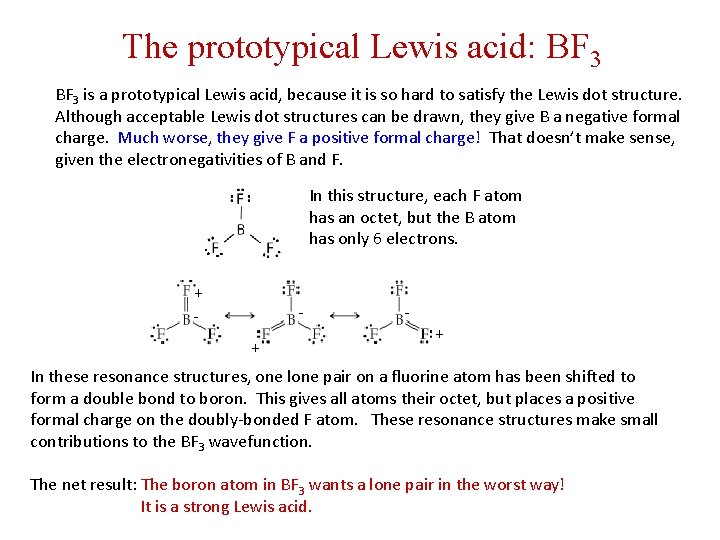
The prototypical Lewis acid: BF 3 is a prototypical Lewis acid, because it is so hard to satisfy the Lewis dot structure. Although acceptable Lewis dot structures can be drawn, they give B a negative formal charge. Much worse, they give F a positive formal charge! That doesn’t make sense, given the electronegativities of B and F. In this structure, each F atom has an octet, but the B atom has only 6 electrons. + - + In these resonance structures, one lone pair on a fluorine atom has been shifted to form a double bond to boron. This gives all atoms their octet, but places a positive formal charge on the doubly-bonded F atom. These resonance structures make small contributions to the BF 3 wavefunction. The net result: The boron atom in BF 3 wants a lone pair in the worst way! It is a strong Lewis acid.
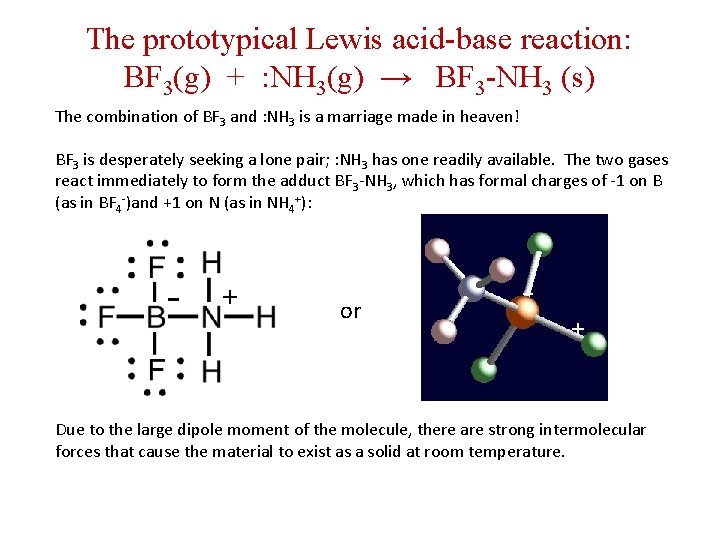
The prototypical Lewis acid-base reaction: BF 3(g) + : NH 3(g) → BF 3 -NH 3 (s) The combination of BF 3 and : NH 3 is a marriage made in heaven! BF 3 is desperately seeking a lone pair; : NH 3 has one readily available. The two gases react immediately to form the adduct BF 3 -NH 3, which has formal charges of -1 on B (as in BF 4 -)and +1 on N (as in NH 4+): - + or - + Due to the large dipole moment of the molecule, there are strong intermolecular forces that cause the material to exist as a solid at room temperature.
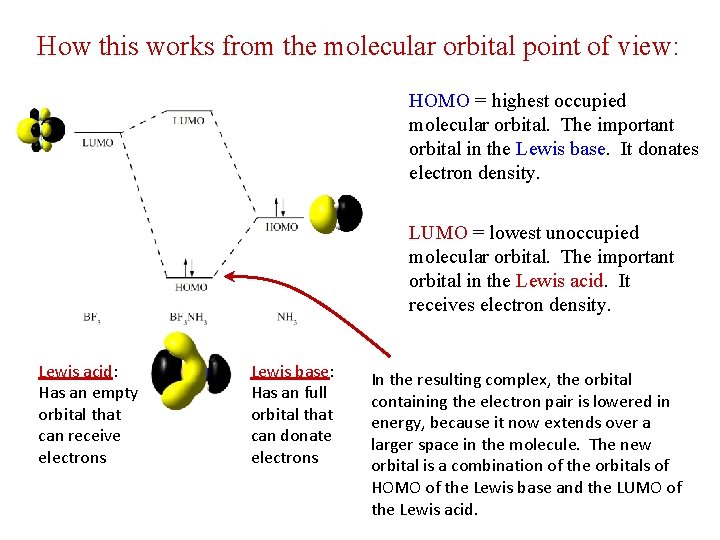
How this works from the molecular orbital point of view: HOMO = highest occupied molecular orbital. The important orbital in the Lewis base. It donates electron density. LUMO = lowest unoccupied molecular orbital. The important orbital in the Lewis acid. It receives electron density. + Lewis acid: Has an empty orbital that can receive electrons Lewis base: Has an full orbital that can donate electrons In the resulting complex, the orbital containing the electron pair is lowered in energy, because it now extends over a larger space in the molecule. The new orbital is a combination of the orbitals of HOMO of the Lewis base and the LUMO of the Lewis acid.
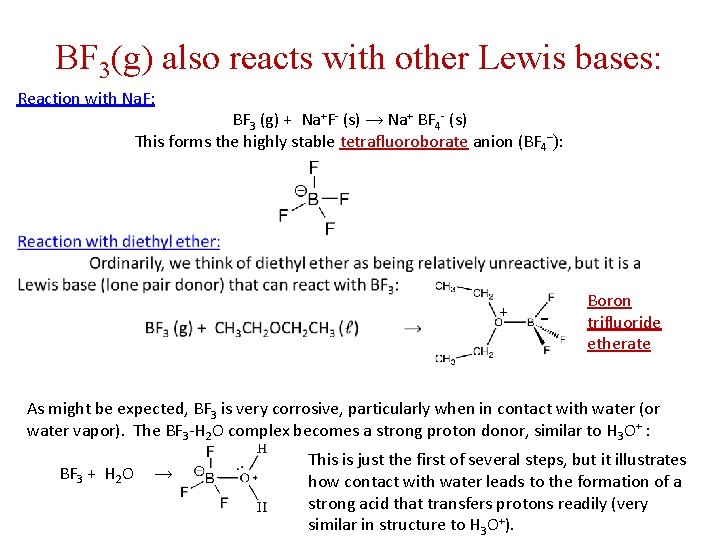
BF 3(g) also reacts with other Lewis bases: Reaction with Na. F: BF 3 (g) + Na+F- (s) → Na+ BF 4 - (s) This forms the highly stable tetrafluoroborate anion (BF 4‒): + - Boron trifluoride etherate As might be expected, BF 3 is very corrosive, particularly when in contact with water (or water vapor). The BF 3 -H 2 O complex becomes a strong proton donor, similar to H 3 O+ : This is just the first of several steps, but it illustrates BF 3 + H 2 O → how contact with water leads to the formation of a strong acid that transfers protons readily (very similar in structure to H 3 O+).
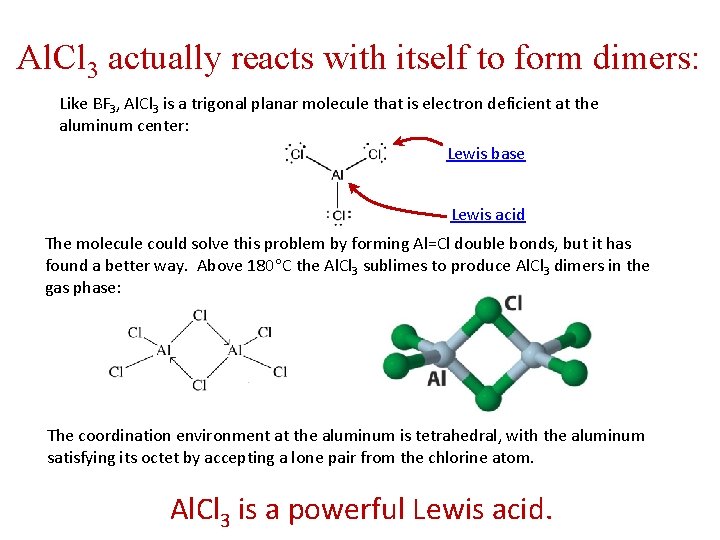
Al. Cl 3 actually reacts with itself to form dimers: Like BF 3, Al. Cl 3 is a trigonal planar molecule that is electron deficient at the aluminum center: Lewis base Lewis acid The molecule could solve this problem by forming Al=Cl double bonds, but it has found a better way. Above 180°C the Al. Cl 3 sublimes to produce Al. Cl 3 dimers in the gas phase: The coordination environment at the aluminum is tetrahedral, with the aluminum satisfying its octet by accepting a lone pair from the chlorine atom. Al. Cl 3 is a powerful Lewis acid.

Lewis acids and bases are crucially important in Organic Chemistry As an example, consider the reaction of t-butyl chloride with Na. OH: First, t-butyl chloride loses Cl‒ to form a t-butyl carbocation (this is a slow step): Electronically, the t-butyl carbocation is just like BF 3. It is a Lewis acid. The central carbon is surrounded by only 6 electrons, and it is desperately seeking a lone pair. If OH‒ is available, it can provide the needed lone pair, allowing the octet rule to be satisfied. + Lewis acid + Lewis base → Acid-base adduct This is an example of what is called an SN 1 reaction (substitution, nucleophilic, type 1). In this type of reaction, the compound first dissociates then a nucleophile (another word for a Lewis base) attacks the carbocation.
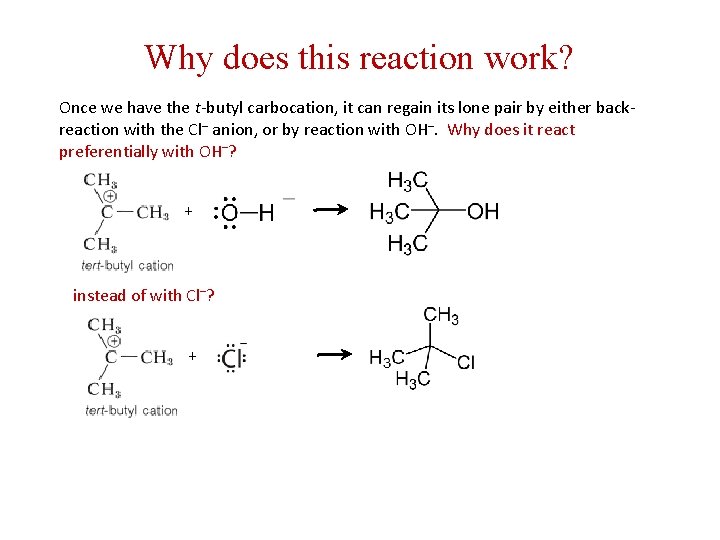
Why does this reaction work? Once we have the t-butyl carbocation, it can regain its lone pair by either backreaction with the Cl‒ anion, or by reaction with OH‒. Why does it react preferentially with OH‒? + instead of with Cl‒? +
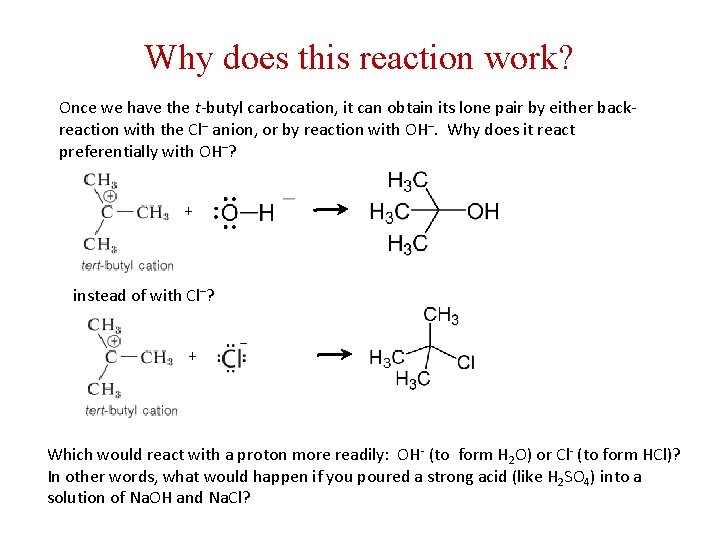
Why does this reaction work? Once we have the t-butyl carbocation, it can obtain its lone pair by either backreaction with the Cl‒ anion, or by reaction with OH‒. Why does it react preferentially with OH‒? + instead of with Cl‒? + Which would react with a proton more readily: OH- (to form H 2 O) or Cl- (to form HCl)? In other words, what would happen if you poured a strong acid (like H 2 SO 4) into a solution of Na. OH and Na. Cl?

Why does this reaction work? Once we have the t-butyl carbocation, it can obtain its lone pair by either backreaction with the Cl‒ anion, or by reaction with OH‒. Why does it react preferentially with OH‒? + instead of with Cl‒? + Which would react with a proton more readily: OH- (to form H 2 O) or Cl- (to form HCl)? What would happen if you poured a strong acid (like H 2 SO 4) into a solution of Na. OH and Na. Cl? The acid reacts with the stronger base (OH-), not the weaker one (Cl-)! The same is true for the Lewis acid, t-butyl carbocation. It reacts with OH-, not Cl-.
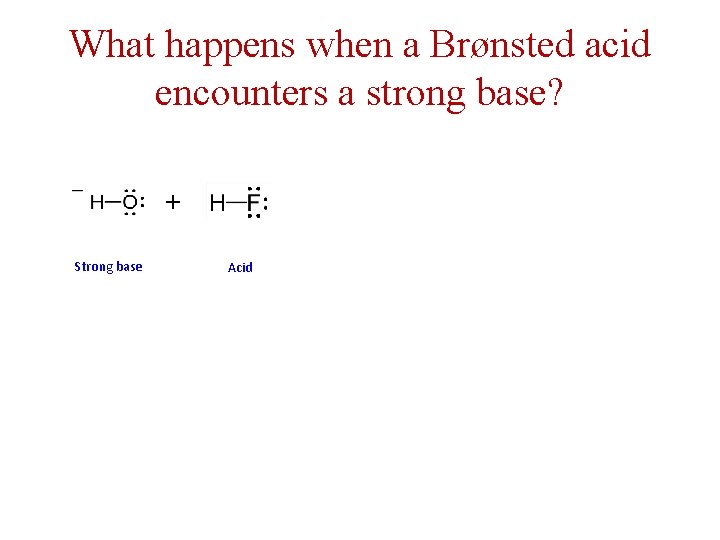
What happens when a Brønsted acid encounters a strong base? + Strong base Acid
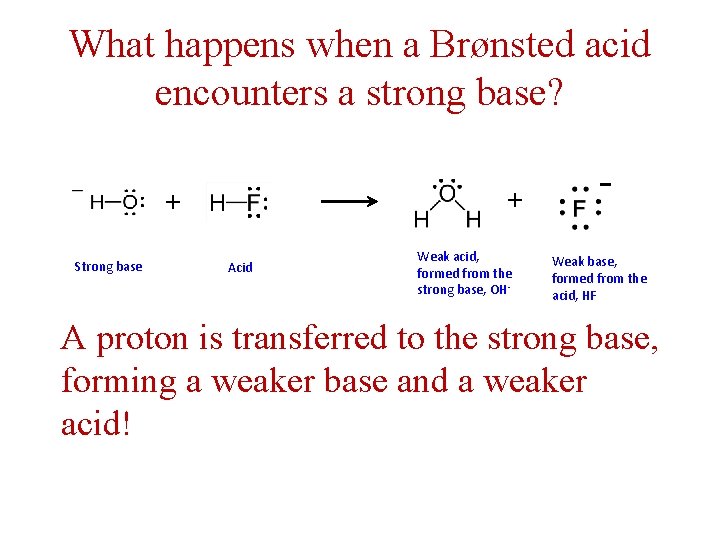
What happens when a Brønsted acid encounters a strong base? + + Strong base Acid Weak acid, formed from the strong base, OH- Weak base, formed from the acid, HF A proton is transferred to the strong base, forming a weaker base and a weaker acid!
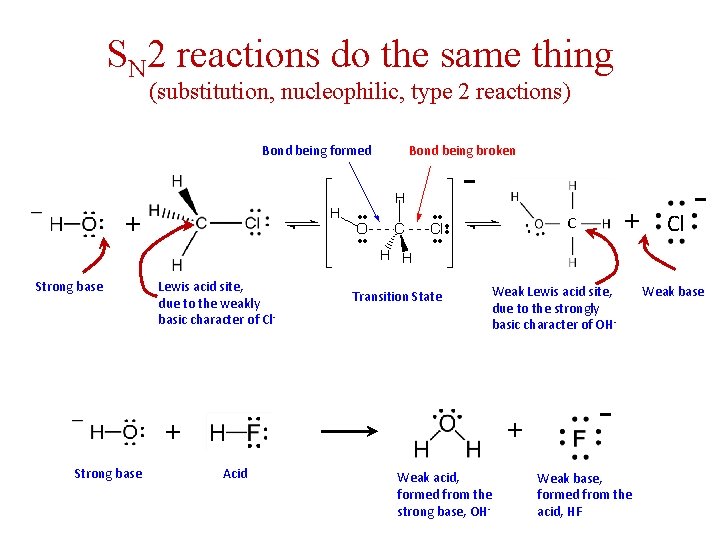
SN 2 reactions do the same thing (substitution, nucleophilic, type 2 reactions) Bond being formed Bond being broken - + Strong base Lewis acid site, due to the weakly basic character of Cl- Transition State Weak Lewis acid site, due to the strongly basic character of OH- + + Strong base + C Acid Weak acid, formed from the strong base, OH- Weak base, formed from the acid, HF Cl Weak base

What makes a good leaving group in an SN 2 reaction? A weak base. Bond being formed Bond being broken - + Strong base Lewis acid, due to the weakly basic character of Cl- Transition State Weak Lewis acid, due to the strongly basic character of OH- + + Strong base + C Acid Weak acid, formed from the strong base, OH- Weak base, formed from the acid, HF Cl Weak base
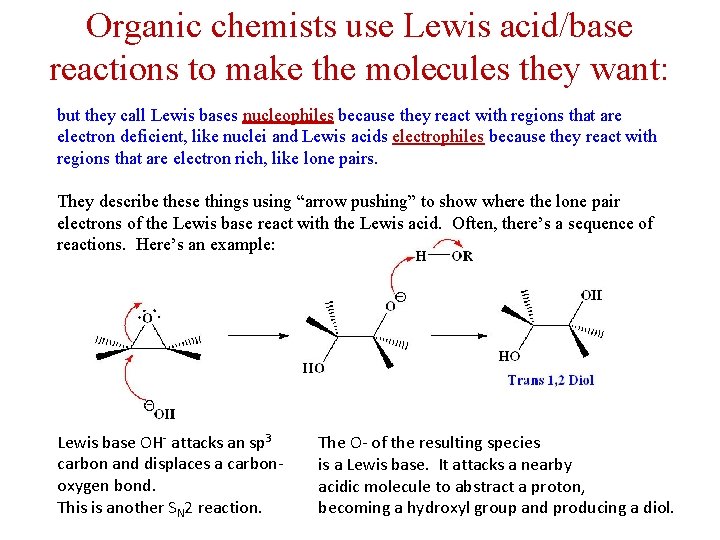
Organic chemists use Lewis acid/base reactions to make the molecules they want: but they call Lewis bases nucleophiles because they react with regions that are electron deficient, like nuclei and Lewis acids electrophiles because they react with regions that are electron rich, like lone pairs. They describe these things using “arrow pushing” to show where the lone pair electrons of the Lewis base react with the Lewis acid. Often, there’s a sequence of reactions. Here’s an example: Lewis base OH- attacks an sp 3 carbon and displaces a carbonoxygen bond. This is another SN 2 reaction. The O- of the resulting species is a Lewis base. It attacks a nearby acidic molecule to abstract a proton, becoming a hydroxyl group and producing a diol.
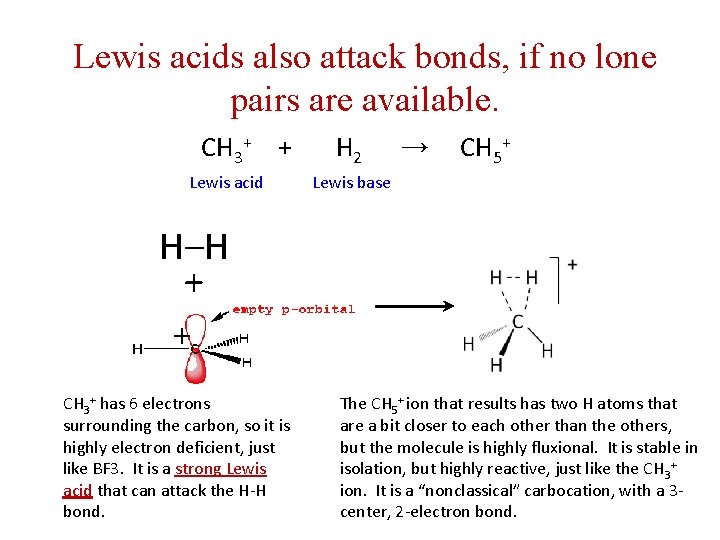
Lewis acids also attack bonds, if no lone pairs are available. CH 3+ + H 2 → CH 5+ Lewis acid Lewis base H‒H + + CH 3+ has 6 electrons surrounding the carbon, so it is highly electron deficient, just like BF 3. It is a strong Lewis acid that can attack the H-H bond. The CH 5+ ion that results has two H atoms that are a bit closer to each other than the others, but the molecule is highly fluxional. It is stable in isolation, but highly reactive, just like the CH 3+ ion. It is a “nonclassical” carbocation, with a 3 center, 2 -electron bond.
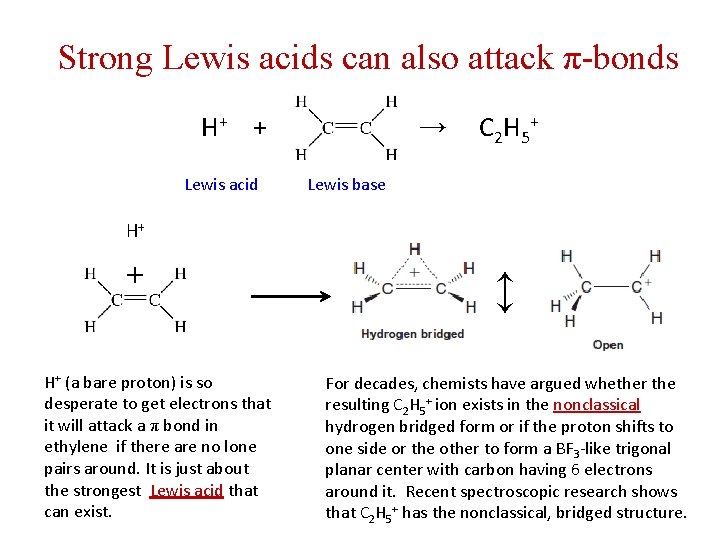
Strong Lewis acids can also attack π-bonds H+ + → C 2 H 5+ Lewis acid Lewis base H+ + H+ (a bare proton) is so desperate to get electrons that it will attack a π bond in ethylene if there are no lone pairs around. It is just about the strongest Lewis acid that can exist. ↕ For decades, chemists have argued whether the resulting C 2 H 5+ ion exists in the nonclassical hydrogen bridged form or if the proton shifts to one side or the other to form a BF 3 -like trigonal planar center with carbon having 6 electrons around it. Recent spectroscopic research shows that C 2 H 5+ has the nonclassical, bridged structure.
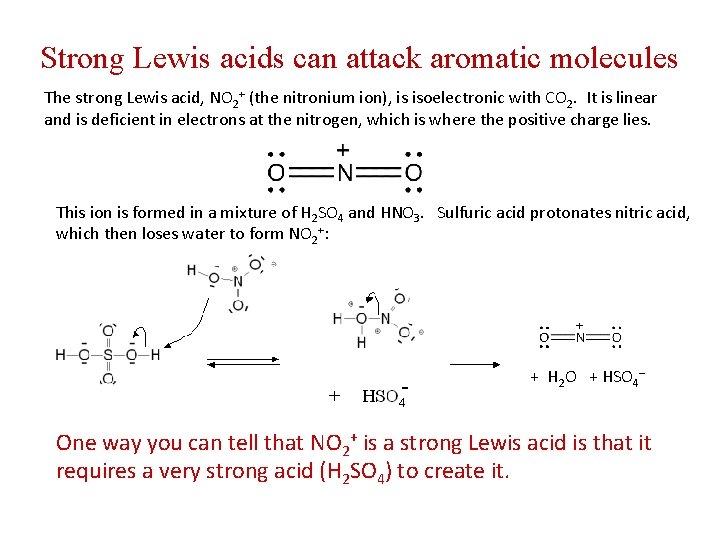
Strong Lewis acids can attack aromatic molecules The strong Lewis acid, NO 2+ (the nitronium ion), is isoelectronic with CO 2. It is linear and is deficient in electrons at the nitrogen, which is where the positive charge lies. This ion is formed in a mixture of H 2 SO 4 and HNO 3. Sulfuric acid protonates nitric acid, which then loses water to form NO 2+: + H 2 O + HSO 4‒ One way you can tell that NO 2+ is a strong Lewis acid is that it requires a very strong acid (H 2 SO 4) to create it.
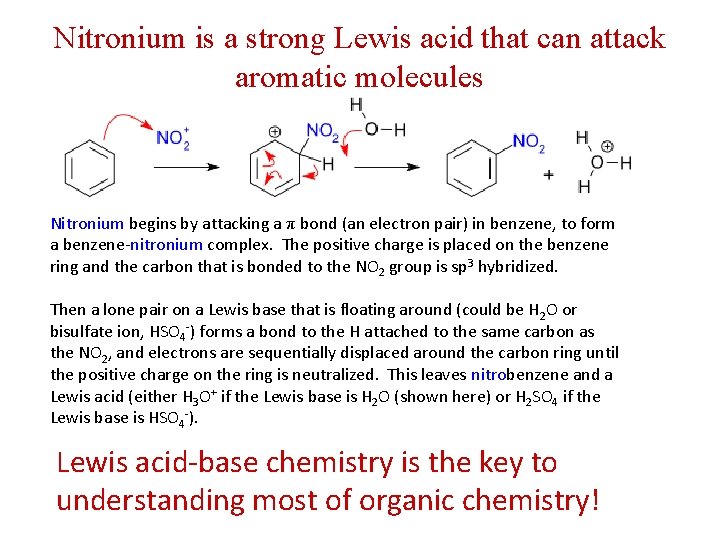
Nitronium is a strong Lewis acid that can attack aromatic molecules Nitronium begins by attacking a π bond (an electron pair) in benzene, to form a benzene-nitronium complex. The positive charge is placed on the benzene ring and the carbon that is bonded to the NO 2 group is sp 3 hybridized. Then a lone pair on a Lewis base that is floating around (could be H 2 O or bisulfate ion, HSO 4 -) forms a bond to the H attached to the same carbon as the NO 2, and electrons are sequentially displaced around the carbon ring until the positive charge on the ring is neutralized. This leaves nitrobenzene and a Lewis acid (either H 3 O+ if the Lewis base is H 2 O (shown here) or H 2 SO 4 if the Lewis base is HSO 4 -). Lewis acid-base chemistry is the key to understanding most of organic chemistry!
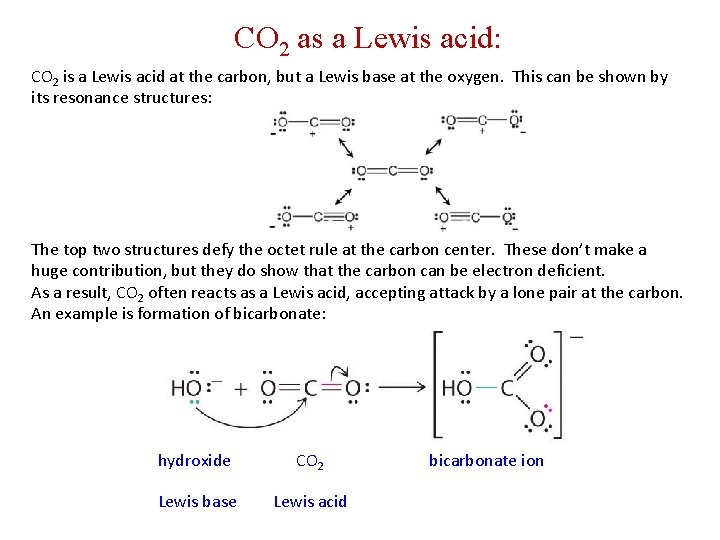
CO 2 as a Lewis acid: CO 2 is a Lewis acid at the carbon, but a Lewis base at the oxygen. This can be shown by its resonance structures: The top two structures defy the octet rule at the carbon center. These don’t make a huge contribution, but they do show that the carbon can be electron deficient. As a result, CO 2 often reacts as a Lewis acid, accepting attack by a lone pair at the carbon. An example is formation of bicarbonate: hydroxide CO 2 bicarbonate ion Lewis base Lewis acid
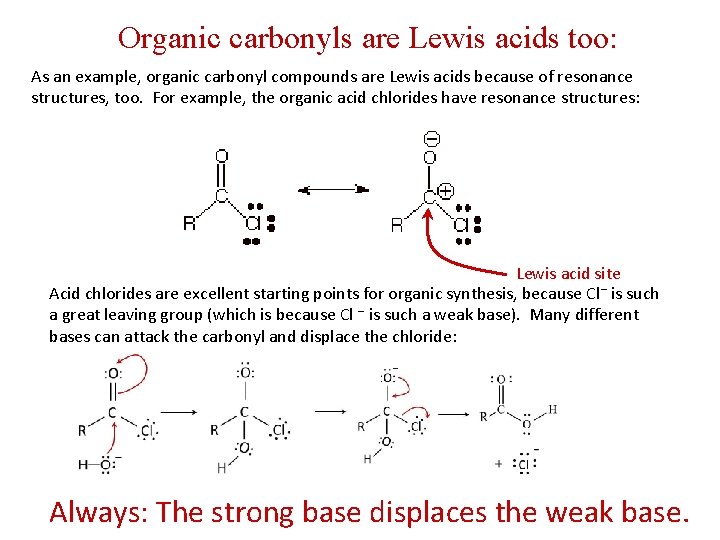
Organic carbonyls are Lewis acids too: As an example, organic carbonyl compounds are Lewis acids because of resonance structures, too. For example, the organic acid chlorides have resonance structures: Lewis acid site Acid chlorides are excellent starting points for organic synthesis, because Cl ‒ is such a great leaving group (which is because Cl ‒ is such a weak base). Many different bases can attack the carbonyl and displace the chloride: Always: The strong base displaces the weak base.
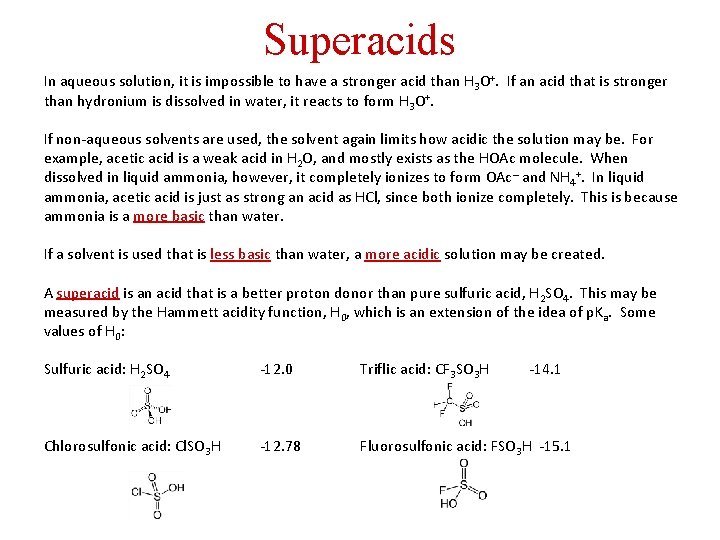
Superacids In aqueous solution, it is impossible to have a stronger acid than H 3 O+. If an acid that is stronger than hydronium is dissolved in water, it reacts to form H 3 O+. If non-aqueous solvents are used, the solvent again limits how acidic the solution may be. For example, acetic acid is a weak acid in H 2 O, and mostly exists as the HOAc molecule. When dissolved in liquid ammonia, however, it completely ionizes to form OAc ‒ and NH 4+. In liquid ammonia, acetic acid is just as strong an acid as HCl, since both ionize completely. This is because ammonia is a more basic than water. If a solvent is used that is less basic than water, a more acidic solution may be created. A superacid is an acid that is a better proton donor than pure sulfuric acid, H 2 SO 4. This may be measured by the Hammett acidity function, H 0, which is an extension of the idea of p. Ka. Some values of H 0: Sulfuric acid: H 2 SO 4 -12. 0 Triflic acid: CF 3 SO 3 H -14. 1 Chlorosulfonic acid: Cl. SO 3 H -12. 78 Fluorosulfonic acid: FSO 3 H -15. 1
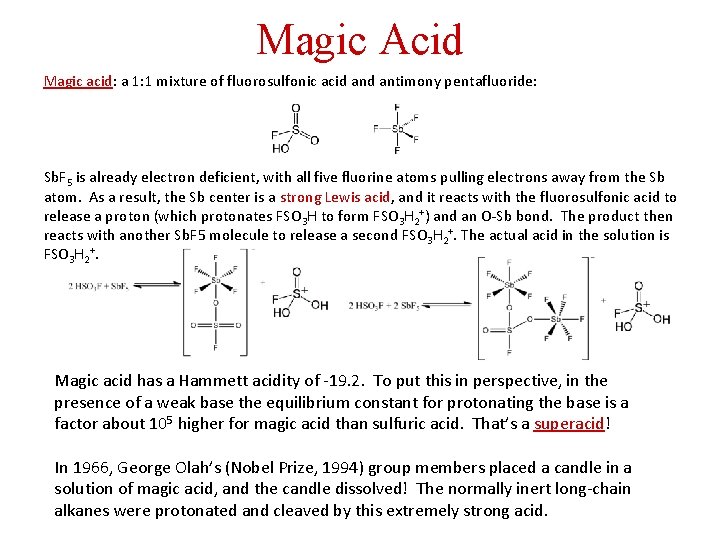
Magic Acid Magic acid: a 1: 1 mixture of fluorosulfonic acid antimony pentafluoride: Sb. F 5 is already electron deficient, with all five fluorine atoms pulling electrons away from the Sb atom. As a result, the Sb center is a strong Lewis acid, and it reacts with the fluorosulfonic acid to release a proton (which protonates FSO 3 H to form FSO 3 H 2+) and an O-Sb bond. The product then reacts with another Sb. F 5 molecule to release a second FSO 3 H 2+. The actual acid in the solution is FSO 3 H 2+. Magic acid has a Hammett acidity of -19. 2. To put this in perspective, in the presence of a weak base the equilibrium constant for protonating the base is a factor about 105 higher for magic acid than sulfuric acid. That’s a superacid! In 1966, George Olah’s (Nobel Prize, 1994) group members placed a candle in a solution of magic acid, and the candle dissolved! The normally inert long-chain alkanes were protonated and cleaved by this extremely strong acid.
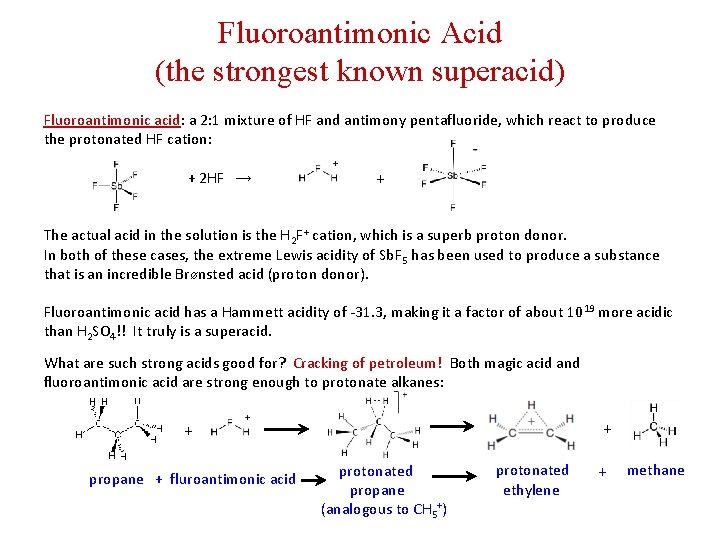
Fluoroantimonic Acid (the strongest known superacid) Fluoroantimonic acid: a 2: 1 mixture of HF and antimony pentafluoride, which react to produce the protonated HF cation: + 2 HF → + The actual acid in the solution is the H 2 F+ cation, which is a superb proton donor. In both of these cases, the extreme Lewis acidity of Sb. F 5 has been used to produce a substance that is an incredible Brønsted acid (proton donor). Fluoroantimonic acid has a Hammett acidity of -31. 3, making it a factor of about 1019 more acidic than H 2 SO 4!! It truly is a superacid. What are such strong acids good for? Cracking of petroleum! Both magic acid and fluoroantimonic acid are strong enough to protonate alkanes: + + propane + fluroantimonic acid protonated propane (analogous to CH 5+) protonated ethylene + methane
Thanks for listening! Anytime you’d like to ask me a question: morse@chem. utah. edu This and all previous presentations can be found at my website: https: //chem. utah. edu/directory/morse/research-group/ap_chemistry_powerpoints. php
- Slides: 29