
Presented by Lionel Williamson Aspergillus species Kingdom Fungi
Presented by Lionel Williamson
Aspergillus species Ú Kingdom: Fungi Phylum: Ascomycota Order: Eurotiales Family: Trichocomaceae Genus gi: Aspergillus Ú Aspergillus is a filamentous, ubiquitous fungus found in nature. It is commonly isolated from soil, plant debris, and indoor air environments.
Types of Aspergillus Ú The genus Aspergillus includes over 185 species. Around 20 species have so far been reported as causative agents of opportunistic infections in man Ú A. flavus produces aflotoxins Ú A. nidulans produces cutaneous aspergillosis Ú A. oryzae used to make soy sauce, and sake
A. fumigatus Ú Is the second most common opportunistic fungal infection (Candida) Ú This species is the most common agent of aspergillosis in both man and animals. It is a thermophilic species (growth at 40°C and beyond) that may be extremely angioinvasive, particularly in the compromised patient
Key words Ú T helper 1 - TH 1 Cytokine response that deals with pro inflammatory response Ú T helper 2 - TH 2 Cytokine response that deals with antiinflammatory response Ú PBMC are macrophages and are involved with the innate immune response Ú Innate immunity refers to antigen-nonspecific defense mechanisms that a host uses immediately or within several hours after exposure to almost any antigen. This is the immunity one is born with and is the initial response by the body to eliminate microbes and prevent infection.
Cytokines Ú Proteins produced by white blood cells that act as chemical messengers between cells. They can stimulate or inhibit the growth and activity of various immune cells Ú Pro-inflammatory response ( TNF, IL-1) Ú Anti-inflammatory response (IL-10)
Structure of Aspergillus Ú Conidia are asexual spores that grown on elaborate structures called conidiophores. These are usually stalked, lifting the conidia off the substrate for better dispersal and to avoid microscopic grazing animals. They often produce hundreds or thousands of conidia at a time Ú Hyphae A hypha (plural hyphae) is a long, branching filament that, with other hyphae, forms the feeding thallus of a fungus called the mycelium. A typical hypha consists of a tubular wall, usually made of chitin, which surrounds, supports, and protects the cells that compose a hypha. For most fungi, a cell within a hyphal filament is separated from other cells by internal crosswalls called septa
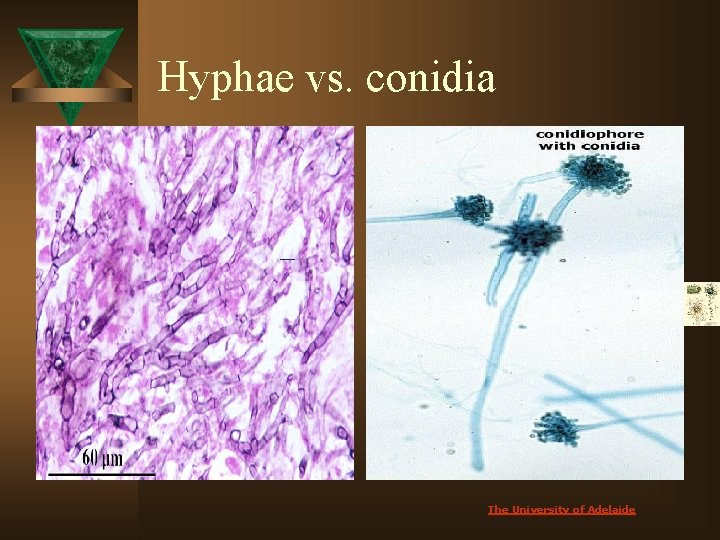
Hyphae vs. conidia The University of Adelaide
Life cycle of Aspergillus Ú A fungus begins its existence as an independent biont as some sort of propagule, most often a spore. From the spore, the fungus grows in a thread-like, branching formation known as a hypha. Ú The hypha grow and intertwine and form mycelia which become the body of the fungus.
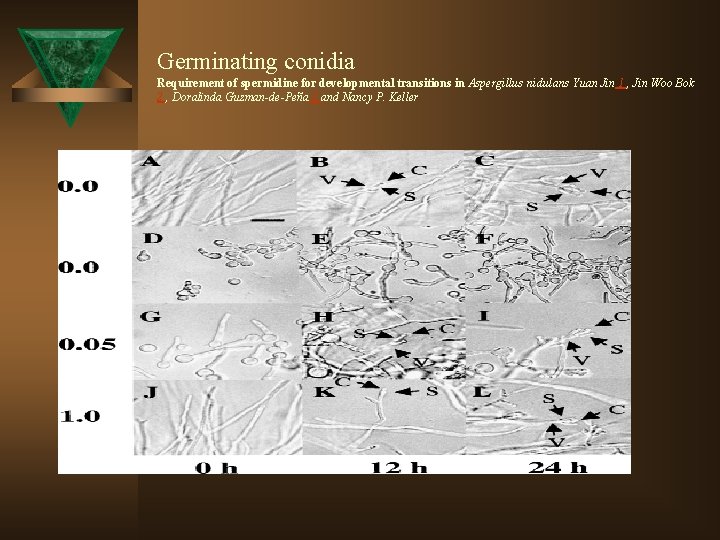
Germinating conidia Requirement of spermidine for developmental transitions in Aspergillus nidulans Yuan Jin 1 , Jin Woo Bok 2 , Doralinda Guzman-de-Peña 3 and Nancy P. Keller
Toll like receptors Ú Are pattern-recognition receptors believed to play a role in innate immunity Ú The receptor was first isolated from Drosophila as a gene required for ontogenesis and antifungal resistance Ú There have been several TLR’s isolated from humans
Types of TLR’s Ú TLR 2 recognizes peptidoglycan that are associated with gram positive bacteria Ú TLR 4 recognizes LPS associated with gram negative bacteria Ú TLR 5 recognizes flagella Ú TLR 9 recognizes bacterial DNA
Experiment 1 Ú Challenged mouse macrophages with conidia or hyphae from A. fumigatus Ú They found that maximal cytokine release induced by stimulation with 10^7 cfu Ú Assessed TLR 4’s role by using a TLR 4 deficient mutant compared to a control Ú Assessed TLR 2’s role by using a TLR 2 deficient mutant compared to a control
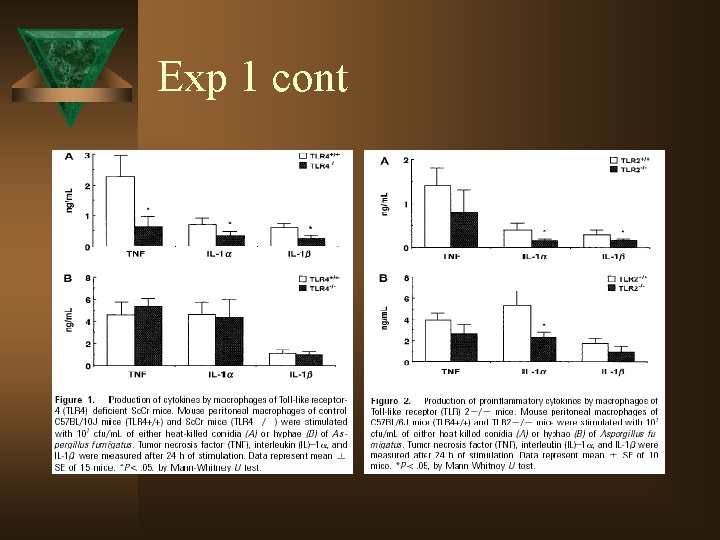
Exp 1 cont
Experiment 2 Ú To prove that TLR 4 was involved in conidia and not hyphae recognition Ú Using a NF-k. B reporter plasmid that drives CD 25 expression Ú Used a cell line (3 E 10) that expressed TLR 4 but not TLR 2 Ú Stimulated the cells with LPS (TLR 4 antagonist) Pam 3 cys (TLR 2 antagonist) Ú Then they transfected c. DNA for TLR 2
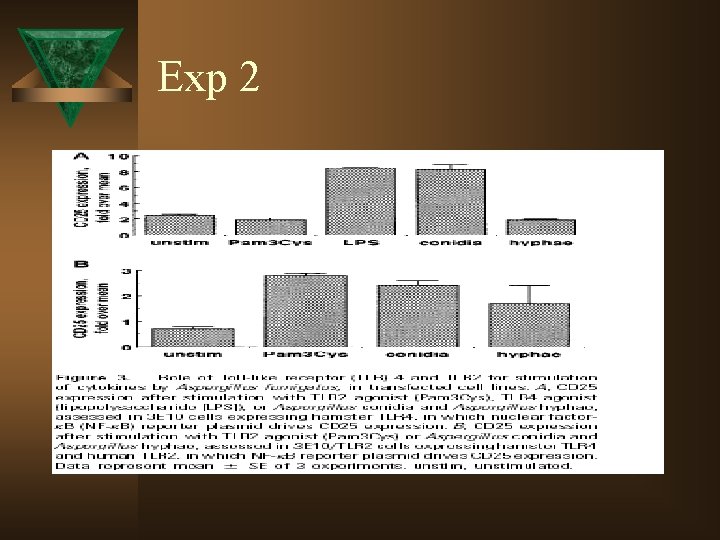
Exp 2
Experiment 3 Ú They wanted to see what roles TLR 4 and TLR 2 played on the Pro-inflammatory response Ú Used PBMC’s with antibodies blocking the TLR 4 then stimulating with 10^7 cfu Ú The same experiment was repeated with TLR 2
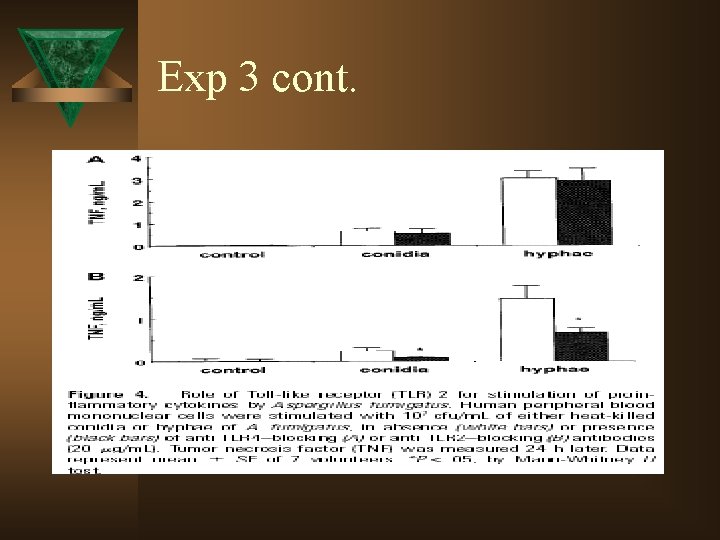
Exp 3 cont.
Experiment 4 Ú Which TLR stimulated IL-10 Ú Recent data suggests that TLR 2 stimulates TH-2 response and TLR 4 stimulates a TH-1 response Ú Role of IL-10 in invasive aspergillosis: increased resistance of IL-10 gene knockout mice to lethal systemic aspergillosis K. V. Clemons, G. Grunig* , R. A. Sobel , L. F. Mirels, D. M. Rennick* & D. A. Stevens
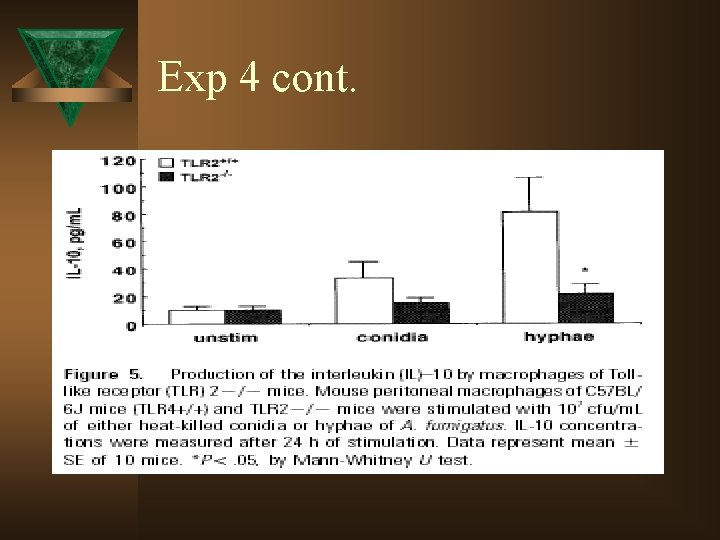
Exp 4 cont.
My conclusion Ú I think that what happens is that Aspergillus conidia gets into the body and meets the macrophages that expresses TLR 4. This causes an increase of expression of IL-1 and TNF, this kills the most of the fungus. Ú The fungus counteracts this by germinating from the conidia to the hyphae forms. TLR 4 does not recognize the new form and the hyphae grows. In a normal immune system TLR 2 which has 2 functions (pro-inflammatory and anti-inflammatory) with the help of the cell mediated response the body is able to fight off the fungal infection
Immunocompromised Ú The same things occur but there is a diminished cell mediated response due to the disease process Ú TLR 2 is releasing both pro-inflammatory and an Anti-inflammatory response Ú This decreases the destruction of the hyphae and they continue to grow. Ú Where they form mycelia and cause Aspergillosis.
Aspergillosis Ú - Pulmonary aspergillosis 1 - CNS aspergillosis - Sinonasal aspergillosis - Osteomyelitis - Endophthalmitis - Endocarditis - Renal abscesses - Cutaneous Ú Why do you think pulmonary aspergillosis is the number one form?
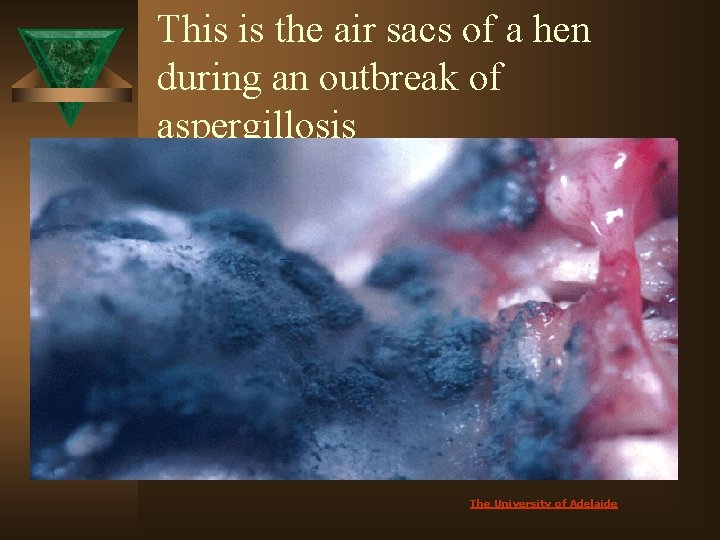
This is the air sacs of a hen during an outbreak of aspergillosis The University of Adelaide
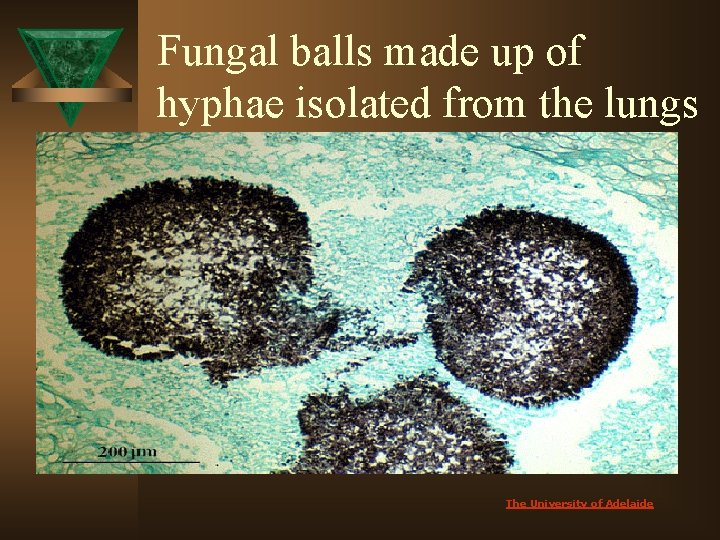
Fungal balls made up of hyphae isolated from the lungs The University of Adelaide
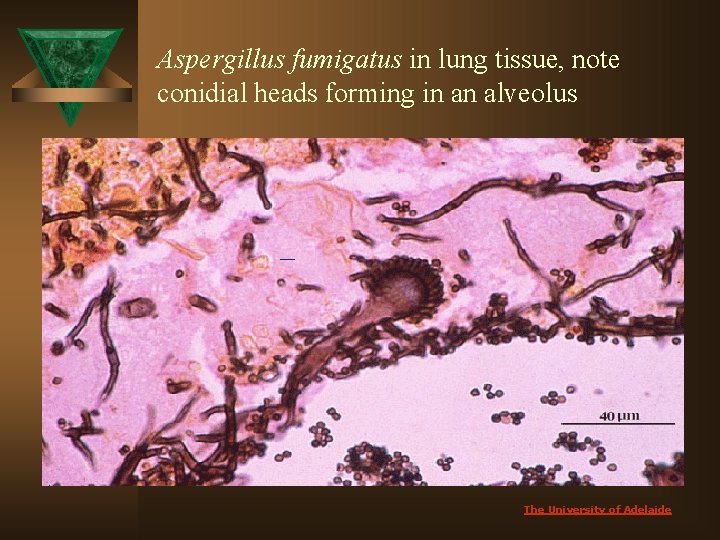
Aspergillus fumigatus in lung tissue, note conidial heads forming in an alveolus The University of Adelaide
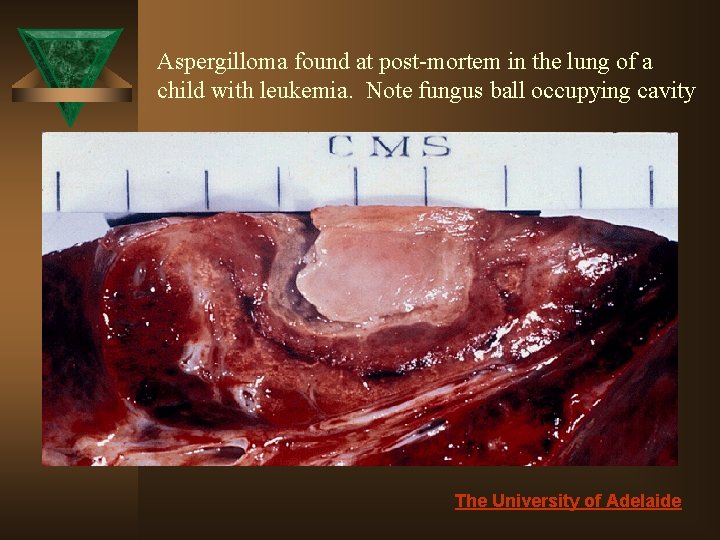
Aspergilloma found at post-mortem in the lung of a child with leukemia. Note fungus ball occupying cavity The University of Adelaide

I’m so glad we had this time together
- Slides: 28