
Presented by Jeremiah W Doyle IV Esq Senior
Presented by: Jeremiah W. Doyle IV, Esq. Senior Wealth Strategist 2019 Heckerling Update: Five Days in 60 Minutes
Fundamentals Session — Basis
Fundamentals Session — Zaritsky and Law Basis • Discussion of background on various rules for determining basis • Income tax planning more important for most than estate tax planning • Community property gets step-up in basis for both deceased spouse and surviving spouse’s interest – Alaska, South Dakota and Tennessee have elective community property statutes • Portability — gives step up in basis at death of both spouses • Remember the basis consistency rules under Section 1014 and Section 6035. Must complete Form 8971. – Awaiting final regulations on basis consistency rules 3
Fundamentals Session — Zaritsky and Law Basis PLAN TO ACHIEVE A STEP-IN BASIS AT DEATH — ALTERNATIVES: • Upstream planning/gift to donee with short life expectancy but beware of Section 1014(e) • Independent trustee with flexible trust distribution provisions — independent trustee distributes low basis assets to beneficiaries, use trust protectors with discretionary powers • Give beneficiary contingent general powers of appointment (GPOA) especially formula GPOA with refinements. Alternatively, trust could provide that a trust protector has the power to grant a GPOA to a trust beneficiary. • Use Delaware tax trap 4
Zaritsky and Law — Basis General Power of Appointment General power of appointment (GPOA) causes inclusion in the gross estate. Section 2041. • Consider formula GPOA i. e. , a GPOA up to the amount that would not generate Federal estate taxes in the beneficiary’s estate (less, for example, $10, 000 to avoid having to file a federal estate tax return) – Contingent on surviving beneficiary having unused applicable exclusion amount – Permit exercise with consent of a nonadverse party to minimize risk that beneficiary will actually exercise the power to divert the assets – Formula should be for the lesser of the available estate or GST exemption. Reason: if parent’s remaining GST exemption is less than their estate tax exemption, it could result in a mixed inclusion ratio. – Sample formula provisions included in written material 5 • Further refinement: – Applies to assets with most appreciation – Applies to assets subject to tax at highest income tax rate e. g, collectibles – Applies to assets that will be sold earliest
Zaritsky and Law — Basis General Power of Appointment CONCLUSION Determine which assets are going to need a step-up in basis and when the basis step-up is going to be needed, and then create a plan that maximizes the basis opportunities 6

Recent Developments
Estate and Gift Tax — 2019 Inflation Adjustments Rev. Proc. 2018 -57 • Estate, gift and GST exemption — $11, 400, 000 – Review formula clauses. Formula clauses that tie distributions at death to trusts (exemption trust, GST trust) based upon the amount of the estate tax or GST tax exemption available at death may result in funding such trusts with larger amounts than intended. • Gift tax annual exclusion — $15, 000 • Gift tax annual exclusion for gifts to non-citizen spouse — $155, 000 • Income taxation of estates and trusts — maximum tax rate reached at taxable income of $12, 750 for ordinary income, $12, 950 for long-term capital gains. 8
Estate and Gift Tax — 2019 Inflation Adjustments • “Bluebook” on TCJA issued in December, 2018 • Footnote 372 of “Bluebook” indicates that new, higher, generation skipping tax exemption can be allocated to prior generation skipping trusts. 9
Clawback Prop. Reg. 2010 -1(c) • IRS issued proposed regulations (REG -106706 -18) on November 20 eliminating “clawback” for estate and gift tax purposes • The proposed regulations look at four situations that may raise issues about the use of the basic exclusion amount (BEA) but states that only one requires regulatory changes. Hearing on the proposed regulations is scheduled for March, 2019. • The proposed regulations do not address whether gifts during the increased exemption (prior to 2026) “come off the top” or “off the bottom” – Consider not electing to split gifts with spouse to preserve the other spouse’s BEA 10
Clawback • In simple terms, the proposed regulation allows the estate to compute its estate tax credit using the higher of the basic exclusion amount (BEA) applicable to gifts made during life or the BEA applicable on the date of death. • Clients should consider making lifetime gifts to lock in the use of the increased exemption • Gifts may be made outright, to a irrevocable trust, especially a grantor trust, or in other forms such as the forgiveness of intra-family loans • Gifts of cash or high basis assets are optimal given that assets with a low basis get a new cost basis equal to fair market value as of decedent’s date of death 11
Fielding v. Commissioner of Revenue 2017 Wl 2484593 (Minn. Tax Ct) • State can’t tax the worldwide income of an irrevocable inter vivos trust based solely on the fact that trust’s grantor was a Minnesota resident at the time the trust was created. 12
Kaestner v. North Carolina Department of Revenue 814 SE 2 d 43 (N. C. June 8, 2018) • Court upholds lower court decision that North Carolina statute taxing a trust’s income based solely on the residence of the beneficiaries in North Carolina violated the due process clause of the U. S. Constitution. • January 12, 2019 — USSC agreed to hear appeal 13
South Dakota v. Wayfair 585 U. S. __ (2018) • Sales tax case • Must have “substantial nexus” but physical presence not required • Overrules Quill 14
Cahill v. Commissioner T. C. Memo. 2018 -84 (June 18, 2018) • IRS Prevails in Summary Judgment Motion Regarding Application of Sections 2036, 2038 and 2703 to the Value of split-dollar Arrangement in Decedent’s Gross Estate • Intergenerational split dollar case – A split dollar arrangement is an agreement by which the cost of life insurance is split between the insured another party 15
Cahill v. Commissioner T. C. Memo. 2018 -84 (June 18, 2018) • This case involved the payment of premiums by a member of one generation for insurance on the life or lives of members of a younger generation • Upon the death of an insured, a portion of the death benefit equal to the greater of the total premiums paid or the cash surrender value of the policy immediately before the insured’s death would be payable to the trust that paid the premiums. • Desired result: – Because the insureds are in a lower generation than the grantor/premium payor, the insured’s deaths are actuarially likely to occur long after the grantor’s death meaning that the value of the right of reimbursement to the grantor/premium payor would be significantly discounted. 16
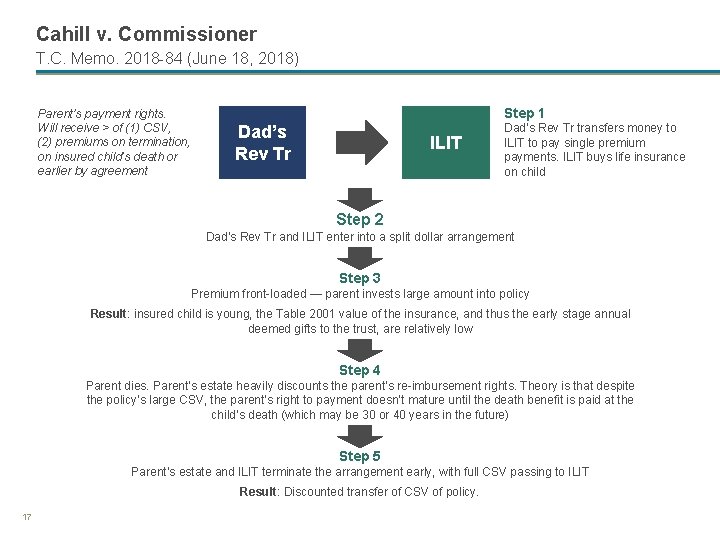
Cahill v. Commissioner T. C. Memo. 2018 -84 (June 18, 2018) Parent’s payment rights. Will receive > of (1) CSV, (2) premiums on termination, on insured child’s death or earlier by agreement Step 1 Dad’s Rev Tr ILIT Dad’s Rev Tr transfers money to ILIT to pay single premium payments. ILIT buys life insurance on child Step 2 Dad’s Rev Tr and ILIT enter into a split dollar arrangement Step 3 Premium front-loaded — parent invests large amount into policy Result: insured child is young, the Table 2001 value of the insurance, and thus the early stage annual deemed gifts to the trust, are relatively low Step 4 Parent dies. Parent’s estate heavily discounts the parent’s re-imbursement rights. Theory is that despite the policy’s large CSV, the parent’s right to payment doesn’t mature until the death benefit is paid at the child’s death (which may be 30 or 40 years in the future) Step 5 Parent’s estate and ILIT terminate the arrangement early, with full CSV passing to ILIT Result: Discounted transfer of CSV of policy. 17
Cahill v. Commissioner T. C. Memo. 2018 -84 (June 18, 2018) • IRS claims the value of the policies was the CSV of $9. 6 million • Estate claimed that Sections 2036(a)(2), 2038(a)(1) and 2703(a)(1) and (2) do not apply and the split-dollar regulations valuing split-dollar arrangements do not apply in valuing Dad’s interest in the split dollar arrangements • Tax Court held economic benefit regime applies under the split-dollar regulations because the only economic benefit provided to MB Trust was current life protection. Even though the regulations apply for gift tax purposes, the Tax Count found them to applicable for estate tax purposes as well. • Tax Court found the CSV was includible in Dad’s gross estate as the rights to terminate and recover at least the CSV were clearly rights, held in conjunction with another person (the MB Trust) includible under Sections 2036(a)(2) and 2038(a)(1). 18
Cahill v. Commissioner T. C. Memo. 2018 -84 (June 18, 2018) • Tax Court found that the exceptions for full and adequate consideration under Sections 2036(a)(2) and 2038(a)(1) was a factual issue which would preclude granting the summary judgment motion in favor of the estate. • Tax Court also found that Section 2703(a)(1) and (2) applied so that the termination agreement should be disregarded in valuing the Survivor Trust’s rights in the split-dollar arrangements • On December 12, 2018, in a stipulated decision, the Tax Court approved a settlement of the case. The executor reportedly accepted the IRS value of the reimbursement right as being $9, 611, 624 along with a 20% accuracy-related penalty 19
Cahill v. Commissioner T. C. Memo. 2018 -84 (June 18, 2018) As a result of Cahill, the Tax Court may have eliminated the transfer tax benefit thought to be available from intergenerational split-dollar arrangements using the economic benefits regime; i. e. , the discount in the CSV of the policies in the parent’s estate. 20
Morrissette v. Commissioner Tax Court Order, Docket No. 4415 -14 (June 21, 2018) • After Tax Court 2016 opinion, executor filed a petition for partial summary judgment claiming Section 2703 did not apply for valuation purposes • Section 2703(a)(2) provides that the value of property is determined without regard to any restriction on the right to sell or use property. The value of any property transferred between family members is determined without regard to any restrictions on the sale of use of property. • In this case, the split-dollar arrangement could be terminated only upon the mutual agreement of Mom’s trust and the Dynasty trusts (termination restriction) • Tax Court denied partial summary judgment holding that the termination restriction was subject to Section 2703(a)(2). • Unless settled, the case will proceed to trial on valuation issue scheduled for May 6, 2019. 21
Green v. U. S. 880 F. 3 d 519 (10 th Cir. January 12, 2018) Tenth Circuit Overrules District Court and Holds That Trust’s Charitable Deduction Is Limited to Adjusted Basis of Contributed Property 22
CCA 201747005 — No Section 642(c) Deduction for Modified Trust • Trust modified pursuant to state court order not entitled to Section 642(c) charitable deduction for payments to two private foundations because payments were not made “pursuant to the terms of the governing instrument” • Reaffirms position IRS took in CCA 201651013 • Trust also not entitled to income distribution deduction under Section 661 — Section 642(c) is the exclusive method for an estate or trust to claim an income tax charitable deduction • Charitable deduction is not made “pursuant to the terms of the governing instrument” when the purpose for modifying the trust does not initiate from a conflict • Here the modification was to obtain an economic benefit — a tax deduction 23
PLR 201825003 — Gift of Remainder Interest in Artwork to Charity • Donor transferred title to artwork to museum, retaining use of the art for life. • Deed of gift imposed certain conditions subsequent which, if not satisfied, would have the effect of giving the donor the option to revoke the transfer to the museum. Those conditions subsequent were outside the control of the donor so the donor was deemed to have parted with dominion and control over the artwork. • Resulted in a completed gift of the remainder interest for gift tax purposes. • Although not mentioned in the ruling, § 2522(c)(2) would prevent the gift of the remainder interest from qualifying for a gift tax charitable deduction. • In addition, § 170(a)(3) would deny an income tax charitable deduction for the gift of a future interest. 24
Rev. Proc. 2018 -32 — IRS Consolidates Reliance Issues Related to Charitable Contributions • Streamlines guidance from four prior revenue procedures on deductibility and compliance issues • If an organization listed in or covered by the searchable “Tax Exempt Organization Search (Pub. 78 Data) or “Exempt Organization Business Master File Extract” databases ceases to qualify as a charity and the IRS revokes a determination letter or ruling concluding that the organization is one to which contributions are deductible under Section 170, grantors and contributors to that organization still may rely on the determination letter or ruling information provided in the databases until the date of a public announcement stating that the organization ceases to qualify as a charity. • The public announcement will be made “via Internal Revenue Bulletin, on the portion of the IRS website that relates to exempt organizations, or by such other means designated to put the public on notice of the change in the organization’s status. ” 25
New Filing Requirements New filing locations for Federal estate and gift tax returns 26 Gift tax returns filed with Kansas City Service Center effective January 1, 2019 Beginning July 1, 2019 estate tax returns also filed with Kansas City Service Center. Prior to July 1, 2019, estate tax returns are filed with the Cincinnati Service Center
Rev. Proc. 2018 -15 — Requirement Eliminated for Domestic Corporate Charities to Re-Apply for Tax-Exempt Status After Certain Corporate Changes • A change in a charity’s state of incorporation and certain changes in corporate structure (mergers) won’t require a new application for tax-exempt status. • IRS is now aligning the requirements for exemption applications with the requirements for obtaining a new EIN. If the charity retains it EIN, it shouldn’t need to re-apply for tax-exempt status because the IRS can track the organization’s qualifications on its annual Form 990, which requires the charity to report significant organizational changes • Note that a conversion from a trust to a corporation isn’t a restructuring that qualifies under the revenue procedure 27
Sveen v. Melin 138 S. Ct. 1815 (June 11, 2018) • Supreme Court Holds That State Statute Revoking Beneficiary Designation Upon Divorce Does Not Violate Contracts Clause 28
Badgley No. 4: 17 -cv-00877 (N. D. Cal. 5/17/2018) • District Court grants IRS’s motion for summary judgment holding that, under Section 2036, a GRAT was property included in the estate of a decedent and Reg. 2036 -1(c)(2)(i), which requires transferred GRAT property to be included in a decedent’s gross estate, to be reasonable and valid under the USSC decision in Chevron U. S. A. v. Natural Res. Def. Council, Inc. , 467 U. S. 837 (1984) • Grantor transfers partnership interest in rental real estate to GRAT retaining an annuity for the lesser of 15 years or her prior death • Grantor died three months before the expiration of the GRAT term • Estate claims (1) Section 2036(a)(1) did not apply to the GRAT and (2) Reg. 2036 -1(c)(2)(i) was overly broad and invalid to the extent it applied to a GRAT 29
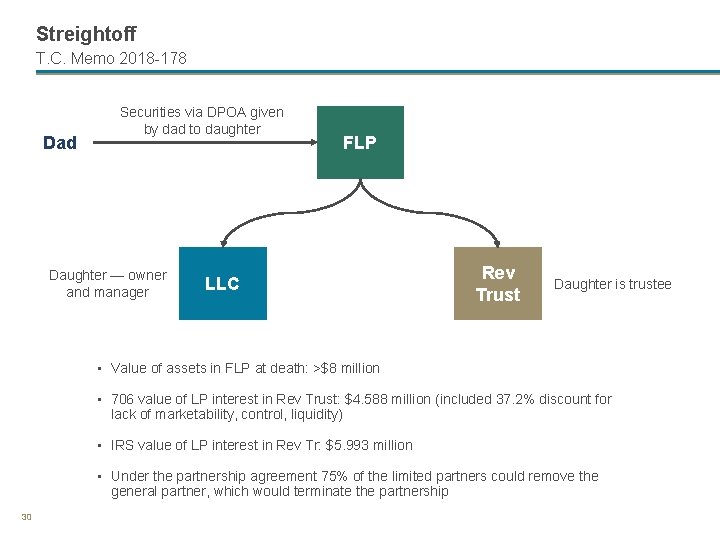
Streightoff T. C. Memo 2018 -178 Dad Securities via DPOA given by dad to daughter Daughter — owner and manager FLP LLC Rev Trust Daughter is trustee • Value of assets in FLP at death: >$8 million • 706 value of LP interest in Rev Trust: $4. 588 million (included 37. 2% discount for lack of marketability, control, liquidity) • IRS value of LP interest in Rev Tr: $5. 993 million • Under the partnership agreement 75% of the limited partners could remove the general partner, which would terminate the partnership 30
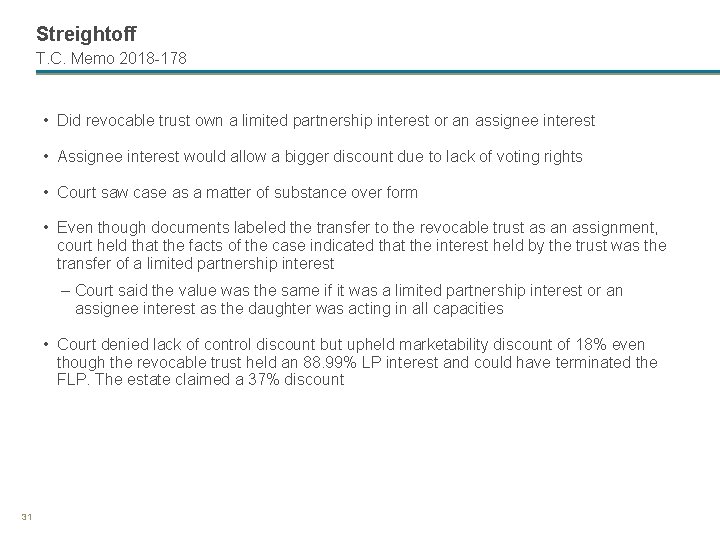
Streightoff T. C. Memo 2018 -178 • Did revocable trust own a limited partnership interest or an assignee interest • Assignee interest would allow a bigger discount due to lack of voting rights • Court saw case as a matter of substance over form • Even though documents labeled the transfer to the revocable trust as an assignment, court held that the facts of the case indicated that the interest held by the trust was the transfer of a limited partnership interest – Court said the value was the same if it was a limited partnership interest or an assignee interest as the daughter was acting in all capacities • Court denied lack of control discount but upheld marketability discount of 18% even though the revocable trust held an 88. 99% LP interest and could have terminated the FLP. The estate claimed a 37% discount 31

Streightoff T. C. Memo 2018 -178 • The IRS did not argue Powell 32
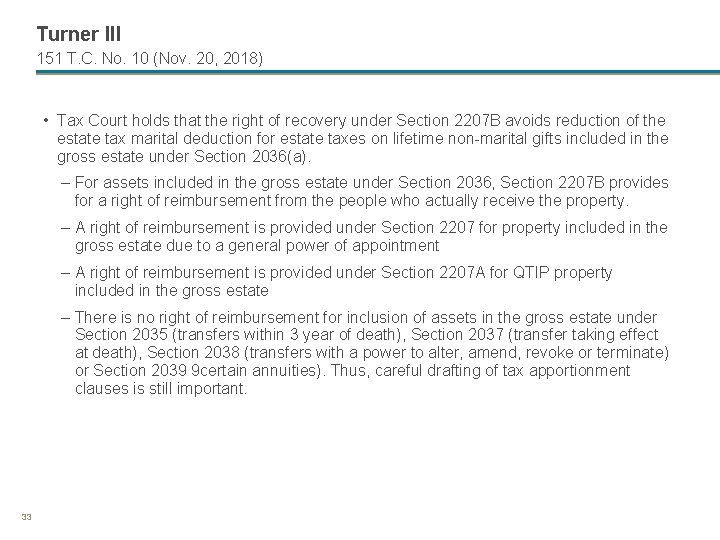
Turner III 151 T. C. No. 10 (Nov. 20, 2018) • Tax Court holds that the right of recovery under Section 2207 B avoids reduction of the estate tax marital deduction for estate taxes on lifetime non-marital gifts included in the gross estate under Section 2036(a). – For assets included in the gross estate under Section 2036, Section 2207 B provides for a right of reimbursement from the people who actually receive the property. – A right of reimbursement is provided under Section 2207 for property included in the gross estate due to a general power of appointment – A right of reimbursement is provided under Section 2207 A for QTIP property included in the gross estate – There is no right of reimbursement for inclusion of assets in the gross estate under Section 2035 (transfers within 3 year of death), Section 2037 (transfer taking effect at death), Section 2038 (transfers with a power to alter, amend, revoke or terminate) or Section 2039 9 certain annuities). Thus, careful drafting of tax apportionment clauses is still important. 33
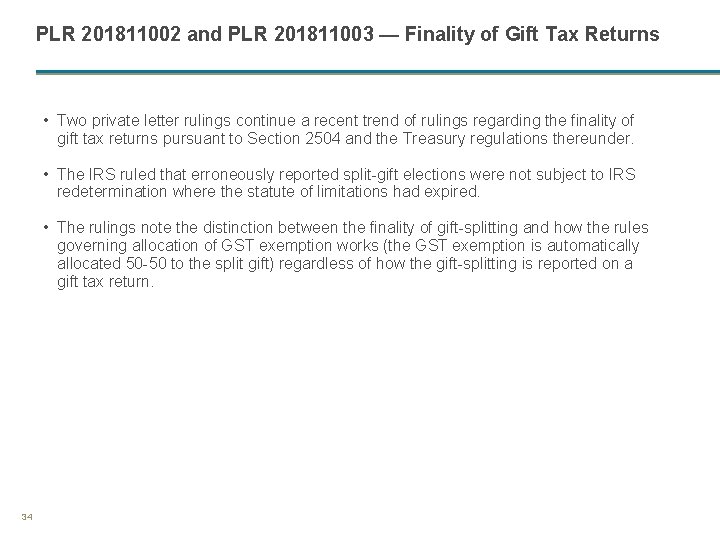
PLR 201811002 and PLR 201811003 — Finality of Gift Tax Returns • Two private letter rulings continue a recent trend of rulings regarding the finality of gift tax returns pursuant to Section 2504 and the Treasury regulations thereunder. • The IRS ruled that erroneously reported split-gift elections were not subject to IRS redetermination where the statute of limitations had expired. • The rulings note the distinction between the finality of gift-splitting and how the rules governing allocation of GST exemption works (the GST exemption is automatically allocated 50 -50 to the split gift) regardless of how the gift-splitting is reported on a gift tax return. 34
New Section 67(g) • New Section 67(g) disallows “miscellaneous itemized deductions” for years 2018– 2025 • This affects estates and trusts as well as individuals • We must determine what estate and trust expenses are “miscellaneous itemized deductions” • To do so, we must review Sections 62, 63 and 67 of the Internal Revenue Code • In addition, we must be familiar with the final Section 67(e) regulations • The results may be surprising 35
Notice 2018 -61 • Treasury and IRS announced intention to issue regulations clarifying that estates and nongrantor trusts may continue to deduct expenses described in Section 67(e) paid or incurred in the administration of an estate or trust that would not have been incurred if the property had not been held in the estate or trust. • Also, the deductions available under Section 642(b) (personal exemption) and Section 651 and 661 (distribution deduction) are still allowed. • There was uncertainty whether the suspension of miscellaneous itemized deductions under Section 67(g) also suspended deductions provided for trusts and estates in Section 67(e). Notice 2018 -61 puts that uncertainty to rest. 36
2017 TCJA — Effect on Income Taxation of Estates and Trusts • Administration expenses not subject to 2% floor still deductible — Notice 2018 -61 • Section 199 A deduction allowed to estates and trusts owning an interest in a flow-through entity • SALT limitation should apply to trusts and estates • Excess deductions may/may not be deductible — Notice 2018 -61 • Section 691(c) deduction survives • 642(c) doesn’t apply to ESBTs — instead, Section 170 limitations now apply, including substantiation requirements 37
Final Regs for Substantiating Charitable Gifts • IRS issued final regs that make changes in the substantiation and reporting rules governing cash and noncash gifts made by individuals, partnerships and corporations • Many changes are minor • However, some of the final regs governing qualification of appraisers and the contents of their appraisals differ significantly from the proposed regs. – Old Regs for gifts made before 2019 — Reg. 1. 170 A-13(c) – New Regs for gifts made after 2018 — Reg. 1. 170 A-17 • TD 9836 38
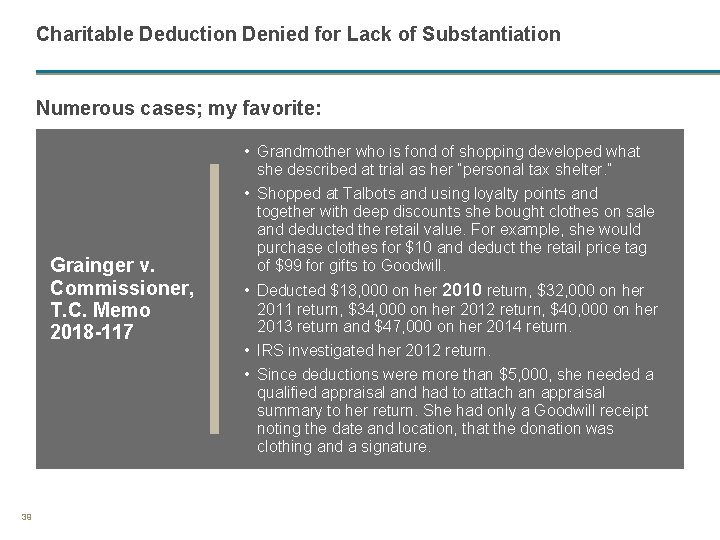
Charitable Deduction Denied for Lack of Substantiation Numerous cases; my favorite: Grainger v. Commissioner, T. C. Memo 2018 -117 39 • Grandmother who is fond of shopping developed what she described at trial as her “personal tax shelter. ” • Shopped at Talbots and using loyalty points and together with deep discounts she bought clothes on sale and deducted the retail value. For example, she would purchase clothes for $10 and deduct the retail price tag of $99 for gifts to Goodwill. • Deducted $18, 000 on her 2010 return, $32, 000 on her 2011 return, $34, 000 on her 2012 return, $40, 000 on her 2013 return and $47, 000 on her 2014 return. • IRS investigated her 2012 return. • Since deductions were more than $5, 000, she needed a qualified appraisal and had to attach an appraisal summary to her return. She had only a Goodwill receipt noting the date and location, that the donation was clothing and a signature.
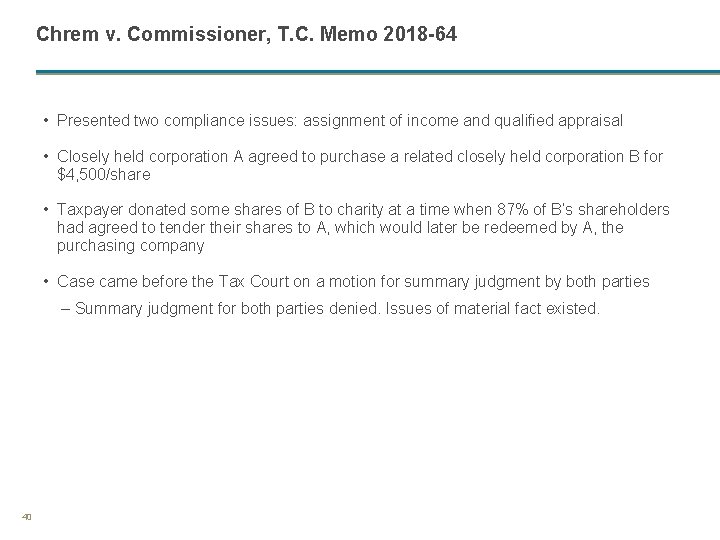
Chrem v. Commissioner, T. C. Memo 2018 -64 • Presented two compliance issues: assignment of income and qualified appraisal • Closely held corporation A agreed to purchase a related closely held corporation B for $4, 500/share • Taxpayer donated some shares of B to charity at a time when 87% of B’s shareholders had agreed to tender their shares to A, which would later be redeemed by A, the purchasing company • Case came before the Tax Court on a motion for summary judgment by both parties – Summary judgment for both parties denied. Issues of material fact existed. 40
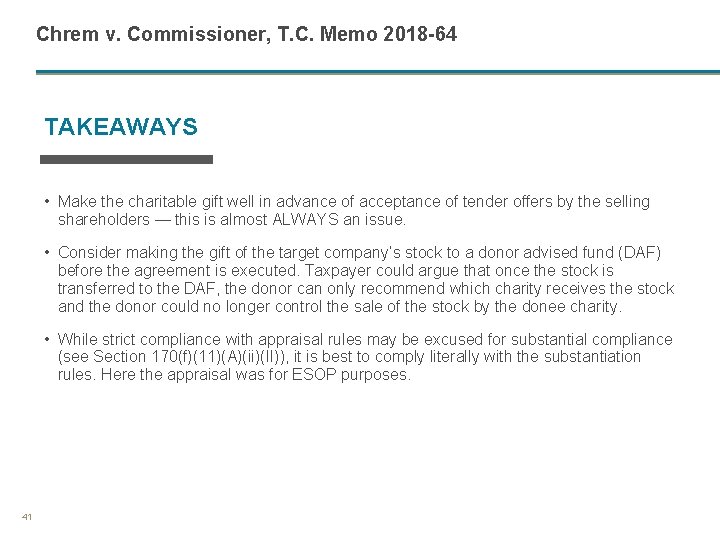
Chrem v. Commissioner, T. C. Memo 2018 -64 TAKEAWAYS • Make the charitable gift well in advance of acceptance of tender offers by the selling shareholders — this is almost ALWAYS an issue. • Consider making the gift of the target company’s stock to a donor advised fund (DAF) before the agreement is executed. Taxpayer could argue that once the stock is transferred to the DAF, the donor can only recommend which charity receives the stock and the donor could no longer control the sale of the stock by the donee charity. • While strict compliance with appraisal rules may be excused for substantial compliance (see Section 170(f)(11)(A)(ii)(II)), it is best to comply literally with the substantiation rules. Here the appraisal was for ESOP purposes. 41
Qualified Opportunity Zones/Funds • Provides federal income tax benefits for investments in QOZ • 2 benefits: – Can defer and potentially exclude capital gain – If held for 10 years, exclude capital gain 42
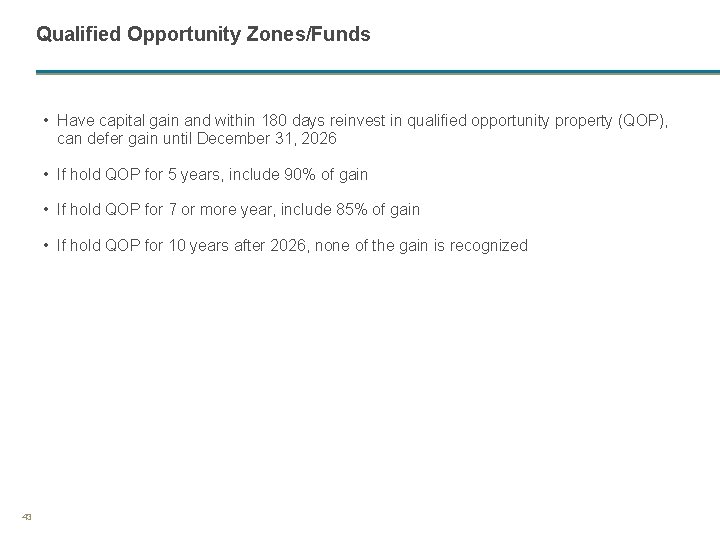
Qualified Opportunity Zones/Funds • Have capital gain and within 180 days reinvest in qualified opportunity property (QOP), can defer gain until December 31, 2026 • If hold QOP for 5 years, include 90% of gain • If hold QOP for 7 or more year, include 85% of gain • If hold QOP for 10 years after 2026, none of the gain is recognized 43
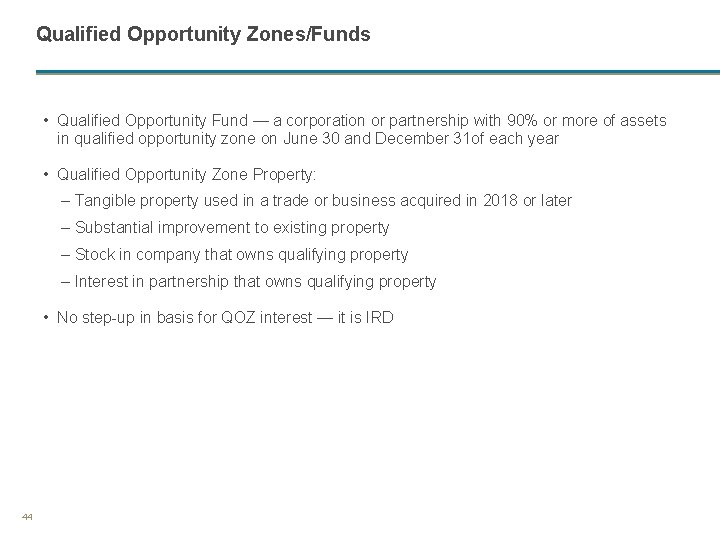
Qualified Opportunity Zones/Funds • Qualified Opportunity Fund — a corporation or partnership with 90% or more of assets in qualified opportunity zone on June 30 and December 31 of each year • Qualified Opportunity Zone Property: – Tangible property used in a trade or business acquired in 2018 or later – Substantial improvement to existing property – Stock in company that owns qualifying property – Interest in partnership that owns qualifying property • No step-up in basis for QOZ interest — it is IRD 44
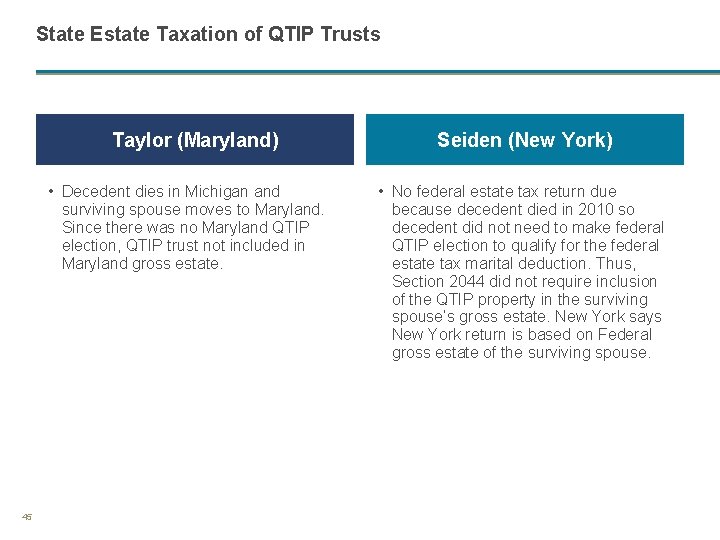
State Estate Taxation of QTIP Trusts Taylor (Maryland) • Decedent dies in Michigan and surviving spouse moves to Maryland. Since there was no Maryland QTIP election, QTIP trust not included in Maryland gross estate. 45 Seiden (New York) • No federal estate tax return due because decedent died in 2010 so decedent did not need to make federal QTIP election to qualify for the federal estate tax marital deduction. Thus, Section 2044 did not require inclusion of the QTIP property in the surviving spouse’s gross estate. New York says New York return is based on Federal gross estate of the surviving spouse.
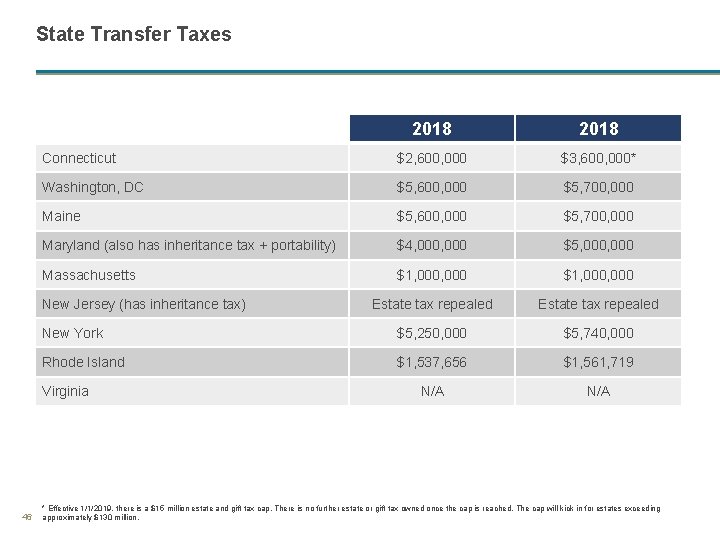
State Transfer Taxes 2018 Connecticut $2, 600, 000 $3, 600, 000* Washington, DC $5, 600, 000 $5, 700, 000 Maine $5, 600, 000 $5, 700, 000 Maryland (also has inheritance tax + portability) $4, 000 $5, 000 Massachusetts $1, 000, 000 Estate tax repealed New York $5, 250, 000 $5, 740, 000 Rhode Island $1, 537, 656 $1, 561, 719 N/A New Jersey (has inheritance tax) Virginia 46 * Effective 1/1/2019, there is a $15 million estate and gift tax cap. There is no further estate or gift tax owned once the cap is reached. The cap will kick in for estates exceeding approximately $130 million.
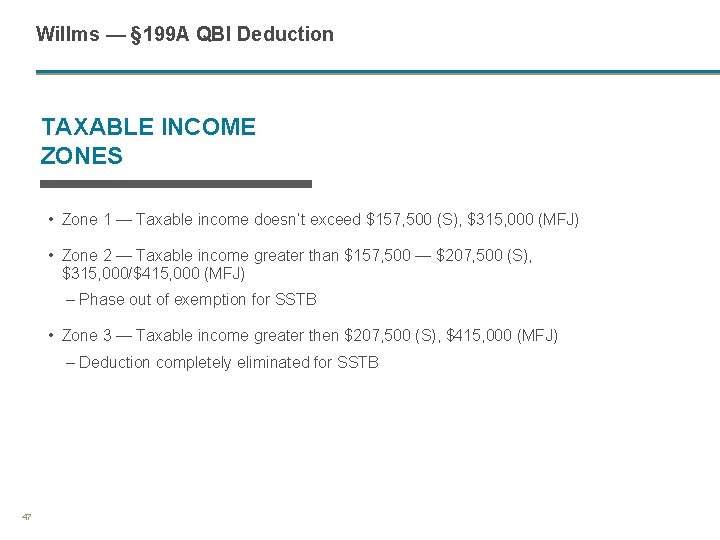
Willms — § 199 A QBI Deduction TAXABLE INCOME ZONES • Zone 1 — Taxable income doesn’t exceed $157, 500 (S), $315, 000 (MFJ) • Zone 2 — Taxable income greater than $157, 500 — $207, 500 (S), $315, 000/$415, 000 (MFJ) – Phase out of exemption for SSTB • Zone 3 — Taxable income greater then $207, 500 (S), $415, 000 (MFJ) – Deduction completely eliminated for SSTB 47
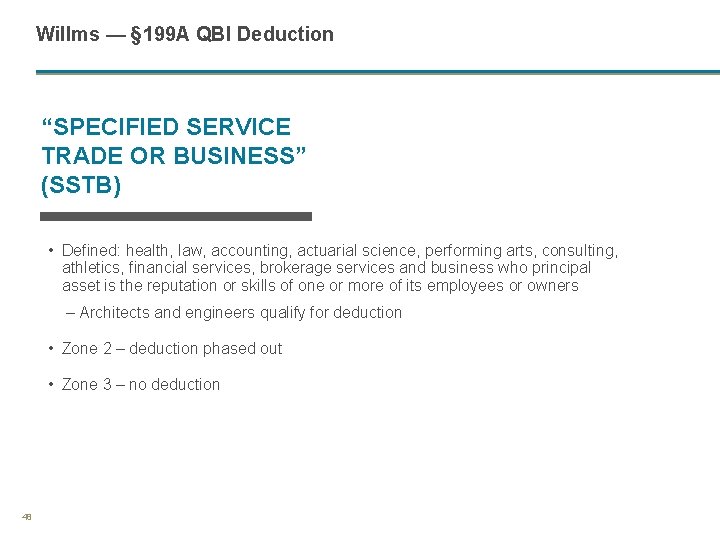
Willms — § 199 A QBI Deduction “SPECIFIED SERVICE TRADE OR BUSINESS” (SSTB) • Defined: health, law, accounting, actuarial science, performing arts, consulting, athletics, financial services, brokerage services and business who principal asset is the reputation or skills of one or more of its employees or owners – Architects and engineers qualify for deduction • Zone 2 – deduction phased out • Zone 3 – no deduction 48
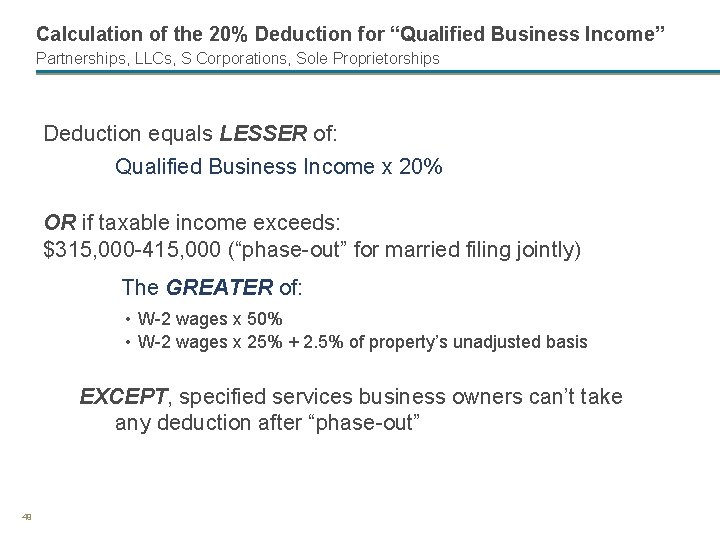
Calculation of the 20% Deduction for “Qualified Business Income” Partnerships, LLCs, S Corporations, Sole Proprietorships Deduction equals LESSER of: Qualified Business Income x 20% OR if taxable income exceeds: $315, 000 -415, 000 (“phase-out” for married filing jointly) The GREATER of: • W-2 wages x 50% • W-2 wages x 25% + 2. 5% of property’s unadjusted basis EXCEPT, specified services business owners can’t take any deduction after “phase-out” 49
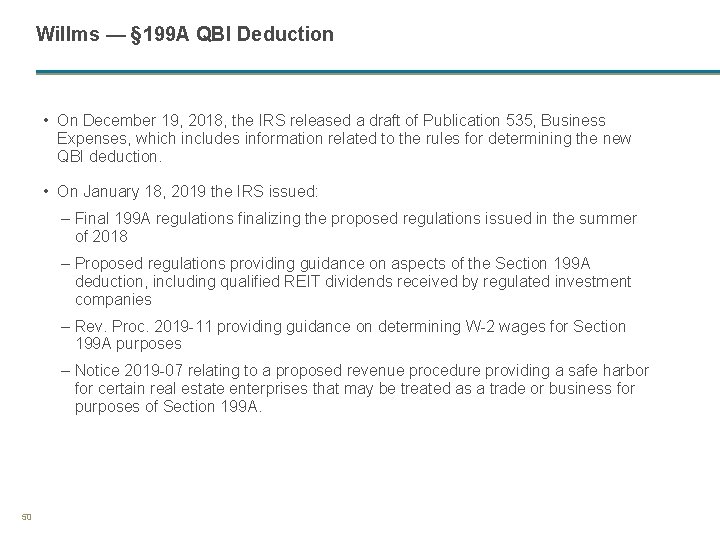
Willms — § 199 A QBI Deduction • On December 19, 2018, the IRS released a draft of Publication 535, Business Expenses, which includes information related to the rules for determining the new QBI deduction. • On January 18, 2019 the IRS issued: – Final 199 A regulations finalizing the proposed regulations issued in the summer of 2018 – Proposed regulations providing guidance on aspects of the Section 199 A deduction, including qualified REIT dividends received by regulated investment companies – Rev. Proc. 2019 -11 providing guidance on determining W-2 wages for Section 199 A purposes – Notice 2019 -07 relating to a proposed revenue procedure providing a safe harbor for certain real estate enterprises that may be treated as a trade or business for purposes of Section 199 A. 50
Lee — Section 1202 Stock • Provides non-corporate taxpayers with an exemption from federal income tax for eligible gains from the sale of qualified small business stock (QSBS) in subchapter C corporations held for more than 5 years. • Exclusion is 50%, 75% or 100% depending upon the date the QSBS was issued. The exclusion is for both the income tax and the 3. 8% tax on net investment income. • Maximum amount of gain that can be taken into account under QSBS rules with respect to an eligible shareholder’s stock in any single issuing corporation is generally the greater of $10 million or 10 times the shareholder’s applicable tax basis in the stock. – Any gain in excess of the “greater than $10 million or 10 times stock basis” limit is taxed under the regular non-QSBS rules i. e. , maximum LTCG rate plus 3. 8% surtax. • Numerous other requirements must be met for a shareholder to qualify for the QSBS exclusion. 51
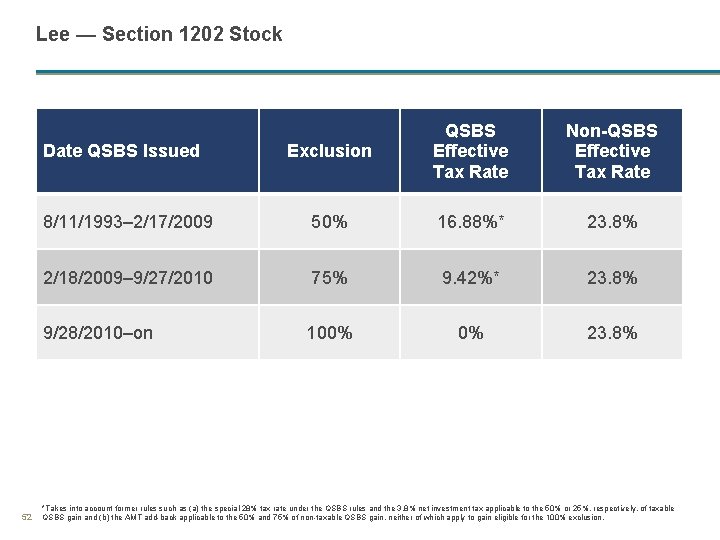
Lee — Section 1202 Stock Exclusion QSBS Effective Tax Rate Non-QSBS Effective Tax Rate 8/11/1993– 2/17/2009 50% 16. 88%* 23. 8% 2/18/2009– 9/27/2010 75% 9. 42%* 23. 8% 9/28/2010–on 100% 0% 23. 8% Date QSBS Issued 52 *Takes into account former rules such as (a) the special 28% tax rate under the QSBS rules and the 3. 8% net investment tax applicable to the 50% or 25%, respectively, of taxable QSBS gain and (b) the AMT add-back applicable to the 50% and 75% of non-taxable QSBS gain, neither of which apply to gain eligible for the 100% exclusion.
Lee — Section 1202 Stock • Eligible shareholders — non-corporate shareholders, including individuals, estates and trusts, and partnerships (for the partner’s share of the gain from the sale of QSBS, subject to certain requirements). • Holding period — an eligible shareholder must have held the QSBS for more than 5 years. • QSBS — the shareholder must have acquired the stock at original issue from a domestic C corporation that is a qualified small business in exchange for money or property (other than stock) or as compensation for services to the corporation (but not as an underwriter). • Stock purchased from a prior shareholder does not qualify 53
Lee — Section 1202 Stock • Have to sell stock, not assets, for Section 1202 to apply • Not elective • Possibility of Section 1045 rollover — QSBS for QSBS within 60 days of sale • Section 1202 has no IRS guidance — existing regulations deal with repealed law • Planning idea: increase the maximum gain exclusion for a single company by gifting shares to family members or irrevocable trusts. Provides an opportunity to “stack” the number of $10 million exclusions. • Important for start-ups especially in Silicon Valley 54
Magill — Planning for Changing Family Structures • Important to include statement of intent in trusts due to the growing length of trusts, i. e. , dynasty trusts • New term — “dibling” — donor produced sibling • Interesting statistics: for Americans who responded to a study for people over 50: – 42% have no will and 38% will die without a will – If respondent had a step-child, the rate of intestacy increases to 49% – If a child stopped communicating with a parent, the rate of intestacy jumps to 59% – If the person is divorced, intestacy jumps to 62% 55
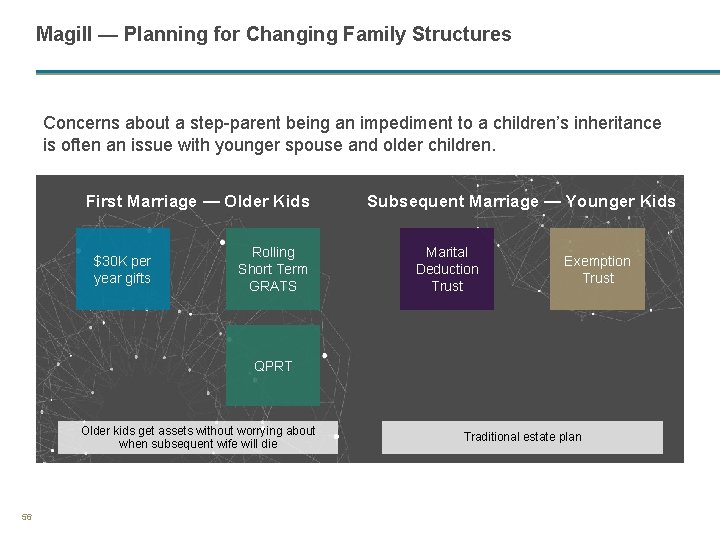
Magill — Planning for Changing Family Structures Concerns about a step-parent being an impediment to a children’s inheritance is often an issue with younger spouse and older children. First Marriage — Older Kids $30 K per year gifts Rolling Short Term GRATS Subsequent Marriage — Younger Kids Marital Deduction Trust Exemption Trust QPRT Older kids get assets without worrying about when subsequent wife will die 56 Traditional estate plan

Hoyt — Make Your Charitable Estate Plan Great Again • Chris’ joke • Making non-taxable distributions to individuals using discretionary trusts with charitable and individual beneficiaries 57
Mc. Caffrey — Tax Consequences of Marriage and Divorce • Repeal of Section 682 • Deals with trusts for divorced spouses – Inver vivos QTIP – What about SLATs? • Generally, under Section 682 grantor trust pre-divorce, non-grantor spouse taxed on distributions post-divorce • Notice 2018 -37 grandfathers existing Section 682 trusts for divorces on or before December 31, 2018 – Notice 2018 -37 doesn’t grandfather old Section 682 trusts if no divorce on or before December 31, 2018. Income distributed to non-grantor spouse but taxed to grantor spouse. – ACTEC doesn’t want Section 672(e) to apply after divorce 58
Mc. Caffrey — Tax Consequences of Marriage and Divorce • To avoid Section 672(e) wait until after divorce to set up support trust • How to deal with problem: – Tax reimbursement clause – Restructure trust in some way • SLAT — could decant • Inter vivos QTIP — can’t decant as spouse is the only allowable beneficiary for the spouse’s life • Don’t want spendthrift clause in trust in case you want to decant. In drafting a trust include a provision in the trust which still allows someone to remove the spendthrift clause 59
Mc. Caffrey — Tax Consequences of Marriage and Divorce • Section 2702 problem — zero valuation rule for term interest • How to avoid Section 2702: – Structure as a qualified interest – Transfer retains remainder interest — protected by regulations under Section 2516. • Remainderman/spouse could do a transfer to children at a later date 60
Kwon — IRS Ruling Requests • Rev. Proc. 2019 -1 — requirements for private letter ruling • Make sure to add as parties to the ruling request those who want to have the ruling apply to them • Determine if the issue is one the IRS will issue a ruling on. Won’t rule on: – Issues under examination – Issues on no ruling list – Issues covered by existing law e. g. , comfort rulings – Hypothetical scenarios or alternative scenarios 61
Kwon — IRS Ruling Requests • If a ruling request is filed on an estate tax issue, if ruling hasn’t been received before the estate tax return is filed, IRS must be notified that ruling request was filed and must attach a copy of the request to the estate tax return. • Expect ruling request to take 6 months – Can ask for expedited ruling but must have good reason. Expedited requests just means they take the request out of order and will handle before others. It doesn’t mean the request will be issued quickly. • A pre-submission conference can be requested. If short on staff, conference may be denied – Benefit of conference — may raise issues the IRS is concerned with that you didn’t think of 62
Kwon — IRS Ruling Requests • Make the request easy to understand • Request a ruling on all the issues i. e. , estate tax, gift tax, income tax and generation skipping tax issues • If a proposed transaction, attach documents of proposed transaction • Request might bring contrary authority to the attention of the IRS. Also, must state whether the law is uncertain on the issue and if there is no contrary authority, state so 63
Johnson — Planning for Parents of Minors • Split in states on whether a person’s last will and testament or the court controls the designation of a guardian – Parent/Will: CO, CT, DC, MA, NJ, NY, VA – Court: CA, DE, PA, RI • Even if all assets are in trust, a conservator may be needed if, for example, the parents died in an accident and there is a wrongful death claim. Need a conservator to deal with the funds 64
Johnson — Planning for Parents of Minors • General rule: in case of death of a divorced spouse, there is a rebuttable presumption that the non-custodial parent is entitled to custody of the child. – Many state statutes explicitly so state – Even where the statute is silent, the U. S. Supreme Court has held there is a constitutional right to parent. – Two ways around presumption: • Obtain consent of surviving parent to the appointment of a guardian designated in the deceased parent’s will • Prove the surviving parent is unfit • Grandparents are becoming guardians due to the opioid epidemic • Parent as custodian of UTMA account causes estate tax inclusion in parent’s estate. 65
Krooks — Incapacity and Disability • Services are available that will locate digital assets for a fee • 40 million Americans live with a disability, or `12% of the U. S. population • Hot issue is whether financial institutions will honor a power of attorney. • Support trusts v. discretionary trusts — support trusts allow the beneficiary to compel the trustee to distribute trust income or principal as necessary for support of the beneficiary – Support trust could pose problem if the beneficiary requires Medicaid or other government benefits. – Attorneys need to be careful that a beneficiary cannot compel a distribution under a trusts instrument where qualifications for government benefits is desired. 66
Graham — U. S. Persons with Foreign Assets • Civil law countries do not recognize trusts • Civil law countries have forced heirship • In civil law countries, assets vest immediately in the name of the heir • In civil law countries, there is a matrimonial regime i. e. , the surviving spouse may already own half the assets and the forced heirship rules may apply • If there is a tax in civil law countries, it is an inheritance tax • Need to understand these concepts to help in formulate a plan for a U. S. person. Not doing an estate plan like you would for U. S. concepts. – Example: The other country may require the owner of an asset to leave the asset to a certain person. 67
Graham — U. S. Persons with Foreign Assets • Countries that have signed the Hague Convention on trusts (e. g. , Japan and Italy) will recognize trusts • With anything in a foreign country, in almost all situations, an informational return must be included with the U. S. income tax return. Otherwise, potential large penalties. • Will a last will and testament created in the U. S. be recognized in another country? – Hague Convention — reciprocity – Washington Convention — reciprocity if the will meets certain requirements • Canada and UK are common law countries — both recognize trusts — however, if trust used in UK, even if revocable, they have a tax on funding and tax when distributed and a tax every ten years. In Canada, there is a 21 year deemed disposition rule. 68
Recent Developments — Q & A • AK — grantor trusts — draft for possibility that grantor may want to “toggle off” grantor trust status. Also, consider giving trustee discretion to reimburse the income tax paid by the grantor on trust income. • SD — Section 643(f) proposed regs — allow the IRS to disregard multiple trusts with the same grantors and beneficiaries. Proposed regs would presume that there is a purpose of tax avoidance and shifts the burden to the taxpayer. • CM — CLAT assets not included in gross estate unless retained control of the charitable beneficiaries e. g. , payable to private foundation controlled by the grantor 69
Rothchild, Snyder and Ward — Charitable Gift Agreements • Naming rights is an incidental benefit • Charitable gift not complete if based on condition — value of gift is reduced by retained right but difficult to value • Donor earmarking — restrictions may be so severe that it looks like donor is making a gift for his benefit • Can school take donor’s name off building but keep the donation? This could be covered by the gift agreement. – Gift agreement should provide for removing the donor’s name in the event the donor’s name will damage the school’s reputation – More common to have an un-naming provisions or a term limit on the naming rights. Could also have this issue covered by the school’s policies and incorporate the school’s policies by reference in the gift agreement 70
Rothchild, Snyder and Ward — Charitable Gift Agreements • Donor scholarship restrictions, particularly race and gender – Constitutional issues for public universities – Strict scrutiny (race), intermediate scrutiny (sex), rational basis (others) • Donor demands return of gift – Charity should contact state attorney general to see if they have an issue with paying back the gift or forgiving the balance of a pledge – Would charity have to issue a 1099 to the donor? Is it taxable income to the donor? Must the donor filed an amended return (assuming an open statute of limitations) and delete the charitable gift? 71
Blattmachr and Berry — Powers of Appointment • Instead of using a testamentary power of appointment, use an inter vivos power of appointment so you can get rid of beneficiaries during life that you don’t want rather than having to wait until death to get rid of them. – But do so with the consent of an adverse party for an additional safeguard – Powers of appointment are good devices to make changes to long-term trusts that otherwise might grow stale over time • Discussed formula general powers of appointment (see Zaritsky and Law Fundamentals session) • Section 2041(a)(3) — Delaware tax trap — have special power of appointment in trust that can be exercised in a manner which extends the rule against perpetuities of the trust. Law treats the special power of appointment as a general power of appointment resulting in estate tax inclusion – Can use Delaware tax trap in NY and CA but it is questionable if you can use it in SD and DE because there is no rule against perpetuities 72
Terrill and Riches — Money Laundering • Government wants to make lawyers and accountants part of law enforcement • Bank Secrecy Act, Patriot Act, etc. , designed to curb money laundering by imposing prerequisites on opening bank accounts • Compliance requirements imposed on financial institutions and non-U. S. attorneys and accountants • ABA has (so far) successfully fought imposing reporting requirements on attorneys • ABA and ACTEC have put together guidance to train attorneys on potential money laundering 73
Henry — Disclaimers • Basic review of requirements for disclaimers: – In time – In writing – No acceptance – No direction • Important concept — when the 9 month period begins to run – Inter vivos transfers — transfer occurs when there is a completed gift for federal gift tax purposes, regardless of whether a gift tax is imposed – Transfers at death — transfers made by a decedent at death, or transfers that become irrevocable upon death occur on the date of the decedent’s death 74
Henry — Disclaimers • Important concept — when the 9 month period begins to run – Lifetime gifts included in transferor’s estate — if a lifetime transfer is later included in the transferor’s gross estate for estate tax purposes, the nine-month period is determined based on the earlier transfer creating the interest and not on the transferor’s date of death – General powers of appointment — the holder of a general power of appointment had nine months from the date on which the power was created to disclaim the power – Transfers by exercise or lapse of a general power of appointment — the transferee of an interest in property which passed as a result of the exercise or lapse of a general power of appointment must make a disclaimer within nine months after the exercise, release or lapse of the power 75
Henry — Disclaimers • Important concept — when the 9 month period begins to run – Limited power of appointment — the holder, permissible appointees, or takers in default of a limited (special or non-general) power of appointment must make a disclaimer within nine months following the original transfer that created the limited power of appointment – Life tenants and remainder beneficiaries — a life tenant or remainder beneficiary (whether their interests are vested or contingent) must make a disclaimer within nine months after the original transfer creating the life income or remainder interest – QTIP property — a remainder beneficiary of qualified terminable interest property must disclaim within nine months of the date of the transfer creating the interest 76
Henry — Disclaimers • Pre-1977 disclaimers — if the interest was created prior to January 1, 1977, Reg. 2511 -1(c)(2) provides that a disclaimer may be made within a reasonable time after knowledge of the existence of the transfer 77
Porter and Prokey — Transfer Tax Audits • IRS checks gift tax returns for adequate disclosure, they flag and set aside until the donor dies • Same with estate tax returns filed to elect portability. They flag them, set them aside until the surviving spouse dies to check the calculation of the DSUE amount – Recall in the Sumner Redstone case they went back to 1972 gifts • QSBS is huge in silicon valley because of the number of start-ups. This is being looked at more closely by the government • Transfer tax audits being done and assigned on a workload basis • Quote: “Legal uncertainty creates valuation discounts. ” For example, is there a liquidation right or not? 78
Porter and Prokey — Transfer Tax Audits • IRS appraisals depend on whether money is available. Less likely for IRS to have money available at the end of the fiscal year. • Tax-effecting is a hot issue — closely-held companies use cash flows of C corporations and then discount for taxes paid at the corporate level. • Section 2036 is the silver bullet in the government’s argument for FLPs and LLCs – Section 2036(a)(1) — these deal with bad facts – Section 2036(a)(2) — retained right to designate the person who will enjoy the property — deals with rights to liquidation as in Powell i. e. , decedent, in connection with others could terminate the partnership – that is a retained power to designate who could enjoy the property 79
Porter and Prokey — Transfer Tax Audits • How to avoid Section 2036 — satisfy the bona fide sale for full and adequate consideration, establish a significant non-tax factor for undertaking the transaction • Porter says don’t give the senior family member a right to vote on liquidation or a right to amend the partnership • Porter says he puts the estate planning attorney on the stand to testify as to the significant non-tax reason. If you do so, you have to waive the attorney-client privilege. – Must put attorney on the stand because the taxpayer has the burden of proof as to the significant non-tax reason. 80
Choate — IRA • Three penalties: – 6% on excess contribution – 10% for early withdrawal – 50% for missed minimum required distribution (MRD) • Prohibited transactions blows up the IRA status is lost. There are no remedies. • MRD must be taken before converting a traditional IRA to a Roth IRA • The first distribution during the year is considered to e the MRD • One of two types of contributions to an IRA: (1) regular contribution or (2) rollover contribution 81
Choate — IRA • An invalid rollover to a Roth IRA is an excess contribution subject to a 6% excise tax • How to fix excess contribution: – Must withdraw excess contribution plus earnings by extended due date of tax return. If you filed return on time (4/15) extended due date is 10/15, even if you didn’t get an extension. If you file the return late, the extended due date is 4/15. If you miss the deadline, you can file for 9100 relief. Remember, the 6% penalty is imposed every year, until the excess contribution is withdrawn. – You have to take the excess amount and earning out of the actual IRA that received the excess contribution 82
Choate — IRA • One rollover per 12 month period. – Could roll second or more IRA distribution to a 401(k) plan (if the taxpayer has one) as there is no one rollover per 12 month period for IRA to qualified plans. • Can do as many trustee to trustee or custodian to custodian transfers per 12 month period as you like • Can self-certify to cure missed 60 day rollover. Must fit into one of eleven reasons – Must complete the rollover within a reasonable time after discovering the error. IRS says a rollover within 30 days is a reasonable time. – Alternative to self-certification: apply for a hardship waiver. IRS user fee is $28, 000. 83
Choate — IRA • Must rollover the cash you got from the IRA and not an asset you purchased with the IRA cash distribution. • Statute of limitations applies to all penalties if you file a Form 5329. Recommended that a Form 5329 be filed every year with your income tax return to get the statute of limitations running on penalties 84
Choate — IRA • Missing a MRD — 50% penalty • Penalty can be waived for reasonable cause • To get penalty waiver: – Use Form 5329 for each missed year – Prepare statement of reasonable cause – Remedy the shortfall — recommended to include a copy of the distribution check to prove you took out the amount of the missed MRD – Filling out the Form 5329 — put “ 0” on Line 52 (Amount actually distributed to you…” and write “RC” (for “reasonable cause”) in the margin. 85
Choate — IRA FRIDAY MORNING SESSION • Discussed difference between a IRA distribution to a “conduit trust” and an “accumulation trust” for purposes of the MRD calculation • Discussed the effect of compressed tax rates on an IRA distribution to a trust and suggested taking IRA distributions during lifetime to reduce the income tax bite • Problems with charity receiving distribution from an IRA when charity is named as the IRA beneficiary – IRA providers are requiring charities to open an inherited IRA account, then the IRA can be distributed to the inherited IRA in order to comply with account opening requirements – Solution: name donor advised fund (DAF) as the beneficiary and the DAF can name the charity as its beneficiary. 86

Thank you!

Questions?
Disclosure The information provided is for illustrative/educational purposes only. All investment strategies referenced in this material come with investment risks, including loss of value and/or loss of anticipated income. Past performance does not guarantee future results. No investment strategy or risk management technique can guarantee returns in any market environment. This material is not intended to constitute legal, tax, investment or financial advice. Effort has been made to ensure that the material presented herein is accurate at the time of publication. However, this material is not intended to be a full and exhaustive explanation of the law in any area or of all of the tax, investment or financial options available. The information discussed herein may not be applicable to or appropriate for every investor and should be used only after consultation with professionals who have reviewed your specific situation. BNY Mellon Wealth Management may refer clients to certain of its affiliated offering expertise, products and services which may be of interest to the client. Use of an affiliate after such a referral remains the sole decision of the client. Strategic Architecture is a service mark owned by The Bank of New York Mellon Corporation. BNY Mellon Wealth Management conducts business through various operating subsidiaries of The Bank of New York Mellon Corporation. 89 © 2019 The Bank of New York Mellon Corporation. All rights reserved.
- Slides: 89