
Presented by Hlne REBEL Head of A 330A
Presented by: Hélène REBEL Head of A 330/A 340 Operational Standard Landing in CONF 3 – Use of reversers
General considerations Airbus Flight Crew Operating Manuals recommendation © AIRBUS S. All rights reserved. Confidential and proprietary document. CONF FULL – Maximum Reverse thrust Maximize safety margins Landing in CONF 3 - Use of reversers April 2007 2
General considerations • For economics, airlines could envisage: 4 Approach in CONF 3 4 Idle or no reverse thrust at landing All operational and economics consequences have to be considered. • Above all, the first considerations must be: © AIRBUS S. All rights reserved. Confidential and proprietary document. 4 The aircraft landing weight 4 The runway length 4 The braking means 4 The runway surface conditions 4 The tailwind 4 Autoland not certified in CONF 3 (CONF 15/20) for A 300/A 310 aircraft family Landing in CONF 3 - Use of reversers April 2007 3
Content ì General considerations ì Fuel economy estimation ì Additional considerations: ì Other operating cost considerations © AIRBUS S. All rights reserved. Confidential and proprietary document. ì Operational consequences ì Pro and Cons: Summary ì Conclusion Landing in CONF 3 - Use of reversers April 2007 4
Fuel economy estimation • Depends on several parameters as: © AIRBUS S. All rights reserved. Confidential and proprietary document. – – – – Aircraft / Engine type Aircraft weight during the approach Approach speed Autobrake selection Airport elevation The ISA conditions … Landing in CONF 3 - Use of reversers Fuel economy estimation April 2007 5
Fuel economy estimation • Simulation hypothesis elevation: Sea Level 4 ISA conditions 4 Approach speed VLS + 5 knots 4 Autobrake LO 42 aircraft weights: light and heavy weights © AIRBUS S. All rights reserved. Confidential and proprietary document. 4 Airport Landing in CONF 3 - Use of reversers April 2007 6
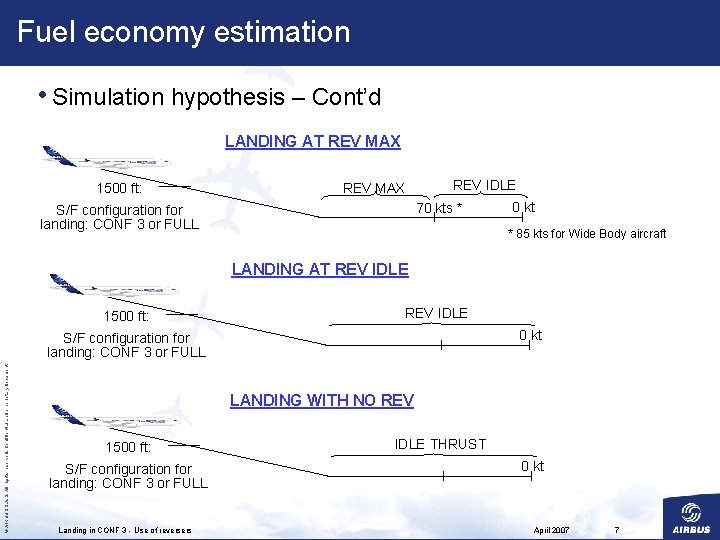
Fuel economy estimation • Simulation hypothesis – Cont’d LANDING AT REV MAX 1500 ft: REV MAX REV IDLE 70 kts * S/F configuration for landing: CONF 3 or FULL 0 kt * 85 kts for Wide Body aircraft LANDING AT REV IDLE 1500 ft: REV IDLE 0 kt © AIRBUS S. All rights reserved. Confidential and proprietary document. S/F configuration for landing: CONF 3 or FULL LANDING WITH NO REV 1500 ft: S/F configuration for landing: CONF 3 or FULL Landing in CONF 3 - Use of reversers IDLE THRUST 0 kt April 2007 7
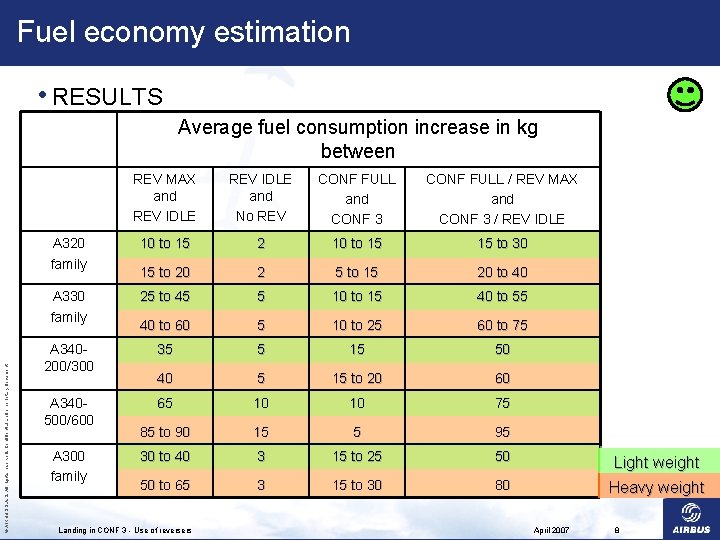
Fuel economy estimation • RESULTS © AIRBUS S. All rights reserved. Confidential and proprietary document. Average fuel consumption increase in kg between REV MAX and REV IDLE and No REV CONF FULL and CONF 3 CONF FULL / REV MAX and CONF 3 / REV IDLE A 320 family 10 to 15 2 10 to 15 15 to 30 15 to 20 2 5 to 15 20 to 40 A 330 family 25 to 45 5 10 to 15 40 to 55 40 to 60 5 10 to 25 60 to 75 A 340200/300 35 5 15 50 40 5 15 to 20 60 A 340500/600 65 10 10 75 85 to 90 15 5 95 30 to 40 3 15 to 25 50 Light weight 50 to 65 3 15 to 30 80 Heavy weight A 300 family Landing in CONF 3 - Use of reversers April 2007 8
Content ì General considerations ì Fuel economy estimation ì Additional considerations: ì Other operating cost considerations © AIRBUS S. All rights reserved. Confidential and proprietary document. ì Operational consequences ì Pro and Cons: Summary ì Conclusion Landing in CONF 3 - Use of reversers April 2007 9
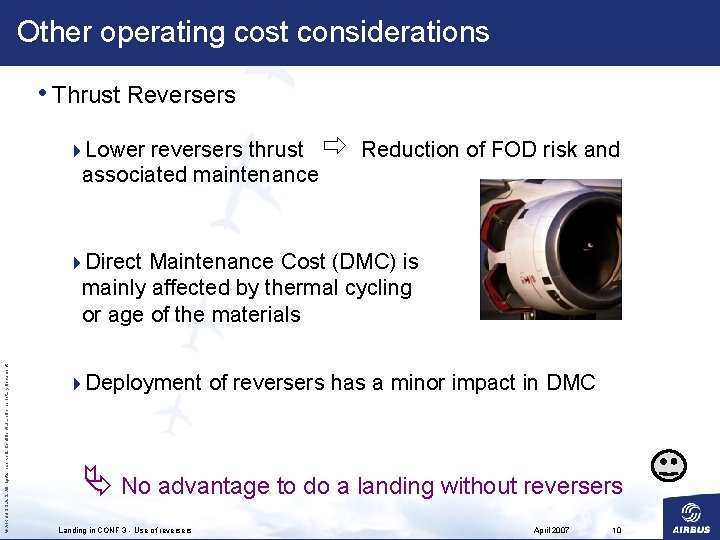
Other operating cost considerations • Thrust Reversers reversers thrust Reduction of FOD risk and associated maintenance 4 Lower Maintenance Cost (DMC) is mainly affected by thermal cycling or age of the materials © AIRBUS S. All rights reserved. Confidential and proprietary document. 4 Direct 4 Deployment of reversers has a minor impact in DMC No advantage to do a landing without reversers Landing in CONF 3 - Use of reversers April 2007 10
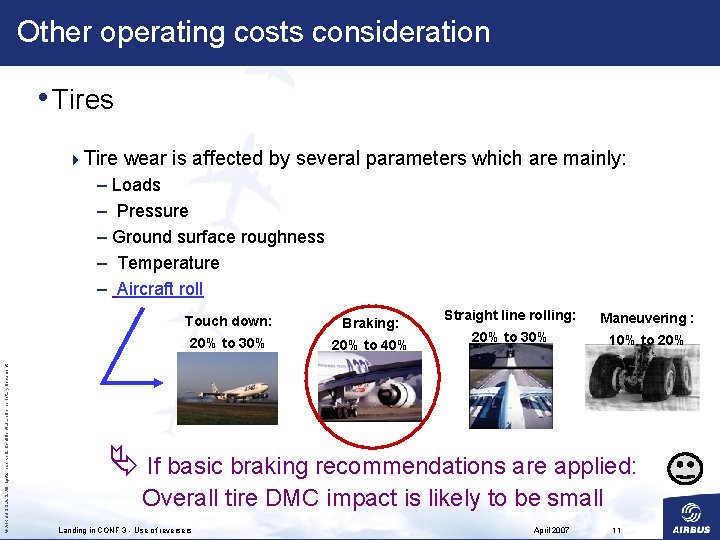
Other operating costs consideration • Tires 4 Tire wear is affected by several parameters which are mainly: © AIRBUS S. All rights reserved. Confidential and proprietary document. – Loads – Pressure – Ground surface roughness – Temperature – Aircraft roll Touch down: Braking: 20% to 30% 20% to 40% Straight line rolling: Maneuvering : 20% to 30% 10% to 20% If basic braking recommendations are applied: Overall tire DMC impact is likely to be small Landing in CONF 3 - Use of reversers April 2007 11
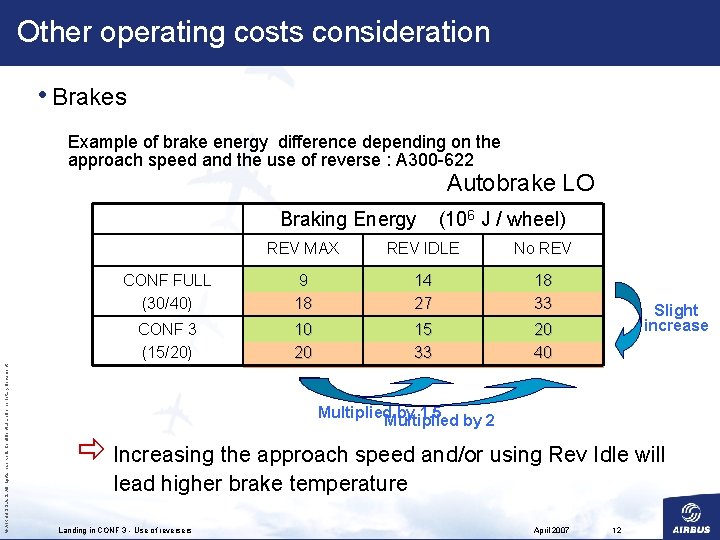
Other operating costs consideration • Brakes Example of brake energy difference depending on the approach speed and the use of reverse : A 300 -622 Autobrake LO © AIRBUS S. All rights reserved. Confidential and proprietary document. Braking Energy (106 J / wheel) REV MAX REV IDLE No REV CONF FULL (30/40) 9 18 14 27 18 33 CONF 3 (15/20) 10 20 15 33 20 40 Slight increase Multiplied by 1. 5 by 2 Increasing the approach speed and/or using Rev Idle will lead higher brake temperature Landing in CONF 3 - Use of reversers April 2007 12
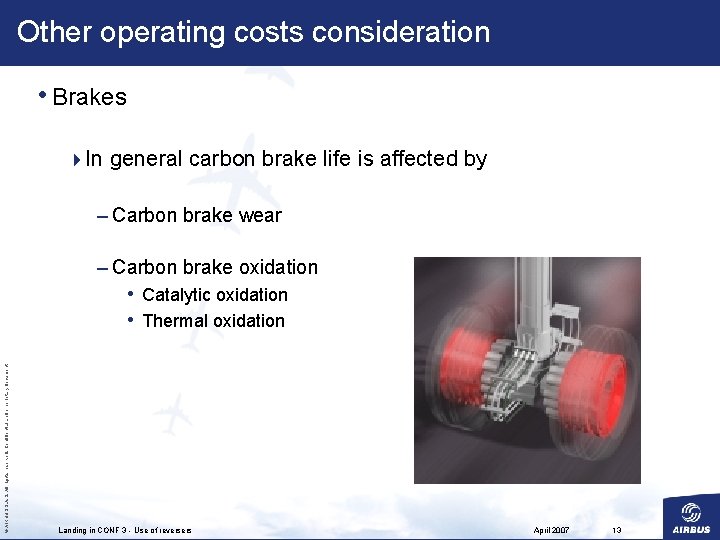
Other operating costs consideration • Brakes 4 In general carbon brake life is affected by – Carbon brake wear – Carbon brake oxidation © AIRBUS S. All rights reserved. Confidential and proprietary document. • Catalytic oxidation • Thermal oxidation Landing in CONF 3 - Use of reversers April 2007 13
Other operating costs consideration • Brakes: Effect on Carbon Brake wear 4 Carbon brake wear is mainly affected by: – Number of brake applications Not linked to the approach conf or the use of © AIRBUS S. All rights reserved. Confidential and proprietary document. reversers Landing in CONF 3 - Use of reversers April 2007 14
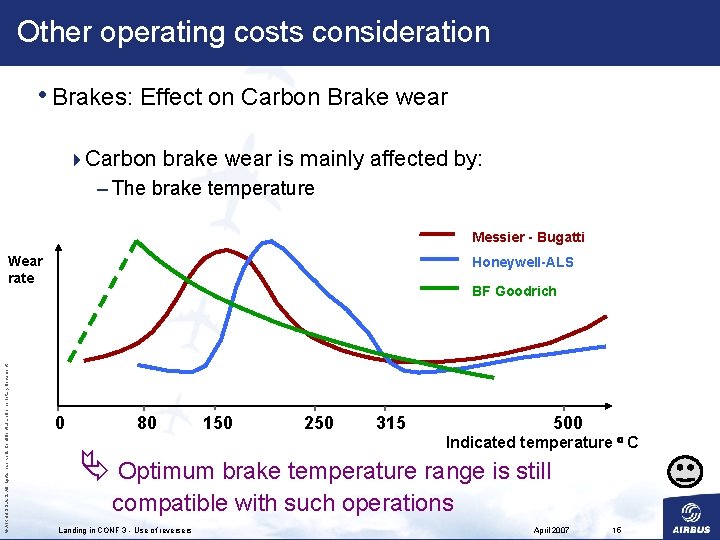
Other operating costs consideration • Brakes: Effect on Carbon Brake wear 4 Carbon brake wear is mainly affected by: – The brake temperature Messier - Bugatti © AIRBUS S. All rights reserved. Confidential and proprietary document. Wear rate Honeywell-ALS BF Goodrich 0 80 150 250 315 500 Indicated temperature C Optimum brake temperature range is still compatible with such operations Landing in CONF 3 - Use of reversers April 2007 15
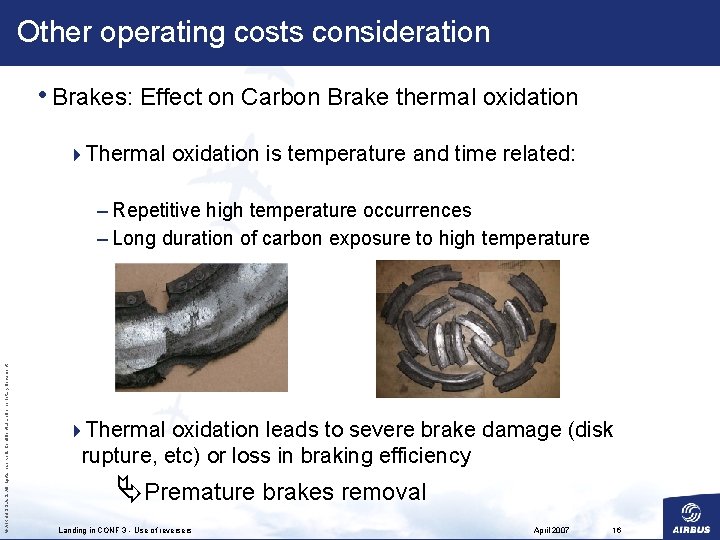
Other operating costs consideration • Brakes: Effect on Carbon Brake thermal oxidation 4 Thermal oxidation is temperature and time related: © AIRBUS S. All rights reserved. Confidential and proprietary document. – Repetitive high temperature occurrences – Long duration of carbon exposure to high temperature 4 Thermal oxidation leads to severe brake damage (disk rupture, etc) or loss in braking efficiency Premature brakes removal Landing in CONF 3 - Use of reversers April 2007 16
Other operating costs consideration • Brakes: Effect on Carbon Brake thermal oxidation 4 Increased approach speed Higher brake energy is necessary to stop the aircraft 4 Rev Idle instead of Rev max Poor sharing of brake energy between reversers and brakes © AIRBUS S. All rights reserved. Confidential and proprietary document. Depending on flight crew braking management, brake oxidation could be drastically increased Landing in CONF 3 - Use of reversers April 2007 17
Other operating costs consideration • Brakes: General guidelines 4 To minimize negative effect on the brakes the following could be considered: – Restrict the application of such procedure to runway where Autobrake LO can be used and is actually used. © AIRBUS S. All rights reserved. Confidential and proprietary document. – Do not override the autobrake to shorten the landing distance. – Respect basic Airbus SOP recommendations: • Delay the brake fans selection for 5 minutes (or at the gate) if turn-around permits. • Avoid prolonged parking brake application on hot brakes. Landing in CONF 3 - Use of reversers April 2007 18
Content ì General considerations ì Fuel economy estimation ì Additional considerations: ì Other operating cost considerations © AIRBUS S. All rights reserved. Confidential and proprietary document. ì Operational consequences ì Pro and Cons: Summary ì Conclusion Landing in CONF 3 - Use of reversers April 2007 19
Operational consequences • Approach in CONF 3: 4 Higher pitch attitude May increase the number of alert triggering by the Flight Data Monitoring software Impact on tailstrike margins © AIRBUS S. All rights reserved. Confidential and proprietary document. – Tailstrike margins are reduced (except for the A 321 aircraft) but, for example, roughly corresponds to: – 5 to 6 degrees on Single Aisle Aircraft family – 7 to 8 degrees on Long Range Aircraft family Tailstrike margins remain comfortable Landing in CONF 3 - Use of reversers April 2007 20
Operational consequences • Use of reversers at Idle: 4 Potential increase in runway occupancy time and block time 4 Additional brake cooling time: could be limitative in case of short turn around-time © AIRBUS S. All rights reserved. Confidential and proprietary document. Must be taken into account for operations Landing in CONF 3 - Use of reversers April 2007 21
Content ì General considerations ì Fuel economy estimation ì Additional considerations: ì Other operating cost considerations © AIRBUS S. All rights reserved. Confidential and proprietary document. ì Operational consequences ì Pro and Cons: Summary ì Conclusion Landing in CONF 3 - Use of reversers April 2007 22
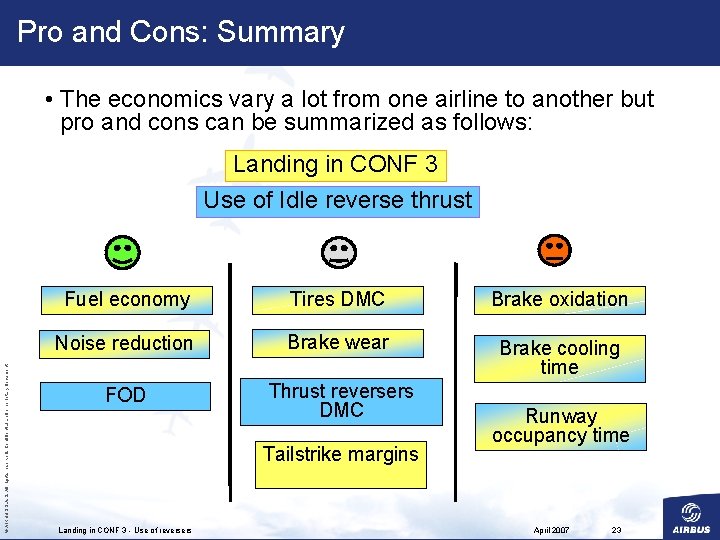
Pro and Cons: Summary • The economics vary a lot from one airline to another but pro and cons can be summarized as follows: Landing in CONF 3 © AIRBUS S. All rights reserved. Confidential and proprietary document. Use of Idle reverse thrust Fuel economy Tires DMC Brake oxidation Noise reduction Brake wear Brake cooling time FOD Thrust reversers DMC Tailstrike margins Landing in CONF 3 - Use of reversers Runway occupancy time April 2007 23
Content ì General considerations ì Fuel economy estimation ì Additional considerations: ì Other operating cost considerations © AIRBUS S. All rights reserved. Confidential and proprietary document. ì Operational consequences ì Pro and Cons: Summary ì Conclusion Landing in CONF 3 - Use of reversers April 2007 24
Conclusion – Airbus recommendation is: • To maximize safety margins in normal operation, Airbus SOP still recommends to approach in CONF FULL and to use MAX thrust reverse for landing. • For economics, provided runway length and conditions are favorable, landing in CONF 3 and/or use of idle reverse thrust can be considered. © AIRBUS S. All rights reserved. Confidential and proprietary document. • No REV landing not recommended 4 System Safety Assessment based on the fact that reversers are deployed at each landing 4 No real benefit in term of fuel economy Landing in CONF 3 - Use of reversers April 2007 25
Conclusion • When applying such procedure, to minimize induced negative effect, the following could be considered: • Restrict the application of such procedure on runway where Autobrake LO can be used and check dispatch conditions. • Do not override the autobrake to shorten the landing distance • Pay particular attention on brake fans use © AIRBUS S. All rights reserved. Confidential and proprietary document. Good Dispatcher and Flight Crew awareness is necessary Clear Airline policy has to be defined for: - All aircraft types - All considered runways Landing in CONF 3 - Use of reversers April 2007 26
- Slides: 26