
Presented By Dr Nadia Mohammed lecturer of Psychiatric
Presented By Dr Nadia Mohammed lecturer of Psychiatric Nursing & Mental Health
At the end of this lecture, you should be able to: v Define communication. v Mention Purpose of communication. v Mention types of communication v Explain the process of communication v Mention Factors affecting communication. v Identify forms of communication. v Mention Characteristics communication of successful
INTRODUCTION Communication is a basic for human relationship, without it, there is no sort of relation will developed. As a psychiatric nurse, it is very important to understand the client and being understood by the client. This can be attained through studying communication process.
DEFINITION OF COMMUNICATION A two ways process and a dynamic interaction concerned with conveying a message between at least two person, one person is the sender and the other is the receiver of the message. The role may become reversed at any time. Communication is the art of transmitting ideas, information, feelings or attitudes and thoughts from one person to another.

The process of people sharing thoughts, ideas, and feelings with each other in commonly understandable ways. 5
PURPOSE OF COMMUNICATION 1 -To understand be understood. 2 - Communicate our beliefs & values. 3 - Communicate perceptions & meanings. 4 - Convey interest and understanding or judgment. 5 - Interaction with others gives the individual sense of identity and being a person’s.

PURPOSE OF THERAPEUTIC COMMUNICATION 1 - Establish a therapeutic nurse- patient relationship. 2 - Identify client’s concerns, needs, and problems. 3 - Assess client’s perception of the problem. 4 - Guide client towards a satisfying and socially acceptable solutions.
Types of communication
(1)INTRAPERSONAL COMMUNICATION Occurs when people communicate within themselves. Ex : self evaluation –personal talk- imagining or solving problems in your head.
(2) INTERPERSONAL COMMUNICATION The process of message transaction between groups of two persons and in small groups. EX: couples, friend to friend, a teacher and student discussing an assignment.
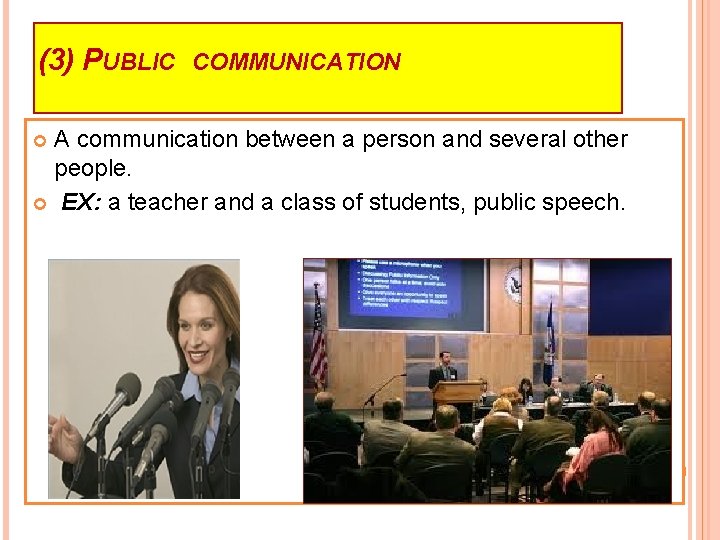
(3) PUBLIC COMMUNICATION A communication between a person and several other people. EX: a teacher and a class of students, public speech.
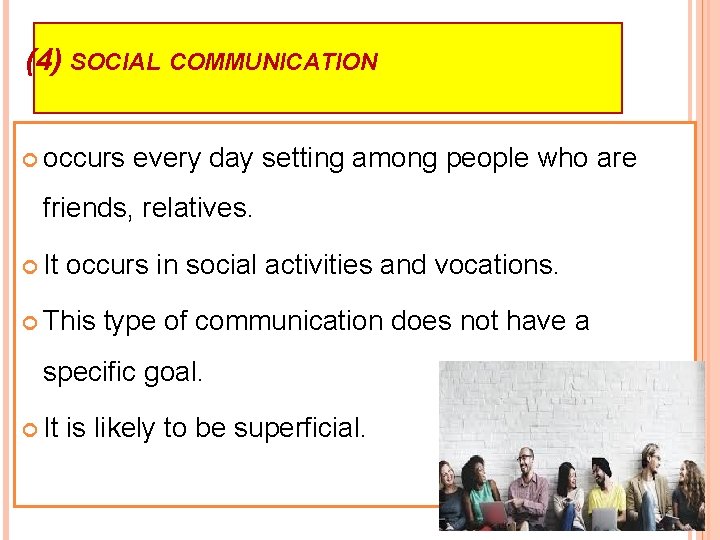
(4) SOCIAL COMMUNICATION occurs every day setting among people who are friends, relatives. It occurs in social activities and vocations. This type of communication does not have a specific goal. It is likely to be superficial.
(5) COLLEGIALCOMMUNICATION Communication between and among members of a team/ profession who meet for a common purpose or goal. EX: such as nursing or medicine, sport, psychology.
(6) THERAPEUTICCOMMUNICATION It is an interpersonal interaction between the nurse and client during which the nurse focuses on the client’s specific needs to promote an effective exchange of information.
COMMUNICATION PROCESS
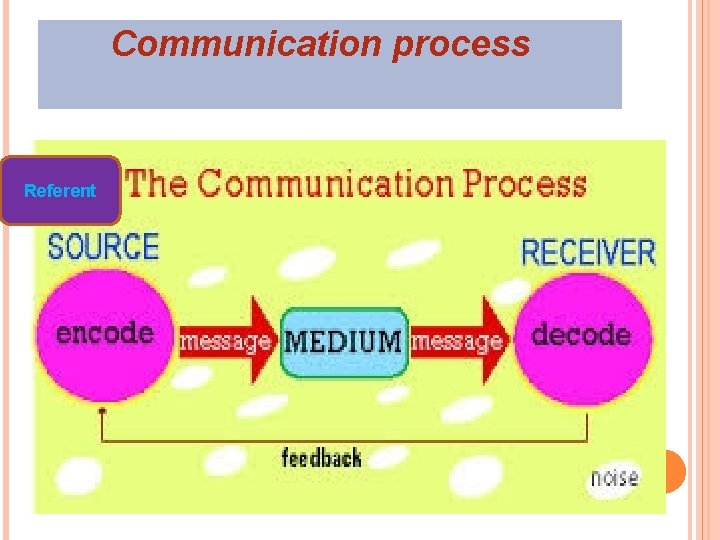
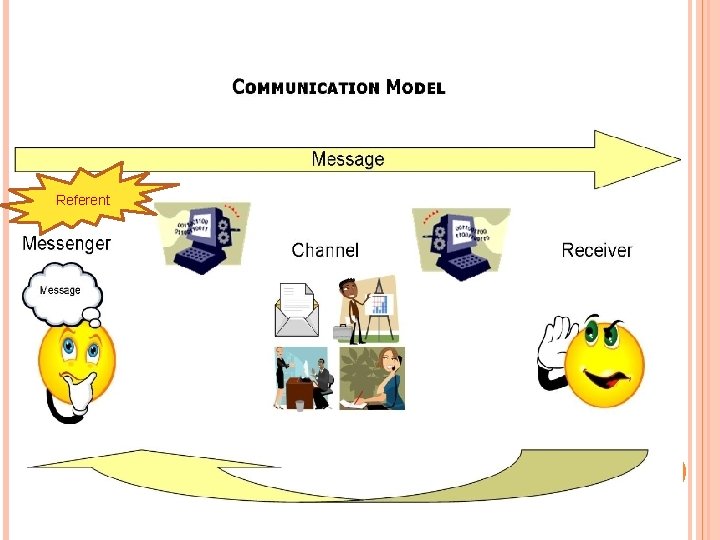
Communication process - (Berlo, 1960) models identify the process of communication as following: 1 -The Referent (stimulus) Communication always starts after a need. The stimulus can be a need for information, comfort, or advice 2 -The Sender / Messenger / Encoder Is the person who initiates the transmission of information (verbal and nonverbal)
Communication process 3 -The message It is the information sent or expressed by other. The clearest messages are those that are well organized and expressed in a familiar manner to the receiver 4 -Medium (channel) A message can be sent through an auditory (hearing), visual (seeing) or tactile (touch) medium. Ex. A person may send a very clear message through silence, and body language.
Communication process 5 -Receiver /decoder Is the person who receives and interpret the message. ( may be single person or more than one person) The receiver then responds to the sender by giving feedback to the sender. The process of interpreting the message by the receiver is called decoding.
Communication process 6 -Noise Anything that interferes with or impedes the ability to send or receive a message. Noise distracts communicators by focusing their attention on something communication act. extraneous to the
Communication process 7 -Feed back It means the response that a receiver makes to a sender’s message. Feedback is information we receive in response to messages we have sent. It can be both verbal and nonverbal and lets us know how another person is responding to us. Examples ( silence and ignoring)
Communication process Referent
Referent
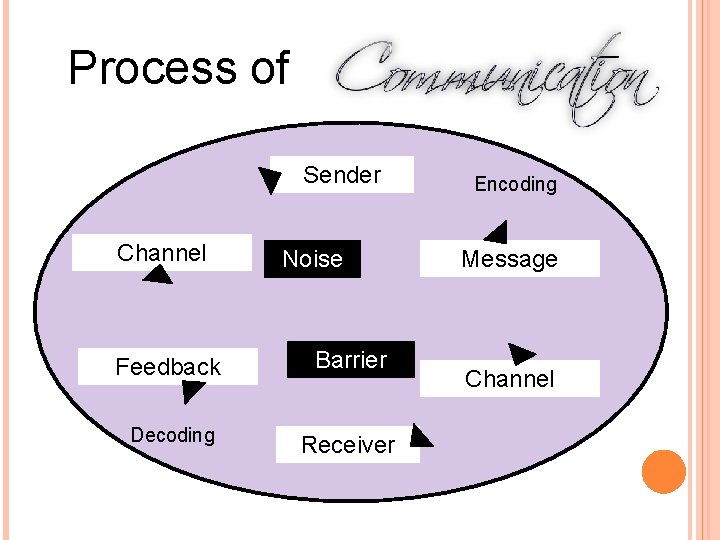
Process of Sender Channel Noise Feedback Barrier Decoding Receiver Encoding Message Channel 23
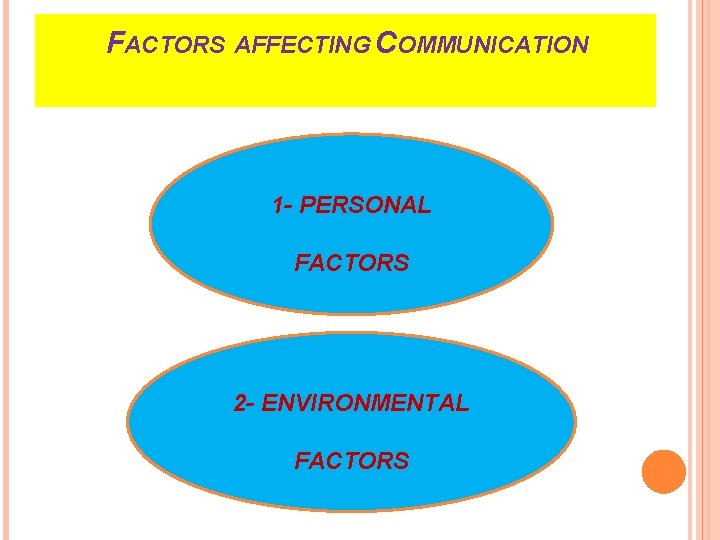
FACTORS AFFECTING COMMUNICATION 1 - PERSONAL FACTORS 2 - ENVIRONMENTAL FACTORS
(1) PERCEPTION, VALUES Values (i. e. , ideals, standards, or moral codes that determine what is right or important). They are acquired through the process of socialization and interaction with others. People can look at the same object and see different things, because people tend to perceive in terms of past experiences, expectations and goals. Also people's values like their perception differ.
(2)GENDER Men and women may give different interpretation to the same conversation because girls use language to reinforce intimacy, while boys use language to establish their independence.
(3)SOCIO-CULTURAL BACKGROUND Communication is culture-bound in the sense that each culture teaches individuals how to communicate through language, clothing, jewelry, hand gestures, facial expression, and the utilization of space.
(4)SOCIAL CLASS communications differ between social classes in relation to gestures and appearance, such differences may create communication barriers between peoples of different social classes.
(5) RELATIONSHIP FACTORS It's referring to whether the participants are equal or un equal as follow; (Symmetrical relation ship) when the two participants are equal such as friends or colleagues. (Complementary relation ship) when there is a difference in power (one participant is superior to the other)
(6)PAST EXPERIENCES Previous positive or negative experiences influence one’s ability to communicate. For example, teenagers who have been criticized by parents whenever attempting to express any feelings may develop a disturbed self-concept and feel that their opinions are not worthwhile.
(7)KNOWLEDGE OF SUBJECT MATTER A person who is well educated or knowledgeable about certain topics may communicate with others at a high level of understanding.
(8) PHYSIOLOGICAL-IMPAIRMENT NOISE OR DEVELOPMENTAL LEVEL Physical illnesses that prevent effective communication, such as actual deafness or blindness preventing messages from being received as they were intended.
2 - ENVIRONMENTAL FACTORS: 1 - time. 2 - Place. 3 - Number of people present. 4 - lack of privacy. 5 - Noise level that physically disrupts communication, such as the noise from a construction site next to a classroom making it difficult to hear the professor 6 - Hot or cold weather.
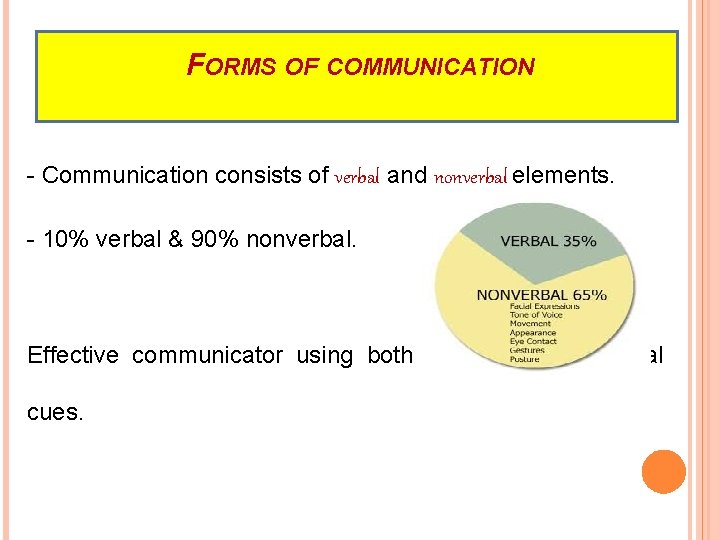
FORMS OF COMMUNICATION - Communication consists of verbal and nonverbal elements. - 10% verbal & 90% nonverbal. Effective communicator using both verbal and nonverbal cues.
1 -VERBAL COMMUNICATION Consists of all written and spoken words a person used in expression of ideas. It is the content of communication. It includes 1 - Oral communication: such as discussion between two persons and telephone call. 2 - Visual communication: such as maps, traffic signal, etc…
1 -VERBAL COMMUNICATION 3 -Written communication: such as letters, reports and paper. 4 -Electronic communication: which is communication facilitated by interface with computer, telephone fax, Email, etc…
2 -NONVERBAL COMMUNICATION: § Is the behavior accompanying the verbal content. § Is the process of communication. It includes; 1 -kinesies, (body motion) 2 -Paralanguage (voice quality and use of sounds in non language vocalization). 3 -Proxemics, (use of space) 4 -Appearance, (use of clothing and other objects)
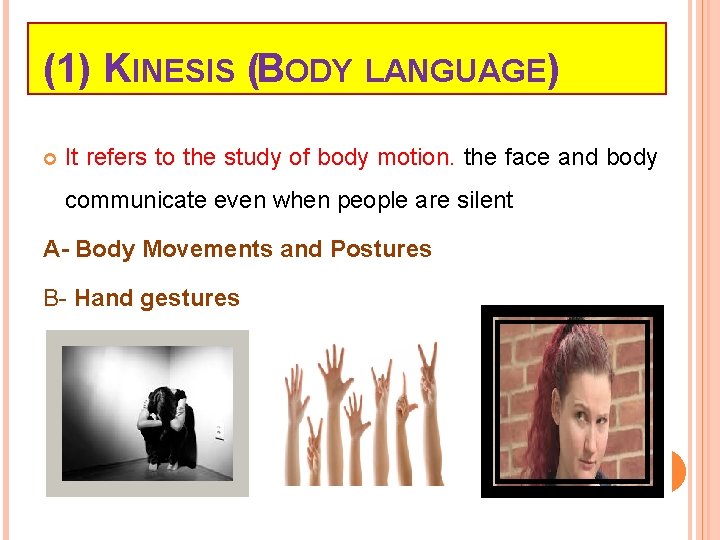
(1) KINESIS (BODY LANGUAGE) It refers to the study of body motion. the face and body communicate even when people are silent A- Body Movements and Postures B- Hand gestures
(1) KINESIS C- Facial expressions: facial expression is the primary source of communication. Facial expressions primarily reveal an individual’s emotional states, such as happiness, sadness, anger, surprise, or fear.
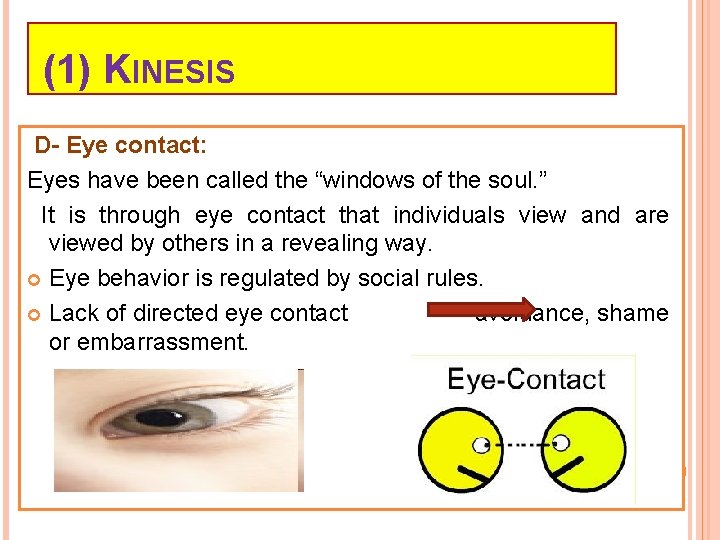
(1) KINESIS D- Eye contact: Eyes have been called the “windows of the soul. ” It is through eye contact that individuals view and are viewed by others in a revealing way. Eye behavior is regulated by social rules. Lack of directed eye contact avoidance, shame or embarrassment.
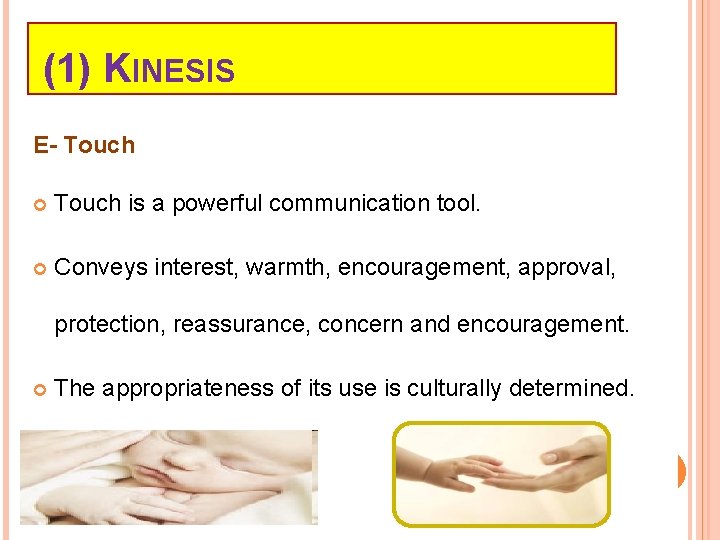
(1) KINESIS E- Touch is a powerful communication tool. Conveys interest, warmth, encouragement, approval, protection, reassurance, concern and encouragement. The appropriateness of its use is culturally determined.
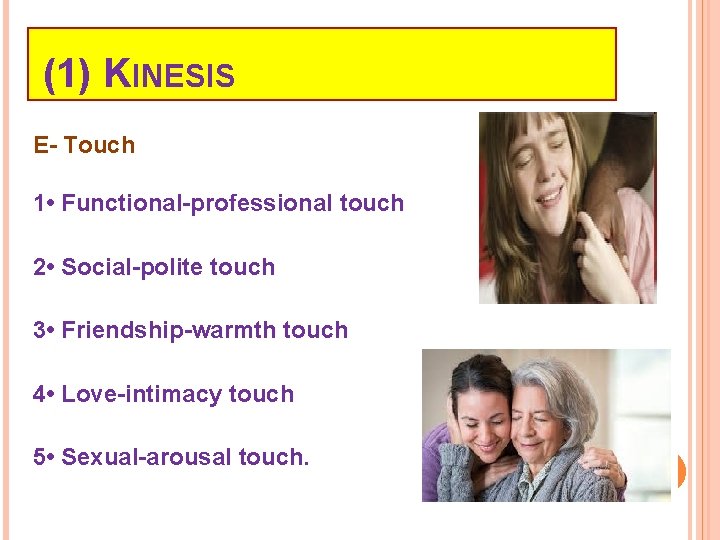
(1) KINESIS E- Touch 1 • Functional-professional touch 2 • Social-polite touch 3 • Friendship-warmth touch 4 • Love-intimacy touch 5 • Sexual-arousal touch.
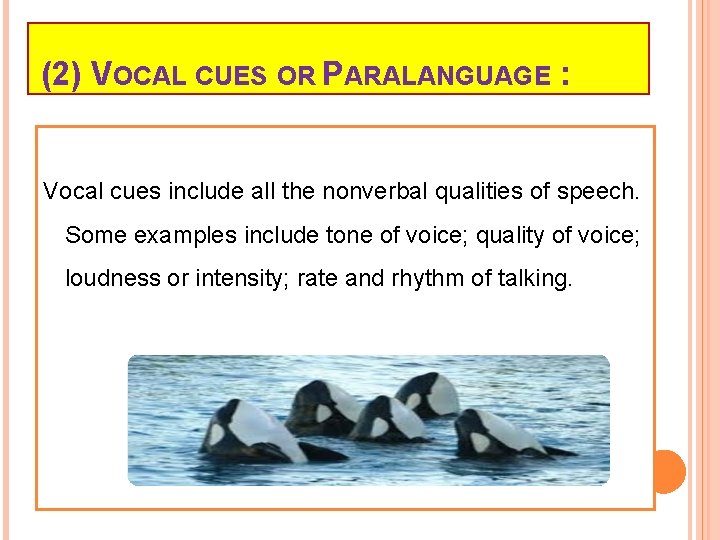
(2) VOCAL CUES OR PARALANGUAGE : Vocal cues include all the nonverbal qualities of speech. Some examples include tone of voice; quality of voice; loudness or intensity; rate and rhythm of talking.
(2) PROXEMICS: It is the study of distance zones between people during communication. Use of space which depending on people's cultural background.
(2) APPEARANCE: It refers to the way in which people use clothing to convey a message. Our dress reflects our respect for those whom we visit.
n o i t a c i n u m om C s e u q i Techn
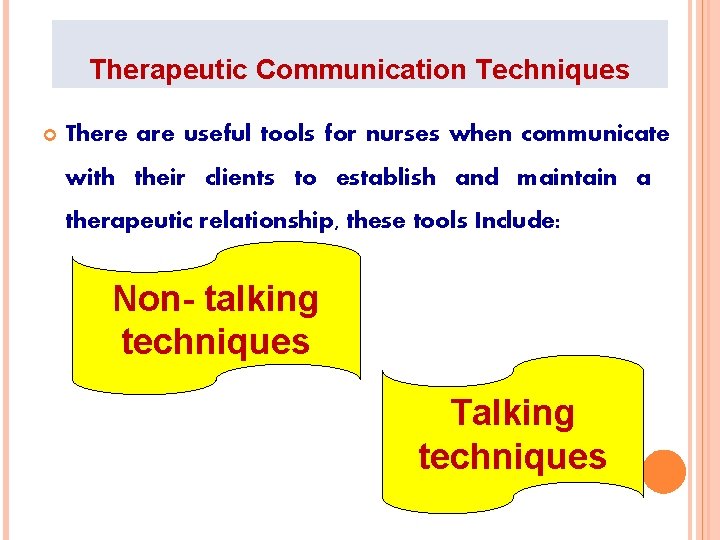
Therapeutic Communication Techniques There are useful tools for nurses when communicate with their clients to establish and maintain a therapeutic relationship, these tools Include: Non- talking techniques Talking techniques
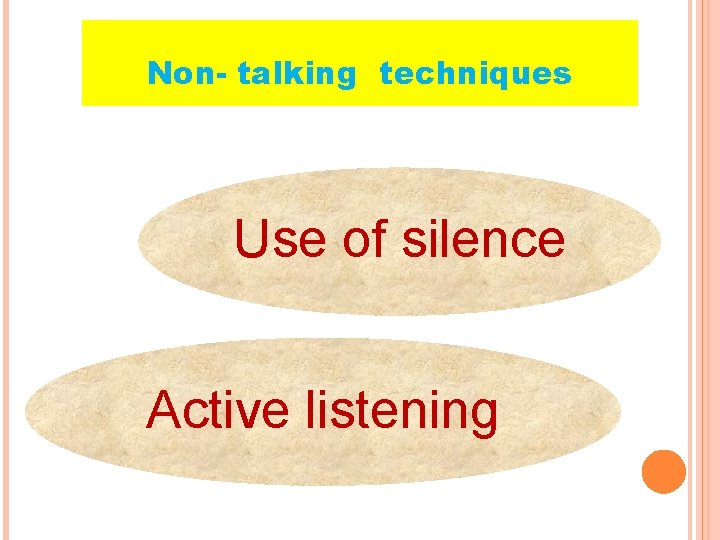
Non- talking techniques Use of silence Active listening
Use of silence � It's not the absence of communication; it's a specific channel for transmitting and receiving messages. � On the part of the patient silence may be attempt to think, recall and collect his/ her thoughts. � On the part of the nurse it may indicate acceptance and , understanding and interest. Importance of silence � It convey acceptance to the patient. � Provide time for observation of non verbal behavior. � Help in evaluation of the message. � Sometimes silence stimulates talking.
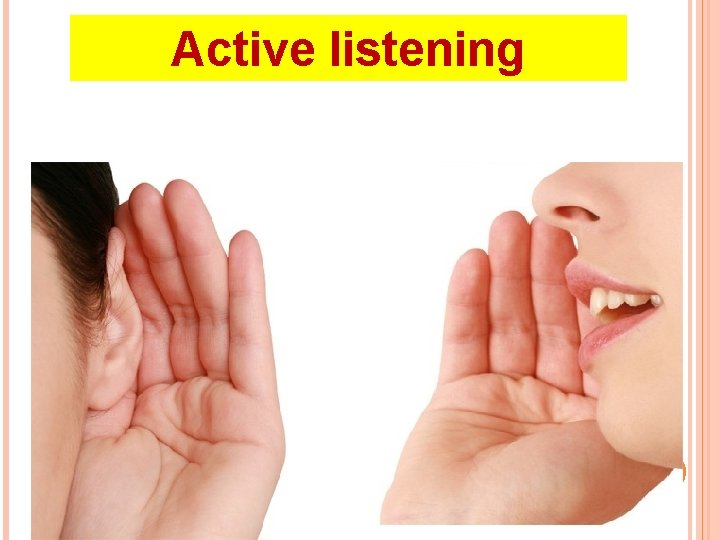
Active listening
Active listening q q One person is silent and the other one is talking. It doesn't Implies passivity, as listener must be alert, active with a very few verbal comments at the appropriate time. q To listen actively is to be attentive to what client is saying, both verbally and nonverbally.
Active listening q Several nonverbal behaviors have been designed to facilitate attentive listening. S – Sit squarely facing the client. O – Observe the client's non verbal message and an open posture. L – Lean forward toward the client. E – Establish eye contact. R – Relax.
Talking techniques 1 - Giving information: making available the data that the client needs. EX: “Visiting hours are. . . ” “My purpose for being here is. . . “ 2 - Offering self: Making self available, offer presence, interest, and concern. Ex. “I would like to spend time with you”
Talking techniques 3 - Giving broad openings : clarifies that the lead is to be taken by the client. (Allow the client to assume some control over topics to be discussed). q The nurse should not allow the patient to discuss non- relevant topics or engage in conversation with a social content. . Ex. “Where would you like to begin”, ” What do you want to talk about”
Talking techniques 4 - Offering general leads: This is a brief statement intended to indicate that the nurse is listening and to encourage the client to continue talking on the same subject Ex. “Go. on” “and then” 5 - Accepting : indicates that the person has been understood in a nonjudgmental and interested manner. Ex. “ I can imagine how that you feel “ “ I understand what you are saying”
Talking techniques 6 - Making observation : calls attention to patient’ behavior and verbalizes what the nurse observed. Ex. “ You appear sad”. “ I notice you’re biting your lips “. “ You seems restless”. 7 - Giving recognition : indicates awareness of change and personal efforts. Does not imply good or bad, right or wrong. Ex. “You’ve combed your hair today”
Talking techniques 8 - Encouraging description of perception: Asking the client to verbalize what he or she perceives. Ex. What do these voices tell you? 9 - Presenting reality: when the patient has a misperception of the environment, the nurse define reality. q The nurse does not urge or try to persuade the patient. EX: ( I understand/ believe your concerns but I don’t see anyone else in the room)
Talking techniques 10 - Voicing doubt: expressing uncertainty about the reality of the client’s beliefs. Ex. (really ? ) (That’s hard to believe).
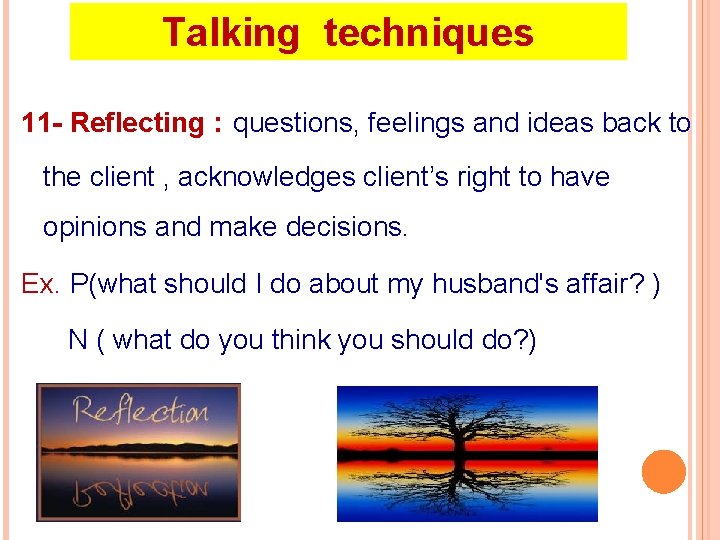
Talking techniques 11 - Reflecting : questions, feelings and ideas back to the client , acknowledges client’s right to have opinions and make decisions. Ex. P(what should I do about my husband's affair? ) N ( what do you think you should do? )
Talking techniques 12 - Restating: Gives the client an idea of what has been communicated using merely the same words he has used, if the message has been misunderstood, the pt can clarify it. Ex. P. (I can’t sleep, I stay a wake all night. ) N. (stay a wake all night. )
Talking techniques 13 - Paraphrasing: repeating the main idea expressed in different words. EX: C : “I can’t sleep, I stay awake all night. ” N: “You have difficulty sleeping. ” 14 - Focusing : concentrates attention on a single issue especially when the client jump from topic to topic.
Talking techniques 15 - Exploring: examines certain ideas, experiences or relationships more fully especially when patient tend to remain on superficial level of communication. EX: “Tell me more about that. ” 16 - Seeking clarification: seeking to clear up which is not meaningful or that which is confused or vague. Helps the clients to clarify their own thoughts and rethink. EX: ( I’m not sure what you mean by. . . ) (Could you tell me about that again)
Talking techniques 17 -Summaring : summing up that which has gone before EX. (you said that…. ), (During the past hour we have discussed. . . . ) 18 - Attempting to translate into feelings: the nurse tries to find clues to the underlying meaning. putting into words the feelings the client has expressed only indirectly.
Non- Therapeutic Communication Techniques 1 - Giving reassurance: may discourage client from further expression of feelings. indicating there is no reason for anxiety or other feelings of discomfort. Ex. (every thing will be alright). 2 -Approving or dis-approving: implies that the nurse has the right to pass judgment on the “goodness” or “badness” of client’s behavior. Ex. (that’s good. . . ) (that’s bad…)
Non- Therapeutic Communication Techniques 3 - Agreeing or disagreeing - implies that the nurse has the right to pass judgment on whether client’s ideas or opinions are “right” or “wrong” Ex. (I agree…) (I disagree with that. . ) 4 - Rejecting: refusing to consider client’s ideas or behavior Ex. (I don’t want to hear about…)
Non- Therapeutic Communication Techniques 5 - Agreeing or disagreeing: implies that the nurse has the right to pass judgment on whether client’s ideas or opinions are “right” or “wrong” Ex. (I agree…) (I disagree with that. . ) 6 - Giving advice: implies that the nurse knows what is best for client and that client is incapable of any self -direction. Ex. (I think you should …)
Non- Therapeutic Communication Techniques 7 - Requesting an explanation: asking “why” and “How” questions which require analytical ability and information that patient does not have. 8 - Challenging: Ex. ( If you dead , how come your heart is beating? )
CHARACTERISTICS OF SUCCESSFUL COMMUNICATION 1 -Efficiency: The Language used by communicators is simple, clear and understood and there's must be enough time between verbal responses for the listener to perceive and evaluate them 2 -Appropriateness: Occurs when the messages are relevant to the situation at hand Appropriateness occurs when the reply is fitting and relevant to the communication received.
CHARACTERISTICS OF SUCCESSFUL COMMUNICATION 3 -Flexibility: lack of flexibility in communication can be manifested as either over control (over control) or over permissiveness (under control). 4 -Feed back: It is the return response of the listener by which performance is checked, it allows people to decide which message have been understood as intended. Feed back requires the cooperation of two persons, one to give it and one to receive it.
Questions 1 - Characteristics of successful communication are ……. , …………. , ……………… 2 - Paralanguage includes all of the following Except: A. Tone of voice. B. Non language vocalizations such as sobbing and laughing. C. Spacing of wards. D. Distance. 3 - Kinesis; refers to the study of body motion. ( )

Questions 4 - Mention the appropriate response and technique should be used by the nurse when patient said: a- "My mother wants to kill me, she puts poison in the food on my plate" Nurse response: ……………………… Technique: ……………………………. . ………… b. Patient: "What should I do about my husband's business? " Nurse response: ………………………………… Technique: …………………………. . ……… c. "I see devils now; you see them too, right? “ Nurse response: . . . . . . Technique: . . . . . .
- Slides: 71