
Presented by Amanda Hassan MSW Disability Services Coordinator
Presented by: Amanda Hassan, MSW, Disability Services Coordinator Joseph Williams, MSW, Special Needs Counselor ACCESSIBLE EDUCATION FOR STUDENTS WITH SPECIAL NEEDS
DISABILITY LAWS � The Rehabilitation Act of 1973 -Section 504 � Section 504 states: “No otherwise qualified person with a disability in the United States. . . shall, solely on the basis of disability, be denied access to, or the benefits of, or be subjected to discrimination under any program or activity provided by any institution receiving federal financial assistance. ” � The American with Disabilities Act � Protects individuals with disabilities from discrimination because of their disability
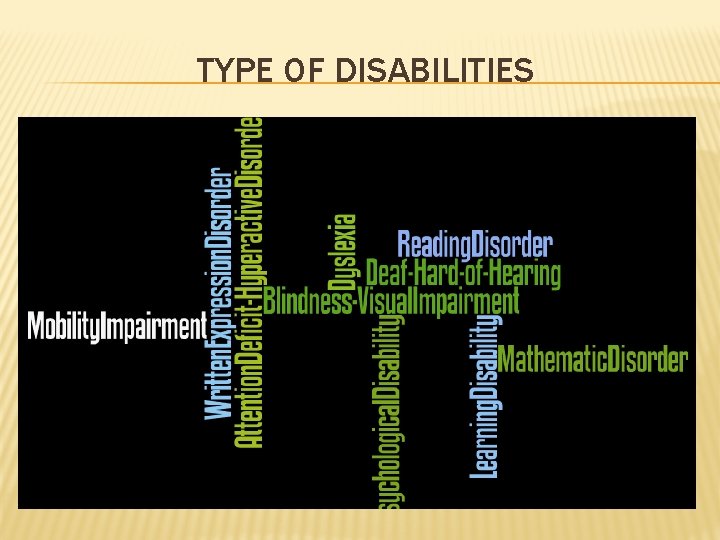
TYPE OF DISABILITIES
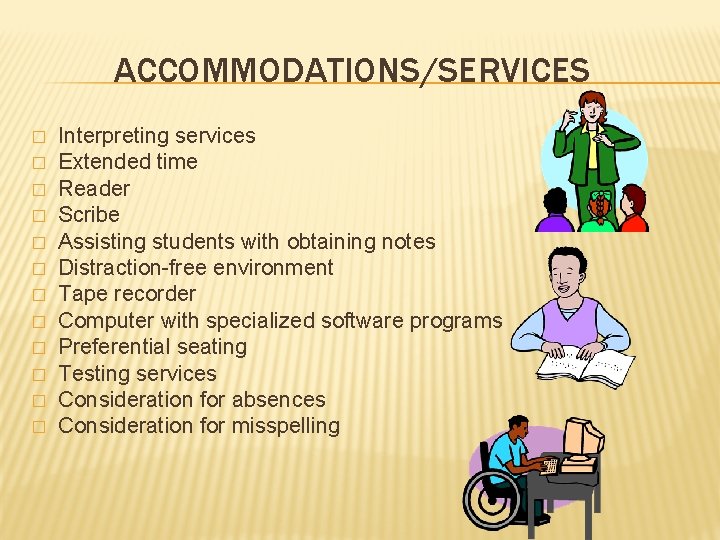
ACCOMMODATIONS/SERVICES � � � Interpreting services Extended time Reader Scribe Assisting students with obtaining notes Distraction-free environment Tape recorder Computer with specialized software programs Preferential seating Testing services Consideration for absences Consideration for misspelling
BARRIERS � � � � Barriers � Think about the barriers that might prevent students with disabilities from participating in the classes, programs, services, and activities that are offered. Physical barriers � Make sure there accessible routes throughout the campus, including routes into buildings. Make sure there is adequate accessible signage. Make sure that adjustable desks or table are available. Program barriers � Review eligibility requirements that tend to screen out people with disabilities, like a requirement that people are able to manipulate lab instruments with their hands. Service animal policy Communication barriers Accessible information technology is critical at the college and university level. Web sites and Online Courses should be accessible to students with visual disabilities (screen reader technology).
UNIVERSAL DESIGN? � Creation or adaptation of environments, programs and products to be usable by everyone, to the greatest extent possible, without the need for adaptation or specialized design. � � For example, ramps and automatic door openers benefit individuals using walkers and wheelchairs, but also benefit elderly people, mothers with baby strollers, or business people with rolling briefcases. If television displays in public areas are captioned, programming is accessible to people who are deaf and everyone else who cannot hear the audio in noisy areas. Universal design goes beyond minimum codes and standards to create designs that serve the broadest public (including people with disabilities) throughout their life spans. A universal design approach to service delivery holds the promise of creating more inclusive environments, alleviating the need for some individual accommodations and creating a more collaborative, wide-reaching role for providers.
ACCESSIBILITY OF COURSE MATERIAL � � Students with disabilities must have the appropriate auxiliary aids needed to locate and obtain library resources. Basic index of holdings (whether formatted on-line or on index cards) must be accessible. � � For example, a screen and keyboard (or card file) must be placed within reach of a student using a wheelchair. If a Braille index of holdings is not available for blind students, readers must be provided for necessary immediate assistance. Class notes � Examinations � Written materials � Public Law 104 -197. . . � Permits reproduction of books in alternate formats for individuals with disabilities �
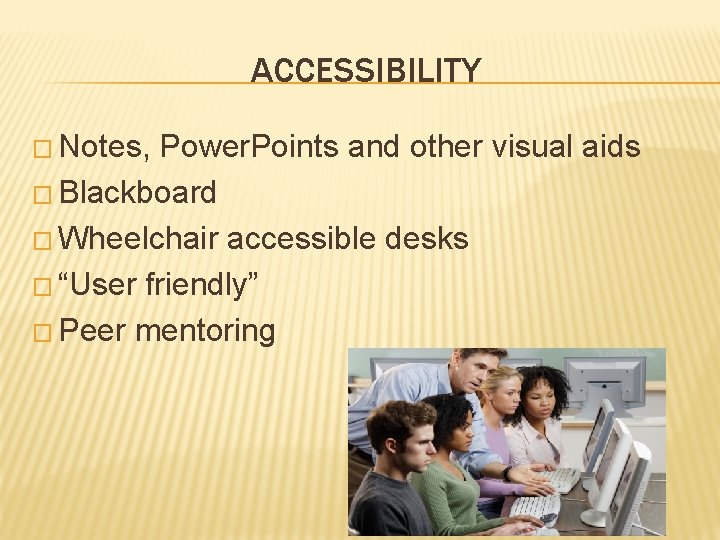
ACCESSIBILITY � Notes, Power. Points and other visual aids � Blackboard � Wheelchair accessible desks � “User friendly” � Peer mentoring
TESTING � Testing Center Option � Send test to The Testing Center via email: cityparktesting@dcc. edu � Student appointment at least 2 days in advance � Specific instructions
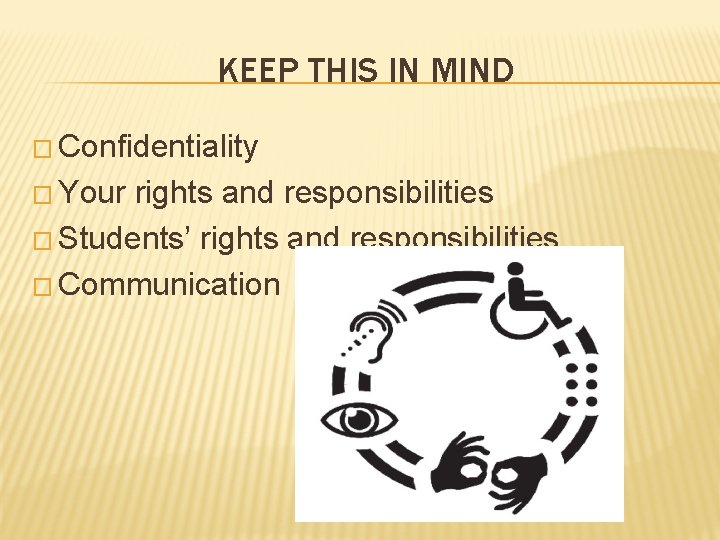
KEEP THIS IN MIND � Confidentiality � Your rights and responsibilities � Students’ rights and responsibilities � Communication
YOUR RIGHTS AND RESPONSIBILITIES � RIGHTS: � � DO NOT ASSUME DO ASK FOR VERIFICATION DO ASK FOR ASSISTANCE RESPONSIBILITIES: � � � � ASSIST INFORM CONFIRM PROVIDE KNOW OPTIONS COMMUNICATE CONSULT EXCEPTIONS
STUDENT RIGHTS & RESPONSIBILITIES � Rights: � � � ADA & SECTION 504 EQUAL ACCESS DENIAL? REASONABLE ACCOMMODATIONS CONFIDENTIALITY Responsibilities: � � � SELF IDENTIFY DOCUMENTATION REQUEST PRESENT & COMMUNICATE REPORT CODE OF CONDUCT
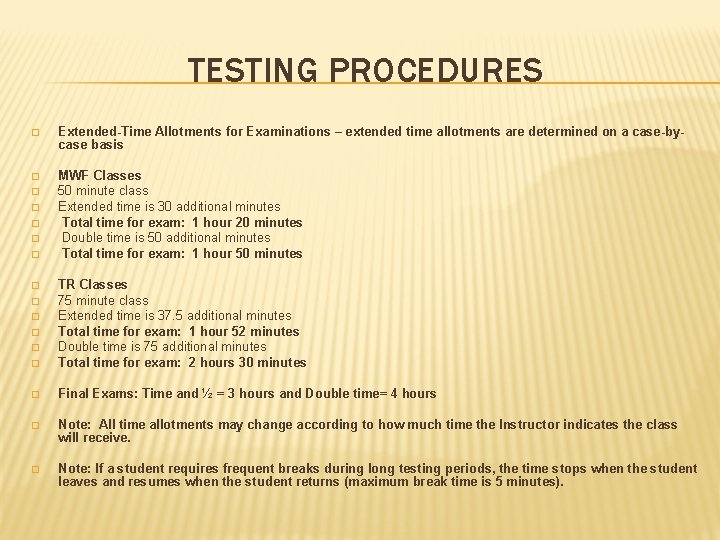
TESTING PROCEDURES � Extended-Time Allotments for Examinations – extended time allotments are determined on a case-bycase basis � MWF Classes 50 minute class Extended time is 30 additional minutes Total time for exam: 1 hour 20 minutes Double time is 50 additional minutes Total time for exam: 1 hour 50 minutes � � � TR Classes 75 minute class Extended time is 37. 5 additional minutes Total time for exam: 1 hour 52 minutes Double time is 75 additional minutes Total time for exam: 2 hours 30 minutes � Final Exams: Time and ½ = 3 hours and Double time= 4 hours � � � � Note: All time allotments may change according to how much time the Instructor indicates the class will receive. � Note: If a student requires frequent breaks during long testing periods, the time stops when the student leaves and resumes when the student returns (maximum break time is 5 minutes).
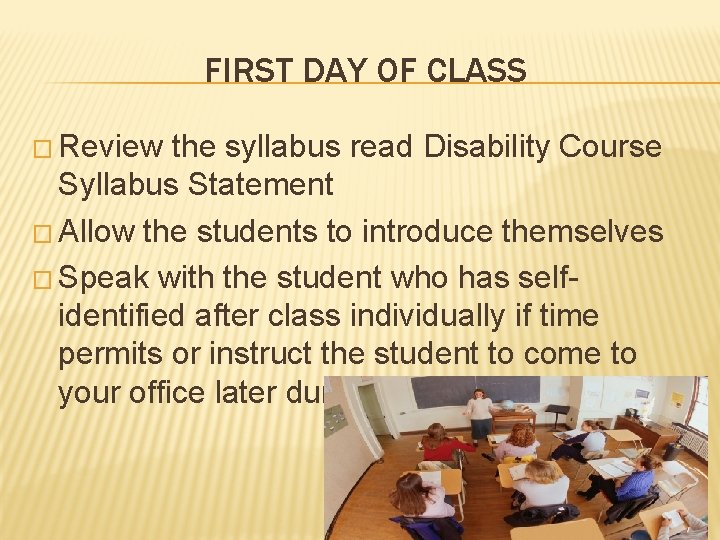
FIRST DAY OF CLASS � Review the syllabus read Disability Course Syllabus Statement � Allow the students to introduce themselves � Speak with the student who has selfidentified after class individually if time permits or instruct the student to come to your office later during office hours
ODS WORKING TOGETHER WITH YOU � Seminars and trainings � Community resource information � Liaisons for the Disability laws � Advocate for you as well as the student � One on one meetings
HELPFUL TIPS: STUDENTS WITH AUTISM � � � Keep directions simple Use clear and detailed directives when referring to revisions that need to be made Ask the students to repeat the directions in his/her own words to check comprehension Supplement oral with written instructions Use clear directives and establish rules if… � � � a student invades your space or imposes on your time the student's classroom comments or conversational volume become inappropriate Clearly define course requirements, the dates of exams and when assignments are due. Provide advance notice of any changes.
HELPFUL TIPS: STUDENTS WHO ARE DEAF/HARD OF HEARING � Speak directly to the student not the interpreter � Maintain class lectures and discussions � Maintain visual contact � Captioning � Pause periodically
HELPFUL TIPS: STUDENTS WITH LEARNING DISABILITIES � Encourage frequent contact � Be sensitive to disability-related issues � Class participation alternatives � Compose exams in a way that makes them accessible for students with learning disabilities � No scantron � Readers � Scribes
HELPFUL TIPS: STUDENTS WITH ADHD � Supplement oral instructions for written instructions (on board or paper) � Try to make class material stimulating � Alternate lecture with discussions � Provide written outlines or notes
HELPFUL TIPS: STUDENTS WITH PHYSICAL DISABILITIES � Wheelchair accessible classroom � Personal care attendants � Frequent breaks � Good eye contact � Aware of student signals � May want to participate � Medical emergency/seizure � Provide outlines/notes
HELPFUL TIPS: STUDENTS WITH PSYCHOLOGICAL DISABILITIES � Encourage frequent communication � Service animals � Don't press students to explain their disabilities if they do not wish to do so � Frequent breaks
HELPFUL TIPS: STUDENTS WITH SPEECH IMPAIRMENTS � Meet with the student early in the semester to discuss their communication styles and how they can best function in your classroom � Will they be able to answer if you call on them? � Will they be able to ask questions and make comments during class discussions, or do oral presentations? � Alternates to testing and participation � Address the student directly and ask for clarification if needed or for the student to repeat what was said
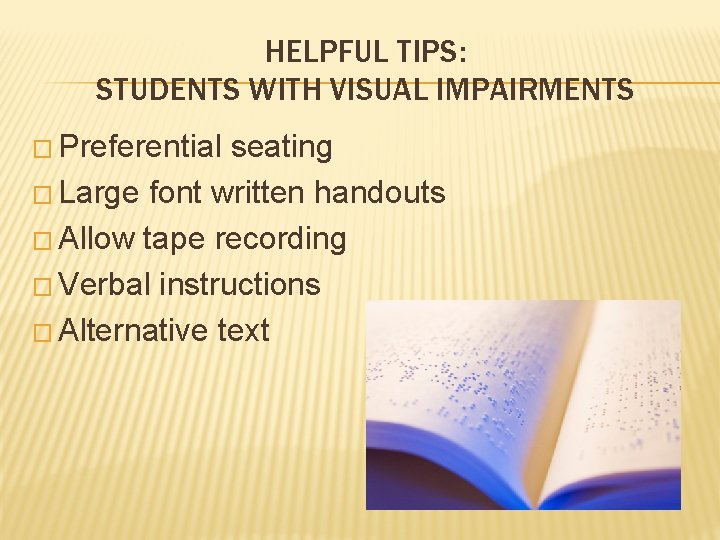
HELPFUL TIPS: STUDENTS WITH VISUAL IMPAIRMENTS � Preferential seating � Large font written handouts � Allow tape recording � Verbal instructions � Alternative text
KEEP IN MIND � Do not ask the student about the nature of his/her disability � Do not assume a student has a disability � Do not demand to see their documentation � Do provide the same customer service to students with disabilities as you would all other students � Do assist when they ask for assistance as best you can
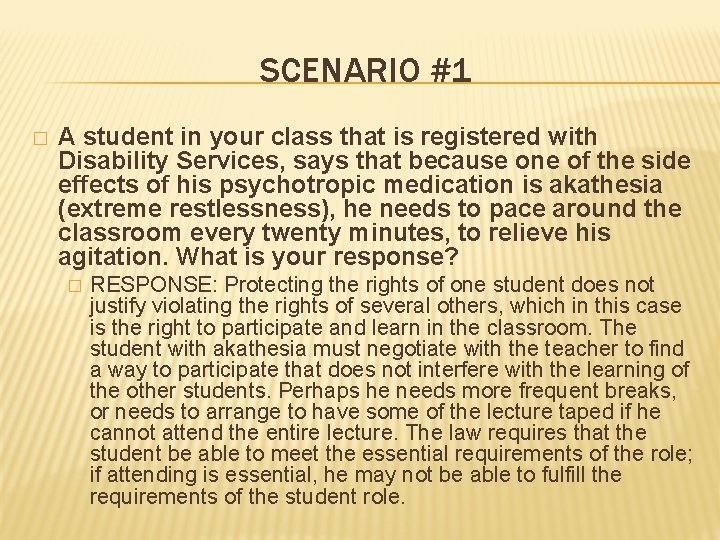
SCENARIO #1 � A student in your class that is registered with Disability Services, says that because one of the side effects of his psychotropic medication is akathesia (extreme restlessness), he needs to pace around the classroom every twenty minutes, to relieve his agitation. What is your response? � RESPONSE: Protecting the rights of one student does not justify violating the rights of several others, which in this case is the right to participate and learn in the classroom. The student with akathesia must negotiate with the teacher to find a way to participate that does not interfere with the learning of the other students. Perhaps he needs more frequent breaks, or needs to arrange to have some of the lecture taped if he cannot attend the entire lecture. The law requires that the student be able to meet the essential requirements of the role; if attending is essential, he may not be able to fulfill the requirements of the student role.
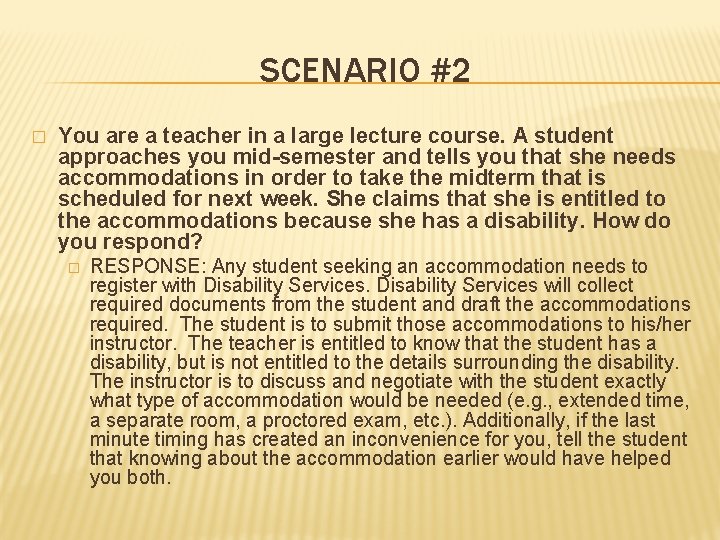
SCENARIO #2 � You are a teacher in a large lecture course. A student approaches you mid-semester and tells you that she needs accommodations in order to take the midterm that is scheduled for next week. She claims that she is entitled to the accommodations because she has a disability. How do you respond? � RESPONSE: Any student seeking an accommodation needs to register with Disability Services will collect required documents from the student and draft the accommodations required. The student is to submit those accommodations to his/her instructor. The teacher is entitled to know that the student has a disability, but is not entitled to the details surrounding the disability. The instructor is to discuss and negotiate with the student exactly what type of accommodation would be needed (e. g. , extended time, a separate room, a proctored exam, etc. ). Additionally, if the last minute timing has created an inconvenience for you, tell the student that knowing about the accommodation earlier would have helped you both.
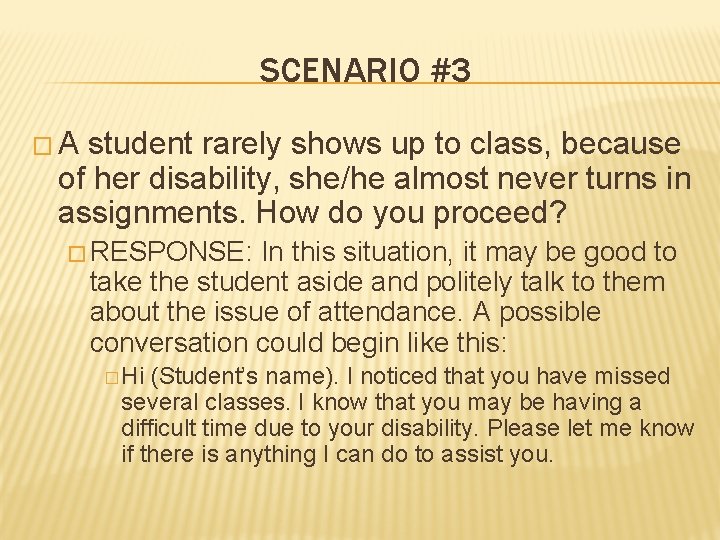
SCENARIO #3 � A student rarely shows up to class, because of her disability, she/he almost never turns in assignments. How do you proceed? � RESPONSE: In this situation, it may be good to take the student aside and politely talk to them about the issue of attendance. A possible conversation could begin like this: � Hi (Student’s name). I noticed that you have missed several classes. I know that you may be having a difficult time due to your disability. Please let me know if there is anything I can do to assist you.
OFFICE OF DISABILITY SERVICES � Amanda Hassan, MSW City Park Campus, Charity School of Nursing, Sidney Collier Site and Northshore. Slidell Site � Building 2 Room 102 � 504 -671 -5161 � ahassa@dcc. edu � � Joseph Williams, MSW West Bank Campus, and Jefferson Site � West Bank Campus, La. Rocca Hall � 504 -762 -3191 � jwilli 6@dcc. edu �
OFFICE OF DISABILITY SERVICES � Questions � OR � Concerns � Please email ahassa@dcc. edu
REFERENCES Ballinger, J. (2013). Creating An Accessible Education Environment: The American With Disabilities Act Higher Education. LCTCS Conference ADA Training. Southwest ADA Center Regional Affiliate Star. Reach Enterprises, Power. Point. Colvin, (2010) Grigal, M. & Hart, D. (2009). Think college: Postsecondary education options for students with intellectual disabilities. Baltimore, MD: Paul H. Brookes. Grigal, M & Neubert, D. (2004). Public school programs for students with severe disabilities in postsecondary settings. Education and Training in Mental Retardation and Developmental Disabilities, 36(3), 224 254. doi: 00. 1177/088572880402700105 Hall, (2011) Hart, D. , Grigal, M. , & Weir, C. (2010). Expanding the paradigm: Postsecondary education options for individuals with autism spectrum disorder and intellectual disabilities. Focus on Autism and Other Developmental Disabilities 25(3), 134 -150. doi: 10. 1177/1088357610373759. Noyes, D. & Sax, C. (2004). Changing systems for transition: Students, families, and professionals working together. Education and Training in Mental Retardation and Developmental Disabilities, 39(1), 3544 Uditsky, B. , & Hughson, A. (2007). Inclusive post-secondary education for students with significant developmental disabilities: challenging legal, moral and pragmatic assumptions. Retrieved February 3, 2011 from National-Louis University Web site: http: //www. nl. edu/dse/docs/Uditsky%20 and%20 Hughson. Inclusive%20 postsecondary%20 education. pdf Wehman, P. & Yasuda, S. (2005) The Need and the Challenges Associated with Going to College. In E. Evans Getzel & P. Wehman, Going to College: Expanding opportunities for people with disabilities (323). Baltimore, MD: Paul H. Brookes
ADDITIONAL RESOURCES � http: //dsp. berkeley. edu/Teach. Students. With. Disa b. html#5 � http: //yalecollege. yale. edu/content/teachingstudents-disabilities-guide#1 � http: //ods. osu. edu/faculty/instructor-handbookteaching-students-with-disabilities/#sixmain � Frequently Asked Questions. docx � www. ada. gov/2010 ADAstandards_index. htm � www. adachecklist. org

THANKS
- Slides: 32