
Presentationsteknik Josef Hallberg josef hallbergltu se About me
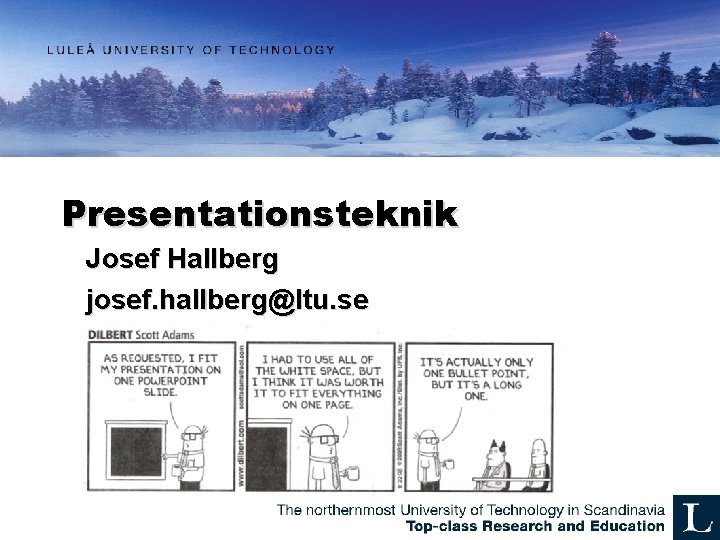
Presentationsteknik Josef Hallberg josef. hallberg@ltu. se
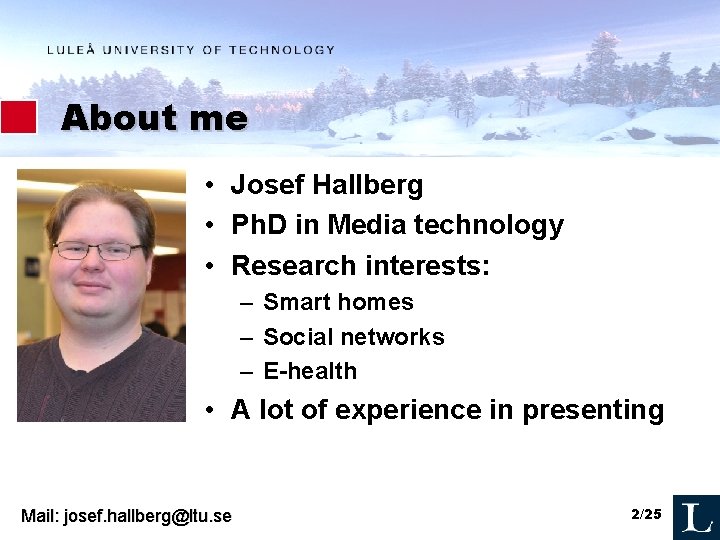
About me • Josef Hallberg • Ph. D in Media technology • Research interests: – Smart homes – Social networks – E-health • A lot of experience in presenting Mail: josef. hallberg@ltu. se 2/25
Aim with this presentation • To give an understanding for: – Why good presentations are important? – What is a good presentation? – How do you give a good presentation? Mail: josef. hallberg@ltu. se 3/25
Why are good presentations important? • Why not just give you all handouts? Mail: josef. hallberg@ltu. se 4/25
Why are good presentations important? • Presence – Captures the attention • Possibility for a dialogue – Unpredictable – More interesting and more fun • The material is conveyed – Written material is not always read Mail: josef. hallberg@ltu. se 5/25
What is a good presentation? • • • Engages Informs Integrates The correct content The correct language Red thread ”The secret of being boring is to say everything” Voltaire Mail: josef. hallberg@ltu. se 6/25
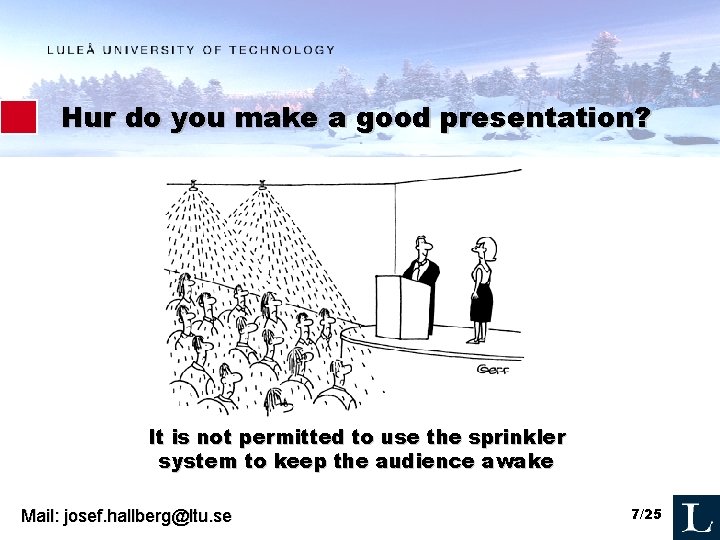
Hur do you make a good presentation? It is not permitted to use the sprinkler system to keep the audience awake Mail: josef. hallberg@ltu. se 7/25
How do you give a good presentation? • Type of presentation (target audience)? – Business presentation? – Conference presentation? – Academic presentation? • Aim/Purpose • What is most important to convey? Mail: josef. hallberg@ltu. se 8/25
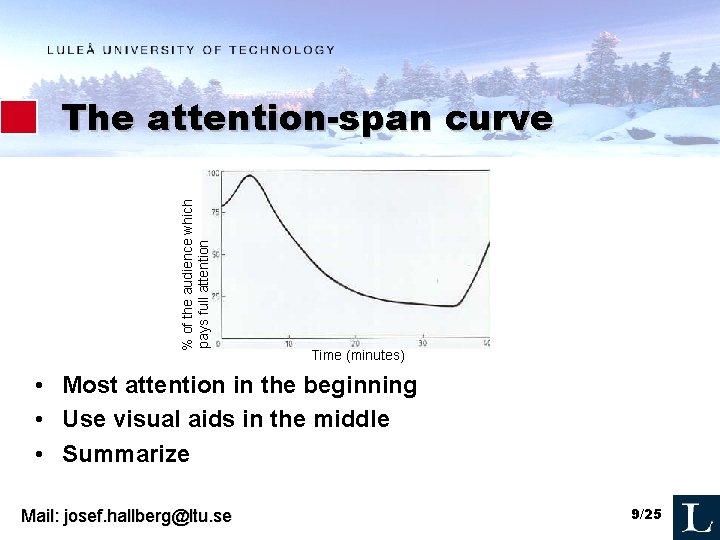
% of the audience which pays full attention The attention-span curve Time (minutes) • Most attention in the beginning • Use visual aids in the middle • Summarize Mail: josef. hallberg@ltu. se 9/25
Structure of the presentation • The Tabloid technique (recommended) – – Editorial model There is always enough time Supports questions Requires good preparation • The logical-historical model (not recommended) – Risk of not getting to the real content – Does not support interruptions Mail: josef. hallberg@ltu. se 10/25
The Tabloid technique • Structure – – – Title Overview Details Depth Summary • The most important first • Dont summarize for too long Mail: josef. hallberg@ltu. se 11/25
How do you make a good presentation? • Tips – Interaction – Presence – Preparation Mail: josef. hallberg@ltu. se 12/25
Tip 1 - Interaction • Interaction / Increase the interest – – – Toss a question to the audience The ”Bee-hive” (discussion in small groups) Use an example (Provoke) Pauses, Silence, Dynamic, Pictues, Humour Avoid a script, use pillars Mail: josef. hallberg@ltu. se 13/25
Tip 2 - Presence • Placement in the room – Don’t hide in a corner • Look for personal contact with the audience – Speak to the audience – Keep an appropriate pace • Dress so you fit in Mail: josef. hallberg@ltu. se 14/25
Tip 3 – Preparations • Practice in front of someone (or infront of a mirror) – Know your area – Where do you keep your arms/hands? Where do you look? • Prepare questions – Answer the questions of the audience, even those that are not asked • Be clear – Don’t leave room for personal interpretations • Learn the equipment, check the room • Plan B Mail: josef. hallberg@ltu. se 15/25
To approach criticism • Approach criticism by acknowledging it – – ”Yes, good that you brought that up…” ”Yes, I understand that you would think that…” ”Yes, I understand how you think…” ”Yes, it may look like that…” • Dialogue is important – Don’t frighten the audience – Invite to questions Mail: josef. hallberg@ltu. se 16/25
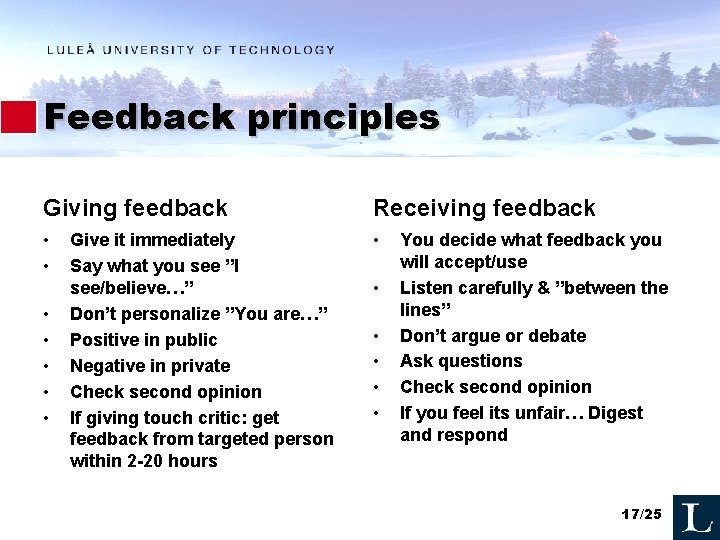
Feedback principles Giving feedback Receiving feedback • • Give it immediately Say what you see ”I see/believe…” Don’t personalize ”You are…” Positive in public Negative in private Check second opinion If giving touch critic: get feedback from targeted person within 2 -20 hours • • • You decide what feedback you will accept/use Listen carefully & ”between the lines” Don’t argue or debate Ask questions Check second opinion If you feel its unfair… Digest and respond 17/25
AV-assistive tools Power. Point etc. /X
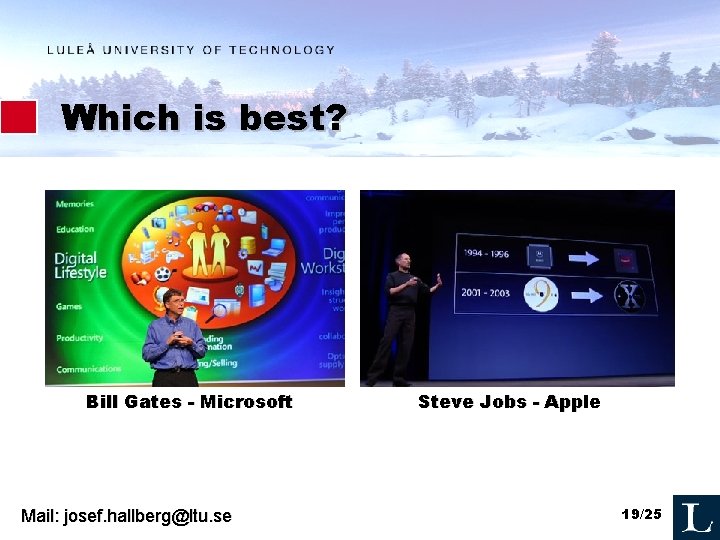
Which is best? Bill Gates - Microsoft Mail: josef. hallberg@ltu. se Steve Jobs - Apple 19/25
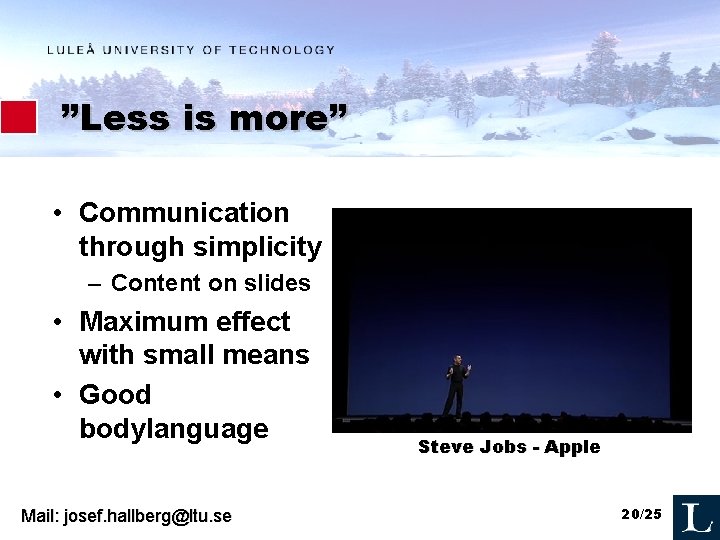
”Less is more” • Communication through simplicity – Content on slides • Maximum effect with small means • Good bodylanguage Mail: josef. hallberg@ltu. se Steve Jobs - Apple 20/25
Material • [6 x 6] rule – 6 words per row at most • (6 columns at most in a table) – 6 rows at most • One illustration per slide (maximum of 2) • Readability of text • Number the slides Mail: josef. hallberg@ltu. se 21/25
Where is the attention directed? • • Speak forward Point when you want the audience to read Avoid annoying animations Pause the presentation (black image) – When you want the attention on you – Press ”b” in Power. Point (or w for white image) Mail: josef. hallberg@ltu. se 22/25
Contact information • What is your name? • What organisation do you belong to? – Suggestion: organisation on every slide • How do they reach you? – Suggestion: email on every slide Mail: josef. hallberg@ltu. se 23/25
Summary /X
Summary • Who whom am I speaking (target audience)? – Frame of reference, opinions, attitude • What do I want my audience? – Aim, Purpose, available time • What do I think they want to know? – Prepare questions, sort in order of interest, find the answers • Red thread with the important things first Mail: josef. hallberg@ltu. se 25/25
Questions? Mail: josef. hallberg@ltu. se 26/25
- Slides: 26